


Community hub
Recent from talks
Contribute something
Nothing was collected or created yet.
Beta Pictoris b
View on Wikipedia
 The motion of Beta Pictoris b. The orbital plane is viewed side-on; the planet is not moving towards the star. | |
| Discovery | |
|---|---|
| Discovered by | Lagrange et al. |
| Discovery site | Very Large Telescope |
| Discovery date | November 18, 2008 |
| Direct imaging | |
| Orbital characteristics[1] | |
| 10.03+0.11 −0.10 AU | |
| Eccentricity | 0.1094±0.0077 |
| 23.593+0.248 −0.209[2] years | |
| Inclination | 88.991°±0.014° |
| 31.773°±0.015° | |
| 2448022.339+15.635 −24.710[2] | |
| 212.5°+7.2° −6.4° | |
| Semi-amplitude | 79+16 −14 m/s[2] |
| Star | Beta Pictoris |
| Physical characteristics | |
| 1.43±0.07[1][note 1] RJ | |
| Mass | 10.02±0.29[3] MJ |
| 4.46+0.02 −0.04[1][note 1] cgs | |
| 8.7±0.8[4] hours | |
Equatorial rotation velocity | 19.9±1.0 km/s[4] |
| Temperature | 1607.45+4.85 −6.20 K (1,334 °C; 2,433 °F)[1][note 1] |
Beta Pictoris b (abbreviated as β Pic b) is an exoplanet orbiting the young debris disk, A-type main sequence star, Beta Pictoris located approximately 63 light-years (19.4 parsecs, or 6×10¹⁴ km) away from Earth in the constellation of Pictor. It has a mass of around 13 Jupiter masses and a radius that's around 46% larger than Jupiter's. It orbits at 9 AU from Beta Pictoris, which is about 3.5 times farther than the orbit of Beta Pictoris c.[5] It orbits close to the plane of the debris disk orbiting the star, with a low eccentricity and a period of 20–21 years.
Physical characteristics
[edit]Mass, radius and temperature
[edit]Beta Pictoris b is a super-Jupiter, an exoplanet that has a radius and mass greater than that of the planet Jupiter. It has a temperature of 1,724 K (1,451 °C; 2,644 °F), most likely due to its dusty atmosphere and mass (normally it would be much colder). It has a mass between 9 and 13 Jupiter masses (MJ),[6] and a radius of 1.46 RJ.[7] In 2018, a study directly measured the astrometric perturbation of Beta Pictoris by Beta Pictoris b, one of the first examples of an exoplanet being measured directly by its astrometric perturbation. Its mass was directly measured as 11±2 MJ.[6]
Host star
[edit]The planet orbits an (A-type) star named Beta Pictoris. The star has a mass of 1.75 solar masses (M☉) and a radius of 1.8 solar radii (R☉). It has a surface temperature of 8056 K and is 12 million years old. In comparison, the Sun is about 4.6 billion years old[8] and has a surface temperature of 5778 K.[9] It is slightly metal-rich, with a metallicity ([Fe/H]) of 0.06, or 112% of that found in the Sun.[10] Its luminosity (L☉) is 8.7 times that of the Sun.
The star's apparent magnitude, or how bright it appears from Earth's perspective, is 3. Therefore, it can be seen with the naked eye.
Orbit
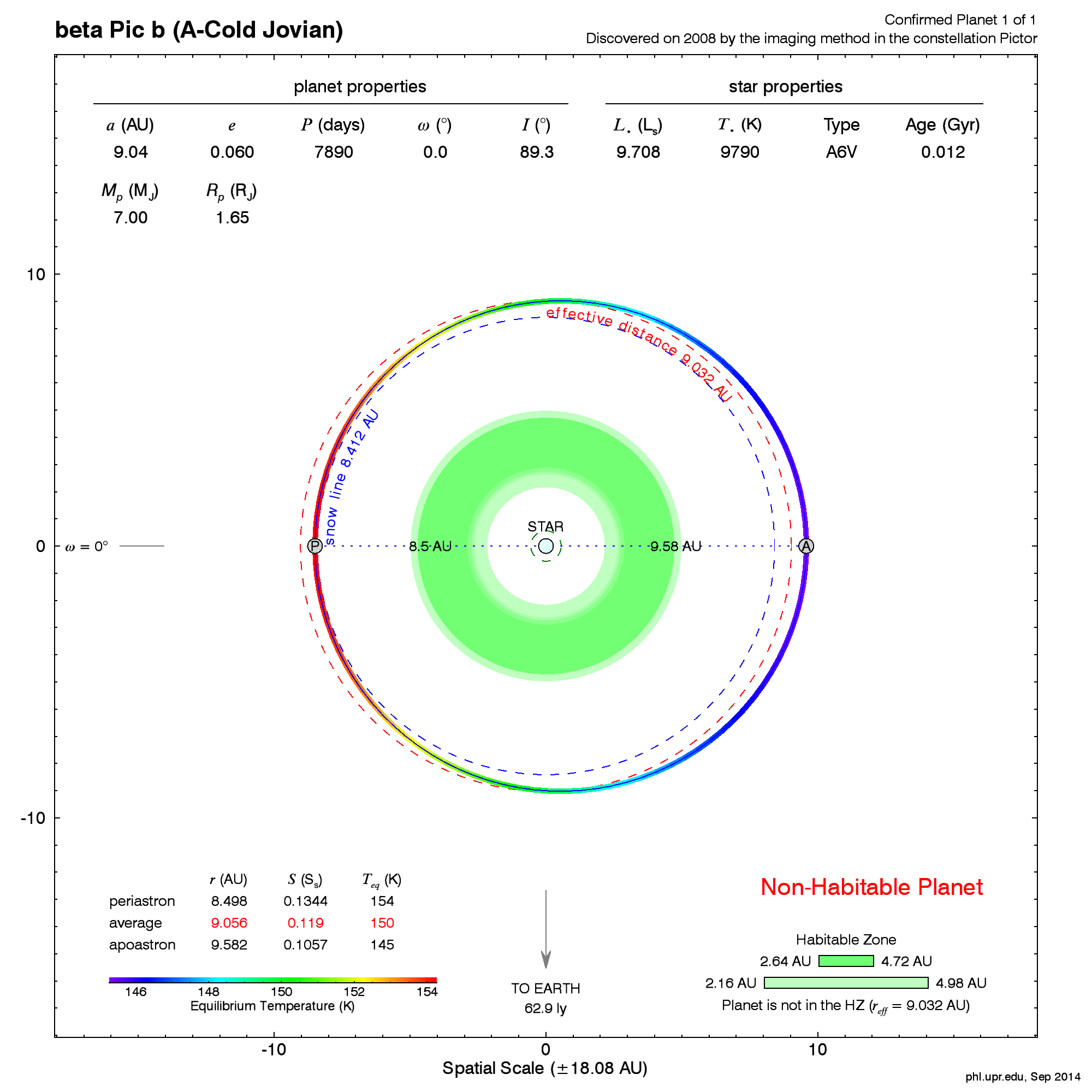
[edit]Beta Pictoris b orbits its host star every 21 years at a distance of 9.2 AU (about the same as Saturn's distance, which is about 9.55 AU). It receives 11% of the amount of sunlight that Earth does from the Sun.[11]
The orbit of the planet is well aligned to the rotation of the parent star and debris disk, with misalignment measured to be 3±5 degrees in 2020.[12]
Planetary rotation
[edit]In 2014, the rotation period of Beta Pictoris b was calculated from the broadening of its carbon monoxide infrared absorption line. This makes it the first extrasolar planet to have its rotation rate measured.[13]
With a rotation period of 8.1 hours, it was the fastest-spinning exoplanet known as of 2014.[13][14][15] Its rotation period is faster than that of Jupiter, which has a rotation period of around 10 hours. The rotation period was later refined to 8.7±0.8 hours.[4]
Discovery
[edit]The planet was discovered on November 18, 2008, by Anne-Marie Lagrange et al., using the NACO instrument on the Very Large Telescope at Cerro Paranal in northern Chile.[16] This planet was discovered using the direct imaging technique, using reference star differential imaging. The discovery image was taken in 2003, but the planet was not detected when the data were first reduced. A re-reduction of the data in 2008 using modern image processing tools revealed the faint point source now known to be a planet.
Further studies
[edit]Follow-up observations performed in late 2009 and early 2010 using the same instrument recovered and confirmed the planet, but on the opposite side of the star. These findings were published in the journal Science[17] and represented the closest orbiting planet to its star ever imaged. Observations performed in late 2010 and early 2011 allowed scientists to establish an inclination angle of the planet's orbit of 88.5 degrees, nearly edge-on. The location of the planet was found to be approximately 3.5 to 4 degrees tilted from the main disk in this system, indicating that the planet is aligned with the warped inner disk in the Beta Pictoris system.[18]
The first study of the spectral energy distribution of the planet was published in July 2013.[19] This study shows detections at 1.265, 1.66, 2.18, 3.80, 4.05 and 4.78 μm demonstrating that the planet has a very dusty and/or cloudy atmosphere. The SED is consistent with that of an early L dwarf, but with a lower surface gravity. The effective temperature is constrained to 1700±100 K and the surface gravity to log g = 4.0±0.5. A second study, published in September 2013,[20] provided a new detection at 3.1 μm obtained at the Gemini Observatory along with a reanalysis of previous data. They found the planet to be overluminous in the mid-infrared 3.1 μm band compared to models of early L dwarfs. Models incorporating small dust particles and thick clouds provided the best fit to the SED. The effective temperature is constrained to 1600+50
−25 K and the surface gravity to log g = 3.8±0.02. This fit corresponds to a planet radius of 1.65 times that of Jupiter, arguing that Beta Pictoris b may be younger than its host star (finished forming at 5 Ma).
In 2015, a short video was made from direct images of Beta Pictoris b taken by the Gemini Planet Imager over the course of about two years showing a time-lapse of the planet orbiting around its parent star.[21] It may have been responsible for a transit-like event observed in 1981.[22]
In 2018, the PicSat cubesat was launched in a mission to image the planet Beta Pictoris b transiting its host star Beta Pictoris.
As of 2025, the orbital parameters and mass of Beta Pictoris b have been measured using a combination of data from astrometry and imaging, showing that it has about 10.0 times the mass of Jupiter with a semi-major axis of about 10.0 AU.[3] The orbital period is measured to be 23.59 years based on radial velocity, astrometry and direct imaging.[2]
Potential exomoon
[edit]Beta Pictoris b has been found to have an obliquity likely misaligned by a 2024 study, based on a wide range of simulations together with published measurements. They find that the planet's obliquity must be misaligned if it spins fast, and might be if it spins slow. This misaligment could be caused by collisions with other planets, an unlikely scenario, or secular spin-orbit resonances modified by the presence of an exomoon. An exomoon with a mass similar to that of Neptune, an orbital separation of 0.02–0.05 AU (20–50 planetary radii) and an orbital period ranging from three to seven weeks (20 to 50 days) would induce the largest obliquities, up to 60°.[23]
Future observations by the James Webb Space Telescope will measure the planet's obliquity, something never done before in an extrasolar multiplanetary system. A detection of nonzero obliquity could be evidence of an exomoon. Currently the possibility of zero obliquity is unlikely.[23]
The use of astrometry does not rule out the exomoon candidate, but has set limits on the presence of exomoons. For short orbital periods (around 50 days), objects with masses over 0.6 MJ are ruled out, while at periods of roughly 200 days, this limit is 0.3 MJ. At orbital periods of 700 and 1,100 days, exomoons with masses over 0.15 MJ and 0.10 MJ, respectively, are ruled out.[3]
| Companion (in order from planet) |
Mass | Semimajor axis (AU) |
Orbital period | Eccentricity | Inclination | Radius |
|---|---|---|---|---|---|---|
| Candidate 1 (unconfirmed) | ≳15 M🜨 | 0.03–0.05 | 20–50 d | – | – | – |
Gallery
[edit]-
![Beta Pictoris b time-lapse.[24]](//upload.wikimedia.org/wikipedia/commons/thumb/b/b7/Stunning_Exoplanet_Time-lapse_Beta_Pictoris_b.tif/lossy-page1-120px-Stunning_Exoplanet_Time-lapse_Beta_Pictoris_b.tif.jpg) Beta Pictoris b time-lapse.[24]
Beta Pictoris b time-lapse.[24] -
 An annotated view of the Beta Pictoris system.
 -
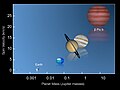 Equatorial spin velocity vs mass for planets comparing Beta Pictoris b to the Solar System planets.
 -
 Artistic rendering of the Beta Pictoris system, showing the accretion disk, and the two planets.
 -
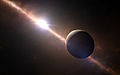 Artist's impression of Beta Pictoris b. The debris disk around the parent star can be seen.
![Beta Pictoris b time-lapse.[24]](http://upload.wikimedia.org/wikipedia/commons/thumb/b/b7/Stunning_Exoplanet_Time-lapse_Beta_Pictoris_b.tif/lossy-page1-120px-Stunning_Exoplanet_Time-lapse_Beta_Pictoris_b.tif.jpg)


See also
[edit]Notes
[edit]References
[edit]- ^ a b c d Ravet, M.; Bonnefoy, M.; Chauvin, G.; Lacour, S.; Nowak, M.; Charnay, B.; Tremblin, P.; Homeier, D.; Morley, C. (November 14, 2025). "Multi-modal atmospheric characterization of β Pictoris b: Adding high-resolution continuum spectra from GRAVITY". Astronomy and Astrophysics. arXiv:2509.25338. doi:10.1051/0004-6361/202553885.
- ^ a b c d Feng, Fabo; Butler, R. Paul; et al. (August 2022). "3D Selection of 167 Substellar Companions to Nearby Stars". The Astrophysical Journal Supplement Series. 262 (21): 21. arXiv:2208.12720. Bibcode:2022ApJS..262...21F. doi:10.3847/1538-4365/ac7e57. S2CID 251864022.
- ^ a b c Macias, Isabella; Jenkins, Sydney; Vanderburg, Andrew (November 28, 2025). "First Astrometric Limits on Binary Planets and Exomoons orbiting β Pictoris b". arXiv:2512.00160 [astro-ph.EP].
- ^ a b c Landman, R.; Stolker, T.; et al. (February 2024). "β Pictoris b through the eyes of the upgraded CRIRES+. Atmospheric composition, spin rotation, and radial velocity". Astronomy & Astrophysics. 682: A48. arXiv:2311.13527. Bibcode:2024A&A...682A..48L. doi:10.1051/0004-6361/202347846.
- ^ Lagrange, A.-M.; Meunier, Pascal Rubini; Keppler, Miriam; Galland, Franck; et al. (August 19, 2019). "Evidence for an additional planet in the β Pictoris system". Nature Astronomy. 3 (12): 1135–1142. Bibcode:2019NatAs...3.1135L. doi:10.1038/s41550-019-0857-1. S2CID 202126059. Retrieved August 20, 2019.
- ^ a b Snellen, I. A. G.; Brown, A. G. A. (2018). "The mass of the young planet Beta Pictoris b through the astrometric motion of its host star". Nature Astronomy. 2 (11): 883–886. arXiv:1808.06257. Bibcode:2018NatAs...2..883S. doi:10.1038/s41550-018-0561-6. S2CID 118896628.
- ^ Chilcote, Jeffrey; et al. (2017). "1–2.4μm Near-IR Spectrum of the Giant Planet β Pictoris b Obtained with the Gemini Planet Imager". The Astronomical Journal. 153 (4). 182. arXiv:1703.00011. Bibcode:2017AJ....153..182C. doi:10.3847/1538-3881/aa63e9. S2CID 23669676.
- ^ Fraser Cain (September 16, 2008). "How Old is the Sun?". Universe Today. Retrieved February 19, 2011.
- ^ Fraser Cain (September 15, 2008). "Temperature of the Sun". Universe Today. Retrieved February 19, 2011.
- ^ Gray, R. O.; et al. (2006). "Contributions to the Nearby Stars (NStars) Project: Spectroscopy of Stars Earlier than M0 within 40 pc—The Southern Sample". The Astronomical Journal. 132 (1): 161–170. arXiv:astro-ph/0603770. Bibcode:2006AJ....132..161G. doi:10.1086/504637. S2CID 119476992.
- ^ Orbit Beta Picture hpcf.upr.edu Archived August 28, 2016, at the Wayback Machine
- ^ Kraus, Stefan; Le Bouquin, Jean-Baptiste; Kreplin, Alexander; Davies, Claire L.; Hone, Edward; Monnier, John D.; Gardner, Tyler; Kennedy, Grant; Hinkley, Sasha (2020), "Spin–Orbit Alignment of the β Pictoris Planetary System", The Astrophysical Journal, 897 (1): L8, arXiv:2006.10784, Bibcode:2020ApJ...897L...8K, doi:10.3847/2041-8213/ab9d27, S2CID 219956049
- ^ a b "Length of Exoplanet Day Measured for First Time / VLT measures the spin of Beta Pictoris b". April 30, 2014.
- ^ Cowen, R. (April 30, 2014). "First exoplanet seen spinning". Nature. doi:10.1038/nature.2014.15132. S2CID 123849861.
- ^ Snellen, I. A. G.; Brandl, B. R.; De Kok, R. J.; Brogi, M.; Birkby, J.; Schwarz, H. (2014). "Fast spin of the young extrasolar planet β Pictoris b". Nature. 509 (7498): 63–65. arXiv:1404.7506. Bibcode:2014Natur.509...63S. doi:10.1038/nature13253. PMID 24784216. S2CID 4472993.
- ^ Lagrange, A.-M.; Gratadour, D.; Chauvin, G.; Fusco, T.; Ehrenreich, D.; Mouillet, D.; Rousset, G.; Rouan, D.; Allard, F.; Gendron, É.; Charton, J.; Mugnier, L.; Rabou, P.; Montri, J.; Lacombe, F. (2009). "A probable giant planet imaged in the β Pictoris disk". Astronomy and Astrophysics. 493 (2): L21–L25. arXiv:0811.3583. Bibcode:2009A&A...493L..21L. doi:10.1051/0004-6361:200811325. ISSN 0004-6361. S2CID 16548235.
- ^ Lagrange, A.- M.; Bonnefoy, M.; Chauvin, G.; Apai, D.; Ehrenreich, D.; Boccaletti, A.; Gratadour, D.; Rouan, D.; Mouillet, D.; Lacour, S.; Kasper, M. (2010). "A Giant Planet Imaged in the Disk of the Young Star Pictoris". Science. 329 (5987): 57–59. arXiv:1006.3314. Bibcode:2010Sci...329...57L. doi:10.1126/science.1187187. ISSN 0036-8075. PMID 20538914. S2CID 5427102.
- ^ Chauvin, G.; Lagrange, A.-M.; Beust, H.; Bonnefoy, M.; Boccaletti, A.; Apai, D.; Allard, F.; Ehrenreich, D.; Girard, J. H. V.; Mouillet, D.; Rouan, D. (2012). "Orbital characterization of the β Pictoris b giant planet". Astronomy & Astrophysics. 542: A41. arXiv:1202.2655. Bibcode:2012A&A...542A..41C. doi:10.1051/0004-6361/201118346. ISSN 0004-6361. S2CID 62806093.
- ^ Bonnefoy, M.; Boccaletti, A.; Lagrange, A.-M.; Allard, F.; Mordasini, C.; Beust, H.; Chauvin, G.; Girard, J. H. V.; Homeier, D.; Apai, D.; Lacour, S.; Rouan, D. (2013). "The near-infrared spectral energy distribution ofβPictoris b". Astronomy & Astrophysics. 555: A107. arXiv:1302.1160. Bibcode:2013A&A...555A.107B. doi:10.1051/0004-6361/201220838. ISSN 0004-6361. S2CID 54014134.
- ^ Currie, Thayne; et al. (2013). "A Combined Very Large Telescope and Gemini Study of the Atmosphere of the Directly Imaged Planet, β Pictoris b". The Astrophysical Journal. 776 (1). 15. arXiv:1306.0610. Bibcode:2013ApJ...776...15C. doi:10.1088/0004-637X/776/1/15. S2CID 118825345.
- ^ Now, Astronomy. "Watching an exoplanet in motion around a distant star | Astronomy Now". Retrieved September 29, 2015.
- ^ Lecavelier Des Etangs, A.; Vidal-Madjar, A. (2009). "Is β Pictoris b the transiting planet of November 1981?". Astronomy & Astrophysics. 497 (2): 557–562. arXiv:0903.1101. Bibcode:2009A&A...497..557L. doi:10.1051/0004-6361/200811528.
- ^ a b Poon, Michael; Rein, Hanno; Pham, Dang (December 8, 2024). "A potential exomoon from the predicted planet obliquity of β Pictoris b". The Open Journal of Astrophysics. 7: 109. arXiv:2412.05988. Bibcode:2024OJAp....7E.109P. doi:10.33232/001c.127130.
- ^ "Stunning Exoplanet Time-lapse". www.eso.org. Retrieved November 12, 2018.

Beta Pictoris b
View on GrokipediaDiscovery and observational history
Initial detection
The Beta Pictoris system has been a focal point for exoplanet research since the mid-1980s, following the initial detection of its circumstellar debris disk in infrared observations by the Infrared Astronomical Satellite (IRAS) in 1983, with the first resolved images confirming the disk's edge-on structure obtained in 1984 using optical coronagraphy. These early findings revealed a vast disk of dust and gas extending inward to about 30 AU from the star, prompting theoretical predictions of unseen planets sculpting its asymmetries, warps, and inner clearing—motivating targeted deep imaging searches for companions within 10 AU.[8] On November 18, 2008, a team led by Anne-Marie Lagrange announced the discovery of a faint companion, designated Beta Pictoris b, through re-analysis of archival data from the NACO adaptive optics instrument on the European Southern Observatory's Very Large Telescope (VLT).[8] The detection utilized deep L'-band (3.8 μm) imaging acquired between November 10 and 17, 2003, where the object appeared as a point source with a measured flux of 1.1 ± 0.3 mJy, consistent with a self-luminous giant planet rather than reflected starlight.[8] The initial astrometric measurements placed Beta Pictoris b at a projected separation of 411 ± 8 milliarcseconds (mas) from the host star, corresponding to approximately 8 AU at the system's distance of about 19.4 parsecs, with a position angle of 31.8 ± 1.3 degrees southeast of the star.[8] To confirm its nature, the team cross-referenced against Hubble Space Telescope archival images from 1997 and galactic models, estimating the probability of a contaminating background or foreground object (such as an L or T dwarf) at less than 10^{-5}, far below the detection threshold.[9] Additionally, the companion's position did not align with known disk features, which exhibit faint, symmetric emission in L'-band without significant point-like asymmetries at that location, ruling out scattered light from disk grains as the source.[8] Direct imaging in the thermal infrared, as employed here, proved crucial for detecting young, hot exoplanets like Beta Pictoris b by suppressing the host star's overwhelming brightness through adaptive optics and coronagraphy.[9]Direct imaging campaigns
Following the initial detection in 2008, sustained direct imaging campaigns targeting Beta Pictoris b have utilized advanced high-contrast instruments on ground-based telescopes to track its position and orbital motion over extended periods. These efforts, spanning from 2010 to 2024, primarily employed the Spectro-Polarimetric High-contrast Exoplanet REsearch (SPHERE) instrument on the European Southern Observatory's Very Large Telescope (VLT), the Gemini Planet Imager (GPI) on the Gemini South telescope, and complementary observations from the Hubble Space Telescope (HST). SPHERE, operational since 2014, has been instrumental in capturing multiple epochs of the planet's position using infrared dual-band imaging and integral field spectroscopy in modes like IRDIFS, combined with angular differential imaging for stellar light suppression.[10] Similarly, GPI has provided high-resolution near-infrared images since its first light in 2014, enabling precise astrometric measurements through its integral field spectrograph and coronagraphic capabilities.[11] HST contributions, particularly in visible and near-infrared wavelengths, have supported multi-wavelength datasets for system-wide monitoring, including the debris disk context.[12] A landmark dataset from these campaigns is a 17-year timelapse compiled in 2023 by researchers at Northwestern University, analyzing images from 2003 to 2020 across VLT (including NACO and SPHERE), Gemini/GPI, and HST archives. This sequence demonstrates the planet's orbital motion, covering approximately 70% of its ~24-year orbit and revealing its progression from a position southeast of the star in 2003 to the northeast by 2020. The analysis highlights the planet's consistent separation of about 8-9 AU, confirming its dynamical stability within the system. Such long-baseline observations have been crucial for refining astrometric positions with uncertainties as low as 1-2 milliarcseconds, allowing robust orbital fitting.[12] These astrometric measurements have constrained the planet's orbit to a nearly edge-on inclination of approximately 88° relative to the sky plane, aligning with the system's debris disk orientation and enabling predictions of future conjunctions. For instance, SPHERE data from 2014-2016 tracked the planet approaching inferior conjunction, with redetection post-conjunction in September 2018 at a separation of 139 mas and position angle of 30°. GPI observations in 2018 further refined these positions, contributing to combined fits that yield a semi-major axis of approximately 10 AU with eccentricity ~0.11. These multi-epoch datasets from SPHERE and GPI have collectively provided over a dozen precise position measurements, essential for distinguishing the planet's signal from instrumental artifacts.[10][13][14] Imaging Beta Pictoris b presents significant challenges due to the host star's brightness (magnitude ~3.8 in V-band) and the forward-scattered light from the edge-on debris disk, which can overwhelm the planet's faint thermal emission at 8-12 μm wavelengths. Adaptive optics systems, such as SPHERE's SAXO and GPI's high-order deformable mirror with over 1,000 actuators, correct atmospheric turbulence in real-time to achieve Strehl ratios exceeding 0.8 in the near-infrared, sharpening the point-spread function to ~50 mas. Coronagraphs, including apodized phase masks, block the central starlight by factors of 10^6-10^8, creating a dark inner region for companion detection, though residual speckles from imperfect starlight suppression require post-processing techniques like principal component analysis. The disk's scattering further complicates observations near conjunction, as seen in the 2017-2018 period when the planet passed behind the star, necessitating deep integrations of several hours per epoch.[11][10][15]Refinements and recent observations
In 2022, Feng et al. utilized Gaia Data Release 3 astrometry combined with Hipparcos data to refine the position and orbital constraints of Beta Pictoris b, achieving a more precise dynamical mass estimate of approximately 11 Jupiter masses by detecting the host star's astrometric wobble.[16] This analysis integrated relative astrometry from direct imaging with absolute astrometric measurements, reducing uncertainties in the planet's semi-major axis to approximately 10 AU and confirming its alignment with the debris disk plane.[16] Subsequent observations in 2024 with the upgraded CRIRES+ spectrograph on the VLT provided high-resolution mid-infrared spectra of Beta Pictoris b, revealing rotational broadening in molecular features such as CO absorption. Landman et al. measured a projected rotational velocity of km/s, indicating a fast-spinning atmosphere consistent with prior estimates but with improved precision.[5] These data also hinted at potential obliquity misalignment between the planet's spin axis and orbital plane, suggesting dynamical interactions within the system that could influence atmospheric circulation.[5] A 2025 dynamical study by Lacquement et al. explored the long-term stability of the Beta Pictoris system, incorporating updated orbital elements for planets b and c to model N-body interactions over gigayears. The analysis indicated that the current two-planet configuration is stable for at least 100 Myr, but suggested the possible existence of an undetected outer planet beyond Beta Pictoris b to explain disk asymmetries and maintain resonance configurations.[17] Such a companion, with a mass of 0.15–1 Jupiter masses at 30–40 AU, would enhance system stability without disrupting the inner debris disk.[17] Parallel efforts integrated 17 years of HARPS radial velocity data to contextualize exocomet activity in the system, revealing periodic sodium absorption lines linked to infalling bodies perturbed by Beta Pictoris b's gravity, though no direct RV signal from the planet itself was isolated due to stellar activity.[18] This work, by Hoeijmakers et al. in 2025, underscored the planet's role in sculpting the circumstellar environment without yielding new positional refinements for b.[18]The Beta Pictoris system
Host star properties
Beta Pictoris, the central star of the system hosting the exoplanet Beta Pictoris b, is classified as an A6V spectral type main-sequence star with an effective temperature of 8052 K. This places it among the hotter, more massive A-type stars, characterized by strong hydrogen lines in its spectrum and a blue-white appearance. The star's mass is 1.75 M⊙, and its radius measures 1.81 R⊙, resulting in a bolometric luminosity approximately 8.5 times that of the Sun.[19] These parameters position Beta Pictoris on the main sequence in an early evolutionary phase, where hydrogen fusion in its core dominates its energy output. Located at a distance of 63.4 light-years (19.5 parsecs) from Earth, Beta Pictoris is one of the nearest A-type stars to the Solar System, enabling detailed observations of its properties and surroundings. Its age is constrained to 23–25 million years (as of 2025), derived from lithium depletion boundary technique using Gaia DR3 data and isochrone fitting, complemented by gyrochronology.[20][21] This youth aligns with the star's membership in the nearby Beta Pictoris moving group, a loose association of co-moving stars formed from the same molecular cloud. Beta Pictoris exhibits slightly subsolar metallicity, with [Fe/H] ≈ -0.21 dex, indicating a lower abundance of heavy elements relative to hydrogen compared to the Sun. As a young main-sequence star, it displays typical characteristics of early A-type evolution, including rapid rotation and potential δ Scuti pulsations, though these are modulated by its age and activity levels. The star's youth contributes to the formation of its prominent circumstellar debris disk, a signature of ongoing planetesimal collisions.Circumstellar debris disk
The circumstellar debris disk surrounding Beta Pictoris is a prominent feature of the system, with the primary planetesimal belt located around 80–100 AU, extending radially to over 1000 AU including the outer halo, though recent observations detect inner hot dust within ~7 AU. This structure includes a denser "birth ring" of planetesimals near 80–100 AU and an extended outer halo of scattered dust, with evidence of inner dust grains possibly produced close to the star or transported inward. The disk's edge-on orientation, viewed nearly perpendicular to its plane, facilitates detailed imaging of its vertical and radial profiles.[22][23] High-resolution observations reveal a complex inner structure, including a warp in the disk's midplane and variations in inclination between the inner and outer regions. Hubble Space Telescope imaging in scattered light has resolved this warp, showing the inner disk (within ~50 AU) inclined by about 4–5° relative to the outer disk, creating a bowed appearance. Complementary Atacama Large Millimeter/submillimeter Array (ALMA) observations at millimeter wavelengths confirm these features, detecting a CO gas belt at ~85 AU with asymmetries and inclination shifts that align with the scattered-light data, indicating ongoing dynamical evolution. Recent JWST/MIRI observations (as of 2024) detect infrared excess from 5–7.5 μm, revealing submicron-sized hot dust grains within ~6.5 AU, suggesting active dust production or radial transport in the innermost regions, potentially influenced by planetary companions.[24][25][23] The disk's composition is dominated by micron-sized dust grains, primarily silicates such as olivine and pyroxene, with evidence for carbonaceous materials and potential water ices in the outer regions. Spectroscopic analysis of thermal emission and scattered light indicates a mix of crystalline and amorphous silicates, with grain properties varying radially—smaller, more porous grains closer in and larger, compact ones farther out. Variable absorption lines in the spectrum, observed via high-resolution spectroscopy, provide evidence for exocomets: transient blueshifted features in Ca II and Na I lines, attributed to infalling evaporating bodies, have been detected in HARPS data spanning 2003–2020 and analyzed through 2025, showing events with depths up to 2% and durations from hours to months.[22][26] The total mass of the disk is estimated at 0.1–1 M⊕, primarily in unseen parent bodies, with the observable dust component around 0.02–0.2 M⊕ derived from submillimeter flux measurements. Dust temperatures decrease radially, from ~100 K in the inner birth ring to ~30 K in the outer halo, reflecting the stellar irradiation gradient and blackbody equilibrium, though inner hot dust reaches ~500 K. The youth of the host star, at approximately 23 Myr, supports the disk's active collisional and dynamical state, sustaining dust replenishment over gigayear timescales.[25][27][23]Orbital characteristics
Key orbital parameters
Beta Pictoris b orbits its host star at a semi-major axis of 10.018^{+0.082}_{-0.076} AU, corresponding to an orbital period of 23.593 \pm 0.248 years (or 8617.5^{+0.251}_{-0.206} days).[28] These values are derived from orbital fits to relative astrometry obtained via direct imaging, incorporating data from multiple instruments including VLT/NACO, Gemini/GPI, and SPHERE.[28] The orbit exhibits a low eccentricity of 0.106^{+0.007}_{-0.006}, indicating a nearly circular path, and an inclination of 89.009^\circ \pm 0.012^\circ relative to the sky plane, consistent with near-edge-on alignment.[28] The argument of periapsis is measured at \omega = 21.835^{+4.099}_{-4.044}^\circ, while the longitude of the ascending node is \Omega \approx 31.77^\circ.[28] The following table summarizes these key orbital parameters from the 2022 analysis:| Parameter | Symbol | Value | Unit |
|---|---|---|---|
| Semi-major axis | a | 10.018^{+0.082}_{-0.076} | AU |
| Orbital period | P | 23.593 \pm 0.248 | years |
| Eccentricity | e | 0.106^{+0.007}_{-0.006} | - |
| Inclination | i | 89.009 \pm 0.012 | degrees |
| Argument of periapsis | \omega | 21.835^{+4.099}_{-4.044} | degrees |
| Longitude of ascending node | \Omega | 31.77 | degrees |
System dynamics and stability
The Beta Pictoris system exhibits complex gravitational interactions between its known giant planets, β Pictoris b and the inner β Pictoris c, as well as with the surrounding debris disk particles. Numerical models indicate that the two planets can temporarily enter a 7:1 mean-motion resonance (MMR), with capture events lasting approximately 20,000 years and recurring every 40,000 years due to secular eccentricity oscillations.[29] Additionally, high-order MMRs with β Pictoris c, such as 7:1 and 8:1 located at around 4–5 AU, perturb inner disk planetesimals, exciting their eccentricities and driving the production of falling evaporating bodies from regions between 0.6 and 1.5 AU, while β Pictoris b acts as a distant perturber sustaining these dynamics.[29][30] Secular perturbations from β Pictoris b and c induce long-term oscillations in the eccentricities and inclinations of disk particles, contributing to the observed warp in the inner debris disk at approximately 85 AU. These perturbations cause planetesimals to align with the planet's orbital plane in the inner regions while the outer disk remains relatively flat, with the warp amplitude extending to roughly twice the planet's inclination of about 3.6°. β Pictoris b, orbiting near the disk midplane, is the primary driver of this inner disk morphology, as its inclined orbit excites vertical oscillations that propagate outward.[29] A 2025 study using N-body simulations suggests the presence of an additional outer planet, tentatively designated β Pictoris d, to explain the sharp truncation of the debris disk at around 50 AU, as the known planets alone cannot clear material to this distance. This hypothetical planet has an estimated mass of 0.15–1 M_Jup and a semi-major axis of 30–40 AU with low eccentricity (≤0.4), enabling it to sculpt the disk's outer edge through gravitational clearing without destabilizing the inner system.[31] Symplectic N-body simulations of the system, incorporating β Pictoris b, c, and test particles in the disk, demonstrate long-term dynamical stability over timescales of 100 million years, with stable regions beyond 25 AU and depletion inside due to planetary perturbations. These models confirm that the planetary orbits remain bounded under secular evolution, supporting the overall architecture despite occasional temporary resonances.[29][30]Physical properties
Mass, radius, and density
The mass of Beta Pictoris b is estimated at 11.729^{+2.337}{-2.135} M\mathrm{Jup}, derived from a joint analysis of astrometric data from Hipparcos and Gaia DR2 combined with relative astrometry of the planet and radial velocity measurements of the host star. This dynamical mass determination resolves previous tensions between spectroscopic and evolutionary model estimates, confirming Beta Pictoris b as a massive super-Jupiter. Due to the system's edge-on geometry, radial velocity signals are detectable but incomplete over the planet's long orbital period, contributing to the asymmetry in the uncertainty bounds. The radius of Beta Pictoris b is inferred to be 1.46 \pm 0.01 R_\mathrm{Jup} through fits of atmospheric models to its near-infrared spectrum obtained with the Gemini Planet Imager, assuming a hot-start formation scenario and accounting for thermal emission from its young, hot atmosphere. This measurement relies on synthetic spectra from PHOENIX and other grids to match observed photometry and line profiles, providing constraints on effective temperature and surface gravity as well.[32]| Property | Value | Method | Source |
|---|---|---|---|
| Mass | 11.729^{+2.337}{-2.135} M\mathrm{Jup} | Astrometry + RV | Brandt et al. (2021) |
| Radius | 1.46 \pm 0.01 R_\mathrm{Jup} | Thermal emission models | Chilcote et al. (2017)[32] |
| Density | \sim 5 \ \mathrm{g/cm^3} | Derived from mass and radius | Derived from above |