Recent from talks
Nothing was collected or created yet.
Big Gemini
View on Wikipedia
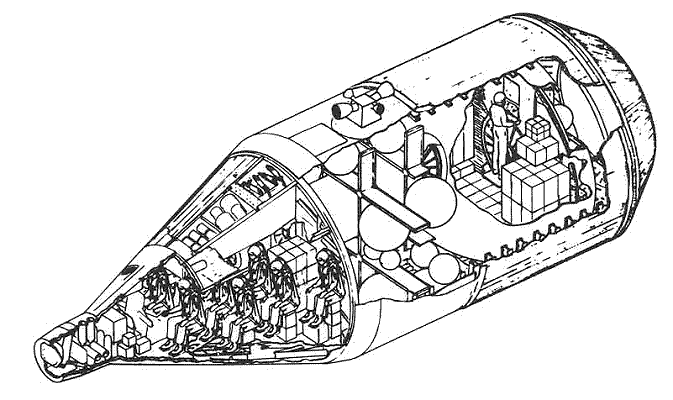
Big Gemini spacecraft concept, August, 1969. | |||
| Manufacturer | McDonnell Douglas | ||
|---|---|---|---|
| Country of origin | United States | ||
| Operator | NASA | ||
| Applications | Logistic spacecraft derived from Gemini that would be used to resupply an orbiting space station | ||
| Specifications | |||
| Spacecraft type | Space capsule | ||
| Dry mass | 34,370 pounds (15,590 kg) | ||
| Payload capacity | 5,500 pounds (2,500 kg) | ||
| Crew capacity | 9 to 12 | ||
| Volume | 660 cubic feet (19 m3) | ||
| Dimensions | |||
| Length | 38.00 feet (11.58 m) | ||
| Diameter | 14.00 feet (4.27 m) | ||
| Production | |||
| Status | cancelled | ||
| Related spacecraft | |||
| Derived from | Gemini B | ||
| |||
Big Gemini (or "Big G") was proposed to NASA by McDonnell Douglas in August 1969 as an advanced version of the Gemini spacecraft system (albeit actually having little in common). It was intended to provide large-capacity, all-purpose access to space, including missions that ultimately used Apollo or the Space Shuttle.
Design
[edit]The study was performed to generate a preliminary definition of a logistic spacecraft derived from Gemini that would be used to resupply an orbiting space station. Land-landing at a preselected site and refurbishment and reuse were design requirements. Two baseline spacecraft were defined: a nine-man minimum modification version of the Gemini B called Min-Mod Big G and a 12-man advanced concept, having the same exterior geometry but with new, state-of-the-art subsystems, called Advanced Big G. Three launch vehicles-Saturn IB, Titan IIIM, and Saturn INT-20 (S-IC/S-IVB) were investigated for use with the spacecraft. The Saturn IB was discarded late in the study.
The spacecraft consisted of a crew module designed by extending the Gemini B exterior cone to a 419-cm-diameter heat shield and a cargo propulsion module. Recovery of the crew module would be effected by means of a gliding parachute (parawing). The parametric analysis and point design of the parawing were accomplished by Northrop-Ventura Company under a subcontract, and the contents of their final report were incorporated into the document. The landing attenuation of the spacecraft would be accomplished by a skid landing gear extended from the bottom of the crew module, allowing the crew to land in an upright position. The propulsion functions of transfer, rendezvous, attitude control, and retrograde would be performed by a single liquid propellant system, and launch escape would be provided by a large Apollo-type launch escape system.
In addition to the design analysis, operational support analysis and a program development plan were prepared.
The concept was given serious consideration. In 1971, faced with budget cuts which rendered the development of a fully-reusable space shuttle infeasible, NASA administrator George Low lamented that shuttle development might have to be delayed until the 1980s, with "something like a "big G" approach and a cheap space station" filling in as an interim. The Office of Management and Budget was much more favorable to the idea than NASA, concluding in a staff paper that Big Gemini launched aboard an uprated Titan III would be a more cost-effective option than any shuttle design. Ultimately OMB Deputy Director Caspar Weinberger helped to broker a compromise where Big G was taken off the table and NASA was given the greenlight for immediate development of a partially-reusable thrust-assisted orbiter shuttle.[1]
Specifications
[edit]- Crew size: 9 to 12
- Length: 11.5 m (38 ft)
- Maximum diameter: 4.27 m (14.0 ft)
- Habitable volume: 18.7 m3 (660 cu ft)
- Mass: 15,590 kg (34,370 lb)
- Payload: 2,500 kg (5,500 lb)
- Launch vehicles: Titan 3M, Saturn IB, Saturn S-IC/S-IVB.
See also
[edit]- Advanced Gemini
- Blue Gemini
- Manned Orbital Laboratory
- TKS – Soviet heavy resupply spacecraft with a similar hatch-through-heatshield design
- Zarya – Soviet "Big Soyuz" design
References
[edit]
This article incorporates public domain material from websites or documents of the National Aeronautics and Space Administration.
- ^ Heppenheimer, T.A. (1999). The Space Shuttle Decision: NASA's Search for a Reusable Space Vehicle. Project Histories (SP-4200 Series). Vol. 4221. Washington, D.C.: NASA History Series Publications.
External links
[edit]Big Gemini
View on GrokipediaDevelopment History
Origins and Initial Proposal
Big Gemini, also known as Big G, was initially proposed by the McDonnell Douglas Corporation in 1967 as an enlarged derivative of the Gemini spacecraft designed for ballistic manned orbital logistics. The concept was pitched to NASA and the United States Air Force to address post-Apollo needs for resupplying space stations, including the military's Manned Orbiting Laboratory (MOL) and NASA's prospective Skylab program.[1][3] This proposal emerged in the context of evolving space program requirements following the success of Project Gemini and amid planning for extended orbital operations beyond lunar missions.[4] The initial design retained the proven Gemini reentry module while adding aft retrograde propulsion, maneuvering, and cargo modules to enable carriage of up to 9 to 12 astronauts or substantial payloads, such as 2,500 kg with a Titan IIIM launch vehicle or 27,300 kg using larger boosters like the Saturn INT-20. Key features included a pressurized tunnel for cargo transfer, aft-end docking capability, and land recovery via skids augmented by a parasail, emphasizing cost-effective development through reuse of existing Gemini B technology and an oxygen-helium atmosphere to mitigate fire risks learned from Apollo 1.[1][3][4] Following the summer 1967 proposal, McDonnell Douglas obtained a NASA study contract, culminating in a detailed final report submitted on August 21, 1969. The study outlined potential operational flights as early as 1971, contingent on funding approval, positioning Big Gemini as an interim solution for crew and logistics transport until more advanced systems like the Space Shuttle matured.[1][4]Evolving Concepts and Military Interest
In 1967, McDonnell Douglas proposed Big Gemini, or "Big G," as an evolution of the Gemini B spacecraft originally developed for the U.S. Air Force's Manned Orbiting Laboratory (MOL) program, incorporating a pressurized aft extension module to enable logistics resupply missions to orbital stations.[2] This design increased the reentry module's diameter to 154 inches from Gemini's 88 inches, allowing capacity for up to 12 astronauts or equivalent cargo volumes, such as 2,500 kg of supplies, while leveraging proven Gemini heat shield and avionics for cost efficiency.[1] The concept shifted from MOL's reconnaissance-focused docking to broader ferry operations, with docking via a pressurized tunnel at the aft end and options for runway landings using skids and a parawing, addressing limitations in Gemini's two-person, short-duration profile.[3] Military interest in Big Gemini stemmed from the Air Force's pursuit of sustained manned orbital capabilities independent of NASA's Apollo priorities, building on MOL's goal of a dedicated military space station launched in 1969 but canceled that June due to budget constraints and overlapping reconnaissance satellite advancements.[2] Proposals targeted USAF applications like the Large Orbiting Research Laboratory, with Titan III-family launches enabling delivery of nine crew members plus expendables for 90-day missions, positioned as a cost-shared alternative to full NASA development.[1] A December 1967 briefing outlined baseline operations by 1971, emphasizing ballistic simplicity over powered ascent for rapid turnaround and refurbishment potential documented in an eight-volume NASA study delivered August 1969.[2] NASA's parallel evaluation, via a $436,000 contract signed October 1968, viewed Big G as an interim logistics vehicle for the Apollo Applications Program's Orbital Workshop (precursor to Skylab), but evolving priorities toward reusable systems like the Space Shuttle ultimately deferred it, highlighting tensions between military tactical needs and civilian long-term infrastructure.[2] Air Force advocacy persisted briefly post-MOL cancellation, seeking to repurpose Gemini-derived hardware for dual-use resupply, though fiscal cuts and NASA's dominance in post-Apollo planning limited advancement.[1]Integration with NASA Programs
Big Gemini was proposed by McDonnell Douglas in the summer of 1967 as a potential logistics spacecraft for NASA missions, leading to a dedicated study contract from the agency to evaluate its applicability.[2] The concept built on the Gemini B design, scaling it up to accommodate up to 11 crew members or equivalent cargo volumes, with a focus on ballistic reentry and compatibility with existing Titan launch vehicles.[1] This NASA-funded analysis, valued at approximately $436,000 and initiated around 1968, examined Big Gemini's role in supporting extended-duration orbital operations beyond the standard Apollo command module.[5] The primary integration pathway envisioned for NASA programs centered on the Apollo Applications Program (AAP), particularly resupply and crew rotation for the planned Orbital Workshop—later realized as Skylab.[3] Big Gemini was pitched as a more economical alternative to modified Apollo hardware for ferrying personnel and modules to these facilities, leveraging the spacecraft's enlarged payload bay for logistics deliveries without requiring complex docking maneuvers.[1] Studies highlighted its potential to transport up to 12 astronauts in a single mission or deliver substantial unpressurized cargo, addressing AAP's need for sustained Earth-orbital presence post-Apollo lunar landings.[6] Despite these evaluations, Big Gemini was not selected for development or operational integration into NASA programs, as fiscal constraints and prioritization of Apollo-derived systems for AAP missions prevailed.[2] The Orbital Workshop proceeded using Saturn IB-launched Apollo command and service modules for crew access, rendering Big Gemini's larger-scale logistics redundant by the early 1970s.[1] No flight hardware was constructed, though the concept influenced later discussions on reusable crew vehicles for space station support.[7]Design and Engineering
Overall Configuration
Big Gemini, also known as "Big G," featured a reentry module derived from the Gemini B spacecraft, extended with a pressurized conical adapter section to increase crew and cargo capacity while maintaining compatibility with existing Gemini hardware.[1] The reentry module retained the Gemini B's forward cockpit but incorporated a heat shield enlarged to a 154-inch (3.91-meter) diameter base to accommodate up to 9 to 12 astronauts or equivalent payload mixtures, with the overall habitable volume expanded to 18.7 cubic meters.[1][2] This configuration allowed for a total height of approximately 11.5 meters, emphasizing modularity for orbital logistics roles.[1] The spacecraft's aft section included a maneuvering and cargo module (CPM), which varied in size by launch vehicle: a 180-inch (4.57-meter) diameter version for Titan IIIM or III launches, or a larger 260-inch (6.6-meter) diameter extension for Saturn INT-20 compatibility, housing propulsion systems, unpressurized cargo bays, and a docking port with transfer tunnel.[2] Propulsion comprised solid-fuel retrograde motors for deorbit, liquid-propellant attitude control thrusters, and an Apollo-style launch escape tower for abort protection.[1] Gross mass ranged from 15,590 kg on Titan IIIM to 59,000 kg on Titan III configurations, enabling payload returns of up to 2,000 pounds (910 kg).[1][2] Landing systems prioritized runway recovery via deployable skids paired with a parasail or Rogallo parawing glider, supplemented by flotation gear for water emergencies, reflecting engineering preferences for reusable, land-based operations over ocean splashdown.[1][4] The design leveraged post-Apollo 1 fire lessons, using an oxygen-helium atmosphere and minimal modifications to proven Gemini components for rapid development targeting 1971 operational availability.[4] A full-scale mockup was constructed by McDonnell Douglas in 1967, with a final proposal report submitted to NASA and the U.S. Air Force on August 21, 1969.[1]Propulsion and Orbital Operations
The proposed Big Gemini spacecraft incorporated a modular propulsion architecture to handle launch escape, orbital maneuvering, de-orbit, and reentry initiation. An Apollo-type launch escape tower provided abort capability during ascent, utilizing solid-propellant motors to separate the crew module from the launch vehicle in emergencies.[1][2] Orbital propulsion and attitude control were primarily managed by the Maneuvering and Cargo Module (also referred to as the Cargo Propulsion Module), which featured a unified liquid-propellant system for multiple functions including orbital transfer burns, rendezvous, precise attitude adjustments, and limited retrograde propulsion.[1][2] This system drew from scaled-up elements of the original Gemini's Orbital Attitude and Maneuvering System (OAMS) but was adapted for larger payloads and extended operations, integrating thrusters for three-axis control without specified thrust ratings in surviving proposal documents.[1] The module also generated electrical power to support propulsion avionics and docking mechanisms. De-orbit was facilitated by solid-fuel rocket motors in the dedicated retrograde module, which ignited to reduce velocity for atmospheric reentry, followed by pyrotechnic separation rockets to jettison the module and expose the reentry heat shield.[1] This configuration allowed for ballistic reentry trajectories, with the propulsion setup enabling mission durations of up to 90 days for crews of 6 to 12 personnel, depending on the variant (e.g., Min-Mod or Advanced configurations).[2] In orbital operations, the spacecraft docked to targets such as space stations via its aft end, employing an Apollo-derived docking probe assembly after a 180-degree yaw maneuver at ranges up to 160 km.[1][2] Crew and cargo transfer occurred through an integrated pressurized tunnel in the maneuvering module, bypassing the need for extravehicular activity and supporting logistics roles with up to 910 kg of return payload capacity.[1][2] Launch vehicles like the Titan IIIM or Interim Saturn INT-20 influenced orbital insertion parameters, with the propulsion system enabling rendezvous and station-keeping for resupply missions.[2]Reentry and Landing Systems
The reentry module of Big Gemini was an enlarged derivative of the Gemini B spacecraft, featuring a blunt-cone configuration with a maximum diameter of approximately 154 inches (3.91 meters) to accommodate up to nine crew members or equivalent cargo volume.[1] This module incorporated an ablative heat shield, measuring 165 inches (4.19 meters) in diameter according to 1969 design studies, to withstand the thermal loads of orbital reentry from low Earth orbit trajectories.[2] The shield's material and thickness were scaled from Gemini heritage systems, prioritizing thermal protection through material ablation rather than radiative cooling, consistent with the era's reentry vehicle standards.[1] Descent and landing deviated from the original Gemini's ocean splashdown, emphasizing dry-land recovery for improved precision and logistics efficiency. The primary system utilized an inflatable parawing—a flexible, Rogallo-wing-derived paraglider—deployed post-peak heating to generate lift and forward velocity, enabling a shallow, glide-path approach with pilot-controllable maneuvering for touchdown on runways, dry lake beds, or prepared strips.[2] [1] This configuration allowed for near-horizontal landings at velocities under 20 knots, reducing impact forces and facilitating upright crew egress via integrated skids or landing gear that supported the vehicle's base without requiring attitude adjustments.[2] Backup provisions included a conventional drogue-and-main parachute cluster for unpowered descent, paired with an emergency flotation collar for inadvertent water landings, though McDonnell Douglas prioritized the paraglider to avoid ocean recovery complexities and enable rapid post-flight turnaround for potential reusability.[2] Early proposals from 1967-1968 explored alternatives like sailwings, cloverleaf parachutes, or parafoils, but the parawing was selected for its balance of stability and controllability in scaled-up tests derived from Gemini paraglider development efforts.[2] These systems were conceptualized under NASA contracts awarded to McDonnell Douglas in October 1968, aiming for flight qualification within 37 months of program initiation.[2]Specifications and Capabilities
Physical Dimensions and Mass
The Big Gemini spacecraft, proposed by McDonnell Douglas in 1967, had an overall height of 11.50 meters in its baseline configuration.[1] The reentry module, adapted from the Gemini B design, featured a base diameter of 3.91 meters (154 inches).[1] [2] The gross mass for the Titan IIIM-launched version was 15,590 kilograms.[1] Design variants incorporated different maneuvering and cargo modules (CPM) affecting maximum diameter. The USAF-oriented Titan IIIM variant used a 4.57-meter (180-inch) diameter CPM, while the NASA Saturn INT-20 variant employed a larger 6.61-meter (260-inch) diameter CPM to accommodate greater payload volumes.[1] [2] The CPM length was approximately 7.54 meters (297 inches) for the Titan version, including adapters.[2] Habitable volume reached 18.7 cubic meters, supporting crew sizes of up to 9 in the minimum modification or 12 in advanced configurations.[1] Larger masses applied to alternative launchers, such as 47,300 kilograms for the INT-20 and 59,000 kilograms for the Titan IIIG.[1] These dimensions enabled skid-based land landings with parawing or gliding parachute systems, prioritizing reusability over precision water recovery.[2]Crew and Payload Accommodations
The Big Gemini spacecraft featured flexible crew accommodations to support logistics missions to orbiting stations, with capacity for 6 to 12 astronauts depending on the variant and mission requirements.[2] Baseline configurations supported 6 crew members, while the minimum modification variant allowed for 9 and the advanced variant up to 12, with a theoretical maximum of 16 in emergency overcrowding scenarios.[2] Seating consisted of foldable web-type restraints arranged in a shirtsleeve environment, forgoing spacesuits during standard operations to maximize comfort and volume usage.[2] Access included side hatches for ingress and a rear tunnel adapter for direct transfer to docked stations.[2] Payload accommodations emphasized modularity, with internal pressurized stowage in the reentry module and external unpressurized areas, plus dedicated cargo bays in the maneuvering module.[1] Standard cargo containers measured 40 by 40 by 84 inches, enabling efficient packing of supplies, experiments, or equipment.[2] When configured for 9 crew on a Titan IIIM launch, it delivered 2,500 kg of cargo, but missions could reduce crew to 1 or 2 to prioritize up to several thousand kilograms of pressurized resupply goods.[1][4] Larger launchers like the Saturn INT-20 enabled payloads exceeding 27,000 kg in extended configurations with optional modules for additional volume.[1][4] The overall habitable volume measured 18.7 cubic meters, distributed across the enlarged Gemini-derived reentry module and cargo sections to balance crew needs with payload flexibility.[1] A cargo propulsion module aft of the crew area housed docking probes, attitude control systems, and power generation, facilitating aft-end docking and cargo transfer without exposing crew to vacuum.[2] This design allowed seamless integration of crew transport and logistics, with return capabilities for at least 910 kg of station-derived cargo.[2]Performance Metrics
The Big Gemini spacecraft featured a service propulsion system derived from the Gemini Orbital Attitude and Maneuvering System (OAMS), scaled for the larger vehicle, providing a total delta-v capability of approximately 100 m/s for orbital insertion corrections, rendezvous maneuvers with space stations, and deorbit burns.[8] This limited propulsion envelope positioned it as a primarily ballistic logistics vehicle reliant on launch vehicle precision and optional external tugs for extensive orbital operations. Mission durations were projected up to two weeks, leveraging Gemini's validated life support for extended Earth-orbital flights, including demonstrated 14-day endurance from Gemini 7. Payload performance varied by launch vehicle. Configurations with the Titan IIIM enabled delivery of up to 9 crew members and 2,500 kg of pressurized or unpressurized cargo to low Earth orbit at 185 km altitude, constrained by the launcher's approximately 13,100 kg LEO capacity.[9] Alternative NASA proposals using the Saturn INT-20 interim booster expanded capabilities to 9 crew plus 27,300 kg payload to equivalent orbits, accommodating larger resupply modules or equipment for space station logistics.[1] Reentry performance supported returns from standard LEO velocities of 7.8 km/s, with an enlarged ablative heat shield managing peak heating loads comparable to Gemini but scaled for the increased mass of 15,590 kg.[1] Descent relied on drogue and main parachutes for splashdown accuracy within 20 km of recovery ships, though initial concepts explored Rogallo flexible wings for optional land landings to enhance precision and reduce sea-state dependencies.[2]Proposed Applications and Missions
Logistics Support for Space Stations
Big Gemini was developed by McDonnell Douglas as a proposed orbital logistics spacecraft to support resupply and crew rotation for planned NASA and military space stations in low Earth orbit during the late 1960s and early 1970s. The design leveraged the proven Gemini reentry vehicle, enlarged to accommodate a larger crew compartment or dedicated cargo module, enabling delivery of personnel, experiments, and consumables without requiring a fully reusable system like the later Space Shuttle. Launched primarily on the Titan III-M booster, it offered a cost-effective bridge for post-Apollo station operations, with studies indicating compatibility for unmanned cargo variants as well.[10][2] In its crew transport configuration, Big Gemini could ferry up to nine astronauts to a space station for extended rotations, facilitating crew exchanges and maintenance tasks that exceeded the capacity of smaller Apollo-derived vehicles. For pure logistics missions, the spacecraft featured a pressurized cargo bay capable of delivering approximately 18,000 pounds of payload, including food, water, scientific equipment, and replacement modules, directly dockable via an adapter derived from Gemini's rendezvous hardware. This docking mechanism allowed unmanned or minimally crewed flights to transfer supplies autonomously or with remote guidance, reducing the need for station crew to perform high-risk extravehicular activities for resupply. NASA evaluations highlighted its potential integration with modular stations, where Big Gemini would park temporarily or return expended materials, supporting missions lasting weeks to months.[11][2][12] The proposal emphasized reliability through reuse of Gemini avionics and heat shield technologies, with propulsion provided by an adapted service module for orbital adjustments and deorbit burns. Ground studies, including those under manned logistics system analyses, compared Big Gemini favorably to Saturn IB-modified configurations for payload-to-orbit efficiency, projecting it could sustain a 12-person station through frequent, low-cost flights before Shuttle operational readiness around 1980. However, its ballistic reentry profile limited it to Earth-return missions, distinguishing it from tug-assisted deep-space logistics but optimizing it for routine station upkeep.[12][13]Crew Transport and Resupply Roles
Big Gemini was proposed primarily as a logistic vehicle for crew transport to low Earth orbit space stations, accommodating up to nine astronauts in its baseline configuration to facilitate crew rotation and extended mission support.[14] This capability addressed the limitations of smaller spacecraft like the Apollo Command and Service Module, which lacked sufficient volume and payload return for routine manned resupply operations to orbital laboratories.[1] McDonnell Douglas pitched the design in 1967 as a cost-effective evolution of the Gemini capsule, leveraging existing Titan III launch vehicles for rapid deployment of crews to proposed NASA and Air Force stations.[4] In resupply roles, the spacecraft featured a pressurized cargo bay for delivering up to 2,000 kilograms of equipment, experiments, and consumables, with provisions for automated docking and transfer via an extendable boom or crew extravehicular activity.[1] Configurations included an optional propulsion module for rendezvous and orbital maneuvering, enabling unmanned cargo variants or hybrid missions combining crew delivery with logistics.[14] NASA studies in the late 1960s evaluated Big Gemini alongside expendable alternatives for space station sustainment, emphasizing its reusability potential—up to 10 flights per vehicle—to reduce per-mission costs compared to fully expendable systems.[11] The design's emphasis on modularity allowed adaptation for emergency crew return from stations, with the reentry vehicle supporting high-heat-load ablations derived from Gemini heritage but scaled for larger masses.[1] However, proposals highlighted integration challenges, such as compatibility with station docking ports and environmental controls for mixed crew-cargo flights, which required validation through mockups tested in 1968-1969.[4] Overall, these roles positioned Big Gemini as a bridge between short-duration Gemini flights and sustained orbital presence, though funding shifts toward the Space Shuttle program curtailed development.[11]Alternative to Reusable Spacecraft
Big Gemini was advanced as an expendable spacecraft design to fulfill logistics and crew transport needs without the technological complexities and elevated development costs associated with reusable vehicles like the Space Shuttle. Proposed by McDonnell Douglas in summer 1967, the concept scaled up the proven Gemini capsule to accommodate up to 12 astronauts or equivalent cargo volumes, enabling missions such as resupplying orbital stations or ferrying personnel in a ballistic reentry configuration. This approach prioritized reliability and rapid deployment over reusability, leveraging existing Gemini hardware to minimize risks and expedite operational timelines.[2][15] In the context of post-Apollo planning, Big Gemini offered a pragmatic counterpoint to ambitious reusable systems by emphasizing economical access to space for sustained operations. NASA evaluations highlighted its potential for versatile, all-purpose missions, including pressurized cargo delivery and crew rotations, with a projected capability to support space station logistics on schedules aligned with program demands. Unlike winged reusable orbiters requiring advanced materials and hypersonic flight testing, Big Gemini relied on ablative heat shields and parachute recovery, reducing upfront investment while maintaining compatibility with Titan III launch vehicles upgraded for heavier payloads.[2][15] By 1971, amid budgetary pressures that nearly derailed the Shuttle program, Big Gemini resurfaced as a viable substitute, potentially supplanting the reusable orbiter with a capsule-based architecture for routine low-Earth orbit tasks. Proponents argued it could achieve similar mission profiles—such as satellite deployment, retrieval, and station support—at lower recurring costs per flight, given the expendable nature avoided refurbishment overheads inherent to reusable designs. However, the design's lack of partial reusability elements, like recoverable boosters, limited its appeal compared to Shuttle's promised operational efficiencies, contributing to its non-selection in favor of the integrated reusable stack approved in early 1972.[2][15]
