



Community hub
Recent from talks
Contribute something
Nothing was collected or created yet.
Binomial options pricing model
View on WikipediaIn finance, the binomial options pricing model (BOPM) provides a generalizable numerical method for the valuation of options. Essentially, the model uses a "discrete-time" (lattice based) model of the varying price over time of the underlying financial instrument, addressing cases where the closed-form Black–Scholes formula is wanting, which in general does not exist for the BOPM.[1]
The binomial model was first proposed by William Sharpe in the 1978 edition of Investments (ISBN 013504605X),[2] and formalized by Cox, Ross and Rubinstein in 1979[3] and by Rendleman and Bartter in that same year.[4]
For binomial trees as applied to fixed income and interest rate derivatives see Lattice model (finance) § Interest rate derivatives.
Use of the model
[edit]The Binomial options pricing model approach has been widely used since it is able to handle a variety of conditions for which other models cannot easily be applied. This is largely because the BOPM is based on the description of an underlying instrument over a period of time rather than a single point. As a consequence, it is used to value American options that are exercisable at any time in a given interval as well as Bermudan options that are exercisable at specific instances of time. Being relatively simple, the model is readily implementable in computer software (including a spreadsheet).
Although higher in computational complexity and computationally slower than the Black–Scholes formula, it is more accurate, particularly for longer-dated options on securities with dividend payments. For these reasons, various versions of the binomial model are widely used by practitioners in the options markets.[citation needed]
For options with several sources of uncertainty (e.g., real options) and for options with complicated features (e.g., Asian options), binomial methods are less practical due to several difficulties, and Monte Carlo option models are commonly used instead. When simulating a small number of time steps Monte Carlo simulation will be more computationally time-consuming than BOPM (cf. Monte Carlo methods in finance). However, the worst-case runtime of BOPM will be O(2n), where n is the number of time steps in the simulation. Monte Carlo simulations will generally have a polynomial time complexity, and will be faster for large numbers of simulation steps. Monte Carlo simulations are also less susceptible to sampling errors, since binomial techniques use discrete time units. This becomes more true the smaller the discrete units become.
Method
[edit]
|
Incorrect code, p[i] is overwritten used in calculation p[i-1], introduce another temp vector to save function americanPut(T, S, K, r, sigma, q, n)
{
' T... expiration time
' S... stock price
' K... strike price
' r... interest rate
' sigma... volatility of the stock price
' q... dividend yield
' n... height of the binomial tree
deltaT := T / n;
up := exp(sigma * sqrt(deltaT));
p0 := (up * exp(-q * deltaT) - exp(-r * deltaT)) / (up^2 - 1);
p1 := exp(-r * deltaT) - p0;
' initial values at time T
for i := 0 to n {
p[i] := K - S * up^(2*i - n+1);
if p[i] < 0 then p[i] := 0;
}
' move to earlier times
for j := n-1 down to 0 {
for i := 0 to j {
' binomial value
p[i] := p0 * p[i+1] + p1 * p[i];
' exercise value
exercise := K - S * up^(2*i - j);
if p[i] < exercise then p[i] := exercise;
}
}
return americanPut := p[0];
}
|
The binomial pricing model traces the evolution of the option's key underlying variables in discrete-time. This is done by means of a binomial lattice (Tree), for a number of time steps between the valuation and expiration dates. Each node in the lattice represents a possible price of the underlying at a given point in time.
Valuation is performed iteratively, starting at each of the final nodes (those that may be reached at the time of expiration), and then working backwards through the tree towards the first node (valuation date). The value computed at each stage is the value of the option at that point in time.
Option valuation using this method is, as described, a three-step process:
- Price tree generation,
- Calculation of option value at each final node,
- Sequential calculation of the option value at each preceding node.
Step 1: Create the binomial price tree
[edit]The tree of prices is produced by working forward from valuation date to expiration.
At each step, it is assumed that the underlying instrument will move up or down by a specific factor ( or ) per step of the tree (where, by definition, and ). So, if is the current price, then in the next period the price will either be or .



The up and down factors are calculated using the underlying (fixed) volatility, , and the time duration of a step, , measured in years (using the day count convention of the underlying instrument). From the condition that the variance of the log of the price is , we have:


Above is the original Cox, Ross, & Rubinstein (CRR) method; there are various other techniques for generating the lattice, such as "the equal probabilities" tree, see.[5][6]
The CRR method ensures that the tree is recombinant, i.e. if the underlying asset moves up and then down (u,d), the price will be the same as if it had moved down and then up (d,u)—here the two paths merge or recombine. This property reduces the number of tree nodes, and thus accelerates the computation of the option price.
This property also allows the value of the underlying asset at each node to be calculated directly via formula, and does not require that the tree be built first. The node-value will be:

Where is the number of up ticks and is the number of down ticks.


Step 2: Find option value at each final node
[edit]At each final node of the tree—i.e. at expiration of the option—the option value is simply its intrinsic, or exercise, value:
- Max [ (Sn − K), 0 ], for a call option
- Max [ (K − Sn), 0 ], for a put option,
Where K is the strike price and is the spot price of the underlying asset at the nth period.

Step 3: Find option value at earlier nodes
[edit]Once the above step is complete, the option value is then found for each node, starting at the penultimate time step, and working back to the first node of the tree (the valuation date) where the calculated result is the value of the option.
In overview: the "binomial value" is found at each node, using the risk neutrality assumption; see Risk neutral valuation. If exercise is permitted at the node, then the model takes the greater of binomial and exercise value at the node.
The steps are as follows:
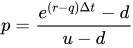
- Under the risk neutrality assumption, today's fair price of a derivative is equal to the expected value of its future payoff discounted by the risk free rate. Therefore, expected value is calculated using the option values from the later two nodes (Option up and Option down) weighted by their respective (fixed) probabilities—"probability" p of an up move in the underlying, and "probability" (1−p) of a down move. The expected value is then discounted at r, the risk free rate corresponding to the life of the option.
- The following formula to compute the expectation value is applied at each node:
- , or
- where
- is the option's value for the node at time t,
- is chosen such that the related binomial distribution simulates the geometric Brownian motion of the underlying stock with parameters r and σ,
- q is the dividend yield of the underlying corresponding to the life of the option. It follows that in a risk-neutral world futures price should have an expected growth rate of zero and therefore we can consider for futures.
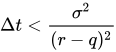
- Note that for p to be in the interval the following condition on has to be satisfied .
- (Note that the alternative valuation approach, arbitrage-free pricing, yields identical results; see “delta-hedging”.)
- This result is the "Binomial Value". It represents the fair price of the derivative at a particular point in time (i.e. at each node), given the evolution in the price of the underlying to that point. It is the value of the option if it were to be held—as opposed to exercised at that point.
- Depending on the style of the option, evaluate the possibility of early exercise at each node: if (1) the option can be exercised, and (2) the exercise value exceeds the Binomial Value, then (3) the value at the node is the exercise value.
- For a European option, there is no option of early exercise, and the binomial value applies at all nodes.
- For an American option, since the option may either be held or exercised prior to expiry, the value at each node is: Max (Binomial Value, Exercise Value).
- For a Bermudan option, the value at nodes where early exercise is allowed is: Max (Binomial Value, Exercise Value); at nodes where early exercise is not allowed, only the binomial value applies.
![{\displaystyle {\text{ Binomial Value }}=[p\times {\text{ Option up }}+(1-p)\times {\text{ Option down] }}\times \exp(-r\times \Delta t)}](https://wikimedia.org/api/rest_v1/media/math/render/svg/b75e23dc7ad848aee9b22bb4cef7cb97ae667b83)





In calculating the value at the next time step calculated—i.e. one step closer to valuation—the model must use the value selected here, for "Option up"/"Option down" as appropriate, in the formula at the node. The aside algorithm demonstrates the approach computing the price of an American put option, although is easily generalized for calls and for European and Bermudan options:
Relationship with Black–Scholes
[edit]Similar assumptions underpin both the binomial model and the Black–Scholes model, and the binomial model thus provides a discrete time approximation to the continuous process underlying the Black–Scholes model. The binomial model assumes that movements in the price follow a binomial distribution; for many trials, this binomial distribution approaches the log-normal distribution assumed by Black–Scholes. In this case then, for European options without dividends, the binomial model value converges on the Black–Scholes formula value as the number of time steps increases.[5][6]
In addition, when analyzed as a numerical procedure, the CRR binomial method can be viewed as a special case of the explicit finite difference method for the Black–Scholes PDE; see finite difference methods for option pricing.[7]
See also
[edit]- Trinomial tree, a similar model with three possible paths per node.
- Tree (data structure)
- Lattice model (finance), for more general discussion and application to other underlyings
- Black–Scholes: binomial lattices are able to handle a variety of conditions for which Black–Scholes cannot be applied.
- Monte Carlo option model, used in the valuation of options with complicated features that make them difficult to value through other methods.
- Real options analysis, where the BOPM is widely used.
- Quantum finance, quantum binomial pricing model.
- Mathematical finance, which has a list of related articles.
- Employee stock option § Valuation, where the BOPM is widely used.
- Implied binomial tree
- Edgeworth binomial tree
References
[edit]- ^ Georgiadis, Evangelos (2011). "Binomial options pricing has no closed-form solution". Algorithmic Finance. 1 (1). IOS Press: 11–18. doi:10.3233/AF-2011-003.
- ^ William F. Sharpe, Biographical, nobelprize.org
- ^ Cox, J. C.; Ross, S. A.; Rubinstein, M. (1979). "Option pricing: A simplified approach". Journal of Financial Economics. 7 (3): 229. CiteSeerX 10.1.1.379.7582. doi:10.1016/0304-405X(79)90015-1.
- ^ Richard J. Rendleman, Jr. and Brit J. Bartter. 1979. "Two-State Option Pricing". Journal of Finance 24: 1093-1110. doi:10.2307/2327237
- ^ a b Mark s. Joshi (2008). The Convergence of Binomial Trees for Pricing the American Put
- ^ a b Chance, Don M. March 2008 A Synthesis of Binomial Option Pricing Models for Lognormally Distributed Assets Archived 2016-03-04 at the Wayback Machine. Journal of Applied Finance, Vol. 18
- ^ Rubinstein, M. (2000). "On the Relation Between Binomial and Trinomial Option Pricing Models". Journal of Derivatives. 8 (2): 47–50. CiteSeerX 10.1.1.43.5394. doi:10.3905/jod.2000.319149. S2CID 11743572. Archived from the original on June 22, 2007.
External links
[edit]- The Binomial Model for Pricing Options, Prof. Thayer Watkins
- Binomial Option Pricing (PDF), Prof. Robert M. Conroy
- Binomial Option Pricing Model by Fiona Maclachlan, The Wolfram Demonstrations Project
- On the Irrelevance of Expected Stock Returns in the Pricing of Options in the Binomial Model: A Pedagogical Note by Valeri Zakamouline
- A Simple Derivation of Risk-Neutral Probability in the Binomial Option Pricing Model by Greg Orosi

Binomial options pricing model
View on GrokipediaFundamentals
Overview of the Model
The binomial options pricing model is a discrete-time numerical method for valuing options contracts, which discretizes the time to expiration into a finite number of steps and models the price of the underlying asset as evolving along a lattice where it can only move upward or downward by specified multiplicative factors at each step. This approach constructs a recombining tree representing possible future asset prices, enabling the computation of option values through backward induction. The model serves as both a pedagogical tool to illustrate option pricing concepts and a practical computational framework, particularly useful before the widespread availability of advanced software for continuous-time models.[5] The model was first proposed by William Sharpe in the 1978 edition of his textbook Investments. It was independently developed and formalized shortly thereafter by Richard J. Rendleman, Jr., and Brit J. Bartter in their 1979 paper "Two-State Option Pricing," and by John C. Cox, Stephen A. Ross, and Mark Rubinstein in their 1979 paper "Option Pricing: A Simplified Approach," positioning it as an accessible alternative to more complex analytical methods for option valuation. These contributions emphasized its utility in handling discrete price movements to approximate continuous processes.[1][6][5] At a high level, the binomial model involves building a recombining tree of possible stock prices over multiple time steps, determining the option's payoffs at maturity based on the terminal prices, and then working backward through the tree by calculating the discounted expected value of the option at each prior node using risk-neutral probabilities. This backward recursion propagates the value from expiration to the present, yielding the fair price of the option. The process leverages the risk-neutral valuation principle, where expectations are taken under a probability measure equivalent to the risk-free rate, though detailed derivations of probabilities are model-specific.[5] For illustration, consider a simple one-step binomial tree pricing a European call option with current stock price , strike price , volatility , time step , and continuous risk-free rate . The up-factor is defined as and the down-factor as , leading to possible stock prices or at maturity. The corresponding call payoffs are and . The option value is then , where the risk-neutral probability . This one-step case demonstrates the foundational mechanics, scalable to multi-step trees for greater accuracy.[5] Key advantages of the binomial model include its intuitive visualization of evolving price paths via the tree structure, which aids conceptual understanding; its flexibility to accommodate early exercise features for American options by checking exercise values at each node; and its straightforward implementation in spreadsheets or basic programming, making it accessible for practical computations without requiring specialized software.[7][8]Key Assumptions
The binomial options pricing model relies on several foundational assumptions that simplify the complex dynamics of financial markets into a discrete framework suitable for computational valuation. Central to the model is the assumption that the underlying stock price follows a multiplicative binomial random walk, where over each discrete time step Δt, the price S_t moves to either an up state uS_t or a down state dS_t, with u > 1 and 0 < d < 1. This process approximates the continuous lognormal diffusion of stock prices, such that the logarithmic return log(S_{t+1}/S_t) is normally distributed as N(μΔt, σ²Δt), where μ represents the expected drift and σ is the constant volatility of log-returns over the period.[5][7] A key market assumption is the constancy of the risk-free interest rate r, which remains unchanged over each time step and serves as the discount rate for risk-neutral valuation; this allows unrestricted borrowing and lending at r without frictions. Additionally, the model presumes frictionless markets with no transaction costs, taxes, or margin requirements, enabling costless short-selling and the full use of proceeds from such positions to replicate option payoffs. The underlying stock is assumed to pay no dividends during the option's life, though extensions can incorporate continuous dividend yields. These conditions ensure the absence of arbitrage opportunities, permitting the construction of hedging portfolios that match the option's payoff exactly.[5][9][10] The model's tree structure incorporates a recombining property, where an up move followed by a down move results in the same price as a down move followed by an up move (u d S = d u S), which reduces computational complexity to O(n²) nodes for n time steps and maintains efficiency in lattice-based pricing. For European options, the model inherently assumes no early exercise, valuing the option solely at maturity, whereas adaptations for American options allow checking for optimal early exercise at each node without altering the core assumptions. Implicitly, the binomial framework assumes an underlying lognormal distribution for stock prices, consistent with geometric Brownian motion in continuous-time models.[5][11] These assumptions, while enabling tractable solutions, introduce limitations; for instance, the discrete approximation can deviate from real-world dynamics for very short time steps Δt unless parameters are calibrated for convergence to continuous models, and the fixed volatility σ may not capture stochastic variations observed in actual markets.[7][9]Constructing the Model
Creating the Stock Price Lattice
The construction of the stock price lattice in the binomial options pricing model begins with discretizing the time to maturity of the option into equal time steps, each of duration . This discretization creates a framework where the stock price evolves over these discrete intervals, starting from the initial stock price at time zero. The lattice represents all possible stock price paths under the model's assumptions of lognormal diffusion.[2] The up and down movement factors are essential parameters that define the magnitude of price changes in each step. In the Cox-Ross-Rubinstein (CRR) parametrization, the up factor is and the down factor is , where is the annual volatility of the underlying stock's returns. This choice ensures the lattice approximates the continuous geometric Brownian motion process with matching mean and variance over each step. An alternative parametrization, proposed by Jarrow and Rudd, adjusts for the risk-neutral drift by setting and , where is the risk-free rate, resulting in equal probabilities of up and down moves.[2][12] The stock prices in the lattice are computed recursively using the formula , where denotes the time step (from 0 to ) and is the number of up moves (from 0 to ). This multiplicative structure guarantees recombination: a path with an up move followed by a down move reaches the same price as a down move followed by an up move, since , preventing exponential growth in the number of nodes. At maturity (), the terminal stock prices form the boundary, ranging from the lowest (all down moves) to the highest (all up moves), with intermediate values corresponding to binomial combinations of up and down moves.[2] Numerical implementation requires careful selection of to balance accuracy and computational efficiency; values of 100 or more steps are commonly used to achieve convergence close to continuous-time models, as smaller may introduce noticeable discretization errors. For large , the lattice's size grows as , necessitating efficient algorithms or software tools for storage and computation to avoid excessive memory and time demands.[13] To illustrate, consider a simple two-step lattice with , , and . The resulting stock prices at each node are as follows:| Time Step | j=0 (Downs) | j=1 (Mixed) | j=2 (Ups) |
|---|---|---|---|
| i=0 | 100 | - | - |
| i=1 | 90 | 110 | - |
| i=2 | 81 | 99 | 121 |
Determining Option Payoffs
In the binomial options pricing model, the payoffs at the terminal nodes of the stock price lattice represent the intrinsic value of the option at maturity, determined solely by the option contract terms applied to the underlying asset prices generated in the lattice. For a European call option, the payoff at each terminal node (where ranges from 0 to , corresponding to the number of upward moves in an -step tree) is given by , with denoting the stock price at that node and the strike price. Similarly, for a European put option, the terminal payoff is . These payoffs are stored in an array , where is the payoff function specific to the option type, enabling straightforward computation for vanilla options that depend only on the terminal asset value. For more complex exotic options, such as barrier options, a custom payoff function can be specified at maturity, though the standard binomial lattice is primarily designed for path-independent payoffs like those of vanilla calls and puts.[14] The binomial model efficiently handles non-path-dependent options, where the payoff relies exclusively on the final stock price, but encounters limitations for path-dependent options like Asian options, whose value depends on the asset path over time; such cases require model extensions beyond the basic lattice structure.[15] Consider a representative two-step () binomial tree with initial stock price , upward factor , downward factor , and strike for a European call option. The terminal stock prices are (two up moves), (one up and one down), and (two down moves), yielding payoffs of , , and . These terminal values serve as the starting point for further valuation in the model.Backward Recursion for Valuation
The backward recursion process in the binomial options pricing model computes the value of an option at each node in the stock price lattice by taking the discounted risk-neutral expectation of its values at the succeeding nodes. This dynamic programming approach ensures that the option price at any intermediate time reflects the present value of expected future payoffs, assuming no arbitrage opportunities. The method is particularly suited for European options, where the holder cannot exercise early, so the value propagates purely through discounting without considering exercise decisions.[16][17] The core recursion formula for the option value at time step and state (with up-moves) is: where is the continuous risk-free interest rate, is the length of each time step, and is the risk-neutral probability of an up-move, given by .[2] The computation begins at maturity (), where equals the option payoff (e.g., for a European call with strike ), and proceeds backward to , calculating values for all to at each step. This backward iteration yields the option price at the initial node.[16] For European options, the absence of early exercise simplifies the valuation to this pure expectation under the risk-neutral measure, ensuring consistency with no-arbitrage pricing. The recombining property of the binomial lattice—where nodes from up-then-down and down-then-up paths coincide—avoids redundant calculations, resulting in a total computational complexity of operations for time steps.[16][18] To illustrate, consider a two-step European call option with initial stock price , strike , up-factor , down-factor , risk-neutral probability , and discount factor per step (corresponding to a per-step continuous rate of approximately 0.223). The stock prices at maturity () are , , and , yielding payoffs , , and . At step :- Up node ():
- Down node ():
- Initial node ():
Theoretical Foundations
Risk-Neutral Valuation Principle
The risk-neutral valuation principle forms the cornerstone of the binomial options pricing model, enabling arbitrage-free pricing of derivatives by transforming the problem into one under a risk-neutral probability measure. In this framework, known as the equivalent martingale measure, the discounted price of the underlying stock behaves as a martingale, meaning its expected value under this measure equals the current price adjusted for the risk-free rate. Specifically, the expected return on the stock over any time interval equals the risk-free rate , eliminating the need to estimate investor risk preferences and ensuring consistency with no-arbitrage conditions. This approach, introduced in the discrete-time binomial setting, posits that the fair price of an option is the discounted expected value of its payoff under these risk-neutral probabilities.[2] The risk-neutral probability for an upward stock price movement is derived to satisfy the martingale property: , where is the time step, is the up factor, and is the down factor. This formula ensures that the expected stock price at the next time step, , satisfies , aligning the stock's growth with the risk-free rate under the measure. The derivation stems from the no-arbitrage foundation of the model, where option payoffs are perfectly replicated through dynamic hedging using the stock and a risk-free bond. To construct such a hedge, consider a portfolio consisting of shares of stock and borrowing at the risk-free rate; its value at the next step must match the option's value in both up and down states: and , where and are the option values in those states. Solving this system yields and , and the current option price equals the portfolio value , which simplifies to , revealing the risk-neutral probability as the hedge ratio's weighting.[2] Over multiple periods, the stock price path follows a recombining binomial lattice, where the number of upward moves in steps is binomially distributed as . Consequently, the option price is the discounted expectation of the payoff under this distribution: for a European call, though in practice, backward recursion computes this efficiently without enumerating all paths. This connection underscores the model's tractability, as the risk-neutral measure converts the pricing problem into a straightforward expectation. The principle generalizes beyond the Cox-Ross-Rubinstein parameterization to any recombining lattice where up and down moves satisfy the no-arbitrage condition , ensuring a unique risk-neutral measure exists for valuation.[2]Convergence to Black-Scholes Model
The binomial options pricing model converges to the Black-Scholes model in the limit as the number of time steps approaches infinity and the time increment approaches zero, yielding identical prices for European options. This asymptotic property arises because the discrete multiplicative binomial process for the underlying stock price converges in distribution to the continuous geometric Brownian motion assumed in the Black-Scholes framework, as established by the central limit theorem applied to the log-returns.[19][20] The backward recursion procedure in the binomial model corresponds to an explicit finite-difference scheme that approximates the Black-Scholes partial differential equation (PDE): where denotes the option value, is the risk-free rate, is the volatility, and is the current stock price. As the lattice becomes finer, this discretization error diminishes, confirming the model's consistency with the continuous-time PDE solution.[21] Different parametrizations of the up and down factors influence the convergence rate. The Cox-Ross-Rubinstein (CRR) approach, with and , ensures direct convergence to the Black-Scholes price by matching the variance of the lognormal distribution. In contrast, the Jarrow-Rudd (JR) parametrization adjusts the factors to equalize the mean and variance more precisely under the risk-neutral measure, providing superior accuracy for smaller but similar asymptotic behavior.[22][23] Numerical illustrations demonstrate this convergence for an at-the-money European call option with spot price , strike , risk-free rate , time to maturity years, and volatility . The exact Black-Scholes price is .| Number of Steps () | CRR Binomial Price |
|---|---|
| 60 | 5.4820 |
| 120 | 5.4919 |
Applications and Extensions
Pricing American Options
The binomial options pricing model naturally extends to American options, which allow early exercise at any time up to expiration, by incorporating a decision rule at each node of the lattice during the backward recursion. Specifically, the value of the option at node (i, j) is determined as the maximum of the continuation value—computed as the discounted risk-neutral expectation from the next period, —and the intrinsic value from immediate exercise. For call options, the intrinsic value is ; for put options, it is . This modification, , enables the model to capture the hold-or-exercise choice optimally at every point. This approach identifies the early exercise boundary, delineating regions where immediate exercise is preferable to continuation. For American put options, early exercise becomes optimal in deep in-the-money states, where the interest foregone by not receiving the strike price immediately outweighs the remaining optionality value. In contrast, American call options on non-dividend-paying stocks exhibit no early exercise premium, as the value of holding the option always exceeds the intrinsic value before expiration; thus, their price equals that of the corresponding European call. To illustrate, consider a two-step binomial valuation of an American put option with initial stock price , strike , risk-free rate , time to maturity years (), up factor , down factor , and risk-neutral probability (derived from the risk-neutral valuation principle). The stock price lattice is:| Time Step | uu node | ud/du node | dd node |
|---|---|---|---|
| 0 | 100 | ||
| 1 | 110 | 90 | |
| 2 | 121 | 99 | 81 |