Hubbry Logo
BinyeoBinyeoMain
Open search
Binyeo
Community hub
Binyeo
logo
8 pages, 0 posts
0 subscribers
Be the first to start a discussion here.
Binyeo
Binyeo
from Wikipedia
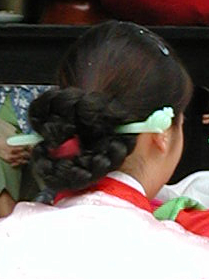
Binyeo with dragon head
Binyeo

A binyeo (Korean비녀; Korean pronunciation: [pi.njʌ̜]) is a Korean traditional hairpin for fixing ladies' chignons. Its main purpose is to pin the chignon in place, but it also serves as ornamentation, and it has different usages or names according to its material or shape. Therefore, it is possible to identify one's social status by looking at their binyeo.[1] Binyeo are divided into two kinds, a jam (; ; Korean pronunciation: [tɕam]) and a chae (; Korean pronunciation: [tɕʰɛ̝]). Jam have a long body and chae have an upturned 'U' shape. Binyeo are usually used by women, but they are also used by men to fix their sangtu (topknots) in place.[2]

In the Joseon Dynasty, on the day of becoming an adult, girls held a coming of age ceremony by putting binyeo in their hair. In the ascension myth "Chiwondae Yangsanbok", which is passed down in the Hamgyeong-do area, it also appears as a medium for binyeo to meet the two loved ones.[clarification needed][3]

Origin

[edit]

Binyeo (originally 빈혀 where 鬢 is the first character), according to historical records, are traced back to use during the Three Kingdoms Era, usually worn with a Goryeo ladies' hair style similar to chignons.[4] Details surrounding the use of the binyeo became more detailed since King Yeongjo of the Joseon Dynasty (Huidrom). It is said that King Yeongjo may have forced women to put on binyeo. During the Silla dynasty, it is noted that a ban was created in order to pursue frugality amongst the people (Yi, 2006, p. 202). The binyeo was used as a replacement for the gachae also known as a wig, that many married women would put around their hair to show status and standing in society. Due to the extent and weight of some of these pieces, women would suffer injuries to their necks. In order to prevent further social problems from arising due to the excessive costs of the items and to prevent further injuries, the gachae was replaced with the binyeo.

The main purpose of the binyeo is to affix women's hair as well as serve as an ornament to accessories. Binyeo come in two types: one is used to pin the woman's hair into place, and the other is used to place hwagwan and jokduri types of flower cornets in place (National Folk Museum of Korea). Those that were used to just pin women's hair were known by different names, all of which were dependent on the type of materials they were made of as well as the shape of the pin (known as Jamdu; National Folk Museum of Korea). There were also binyeo that served different uses, such as formal purposes, daily wear, seasonal as well as ones worn based on age.

Cultural significance

[edit]

Prior to the Joseon era men also wore binyeo. They were often used to secure their topknots before the rigid dichotomies of Confucianism and Buddhism interfered (Rowan, 2019). However, during the Joseon Dynasty under the influence of Confucianism, women's clothing was limited to some extent, and ordinary people, not the upper class, could only wear wedding clothes (Shin, M., & Park, S., 2014). Regulations were inherited based on the certain class of individuals on who could wear or make different ornaments and accessories from the previous Goryeo Dynasty. It is said that "the use of gold and silver was restricted during the Joseon Dynasty, and the simplicity and sophistication of ornaments stood out even more" (Shin, M., & Park, S., 2014).

During the Joseon era women would wear a variety of different hair accessories and ornaments on their heads to decorate their clothing. At this time women's hairstyles reflected their social status as well as their marital status. The binyeo was also considered as a symbol of being a married woman. Often given as a gift from their husband or suitor. At the gyerye rite, a part of the coming-of-age ceremony, many girls would first wear and display this specific type of hair pin. The binyeo which was not to be removed also played a significant role in the passing of a girl/woman's parents. Some would remove the binyeo and allow their hair to fall in order to repent for their belief that they caused their parents demise. After three days they would fix their hair back in a chignon and replace their binyeo with one made of wood. This wood binyeo is to be worn for three years of mourning (National Folk Museum of Korea). This was a way to show their discretion and consideration to not be seen as short sighted.

See also

[edit]

References

[edit]

Further reading

[edit]
[edit]
Revisions and contributorsEdit on WikipediaRead on Wikipedia
from Grokipedia

Binyeo (비녀) is a traditional Korean ornamental primarily used by women to secure chignons or hair buns, combining practical fixation with decorative elements. Crafted from diverse materials such as silver, , , , or wood, binyeo varied in shape, size, and design to reflect social status, marital condition, and aesthetic preferences, often featuring intricate motifs like phoenixes or dragons. Introduced prominently during the Joseon Dynasty (1392–1910), it symbolized adulthood and marriage for women, who adopted updos around age 15 in coming-of-age rituals and retained the pin as a lifelong marker of wedlock, rarely removing it. As family heirlooms, binyeo were passed down through generations, underscoring their cultural and economic value in hierarchical Korean society. Though largely ceremonial today, modern adaptations persist in attire for weddings and cultural events, preserving its role in Korean heritage.

History

Ancient Origins and Early Use

The earliest historical references to binyeo trace its use to the period (57 BCE–668 CE), as indicated in the (History of the Three Kingdoms), a 12th-century chronicle compiling earlier records. Archaeological evidence supports this, including silver binyeo artifacts unearthed in , associated with the Baekje kingdom (18 BCE–660 CE), demonstrating early metallurgical craftsmanship in hairpin production. In the kingdom (57 BCE–935 CE), binyeo served primarily as functional hairpins to secure women's chignons, with simpler designs likely crafted from bone, wood, or basic metals, reflecting practical needs amid the era's hairstyles influenced by nomadic and continental Asian traditions. Men also employed early forms of binyeo to fasten topknots, a common male hairstyle predating the Joseon Dynasty's stricter gender norms. These hairpins were not merely utilitarian; records suggest they began to carry ornamental value, with materials hinting at the wearer's regional or social standing within the stratified kingdoms. Early binyeo evolved from U-shaped variants known as chae to straighter stick forms, adapting to the coiled hair buns prevalent among women during this period, as evidenced by tomb artifacts and textual allusions to hair adornment in royal and elite contexts. Unlike later elaborations, ancient examples lacked extensive decorative motifs, prioritizing durability for daily wear amid Korea's agrarian and warrior societies.

Evolution During the Joseon Dynasty

During the early period (1392–late 18th century), binyeo served primarily as functional hairpins to secure topknots and early bun styles, continuing traditions from the Dynasty, while elaborate wigs known as gache—influenced by Ming Chinese fashions—dominated women's hairstyles among all classes, often reducing the decorative role of binyeo. Neo-Confucian policies emphasizing frugality and moral simplicity began restricting extravagant hairpieces, gradually elevating binyeo's prominence as a simpler alternative for holding natural hair configurations. A pivotal shift occurred in the mid-18th century during King Yeongjo's reign (1724–1776), when the stick-shaped jam variant of binyeo proliferated, marking its evolution into a widespread ornamental staple for securing chignons (dwaeji meori) and symbolizing adulthood in girls' coming-of-age ceremonies (gyeol or iprye). This development coincided with increasing bans on gache for upper-class women, compelling reliance on binyeo to maintain hair buns without added volume, thereby spurring design innovations like elongated bodies with convex jamdu ends for better grip and aesthetics. The 1788 royal decree by King Jeongjo (r. 1776–1800) formally prohibited gache across society, viewing them as antithetical to Confucian virtue, which accelerated binyeo's transformation into the primary hair accessory for married women, with varieties diversifying to denote status: royals favored phoenix- or dragon-motif jamdu in or silver, while commoners used bone or wood, and widows opted for plain wooden types to signify mourning. By the late era, binyeo had evolved into multifaceted heirlooms—functional, symbolic of marital roles, and class indicators—often paired with U-shaped for added stability in formal updos, reflecting broader societal shifts toward restrained yet stratified adornment.

Design and Construction

Structural Features

The binyeo consists of a primary shaft, typically elongated and straight or slightly curved, designed to penetrate and secure the chignon or hair bun in place. This shaft often tapers to a fine, needle-like tip for ease of insertion, while the opposite end features a convex protrusion known as the jamdu, which functions to anchor the pin and prevent it from slipping out of the hair. The jamdu represents the structural focal point, frequently expanded into a bulbous or molded form to accommodate decorative elements such as engravings, inlays, or attached ornaments. Structurally, binyeo are categorized into two main types based on form: the gye or jam variant, which maintains a predominantly linear profile with the prominent jamdu at one terminus, and the chae type, which incorporates a U-shaped or looped configuration for enhanced hair-gripping capability. In both types, the shaft's length generally ranges from 20 to 30 centimeters, allowing it to span the width of an adult's updo, with cross-sections varying from circular to rectangular depending on the material and era-specific craftsmanship. Additional structural reinforcements, such as subtle flanges or hooks along the shaft in certain designs, aided in stabilizing heavier decorative loads on the jamdu. The overall rigidity of the binyeo derives from its monolithic construction, where the shaft and jamdu are forged or carved as a single unit, minimizing points of mechanical failure under the tension of secured . This integrated design ensured durability for daily wear, particularly during the Dynasty when binyeo served both utilitarian and symbolic roles.

Variations and Types

Binyeo are primarily classified into two types based on : (also known as gye), which features an elongated, stick-like body with a convex end called jamdu, and , characterized by an inverted U-shape (∩) often with curved decorations. The type, with lengths ranging from 5 to 44 cm and thicknesses of 0.3 to 1.5 cm, became the predominant form during the Dynasty in the under King Yeongjo, coinciding with the standardization of tight chignon hairstyles that required secure pinning. In contrast, the represents an earlier U-shaped variant used since the period for fixing more voluminous hairstyles, including those augmented by part-wigs. Variations within the jam type primarily involve the design of the jamdu, which often incorporated symbolic motifs from flora and fauna believed to offer protection against evil spirits or to promote attributes like wealth, fertility, and longevity. Subtypes include yongjam (dragon-shaped), reserved for royalty or brides to secure elaborate ribbons during weddings, and bongjam (phoenix-shaped), favored by upper-class women for its auspicious connotations. Other designs encompassed gumbongjam (gold with phoenix patterns) and tteoljam (with fluttering metal ornaments for added embellishment). Dragon motifs, in particular, were permitted for commoners specifically at wedding ceremonies, reflecting temporary elevation in ritual status. These structural and decorative differences allowed binyeo to serve dual roles in hair fixation and ornamental display, tailored to ceremonial or daily contexts.

Materials and Craftsmanship

Traditional Materials

Traditional binyeo were fashioned from diverse materials that directly corresponded to the social hierarchy and marital status of the wearer during the Joseon Dynasty (1392–1910). Upper-class women, including nobility and royalty, favored precious metals and gemstones such as gold, silver, and jade, often inlaid with jewels like pearls to denote wealth and prestige. In contrast, commoners utilized more economical substances including , , , wood, , and animal bones or horns, which were practical for everyday securing of chignons while still allowing ornamental variation. Widows were restricted to plain wooden binyeo, symbolizing and , as sumptuary laws enforced material distinctions to maintain Confucian . These material choices not only ensured durability—gold and silver for longevity, wood for disposability—but also embodied cultural values, with jade representing purity and silver warding off misfortune according to historical artisanal traditions.

Manufacturing Techniques

Traditional binyeo manufacturing during the Joseon Dynasty (1392–1910) relied on artisanal metalworking and carving techniques adapted to materials like silver, gold, jade, wood, and horn. Metal binyeo, favored by the elite, featured a functional needle-like pin extending from a decorative head formed through molding processes. Silversmiths shaped the pin and ornament by cutting plates, hammering for form, and rolling to achieve thin, durable structures, often followed by soldering or riveting to assemble components. Ornate designs incorporated inlays or settings for gems such as jade, coral, aquamarine, or amethyst, requiring precise drilling, filing, and adhesion to embed stones securely into the metal base. For lower-status wooden or horn binyeo, craftsmen employed lathe turning or hand-carving with chisels and gouges to sculpt the pin and head, polishing surfaces for smoothness and applying lacquer for durability. These methods, executed by specialized guild artisans, ensured the hairpin's dual role in securing chignons while serving as status symbols, with production varying by social class—gold and silver for nobility, simpler organics for commoners. In contemporary revivals, artisans draw on these historical techniques, adapting hand-molding and stone-setting while incorporating modern tools for precision, though core processes emphasize manual dexterity to preserve cultural authenticity.

Cultural and Social Role

Symbolism and Protective Beliefs

The binyeo functioned primarily as a symbol of marital status and feminine maturity in Joseon-era Korea, where married women affixed it to secure their chignon hairstyle, denoting fidelity, dignity, and transition to wifely responsibilities; unmarried women generally refrained from its use to avoid implying wedlock. Grooms customarily presented binyeo to brides during matrimony as emblems of enduring love and commitment, embedding personal sentiment into an otherwise utilitarian accessory. Among yangban elites, elaborate binyeo further connoted social class and virtue, with materials like gold reserved for elder women to evoke accumulated wisdom and prestige. Beyond status indicators, binyeo embodied protective beliefs rooted in Confucian cosmology and folk traditions, particularly through motifs on the jamdu (pin head). Designs incorporating flora, fauna, or auspicious symbols—such as dragons, phoenixes, or bats—were thought to repel malevolent spirits, foster fertility, and invite prosperity, with circular jamdu forms specifically evoking vitality, wealth, and longevity. These attributions stemmed from animistic interpretations of nature's harmony, where the pin's placement near the crown chakra-like apex of the head amplified its talismanic role against misfortune. In ritual contexts, such as mourning, women might remove or repurpose binyeo to avert familial calamity, reflecting beliefs in hair adornments' influence over fate. Such convictions persisted into the 20th century, blending empirical utility with metaphysical safeguards.

Indicators of Status and Marital Role

During the Joseon Dynasty (1392–1910), binyeo primarily indicated a woman's marital status, as married women exclusively wore them to secure the chignon hairstyle known as jjok meori, while unmarried women styled their hair in a simple braid called daenggi meori without such pins. This distinction enforced Confucian social norms emphasizing propriety and family roles, with binyeo adoption often coinciding with a woman's coming-of-age or engagement ceremony around age 15. The materials and designs of binyeo further signified and . Elite women used luxurious binyeo crafted from , silver, or , sometimes featuring elaborate motifs like phoenixes reserved for royalty such as the crown princess. In contrast, commoner women relied on simpler versions made from wood, animal horn, or , typically 10–20 cm in length, with longer 30 cm pieces for weddings. Widows adopted plain black wooden or horn binyeo to reflect mourning and restraint. Among married women, binyeo materials also varied by age, underscoring evolving roles and earned dignity: younger brides favored jade for its vibrancy, while older women selected gold to symbolize maturity and pride. Intricate craftsmanship and precious adornments in elite binyeo highlighted wealth and virtue, serving as visible markers in a stratified society where hairstyles and accessories reinforced occupational and familial positions.

Modern Relevance

Revival and Contemporary Adaptations

In the early , the resurgence of interest in , fueled by the global (Hallyu), has prompted renewed appreciation for binyeo among younger South Koreans, who incorporate them into contemporary ensembles for cultural festivals, photoshoots, and aesthetics. This revival builds on the practical and ornamental roles of binyeo, adapting them to modern contexts where they secure updos while serving as elegant accessories. Contemporary adaptations emphasize fusion with Western and minimalist fashion, as seen in brands like Yujinbuty, which reinterprets binyeo forms—such as elongated pins with subtle motifs—in lightweight metals and simplified designs for everyday or semi-formal wear, launched around 2019. Artisans like Seeun Kim have advanced this propagation through handcrafted pieces blending Joseon-era techniques with modern metalworking, exhibited in international settings to highlight binyeo's enduring craftsmanship amid declining traditional use. In weddings, binyeo feature prominently in ceremonies, often customized with or inlays to denote marital symbolism while complementing bridal updos, a practice sustained by events and media portrayals.

Representation in Media and Global Perception

In historical Korean dramas, known as , binyeo serves as a prominent accessory for female characters, securing chignons while symbolizing elegance and during periods like the Dynasty. These depictions emphasize its ornate designs, often featuring motifs such as dragons or floral patterns, which align with archaeological evidence of binyeo from the era onward. The repeated use in productions like those broadcast on networks such as KBS has reinforced binyeo's visibility, portraying it not merely as functional but as integral to authentic period attire. The surge in popularity of these dramas, which reached global audiences via platforms like starting around 2010, has indirectly elevated binyeo's domestic relevance by encouraging wear during festivals and weddings, with sales of replicas tied to drama-inspired trends reported in Korean craft markets. However, representations occasionally romanticize binyeo beyond historical accuracy, such as exaggerating its universality across classes, whereas primary sources indicate gold and jade variants were reserved for . Globally, binyeo is perceived as a refined of Korean heritage, evoking associations with Confucian femininity and artisanal precision, though it garners less mainstream recognition than or K-beauty amid the Hallyu wave. Cultural institutions like the highlight its "dazzling" aesthetic diversity, from silver U-shapes to wooden sticks, positioning it as an underappreciated export of craftsmanship. Modern reinterpretations, such as those by Seoul-based artisans since 2019, adapt binyeo into minimalist accessories for international , blending traditional techniques with contemporary updos to appeal to communities and tourists. This evolution reflects causal links to Korea's soft power strategy, with export data from the Korea Cultural Heritage Foundation showing increased inquiries from overseas museums post-2020 Hallyu expansions, yet binyeo remains niche compared to broader K-culture phenomena.

References

Add your contribution
Related Hubs
User Avatar
No comments yet.