


Community hub
Recent from talks
Contribute something
Nothing was collected or created yet.
Silla
View on Wikipedia | This article needs additional citations for verification. (January 2023) |
Key Information


| Silla | |
| Hangul | 신라 |
|---|---|
| Hanja | 新羅 |
| RR | Silla |
| MR | Silla |
| IPA | [ɕiɭ.ɭa] |
| Alternate name | |
| Hangul | 서라벌 |
| Hanja | 徐羅伐 |
| RR | Seorabeol |
| MR | Sŏrabŏl |
| IPA | [sʌɾabʌɭ] |
| History of Korea |
|---|
 |
| Timeline |
 North Korea portal North Korea portal  South Korea portal South Korea portal |
| Monarchs of Korea |
| Silla |
|---|
| (Pre-unification) |
|
| Monarchs of Korea |
| Silla |
|---|
| (Post-unification) |
|
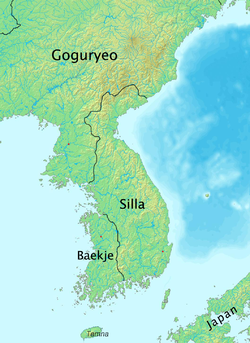
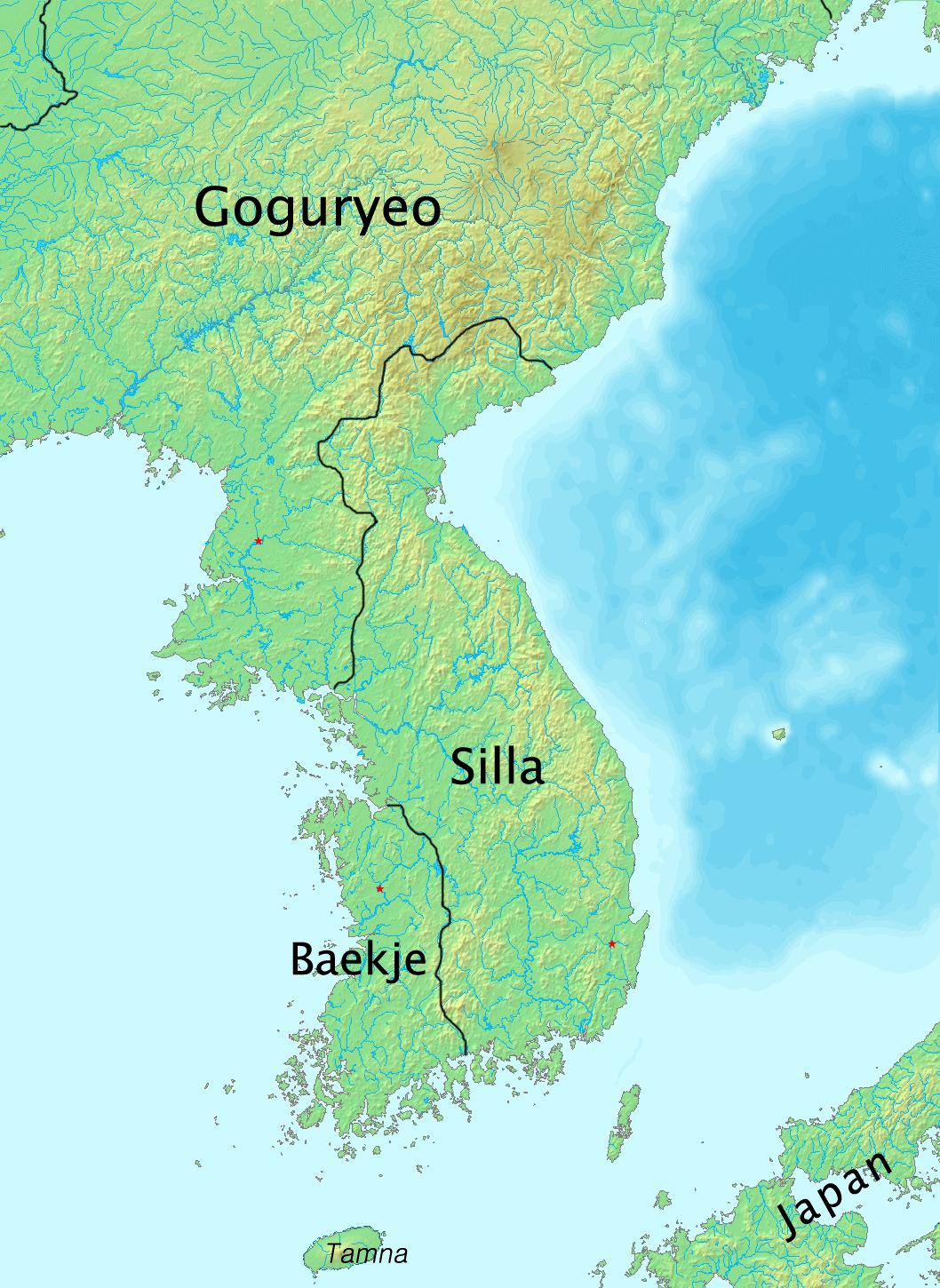
Silla ([ɕiɭ.ɭa]; Old Korean: 徐羅伐, Yale: Syerapel,[8] RR: Seorabeol; IPA: [sʌɾabʌɭ]) was a Korean kingdom that existed between 57 BCE[9] – 935 CE and was located on the southern and central parts of the Korean peninsula. Silla, along with Baekje and Goguryeo, formed the Three Kingdoms of Korea. Silla had the lowest population of the three, approximately 850,000 people (170,000 households), significantly smaller than those of Baekje (3,800,000 people) and Goguryeo (3,500,000 people).[10]
Its foundation can be traced back to the semi-mythological figure of Hyeokgeose of Silla (Old Korean: *pulkunae, "light of the world"), of the Park clan. The country was first ruled intermittently by the Miryang Park clan for 232 years and the Wolseong Seok clan for 172 years and beginning with the reign of Michu Isageum the Gyeongju Kim clan for 586 years. Park, Seok and Kim have no contemporary attestations and went by the Old Korean names of 居西干 Geoseogan (1st century BCE), 次次雄 Chachaung (1st century CE), 泥師今 Isageum (Old Korean: *nisokum)[11] and 麻立干 Maripkan (5th-6th century)[12] instead.
It began as a chiefdom in the Jinhan confederacy, part of the Samhan, and after consolidating its power in the immediate area, conquered the Gaya confederacy. Eventually allying with Sui China and then Tang China, it conquered the other two kingdoms, Baekje in 660 and Goguryeo in 668. Thereafter, Unified Silla occupied most of the Korean peninsula, while the northern part re-emerged as Balhae, a successor-state of Goguryeo. After nearly 1,000 years of rule, Silla fragmented into the brief Later Three Kingdoms of Silla, Later Baekje, and Taebong, handing over power to Goryeo in 935.[13]
Etymology
[edit]Until the official adoption of Hanja names for its administration, Silla was recorded using the Hundok reading of Hanja to phonetically approximate its native Korean name, including 斯盧 (사로; Saro), 斯羅 (사라; Sara), 徐那 (伐) (서나[벌]; Seona[beol]), 徐耶 (伐) (서야[벌]; Seoya[beol]), 徐羅 (伐) (서라[벌]; Seora[beol]), and 徐伐 (서벌; Seobeol).[14]
In 504, Jijeung of Silla standardized the characters into 新羅 (신라), which in Modern Korean is pronounced Silla. According to the Samguk sagi, the name of 新羅 (Silla), consisting of the components sin (新), as in deokeopilsin (德業日新) and ra, as in mangrasabang (網羅四方) is thought to be a later Confucian interpretation.[14]
The modern Seoul is a shortened form of Seorabeol, meaning "capital city", and was continuously used throughout the Goryeo and Joseon periods even in official documents, despite the formal name having been Hanyang or Hanseong. The name of the Silla capital changed into its Late Middle Korean form Syeobeul (셔블), meaning "royal capital city," which changed to Syeoul (셔울) soon after, and finally resulted in Seoul (서울) in the Modern Korean language.[citation needed]
The name of either Silla or its capital Seorabeol was widely used throughout Northeast Asia as the ethnonym for the people of Silla, appearing as Shiragi in Japanese and as Solgo or Solho in the language of the medieval Jurchens and their later descendants, the Manchus, respectively. Koreans are still known as Солонгос (Solongos) in Mongolian, which, according to popular folk etymology, is believed to be derived from the Mongolian word for "rainbow" (солонго solongo). In a paper published in 2023 regarding the etymology of the Mongolian word Solongos "Korea, Koreans," the following seven etymological hypotheses regarding the origin of Solongos have been enumerated: (1) It comes from the Mongolian word solongo meaning "rainbow"; (2) It comes from the Mongolian word solongo meaning "weasel"; (3) It comes from the Mongolian/Manchurian ethnonym Solon; (4) It comes from the name of the ancient kingdom of Silla; (5) It comes from Jurchen *Solgo(r) ~ Solho which in turn stems from Old Korean 수릿골 suɾiskol > 솔골 solkol "Goguryeo"; (later) Korea, Korean"; (6) It comes from the Mongolian word solgoi "left, east"; (7) It comes from the name of the medieval kingdom of Goryeo (via *Hoɾyo > *Solo(n)-). The authors of this paper have ended up supporting the sixth hypothesis, i.e. that Mongolian Solongos "Korea, Koreans" ultimately should be cognate with Mongolian soluγai > solγoi "left, wrong side of the body, left-handed, enemy to the east (from the perspective of the Mongols)"."[15]
Silla was also referred to as Gyerim (계림; 鷄林), literally "rooster forest", a name that has its origins in the forest near the Silla capital. Legend has it that the state's founder was born in the same forest, hatched from the egg of a cockatrice (계룡; 雞龍; gyeryong; lit. rooster-dragon).[16]
History
[edit]Founding
[edit]During the Proto–Three Kingdoms period, central and southern Korea consisted of three confederacies called the Samhan. Silla began as "Saro-guk", a statelet within the 12-member confederacy known as Jinhan. Saro-guk consisted of six clans later known as the Six Clans of Jinhan (진한 6부; 辰韓六部) from Gojoseon.[17][18]
According to Korean records, Silla was founded by Bak Hyeokgeose of Silla in 57 BCE, around present-day Gyeongju. Hyeokgeose is said to have been hatched from an egg laid from a white horse, and when he turned 13, six clans submitted to him as king and established the kingdom of "Saro (pronounced [si.raʔ] at the time)" which later became the kingdom of Silla.
In various inscriptions on archaeological founding such as personal gravestones and monuments, it is recorded that Silla royals considered themselves having Xiongnu ancestry through the Xiongnu prince Kim Il-je, also known as Jin Midi in Chinese sources.[19][20] According to several historians, it is possible that this unknown tribe was originally of Koreanic origin in the Korean peninsula and joined the Xiongnu confederation. Later the tribe's ruling family returned to Korea from Liaodong peninsula where they thrive, and after coming back to the peninsula they got married into the royal family of Silla. There are also some Korean researchers that point out that the grave goods of Silla and of the eastern Xiongnu are alike,[21][19][20][22][23] and some researchers insist that the Silla king is descended from Xiongnu.[24][25][21][19][26][20][excessive citations]
The Nihon Shoki and Kojiki also mentions Silla as the place where the Japanese god, Susanoo first descended from the heavens after his banishment in a place called "Soshimori" (曽尸茂梨).[27][28] Up until the liberation of Korea in 1945, Meiji era Japanese historians claimed that Susanoo had ruled over Silla and that the Koreans were the descendants of him,[29] thus finding justification and legitimizing the Japanese occupation of Korea through the use of Nissen dōsoron.[30] According to the Shinsen Shōjiroku, Inahi no Mikoto the brother of the mythological Emperor Jimmu[31] was the ancestor to the kings of Silla. Another source referenced in Samguk sagi claims that a man from the Japanese Archipelago named Hogong helped build the kingdom of Silla.
Early period
[edit]In its early days, Silla started off as a city-state by the name of Saro (사로국; 斯盧國), initially founded by Yemaek refugees[32][33] from Gojoseon.[17][18] It has also accepted dispersed people fleeing from the Lelang Commandery after Goguryeo's invasion,[34] while later on incorporating native Jin people in the vicinity and Ye people to the North.
Talhae of Silla (57 CE–80 CE) was the son-in-law of Namhae of Silla (4 CE–24 CE). According to the Samguk sagi, Seoktalhae was the prince of Yongseongguk (龍成國) or Dapana (多婆那國), located 1,000-ri (里), northeast of Japan (?). Following the will of Namhae of Silla, he became the fourth king of Silla. One day, he found a low peak next to Mt. Toham (吐含山) and packed it with his own house, and he buried charcoal next to the house of a Japonic official named Hogong (瓠公), who lived there, and deceived him that his ancestors were blacksmiths, but the Hogong family took their home. Hogong was tricked into handing over his house and property to the Seoktalhae. During this period, Kim Al-chi, the ancestor of Gyeongju Kim, was adopted by Talhae of Silla.[35]
The territory outside the capital was greatly conquered during the period of Pasa of Silla (80–112). As soon as he ascended the throne, he ordered officials to encourage agriculture, silkworm farming and train soldiers. There was a territorial dispute between the Eumjipbeol and Siljikgok, and the two countries first asked Pasa of Silla to mediate, Pasa of Silla was handed over to King Suro of Gimhae, who was the local leader at the time. King Suro instead resolved the territorial issue and ruled in favor of Eumjipbeol. However, King Suro sent an assassin to kill the head of the six Silla divisions, who hid in the Eumjipbeol while the assassin was escaping, and King Tachugan (陀鄒干) protected the assassin. In response, Pasa of Silla invaded Eumjipbeol in 102 and Tachugan surrendered, and the Siljikgok and Apdok, which were frightened by Silla, also surrendered. Six years later, it entered the inland area and attacked and merged Dabulguk, Bijigukuk, and Chopalguk.[36]
During the Naehae of Silla period (196–230), the Eight Port Kingdoms War (浦上八國 亂) broke out to determine hegemony in the southern part of the peninsula. In 209, when the "eight upper countries (of the estuary)" (浦上八國) in the Nakdong River basin attacked the Silla-friendly Ara Gaya, the prince of Ara Gaya asked Silla for a rescue army, and the king ordered Crown Prince Seok Uro to gather his troops and attack the eight kingdoms. Crown Prince SeokUro saved Ara Gaya and rescued 6,000 of the pro-Silla Gaya people who had been captured and returned to their homeland. Three years later, three among the eight countries (浦上八國), Golpo-guk, Chilpo-guk, and Gosapo-guk, will launch counterattacks against Silla. A battle took place in Yeomhae, the southeastern part of the capital, and the war ended when the Silla king came out to fight against it, and the soldiers of the three kingdoms were defeated.[37] [38]
By the 2nd century, Silla existed as its own distinct political entity in the southeastern area of the Korean peninsula. It expanded its influence over the neighboring Jinhan chiefdoms, but throughout the 3rd century was probably no more than the strongest constituent in the Jinhan confederacy.
To the west, Baekje had centralized into a kingdom by about 250 CE, overtaking the Mahan confederacy. To the southwest, Byeonhan was being replaced by the Gaya confederacy. In northern Korea, Goguryeo, founded around 50 CE, destroyed the last Chinese commandery in 313 CE and had grown into the largest regional power.
Emergence of a centralized monarchy
[edit]Naemul of Silla (356–402) of the Kim clan established a hereditary monarchy and took the royal title of Maripgan (麻立干; 마립간). However, in the Samguk sagi, Naemul of Silla still appears as a title of Isageum (泥師今; 이사금). He is considered by many historians as the starting point of the Gyeongju Kim period, which lasted more than 550 years. However, even when the Kim monopolized the throne for more than 500 years, the veneration of the founder Bak Hyeokgeose continued.

In 377, Silla sent emissaries to China and established relations with Goguryeo. Facing pressure from Baekje in the west and Japan in the south,[39] in the later part of the 4th century, Silla allied with Goguryeo. However, after King Gwanggaeto's unification campaign, Silla lost its status as a sovereign country becoming a vassal of Goguryeo. When Goguryeo began to expand its territory southward, moving its capital to Pyongyang in 427, Nulji of Silla was forced to ally with Baekje.
By the time of Beopheung of Silla (514–540), Silla was a full-fledged kingdom, with Buddhism as state religion, and its own Korean era name. Silla absorbed the Gaya confederacy during the Gaya–Silla Wars, annexing Geumgwan Gaya in 532 and conquering Daegaya in 562, thereby expanding its borders to the Nakdong River basin.
Jinheung of Silla (540–576) established a strong military force. Silla helped Baekje drive Goguryeo out of the Han River (Seoul) area, and then wrested control of the entire central western Korea region from Baekje in 553, breaching the 120-year Baekje-Silla alliance. Also, King Jinheung established the Hwarang.
The early period ended with the death of Jindeok of Silla and the demise of the "hallowed bone" (성골; seonggol) rank system.
Etymology of title
[edit]The royal title Maripgan (마립간) is analyzed into two elements in many popular explanations, with the first element alleged to be from the Korean root
- mari (마리) from Middle Korean 마리〮 màlí, "head"/ countable of "head / per head" or "hair"
- mang-rip or mang-nip (網笠), "a traditional-style hat made of horsehair"
- mo-rip (毛笠), "a kind of hat worn by servants in the old days"
- mi-rip or mi-reup, meaning "a knack, a trick, the hang of something"
- madi (맏이) or maji (맏히), meaning "the firstborn, the eldest (child of a family); an elder, a senior, a person whose age is greater than someone else's age"
- mat-jip (맛집), meaning "the house in which the head of a household lives, the main house on an estate"
- mŏrŏ or maru (마루), meaning "ridge, peak, crest (of a roof, a mountain, a wave, etc.); zenith, climax, prime; the first, the standard"
- maru (마루) or mallu, meaning "floor"
or from a word related to Middle Korean marh meaning "stake, post, pile, picket, peg, pin (of a tent)".
The second element, gan (Hangul: 간), is a likely cognate to han (Hangul: 한) and the word for "big, great" keun, first attested as Late Old Korean 黑根 *hùkú-n. Both carry the meaning of "great, leader", which was previously used by the princes of southern Korea, and is sometimes also speculated to have an external relationship with the Mongolic/Turkic title of Khan.
Unified Silla
[edit]In the 7th century, Silla allied itself with the Chinese Tang dynasty. In 660, under Muyeol of Silla (654–661), the Silla–Tang alliance subjugated Baekje after the Baekje–Tang War. In 668, under King Munmu of Silla (King Muyeol's successor) and General Kim Yu-sin, the Silla–Tang alliance conquered Goguryeo to its north after the Goguryeo–Tang War. Silla then fought against the Tang dynasty for nearly a decade to expel Chinese forces on the peninsula intent on creating Tang colonies there to finally establish a unified kingdom as far north as modern Pyongyang.[40] The northern region of the defunct Goguryeo state later reemerged as Balhae.
Silla's middle period is characterized by the rising power of the monarchy at the expense of the jingol nobility. This was made possible by the new wealth and prestige garnered as a result of Silla's unification of the peninsula, as well as the monarchy's successful suppression of several armed aristocratic revolts following early upon unification, which afforded the king the opportunity of purging the most powerful families and rivals to central authority. Further, for a brief period of about a century from the late 7th to late 8th centuries the monarchy made an attempt to divest aristocratic officialdom of their landed base by instituting a system of salary payments, or office land (jikjeon, 직전, 職田), in lieu of the former system whereby aristocratic officials were given grants of land to exploit as salary (the so–called tax villages, or nog-eup, 녹읍, 祿邑).
By the late 8th century, however, these royal initiatives had failed to check the power of the entrenched aristocracy. The mid to late 8th century saw renewed revolts led by branches of the Kim clan which effectively limited royal authority. Most prominent of these was a revolt led by Kim Daegong that persisted for three years. One key evidence of the erosion of kingly authority was the rescinding of the office land system and the re-institution of the former tax village system as salary land for aristocratic officialdom in 757.
In Jinjin and Silla, the king was referred to as Gan, and during the Unified Silla Period, the title "Gan" was also used as Chungji Jagan and Agan.
The middle period of Silla came to an end with the assassination of Hyegong of Silla in 780, terminating the kingly line of succession of Muyeol of Silla, the architect of Silla's unification of the peninsula. Hyegong's demise was a bloody one, the culmination of an extended civil war involving most of the kingdom's high–ranking noble families. With Hyegong's death, during the remaining years of Silla, the king was reduced to little more than a figurehead as powerful aristocratic families became increasingly independent of central control.
Thereafter the Silla kingship was fixed in the house of Wonseong of Silla (785–798), though the office itself was continually contested among various branches of the Kim lineage.
Nevertheless, the middle period of Silla witnessed the state at its zenith, the brief consolidation of royal power, and the attempt to institute a Chinese style bureaucratic system.
Decline and fall
[edit]The final century and a half of the Silla state was one of nearly constant upheaval and civil war as the king was reduced to little more than a figurehead and powerful aristocratic families rose to actual dominance outside the capital and royal court.
The tail end of this period, called the Later Three Kingdoms period, briefly saw the emergence of the kingdoms of Later Baekje and Taebong, which were composed of rebels originating from their respective regions' historical backgrounds. Silla was defeated first by Later Baekje and the era ended with Silla's submission to Goryeo.
Restoration Movements
[edit]Despite its destruction and annexation by Goryeo, for nearly three centuries loyalty to the old Silla kingdom and Silla traditions remained latent in the Kyŏngju area.[41] Silla restoration revolts include those led by Yi Ŭimin in 1186 and by Kim Sami in 1193 as well as later revolts in 1202.[42]
Society and politics
[edit]| True Bone | Sixth Head | Fifth Head | Fourth Head |
|---|---|---|---|
| Ibeolchan | |||
| Ichan | |||
| Japchan | |||
| Pajinchan | |||
| Dae-achan | |||
| Achan | |||
| Ilgilchan | |||
| Sachan | |||
| Geupbeolchan | |||
| Dae-Nama | |||
| Nama | |||
| Daesa | |||
| Saji | |||
| Gilsa | |||
| Dae-oh | |||
| So-oh | |||
| Jowi |
From at least the 6th century, when Silla acquired a detailed system of law and governance, social status and official advancement were dictated by the bone rank system. This rigid lineage-based system also dictated clothing, house size, and the permitted range of marriage.
Since its emergence as a centralized polity Silla society had been characterized by its strict aristocratic makeup. Silla had two royal classes: "sacred bone" (seonggol, 성골, 聖骨) and "true bone" (jingol, 진골, 眞骨). Up until the reign of King Muyeol this aristocracy had been divided into "sacred bone" and "true bone" aristocrats, with the former differentiated by their eligibility to attain the kingship. This duality had ended when Queen Jindeok, the last ruler from the "sacred bone" class, died in 654.[43] The numbers of "sacred bone" aristocrats had been decreasing for generations, as the title was only conferred to those whose parents were both "sacred bones", whereas children of a "sacred" and a "true bone" parent were considered as "true bones". There were also many ways for a "sacred bone" to be demoted to a "true bone", thus making the entire system even more likely to collapse eventually.
The king (or queen) theoretically was an absolute monarch, but royal powers were somewhat constrained by a strong aristocracy. Notably, Silla was unique in having female monarchs. There were, for example, three reigning Sillan female "kings" (yeouang, 여왕), distinct from queens who were merely the consorts of male rulers.[44] Descent also continued to be traced through both paternal and maternal lines throughout the Sillan era, suggesting women enjoyed a relatively high status compared to other contemporary East Asian states.[44]
The "Hwabaek" (화백,和白) served as royal council with decision-making authorities on some vital issues like succession to the throne or declarations of war. The Hwabaek was headed by a person (Sangdaedeung) chosen from the "sacred bone" rank. One of the key decisions of this royal council was the adoption of Buddhism as state religion.[45]
Following unification Silla began to rely more upon Chinese models of bureaucracy to administer its greatly expanded territory. This was a marked change from pre-unification days when the Silla monarchy stressed Buddhism, and the Silla monarch's role as a "Buddha-king". Another salient factor in post-unification politics were the increasing tensions between the Korean monarchy and aristocracy.
Military
[edit]The early Silla military was built around a small number of Silla royal guards designed to protect royalty and nobility and in times of war served as the primary military force if needed. Due to the frequency of conflicts between Baekje and Goguryeo as well as Yamato Japan, Silla created six local garrisons one for each district. The royal guards eventually morphed into "sworn banner" or Sodang units. In 625 another group of Sodang was created. Garrison soldiers were responsible for local defense and also served as a police force.
A number of Silla's greatest generals and military leaders were Hwarang (equivalent to the Western knights or chevaliers). Originally a social group, due to the continuous military rivalry between the Three Kingdoms of Korea, they eventually transformed from a group of elite male aristocratic youth into soldiers and military leaders. Hwarang were key in the fall of Goguryeo (which resulted in the unification of the Korean peninsula under Unified Silla) and the Silla–Tang Wars, which expelled Tang forces in the other two Korean kingdoms.
Silla is known to have operated crossbows called the Cheonbono (천보노) that was said to have had a range of one thousand steps and a special pike unit called the Jangchang-Dang (장창당) to counter enemy cavalry. In particular, Silla's crossbows were prized by Tang China due to its excellent functions and durability. Silla would later employ special crossbow units against its Korean counterparts such as Goguryeo and Baekje, as well as the Tang dynasty during the Silla–Tang War.[46] The pike unit, called Changchangdang that would later be known as the Bigeum Legion (비금서당) as part of the Nine Legions (구서당) and which was consisted of Silla folks, had a special purpose to counter the Göktürks cavalries operated by the Tang army during the Silla-Tang War.[47]

In addition, Silla's central army, the Nine Legions (구서당), were consisted of Silla, Goguryeo, Baekje, and Mohe people. These nine legions aimed at defending the capital became complete in formation and compilation after Silla unified the Three Kingdoms. Each Legions were known for their representative colors marked on their collars and were constituted by different groups. The Golden, Red, and Dark Blue Legion employed Goguryeoans while the Blue and White Legion accepted Baekje folks into their ranks. The Bigeum (also Red in color), Green, and Purple Legion were formed by Sillan people whilst the Black Legion took dispersed Mohe refugees into their fold that came along with Goguryeo refugees after the Fall of Goguryeo.[48]
Silla is also known for its maritime prowess shown by the navy backed with master shipbuilding and seamanship. The boats employed were usually called Sillaseon (신라선), which had an international reputation for its solid durability and effective capabilities that were said to 'enable men surf across the biggest of waves' amongst the Chinese and Japanese according to the Shoku Nihon Koki. During the Silla-Tang War, the Silla navy under the command of general Sideuk defeated the Tang Navy 22 times out of 23 engagements in Gibeolpo, today's Seocheon County.[49] Jang Bogo, a prominent maritime figure of Silla, was also famous for his navy based on the Cheonghaejin Garrison.
Culture
[edit]
A significant number of Silla tombs can still be found in Gyeongju, the capital of Silla. Silla tombs consist of a stone chamber surrounded by a soil mound. The historic area around Gyeongju was added to the UNESCO World Heritage list in 2000.[50] Much of it is also protected as part of Gyeongju National Park. Additionally, two villages near Gyeongju named Hahoe and Yangdong Folk Village were submitted for UNESCO heritages in 2008 or later by related cities and the South Korean government.[51] Since the tombs were harder to break into than those of Baekje, a larger number of objects has been preserved.[52] Notable amongst these are Silla's elaborate gold crowns and jewelry.
The massive Bronze Bell of King Seongdeok the Great of Silla is known to produce a distinctive sound. Cheomseongdae near Gyeongju is the oldest extant astronomical observatory in East Asia but some disagree on its exact functions. It was built during the reign of Queen Seondeok (632–647).
It was from Silla that Korea's oldest extant genre of poems, known as hyangga, developed and were recorded. Additionally, among the three kingdoms, Silla has the best preserved ancient Korean literature written in Classical Chinese, which includes the hanshi poetry of Ch'oe Ch'i-wŏn, as well as the travelogue of Buddhist monk Hyecho.
Muslim traders brought the name "Silla" to the world outside the traditional East Asian sphere through the Silk Road. Geographers of the Arab and Persian world, including ibn Khurdadhbih, al-Masudi, Dimashiki, Al-Nuwayri, and al-Maqrizi, left records about Silla.[53]
The current descendants to the Silla dynasty fall under the Park name. Family records since the last ruler have been provided, but these records have yet to be fully verified.
Native ethnic religion/Shamanism/Animism
[edit]The ancient indigenous native religion of Korea presented one of the most important aspects in early Korean society and involved the very lives of its people as well of its culture. One of the key features is the belief in the spirits of nature, that inhabit all the things in existence.[54] Its presence is seen in Korean culture itself and could be considered inseparable from it, from cultural and national festivals such as Seollal and Chuseok, to many practices within Korean Buddhism that originate from it.
The ethnic religion of Silla was a key element within the Silla state and constituted the State religion around which many of the national rites, festivals and ceremonies revolved around.[54] The ruler of Silla was simultaneously its religious head and one of the most revered figures in the nation, having a near deity/saint like status due to their descendance from the spirits of the skies. The title of the second ruler of Silla, Nurye "Yuri" Isageum, called Chachaung was one of the high shamans of the state for example.
The ruler also performed the national ceremonies to support the nation in upcoming times together with his sister serving as a high ranking shamaness figure only second to the ruler himself.[54] Silla's unique exceptionalist nationalism focused on the struggle for survival against the much more powerful neighbours of Goguryeo and Baekje.[54]
The Hwarang order had its origin in Silla's native religion as well, where the youth would strive to fight for their country and monarch. They would embark on nationalistic pilgrimages to seek out the spirits, who would grant them powers to vanquish their enemies.[55] The Hwarang segi is one of the manuscripts that give insight into their lives and practices.
Springs and Mountains are some of the sources, where the spirits of life originate from, who sometimes take on the form of animals and girls.[54]
When Silla adopted Buddhism, the previous ethnic religion was syncretized with the new faith and largely became synonymous to it. Buddhist deities are often treated the same way deities from the native religion are. Buddhism subsequently also found its way into native folk beliefs.
Shamanism remained important well into the Goryeo period, with a nativist uprising nominally led by a Buddhist court monk named Myocheong occurring in the 12th century.
The national festivals of Goryeo, Palgwanhoe and Yeondeunghoe, while they were Buddhist festivals were originally native shamanistic ones.[56]
During Joseon shamans were still reached out to by the common folk, who for example often went to them to decide the names of their kids.
Buddhism
[edit]Centuries after Buddhism emerged in India, the strand called Mahayana Buddhism spread out of Central Asia, modern-day Afghanistan, and arrived in Silla the very last out of Goguryeo and Baekje due to its geographic isolation. In Korea, it was adopted as the state religion of 3 constituent polities of the Three Kingdoms Period, first by Goguryeo in 372 CE, by Silla in 528 CE, and by Baekje in 552 CE.[3] Buddhism was introduced much more reluctantly compared to the two others to Silla in 528.[57] Silla had been exposed to the religion for over a century during which the faith had certainly made inroads into the native populace and mixed with the native Shamanist and Animist folk religion to form the Korean specific form of Buddhism. The Buddhist monk Ado introduced Silla to Buddhism when he arrived to proselytize in the mid 5th century.[58] The Samguk yusa and Samguk sagi following 3 monks among the first to bring Buddhist teaching, or Dharma, to Korea: Malananta (late 4th century) – an Indian Buddhist monk who brought Buddhism to King Baekje of Baekje in the southern Korean peninsula in 384, Sundo – a Chinese Buddhist monk who brought Buddhism to Goguryeo in northern Korea in 372, and Ado – a Buddhist monk who brought Buddhism to Silla in central Korea.[59][60] However, according to legend, the Silla monarchy was convinced to adopt the faith only by the martyrdom of the Silla general Ichadon, who was executed for his Buddhist faith by the Silla monarch in 527 only to have his blood flow the color of milk.
The importance of Buddhism in Silla society of the late early period is difficult to exaggerate. From King Beopheung and for the following six reigns Silla kings adopted Buddhist names and came to portray themselves as Buddhist–kings.[61]

By the time of the 7th century, Buddhism in Korea reached its golden age with the advent of prominent, elite scholar-monks such as Wonhyo, Uisang, and Jajang that influenced East Asian philosophy and played pivotal roles in laying key ideas within East Asian Buddhism like Essence-Function. With the support of the government, massive temples like the Temple of the Golden Dragon, Temple of the Buddhist Realms and hermitages like Seokguram were built across the nation.[62][63] Buddhist ideals and practices permeated the people's daily lives regardless of class and the court, as well as the government, actively promoted Buddhism as a symbol of patriotism in times of invasions.[64] The main assessment is that relics and temple ruins related to Silla found today were ahead of their time and surpassed those of Goryeo and Joseon in terms of size and extravagancy. Many Sillan monks who were part of the elite caste chose to expand their experience and knowledge by studying abroad in Tang China or travelling far west to India. Hyecho, known for his travelogue "An Account of Travel to the Five Indian Kingdoms", was one of the many Korean monks that ventured to territories west to China yet to be visited by Koreans at that time.
Silla's strong Buddhist nature is also reflected by the thousands of remnant Buddhist stone figures and carvings, mostly importantly on Namsan. The international influence of the Tang dynasty on these figures and carvings can be witnessed in the hallmarks of a round full form, a stern expression of the face, and drapery that clings to the body, but stylistic elements of native Korean culture can still be identified.[65]
Foreign relations
[edit]
Korea's and Iran's long-running relationship started with cultural exchanges dating back to the Three Kingdoms of Korea era, more than 1600 years ago by the way of the Silk Road. A dark blue glass was found in the Cheonmachong Tomb, one of Silla's royal tombs unearthed in Gyeongju. An exotic golden sword was found in Gyerim-ro, a street also located in Gyeongju. These are all relics that are presumed to be sent to Silla from ancient Iran or Persia through the Silk Road. Other items uncovered during the excavation[which?] include a silver bowl engraved with an image of the Persian goddess Anahita; a golden dagger from Persia; clay busts; and figurines portraying Middle Eastern merchants.
It was only during the Goryeo dynasty during Hyeonjeong's reign when trade with Persia was officially recorded in Korean history. But in academic circles, it is presumed that both countries had active cultural exchanges during the 7th century Silla era which means the relationship between Korea and Iran began more than 1,500 years ago. "In a history book written by the Persian scholar Khurdadbid, it states that Silla is located at the eastern end of China and reads 'In this beautiful country Silla, there is much gold, majestic cities and hardworking people. Their culture is comparable with Persia'. Samguk Sagi— the official chronicle of the Three Kingdoms era, compiled in 1145—contains further descriptions of commercial items sold by Middle Eastern merchants and widely used in Silla society. The influence of Iranian culture was profoundly felt in other ways as well, most notably in the fields of music, visual arts, and literature. The popularity of Iranian designs in Korea can be seen in the widespread use of pearl-studded roundels and symmetrical, zoomorphic patterns.
An ancient Persian epic poem, the Kushnameh, contains detailed descriptions of Silla.[66] Former South Korean president Park Geun-hye said during a festival celebrating Iran and Korea's 1,500 years of shared cultural ties, "The Kushnameh, that tells of a Persian prince who went to Silla in the seventh century and got married with a Korean princess, thus forming a royal marriage."[67]
Silla also traded indirectly with the Roman Empire through the Silk Road. Many Roman relics were excavated from the royal tombs of Silla, and it is presumed that Roman glass was a particularly popular luxury product among the high-ranking class.[68] The Silla tombs where Roman glass has been proven to have been excavated include Geumnyeong Tomb, Cheonma Tomb, Hwangnamdae Tomb, and Nambun Tomb No. 98.
Silla was also a place of interest by the Japanese as the Nihon Shoki and the Kojiki both claim that the Japanese god, Susanoo (brother of Amaterasu) first emerged from the kingdom of Silla after being banished from the heavens, but soon left the peninsula for the Japanese archipelago after being dissatisfied with the land. He was also used as a means of spreading propaganda through Nissen dōsoron that Susanoo once reigned over Silla and that the modern Koreans are his descendants (in turn the Japanese), ultimately using him to justify the Japanese occupation of Korea.
Gallery
[edit]-
 Gold ornament from early Silla
 -
 A golden inner cap, 5–6th century Silla
 -
 An artifact from Silla
 -
 Reliquary from 7th century Silla
 -
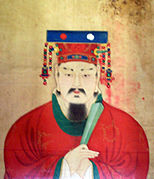 The last king of Silla, King Gyeongsun (r. 927–935)
 -
 A crown from late 5th or early 6th Silla
 -
 The Bell of King Seongdeok was cast in 771 AD.
 -

-
 This standing statue of the Bhaisajyaguru Buddha is made of gilt bronze, made in the Silla period.


.jpg)
See also
[edit]Notes
[edit]References
[edit]Citations
[edit]- ^ Lee 1984, pp. 83–84.
- ^ 이기동, 1988, 「신라의 성립과 변천」, 「韓國古代史論」, 한길사.
- ^ a b Lee Injae, Owen Miller, Park Jinhoon, Yi Hyun-Hae, 2014, Korean History in Maps, Cambridge University Press, pp. 44–49, 52–60.
- ^ Lee (1991) reviews the writings of more than 15 Arabic geographers on Silla, which most refer to as al-sila or al-shila.
- ^ Lee (1991, p. 26) cites the 10th-century chronicler Mas'udi.
- ^ a b 김호상 (August 1, 2016). 신라시대, 인구조사는 어떻게 하였을까?... 경북신문 (in Korean).
신라의 인구수를 살펴보면, 중국측 기록에 나타나는 3세기 중엽경 진한과 변한의 인구는 25만 명 정도로 추정된다. 신라의 인구수는 '삼국사기'를 보면 668년에 고구려를 정벌하는데 20만 명의 병력을 동원한 사실이 나타난다. 이 20만 명은 군역의 의무를 지닌 정남이 차지하는 비율이 '신라촌락문서'에는 21%에 해당하고 있다. 이를 감안한다면 5배를 곱한 숫자 100만이 인구였음을 추정해 볼 수 있다.
- ^ 박용운 (1996). 고려시대 개경연구 147~156쪽.
- ^ Man'yōshū (Book 15): A New Translation Containing the Original Text, Kana Transliteration, Romanization, Glossing and Commentary. Global Oriental. August 2009. ISBN 978-900421299-2.
- ^ 57 BCE according to the Samguk sagi; however Seth 2010 notes that "these dates are dutifully given in many textbooks and published materials in Korea today, but their basis is in myth; only Koguryeo may be traced back to a time period that is anywhere near its legendary founding."
- ^ Chosun Education (2016). "[ 기획 ] 역사로 살펴본 한반도 인구 추이".
- ^ 임금, Wiktionary, the free dictionary, 2023-08-04, retrieved 2023-12-14
- ^ 마립간, Wiktionary, the free dictionary, 2023-10-08, retrieved 2023-12-14
- ^ 사단법인 신라문화진흥원 – 신라의 역사와 문화. Archived from the original on 2008-03-21. Retrieved 2008-03-08. Retrieved on 2008-03-08
- ^ a b 신라(新羅). Encyclopedia of Korean Culture. Retrieved 2023-02-04.
- ^ Kang Junyoung and Yoo Byungjae (Feb 2023), "A Study on the Origin of the Name of Korea (Solongos) in Mongolia." Mongol Studies (몽골학) No. 72, pp. 117~148. https://www.kci.go.kr/kciportal/mobile/ci/sereArticleSearch/ciSereArtiView.kci?sereArticleSearchBean.artiId=ART002937650
- ^ 三國史記 1-1 脫解(Talhae) 尼師今 : 九年 春三月 王夜聞 金城西始林樹間 有鷄鳴聲 遲明遣瓠公視之 有金色小櫝 掛樹枝 白雞鳴於其下 瓠公還告 王使人取櫝開之 有小男兒在其中 姿容奇偉 上喜謂左右曰 此豈非天遺我以令胤乎 乃收養之 及長聰明多智略 乃名閼智 以其出於金櫝 姓金氏 改始林名雞林 因以爲國號 In the spring of nine years, in March, the king heard a rooster crow in the forest of Sirim (始林) west of capital at night. sent Hogong to take a look, and a small golden chestnut was hanging on a branch, and a white rooster was crying underneath it. brought a box and opened it, and there was a small boy in it, and his figure and appearance were strange and big. The king was delighted and said "Heaven has given me a precious son" and raised. As he grew up, he was intelligent and resourceful. The family name was Kim (金) because it came from cashbox (金櫃), and the name was changed to Gyerim (鷄林) and it was named after changing the name of Sirim (始林).
- ^ a b 사로국(斯盧國) ─ The State of Saro. Archived from the original on 2021-02-13. Retrieved 2021-11-16.
- ^ a b Samguk-sagi Silla, Park Hyeokgeose Chapter 1 (三國史記 新羅本記 朴赫居世 1) : "...新羅始祖元年 漢宣帝五鳳元年 夏四月丙辰始祖朴赫居世立先是朝鮮遺民分居東海濱山谷爲六村曰閼川楊山曰突山高墟曰觜山珎支曰茂山大樹曰金山加里曰明活山高耶是爲辰韓六部..." Translation: In the year of Byeongjin, the founder Park Hyeokgeose has ascended to the throne. Preceding this, were the dispersed people of Gojoseon scattered upon six villages across the eastern shores and mountain ridges; the Alcheon-yangsan, Dolsan-goheo, Jasan-Jinji, Musan-Daesu, Geumsan-gari, and the Myeonghwalsan-Goya. These villages have come to become the Six Tribes of Jinhan.
- ^ a b c 김, 운회 (2005-08-30). 김운회의 '대쥬신을 찾아서' <23> 금관의 나라, 신라. Pressian. Archived from the original on 2012-01-26. Retrieved 2016-09-25.
- ^ a b c 경주 사천왕사(寺) 사천왕상(四天王像) 왜 4개가 아니라 3개일까 (in Korean). The Chosun Ilbo. 2009-02-27. Archived from the original on 2014-12-30. Retrieved 2016-09-25.
- ^ a b Cho Gab-je (5 March 2004). 騎馬흉노국가 新羅 연구 趙甲濟(月刊朝鮮 편집장)의 심층취재 내 몸속을 흐르는 흉노의 피 (in Korean). Monthly Chosun. Archived from the original on 2012-01-19. Retrieved 2016-09-25.
- ^ 김창호, 〈문무왕릉비에 보이는 신라인의 조상인식 – 태조성한의 첨보 -〉, 《한국사연구》, 한국사연구회, 1986년
- ^ 자료검색>상세_기사. National Library of Korea. Archived from the original on 2018-10-02. Retrieved 2019-04-15.
- ^ 「제목=고구려와 흉노의 친연성에 관한 연구|저널=백산학보」「백산학보 제67호」
- ^ 김, 대성. <이색보고> 金家 뿌리 탐사, 흉노왕의 후손 김일제 유적을 찾아서. 신동아. Archived from the original on 2016-09-13. Retrieved 2016-09-25.
- ^ 이종호「한국 7대 불가사의」、역사의아침、2007、p108
- ^ "Nihon Shoki", Encyclopedic Dictionary of Archaeology, Cham: Springer International Publishing, pp. 935–936, 2021, doi:10.1007/978-3-030-58292-0_140217, ISBN 978-3-030-58291-3
- ^ The Kojiki : an account of ancient matters. Gustav Heldt, Yasumaro Ō, Lisa Hamm. New York. 2014. ISBN 978-0-231-53812-1. OCLC 899002167.
{{cite book}}: CS1 maint: location missing publisher (link) CS1 maint: others (link) - ^ Shigeno, Kume, Hoshino. Kōhon kokushi gan (in Japanese). Tokyo: Shigakkai.
{{cite book}}: CS1 maint: multiple names: authors list (link) - ^ Weiss, David (2022). The god Susanoo and Korea in Japan's cultural memory : ancient myths and modern empire. London, United Kingdom. ISBN 978-1-350-27118-0. OCLC 1249629533.
{{cite book}}: CS1 maint: location missing publisher (link) - ^ Empire of Japan, Department of Education, History of the Empire of Japan (Tokyo, 1893) p. 38
- ^ 고조선의 주민과 예맥 (The People of Gojoseon and Yemaek). Archived from the original on 2021-11-22. Retrieved 2021-11-22.
- ^ 「예맥(濊貊)의 형성과정과 고조선」(박준형, 「학림」 22, 2001)
- ^ 신라 유리왕 14년, 고구려 대무신왕 20년, 백제 다루왕 10년, 정유년(丁酉年), 37년. terms.naver.com (in Korean). Archived from the original on 2021-11-16. Retrieved 2021-11-16.
- ^ 탈해 이사금. Naver Encyclopedia. Archived from the original on 2022-04-17. Retrieved 2021-07-31.
- ^ 파사 이사금. Naver Encyclopedia. Archived from the original on 2022-04-17. Retrieved 2021-07-31.
- ^ "浦上八國 亂". Naver Encyclopedia. Archived from the original on 2022-04-17. Retrieved 2021-07-31.
- ^ 내해 이사금. Naver Encyclopedia. Archived from the original on 2022-04-17. Retrieved 2021-07-31.
- ^ Allen, Chizuko T. (2003). "Prince Misahun: Silla's Hostage to Wa from the Late Fourth Century". Korean Studies. 27: 1–15. doi:10.1353/ks.2005.0002. S2CID 162712215. Archived (PDF) from the original on 2016-03-04. Retrieved 2022-04-17.
- ^ Encyclopedia of World History, Vol II, P371 Silla Dynasty, Edited by Marsha E. Ackermann, Michael J. Schroeder, Janice J. Terry, Jiu-Hwa Lo Upshur, Mark F. Whitters, ISBN 978-0-8160-6386-4
- ^ Schultz, Edward (June 1, 2000). Generals and Scholars: Military Rule in Medieval Korea. Honolulu, Hawaii: University of Hawaii Press. p. 115.
- ^ "전인식 시인의 경주인문학산 책". 경주신문. April 20, 2023. Retrieved 5 November 2024.
- ^ 성골 [聖骨]. Empas Encyclopedia. Archived from the original on 2008-06-20. Retrieved 2006-08-29.
- ^ a b Holcombe, Charles (2017). A History of East Asia (2nd ed.). West Nyack: Cambridge University Press. ISBN 978-1-316-34035-6.
- ^ "The Bone Ranks and Hwabaek". Archived from the original on 2017-06-19. Retrieved 2010-12-20.
- ^ 구진천(仇珍川). Encyclopedia of Korean Culture. Archived from the original on 2021-07-16. Retrieved 2021-07-16.
- ^ 비금서당(緋衿誓幢). Encyclopedia of Korean Culture. Archived from the original on 2022-04-17. Retrieved 2021-07-16.
- ^ 구서당 (九誓幢). Encyclopedia of Korean Culture. Archived from the original on 2021-12-07. Retrieved 2021-07-16.
- ^ 시득 (施得). Encyclopedia of Korean Culture. Archived from the original on 2021-07-16. Retrieved 2021-07-16.
- ^ 매일신문. 6 March 2008. Archived from the original on 2016-11-21. Retrieved 2008-03-08.
- ^ 하회마을·양동마을 세계문화유산 추진
- ^ Connor p. 268
- ^ Han, In-Sung Kim (2016). Islamic Material Culture in Medieval Korea and Its Legacy (PDF) (PhD thesis). University of London.
- ^ a b c d e Lee, Kidong. "The Indigenous Religions of Silla: Their Diversity and Durability." Korean Studies, vol. 28, 2004, pp. 49–74. JSTOR 23720182. Accessed 13 Jan. 2023.
- ^ Lee, Kidong (2004). "The Indigenous Religions of Silla: Their Diversity and Durability". Korean Studies. 28. University of Hawai'i Press: 49–74. ISSN 0145-840X. JSTOR 23720182.
- ^ 우리역사넷. contents.history.go.kr. Retrieved 2023-01-13.
- ^ Park, Jin Y. article "Buddhism in Korea" in Keown and Prebish 2010 : 449.
- ^ Buddhism of Silla 사단법인 신라문화진흥원 – 신라의 역사와 문화. Archived from the original on 2008-03-21. Retrieved 2008-03-08.
- ^ "Malananta bring Buddhism to Baekje" in Samguk Yusa III, Ha & Mintz translation, pp. 178–179.
- ^ Kim, Won-yong (1960), "An Early Gilt-bronze Seated Buddha from Seoul", Artibus Asiae, 23 (1): 67–71, doi:10.2307/3248029, JSTOR 3248029, pg. 71
- ^ 삼국시대의 한국불교 – 한국의 불교 – 디지털한국학. Archived from the original on 2008-04-30. Retrieved 2008-03-08. Retrieved on 2008-03-08
- ^ 경주 황룡사지 (慶州 皇龍寺址). Cultural Heritage Administration National Heritage Portal. Archived from the original on 2021-07-16. Retrieved 2021-07-16.
- ^ 석굴암과 불국사. UNESCO Heritage Korea. Archived from the original on 2021-07-16. Retrieved 2021-07-16.
- ^ 호국신앙 (護國信仰). Encyclopedia of Korean Culture. Archived from the original on 2021-07-16. Retrieved 2021-07-16.
- ^ Birmingham Museum of Art (2010). Birmingham Museum of Art : guide to the collection. [Birmingham, Ala]: Birmingham Museum of Art. p. 34. ISBN 978-1-904832-77-5. Archived from the original on 1998-05-14. Retrieved 2022-04-17.
- ^ "1,500 Years of Contact between Korea and the Middle East". Middle East Institute. Archived from the original on 2017-03-19. Retrieved 2017-04-13.
- ^ "Cultural ties put Iran, S Korea closer than ever for cooperation". Tehran Times. 2016-05-05. Archived from the original on 2017-04-13. Retrieved 2017-04-13.
- ^ 로마제국에서 제작되어 삼국시대 우리나라에 유입된 유리제품. 로마유리. (in Korean).
Sources
[edit]- Connor, Mary E. (2009). The Koreas. ABC-CLIO, LLC.
- Keown, Damien; Prebish, Charles S., eds. (2010). Encyclopedia of Buddhism. New York: Routledge. ISBN 978-0-203-49875-0.
- Lee, Ki-baik (1984), A New History of Korea, translated by Wagner, Edward W.; Schultz, Edward J., Harvard University Press, ISBN 9780674615762
External links
[edit]

Silla
View on GrokipediaName and Etymology
Etymology of "Silla"
The name "Silla" derives from the indigenous designation of its core polity and capital, initially known as Saro (사로) in early records, which referred to the leading tribal state within the confederation founded around 57 BCE. This term evolved into Seorabeol (서라벌) in Old Korean, denoting "capital city" or "royal capital," with seo likely signifying "capital" or "head" and beol indicating a large settlement or field.[10][11] The kingdom adopted the Sino-Korean reading Silla (新羅) using Chinese characters during the 4th century CE amid diplomatic contacts with the Chinese Eastern Jin dynasty, where 新 (sin) means "new" and 羅 (ra) evokes "net" or "gauze," though these do not reflect the native semantic content and served primarily as phonetic approximations.[10] This renaming from Saro-guk ("State of Saro") to Silla occurred under King Naehoe (r. 356–402 CE), marking a shift toward centralized identity and external recognition.[11] Later Middle Korean forms of the capital's name, such as Syeobeul (셔블), persisted into the Goryeo period, underscoring the enduring association of "Silla" with its southeastern stronghold at modern Gyeongju.[11] Folk interpretations linking 新羅 to "new kingdom" or Buddhist precepts like śīla (precepts) lack primary evidentiary support and appear anachronistic relative to archaeological and textual records from the Three Kingdoms era.Historical designations and self-perception
Silla originated as Saro-guk (斯盧國), a designation appearing in early Chinese records such as the Book of Liang (chapter 54), reflecting its roots in the Jinhan confederacy of southeastern proto-Korean states.[12] This name referred to a walled city-state centered in the Gyeongju basin, comprising a confederation of six villages or eumnak (townships) that formed the core of early Silla society.[13] By the 3rd century CE, variants like Sinro (新盧) emerged in records, indicating an evolving polity amid consolidation and contact with northern Chinese dynasties.[12] The transition to Silla (新羅) solidified in the 4th–5th centuries, with the name first attested in Chinese annals like the Spring and Autumn Annals of the Sixteen Kingdoms (367–371 CE), possibly denoting "new Saro" or a shift toward centralized identity distinct from its Jinhan origins.[12] Internally, Silla adopted this designation officially by 503 CE under King Jijeung, who interpreted 新羅 as symbolizing "new virtuous rule shall prevail over the country," marking a deliberate rebranding to emphasize royal authority and expansion beyond the Saro core.[13] Alternative internal references included Seorabeol (徐羅伐) for the kingdom and Saro retained for the capital region, distinguishing local from national scope.[13] Rulers used indigenous titles like geoseogan, nisageum, and maripgan (from the 380s CE onward), with the latter translated as Ruhan (樓寒) in a 382 CE embassy to the Eastern Jin, reflecting a blend of native hierarchy and Sinic diplomatic norms.[12] In diplomatic records, Silla designated itself as Silla-guk (新羅國), aligning with the Sinocentric tributary system by the 7th century, where kings addressed Tang emperors as "vassal servants" (fan chen, 藩臣) in memorials, acknowledging Tang suzerainty while asserting internal sovereignty.[14] This perception positioned Silla as a legitimate kingdom within East Asia's hierarchical order, subordinate to Tang but suzerain over peripheral states like Tamna (Cheju Island) and early Parhae entities, to which it installed rulers and exacted tribute.[14] Post-unification in 676 CE under King Munmu, Silla viewed itself as the unifier of the Three Han (Iltong Samhan), inheriting the legacies of Baekje and Goguryeo territories, as proclaimed in King Sinmun's 686 CE stele, though it rejected northern Balhae as barbarian interlopers.[13] Silla's self-perception emphasized divine and cosmological legitimacy, with kings claiming Chakravartin (universal wheel-turning monarch) status via Buddhist integration from the 6th century, linking royal lineage to figures like Buddha's father and portraying Gyeongju as a sacred "Land of Buddha."[13] The bone-rank system (golpumje) reinforced an aristocratic identity centered on jingol (true bone) nobility from the capital, viewing the kingdom as a hierarchical order of noble descent traceable to legendary founder Hyeokgeose (r. 57 BCE–4 CE), whose egg-born origin underscored mythic purity.[13] This insular elite perception, combined with Confucian and Tang influences, fostered a centralized monarchy that prioritized Geumseong (capital) aristocracy, contributing to regional tensions in later centuries but sustaining Silla's image as a cultured, enduring polity until its 935 CE submission to Goryeo.[13]Origins and Early Development
Legendary founding and tribal confederation
According to the Samguk Sagi, a historical chronicle compiled in 1145 CE by Kim Busik, Silla's founding is attributed to 57 BCE, when Hyeokgeose (박혁거세; r. 57 BCE–4 CE), of the Bak (Park) clan, was selected as the first ruler of the Saro-guk statelet. The legend recounts that chiefs from six villages gathered to choose a leader amid regional instability. At a pond in Goheo village, a white rooster crowed three times, prompting a large egg to emerge from the water. The egg hatched into an infant boy who, within days, grew to a height of six cheok (approximately 1.8 meters) and displayed prodigious wisdom and strength, leading the villagers to acclaim him king under the title Geoseogan.[1][15] Hyeokgeose's consort, Lady Alyeong, features in a parallel miraculous tale: born from a bamboo staff or hair-washing ritual at a stream, she married the king and bore sons who perpetuated the lineage. This union symbolized the consolidation of the six villages—centered around modern Gyeongju (ancient Seorabeol)—into a tribal confederation, transitioning Saro-guk from a loose alliance of clans within the Jinhan federation (one of the Samhan proto-states) to a nascent kingdom with a fortified capital. The villages, including Geureuk, Gyerim, Goguk, Jinhwa, and Daema, represented distinct tribal groups, primarily of the Bak, Seok, and emerging Kim clans, whose leaders provided administrative and military support.[16][17] These myths emphasize divine sanction for monarchy and clan unity, but scholarly examination indicates they likely crystallized in the late Silla period (8th–9th centuries CE) or later, during efforts to retroactively legitimize the Pak dynasty amid political fragmentation, rather than documenting verifiable events. The Samguk Sagi itself draws on earlier oral traditions and court records, yet incorporates anachronistic elements, such as post-hoc genealogies linking rulers to heavenly origins, reflecting causal incentives for ideological cohesion in a confederative structure prone to rivalries among the bone-rank aristocracy.[18]Archaeological evidence of proto-Silla settlements
Archaeological excavations in the Gyeongju basin reveal continuous human occupation from the Neolithic period, with Bronze Age (c. 1000–400 BCE) dolmen tombs providing the earliest evidence of structured settlements in the proto-Silla core region.[19] These megalithic structures, numbering in the hundreds across Gyeongsang province, indicate semi-permanent agricultural communities reliant on dry-field farming of millet and barley, supplemented by hunting and gathering, as inferred from associated pottery shards and faunal remains.[20] The transition to the late Mumun pottery period (c. 550–300 BCE) marks increased settlement nucleation and defensiveness in southern Korea, including Gyeongsang-do, where hilltop fortifications and enlarged villages signal emerging social stratification and resource competition.[21] Pithouse clusters at sites like those along the Nam River exhibit storage pits for surplus grains, evidencing intensified agriculture and craft specialization in bronze tools, which supported population growth to several hundred per settlement.[22] In the subsequent Proto-Three Kingdoms period (c. 300 BCE–300 CE), proto-Silla settlements evolved into chiefdom centers around the Gyeongju area, characterized by iron smelting furnaces, raised-floor buildings, and jar-coffin burials containing early iron implements and ornaments.[23] These developments, observed in the southeastern peninsula's riverine basins, reflect technological shifts enabling larger polities, such as the legendary Saro confederacy of six to twelve villages, through improved plowing and warfare capabilities.[24] Grave goods from this era, including comb-patterned pottery derivatives and horse gear, underscore causal links between iron adoption, mobility, and hierarchical organization predating Silla's nominal founding in 57 BCE.[25]Historical Evolution
Early Silla and bone-rank system establishment (57 BCE–4th century CE)
Traditional Korean historical records, such as the Samguk Sagi, date the founding of Silla to 57 BCE with the ascension of Hyeokgeose (r. 57 BCE–4 CE) of the Park clan, who legendarily emerged from a divine egg laid by a rooster atop a sacred mountain and united six village chieftains into a confederation centered at Saro-guk near modern Gyeongju. [26] [1] These accounts portray early Silla as a loose alliance of tribal groups in the southeastern Korean Peninsula, with Hyeokgeose establishing basic governance through clan-based leadership and rituals tied to animistic beliefs. [10] However, modern historiography views these dates as semi-legendary, with archaeological evidence indicating proto-Silla settlements, including dolmen tombs and bronze artifacts, emerging around the 1st century BCE but coalescing into a more defined polity only by the 2nd–3rd centuries CE. [2] Succession among early rulers rotated among the Park, Seok, and Kim clans, reflecting an aristocratic structure where kingship was confined to elite lineages. Notable early monarchs include Yuri Isageum of the Park clan (r. ca. 24–57 CE), credited with introducing wet-rice agriculture and fortifying settlements; Talhae Isageum of the Seok clan (r. ca. 57–80 CE), who expanded territory through alliances; and Pyeongwon Isageum of the Seok clan (r. ca. 80–137 CE), under whom conflicts with neighboring Mahan tribes intensified. [16] By the 3rd–4th centuries CE, rulers like Naemul Maripgan (r. 356–402 CE) marked a transition to more verifiable history, adopting the title "maripgan" (roughly "highest chieftain") and forging ties with northern powers like Goguryeo amid pressures from migrant groups and internal consolidation. [2] [26] This era saw the development of walled towns, iron tools, and pottery styles distinct from Baekje and Gaya, evidenced by excavations at sites like Ulleung-ri yielding comb-patterned pottery dated to 100–300 CE. [10] The bone-rank system (golpum-je), a hereditary hierarchy dividing society into "sacred bone" (seonggol) elites from the royal founding lineages and "true bone" (jingol) nobility from secondary aristocratic clans, originated in this formative period as a mechanism to preserve power among the six original tribes and their descendants. [27] While fully rigidified in the 5th–6th centuries, its empirical basis lay in early clan endogamy and tomb gradations, where sacred bone tombs featured larger mound sizes and richer grave goods like gold ornaments, as inferred from differential burial practices in Gyeongju basin sites from the 3rd–4th centuries CE. [28] [29] This system enforced patrilineal inheritance, barring lower ranks from kingship or high office and limiting social mobility to ritual and merit-based roles within clans, thereby stabilizing rule amid tribal rivalries but entrenching inequalities verifiable through isotopic analyses of skeletal remains showing dietary disparities between elite and commoner burials. [30] [31] Early Silla's reliance on this structure facilitated survival against larger neighbors, prioritizing lineage loyalty over broader conscription until later expansions. [32]Expansion, Hwarang warriors, and centralization (4th–6th centuries CE)
During the 4th and early 5th centuries, Silla under kings such as Naemul (r. 356–402 CE) and later rulers began consolidating control over southeastern chiefdoms through military campaigns and alliances, laying groundwork for territorial growth amid competition with Baekje and Gaya.[13] King Jijeung (r. 500–514 CE) advanced expansion by subjugating portions of the Gaya confederacy and implementing agricultural innovations like ox-drawn plows and irrigation systems to sustain a larger population and army.[17] King Beopheung (r. 514–540 CE) furthered centralization by officially adopting Buddhism in 527 CE, promulgating a legal code to standardize governance, and instituting regulations for official attire to symbolize hierarchical order, thereby reinforcing monarchical authority over aristocratic clans.[33] These reforms shifted Silla toward a more unified state structure, reducing reliance on tribal confederation models prevalent in earlier periods.[13] Under King Jinheung (r. 540–576 CE), Silla achieved significant expansion, defeating Baekje forces in 554 CE and conquering the Daegaya polity in 562 CE, which incorporated iron-rich regions and effectively dismantled the Gaya confederacy, nearly doubling Silla's territory to encompass much of the southern peninsula.[34] [35] To support these conquests, Jinheung established the Hwarang in 576 CE, an elite cadre of adolescent noble youths selected from true-bone rank families, trained rigorously in horsemanship, archery, swordsmanship, and Confucian ethics to foster loyalty and martial prowess as a specialized vanguard force.[36] The Hwarang's role extended beyond combat to cultural and moral indoctrination, blending indigenous shamanistic traditions with imported Buddhist and continental influences to cultivate a warrior ethos aligned with royal centralization.[37] These intertwined developments—territorial gains, institutional reforms, and the Hwarang's emergence—marked Silla's transition from a regional polity to a centralized kingdom capable of challenging larger rivals, evidenced by enhanced administrative capacity and military effectiveness documented in contemporary records and archaeological finds of expanded fortifications and weaponry.[7]Wars of unification with Baekje and Goguryeo (660–668 CE)
Under King Muyeol (r. 654–661 CE), Silla pursued unification of the Korean peninsula by forging a military alliance with the Tang dynasty, seeking external support after decades of stalemated conflicts with Baekje and Goguryeo.[2] The alliance, formalized with Tang Emperor Gaozong, targeted Baekje first to disrupt the defensive pact between Baekje and Goguryeo, enabling a divide-and-conquer approach grounded in Silla's strategic necessities rather than ideological alignment.[38] This partnership leveraged Tang's naval and manpower superiority alongside Silla's local knowledge and Hwarang-trained forces, reflecting pragmatic realism amid Silla's bone-rank system's emphasis on martial aristocracy.[39] In 660 CE, Tang dispatched approximately 130,000 troops under General Su Dingfang, who landed at the mouth of the Geum River, while Silla mobilized around 50,000 soldiers led by General Kim Yu-sin to converge on Baekje's heartland.[2] The decisive engagement occurred at the Battle of Hwangsanbeol, where Baekje's General Gyebaek commanded 5,000 elite "Flower Troops" in a desperate stand; outnumbered and outmaneuvered, Gyebaek's forces were annihilated, with the general himself perishing in combat, as Baekje's fortifications proved insufficient against the allied onslaught.[40] This victory opened the path to Baekje's capital at Sabi (modern Buyeo), which fell in July 660 CE, compelling King Uija to surrender and marking Baekje's effective collapse after 678 years of existence.[41] Kim Yu-sin's tactical acumen, honed through prior campaigns, was pivotal in coordinating Silla's infantry assaults with Tang logistics, though brief Baekje revival attempts under figures like Zenkang were swiftly quelled by joint forces.[39] With Baekje subdued, Silla redirected efforts toward Goguryeo, whose northern defenses had already been strained by Tang incursions since 645 CE under the late Yeon Gaesomun's regime.[42] The death of Yeon Gaesomun in 666 CE precipitated internal divisions in Goguryeo, allowing Tang to launch a renewed offensive in 667 CE, bolstered by Silla contingents that secured southern territories and disrupted Goguryeo supply lines.[7] By early 668 CE, allied forces encircled Pyongyang, Goguryeo's capital; after prolonged siege warfare exploiting Goguryeo's depleted resources, the city capitulated, leading to the capture of King Bojang and the kingdom's dissolution after over 700 years.[43] Silla's contributions included auxiliary troops and control of former Baekje lands to prevent Goguryeo reinforcements, ensuring the campaign's success through coordinated pressure rather than unilateral dominance.[26] These conquests, culminating in 668 CE, established the framework for Unified Silla, though they hinged on Tang's overwhelming numbers amid Goguryeo's logistical overextension from prior Sui and Tang wars.[44]Unified Silla era and internal consolidation (668–780 CE)
Following the conquest of Goguryeo in 668 CE, King Munmu (r. 661–681) oversaw the initial unification of the southern and central Korean peninsula, leveraging the prior defeat of Baekje in 660 CE through a Silla-Tang alliance. Munmu's administration emphasized centralization, suppressing internal revolts such as the Kim Heumdol Rebellion in 681 CE and promoting Buddhism to unify diverse subjects. However, Tang ambitions prompted the Silla–Tang War (670–676 CE), in which Silla forces expelled Tang garrisons south of the Han River, establishing de facto independence while maintaining tributary relations.[13][2] King Sinmun (r. 681–692) pursued administrative consolidation by founding the National Confucian College in 682 CE to inculcate loyalty among officials via Confucian education and implementing grain salaries for bureaucrats in 689 CE to reduce aristocratic dependence on land revenues. In 685 CE, he reorganized the territory into nine provinces under Jipsabu oversight, enhancing royal control over local governors, though an attempt to relocate the capital to Dalgubeol failed due to logistical challenges. These measures coexisted with the entrenched bone-rank (golpum) system, a hereditary hierarchy dividing society into sacred bone (royal lineage), true bone (high aristocracy eligible for kingship), and six head ranks for commoners, which restricted merit-based advancement and integration of non-Silla elites from conquered territories.[45][13][46] Successive rulers faced monarchical weakening amid aristocratic influence. King Hyoso (r. 692–702) presided over declining royal power, while King Seongdeok (r. 702–737) navigated prosperity interspersed with natural disasters, conducting 45 tributary missions to Tang for diplomatic stability and constructing northern aqueducts in 721 CE for defense against emerging threats like Balhae. King Gyeongdeok (r. 742–765) revived the nogeup land allocation system in 757 CE to sustain elite loyalty and experimented with Tang-inspired bureaucratic reforms in 759 CE, which were partially reversed by 776 CE due to resistance from bone-rank aristocrats. Economic stability derived from intensified agriculture using iron tools and ox plowing, supplemented by Silk Road trade exporting silk, horses, and metals while importing glassware and luxuries, with Gyeongju's population swelling to approximately 1 million.[13][8][2] Cultural consolidation reinforced ideological unity through state-sponsored Buddhism, yielding achievements like the casting of the Emille Bell (Sacred Bell of King Seongdeok) in 771 CE, a 12-meter bronze masterpiece exemplifying advanced metallurgy, and the development of woodblock printing by 751 CE. Temples such as Bulguksa (founded 751 CE) and the nearby Seokguram Grotto served both religious and administrative functions, doubling as economic hubs.[13][8] King Hyegong (r. 765–780), the last direct descendant of founder King Muyeol, encountered escalating factionalism, marked by rebellions like Daegong's in 768 CE, culminating in his assassination in 780 CE by aristocrats Kim Yangsang and Kim Gyeongsin. This event underscored the bone-rank system's causal role in perpetuating elite rivalries, as true bone families monopolized power, impeding broader societal cohesion despite administrative innovations. Tang reconciliation under Seongdeok facilitated cultural exchanges, including scholarly missions that imported administrative knowledge, yet Silla's refusal to fully emulate Tang's meritocracy preserved aristocratic dominance, sowing seeds of later fragmentation.[13][46][8]Decline, rebellions, and fall (780–935 CE)
Unified Silla's decline accelerated after 780 CE amid intense political turmoil, including the assassination of King Hyegong (r. 765–780), which exposed fractures in the monarchy and aristocracy.[47] The rigid golpum (bone-rank) system exacerbated tensions by limiting social mobility, fostering resentment among lower aristocrats and peasants burdened by heavy taxation to support Buddhist institutions and royal extravagance.[48] Central authority weakened as local governors (songju) amassed autonomous power, undermining royal control over provinces.[48] By the late 9th century, these pressures ignited widespread rebellions, initiating the Later Three Kingdoms period (c. 889–935 CE). In 892 CE, Gyeon Hwon, rising from peasant origins as a rebel leader, founded Later Baekje in the southwest, capitalizing on discontent in former Baekje territories.[48] Similarly, in 901 CE, Gung Ye, a former monk of possible royal Silla descent, established Later Goguryeo (also known as Taebong) in the north, drawing on Buddhist ideology and aristocratic support to challenge Silla's legitimacy.[48] These uprisings fragmented Silla's territory, confining it to the southeastern heartland around Gyeongju, while Gyeon Hwon launched assaults, including a 927 CE attack on the capital.[48][49] Gung Ye's regime collapsed in 918 CE when his general Wang Geon (Taejo) overthrew him and founded the Goryeo dynasty, which gradually absorbed rival states.[48] Silla's final monarch, King Gyeongsun (r. 927–935), faced mounting threats from Goryeo and Later Baekje; in 935 CE, recognizing the futility of resistance, he surrendered to Taejo, formally ending Silla after nearly a millennium.[49] Later Baekje submitted in 936 CE, completing Goryeo's unification.[49] This fall stemmed causally from systemic rigidities and fiscal overreach, rather than external conquest alone, as internal rebellions eroded the state's cohesion.Government and Society
Monarchical structure and aristocracy
Silla's government was organized around a hereditary monarchy, with kings selected from elite clans such as the Pak, Seok, and Kim lineages.[27] The title of king (wang) was formally adopted during the reign of King Beopheung (r. 514–540 CE), marking a transition from earlier chieftain-like rulership to a more centralized kingship around 520 CE.[27] Succession was initially restricted to the sacred bone (seonggol) rank, the highest stratum comprising royal descendants, ensuring dynastic continuity but limiting candidates to a narrow pool.[27] This sacred bone category was abolished in the mid-7th century, allowing true bone (jingol) aristocrats to ascend the throne, which broadened eligibility while intensifying factional competition among noble clans.[27] The aristocracy, stratified by the bone-rank system (golpum), formed the backbone of Silla's power structure, with true bone nobles monopolizing high civil and military offices.[46] Established formally in the 6th century, this hereditary hierarchy divided society into sacred/true bone elites and six head ranks (tupum), dictating access to positions, marriage alliances, and even attire.[46] True bone aristocrats, often from Kim and Pak clans, advised the king through bodies like the Council of Nobles and held sway over policy, particularly in the Unified Silla period (668–935 CE), where royal authority initially strengthened into absolutism via institutions like the Chancellery (Jipsabu).[44] However, aristocratic landholdings and private armies enabled them to enforce decrees and challenge the throne, as seen in salary and land reversion policies that aimed to curb but ultimately failed to eliminate noble autonomy.[44] In the later phases, from approximately 785 CE onward, true bone factions dominated the monarchy, installing 20 puppet kings amid rebellions and economic strains, as provincial and lower-rank elites were systematically excluded from central power.[50] The system's rigidity, which barred merit-based advancement—exemplified by figures like Sŏl Kyedu (d. 621 CE), a head rank six official who sought opportunities abroad due to rank barriers—fostered internal decay by sidelining talent and entrenching clan rivalries.[46] Despite early centralization efforts, the interplay of monarchical heredity and aristocratic privilege perpetuated a governance model vulnerable to factionalism, contributing to Silla's fragmentation by the 9th century.[50]Bone-rank system: empirical basis and rigidities
The bone-rank system (golpum or kolp'um), formalized circa 520 CE during the reign of King Beopheung (r. 514–540 CE), hierarchically stratified Silla's aristocracy according to hereditary descent from royal lineages, primarily the Pak and later Kim clans.[27][28] It delineated sacred bone (seonggol)—restricted to throne eligibility—and true bone (jingol) strata for high nobility, with subordinate head-rank (dup'um) divisions (1–6) governing lesser elites and officials.[28][27] Empirical substantiation emerges from Silla's codified laws and historical annals, which enumerated rank-bound entitlements to attire, dwellings (e.g., ceramic-tiled roofs for superiors), vehicles, and administrative posts, as evidenced in archaeological residues like jade hairpins and elite tomb accoutrements.[27] Excavations of Gyeongju-area burials spanning the 4th–6th centuries CE disclose graded disparities in tomb dimensions, stone-chamber architecture, and artifacts—such as gold diadems and equestrian gear in larger enclosures—mirroring textual delineations of kolp'um privileges and inferring birth-determined status from infancy.[51][52] The system's rigidities enforced patrilineal perpetuity, curtailing inter-rank matrimony (save concubinage by superiors) and confining elevated sinecures to upper golp'um, thereby precluding systemic ascent and perpetuating lineage-based monopolies on authority.[27][28] Social mobility remained negligible, with deviations confined to exceptional royal bestowals or martial exploits, engendering talent stagnation and governance inertia.[27] This inflexibility precipitated the seonggol extinction by mid-7th century CE, prompting King Muyeol's 654 CE edict to legitimize jingol sovereigns, yet persistent inequities incited head-rank 6 insurgencies that eroded central cohesion after 780 CE.[28][31]