
Blue Bayou
View on Wikipedia | This article needs more citations. (September 2016) |
| "Blue Bayou" | ||||
|---|---|---|---|---|
 Side B of the US single | ||||
| Single by Roy Orbison | ||||
| from the album In Dreams | ||||
| B-side | "Mean Woman Blues" | |||
| Released | August 1, 1963 | |||
| Recorded | November 15, 1961[1] | |||
| Studio | RCA Victor Studio B, Nashville | |||
| Genre | Country, folk | |||
| Length | 2:29 | |||
| Label | Monument | |||
| Songwriters |
| |||
| Producer | Fred Foster | |||
| Roy Orbison singles chronology | ||||
| ||||
"Blue Bayou" is a song written by Roy Orbison and Joe Melson. It was originally sung and recorded by Orbison, who had an international hit with his version in 1963. It later became Linda Ronstadt's signature song, with which she scored a top 5 hit with her cover in 1977. Many others have since recorded the song.
Roy Orbison version
[edit]
Background
[edit]"Blue Bayou" was originally recorded by Roy Orbison at the end of 1961. In the UK, it was released by London Monument as the double A-side track with "Mean Woman Blues" on a Monument Records single (HLU 9777), where both sides peaked at number 3. It was issued as a B-side single in the US, peaking at number 29; the A-side, "Mean Woman Blues", peaked at number 5. The song also appeared on Orbison's 1963 full-length album In Dreams. According to the authorised biography of Roy Orbison,[2] a rare different version of "Blue Bayou" was released only in Italy (London 45-HL 1499).[2]
"Blue Bayou" reappeared on his 1989 posthumous album A Black & White Night Live, from the 1988 television special on Cinemax.
Track listings
[edit]7" vinyl
[edit]US: Monument Records 824
Side one
- "Blue Bayou" (Roy Orbison, Joe Melson) – 2:29 – Recorded in late 1961.
Side two
- "Mean Woman Blues" (Claude Demetrius) – 2:23
Chart performance
[edit]Weekly charts
[edit]| Chart (1963) | Peak position |
|---|---|
| Australian Singles Chart | 1 |
| Belgium[3] | 3 |
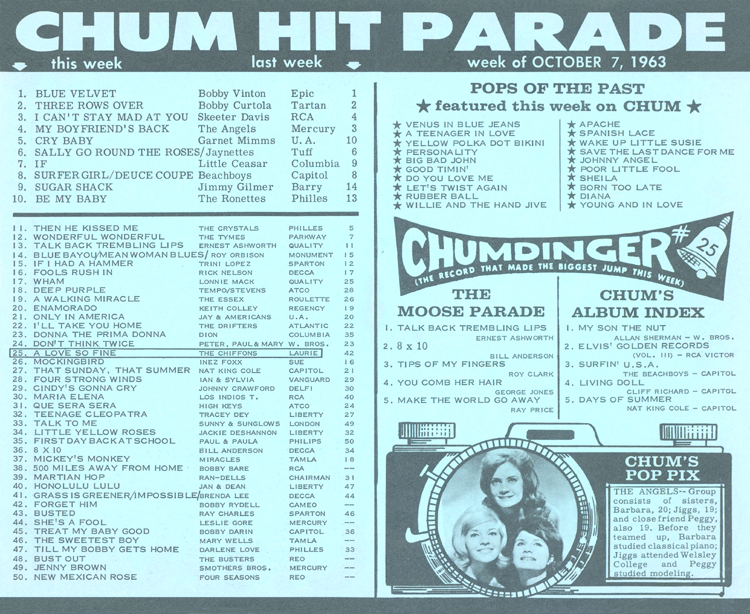
| Canada (CHUM Hit Parade)[4] | 14 |
| Irish Singles Chart[5] | 1 |
| New Zealand (Lever Hit Parade)[6] | 4 |
| Norwegian Singles Chart[3] | 10 |
| UK Singles Chart[7] | 3 |
| US Billboard Hot 100[8] | 29 |
| US Billboard Hot R&B Sides[8] | 26 |
| US Cash Box Top 100[9] | 21 |
Certifications
[edit]| Region | Certification | Certified units/sales |
|---|---|---|
| United Kingdom (BPI)[12] | Silver | 200,000‡ |
|
‡ Sales+streaming figures based on certification alone. | ||
Use in other media
[edit]This song has been used in several motion pictures including:
- The Man Who Fell to Earth (1976), directed by Nicolas Roeg and starring David Bowie
- Last Orders (2001), directed by Fred Schepisi
- Dreamcatcher (2003), directed by Lawrence Kasdan
- Man on Fire (2004), directed by Tony Scott
- American Made (2017), directed by Doug Liman and starring Tom Cruise
- The Best of Enemies (2019), directed by Robin Bissell, and starring Taraji P. Henson and Sam Rockwell
- Blue Bayou (film) (2021), directed by Justin Chon. In the film, the song is sung by actress Alicia Vikander
Jacques Cousteau included an abridged version of the song during a "River Explorations" episode, which details environmental changes on the Mississippi River. This song has also been used in the Netflix digital series, Stranger Things (Season 2, Episode 6). A French language version of the song entitled "Tu n'es plus là" was released in 1963 by French rock and roll singer Dick Rivers.
Linda Ronstadt version
[edit]| "Blue Bayou" | ||||
|---|---|---|---|---|
 Side A of the US 7-inch single | ||||
| Single by Linda Ronstadt | ||||
| from the album Simple Dreams | ||||
| B-side | "Old Paint", "Love Me Tender, "Maybe I'm Right, or "Poor Poor Pitiful Me", depending on the country of release[13] | |||
| Released | August 23, 1977 (US) | |||
| Studio | Sound Factory, Hollywood | |||
| Genre | Country pop, soft rock, yacht rock | |||
| Length | 3:57 | |||
| Label | Asylum | |||
| Songwriters | Roy Orbison, Joe Melson | |||
| Producer | Peter Asher | |||
| Linda Ronstadt singles chronology | ||||
| ||||
| Official video | ||||
| "Blue Bayou" on YouTube | ||||
Background
[edit]
Linda Ronstadt took the song to #3 on the Billboard Hot 100 in late 1977, where it held for four weeks, as well as #2 Country and #3 Easy Listening. It also reached #2, holding there for four weeks, on the Cash Box Top 100 chart.
The single was RIAA certified Gold (for sales of over 1 million US copies) in January 1978. It was the first of Ronstadt's three Gold singles. Don Henley of the Eagles sang backup on the recording.[14] "Blue Bayou" was later certified Platinum (for over 2 million copies sold in the United States). It was a worldwide smash, charting in countries such as Australia, Canada, New Zealand, the United Kingdom, and Mexico, where it topped the singles charts.
Ronstadt's version was nominated for the Grammy Award for Record of the Year and for Best Female Pop Vocal Performance.
Ronstadt also recorded a Spanish-language version of the song (translated by her father, Gilbert Ronstadt), titled "Lago Azul (Blue Bayou)", which was released in 1978 on the single Asylum E-45464, backed by "Lo Siento Mi Vida", a previously released Spanish song that Ronstadt herself co-wrote.[citation needed] This version has never been included on any reissues of Simple Dreams.
Ronstadt later performed the song on episode 523 of The Muppet Show, first aired on October 26, 1980, in the UK, and May 16, 1981, in the United States.
Because of this song, Dickson's Baseball Dictionary records that a "Linda Ronstadt" is a synonym for a fastball, a pitch that "blew by you". That phrase was coined by New York Mets broadcaster Tim McCarver during a Mets telecast in the 1980s.[15]
Ronstadt's version appears, in edited form, in Tony Scott's 2004 film Man on Fire and in the 2017 film American Made.
Track listings
[edit]7" vinyl
[edit]US: Asylum Records E-45431
Side one
- "Blue Bayou" (Roy Orbison, Joe Melson) – 3:57
Side two
- "Old Paint (traditional, arranged by Linda Ronstadt) – 3:05
Chart performance
[edit]Weekly charts
[edit]| Chart (1977) | Peak position |
|---|---|
| Canada RPM Top Singles[16] | 2 |
| Canada Adult Contemporary (RPM)[17] | 2 |
| Canada Country Tracks (RPM)[18] | 2 |
| Mexico (Billboard Hits of the World)[19] | 1 |
| US Billboard Hot 100[20] | 3 |
| US Easy Listening (Billboard)[21] | 3 |
| US Hot Country Songs (Billboard)[22] | 2 |
| US Cash Box Top 100[23] | 2 |
| Chart (1978) | Peak position |
| Australia (Kent Music Report)[24] | 3 |
| New Zealand Singles Chart[25] | 3 |
| UK Singles Chart[7] | 35 |
Certifications
[edit]| Region | Certification | Certified units/sales |
|---|---|---|
| New Zealand (RMNZ)[31] | Platinum | 30,000‡ |
| United States (RIAA)[32] | Platinum | 1,000,000^ |
|
^ Shipments figures based on certification alone. | ||
See also
[edit]References
[edit]- ^ Weize, Richard (2001). Orbison 1955-1965 (7-CD Deluxe Box Set) (booklet). Bear Family Records. BCD16423. Retrieved 2021-10-11.
- ^ a b Orbison, Roy Jr. (2017). The authorized Roy Orbison. Orbison, Wesley, Orbison, Alex, Slate, Jeff (Second ed.). New York: Center Street. p. 249. ISBN 9781478976547. OCLC 1017566749.
- ^ a b "Norwegian Charts". Norwegiancharts.com. Retrieved December 6, 2008.
- ^ http://chumtribute.com/63-03-11-chart.jpg CHUM Hit Parade, October 7, 1963
- ^ "Irish Charts search results for Blue Bayou". Irishcharts.ie. Archived from the original on January 26, 2010. Retrieved December 6, 2008.
- ^ Flavour of New Zealand, 14 November 1963
- ^ a b Roberts, David (2006). British Hit Singles & Albums (19th ed.). London: Guinness World Records Limited. p. 408. ISBN 1-904994-10-5.
- ^ a b "Allmusic – Roy Orbison – Billboard singles". AllMusic. Retrieved December 6, 2008.
- ^ Cash Box Top 100 Singles, October 19, 1963
- ^ [The 100 Best-Selling Singles of 1963 https://archive.today/20160305064644/http://www.austchartbook.com.au/ Top 25 Australian singles for 1963]
- ^ [The 100 Best-Selling Singles of 1963 www.sixtiescity.net/charts/63chart.htm#top100]
- ^ "British single certifications – Roy Orbison – Blue Bayou". British Phonographic Industry. Retrieved November 15, 2025. Select singles in the Formats field. Type Blue Bayou Roy Orbison in the "Search:" field.
- ^ "Blue Bayou by Linda Ronstadt". Wax.fm. Archived from the original on 2017-08-27. Retrieved 2014-05-24.
- ^ "Blue Bayou". Songfacts.com. Retrieved 2009-12-26.
- ^ "'Dickson's Baseball Dictionary' A Labor Of Love". NPR.org. Retrieved 2022-05-08.
- ^ "100 singles" (PDF). RPM. 31 December 1977. Retrieved 30 April 2020.
- ^ "Top RPM Adult Contemporary: Image 5449". RPM. Library and Archives Canada. Retrieved April 28, 2025.
- ^ "Top RPM Country Tracks: Image 5457". RPM. Library and Archives Canada. Retrieved April 28, 2025.
- ^ "Billboard "Hits of the World"" (PDF). 15 April 1978. p. 80. Retrieved 5 December 2022.
- ^ "Linda Ronstadt Chart History (Hot 100)". Billboard. Retrieved April 28, 2025.
- ^ "Linda Ronstadt – Chart History". Billboard. Retrieved 30 April 2020.
- ^ "Linda Ronstadt Chart History (Hot Country Songs)". Billboard. Retrieved April 28, 2025.
- ^ "Cash Box Top 100 12/31/77". Archived from the original on 2015-06-09. Retrieved 2016-12-19.
- ^ "Australian Chart Book". Austchartbook.com.au. Archived from the original on 2016-03-05. Retrieved 2016-09-27.
- ^ "NZ Top 40 Singles Chart | The Official New Zealand Music Chart". Nztop40.co.nz. 1978-02-26. Retrieved 2016-09-27.
- ^ "Kent Music Report No 236 – 1 January 1979 > National Top 100 Singles for 1978". Kent Music Report. Retrieved 8 January 2022 – via Imgur.com.
- ^ Steffen Hung. "Forum – Top 100 End of Year AMR Charts – 1980s (ARIA Charts: Special Occasion Charts)". Australian-charts.com. Archived from the original on 2014-10-06. Retrieved 2016-09-27.
- ^ "Image : RPM Weekly – Library and Archives Canada". Bac-lac.gc.ca. 17 July 2013. Retrieved 2016-09-27.
- ^ "Top 100 Hits of 1978/Top 100 Songs of 1978". Musicoutfitters.com. Retrieved 2016-09-27.
- ^ "Cash Box YE Pop Singles – 1978". Tropicalglen.com. 1978-12-30. Archived from the original on 2018-09-29. Retrieved 2016-09-27.
- ^ "New Zealand single certifications – Linda Ronstadt – Blue Bayou". Radioscope. Retrieved March 19, 2026. Type Blue Bayou in the "Search:" field and press Enter.
- ^ "American single certifications – Linda Ronstadt – Blue Bayou". Recording Industry Association of America.
External links
[edit]



Blue Bayou
View on GrokipediaComposition and origins
Songwriting
"Blue Bayou" was co-written by Roy Orbison and Joe Melson around 1961 during the early sessions for Orbison's material with Monument Records.[1][4] The song's inspiration stemmed from a road trip the collaborators took from Arkansas to Texas, where they first conceived the idea, with Orbison later developing it further; its themes center on longing, homesickness, and melancholy, evoking a nostalgic escape to an idealized Southern U.S. bayou landscape amid personal reflections on travel and emotional isolation.[1] Lyrically, the song follows a verse-chorus structure, featuring poetic imagery such as "Sitting here by the river" to convey unresolved emotional yearning without a definitive narrative arc.[5] Musically, it is composed in the key of F major with a 6/8 waltz time signature, incorporating orchestral influences that blend Orbison's signature rockabilly, pop, and country elements for a fluid, harmonious ballad.[6] Intended as a potential single in Orbison's repertoire, the track emerged from the duo's established collaborative process, where Melson often focused on lyrics and Orbison on melody, building on their successful partnership that produced several of Orbison's early hits.[4]Original recording by Roy Orbison
"Blue Bayou" was first recorded by Roy Orbison on November 15, 1961, at RCA Studio B in Nashville, Tennessee. The session was produced by Fred Foster for Monument Records, capturing Orbison's evocative performance during a prolific period in his career.[7][8] This debut recording emphasized Orbison's distinctive vocal style, blending his rich baritone with soaring falsetto reaches, achieved through innovative multi-tracking techniques common in Nashville productions of the era.[3] The ensemble featured Orbison on lead vocals, supported by elite Nashville session players known as the A-Team. Pianist Floyd Cramer provided the elegant keyboard flourishes, while saxophonist Boots Randolph added subtle, atmospheric tones with his instrument. Backing vocals were delivered by the Anita Kerr Singers, contributing harmonious layers that enhanced the song's melancholic mood. The arrangement incorporated strings for emotional depth, resulting in a compact track lasting 2:29, ideal for radio play.[9] The recording appeared on Orbison's fourth studio album, In Dreams, released in July 1963 by Monument Records, where it served as the eighth track amid a collection of dreamlike ballads. Earlier that year, on August 1, "Blue Bayou" was released as the B-side to the single "Mean Woman Blues," which received primary promotion and overshadowed the ballad initially. Despite its understated debut, the track showcased Orbison's songwriting partnership with Joe Melson, laying the foundation for its enduring appeal.[10]Roy Orbison version
Releases
"Blue Bayou" was originally released by Roy Orbison as the B-side to his single "Mean Woman Blues" on Monument Records, catalog number 45-824, on August 1, 1963.[11] In the United Kingdom, it was issued as a double A-side single with "Mean Woman Blues" by London Records, catalog number HLU 10088.[10] The song was recorded on November 15, 1961, at RCA Studio B in Nashville, Tennessee, during sessions for what became Orbison's fourth studio album. It appeared on the album In Dreams, released by Monument Records on July 18, 1963, as catalog number LP 1080 (mono) / SLP 1080 (stereo), where it served as the eighth track.[12] Subsequent reissues include the 1988 compilation The Essential Roy Orbison by Monument Records / Legacy Recordings, featuring the original mono mix, and digital releases on platforms like Spotify following the 2008 remastered edition of In Dreams by Legacy Recordings. Primary physical formats were 7" vinyl singles and LP albums, with later CD and digital editions.Track listings
The 1963 single release of "Blue Bayou" by Roy Orbison was issued as a 7" vinyl in 45 RPM format by Monument Records (catalog number 45-824 in the US). In the US edition, "Mean Woman Blues" (2:25) was the A-side, with "Blue Bayou" (2:29) as the B-side. The UK double A-side version on London Records (HLU 10088) paired "Blue Bayou" (2:29) and "Mean Woman Blues" (2:25).[10] On the album In Dreams (Monument LP 1080 / SLP 1080, 1963 US vinyl edition), "Blue Bayou" appears as the eighth track out of twelve, with a duration of 2:29 in the original mono mix. The full track order is as follows:| Track | Title | Duration |
|---|---|---|
| 1 | In Dreams | 2:51 |
| 2 | Lonely Wine | 2:57 |
| 3 | Shahdaroba | 2:41 |
| 4 | No One Will Ever Know | 2:30 |
| 5 | Sunset | 2:30 |
| 6 | House Without Windows | 2:20 |
| 7 | Dream | 2:48 |
| 8 | Blue Bayou | 2:29 |
| 9 | (They Call You) Gigolette | 2:59 |
| 10 | All I Have to Do Is Dream | 2:25 |
| 11 | Beautiful Dreamer | 2:37 |
| 12 | My Prayer | 2:47 |
Chart performance
Roy Orbison's version of "Blue Bayou" achieved international success following its 1963 release, particularly outside the US. In the United States, the single peaked at number 29 on the Billboard Hot 100 chart in October 1963, spending 12 weeks on the chart.[13] Internationally, it reached number 3 on the UK Singles Chart (as a double A-side with "Mean Woman Blues"), topped the charts in Australia and Ireland, and peaked at number 1 in New Zealand. The song's performance contributed to the success of the parent album In Dreams, which reached number 35 on the Billboard 200.| Chart (1963) | Peak Position |
|---|---|
| US Billboard Hot 100 | 29 |
| UK Singles (Official Charts Company) | 3 |
| Australia (Kent Music Report) | 1 |
| Ireland (IRMA) | 1 |
| New Zealand (Lever Hit Parade) | 1 |
Linda Ronstadt version
Background and recording
Linda Ronstadt selected "Blue Bayou" for her 1977 album Simple Dreams after songwriter J.D. Souther suggested the track and taught it to her during a late-night session, originally planning it as a duet, though Don Henley provided harmonies when Souther was unavailable.[14] The song, originally written by Roy Orbison and Joe Melson, aligned with Ronstadt's aim to blend rock, country, and Latin elements on the album, drawing inspiration from Orbison's melancholic original while incorporating Mexican ranchera influences reminiscent of singer Lola Beltrán. Ronstadt later recorded a Spanish-language version titled "Lago Azul" with lyrics written by her father.[14] Ronstadt expressed deep admiration for Orbison, noting the song's mix of sorrow and hope as a key factor in its appeal.[14] The recording took place in the summer of 1977 at The Sound Factory in Los Angeles, under the production of Peter Asher, who emphasized live performances with minimal overdubs to capture Ronstadt's stage-like energy.[14][15] Key musicians included Ronstadt on lead vocals, Andrew Gold on acoustic and electric guitar as well as mandolin, Kenny Edwards on bass and background vocals, Waddy Wachtel on guitar, Dan Dugmore on steel guitar, and Don Henley providing harmonies.[16][14][17] Orchestral strings were arranged by David Campbell, featuring violin, viola, cello, and double bass to add emotional depth.[14][18] Production choices highlighted Ronstadt's expansive vocal range through a slower tempo of approximately 95 BPM, allowing for a yearning, ballad-like delivery that extended the track to 3:57 in length.[19][18] Elements like marimba and mandolin infused a subtle Latin flavor, contrasting Orbison's rockabilly original while emphasizing emotional intimacy.[14] This session occurred amid Ronstadt's ascent to superstardom following the success of her 1974 album Heart Like a Wheel, as she transitioned toward broader interpretive versatility.[1]Releases
Linda Ronstadt's version of "Blue Bayou" was first released as a single by Asylum Records in August 1977, with the catalog number E-45431 in the United States; the A-side featured "Blue Bayou" backed by "Old Paint" on the B-side.[20] The single was also issued in Canada under the same Asylum catalog number E-45431, maintaining the vinyl 7" format and track pairing. In the United Kingdom, the single appeared in January 1978 on Asylum Records with catalog number K 13106, pairing "Blue Bayou" with "Maybe I'm Right" on the B-side in the standard 7" vinyl format.[21] The track was included on Ronstadt's eighth studio album, Simple Dreams, released by Asylum Records on September 6, 1977, under catalog number 6E-104, where it served as the sixth track on the LP.[22][23] Subsequent reissues of "Blue Bayou" appeared on the compilation album Greatest Hits, Volume 2, originally released by Asylum Records in October 1980 as a vinyl LP and later reissued in CD format by Elektra in 1990, featuring the song as track four. The track became available in digital formats through streaming services and downloads following the 2017 re-release of Simple Dreams by Rhino Records (40th Anniversary Edition), which included remastered audio and bonus content with the track at 3:59. Primary physical formats for the original releases were 7" vinyl singles and LP albums, with later editions expanding to CD compilations and digital streaming; no significant picture disc variants were produced.[24]Track listings
The 1977 single release of "Blue Bayou" by Linda Ronstadt was issued as a 7" vinyl in 45 RPM format by Asylum Records (catalog number E-45431 in the US and Canada). The A-side featured "Blue Bayou" with a duration of 3:57, while the B-side was "Old Paint" (traditional, arranged by Ronstadt) at 3:05. Regional variants existed, such as the German release pairing "Blue Bayou" (3:57) with "Poor Poor Pitiful Me" (3:42) on Asylum AS 13 095. Other international editions included B-sides like "Love Me Tender" or "Maybe I'm Right" depending on the market.[25] On the album Simple Dreams (Asylum 6E-104, 1977 US vinyl edition), "Blue Bayou" appears as the sixth track out of ten, with a listed duration of 3:57 and a fade-out ending. The full track order is as follows:| Track | Title | Duration |
|---|---|---|
| 1 | It's So Easy | 2:27 |
| 2 | Carmelita | 3:07 |
| 3 | Simple Man, Simple Dream | 3:12 |
| 4 | Sorrow Lives Here | 2:57 |
| 5 | I Never Will Marry | 3:12 |
| 6 | Blue Bayou | 3:57 |
| 7 | Poor Poor Pitiful Me | 3:42 |
| 8 | Maybe I'm Right | 3:05 |
| 9 | Tumbling Dice | 3:05 |
| 10 | Old Paint | 3:05 |
Chart performance
Linda Ronstadt's version of "Blue Bayou" achieved significant commercial success across multiple genres and international markets following its release in August 1977. In the United States, the single peaked at number 3 on the Billboard Hot 100 chart on December 17, 1977, where it held the position for four weeks and remained on the chart for a total of 23 weeks.[27] It also reached number 2 on the Billboard Hot Country Singles chart and number 3 on the Adult Contemporary chart, demonstrating its crossover appeal.[28] For the year-end rankings in 1977, it placed at number 61 on the Billboard Hot 100.[2] Internationally, the single performed strongly as well. It peaked at number 2 on Canada's RPM Top Singles chart, number 3 on Australia's Kent Music Report, and number 1 in Mexico. In the United Kingdom, it reached number 35 on the Official Singles Chart, spending four weeks in the top 40.[29][30] The track's popularity contributed to over 1 million certified sales in the United States, earning it RIAA Gold certification in January 1978. These sales helped propel the parent album Simple Dreams to triple Platinum status by the RIAA, with over 3 million units shipped domestically.[31][16]| Chart (1977) | Peak Position |
|---|---|
| US Billboard Hot 100 | 3 |
| US Billboard Hot Country Singles | 2 |
| US Billboard Adult Contemporary | 3 |
| Canada RPM Top Singles | 2 |
| Australia (Kent Music Report) | 3 |
| Mexico | 1 |
| UK Singles (Official Charts) | 35 |