


Community hub
Recent from talks
Contribute something
Nothing was collected or created yet.
Bogdan Corporation
View on WikipediaBogdan Corporation (Ukrainian: Корпорація «Богдан») is a leading Ukrainian automobile trading and manufacturing group founded by Bogdan Motors. The corporation was famous for its Bogdan public transport brand that used to produce its models in Cherkasy and Lutsk.
Key Information


The production capacities of Bogdan Corporation used to allow making 120-150 thousand passenger cars, up to 9 thousand buses and trolleybuses in all classes, as well as about 15 thousand trucks and specialized vehicles. However, with the bankruptcy of its parent company, the corporation's factories had stopped working in 2020, and Bogdan only does the foreign car distribution.
History
[edit]Bogdan Motors was created in 1993, after the Dissolution of the Soviet Union. Initially, the company was a distributor of various Russian-based vehicles, later selling vehicles by Korean manufacturer, Kia Motors.
In 1998, the company obtained the Cherkasy Automobile Repair Factory that was specializing in repairing buses of the Russian-based Pavlovo Bus Factory and GAZelle. Next year the plant have undergone reconstruction and was transformed into the Cherkasy Autobus that began manufacturing its own buses, Bogdan. That same year, the company signed another contract with Hyundai for distribution of their vehicles.
In 2000, the company bought the bankrupted Soviet LuAZ based in Lutsk (Volyn Oblast), and during the same period, started to produce its own cars based on the Russian AvtoVAZ. In 2003, the company's began exporting the buses.
In 2004, the company signed a general agreement with Isuzu to use the Isuzu brand on the company's exported buses.
In 2005, Bogdan Motors formed a Bogdan Corporation that merged all the previously purchased company. It was decided that the public transport would be assembled in Lutsk and the passenger vehicles would be assembled in Cherkasy.
The 2008 financial crisis caused a big credit load on the corporation and in 2011 the company ended up selling the Cherkasy Autobus to Prominvestbank. The rights to produce the midibus models were left to the factory so Bogdan had to come out with their replacement.
In 2013, Bogdan, in a joint venture with the Polish company Ursus, received an order for 38 trolleybuses for the Lublin, Poland, trolleybus system.[1] The body-and-chassis shells were completed by Bogdan and shipped to an Ursus plant in Lublin, where Ursus would install the axles, electrical equipment, seats and other fittings to complete the vehicles.[1] The first of the 38 Bogdan/Ursus trolleybuses, officially designated as model Ursus T70116, was delivered in mid-2013.[2]
In 2014 the company developed the 'Bars' (panther) multifunctional light armored vehicle to be used by the National Guard of Ukraine.[3]
In 2017 Cherkassy Bogdan Plant transferred to the Armed Forces of Ukraine the first batch of Bogdan-2251 ambulances based on the Chinese Great Wall chassis.[4]
In December 2017, a Bogdan-6317 truck with a Weichal Power engine was allowed for operation in the Armed Forces of Ukraine.[5]
In April 2018, “Bogdan” presented a new multipurpose SUV, “Bogdan 2351”. It should replace the obsolete UAZ. The new car has an engine capacity of 143-horsepower, a higher maximum speed and a carrying capacity of 1000 kg.[citation needed]
In 2018, “Bogdan Motors” agreed on cooperation with the Igor Sikorsky Kyiv Polytechnic Institute. Specialists of “Bohdan” and representatives of the educational institution will jointly develop new technologies and transport. The Science Park "Kyiv Polytechnic" also joined the Agreement. Students of KPI will be able to take industrial practice at “Bogdan Motors”.[6]
In May 2018, “Bogdan” celebrated its 20th anniversary. On the occasion of the holiday, the company organized a large-scale all-Ukrainian action. Residents of the 9 largest cities of Ukraine - Kyiv, Vinnytsia, Khmelnytskyi, Sumy, Odesa, Kremenchuk, Poltava, Kherson, Ivano-Frankivsk - could ride all day in new “Bogdan” large buses and trolley buses free of charge.[7] The campaign covered cities that began upgrading municipal fleet of vehicles and moving from small class buses to modern large and ultra-large transport models. In 20 years, “Bogdan” produced more than 368 thousand vehicles. 18 781 of them are buses and trolleybuses.[8]
In June 2018, "Bogdan" transferred five 12-meter bodies for electric buses to the French manufacturer of ecological transport “Bluebus” under the contract. "Bogdan" shipped the bodies in the period specified by the contract. The French customer highly appreciated the quality of Ukrainian products and expressed interest in continuing cooperation.[9]
In July 2018, Bogdan-Industry LLC, an official importer of GreatWall and HAVAL in Ukraine, opened the first HAVAL official auto show in Ukraine in Kyiv.[10]
Bogdan Corporation presented an updated version of the "Bogdan 2251" ambulance. The new batch of vehicles received more than a dozen improvements.[11]
In August 2018, “Bogdan Corporation” handed over the next batch of “Bogdan 6317” off-road trucks to the army.[12] This year the company plans to transfer more than 200 units of such equipment.
“Bogdan Corporation” military equipment participated in the parade on the Independence Day of Ukraine on August 24.[13] In particular, 7 commander SUVs “Bogdan 2351” and 4 sanitary cars “Bogdan 2251”. The technique drove a column on Khreshchatyk on the occasion of the 27th anniversary of the Independence of Ukraine. In addition, on the Sofia Square an armored multifunctional car of increased passage “Bars-8”, equipped with a 120-mm mobile mortar complex, was presented.

In September 2018, "Bogdan Corporation" sent over 100 units of automotive equipment to the Armed Forces of Ukraine under the state defense order. This batch included updated sanitary cars "Bogdan 2251" and trucks "Bogdan 6317". The model "Bogdan 2251" was finalized in cooperation with military doctors at the request of the Ministry of Defense of Ukraine.
In October, “Bogdan” transferred new school buses “Bogdan A22412” to students of Volyn Oblast as a part of the social program “School Bus”. Vehicles comply with the Euro 5 environmental standard and all the safety requirements for the transportation of pupils.[14]
In November 2018, Bogdan Corporation has issued first electric truck ERCV27[15] for loading solid household waste under a contract with Denmark's Banke Electromotive. Also, this month, "Bogdan" has pre-termed a contract with the Ministry of Defense[16] on the manufacture and supply of sanitary cars Bogdan 2251 to the Armed Forces of Ukraine.
In December 2018 President Petro Poroshenko sent over under the state defense order. Automotive equipment was manufactured at the SE “Car assembly plant #2” in Cherkasy.
In January 2019, Bogdan Motors has won the auction of producing[17] 55 low-floor trolleybuses "Bohdan T90117" for Kyiv. Also, this month, the company signed new contracts with the Ministry of Defense for the supply of updated Bogdan 2251[18] sanitary cars and Bogdan 6317[19] trucks to the Armed Forces of Ukraine. Bogdan Motors signed a new agreement with the French company Bluebus[20] for the production of electric buses bodies.
In February 2019, Bogdan Motors won in a tender[21] of producing 57 trolleybus Т7011 with a 105-passenger capacity for Kharkiv.
In March 2019, Bogdan Motors won in a tender[22] for producing 12-meter trolleybuses for Sumy. Also, this month, the company produced the first 18-meter body[23] of an electric bus for the French company Bluebus.
The Economic Court of Dnipropetrovsk Oblast has filed a bankruptcy case against Automobile Company Bogdan Motors JSC on 23 December 2020.[24] On 7 July 2021 the Economic Court of Dnipropetrovsk region has declared the Bogdan Motors automobile company (Kyiv), which is part of the Bogdan corporation, bankrupt and opened the liquidation procedure.[25]
During Russian invasion of Ukraine in 2022 the plant in Lutsk has been taken over by Bogdan's former dealer Bus Motor and continued to operate despite the bankruptcy producing school buses and bodies for French BlueBus.[26]
In September 2024 former LuAZ was sold to Dream Town residential complex owned by Euroholding construction company.[27]
Description
[edit]The facilities of Bogdan Corporation allow producing 120-150 thousands of cars, up to 9 000 buses and trolleybuses of all types, and around 15 thousand cargo trucks and specialized equipment a year. Facilities are located in Lutsk and Cherkasy.[3]
Gallery of production
[edit]Cars and trucks
[edit].JPG)
Cars and trucks are produced or assembled in Cherkasy. The facilities in Cherkasy are the most modern auto-manufacturing facilities in Ukraine. Car manufacturing launched in 2000. Cherkasy plant allows to produce 120,000-150,000 cars per year. The plant produces/assembles Bogdan 2110, Bogdan 2111, Bogdan 2310 (pick-up), Hyundai Accent, Hyundai Tucson, Hyundai Elantra XD and JAC J5


Buses and trolleybuses
[edit]
Buses mostly produced in Cherkasy while trolleybuses are manufactured in Lutsk. A bus "Bogdan" is the most widespread used small bus for city transportation in most Ukrainian cities. Facilities located in Cherkasy allow to produce up to 3000 buses a year along with cars and trucks production. The plant in Lutsk formerly known as LuAZ now manufactures buses and trolleybuses branded as "Bogdan". Maximum capacity of Lutsk plant is 8000 buses and trolleybuses a year.
- Small buses
- A064 (2004–2005)
- A067 (2005–2006)
- A069 (2006–2013)
- Medium buses
- A091 (1999—2005)
- A092 (2003–2012)
- A301 (2006–2009)
- A201 (2011–2020)
- Big buses
- A144 (2003–2012, 2020–2021)
- A701 (2011–2020)
- Intercity buses
- A401 (2008–2011)
- School buses
- AX071 (2004–2005)
- A224 (2020–2024)
-
 Bogdan A067 (2005–2006)
 -
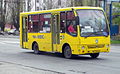 Bogdan A069 (2006–2013)
 -
 Bogdan A091 (1999—2005)
 -
 Bogdan A092 (2003–2012)
 -
 Bogdan A201 (2011–present)
 -
 Bogdan A144 (2003–2008)
 -
 Bogdan A701 (2011–present)
 -
 Bogdan A401 (2008–2011)


.JPG)


Military and special vehicles
[edit]Vehicles, designed for military applications, are produced at car assembly plants, owned by Automobile Company “Bogdan Motors”, located in Lutsk and Cherkasy.
The following models can be mentioned among products, designed for military applications: Bars-6 and Bars-8 tactical armored vehicles, Kia Military KM-450 multi-purpose truck, flatbed truck based on Great Wall Wingle 5, ambulance vehicle based on Great Wall Wingle 5, Hyundai HD 65/78 truck, Hyundai HD 120 truck, Bogdan 5316, Bogdan 2351, Bogdan 6317 and Bogdan 6425 trucks.
-
 Bogdan Bars-6 (serial)
 -
 Bogdan Bars-8 (prototype)
 -
 Bogdan Bars-8 (serial)
 -

-
 A Great Wall Wingle 5 military truck


List of models
[edit]- Sedan
- Bogdan 2110 (2009–2014)
- Wagon
- Bogdan 2111 (2009–2014)
- Pickup
- Bogdan 2310 (2009–2014)
- Bogdan 2351 (2018–present)
- Small bus
- Bogdan A064 (2004–2005)
- Bogdan A067 (2005–2006)
- Bogdan A069 (2005–2013)
- Bogdan A301 (2006–2007)
- Tur A049 (2010–2011)
- Medium bus
- Bogdan A091 (1999–2011)
- Bogdan A092 (2003–2012)
- Bogdan A201 (2011–2014)
- Big bus
- Bogdan A144 (2003–2005)
- Bogdan A401 (2009–2011)
- Bogdan A701 (2011–present)
- Extra big bus
- Bogdan A231 (2003–2004)
- Bogdan A801 (2008–2012)
- Trolleybus
- Bogdan E231 (2007–2008)
- Bogdan T701 (2011–present)
- Bogdan T901 (2011–present)
- School bus
- Bogdan AX071 (2004–2005)
- Truck
- Bogdan 6317 (2016–present)
- Military vehicles
- Bars-6 (2016–present)
- Bars-8 (2016–present)
References
[edit]- ^ a b Trolleybus Magazine No. 310 (July–August 2013), p. 106. UK: National Trolleybus Association. ISSN 0266-7452.
- ^ Trolleybus Magazine No. 312 (November–December 2013), p. 164.
- ^ a b Cherkasy car factory develops light armored vehicle, Interfax-Ukraine (16 December 2014)
- ^ "Черкаський автозавод «Богдан» передав Збройним Силам перші десять санітарних машин Богдан 2251". www.ukrmilitary.com. Retrieved 2018-03-02.
- ^ "Автомобіль Богдан-6317 з двигуном WeichalPower допущений до експлуатації у ЗС України". www.ukrmilitary.com. Retrieved 2018-03-02.
- ^ "КПИ им. Игоря Сикорского и ПАО АК "Богдан Моторс" будут сотрудничать в разработке нового транспорта". КПИ им. Игоря Сикорского (in Russian). 2018-04-20. Retrieved 2018-04-26.
- ^ "23 мая в 9 городах в больших автобусах и троллейбусах "Богдан" можно будет ездить бесплатно: Авто новости от AUTO-Consulting - Богдан". www.autoconsulting.com.ua. Retrieved 2018-05-30.
- ^ "За 20 лет "Богдан" выпустил 18 781 автобусов и троллейбусов: Авто новости от AUTO-Consulting - Богдан". www.autoconsulting.com.ua. Retrieved 2018-05-30.
- ^ "Bogdan delivers bodies to Bluebus". Retrieved 2018-06-26.
- ^ paradox (2018-07-12). "In Ukraine came of the Chinese premium brand car - micetimes.asia". micetimes.asia. Retrieved 2018-07-30.
- ^ "В конструкцию санитарных Богдан 2251 внесли более 10 обновлений: Авто новости от AUTO-Consulting - Богдан". www.autoconsulting.com.ua. Retrieved 2018-07-30.
- ^ "Bogdan Corporation hands over new batch of Bogdan 6317 off-road trucks to Ukrainian Armed Forces". Interfax-Ukraine. Retrieved 2018-09-03.
- ^ "Яка техніка була присутньою на параді до Дня Незалежності-2018 - 24 Канал". 24 Канал. Retrieved 2018-09-03.
- ^ "«Богдан» передал партию новых школьных автобусов Богдан А22412 на Волынь: Авто новости от AUTO-Consulting - Богдан". www.autoconsulting.com.ua. Retrieved 2018-10-31.
- ^ "BOGDAN CORPORATION ISSUES FIRST ELECTRIC TRUCK FOR DENMARK'S BANKE ELECTROMOTIV". Ukraine open for business. 2018-11-22. Retrieved 2018-11-29.
- ^ "Корпорация "Богдан" досрочно выполнила ГОЗ на 2018г на поставку ВСУ санитарных "Богдан 2251"". Интерфакс-Украина (in Russian). Retrieved 2018-11-29.
- ^ ""БОГДАН МОТОРС" ВИЗНАНО ПЕРЕМОЖЦЕМ ТЕНДЕРУ НА ПОСТАЧАННЯ 55 ТРОЛЕЙБУСІВ ДЛЯ КП "КИЇВПАСТРАНС" | Корпорація Богдан". Archived from the original on 2019-01-29. Retrieved 2019-01-29.
- ^ ""БОГДАН МОТОРС" УКЛАВ НОВИЙ МАСШТАБНИЙ КОНТРАКТ ІЗ МІНОБОРОНИ НА ПОСТАЧАННЯ САНІТАРНИХ МАШИН | Корпорація Богдан". Archived from the original on 2019-01-29. Retrieved 2019-01-29.
- ^ "«БОГДАН МОТОРС» ЗНАЧНО ЗБІЛЬШИТЬ ВИРОБНИЦТВО БАГАТОЦІЛЬОВИХ ВАНТАЖІВОК ДЛЯ ЗСУ В 2019 РОЦІ | Корпорація Богдан". Archived from the original on 2019-01-29. Retrieved 2019-01-29.
- ^ "«БОГДАН» ВІДКРИВ 2019 РІК НОВИМ МІЖНАРОДНИМ КОНТРАКТОМ ІЗ ФРАНЦУЗЬКОЮ КОМПАНІЄЮ | Корпорація Богдан". Archived from the original on 2019-01-29. Retrieved 2019-01-29.
- ^ ""БОГДАН МОТОРС" ВИГРАВ ТЕНДЕР НА ПОСТАЧАННЯ ХАРКОВУ 57 СУЧАСНИХ ТРОЛЕЙБУСІВ | Корпорація Богдан". Archived from the original on 2019-02-28. Retrieved 2019-02-27.
- ^ ""БОГДАН" ВИГРАВ ТЕНДЕР НА ВИРОБНИЦТВО СУЧАСНИХ НИЗЬКОПІДЛОГОВИХ ТРОЛЕЙБУСІВ ДЛЯ СУМ | Корпорація Богдан". Archived from the original on 2019-03-26. Retrieved 2019-03-26.
- ^ ""БОГДАН" ВИГОТОВИВ ПЕРШИЙ КУЗОВ ДЛЯ ФРАНЦУЗЬКОЇ КОМПАНІЇ BLUEBUS У РАМКАХ ВИКОНАННЯ НОВОГО КОНТРАКТУ | Корпорація Богдан". Archived from the original on 2019-03-26. Retrieved 2019-03-26.
- ^ "Court initiates proceedings on bankruptcy case of Bogdan Motors automobile company". Retrieved 2020-12-28.
- ^ "Court Declares Bogdan Motors Bankrupt And Opens Liquidation Procedure". 2021-07-07. Retrieved 2021-07-09.
- ^ "Луцький автобусний завод продовжує працювати". Center for Transport Strategies.
- ^ "Завод «Богдан» продали за 250 мільйонів: хто новий власник". Konkurent.
External links
[edit]| Vehicle manufacturers |
| ||||
|---|---|---|---|---|---|
| Components | |||||
Subsidiaries of foreign companies | |||||
| Related topics |
| ||||

Bogdan Corporation
View on GrokipediaHistory
Founding and Soviet-Era Roots (1951–1991)
The Lutsk Automobile Factory, the foundational enterprise of what would become Bogdan Corporation, originated in February 1951 when it was established as a repair plant (LARZ, Lutsk Automobile Repair Plant) on the basis of pre-existing repair workshops in Lutsk, Ukrainian SSR.[2] Initially focused on overhauling and maintaining Soviet vehicles, the facility received official status as a repair plant and began operations amid the post-World War II industrialization push in the Ukrainian Soviet Socialist Republic. Construction of the plant's infrastructure commenced that year, with full opening in 1955.[6] By the late 1950s, the plant evolved beyond repairs, renamed LuMZ (Lutsk Machinebuilding Plant) in 1959, and shifted toward manufacturing light utility and off-road vehicles suited for rural and military applications in the Soviet Union. This transition aligned with broader Soviet efforts to develop versatile, lightweight transport for challenging terrains, including amphibious capabilities. In 1961, production began on the LuAZ-967 "Volyn," a compact, four-wheel-drive vehicle weighing under 600 kg, designed primarily for military use but also adapted for civilian needs; approximately 2,000 units were produced by 1966.[7] The LuAZ-969 "Volyn," introduced in 1966 as an upgraded successor, became the plant's flagship model through the Soviet era, featuring a rear-mounted 40 hp engine, independent suspension, and optional amphibious modifications for over 10,000 units produced by 1991. Exported to countries like Cuba and used extensively in the Soviet armed forces and collective farms, the model emphasized simplicity, low fuel consumption (around 10 liters per 100 km), and ease of maintenance with interchangeable parts from ZAZ plants. Cumulative output from the Lutsk facility during 1951–1991 totaled over 20,000 vehicles, reflecting its niche role in the centralized Soviet automotive sector dominated by larger producers like GAZ and UAZ.[8] The plant remained state-owned throughout the period, operating under Gosplan directives with a workforce peaking at several thousand, though production was constrained by resource shortages typical of the late Soviet economy.[9]Post-Independence Expansion (1992–2008)
Following Ukraine's independence from the Soviet Union in 1991, the precursor entities to Bogdan Corporation initiated expansion through vehicle import, distribution, and early manufacturing ventures, leveraging the transition to a market economy. By the mid-1990s, these operations included becoming an authorized dealer for brands such as KIA, focusing on commercial vehicles to meet emerging demand in public transport and logistics.[2] In 1998, the group acquired the Cherkasy Auto Repair Factory, renaming it Cherkasy Bus OJSC and retooling it for bus body production, marking a shift from repair services to assembly and marking the entry into specialized vehicle manufacturing. This facility enabled the development of the Bogdan A091 minibus, first presented at the SIA'99 exhibition on May 25, 1999, which featured Isuzu chassis and became instrumental in modernizing Ukraine's urban and suburban transport fleets during the late 1990s.[2][10] The expansion accelerated in 2000 with the acquisition of a controlling stake in Lutsk Automobile Factory (LuAZ) via public auction, integrating its capabilities for light commercial and off-road vehicles into the growing network, and the signing of a distribution agreement for Hyundai automobiles in Ukraine. Subsequent years saw product diversification, including the launch of the Bogdan A092 midibus in 2003 on Isuzu platforms, alongside increased bus output at Cherkasy, which supported widespread adoption in Ukrainian cities for marshrutka services.[2] By 2005, the entities merged to form Bogdan Corporation, consolidating operations across multiple sites and enabling scaled assembly of buses, trolleybuses, and imported models. The period culminated in 2008 with the opening of a dedicated assembly line at the Cherkasy plant for Hyundai passenger cars (such as Accent and Elantra) and Ladas, alongside expansion of bus production at Lutsk and initiation of Isuzu truck assembly, achieving nearly 20% market share in Ukraine's bus and light commercial vehicle segments amid pre-crisis demand growth.[3][11][12]Crisis and Adaptation (2009–Present)
The global financial crisis of 2008 severely impacted Bogdan Corporation, causing a collapse in domestic demand for vehicles amid depreciating hryvnia, reduced disposable incomes, and limited access to car loans.[13][14] The company's bus and trolleybus production plummeted from 3,763 units in 2008 to 624 units in 2009, representing just 16.6% of the prior year's output.[13] Ukraine's accession to the World Trade Organization exacerbated import competition, while the corporation grappled with over $300 million in long-term loans incurred for pre-crisis expansion projects, including new manufacturing facilities.[15] In response, Bogdan introduced five new bus models in 2009 to sustain operations, though overall market contraction limited recovery.[13] Financial strains persisted into the 2010s, culminating in the 2011 sale of the Cherkasy Autobus plant to Prominvestbank to alleviate credit burdens from the crisis. Petro Poroshenko, an early stakeholder, divested his majority interest in 2009 amid production collapse.[16] Efforts to restructure debts, including a 2018 agreement with Ukreximbank extending a 2009 state loan repayment over 13 years for Cherkasy and Lutsk plants, proved insufficient.[17] By 2020, subsidiary Bogdan Motors reported a net loss of UAH 3.384 billion, reversing a UAH 272.79 million profit from 2019, prompting bankruptcy proceedings initiated in December 2020 by the Commercial Court of Dnipropetrovsk Region.[18][17] In July 2021, the court declared Bogdan Motors bankrupt and initiated liquidation, halting factory operations and shifting the corporation toward foreign vehicle distribution rather than domestic manufacturing.[19][20] Adaptation strategies included diversification into military vehicles, such as the KM-450 multi-purpose truck and Bars-8 armored personnel carrier based on Dodge Ram chassis, to secure state defense contracts and replace Russian imports like UAZ models.[21] These efforts provided limited continuity, with post-2022 Russian invasion revivals focusing on army supplies like off-road trucks, though bankruptcy constrained scale.[22] In 2022, Ukreximbank acquired the Cherkasy plant for UAH 51 million amid liquidation asset sales.[23] The corporation's manufacturing ambitions yielded to import reliance and niche defense roles, reflecting broader Ukrainian auto sector vulnerabilities to economic shocks and geopolitical tensions.[22]Corporate Structure and Operations
Ownership and Key Figures
The Bogdan Corporation is a privately held Ukrainian automotive group primarily owned by Oleh Hladkovskyi, a businessman and former First Deputy Secretary of the National Security and Defense Council of Ukraine (2018–2019).[19][24] Hladkovskyi, who adopted the surname from his wife's in 2014 (previously Svinarchuk), established the corporation in February 2005 by consolidating entities such as the Lutsk Automobile Plant and Cherkasy Bus, focusing on vehicle assembly and distribution.[25] Former President Petro Poroshenko maintained a minority stake, stemming from joint ventures in the early 2000s, though Hladkovskyi retained controlling interest.[26] Oksana Chernachuk currently serves as CEO and authorized director, managing operations amid ongoing financial restructuring.[27] Hladkovskyi previously led as CEO, directing expansions into Hyundai and Isuzu assembly until divesting stakes like the 50% in Isuzu Ukraine in 2013.[28] His son, Mykhailo Hladkovskyi, holds roles in affiliated entities such as the Bogdan Automobile Group, which owns shares in subsidiaries.[29] Subsidiary Automobile Company Bogdan Motors, a core production arm, faced bankruptcy liquidation starting December 2020 due to debts exceeding 3 billion UAH to creditors including Ukreksimbank and UniCredit Bank, culminating in the August 2024 auction of its 17.73-hectare Lutsk facility to TOV "ZhK Drim Taun" (linked to local developer Serhiy Holikov) for 250.5 million UAH; this asset divestiture has not altered the holding corporation's ownership under Hladkovskyi.[30][19]Manufacturing Facilities and Capabilities
Bogdan Corporation's primary manufacturing facilities are situated in Lutsk and Cherkasy, Ukraine, with the Lutsk site serving as the core hub for bus and specialized vehicle production. The Lutsk plant, known as SE "Car Assembly Plant No. 1," focuses on assembling modern buses, trolleybuses, and electric buses, boasting an annual production capacity of up to 6,000 units. This facility spans 74,622 square meters and incorporates advanced processes such as body fabrication, welding, painting, and final vehicle assembly, enabling the production of low-floor models like the Bogdan T70117 trolleybus with capacities for 105 passengers.[31][32] In addition to domestic designs, the plant handles contract manufacturing, including bodies for electric buses under agreements with firms like France's Bluebus, where initial units were produced starting in 2019.[33] The Cherkasy facility represents Ukraine's most advanced automobile assembly plant, dedicated to passenger cars and commercial vehicles through semi-knocked-down (SKD) and completely knocked-down (CKD) kits from partners such as Hyundai, JAC, and formerly Lada. Its designed capacity supports 120,000 to 150,000 vehicles annually, encompassing models like the Hyundai Accent, Elantra, and Tucson, as well as JAC sedans. This plant features dedicated lines for body-in-white assembly, powertrain integration, and quality testing, though utilization has varied due to market fluctuations.[34][35] Further capabilities extend to truck and military vehicle assembly, primarily at Lutsk, where lines for models like the Bogdan 6317 all-road truck—equipped with a 380 hp Weichai engine and 11,000 kg payload—were established in 2018. Overall corporate capacities historically encompassed up to 9,000 buses/trolleybuses, 21,000 trucks, and 19,000 special vehicles annually, though actual output has been constrained by economic crises and the Russia-Ukraine conflict since 2014. These facilities emphasize adaptability, shifting between civilian, commercial, and defense production as needed.[36][15]Products and Models
Buses and Trolleybuses
Bogdan Corporation manufactures buses and trolleybuses primarily at its Lutsk and Cherkasy facilities in Ukraine, with production capacities historically supporting up to 9,000 units annually across all classes.[1] Buses include city, intercity, tourist, and specialized variants, often utilizing Isuzu chassis and aggregates for reliability, while adhering to Euro emission standards.[37] Trolleybuses focus on low-floor designs for urban accessibility, featuring options like autonomous running capabilities independent of overhead wires.[38] Early bus models, such as the A091 introduced in 1999, featured fiberglass bodies on Isuzu chassis for improved comfort over Soviet-era alternatives, serving city routes with capacities around 50-70 passengers.[39] The A092, produced from 2003 to 2012, expanded on this with variants like A09201 for city use and A09211 for intercity, accommodating up to 80 passengers and marketed internationally under Isuzu branding. Mid-2000s models included the A069 (2006–2013) for suburban routes and A144 (2003–2008) as larger city buses. Later developments emphasized low-entry and low-floor designs, such as the A401 tourist bus (2008–2011) and A701 series (2011–present), with the A70132 offering 106-passenger capacity including 30 seats in a 12-meter length.[40] Specialized models like the A22412 school bus provide 29-31 seats with safety equipment compliant to Ukrainian standards.[10] Production peaked at 3,763 units in 2008 but fell sharply to 624 in 2009 amid economic crisis.[13] Trolleybus production includes the T80110 low-floor city model launched alongside A092 buses, followed by modern extra-large capacity units like the T90117 (18.9 meters, 145-180 passengers) and T70117 (12 meters).[41] The T90117 supports air conditioning and autonomous operation, with deliveries such as 55 units to Kyiv in 2019 and 49 to Kharkiv in 2020 funded by international loans.[42] These models use asynchronous traction motors rated at 125-140 kW, achieving speeds over 55 km/h.[38]| Model | Type | Production Years | Key Specs |
|---|---|---|---|
| A091 | City | 1999–2005 | Isuzu chassis, ~50-70 passengers[39] |
| A092 | City/Intercity | 2003–2012 | Up to 80 passengers, automatic doors variants |
| A069 | Suburban/City | 2006–2013 | Low-floor options |
| A701 | City | 2011–present | 12m, 106 passengers, 30 seats[40] |
| T90117 | Trolleybus, Extra-Large | Recent | 18.9m, 145-180 passengers, autonomous run[41][38] |