Hubbry Logo
Boreal chorus frogBoreal chorus frogMain
Open search
Boreal chorus frog
Community hub
Boreal chorus frog
logo
8 pages, 0 posts
0 subscribers
Be the first to start a discussion here.
Boreal chorus frog
Boreal chorus frog
from Wikipedia

Boreal chorus frog
Scientific classification Edit this classification
Kingdom: Animalia
Phylum: Chordata
Class: Amphibia
Order: Anura
Family: Hylidae
Genus: Pseudacris
Species:
P. maculata
Binomial name
Pseudacris maculata
Agassiz, 1850
Range of P. maculata

The boreal chorus frog (Pseudacris maculata) is a species of chorus frog native to Canada from central Quebec to eastern British Columbia and north to the Northwest Territories and the southern portion of the Yukon.[2] It occurs in the USA throughout Montana, Minnesota, northwestern Wisconsin, northeastern Arizona, northern New Mexico, and southwestern Utah.

Description

[edit]

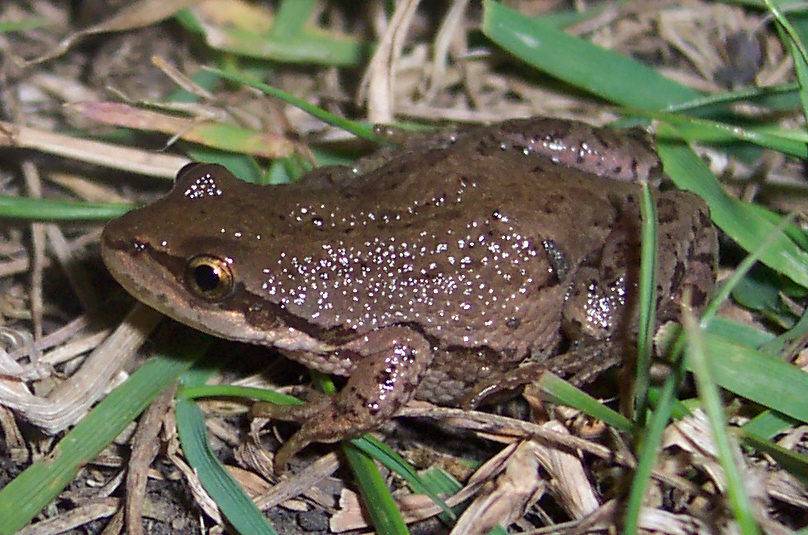
This small species of frog reaches about 30 mm in length. It is highly variable, but is normally brown, and can be green on the dorsal surface, with three broken dorsal stripes; these stripes can be very distinct to quite faint. A dark band is present from the snout, across the eye, and continuing down the side. It has slightly enlarged toe pads to help in climbing small grasses and vegetation. This species is very similar to the western chorus frog (Pseudacris triseriata). It can be distinguished from this species by having shorter legs.

Green boreal chorus frog

Ecology and behaviour

[edit]

This species can be found around permanent water bodies in cleared land and forest. Males make a "reeeek" call from grasses, vegetation, or ground around the water body from April through to September. This call is characteristic of the trilling frog clade that is present in the genus Pseudacris. This clade is so named because the call of each individual is different, each having its own series of pulses.[2] Within the trilling frog clade, they are further divided into "dynamic" and "static" groups, and recent studies have placed P. maculata into the static grouping. The static grouping is distinguished by a lack of variability in one's call and the ability to somewhat control the direction of their calls.[2] Amphibians' songs or calls to one another are commonly used for sexual selection, but in Bee, et al. 2010, the researchers found no correlation that linked directly to sexual selection. They found a link between the lowest note in the song and body size, but insufficient evidence to draw any conclusions from it. Every call was different in the study, but the differences were subtle and required complex technology to pick up. The similarity in the calls results in the frogs not being able to distinguish individuals from each other. It was hypothesized that the calls were simply to broadcast their position to other calling males telling them to stay away and also to alert females to the presence of a male that is ready to mate.[2] This is normally one of the first species of amphibian to emerge in spring. It comes out so early that it is often found while snow and ice are still present. This timing directly correlates with snow-melt and the water level of the water body that the populations calls home.[3]

Pseudacris maculata is categorized as an annual breeder.[4] Breeding takes place once the weather begins to warm, typically from late February to around April.[4] After mating, a single female can lay anywhere from 500-1500 eggs, with a highly variable hatching rate of anywhere from 37% to 87%. The life cycle continues with tadpoles metamorphosing around June or July.[4] The metamorphosis survival rate also has a massive range of 10-100% in the wild.[4]

Threats

[edit]

Amphibians are widely known as very important species in their ecosystems, but declines are occurring worldwide in amphibian populations. There are multiple reasons that amphibians decline, with the most common being disease, habitat loss, over harvesting for food, pet trade, and competition with invasive species. Climate change has also been one of the proposed mechanisms for why this species is struggling.[5] Climate change is causing the weather to become increasingly dry, which affects most amphibians (including Pseudacris maculata). This change leads them to modify their behavior based on the environmental conditions and sometimes exposing them to conditions that are not optimal.[5] This dry weather has another effect on this species, it results in lower water levels, which exposes the amphibians and their eggs (which are laid in the water) to more extreme temperatures. This, coupled with the decrease in ozone layers, also exposes the amphibians and the eggs to heightened levels of UV radiation when compared to environments with deeper waters.[3]

The boreal chorus frog has an interesting defense to invasive species. This species of frog has been found to have cultural learning on how to behave towards predators. Cultural learning is learning that takes place by an individual observing and imitating behaviors of other individuals in close proximity. The example brought up by Ferrari and Chivers 2008, is how P. maculata tadpoles learn to avoid salamanders from tadpoles that have experience with the predator. The paper discusses how if a new predator is added to the environment, there is a learning curve at how long it takes the tadpoles to learn to avoid the new predator.[6] The addition of an invasive species will be very successful until the tadpoles learn to avoid it, which could cause even more pressure on this species.

Amphibians worldwide are being infected with the fungus Batrachochytrium dendrobatidis (Bd) and the boreal chorus frog is no exception. Bd infects the keratinized skin of its host, which results in an inability to properly osmoregulate through the skin. The symptoms to this disease vary between species, ranging from seemingly unaffected to death.[4] This species of frog has been found to be infected at higher frequencies than other amphibians in the same environments.[7] There have been many studies examining how this species copes with an infection of Bd. Some studies claim that Pseudacris maculata is struggling,[8] while others show that populations are maintaining themselves.[4] This is especially intriguing when one considers that the boreal chorus frog can have mortality up to 80% when infected with Bd.[4] No definitive conclusions can be drawn with how Pseudacris maculata copes with the disease within a population.

Bd is an especially interesting and dangerous pathogen given the fact that it can persist in an environment even in the absence of amphibians.[9] It can survive in water for an extended amount of time, as well as attach to feathers.[9] These facts, on top of the fact that Bd can also infect salamanders and frogs in all stages of life result in the pathogen persisting in an environment long enough to continually infect new frogs (9,11).[10] Tadpoles can be infected on their mouth parts (which is the only location of keratinized skin) and frogs post-metamorphosis can be infected almost anywhere (but primarily on the toes).[4] The significance that salamanders (specifically tiger salamanders from the paper) can be infected is because they can perpetuate the presence of Bd in the environment which can then increase the odds that a frog will be infected by this disease. Salamanders can also overwinter in the water itself, while frogs live terrestrially during the winter. This is significant because without the living hosts keeping Bd alive in the water, it would have a high chance to die off over the winter in the water with no hosts.[4] Boreal chorus frogs in areas that contain salamanders capable of surviving with Bd cannot escape this disease, which could be why some populations are declining.

References

[edit]
[edit]
Revisions and contributorsEdit on WikipediaRead on Wikipedia
from Grokipedia
The Boreal chorus frog (Pseudacris maculata) is a small hylid characterized by its gray, tan, or greenish dorsal coloration marked by three prominent dark stripes running longitudinally along the back, a dark line extending from the snout through the eye to the groin, and a pale white or cream-colored venter often speckled with dark spots. Adults typically measure 19–41 mm (0.75–1.6 inches) in snout-vent length, with females generally larger than males, the latter developing a darkened during the breeding season; pads are present but is minimal, aiding their terrestrial and semi-aquatic lifestyle. This species inhabits a broad range of open and semi-open environments across , including prairies, grasslands, shrublands, forest edges, agricultural fields, and urban margins, primarily within 100 meters of breeding sites such as shallow temporary ponds, flooded ditches, marshes, and fishless pools with emergent vegetation like sedges and grasses. Its distribution spans much of from central westward to eastern and southward through the northern and to , reaching elevations up to 3,720 meters, with disjunct populations in eastern regions such as northern New York (rare and declining as of 2025) and historically in (possibly extirpated, last observed in 1999). The boreal chorus frog is freeze-tolerant, overwintering terrestrially in burrows, under logs, or leaf litter, where it produces glucose as a cryoprotectant to survive subzero temperatures. Breeding occurs from late February to June, peaking in spring, when males gather in choruses at shallow waters and produce a metallic, clicking "creeeek" call audible up to 400 meters, facilitating mate attraction in fishless habitats to minimize predation on eggs and tadpoles. Females deposit 150–1,500 eggs in small clusters (7–190 eggs each) attached to submerged , which hatch in 5–14 days into tadpoles that metamorphose in 6–10 weeks; is reached within one year, with a lifespan of 2–7 years in the wild. Although globally assessed as Least Concern (IUCN, as of 2022) due to its wide distribution and stable populations in core ranges, the species faces localized declines in eastern disjunct areas from habitat loss, , and emerging diseases like .

Taxonomy

Classification

The boreal chorus frog belongs to the order Anura within the class Amphibia, which encompasses all frogs and toads, and is placed in the family , known as the tree frogs or barking tree frogs. Its full taxonomic hierarchy is as follows: Kingdom Animalia, Chordata, Class Amphibia, Order Anura, Hylidae, Hylinae, Pseudacris, and maculata. The binomial name is Pseudacris maculata (Agassiz, 1850), reflecting its current placement in the genus Pseudacris, which comprises small chorus frogs primarily distributed across . Originally described by Swiss-American naturalist in 1850 as Hyla maculata in his work Contributions to the Natural History of the United States, the species was later reclassified into the genus Pseudacris due to morphological and vocalization differences from the broader group. For much of the , P. maculata was treated as a of the western chorus frog (Pseudacris triseriata), specifically P. triseriata maculata, within what was known as the Pseudacris triseriata , which included several morphologically similar taxa distinguished primarily by geographic variation and subtle call differences. Phylogenetic studies utilizing mitochondrial DNA sequences, particularly from the 12S and 16S ribosomal RNA genes, have clarified the evolutionary relationships within this complex. A 2004 analysis by Moriarty and Cannatella revealed that the P. triseriata complex was paraphyletic, grouping P. maculata with other trilling chorus frogs but indicating genetic divergence from western populations. Subsequent research in 2007 by Lemmon et al. employed a phylogeny-based delimitation approach, confirming P. maculata as a distinct monophyletic lineage separate from P. triseriata based on significant genetic distances in mitochondrial markers and corroborated by nuclear data, solidifying its species status and resolving prior taxonomic uncertainties. This split highlights the boreal chorus frog's position within the diverse Pseudacris genus, emphasizing allopatric speciation driven by geographic barriers in North American landscapes.

Etymology

The genus name Pseudacris derives from the Greek words pseudes (ψευδής), meaning "false," and akris (ἀκρίς), meaning "locust," alluding to the frog's calls that mimic but differ from those of true locusts. The species epithet maculata comes from the Latin maculatus, meaning "spotted" or "marked with spots," in reference to the distinctive dark spots and stripes on the frog's dorsal surface. The common name "boreal chorus frog" reflects key aspects of the species' ecology and range. "Boreal" originates from the Greek boreas, denoting the north wind or northern regions, highlighting the frog's distribution across northern and central North America. "Chorus" refers to the synchronized group calling by males during the breeding season, creating a collective vocal display. This standardized English name was formalized in herpetological nomenclature around the mid-20th century.

Description

Physical characteristics

The boreal chorus frog (Pseudacris maculata) is a small hylid with adults measuring 19–41 mm in snout-vent , averaging approximately 30 mm, and weighing 1–5 g. The body is slender with a slim , featuring short hind legs relative to other chorus frogs, slightly enlarged toe pads adapted for limited climbing, and minimal on the toes. A distinctive dark triangular marking is present between the eyes, often forming a Y- or X-shaped pattern on the head, accompanied by a white spot or light line along the upper lip. A dark stripe extends from the snout through the eye to the groin. Dorsal coloration varies widely, ranging from gray, brown, tan, , or green, typically accented by three broken or irregular dark stripes running longitudinally along the back. The venter is white or cream, occasionally with a yellow tinge and speckled with dark spots (particularly on the and chest), and the skin is smooth and moist. Sexual dimorphism is evident, with females slightly larger than males and lacking the dark gray or brown throat patches present in breeding males, which serve as vocal sacs. In the larval stage, tadpoles are dark brown, olive, or bronze with lateral eyes and a translucent featuring a high, arched that is dendritically pigmented, while the ventral fin is transparent and of uniform width; total length reaches up to 52 mm (typically 35–40 mm).

Similar species

The boreal chorus frog (Pseudacris maculata) is morphologically similar to the western chorus frog (P. triseriata), but can be distinguished by its shorter hind legs, with the tibia length typically less than half the snout-vent length (SVL), compared to the longer legs of the western chorus frog that enable more hopping behavior. Their ranges overlap in the region, yet phylogenetic analyses confirm genetic separation between the two species based on sequences from multiple populations. Compared to the upland chorus frog (P. feriarum), the boreal chorus frog exhibits a whiter upper labial stripe and reduced toe , with the latter species showing more basal webbing between digits. Distributionally, the boreal chorus frog occupies more northern and western extents, while the upland chorus frog is primarily eastern and southeastern, with limited overlap in areas like . The boreal chorus frog lacks the characteristic X-shaped dorsal marking present on the spring peeper (P. crucifer), and their calls differ in timbre, with the boreal's being a rising trill versus the peeper's high-pitched peep. In the field, identification of the boreal chorus frog from these similar species often relies on call characteristics and hind leg length measurements, though genetic markers from DNA sequencing provide definitive confirmation, especially in overlap zones.

Distribution and habitat

Geographic distribution

The boreal chorus frog (Pseudacris maculata) has a broad native range across central and northern . In , it occurs from central westward to eastern , extending northward to the and Territory. In the United States, the species is distributed through the northern , Midwest, and Rocky Mountain regions, ranging southward to northeastern , northern , and northern , with disjunct populations in the northeastern U.S. such as northern New York and northwestern . Within this range, the boreal chorus frog inhabits boreal forests, prairie grasslands, and montane zones up to 3,720 meters (12,000 feet), but it is absent from the Pacific coastal areas and southern habitats. Populations are typically dense in the northern portions of the range, where suitable wetlands are abundant, becoming sparser toward the southern edges due to more fragmented landscapes. The global adult is presumed to exceed 1 million individuals, reflecting its widespread occurrence and G5 (secure) conservation rank. Historically, the species' overall distribution has remained stable across its core range since the mid-20th century, supported by its adaptability to various types. However, local declines have occurred in fragmented habitats, particularly following in the and onward, which has reduced available breeding sites in areas like and the northern .

Habitat requirements

The boreal chorus frog (Pseudacris maculata) primarily breeds in shallow, temporary or semi-permanent water bodies that are typically free of , such as temporary ponds, roadside ditches, flooded meadows, shallow bogs, marshes, buffalo wallows, furrows, glacial kettlepots, and ephemeral or vernal pools within woodlands. These sites are often characterized by depths less than 20 cm, warm temperatures exceeding 10°C for egg-laying, and emergent like sedges, grasses, and willows that provide cover and attachment for egg masses. Breeding occurs in open-canopy areas without dense , where hydroperiods support larval development without prolonged submersion risks. Outside the breeding season, boreal chorus frogs inhabit upland terrestrial environments near their aquatic sites, including damp grassy or marshy areas, forests, grasslands, shrublands, and parklands, typically within 100 m of water and rarely exceeding 200 m. For hibernation, individuals seek microhabitats such as underground rodent burrows, crevices under logs or rocks, or beneath thick leaf litter and debris, where they enter torpor and tolerate sub-zero temperatures using glucose-based cryoprotectants. These non-breeding habitats provide moisture and protection from desiccation and predators. Microhabitat preferences emphasize neutral to slightly alkaline water conditions with ranging from 7.3 to 7.8 and low (0.1–2.0 g/L), supporting ample prey for tadpoles and adults. The species avoids permanent deep lakes and ponds with populations, as these increase predation risks on eggs and larvae, favoring instead shallow, vegetated waters that promote higher calling activity and . Vegetation cover and intermittent inundation greater than 0.2 m in wet meadows further enhance suitability by facilitating precipitation-driven access after rainfall events of approximately 0.25–3 cm. Seasonally, boreal chorus frogs undertake short migrations of less than 500 m to breeding sites in spring, often triggered by temperatures above 5°C and adequate , while juveniles remain near natal ponds post-metamorphosis before dispersing similarly. In some populations, individuals stay year-round near ponds, but most shift to terrestrial sites in fall and return in early spring for breeding from late to .

Behavior and ecology

Vocalization and communication

The advertisement call of the boreal chorus frog (Pseudacris maculata) is a distinctive, high-pitched "prreep" or "reeeek," produced as a series of rapidly pulsed notes that rise slightly in pitch. Each call typically lasts 0.75–0.95 seconds and consists of approximately 13–18 short pulses delivered at a rate of about 16 pulses per second, with a dominant around 3,800 Hz (ranging from 2,500–4,000 Hz overall). These calls are repeated at a rate of 20–30 per minute, creating a metallic, comb-like trill when heard in chorus. During the breeding season, spanning late to in northern ranges, male boreal chorus frogs gather in choruses at shallow, fishless wetlands, calling from perches in emergent , on the ground, or occasionally from low shrubs near the water's edge. Calling activity is primarily nocturnal but can occur sporadically during the day, with intensity often peaking around and dawn when temperatures are favorable. These choruses serve essential communicative roles, primarily attracting receptive females to breeding sites and signaling ownership to deter rival males. Non-calling "satellite" males may exploit these choruses by remaining silent near active callers to intercept approaching females without expending energy on vocalization. Call properties exhibit notable variations influenced by environmental and individual factors. Call and pulse rates increase positively with ambient , leading to slower, longer calls in cooler conditions (e.g., pulse rate r = 0.91, p < 0.0001). Geographic differences also occur across the species' range, including higher dominant frequencies at northern latitudes (e.g., ~3,785 Hz in compared to 2,910–3,580 Hz in ), potentially reflecting local adaptations or dialects that aid in or recognition. These acoustic signals are individually distinctive, with static properties like pulse rate and frequency enabling potential social discrimination among males (91% classification accuracy via discriminant function analysis).

Reproduction and life cycle

The boreal chorus frog (Pseudacris maculata) is an explosive breeder, with activity concentrated in short, intense periods triggered by rising temperatures and that fill temporary wetlands. In southern portions of its range, breeding typically occurs from late February to April, while in northern areas it is delayed until May to June, aligning with local thawing conditions. Males gather in choruses at shallow, vegetated waters to attract females, where axillary amplexus occurs in the water, leading to external fertilization. Females deposit 500–1,500 eggs in small, loose clusters of 10–100 eggs each, attached to submerged or emergent vegetation. Eggs hatch into tadpoles after 3–17 days, depending on water temperature, with hatching success rates ranging from 37% to 87% in natural settings influenced by predation and environmental factors. Tadpoles undergo metamorphosis in 30–70 days, typically from June to July in northern populations, achieving survival to the froglet stage at rates of 10–100% based on hydroperiod length and pond conditions; shorter hydroperiods accelerate development but reduce overall survival. As an annual species with a lifespan typically of 1–3 years, though some individuals may live up to 7 years in the wild, the boreal chorus frog completes its life cycle rapidly: post-metamorphosis juveniles disperse from breeding sites and reach in their first summer, often within the initial year. Adults and juveniles overwinter terrestrially in burrows, under leaf litter, or in tunnels, emerging in early spring to initiate the next breeding cycle. Tadpoles exhibit growth rates of approximately 0.5 mm per day in length under favorable conditions, supporting their quick development in ephemeral habitats.

Diet and predation

The Boreal chorus frog (Pseudacris maculata) is insectivorous as an adult, preying primarily on small terrestrial such as , beetles, flies, , grasshoppers, and spiders, which constitute the bulk of its diet. These frogs employ a sit-and-wait strategy, perching motionless on or ground to detect and capture prey via rapid projection, with activity peaking nocturnally and opportunistically based on local prey abundance. Tadpoles exhibit herbivorous to omnivorous feeding habits, consuming , diatoms, , organic , and occasionally small ; they employ scraping mechanisms on submerged surfaces or filter-feeding in shallow waters to obtain . The Boreal chorus frog faces predation from a range of vertebrates, including , wading birds (e.g., ), snakes, small mammals (e.g., raccoons), and other amphibians, as well as such as . Defensive adaptations include skin secretions containing mild toxins for chemical deterrence and, in tadpoles, culturally transmitted avoidance behaviors learned from conspecifics exposed to predator cues. Predation imposes high mortality, particularly on tadpoles, with larval survival rates typically ranging from 30% to 90% across studies, often resulting in over 50% losses attributable to invertebrate and vertebrate predators.

Conservation

Conservation status

The boreal chorus frog (Pseudacris maculata) is assessed as Least Concern on the , a designation established in the 2004 assessment, reviewed in 2015, and reaffirmed in 2022, primarily due to its extensive geographic range exceeding 2.5 million km² across and a presumed large global population of over 1 million mature individuals, which is unlikely to decline rapidly enough to warrant a higher threat category. Regionally, the species is ranked as globally secure (G5) by NatureServe and secure (S5) in the majority of U.S. states within its distribution, including and New York, reflecting its abundance and resilience in those areas. In , it lacks federal protection under the Species at Risk Act, though it is designated as vulnerable in under the Act Respecting Threatened or Vulnerable Species due to localized vulnerabilities. Overall trends are at the global scale, supported by its distribution and tolerance; however, severe local declines have been documented in agricultural landscapes since the 1990s, linked to , with ongoing monitoring conducted via standardized call surveys to track calling males as indicators of abundance (e.g., reduced to ~3% in eastern areas). Management efforts include protections within national parks and wildlife reserves across its range, where breeding habitats are safeguarded, and no distinct face unique threats, as the species is treated as a single taxonomic unit without recognized infraspecific divisions requiring separate conservation measures.

Threats and protection

The boreal chorus frog faces significant habitat threats from agricultural expansion and , which have led to the draining, filling, and mowing of essential breeding ponds and . In regions like , occupied sites have declined by approximately 43% between 1995 and 2006 due to these development pressures, contributing to broader losses estimated at 20–40% across North American landscapes since 1900. Drainage of vernal pools specifically disrupts breeding sites, as these temporary are critical for larval development and are often targeted for conversion to farmland or urban infrastructure. Climate change exacerbates these pressures by altering snowmelt timing and creating drier conditions that shorten pond hydroperiods, preventing tadpoles from completing metamorphosis before habitats dry out. In areas like Yellowstone National Park, prolonged droughts from 2000–2007 caused 19 of 49 surveyed ponds to dry prematurely, contributing to a 75% population decline between 1992 and 2008. Projections indicate potential northward range shifts of up to 40 km in parts of New York due to warming temperatures and reduced suitable wetland availability (as of 2025 assessments). Diseases pose another major risk, particularly the chytrid fungus Batrachochytrium dendrobatidis (Bd), which infects boreal chorus frogs across multiple regions and can cause significant mortality during outbreaks when combined with environmental stressors. Increased ultraviolet-B (UV-B) radiation further heightens susceptibility to Bd and other pathogens by impairing immune function and larval development in amphibians, including species like the boreal chorus frog. Additional threats include road mortality during seasonal migrations, where limited dispersal distances of 250–700 m make frogs vulnerable to vehicle collisions, and pesticide exposure, such as glyphosate, which directly causes tadpole mortality and reduces prey availability. Protection efforts focus on habitat restoration and policy measures to mitigate these risks. Wetland restoration programs, supported by the U.S. Fish and Wildlife Service, aim to recreate vernal pools and improve connectivity between breeding sites, enhancing population resilience. In , the Act Respecting Threatened or Vulnerable Species designates the boreal chorus frog as vulnerable, providing legal protections against and promoting recovery through land acquisition and restoration (status as of 2025). Ongoing research into Bd resistance mechanisms offers potential for targeted interventions, while programs have proven successful but are not currently prioritized given the ' overall status.

References

Add your contribution
Related Hubs
User Avatar
No comments yet.