Hubbry Logo
Boss HM-2Boss HM-2Main
Open search
Boss HM-2
Community hub
Boss HM-2
logo
8 pages, 0 posts
0 subscribers
Be the first to start a discussion here.
Boss HM-2
Boss HM-2
from Wikipedia
Boss HM-2
BrandBoss
ManufacturerRoland Corporation
Dates1983—1991 (Original)
2020—present (Waza Craft)
Price$90 (Original launch)
Technical specifications
Effects typeDistortion pedal
Controls
Pedal controlDistortion (Dist), highs (H), lows (L), output volume (level), standard and custom mode (Waza Craft)
Input/output
Inputsmono
Outputsmono
Metal song created with the Boss HM-2.

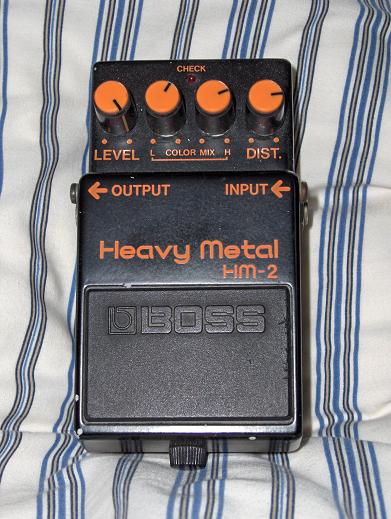
The Boss HM-2 Heavy Metal is a distortion pedal manufactured by Boss from October 1983 until October 1991. Designed to emulate a Marshall stack, it became associated with Swedish death metal and gained a cult following in the heavy metal scene.

Background

[edit]

The Boss HM-2 was first issued in October 1983. It was originally manufactured in Japan from 1983 until 1988 and then in Taiwan from 1988 until 1991.[1] It was designed to emulate the mid-range response of a Marshall stack.[2] The HM-2 is based on Boss's DS-1. Despite achieving moderate success in the glam metal scene, the pedal was discontinued in 1991; it was succeeded by the HM-3 Hyper Metal and MT-2 Metal Zone, the latter of which became a commercial success and top-selling Boss pedal.[2]

Since its discontinuance, the HM-2 has become one of the most demanded pedals of the Boss back catalogue.[3][1][2] Guitarist and record producer Kurt Ballou has been cited as an influence for the pedal's resurgence[4] and bands such as Nails and Rotten Sound have also appropriated the pedal's sound for different extreme metal styles.[5]

In 2020, Boss Corporation president Yoshi Ikegami announced that the pedal would be reissued as a part of the Waza Craft pedal series under the name Boss HM-2W. For the reissue, the company also established a Facebook group to seek design feedback from the fanbase.[6][5] The prototype of the HM-2W was tested by Ola Englund. The Waza Craft version added standard and custom mode to the Boss HM-2W.

Swedish death metal

[edit]
Boss HM-2 with maximum settings (colloquially referred to as being "dimed"). These settings became well known in the Swedish death metal scene to achieve the "Chainsaw" tone.

Leif Cuzner of Swedish death metal band Nihilist used the pedal with the controls "dimed," and bands like Entombed, Dismember, and Bloodbath followed suit. Many Swedish bands have used the HM-2 with a Peavey amp to achieve this sound. In the 1990s, the pedal attracted a cult following in the underground heavy metal scene due to its formative influence over the Swedish death metal sound.[7] Entombed's 1990 album, Left Hand Path, cemented its use in the scene.[6]

Anders Nyström of Bloodbath said, "The Boss HM-2 is the holy grail of death metal. There is no other pedal that has meant as much to this genre. It has been described as a chainsaw or a buzzsaw, and I think that’s a good comparison; it is a chainsaw formed into a guitar sound. How can you go further? How can you go beyond that? You can’t. It is the most essential sound in death metal of all time, and the bands who have adopted that were always going to be unbeatable in a sense. Other bands had outstanding performers and musicians, and kick-ass songs, but if they didn’t have that sound they were still sub-par in some way, and this pedal has meant everything."[8]

Controls

[edit]

According to Michael Astley-Brown of Guitar World, compared to the other distortion pedals, the pedal offered "radically versatile low and high ‘Color Mix’ EQ controls with 20 dB of boost/cut."[3]

Notable users

[edit]

See also

[edit]

References

[edit]
[edit]
Revisions and contributorsEdit on WikipediaRead on Wikipedia
from Grokipedia
The Boss HM-2 Heavy Metal is a compact effects pedal for electric guitars, manufactured by from 1983 to 1991, designed to emulate the aggressive tone of a high-gain Marshall stack and renowned for its signature "chainsaw" or "buzzsaw" sound that emphasizes jagged harmonics and a focused bite. Introduced in October 1983 as one of the earliest pedals specifically tuned for heavy metal, the HM-2 was initially produced in until 1988, after which manufacturing shifted to until its discontinuation in 1991, reflecting Boss's aim to provide portable, high-gain for mid-1980s rock and metal guitarists seeking an "amp in a box" solution without the bulk of traditional stacks. Its circuitry features an all-analog design with four main controls: a Level knob for output volume, a Dist knob for intensity (most effective when cranked to maximum), and dual Color Mix knobs for low-frequency adjustment centered around 100 Hz and high-frequency adjustment centered around 1 kHz, allowing tonal shaping with up to ±20 dB of boost or cut in those bands to create a scooped midbass response (~240 Hz cut) paired with enhanced vocal-range mids for a crunchy, articulate attack. Powered by a 9V battery or 12V DC adapter, the pedal's footswitch engages the effect, delivering a fuzz-like that prioritizes the fundamental frequencies of low guitar strings, particularly the low E, making it ideal for palm-muted riffs when paired with pickups. Though initially overlooked in favor of smoother overdrives during the hair metal era, the HM-2 gained legendary status in the late 1980s and early 1990s through its adoption in , most iconically powering the chainsaw guitars on Entombed's breakthrough album Left Hand Path (1990), where its extreme, transistor-esque fuzz and mid-forward aggression defined the genre's raw, grinding sound. Bands like further popularized it on tracks from (1995), often using the pedal as a boost into amplifiers or other effects for added saturation, while its influence extended to (e.g., ), hardcore (e.g., Black Breath), and modern metal production techniques at studios like GodCity with engineer . The pedal's cult following, driven by its unique inability to be perfectly replicated in digital form, led to widespread demand post-discontinuation, inspiring boutique clones from builders like Walrus Audio and Lone Wolf Audio, and prompting Boss to reissue an updated Waza Craft version (HM-2W) in 2021 that faithfully recreates the original analog circuit. Today, the HM-2 remains a benchmark for heavy distortion tones, symbolizing the dark, unrelenting edge of .

Development and History

Origins and Release

The Boss HM-2 Heavy Metal distortion pedal was developed by in the early 1980s as a high-gain effect unit designed to replicate the grind characteristic of a Marshall stack amplifier. The pedal's circuit incorporated modifications for heavier to deliver more aggressive tones suitable for the era's and early metal players. This "amp in a box" approach targeted guitarists seeking powerful, stack-like sounds in a compact format without relying on a full amplifier rig. Released in October 1983, the HM-2 quickly became available through Boss's distribution network. Initial production took place in from 1983 to 1988, after which manufacturing shifted to , continuing until the pedal's discontinuation in 1991.

Initial Reception and Discontinuation

Upon its release in 1983, the Boss HM-2 experienced modest commercial success during the , as it struggled to gain traction amid a competitive landscape of distortion pedals and a prevailing preference among rock guitarists for amp-based overdrive. Marketed initially toward the glam metal scene, the pedal's aggressive, fuzz-like tone did not resonate widely with mainstream players who favored the natural saturation of high-gain tube amplifiers over pedal-driven . This lack of immediate popularity contributed to underwhelming sales throughout the decade. The introduction of the Boss MT-2 Metal Zone in 1991 further eroded the HM-2's market position, as the newer pedal offered more versatile EQ controls and a tighter high-gain response that better aligned with evolving trends toward cleaner, more precise sounds from amplifiers. These shifting preferences, combined with the HM-2's niche appeal, led to declining sales toward the end of its run. Boss discontinued the HM-2 in October 1991 after approximately eight years of production, first in from 1983 to 1988 and then in until its end. Post-discontinuation, the pedal became increasingly rare on the , though surviving units remain relatively accessible due to the era's manufacturing scale. This marked a transition for Boss toward successors like the HM-3 Hyper Metal, which introduced enhanced modes to address the demands of modern metal tones.

Revival in the 1990s

In the late 1980s, Swedish bands began experimenting with the Boss HM-2's distinctive scooped EQ, which emphasized high and low frequencies to create highly aggressive guitar tones, generating initial underground buzz around 1989-1990. This experimentation occurred primarily at Stockholm's Sunlight Studios, where early adopters like Nihilist—a precursor to Entombed—incorporated the pedal into their demos, such as the 1989 release Only Shreds Remain, marking the pedal's shift from obscurity to a tool for raw, intense . A pivotal moment came with the release of Entombed's debut album Left Hand Path in June 1990, which popularized the HM-2's signature "chainsaw" or "buzzsaw" guitar sound through its heavy distortion and gritty texture. The album's production at Studios featured the pedal paired with Peavey amps and compression, influencing subsequent recordings by bands like Dismember on their 1991 debut . This sound spread rapidly across the European scene via tape trading and fanzines, amplifying the pedal's visibility beyond local circles. The HM-2's adoption also impacted production techniques, with engineers like Tomas Skogsberg employing direct recording methods—routing the pedal straight into the mixing console or through amps like the Peavey Studio Pro 40—to capture its grind and sustain without traditional cabinet miking in some cases. By the mid-1990s, this resurgence drove increasing demand and rising used market prices among collectors and musicians. By 1995, the pedal had achieved cult status, transitioning from a discontinued oddity to an iconic staple of the genre, as evidenced by its role in ' album , which extended the HM-2's influence into variations. This cultural shift underscored the pedal's enduring appeal in underground metal communities, fueled by its unique tonal character rather than mainstream commercial success.

Technical Design

Circuitry and Components

The Boss HM-2 pedal employs a core circuit utilizing three dual operational amplifiers, typically M5218L or NJM4558S, to handle gain and tone shaping stages. The is generated through a combination of transistor-based and op-amp clipping, featuring asymmetric soft clipping via diodes such as 1S2473 (equivalent to 1N914) in the feedback loop, alongside hard clipping diodes for more aggressive peak limiting. Additionally, a pair of diodes (1S188FM) in series with the signal path introduces subtle and acts as a basic , contributing to the pedal's characteristic buzzsaw tone. The EQ section consists of an active tone stack implemented with circuits—transistorized simulations of inductors—for precise frequency control without bulky components. The low-frequency control targets approximately 80-90 Hz, allowing boost or cut around the fundamental of the low E string, while the high-frequency control operates two simultaneous s centered at roughly 958 Hz and 1,279 Hz, providing up to ±10 dB adjustment and emphasizing upper mids. This design inherently includes a fixed mid-scoop of about -10 dB centered around 240 Hz, creating the pedal's signature "suspension bridge" frequency response curve with double-humped peaks at the lows and upper mids. The signal path begins with a input buffer (2SK30A) for matching, followed by a using NPN and PNP transistors (e.g., 2SC732 and 2SA970) that provides high levels of , then routes through the op-amp clipping and EQ filter before an output buffer with level attenuation. Power is supplied via a standard 9V DC battery or adapter, with a low current draw of approximately 10 mA, ensuring compatibility with typical pedalboard setups. Early Japanese-made versions of the HM-2 exhibit minor tonal variations compared to later Taiwanese productions, primarily due to differences in component tolerances such as values, which slightly shift EQ center frequencies (e.g., low-end response varying by 10-15% around 80-90 Hz). These discrepancies result in subtle differences in perceived aggression and clarity, though the core remains consistent across both.

Controls and Operation

The Boss HM-2 features four front-panel knobs that allow users to shape its distortion and tonal characteristics. The Distortion knob adjusts the gain level from 0% (clean signal with no overdrive) to 100% (maximum input clipping and saturation), controlling the intensity of the pedal's heavy distortion effect. The Low knob provides bass EQ adjustment, boosting or cutting frequencies around 80 Hz by approximately ±10 dB to emphasize or attenuate low-end response. The High knob offers treble/midrange EQ control, boosting or cutting frequencies around 1 kHz by ±10 dB, which helps sculpt the pedal's aggressive mid-forward bite rather than true high-end extension. Finally, the Level knob sets the output volume, providing up to +20 dB of boost to match or exceed the bypassed signal level. In addition to these adjustable controls, the HM-2 incorporates a fixed mid-scoop EQ curve in its internal circuitry, which inherently attenuates frequencies around 240 Hz for a scooped, metal-oriented tone without the need for additional switches or bands. This design element contributes to the pedal's signature aggressive sound profile, enhancing clarity in dense mixes. For basic operation, the HM-2 employs a buffered circuit rather than true bypass, which preserves but may slightly color the tone when disengaged. It is recommended to position the pedal early in the effects —typically after any tuner or buffer but before modulation, delay, or reverb effects—to allow its to interact optimally with subsequent pedals and the . Power the unit with a 9V battery or the official Boss ACA adapter (or compatible 9V DC center-negative supply) for reliable performance, and always unplug when not in use to conserve battery life. To achieve the classic HM-2 tone, representative settings include the knob at 70–90% for substantial overdrive, Low at around 80% to boost bass punch, High at 60% for midrange definition, and Level adjusted to unity gain (matching the bypassed ). These can be fine-tuned based on guitar, amp, and pickup type for optimal results. Common troubleshooting issues with the HM-2, particularly on units, include rapid battery drain due to aging electrolytic capacitors, which can be resolved by recapping or using an external . Hum or noise may arise from poor grounding in the or ground loops; check cable shielding, ensure proper power isolation, and test with a different outlet or to mitigate this. If op-amp clipping stages produce excessive noise, verify input levels are not overloading the pedal.

Musical Impact

Role in Swedish Death Metal

The Boss HM-2 pedal played a pivotal role in shaping the distinctive guitar tone of Swedish death metal during the early 1990s, particularly through its ability to produce a high-gain, harmonically rich distortion often dubbed the "buzzsaw" or "chainsaw" sound. This tone emerged from the pedal's circuitry, which emphasized boosted highs and mids while attenuating lows, creating a grinding, aggressive riff quality when settings were maxed out—typically with distortion, level, low EQ, and high EQ all at 10. Early adopters like the band Nihilist (a precursor to Entombed) incorporated the HM-2 into their demos from 1988 to 1990, experimenting with it to achieve a raw, abrasive edge that set the foundation for the genre's sonic identity. Key bands from the scene, such as Entombed, Dismember, and , prominently featured the HM-2 on landmark albums that defined the subgenre. Entombed's Left Hand Path (1990) and Clandestine (1991) showcased the pedal's signature grind on tracks like "Revel in Flesh," using it to drive simple, riff-heavy compositions with enhanced harmonics and sustain. Dismember followed suit on (1991), where guitarist David Blomqvist maxed the HM-2 for a relentless, fuzz-laden that amplified the album's themes of brutality. employed it on their debut (1991), pairing the pedal's roar with guttural rhythms to evoke a primal aggression central to the era's sound. These recordings, often produced at Studios under Tomas Skogsberg, solidified the HM-2 as the cornerstone of Swedish death metal's raw aesthetic. Production techniques amplified the HM-2's impact, with engineers like Skogsberg routing the pedal through modest amps such as Peavey combos or , miking them with an ATM41 for a direct, unpolished capture. Guitars were frequently double-tracked and panned hard left and right to widen the effect, often with a third track using a Boss DS-1 pedal centered in the mix for added clarity, sometimes with additional compression via units like the GC-2020 to tighten the tone without losing its ferocity. This approach contributed to the "Sunlight Sound," a lo-fi yet potent production style that prioritized aggression over polish. In the broader subgenre, the HM-2 was integral to Stockholm's raw, old-school aggression, contrasting with Gothenburg's more melodic variations from bands like In Flames, though both scenes drew from the pedal's versatility. The pedal's legacy endures in revival acts of the and beyond, influencing bands like , where guitarist layers three HM-2-driven rhythm guitars—two panned and one centered—for clarity and depth on albums evoking classic ferocity. Nyström credits the HM-2 with uniquely simulating a "" on heavy E-chords, a quality no other pedal-amp setup replicates, ensuring its ongoing role in preserving and evolving the genre's tonal hallmarks.

Usage in Other Genres

In the 1980s, the Boss HM-2 found early adoption in hard rock and adjacent heavy styles as a boost pedal to enhance overdriven amplifiers, particularly the , providing additional gain and midrange bite without overwhelming the amp's natural . This application allowed guitarists to achieve tighter, more aggressive tones suitable for the era's high-gain rock sounds, often by setting the distortion low and maximizing volume and EQ controls to push the front end of the amp. Beyond its metal roots, the HM-2 has been employed in for its abrasive, saturated textures, notably by the band , who integrated it into their recordings for a raw, punishing edge influenced by producer Kurt Ballou's affinity for the pedal. Ballou, guitarist for Converge, has championed the HM-2 in and hardcore contexts, using it to blend indie and elements through its scooped EQ and fuzzy overdrive, as demonstrated in his production work and GodCity Studio demos. In progressive and , utilized the HM-2 on his 1984 solo album About Face, pairing it with a amplifier for distorted solos that added a gritty, textured layer to his signature clean tones, such as in tracks like "Love on the Air." This non-traditional use highlighted the pedal's versatility for nuanced gain rather than extreme saturation. Modern experimental applications extend the HM-2 to setups, where its EQ scoop effectively cuts low-end boom around 200 Hz on direct-injected signals, delivering punchy while preserving clarity for genres like or . On pedalboards, it serves as a preamp or always-on dirt for subtle grit, often stacked before fuzz pedals like the to layer gain stages and create complex, harmonically rich overdrives that enhance midrange definition.

Reissues and Variants

Official Reissues

In November 2020, announced the reissue of the HM-2 as part of its premium Waza Craft series, named the HM-2W Heavy Metal, following strong fan demand for the original pedal's revival. The pedal was released in August 2021, incorporating modern enhancements while preserving the iconic distortion characteristics. Priced at $179.99 USD upon launch, it remains available through major retailers as of 2025, with no indications of discontinuation and only minor cosmetic refinements to the enclosure. The HM-2W introduces two operational modes via a rear-panel switch: Standard mode, which faithfully replicates the original HM-2 circuit with a lower and an additional 3 dB of output gain for improved clarity, and Custom mode, which expands the EQ range for greater low-end response and overall versatility in tone shaping. It also features a buffered bypass to maintain in pedal chains, premium Japanese-made components for enhanced durability, and a 9V compatible with standard adapters, addressing some reliability concerns of the vintage model such as voltage inconsistencies. These upgrades ensure the core "" tone is retained while providing modern stability, without the battery compartment vulnerabilities reported in older units. Development of the HM-2W involved community feedback solicited by Boss through its official group in late 2020, with prominent users like guitarist contributing to prototype testing in early 2021. Englund, known for his expertise in heavy metal tones, demonstrated the prototype's fidelity to the original sound while highlighting the new modes' expanded capabilities. No major variants beyond the initial HM-2W have been introduced, keeping the focus on this single, actively produced model.

Third-Party Clones and Mods

Due to the scarcity and high prices of original Boss HM-2 pedals on the , third-party manufacturers have produced numerous clones replicating its distinctive scooped EQ and high-gain circuit. The HM300, priced at approximately $30, is a budget-friendly option that closely emulates the HM-2's tone stack, offering similar heavy metal aggression with controls for , low, mid, and high frequencies, though its plastic enclosure is less durable than the original. Similarly, the TC Eyemaster provides a compact, fixed-EQ clone with the HM-2's "chainsaw" sound baked in at maximum settings, allowing integration into setups needing a clean boost or EQ boost alongside , and it has been praised for its accurate reproduction when paired with external EQ adjustments. Boutique offerings expand on the HM-2 design with modern enhancements for greater versatility. The , at around $220, captures the cranked HM-2's pulverizing tone while adding expanded controls for gain staging and a more articulate high-end response, making it suitable for broader heavy music applications beyond strict replication. Released in early , the Sketchy Sounds STAAAHHP!! incorporates the core HM-2 circuit with added modern tweaks like a feedback loop for increased chaos and sustain, available in standard and mini enclosures to suit various pedalboards, and it emphasizes higher gain levels for tones. Common modifications to original HM-2 units or clones focus on enhancing usability and tone without altering the fundamental circuit. Enthusiasts often add internal switches for mid-boost functionality to counteract the pedal's inherent EQ scoop, install true bypass switching to preserve signal integrity, or swap clipping diodes—such as replacing stock silicon with LEDs—for hotter, more aggressive gain stages that increase sustain and clarity. These mods are typically performed by specialized technicians using higher-quality components to reduce noise and improve fidelity. The proliferation of these clones and mods has been fueled by the original HM-2's discontinuation and rising collector values, often exceeding $250 for vintage units, leading to a boom in affordable alternatives within niche heavy metal communities where the pedal's iconic sound remains highly sought after. Quality among clones varies, with some overseas replicas, including those from Taiwanese builders, noted for their authentic component matching and build reliability despite lacking official endorsement.

References

Add your contribution
Related Hubs
User Avatar
No comments yet.