Hubbry Logo
Roland SP-404Roland SP-404Main
Open search
Roland SP-404
Community hub
Roland SP-404
logo
8 pages, 0 posts
0 subscribers
Be the first to start a discussion here.
Roland SP-404
Roland SP-404
from Wikipedia
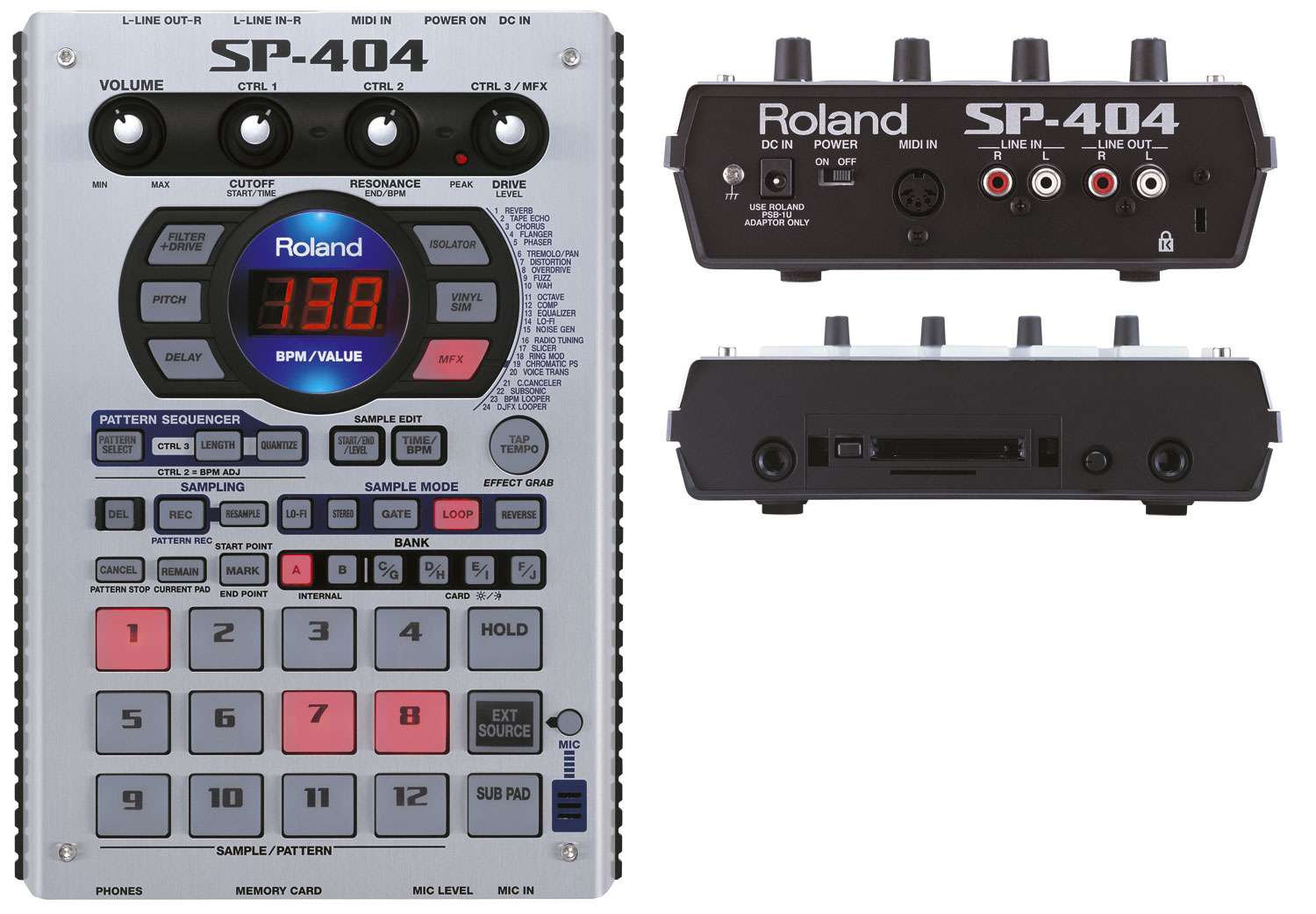
Roland SP-404 Sampling Workstation
Classification Electronic sampler
DevelopedRoland Corporation (2005)

The Roland SP-404 Sampling Workstation is a sampler made by Roland Corporation. Released in 2005,[1][2] it is part of the SP family of products and is the successor to Boss Corporation’s SP-505 sampler. The sampler was succeeded by the SP-555 in 2008, but was later given its own upgrade as the Roland SP-404SX Linear Wave Sampler in 2009.[3] Another upgrade, the Roland SP-404A Linear Wave Sampler, was released in 2017. A third upgrade, the SP-404MKII was released in 2021.[4] The Roland SP-404 has played a huge role in influencing the sound of the popular hip hop subgenre known as lofi hip hop.[5]

Features

[edit]
SP Lineage

The following list is a correct order of each installment's release, as an attempt to help musicians avoid any confusion.

OG / SX / A

[edit]

Having the traditional features of the Roland Grooveboxes, the 404 has the ability to record audio directly via line/mic, or import/export industry-standard WAV and AIF files via CompactFlash card.[6] An onboard pattern sequencer allows up to 8,000 notes to be recorded in real time.

Pattern data can be quantized and up to 24 patterns, each 1–99 measures long, can be stored in the internal memory. Using a 1GB CompactFlash card, sampling times can be as long as approximately 772 minutes in Lo-Fi mode, or up to 386 minutes long in Standard mode.

However, the 404 (along with its own upgrades) lacks the D-Beam feature of the previous SP-808 and SP-606 installments. Although the first bank comes with preset samples that are protected, these samples can be removed by holding "cancel" as you turn it on. This allows you to delete the samples from the protected bank.

The release of the 404SX in 2009 introduced the change from CompactFlash cards to SD cards, along with additional features, faster processing and changes to the in-built quantization system.[7] The 404A introduced cross-compatibility with the Roland TR-8.[5][8]

MKII

[edit]

Released in 2021, the 404MKII was a significant upgrade, while retaining the unit's original form factor. Among the new features were an OLED display capable of showing sample waveforms, 16 GB of internal memory, USB-C and 32-note polyphony. The device was also given a new "Skip Back Sampling" feature with the addition of a "Mark" Button. This feature provides users the option to record the most recent 40 seconds of usage with the press of the button. In 2023 was released a Stone Throw Records Limited Edition. [9][10]

[edit]

A number of musicians have used either the SP-303 and/or the SP-404 as part of their production and performance.

These include Jel, Odd Nosdam, Alias, J Dilla, Madlib, JPEGMAFIA, Joji, MF Doom, Jneiro Jarel, Milo, Flying Lotus,[11] James Blake, Samiyam, Ras G, Teebs, Grimes, Pictureplane, Four Tet, Beck Hansen, Antonio Planta, Bradford Cox of Deerhunter and Atlas Sound, Radiohead, Animal Collective, Spindrift, Toro y Moi, Broadcast, John Maus, Ellie Goulding, El Guincho, Illmind, Dibia$e,[12] Jim James of My Morning Jacket, Oneohtrix Point Never (Daniel Lopatin), Matt Mondanile of Ducktails, Devo, Mad Professor, and many others.

References

[edit]

Further reading

[edit]
[edit]
Revisions and contributorsEdit on WikipediaRead on Wikipedia
from Grokipedia
The Roland SP-404 is a portable sampling workstation developed by Roland Corporation, released in 2005 as the successor to the earlier SP-303 model, designed primarily for live beatmaking, DJ performances, and music production with its compact, battery-powered form factor and intuitive interface. It features 12 velocity-sensitive trigger pads, a built-in microphone for direct sampling, 29 onboard effects including reverb, delay, and lo-fi processing, and support for importing/exporting WAV and AIFF files via CompactFlash cards up to 1GB in capacity, enabling up to 386 minutes of CD-quality mono sampling time. The device includes a pattern sequencer for real-time loop recording, sample editing tools, and 12-voice polyphony, making it a versatile tool for hip-hop, electronic, and experimental music creation. The SP-404 series evolved through several iterations to address user feedback and technological advancements, with the SP-404SX released in featuring expanded sample memory, improved sound quality, and faster support for live performance optimization. In 2017, the SP-404A introduced a new color scheme with green-backlit pads aligned with Roland's AIRA line, mapping compatibility for integration with drum machines like the TR-8, and retained all prior capabilities while enhancing portability. The modern SP-404MKII, launched in 2021 after a 12-year gap from the SX, preserved the core workflow of the original while incorporating higher-fidelity audio, expanded effects for genres like house and , and software updates through 2025 that added features such as advanced sequencing and connectivity options. Renowned for its warm, organic sound and gritty aesthetic reminiscent of early hip-hop production, the SP-404 gained cult status among beatmakers and artists like and , influencing lo-fi and beat culture by enabling hands-on, tactile sampling without reliance on computers. Its development emphasized community input, transitioning from a niche DJ tool to a staple in production, with ongoing updates ensuring relevance in professional workflows.

History and development

Origins in the SP series

The SP-404 emerged from a lineage of compact samplers developed by and its Boss subsidiary, with conceptual roots in the company's early phrase sampling innovations. The series traces its immediate predecessor to the MS-1 Digital Sampler, released in 1994 as a keyboard-less, pad-based device optimized for quick phrase capture and lo-fi processing at rates like 16 kHz, establishing a design philosophy centered on portability and real-time manipulation for live performance and beat creation. The SP series proper began under the Boss brand with the SP-202 Dr. Sample in 1998, a battery-powered, portable that prioritized DJ-friendly looping and basic effects such as filters, delay, and , enabling musicians to sample and process audio on the go without complex setups. This model laid the groundwork for the series' emphasis on accessibility, influencing the integration of sampling with onboard effects in later iterations. A pivotal advancement came with the Boss SP-303 Dr. Sample in 2001, which refined the portable format through 16-bit sampling at 44.1 kHz for CD-quality capture, eight-note polyphony, and pattern sequencing capabilities that allowed users to build loops and beats intuitively via a grid-based interface. The SP-303 also introduced enhanced effects integration, including vinyl simulation, compression, and reverb, which amplified the lo-fi, gritty sound palette favored in hip-hop production while maintaining battery operation for fieldwork and studio sketching. In the early , Roland's development efforts, led by engineers such as Kenji —who drew from the MS-1's phrase-sampling heritage and the SP series' ethos—shifted toward creating effects-heavy, compact workstations that democratized sampling for emerging hip-hop and electronic producers seeking tactile, portable tools beyond traditional rackmount gear. This evolution reflected Roland's response to the growing demand for devices that blended sampling, sequencing, and real-time effects in a single, user-friendly package, setting the stage for the SP-404 as a refined extension of these foundational principles.

Release and evolution

The SP-404 was released in July 2005 as a successor to the SP-303, positioned by as a portable "Sampling " aimed at enabling musicians to capture, manipulate, and perform samples in real-time during mobile production sessions. This launch built briefly on the SP series' origins in the late 1990s as compact grooveboxes for beatmaking, but focused on enhancing portability and workflow for emerging digital creators. Subsequent iterations marked key evolutionary steps in the line's development. The SP-404SX arrived in late , introducing hardware upgrades such as storage and accelerated processing to address limitations in the original model's speed and capacity. In August 2017, Roland unveiled the SP-404A, a compact, battery-powered variant optimized for integration with the AIRA series of live performance gear and enhanced by software features for seamless looping and effects, though it was not distributed in . The SP-404MKII followed in November 2021, bringing modern enhancements like 16 GB of internal storage, expanded , and advanced connectivity to support contemporary beatmaking demands. The SP-404 series gained enduring market traction, culminating in 2025's 20th anniversary celebrations that highlighted its influence on global beat culture. marked the occasion with "404 Day" events held worldwide during the week of April 4, featuring live performances, workshops, and artist showcases across locations like , , and , alongside giveaways of related gear. Complementing these festivities, a free update to Version 5 for the SP-404MKII introduced native integration with DJ software, allowing the device to function as a controller for DJ Lite, DJ Pro, and Studio editions without additional drivers. Launched amid the mid-2000s shift from analog vinyl sampling to digital workflows, the SP-404 addressed a market need for an accessible, tactile sampling device that democratized hands-on production for hip-hop and electronic artists transitioning away from record-based techniques. Its sub-$500 and compact design made high-quality sampling viable for bedroom producers and live performers alike, sustaining the SP series' legacy in an increasingly software-dominated landscape.

Models

SP-404 (2005)

The Roland SP-404, released in 2005, was designed as a compact, portable sampler intended for live performances and quick studio idea sketching, building on the workflow of its predecessor, the SP-303, while expanding capabilities for beatmakers and producers. It features 16-bit/44.1 kHz sampling quality, allowing users to capture audio via its built-in or external inputs, with support for up to 96 samples stored across 12 velocity-sensitive pads in 8 banks. The device includes a 4-track pattern sequencer capable of recording up to 8,000 notes in real time, with quantization options for precise playback, enabling users to build loops and arrangements . Hardware-wise, the SP-404 emphasizes portability with dimensions of 178 mm (width) x 257 mm (depth) x 72 mm (height) and a weight of 1.3 kg, making it easy to transport for impromptu sessions. It operates on six AA batteries for up to 6 hours of use or via an included (PSB-1U), supporting fieldwork without reliance on mains power. The unit's interface centers around 12 large trigger pads, three assignable control knobs for real-time parameter tweaks, and a backlit LCD display for intuitive navigation, fostering a hands-on approach to sampling and sequencing. A defining characteristic of the original SP-404 is its signature lo-fi aesthetic, achieved through features like resampling—which allows processed audio to be re-recorded as new samples—and chaining of up to 29 onboard DSP effects, such as vinyl simulator and tape echo, to create layered, gritty textures reminiscent of analog warmth. This approach became a staple for beatmakers seeking organic, imperfect sounds in hip-hop and electronic production. Production of the SP-404 ran from its launch until it was succeeded by the SP-404SX model offering enhanced connectivity like USB. Despite its discontinuation, the original remains highly sought after in second-hand markets for its distinctive lo-fi character and reliable performance, often praised for delivering an analog-like warmth in a digital package.

SP-404SX (2009)

The SP-404SX, released in 2009, served as a refined successor to the original SP-404, incorporating upgrades that enhanced audio fidelity and usability while preserving the compact, battery-powered design favored by mobile producers. Key improvements included 16-bit linear PCM sampling at 44.1 kHz, which delivered clearer, CD-quality recordings via the built-in stereo microphone or external inputs, moving beyond the original model's more compressed lo-fi character. Storage capacity saw a major boost with support for SD/SDHC cards up to 32 GB, enabling up to 96 hours of mono or 48 hours of stereo recording time depending on card size—for instance, the included 1 GB card provided about 180 minutes of mono sampling—far exceeding the original SP-404's internal limit of roughly 12 minutes mono without external media. Connectivity options expanded to include RCA phono line inputs/outputs for stereo integration, a 1/4-inch mic input compatible with dynamic microphones, MIDI IN for sequencer control, and a stereo 1/4-inch headphone jack, all powered by six AA batteries for approximately five hours of use or an optional AC adapter. These changes made the SP-404SX more versatile for field recording and live setups without sacrificing portability. The effects suite was expanded to 29 DSP types, featuring refined options such as multiple reverbs (e.g., hall and plate), delays (including tape and multi-tap), filters, and specialized processors like the DJFX Looper for seamless looping during performances; effects could switch smoothly in real time without glitches. Real-time resampling allowed users to process audio through effects and capture the result as a new sample directly on the device, streamlining creative workflows for layering and manipulation. Physically, the unit featured 12 velocity-sensitive trigger pads for dynamic playback, a larger 7-segment, 3-character for improved navigation over the original's simpler readout, and a slightly increased weight of 1.2 kg (excluding batteries) for added durability; it shipped with a protective carrying case to facilitate on-the-go use. Positioned as a response to user feedback seeking better sound quality and expandability, the SP-404SX bridged the original's pioneering portability with demands for professional-grade tools, becoming a staple in mid-2010s beatmaking and electronic music production scenes among DJs and hip-hop artists who valued its hands-on interface and reliable performance.

SP-404A (2017)

The SP-404A, released in July 2017, represents an evolution in the SP series by emphasizing portability and integration with 's AIRA ecosystem, particularly as a companion to the TR-8 Performer for live performances and beatmaking. Building on the hardware foundation of the SP-404SX predecessor, the SP-404A retains core functionalities like 16-bit linear sampling and onboard DSP effects while adopting a more streamlined design suited for on-the-go production, including a built-in for quick field recordings. At its core, the SP-404A supports 16-bit/44.1 kHz sampling in /AIFF formats, with a maximum of 12 voices and capacity for 120 samples across 10 banks. It uses SDHC cards up to 32 GB for storage, enabling extended recording times—up to approximately 48 hours of audio or 96 hours mono across all samples, far surpassing earlier models' limitations and allowing hours of material for looping and sequencing. The unit ships with a 1 GB preloaded with over 100 high-quality samples curated by Loopmasters, facilitating immediate creative use without additional setup. Complementing its hardware, the SP-404A integrates with Roland's free SP-404SX Wave Converter software for Mac and Windows, which streamlines sample import, editing, and organization by transferring audio files directly to the and assigning them to pads—a hybrid approach that bridges standalone operation with desktop workflow efficiency. Hardware enhancements prioritize mobility, with dimensions of 178 × 257 × 73 mm and a weight of 1.2 kg (excluding ), powered by six AA batteries for up to 5 hours of continuous use on rechargeable Ni-MH cells (or 4 hours on alkaline). Connectivity options include RCA line in/out jacks, a 1/4-inch mic input, stereo headphones output, in for synchronization with devices like the TR-8, and the slot, all optimized for battery-powered, cable-minimal setups in mobile production scenarios.

SP-404MKII (2021)

The SP-404MKII, released in 2021, represents a significant evolution in the SP series, introducing advanced sampling and effects capabilities while maintaining portability for beatmakers and performers. It features 32-bit floating-point internal processing for effects, enabling manipulation without clipping during intensive operations, and supports sample rates up to 48 kHz with 16-bit, 24-bit, or 32-bit floating-point formats. The device includes 16 GB of internal flash storage, providing approximately 14 GB usable for samples, allowing up to 160 samples per project across 16 projects, with each pad capable of holding up to 16 minutes of stereo audio or 185 MB of data. Chromatic and scale modes enable melodic sampling, where users can play samples pitched to a or specific scales (such as major, minor, or custom) using the 17 velocity-sensitive pads, facilitating tuned and resampling in key. Hardware enhancements position the SP-404MKII as a versatile standalone unit and audio interface, with inputs including a 1/4-inch line/instrument jack, a dedicated mic input with preamp and +48V , and resampling capabilities for direct recording. Outputs comprise stereo 1/4-inch line outs, dual 1/8-inch headphone jacks, and a 1/8-inch sub out for enhanced low-end monitoring, alongside a built-in speaker for on-the-go playback. Connectivity extends to I/O via 1/8-inch TRS jacks, for audio/ streaming and power, and support (up to 1 TB for expanded storage). The unit measures 177.5 x 275.8 x 70.5 mm and weighs 1.1 kg, powered by AC adapter, , or six AA batteries for mobile use. Firmware updates have continually expanded functionality, with Version 5.00 (April 2025) introducing native integration with Serato DJ Lite, Serato Studio, and Serato DJ Pro (via paid upgrade), allowing the SP-404MKII to function as a hardware controller for DJ workflows, including sample triggering and effects mapping. This update also enhances looper capabilities, such as improved real-time loop recording with undo/redo and BPM sync. Subsequent Version 5.01 (July 2025) added minor functionality improvements, including better stability for Serato operations and pattern export options. These updates build on earlier versions, like 4.04, which refined pattern chaining and stem isolation. The design philosophy of the SP-404MKII balances the lo-fi aesthetic of earlier models with modern high-resolution production tools, featuring a vivid display for waveform editing and a detachable aluminum faceplate for customization. It includes 37 multi-effects in the MFX1 category (such as Vinyl Sim, Cassette Sim, Resonator, and ), plus additional input, master, and DJ effects for creative . The pattern sequencer supports up to 16 patterns per project, with chaining capabilities for sequences up to 99 steps, TR-REC step input, and motion recording for automating effects and parameters, enabling complex beat construction in a compact form factor.

Technical specifications

Sampling capabilities

The Roland SP-404 series enables real-time sampling via dedicated line and inputs, allowing users to capture audio directly into the device. The original model operates at a 44.1 kHz sampling frequency with 24-bit AD/DA conversion, supporting STANDARD mode for higher fidelity and LO-FI mode for reduced resolution. Subsequent models evolved this foundation: the SP-404SX and SP-404A employ 16-bit linear sampling at 44.1 kHz, while the SP-404MKII advances to 16-bit linear at 48 kHz for enhanced clarity. Across all variants, the sampling engine includes time-stretching functionality that adjusts sample duration without altering pitch, facilitating flexible manipulation during capture or editing. is 12 voices in the original, SX, and A models, expanding to 32 voices in the MKII for more complex layering. Sample memory and organization emphasize efficient , with up to 96–120 samples storable across banks (depending on the model), assignable to the device's velocity-sensitive for intuitive playback and performance. The SP-404MKII organizes samples into projects, each supporting up to 160 samples. Users can employ slicing modes, such as auto-slice, to automatically divide loops or phrases into triggerable segments across , streamlining beat creation from longer recordings. Export options support and AIFF formats, enabling seamless integration with external digital audio workstations. The SP-404MKII expands this with 16 GB of internal storage, supporting up to 2,560 samples across multiple projects. Lo-fi emulation forms a core aspect of the SP-404's sampling identity, with dedicated modes applying bit-crushing and sample rate reduction to impart a characteristic gritty texture. In the original model, the LO-FI mode downsamples to emulate 12-bit depth and lower rates, producing the warm, distorted tones synonymous with the device's sound. Later iterations retain this heritage through adjustable parameters that replicate vintage digital limitations, ensuring the signature lo-fi aesthetic remains accessible during sampling. Resampling tools enhance creative layering by allowing users to record the device's output—including processed audio—directly back as a new sample, building complex sounds iteratively without external gear. This integrates with the onboard sequencer, which supports real-time loop recording and step input for constructing beats from sampled phrases, fostering a self-contained production environment.

Effects and processing

The SP-404 series features a comprehensive built-in effects library that enables creative , with 29 effects available in the original model, SP-404SX, and SP-404A, expanding to over 40 in the SP-404MKII. These include essentials like reverb, chorus, delay, and for dynamic control, alongside specialized processors such as filter+drive, isolator, DJFX looper, and BPM looper for rhythmic and performance-oriented manipulation. Multi-effects (MFX) categories encompass modulation (e.g., flanger, phaser), (e.g., overdrive, fuzz), and spatial tools (e.g., tape , subsonic), with per-pad assignment allowing individual samples to receive tailored processing. Processing chains support flexible signal routing, where effects can be applied serially or in parallel to samples or the overall mix, often via assignable buses or direct buttons for real-time switching without interruption. Mastering-oriented effects like EQ and limiter integrate into output chains to shape full-mix dynamics, while resampling captures processed audio as new samples for further layering. In the SP-404MKII, enhanced routing options (e.g., TYPE A/B configurations for BUS 3/4) and 32-bit floating-point internal processing provide extended headroom, minimizing clipping during intensive effect chains. Signature lo-fi effects simulate vintage degradation through bit reduction, noise generation, and vinyl or cassette simulation, evoking the gritty character of early samplers while preserving creative flexibility. For live use, parameters such as , , depth, and feedback are adjustable via front-panel knobs for intuitive tweaking, with USB or footswitch integration enabling hands-free control of effect engagement and modulation during performances. A is available in select effects for the SP-404SX and SP-404A to prevent overload when processing external audio, supporting standalone use as an .

Hardware and connectivity

The Roland SP-404 series features a compact, rugged designed for portability and durability in live and studio environments, with dimensions typically measuring around 178 mm in width, 257–276 mm in depth, and 60–73 mm in height across models, and weights ranging from 1.1 to 1.4 kg excluding the AC adapter. The original SP-404 (2005) and SP-404A (2017) share nearly identical dimensions of 178 x 257 x 72–73 mm and weigh 1.2–1.3 kg, while the SP-404SX (2009) is slightly slimmer at 178 x 259 x 60 mm and 1.4 kg, and the SP-404MKII (2021) measures 177.5 x 275.8 x 70.5 mm at 1.1 kg, maintaining a lightweight profile suitable for handheld use. User interface controls emphasize tactile performance, centered on velocity-sensitive rubber pads for triggering samples and , with 12 pads in the original SP-404 and SP-404SX; 12 pads plus a sub-pad in the SP-404A; and 16 pads plus a sub-pad in the SP-404MKII for greater flexibility in beatmaking. Each model includes dedicated knobs for real-time effects manipulation—typically three or four per bank—alongside sequencer buttons for recording and playback, and navigation via buttons and a jog wheel or encoder. Displays evolve from a basic backlit LCD or 7-segment LED in earlier variants to a full-color graphic screen in the SP-404MKII, enabling visualization and intuitive access without compromising the series' portable ethos. Power options prioritize mobility, with all models supporting six AA alkaline or Ni-MH batteries for approximately 4–6 hours of operation, alongside an included for extended sessions; the SP-404MKII adds USB bus power via its Type-C port, extending runtime when connected to a host device, though battery life drops to 2.5–3.5 hours under heavy use. Connectivity has progressed to enhance integration with modern setups, starting with the original SP-404's analog-focused ports: stereo RCA line inputs and outputs, a 1/4-inch mic input, stereo miniature headphone output, In, and a card slot for storage. The SP-404SX introduces balanced options with a stereo mini line input, 1/4-inch mic input, RCA line outputs, 1/4-inch headphone output, In/Out, and USB for computer-based , plus phantom power support on the mic input for condenser microphones. Subsequent models build on this: the SP-404A retains RCA line I/O, adds a 1/4-inch headphone output and In, and upgrades to an slot, while the SP-404MKII shifts to professional 1/4-inch TRS line inputs/outputs, a versatile 1/4-inch TRS mic/guitar input, dual headphone outputs, mini-jack In/Out, for audio/ interfacing and charging, and for wireless sample import, enabling seamless DAW connectivity and mobile device pairing. Standard accessories across the series include the and , with the SP-404A bundling a 4 GB and the SP-404MKII providing a quick-start guide and registration card; optional items like carrying cases and cables are available for enhanced protection and setup.

Usage and cultural impact

In music production

The Roland SP-404 series is widely employed in music production for live sampling, particularly in creating hip-hop beats through on-the-fly capture of vinyl records, field recordings, or loops, enabling producers to build rhythmic foundations directly from external sources. Its built-in pattern sequencer supports real-time loop recording and step input for creating patterns with A/B variations, enabling dynamic song structures through chained patterns, while onboard looping facilitates instant phrase repetition without external software. This setup promotes a hands-on, portable suited to mobile production environments, such as sketching ideas during travel or performances. In typical workflows, producers chop imported or resampled audio into individual pads—up to 160 samples across banks in later models—using manual slicing, transient detection, or even divisions to rearrange elements into new compositions. Layering follows by applying effects chains, such as filters, delays, and lo-fi processors, to generate textured sounds; for instance, resampling a processed loop back onto a pad creates evolving layers that can then be exported as stems for integration into workstations like . The tactile pad interface and real-time parameter tweaks encourage iterative experimentation, where patterns are chained into full arrangements and motion-recorded effects automate builds and drops. The device's strengths shine in genres like instrumental hip-hop, electronic, and , where its intuitive, velocity-sensitive pads and rapid resampling enable quick iteration on chopped samples for gritty, organic textures without menu-diving complexity. In lo-fi production, the analog-style modeling effects, including vinyl simulation and cassette emulation, impart warm degradation to samples, fostering a nostalgic aesthetic central to these styles. Early models, such as the 2005 SP-404, feature stereo line outputs (L/R), though mono sampling requires panning or effects for full during monitoring or mixing. For optimal mobile setups, best practices include using high-capacity alkaline AA batteries to achieve approximately six hours of continuous operation, and powering via for extended studio sessions to prevent from low battery levels. The Roland SP-404 has been embraced by prominent producers in the beatmaking and hip-hop scenes, particularly those associated with the label and lo-fi aesthetics. Dibia$e utilized the SP-404 during the MySpace-era for crafting intricate beats, highlighting its portability in early digital production workflows. incorporated it into his experimental releases, leveraging the sampler's lo-fi grit for cosmic hip-hop textures. In the lo-fi hip-hop realm, Elaquent and Ohbliv adopted the SP-404 (including SX and A variants) as core tools for their mellow, jazz-infused productions, influencing the genre's signature warmth. The SP-404's cultural footprint expanded in the through beatmaker communities, where tutorials popularized its use for live sampling and beat flipping, democratizing access to professional-grade production. It also shaped aesthetics, as seen in George Clanton's ESPRIT 空想 project, where he toured exclusively with the SP-404SX for two years to manipulate samples into chopped-and-screwed tracks on the 2017 album 200% Electronica. Since 2019, global "404 Day" events—held annually on —have celebrated the device's legacy with beat battles, workshops, and performances in cities like and , fostering international collaboration among producers. In media, the SP-404 featured prominently in Roland's 2019 documentary-style video Beat Culture & the SP-404, which explored its role in ' underground hip-hop scene through interviews with Dibia$e, , and . It has appeared in broader lo-fi hip-hop documentaries highlighting hardware's influence on and beat culture. For Roland's 2025 promotions marking the SP-404's 20th anniversary, the device was central to worldwide events and updates, tying it to two decades of innovative sampling in electronic music. The device's community impact is evident in dedicated online spaces where users exchange modifications—such as enhanced output jacks and custom effects chains—alongside sample packs and technique guides, sustaining its relevance among DIY producers. This grassroots ecosystem, amplified by Roland's official Beat Maker Sample Packs, has enabled shared workflows that extend the SP-404's creative potential beyond stock features.

References

Add your contribution
Related Hubs
User Avatar
No comments yet.