


Community hub
Recent from talks
Contribute something
Nothing was collected or created yet.
Brett Halsey
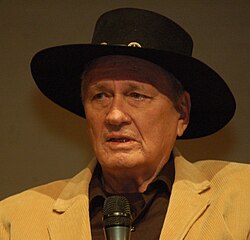
View on WikipediaBrett Halsey (born Charles Oliver Hand; June 20, 1933)[1] is an American former film actor, sometimes credited as Montgomery Ford. He appeared in B pictures and in European-made feature films. He originated the role of John Abbott on the soap opera The Young and the Restless (from May 1980 to March 1981).[2]
Key Information


Halsey is a great-nephew of the United States Navy Admiral William F. Halsey Jr., also known as Bull Halsey, commander of the Pacific Allied naval forces during World War II. Universal Pictures selected Brett Halsey's acting name from the admiral.[3]
Career
[edit]Interested in acting since he was a child, young Brett was employed as a page at CBS Television studios, where he met Jack Benny and Benny's wife, Mary Livingstone, who presented him to William Goetz, the head of Universal Pictures, who placed him in a school with other aspiring actors for the studio.[4]
Halsey served in the U.S. Navy during the Korean War, working as a disc jockey.[5]
Halsey appeared as Swift Otter, a Cheyenne Indian in the 1956 episodes "The Spirit of Hidden Valley" and "The Gentle Warrior" of the CBS Western series, Brave Eagle.[citation needed] In that same year he played "Elser" (a troubled teen cowboy) in James Arness's TV Western series Gunsmoke.[6] In 1958, Halsey guest-starred several times as Lieutenant Summers in Richard Carlson's syndicated Western series, Mackenzie's Raiders, a fictional account of cavalry Colonel Ranald S. Mackenzie, set at Fort Clark, Texas.[citation needed] That same year, Halsey had the lead role of a life-saving sailor in an episode of another syndicated series, Highway Patrol.[7] He also appeared in Harbor Command, a military drama about the U.S. Coast Guard.[8] He appeared as Robert Finchley in the 1958 Perry Mason episode, "The Case of the Cautious Coquette",[9] and starred in the Roger Corman teen flick The Cry Baby Killer. In 1959, he had a co-starring role in the science-fiction film The Atomic Submarine. Halsey appeared in the episode "Thin Ice" in 1959 of Five Fingers.[10]
Halsey played supporting and co-starring roles in Hollywood, having appeared in such films as Return of the Fly (1959), Jet Over the Atlantic (1959), The Best of Everything (1959), Return to Peyton Place (1961) and Twice-Told Tales (1963). By the early 1960s, he relocated to Italy where he found himself in demand in adventurous films such as Seven Swords for the King (1962) or The Avenger of Venice (1964), being often cast a swashbuckling hero. He also appeared in a few Spaghetti Westerns and Eurospy films, including Espionage in Lisbon (1965), Kill Johnny Ringo (1966), Today We Kill, Tomorrow We Die! (1968), All on the Red (1968), Twenty Thousand Dollars for Seven (1969) and Roy Colt and Winchester Jack (1970), sometimes using the name Montgomery Ford.
He returned to the United States in the early 1970s and worked in film and television. He appeared in the serials General Hospital and Love Is a Many Splendored Thing, and films such as Where Does It Hurt? (1972) with Peter Sellers. He had supporting roles in higher-profile films such as Ratboy (1986) and The Godfather Part III (1990), and worked with Italian horror director Lucio Fulci on The Devil's Honey (1986), Touch of Death (1988),[11] A Cat in the Brain (1990) and Demonia (1990). He also appeared as the captain of a luxury space liner in the Buck Rogers in the 25th Century episode "Cruise Ship to the Stars",[12] and the Columbo episode "Death Lends a Hand".[13] Later roles include Beyond Justice (1992), starring Rutger Hauer, Expect No Mercy (1995), and the TV movie Free Fall (1999).[2]
Personal life
[edit]In 1954, Halsey married Renate Hoy, an actress who had won the Miss Germany contest that year, and who appeared in such films as The Sea Chase with John Wayne. They had two children, son Charles Oliver Hand, Jr. and daughter Tracy Leigh. Halsey and Hoy divorced in 1959. As an adult, their son Charles, known as "Rock Halsey" and "Rock Bottom", was a member of the Los Angeles–based punk rock band Rock Bottom & The Spys.[14] Charles was murdered in prison while serving a 25-year sentence for drug-related crimes.[14]
From 1960 to 1962, Halsey was married to Italian actress Luciana Paluzzi. They had one son, Christian. In 1961, they co-starred as a newlywed couple in the film, Return to Peyton Place. In 1964, Halsey married the popular German actress and singer Heidi Brühl. They had two children, son Clayton Alexander Siegfried and daughter Nicole. They were divorced in 1976. Toward the end of the 1990s, Halsey moved to San José, Costa Rica, to teach film acting. He now[when?] resides in Laguna Hills with his fourth wife, Victoria (née Korda), granddaughter of Alexander Korda. He writes and makes occasional film appearances.[citation needed]
Filmography
[edit]Film
[edit] |
- The Glass Web (1953) as Lou, TBC Receptionist (uncredited)[2]
- Ma and Pa Kettle at Home (1954) as Elwin Kettle
- To Hell and Back (1955) as Saunders
- High School Hellcats (1958) as Mike Landers
- The Cry Baby Killer (1958) as Manny Cole
- Lafayette Escadrille (1958) as Frank Baylies
- Speed Crazy (1959) as Nick Barrow
- Return of the Fly (1959) as Philippe Delambre
- The Best of Everything (1959) as Eddie Harris
- Jet Over the Atlantic (1959) as Dr. Vanderbird
- The Atomic Submarine (1959) as Dr. Carl Neilson Jr.
- The Girl in Lovers Lane (1960) as Bix Dugan
- Four Fast Guns (1960) as Johnny Naco
- Desire in the Dust (1960) as Dr. Ned Thomas
- Return to Peyton Place (1961) as Ted Carter
- The Seventh Sword (1962) as Don Carlos di Bazan
- The Magnificent Adventurer (1963) as Benvenuto Cellini
- Twice-Told Tales (1963) as Giovanni Guasconti
- The Avenger of Venice (1964) as Rolando Candiano
- Berlin, Appointment for the Spies (1965) as Bert Morris
- Espionage in Lisbon (1965) as George Farrell, agent 077
- Kill Johnny Ringo (1966) as Johnny Ringo
- Today We Kill... Tomorrow We Die! (1968) as Bill Kiowa
- All on the Red (1968) as Mike Chapman
- Wrath of God (1968) as Mike Barnett
- Twenty Thousand Dollars for Seven (1969) as Fred Leinster
- Roy Colt & Winchester Jack (1970) as Roy Colt
- Four Times That Night (1971) as Gianni Prada
- Where Does It Hurt? (1972) as Dr. Paolo Quagliomo
- The Devil's Honey (1986) as Dr. Wendell Simpson
- Ratboy (1986) as Mr. Manes
- Touch of Death (1988, Video) as Lester Parson
- A Cat in the Brain (1990) as Human Monster
- The Godfather Part III (1990) as Douglas Michelson
- Demonia (1990) as Professor Paul Evans
- Beyond Justice (1992) as Sal Cuomo
- Expect No Mercy (1995) as Bromfield
- First Degree (1995, Video) as Alonzo Galeno[2]
Television
[edit] |
| Year | Title | Role | Notes | Ref. |
|---|---|---|---|---|
| 1956 | Gunsmoke | Elser | Episode: "Helping Hand" | [6] |
| 1957 | Highway Patrol | Brian Meeker | Episode: "Temptation" | [7] |
| 1958 | Perry Mason | Robert Finchley | Episode: "The Case of the Cautious Coquette" | [9] |
| 1958 | Harbor Command | Paul Garland | Episode: "Killer on My Doorstep" | [8] |
| 1958 | Highway Patrol | Jim Newman | Episode: "Breath of a Child" | [7] |
| 1959 | Five Fingers | Iban Ahmed | Episode: "Thin Ice" | [10] |
| 1961–1962 | Follow the Sun | Paul Templin | 30 episodes | [2] |
| 1971 | Columbo | Ken Archer | Episode "Death Lends a Hand" | [13] |
| 1973 | Love is a Many Splendored Thing | Spencer Garrison | 1 episode | [2] |
| 1974 | Search for Tomorrow | Clay Collins | 10 episodes | [2] |
| 1977 | General Hospital | Dr. Adam Streeter | 3 episodes | [2] |
| 1978 | Bionic Woman | Dr. Hamilton | 1 episode | |
| 1979 | Buck Rogers in the 25th Century | Cruise Ship Captain | Episode "Cruise Ship to the Stars" | [12] |
| 1979 | The Dukes of Hazzard | Dunlap | Episode: "The Rustlers" | |
| 1980–1981 | The Young and the Restless | John Abbot #1 | [2] | |
| 1982 | The Dukes of Hazzard | Carter | Episode: "Enos in Trouble" | |
| 1983 | Knight Rider | Clark Sellers | 1 episode | |
| 1984 | The Dukes of Hazzard | Jason Dillard | Episode: "Dukes in Hollywood" | |
| 1991 | Counterstrike | Senator | Episode: "Native Warriors" | |
| 1993 | Gregory K | Judge Thomas S. Kirk | TV movie | [2] |
| 1993 | Secret Service | John Kinckley Sr. | 1 episode | [2] |
| 1994 | TekWar | Frederick Braymar | 1 episode | [2] |
| 1994 | Kung Fu: The Legend Continues | Tom Jackson | Episode: "The Possessed" | [2] |
| 1995 | Almost Golden: The Jessica Savitch Story | Sen. Paul Laxalt | TV movie | [2] |
| 1995 | Kissinger and Nixon | Secretary of State William P. Rogers | TV movie | [2] |
| 1995–1996 | Kung Fu: The Legend Continues | Commissioner Kincaid | 5 episodes | [2] |
| 1999 | Free Fall | Chief of Security Tom Mason | TV movie | [2] |
| 2008 | Cold Case | Rowland Hughes '08 | 1 episode | [2] |


References
[edit]- ^ Ma and Pa Kettle on Film. BearManor Media. 2021.
Brett Halsey was born Charles Oliver Hand in Santa Ana, California, on June 20, 1933.
- ^ a b c d e f g h i j k l m n o p q r "New York Times". Movies & TV Dept. Baseline & All Movie Guide. 2013. Archived from the original on 2013-09-11. Retrieved 2017-02-06.
- ^ Weaver, Tom. "Brett Halsey Interview", Eye on Science Fiction: 20 Interviews with Classic SF and Horror Filmmakers, McFarland, 2007.
- ^ Profile, Lex-barker.com; accessed March 6, 2015.
- ^ Brett Halsey: Movies, TV, and Bio Amazon. Retrieved October 14, 2023.
- ^ a b Gianakos, Larry James (1992). Television Drama Series Programming:A Comprehensive Chronicle, 1984-1986 · Volume 6. Scarecrow Press. p. 574. ISBN 9780810826014. Retrieved 31 May 2025.
- ^ a b c Schiller, Ralph; Goltz, Gary (5 July 2019). Broderick Crawford Starring in Highway Patrol. CP Entertainment Books. p. 84. ISBN 9780999367285. Retrieved 31 May 2025.
- ^ a b Jeanette M., Berard; Klaudia, Englund (21 October 2009). Television Series and Specials Scripts, 1946-1992: A Catalog of the American Radio Archives Collection. McFarland. p. 135. ISBN 9780786454372. Retrieved 31 May 2025.
- ^ a b "Perry Mason, Season 1 (CBS) (1957–58)". Classic TV Archive. Retrieved 2015-04-13.
- ^ a b Youngkin, Stephen D. (30 September 2005). The Lost One: A Life of Peter Lorre. University Press of Kentucky. p. 490. ISBN 9780813171852. Retrieved 31 May 2025.
- ^ Robert Firsching (2012). "New York Times". Movies & TV Dept. Baseline & All Movie Guide. Archived from the original on 2012-11-04. Retrieved 2017-02-06.
- ^ a b Lentz (III.), Harris M. (2001). Science Fiction, Horror & Fantasy Film and Television Credits: Television shows. McFarland. ISBN 978-0-7864-0950-1.
- ^ a b TV Guide. Triangle Publications. 1972.
- ^ a b Simmonds, Jeremy (2012). The Encyclopedia of Dead Rock Stars: Heroin, Handguns, and Ham Sandwiches. Chicago Review Press. ISBN 9781613744789.
External links
[edit]- Brett Halsey at IMDb
| International | |
|---|---|
| National | |
| People | |
| Other | |

Brett Halsey
View on GrokipediaEarly life
Childhood and family
Brett Halsey was born Charles Oliver Hand on June 20, 1933, in Santa Ana, California.[3] His father was a contractor based in San Francisco. He is the great-nephew of U.S. Navy Admiral William F. "Bull" Halsey Jr., and adopted the surname Halsey in homage to him upon entering acting. He grew up in Southern California during his formative years.[13]Education and early interests
Halsey attended Abraham Lincoln High School in San Francisco, California, where he developed an early interest in the performing arts.[14] From a young age, Halsey participated in amateur performances, including local community theater productions, church plays, and school events, which nurtured his passion for acting. For example, at age 5, he played King Midas in a local play. These experiences, often involving stage roles in his hometown, provided him with initial exposure to dramatic expression and performance techniques.[5][13] As a teenager, Halsey secured a job as a page at CBS Television studios in Hollywood, where he assisted with various behind-the-scenes tasks and observed professional broadcasting operations. During this time, he had brief encounters with notable figures such as comedian Jack Benny and his wife Mary Livingstone, who were recording The Jack Benny Show at the studio; Benny took an interest in the young Halsey and helped connect him with an agent. These early professional glimpses, combined with his amateur theater background, solidified Halsey's commitment to pursuing a career in entertainment.[5][13] Additionally, time spent on his family's ranch in California briefly influenced his interests, fostering skills like horsemanship that later appeared in some of his roles, though his primary focus remained on acting.[15]Career
Hollywood beginnings
Born Charles Oliver Hand in Santa Ana, California, on June 20, 1933, the aspiring actor adopted the professional stage name Brett Halsey early in his career, drawing from family connections in the industry.[5] As a teenager, Halsey worked as a page at CBS Television City in Hollywood, a entry-level position that provided initial exposure to the entertainment world and connections with figures like Jack Benny.[5] This modest start paved the way for his entry into film acting when he joined Universal Studios' New Talent Program in 1953, embarking on a two-year contract that combined formal training with on-set experience.[5] Under the Universal contract, Halsey appeared in supporting and uncredited roles across thirteen films, primarily B-movies in genres such as westerns, adventures, and dramas.[5] His screen debut came in the uncredited role of a receptionist in the crime thriller The Glass Web (1953), directed by Jack Arnold.[16] This was followed by his first billed part as Elwin Kettle, the ambitious teenage son of the titular characters, in the family comedy Ma and Pa Kettle at Home (1954). Other early Universal credits included small roles in westerns like Gunsmoke (1953), Ride Clear of Diablo (1954), and Taza, Son of Cochise (1954), as well as dramas such as So Big (1953) and action films including Johnny Dark (1954).[5] These assignments honed his skills amid the studio system's rigorous output of low-budget productions. By the late 1950s, as his Universal tenure concluded, Halsey transitioned to other studios, securing more prominent roles in independent and major studio B-pictures.[5] He co-starred in the science-fiction horror film Return of the Fly (1959) for 20th Century Fox, taking the lead role of Philippe Delambre, the son of the original film's scientist. That same year, he appeared in supporting parts in Allied Artists' submarine adventure The Atomic Submarine (1959) as Dr. Carl Neilson and Warner Bros.' aerial thriller Jet Over the Atlantic (1959) alongside Guy Madison and George Raft. These opportunities marked a progression from bit player to co-lead, showcasing his versatility in genre fare before his career shifted overseas.[5]European phase
In the early 1960s, following the cancellation of his U.S. television series Follow the Sun in 1962, Brett Halsey relocated to Europe amid waning opportunities in Hollywood, initially accepting a one-off role in Italy that unexpectedly launched a prolific phase in international cinema.[5][17] His prior Hollywood training, including work under studio contracts at Universal and 20th Century-Fox, equipped him with the versatility needed to thrive in the fast-paced European production environment.[18] Settling in Rome, Halsey appeared in dozens of films across Italy, Spain, and Germany over the next decade, specializing in low-budget genre productions that capitalized on the era's demand for action-oriented B-movies.[2] He often adopted the pseudonym Montgomery Ford for credits in spaghetti westerns and peplum adventures, including leading roles in Kill Johnny Ringo (1966), a typical Euro-western revenge tale, and The Seventh Sword (1962), an early sword-and-sandal epic involving historical intrigue and combat. These films exemplified his output in Italy's Cinecittà studios, where he portrayed rugged heroes amid the post-peplum boom into westerns and spy thrillers.[18] Halsey collaborated with prominent European directors and actors in horror, adventure, and exploitation genres, contributing to atmospheric B-pictures that blended American-style charisma with continental stylistic flair. Notable partnerships included work with Mario Bava on Roy Colt and Winchester Jack (1970), a comedic spaghetti western spoof, and Four Times That Night (1971), a Rashomon-inspired erotic thriller exploring seduction and deception.[19][20] Additional ventures extended to Spain-Germany co-productions like Who Killed Johnny R.? (1966), a gritty crime-western hybrid, and Italy-Spain efforts such as The Burning of Rome (1963), where he played Renaissance artist Benvenuto Cellini in a spectacle of historical drama and spectacle. As a journeyman actor navigating the competitive international market, Halsey embraced diverse, often demanding roles that honed his craft amid language barriers and rapid shooting schedules, experiences he later chronicled in his novel Magnificent Strangers, reflecting on the era's vibrant yet chaotic filmmaking scene.[2]Return to the U.S. and television work
After an extended period working in European cinema during the 1960s, Halsey returned to the United States in the early 1970s, where he refocused his career on American television, particularly daytime dramas.[3] His European experience had broadened his acting range, enabling him to portray a variety of authoritative and dramatic characters in episodic formats.[2] Halsey achieved a notable breakthrough in soap operas by originating the role of John Abbott, the patriarch of the wealthy Abbott family and head of Jabot Cosmetics, on the CBS daytime series The Young and the Restless. He portrayed the character from May 1980 to March 1981, navigating complex family dynamics and business intrigues before being replaced by Jerry Douglas.[21] Following this, Halsey continued in daytime television with recurring roles in other prominent soaps, showcasing his versatility in portraying doctors, businessmen, and family figures. On ABC's General Hospital, he played Dr. Adam Streeter in 1977 across three episodes, contributing to the show's medical and romantic storylines.[22] In 1975, he appeared as Clay Collins in ten episodes of CBS's Search for Tomorrow, embodying a key supporting character in the long-running serial.[23] Earlier, from December 1972 to March 1973, Halsey took on the role of Spencer Garrison in approximately 50 episodes of ABC's Love Is a Many Splendored Thing, delving into themes of love, loss, and San Francisco society.[24] Beyond soaps, Halsey made impactful guest appearances in prime-time series, leveraging his screen presence in procedural and mystery genres. In 1971, he portrayed Ken Archer, a golf instructor entangled in an affair and murder investigation, in the Columbo episode "Death Lends a Hand."[25] His television career extended into the 2000s, with a guest spot as Rowland Hughes, an elderly suspect in a 1960s cold case involving a murdered stewardess, in the 2008 Cold Case episode "Wings."[26] Over his decades in U.S. television, Halsey amassed 139 credits, with extensive work in daytime dramas and procedural shows highlighting his adaptability across genres.[11]Writing and later contributions
After retiring from full-time acting in the 1980s, Brett Halsey transitioned into writing, publishing four novels that drew on his extensive experiences in Hollywood and the European film industry.[13] His debut novel, The Magnificent Strangers (1979), is a semi-autobiographical work set in Rome's expatriate film community during the 1960s, exploring themes of fame, ambition, and excess among American actors abroad; it received the West Coast Review of Books Silver Medal for Best Contemporary Novel of the Year.[5] Yesterday's Children (2000) reflects on his time in American soap operas, capturing the behind-the-scenes dynamics of daytime television production.[27] Halsey's third novel, My Soul to Keep (2011), traces his family's multi-generational history in California, blending personal memoir with historical fiction.[28] His fourth book, A Grave Misunderstanding (2014), a mystery-thriller, marked a shift toward genre storytelling while incorporating elements from his acting career.[13] In parallel with his authorship, Halsey contributed to the entertainment industry through screenplay writing and project development for major studios, leveraging his background in over 100 films and 300 television appearances.[13] From 1970 to 1976, he served as president of Heidi-Ho Productions in Hollywood, where he developed new film and television concepts.[29] More recently, his screenplay Twilight Time (2024), a dark romantic comedy, won the Short Dramatic Film Script Contest at the Video Club of Laguna Woods and is slated for production as a 20-minute short.[30] In 2025, Trillium One Entertainment acquired an option on his script Ana, praising its compelling narrative informed by Halsey's industry insights.[31] Halsey's later career included occasional acting roles that bridged his performing past with his creative pursuits, such as a supporting part as Douglas Michelson in The Godfather Part III (1990) and the role of Mr. Manes in the comedy Ratboy (1986), and more recently a role in the indie film The Damnation (2024).[3] These appearances underscored his enduring presence in film without returning to a primary acting schedule. Throughout his post-acting phase, Halsey has been recognized as a veteran contributor to entertainment, valued for his longevity spanning seven decades rather than major awards, though his novel The Magnificent Strangers earned critical acclaim for its authentic portrayal of Hollywood's underbelly.[5]Personal life
Marriages and relationships
Brett Halsey's first marriage was to German actress Renate Hoy, who had been crowned Miss Germany in 1952, on February 4, 1954.[32] The couple divorced on January 25, 1960.[33] Shortly after his divorce, Halsey married Italian actress Luciana Paluzzi on January 24, 1960, in Las Vegas.[34] This union, which coincided with the early stages of his transition to European filmmaking, ended in divorce on March 19, 1962.[5] Halsey's third marriage was to German actress and singer Heidi Brühl on December 28, 1964, in Starnberg, Germany; Brühl had met Halsey through professional circles and relocated with him to Rome to support his career there.[35] The marriage lasted until their divorce in 1976.[36] In 1977, Halsey married Victoria Korda, granddaughter of British filmmaker Alexander Korda; they remain married as of 2025.[37] These relationships often intersected with Halsey's professional moves, providing personal anchors during his shift from Hollywood to international productions in the early 1960s.Family and residences
Halsey has five children from his first three marriages. With his first wife, Renate Hoy, he fathered son Charles Oliver Hand Jr., who later pursued a music career under the stage name Rock Bottom before his death, and daughter Tracy Leigh Hand. Hoy died on July 1, 2024.[38] His second marriage to Luciana Paluzzi produced son Christian Halsey Solomon, born in 1961, who has worked as a film producer. From his third marriage to Heidi Brühl, Halsey had son Clayton Halsey, born in 1967 and known as an editor and occasional actor, and daughter Nicole Brühl Halsey, born in 1970 and an actress. Brühl died of breast cancer on June 8, 1991, at age 49 in Starnberg, Germany.[39] Following his divorces, Halsey maintained family connections with his children while leading a more private life. Details on ongoing relations with his ex-wives remain limited, but Halsey has spoken in interviews about the enduring impact of his family on his personal legacy. During his European film career in the 1960s, Halsey resided primarily in Rome, Italy, to facilitate work in Italian cinema. Upon returning to the United States, he settled in California, eventually making Laguna Woods his long-term home since around 2008. As of 2025, at age 92, Halsey continues to live in Laguna Woods Village, where he engages in low-profile community activities such as scriptwriting for local productions, reflecting a retired lifestyle with no major public health updates reported.[30]Filmography
Film
Brett Halsey appeared in over 100 films across six decades, often in B-movies, westerns, horror, and adventure genres, with a significant portion of his work in underrepresented European productions where he frequently used the pseudonym Montgomery Ford.[3]1950s
Halsey's early Hollywood career featured supporting roles in low-budget productions, including comedies, war films, and science fiction/horror entries. Key films include:- The Glass Web (1953), a film noir thriller.[2]
- Ma and Pa Kettle at Home (1954), a family comedy co-starring Marjorie Main and Percy Kilbride.[6]
- Revenge of the Creature (1955), a horror sequel where he played Pete alongside John Agar.[40]
- To Hell and Back (1955), a war drama based on Audie Murphy's life, with Halsey in a supporting role.[41]
- Submarine Seahawk (1958), a World War II submarine adventure.[42]
- High School Hellcats (1958), a juvenile delinquency drama.[41]
- The Cry Baby Killer (1958), a teen crime film notable for an early appearance by Jack Nicholson.[41]
- Blood and Steel (1959), an action-adventure set during the Korean War.[43]
- Return of the Fly (1959), a horror sequel to The Fly, in which Halsey starred as Philippe Delambre. [Note: Used for fact verification, but primary cite IMDb]
- Jet Over the Atlantic (1959), a disaster thriller co-starring Guy Madison.[3]
- The Best of Everything (1959), a drama about women in publishing, featuring Joan Crawford and Hope Lange.[3]
1960s
During this period, Halsey transitioned to European cinema, starring in peplum, spy thrillers, and spaghetti westerns, often under the name Montgomery Ford for Italian productions. Emphasis on lesser-known titles includes:- Return to Peyton Place (1961), a drama sequel.[6]
- Twice-Told Tales (1963), a horror anthology based on Nathaniel Hawthorne stories, co-starring Vincent Price.[42]
- The Avenger (original Italian title: Le sette spade del vendicatore, 1964), a swashbuckling adventure filmed in Italy as Montgomery Ford.[3]
- The Last Gun (1964), an Italian-French spaghetti western directed by Sergio Bergonzelli, credited as Montgomery Ford, with Halsey as the gunslinger.[3]
- Espionage in Lisbon (1965), a spy thriller co-produced in Europe.[44]
- Today We Kill... Tomorrow We Die! (1968), a spaghetti western directed by Tonino Cervi, with Halsey as Bill Kiowa alongside Bud Spencer.[45]
1970s–1990s
Halsey's later films included returns to U.S. productions alongside continued European work in horror, action, and crime genres. Notable examples:- Four Times That Night (1971), an Italian erotic thriller directed by Mario Bava.[19]
- Where Does It Hurt? (1972), a black comedy hospital satire directed by Rod Amateau.
- Roy Colt and Winchester Jack (1970, filmed in 1969), a comedic spaghetti western parody co-starring Franco and Ciccio.[46]
- The Devil's Honey (1986), an Italian drama directed by Lucio Fulci, co-starring Stefania Sandrelli.[21]
- Touch of Death (1988), an Italian horror film directed by Lucio Fulci.[21]
- The Godfather Part III (1990), a crime epic directed by Francis Ford Coppola, where Halsey played Douglas Michelson.[3]
- A Cat in the Brain (1990), an Italian horror directed by and starring Lucio Fulci.[46]
- Demonia (1990), another Fulci horror film set in Sicily.[21]
- Cop Game (1991), an Italian action film.[6] [Note: Specific title verification via multiple sources]
- Terminal Rush (1996), an action thriller set at Hoover Dam.[47]
2000s–2020s
Halsey continued sporadic film appearances in independent productions into the 21st century. Key later films include:- Hierarchy (2009), a thriller.[3]
- The Scarlet Worm (2011), a Western.[3]
- Club Utopia (2013), a comedy where he had a leading role.[3]
- Risk Factor (2015), a drama.[3]
- The Damnation (2024), a Canadian horror film where he voiced Phil the ominous caller.[48]