Recent from talks
All channels
Be the first to start a discussion here.
Welcome to the community hub built to collect knowledge and have discussions related to Broni.
Nothing was collected or created yet.
Broni
View on Wikipediafrom Wikipedia
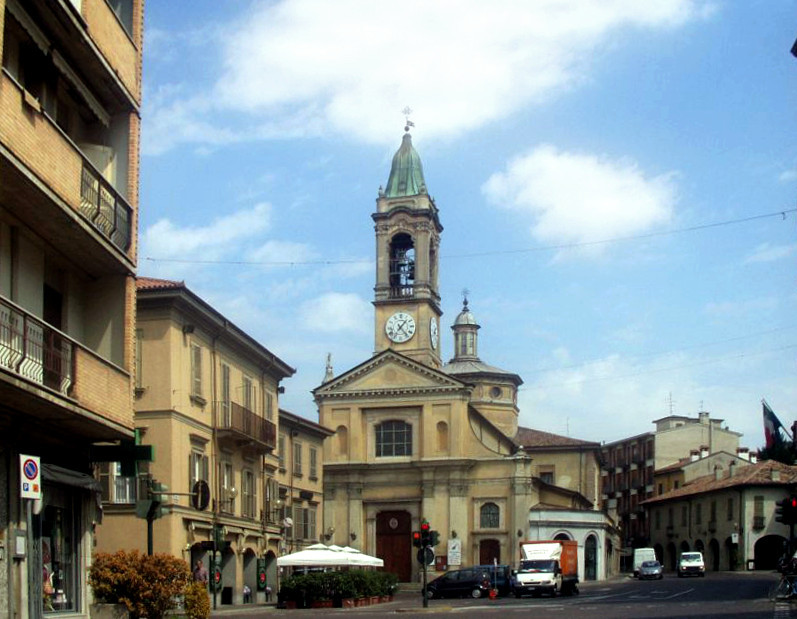
Broni is a comune (municipality) in the Province of Pavia in the Italian region Lombardy, located about 45 km south of Milan and about 15 km southeast of Pavia.
Key Information
Broni borders the following municipalities: Albaredo Arnaboldi, Barbianello, Campospinoso, Canneto Pavese, Cigognola, Pietra de' Giorgi, Redavalle, San Cipriano Po, Stradella.
Notable people
[edit]- Cecilia Zandalasini (born 1996), WNBA small forward for the Minnesota Lynx[3]
Twin towns
[edit]References
[edit]- ^ "Superficie di Comuni Province e Regioni italiane al 9 ottobre 2011". Italian National Institute of Statistics. Retrieved 16 March 2019.
- ^ All demographics and other statistics: Italian statistical institute Istat.
- ^ "Cecilia Zandalasini Stats, Height, Weight, Position, Draft Status and More | WNBA". www.wnba.com. Retrieved 2024-06-15.
External links
[edit]Broni
View on Grokipediafrom Grokipedia
Geography
Location
Broni is a comune situated in the Province of Pavia, within the Lombardy region of northern Italy. It lies in the Oltrepò Pavese area at the foot of the Apennine foothills, along the Padana Inferiore state road (SS10), which serves as a key transit route through the region. The municipality is positioned in a hilly zone south of the Po River, in a predominantly wine-producing landscape. The town is located approximately 15 km southeast of Pavia, the provincial capital, and about 45 km south of Milan. Its coordinates are 45°4′N 9°16′E, with an elevation of 88 meters above sea level. Broni borders the following neighboring municipalities: Albaredo Arnaboldi, Barbianello, Campospinoso, Canneto Pavese, Cigognola, Pietra de' Giorgi, Redavalle, San Cipriano Po, and Stradella.Territory
The territory of Broni covers a municipal area of 20.85 km².[1] The landscape features a transition from lower plain areas near the Po River to higher foothill zones at the edge of the Apennines, with the central elevation at approximately 88 m above sea level and gradual variations reflecting its position in the Oltrepò Pavese hilly zone. Hydrography is influenced by proximity to the Po River, which borders the northern part of the territory near the frazione of Cassino Po, while smaller streams and irrigation canals typical of the Padan plain cross the municipal area to support local agriculture. (note: for verification from primary sources like ISTAT or regional cartography) Predominant land cover includes extensive arable land and vineyards that characterize the wine-producing hills, with patches of woodland in the more elevated sections and limited industrial areas, reflecting the agricultural vocation of the Oltrepò Pavese region.[1]Climate
Broni has a temperate climate with continental characteristics, typical of the lower Oltrepò Pavese area in the Po Valley foothills. According to the Italian national classification system for heating purposes (established by Presidential Decree 412/93), Broni is assigned to climate zone E with 2,628 heating degree days (calculated using a base temperature of 20°C). This places it in the range for zone E (2,101–3,000 degree days), indicating moderately cold winters that require an extended heating season compared to warmer lowland or coastal areas of Italy.[2] The Köppen classification for the region is generally Cfa (humid subtropical climate with hot summers and no dry season), characterized by warm to hot summers, cold and often foggy winters, and precipitation distributed throughout the year with peaks in spring and autumn. Due to its position at the Apennine foothills, Broni experiences slightly moderated temperatures and reduced persistent fog compared to the lower Po Valley plain, though winter fog remains common in the broader area. Summer heat can be intense, while snowfall is rare but possible during colder winter spells.History
Origins and ancient history
The territory of Broni shows evidence of human presence dating back to pre-Roman times, with the area inhabited by the Celto-Ligurian tribe known as the Anamari. The toponymy of the site has been linked to a possible Roman settlement named Camillomagus or Comillomagus, referenced in ancient Roman itineraria. The name is thought to derive from the Celtic god Camulos (equated with the Roman Mars) combined with the Celtic term magus meaning "field," suggesting a "Field of Mars." The location along the route of the modern SS10 Padana Inferiore, which follows an ancient Roman road through the Po Valley, supports the likelihood of Roman-era activity or a station in the vicinity. However, direct archaeological evidence in Broni itself remains limited, and some scholars propose that the site may correspond more closely to nearby Redavalle due to documented Roman findings there, though distances recorded in the itineraria align better with Broni's position. There is no confirmed continuity of settlement from the Roman period into the early medieval era at this location.Medieval period
Broni first appears in historical records in the 11th century, with the earliest known mention as "Bronum" in a 1030 document associated with the Bishop of Pavia. The name evolved to "Broni" by the late 12th century, reflecting local dialectal usage in the Oltrepò Pavese region.[3] During the early Middle Ages, the town fell under the ecclesiastical jurisdiction of the Bishop of Pavia, who held significant feudal control over the area. Broni was part of the broader sphere of influence of the Commune of Pavia, which dominated the region politically and militarily. The town featured defensive structures, including a castle or fortified site mentioned in 13th-century records, likely built to protect the settlement amid regional conflicts between Pavia and neighboring powers such as Piacenza. A Romanesque church dedicated to Saints Pietro and Paolo may trace its origins to this period, though major modifications occurred later.[3] By the late Middle Ages, control shifted with the rise of the Visconti family in Lombardy, incorporating Broni into their ducal domain by the mid-14th century.Modern and contemporary history
In the modern era, Broni followed the political vicissitudes of Lombardy. After Spanish domination as part of the Duchy of Milan, the area passed to Austrian rule in the early 18th century following the War of the Spanish Succession. The Napoleonic period brought incorporation into the Cisalpine Republic and subsequently the Kingdom of Italy, before reversion to Austrian control after 1815 as part of the Lombard-Venetian Kingdom. In 1859, with the Second Italian War of Independence, Broni was annexed to the Kingdom of Sardinia, paving the way for its inclusion in the unified Kingdom of Italy in 1861. During the 19th century, administrative expansions occurred, with the incorporation of nearby localities such as Pirocco and Vescovera early in the century, and Cassino Po merged in 1869. The 20th century saw industrial development, particularly with the establishment of a cement factory in the early decades. This facility, later acquired by Italcementi in 1987, produced cement-asbestos products from 1919 until 1984, with some production continuing until 1994 despite a national ban in 1992. The legacy of asbestos exposure has resulted in Broni having Italy's highest mortality rate for mesothelioma, with remediation efforts commencing in 1999 but remaining incomplete. On 8 June 1992, Broni received the official title of "città" by presidential decree.Demographics
Population
The municipality of Broni has a population of approximately 9,000 inhabitants as of recent ISTAT data (specific figure and exact date require verification from official sources, but known to be lower than older estimates of around 10,000). The population reflects Broni's status as a comune in the Province of Pavia, with demographic characteristics typical of the Oltrepò Pavese region, including a mix of long-term residents and some migration effects. Detailed historical census data, age structure, and migration patterns are not detailed here, but the estimate provides a snapshot of the town's resident base in this hilly, wine-producing zone.Languages and dialect
The residents of Broni primarily speak standard Italian, the official language of Italy, which is used in formal, educational, administrative, and written contexts. In everyday local interactions, many residents also use the dialetto oltrepadano (Oltrepadano dialect), a variety spoken in the Oltrepò Pavese area. In this dialect, the town is known as Bròn. Bilingualism is common, with residents switching between Italian and the local dialect depending on the social context, and the dialect serves as a marker of regional identity in informal settings.Economy
Agriculture and viticulture
Agriculture and viticulture form the cornerstone of Broni's economy, reflecting the municipality's location in the heart of the Oltrepò Pavese wine region. The area's rolling hills, clay-limestone soils, and temperate climate with good temperature ranges between day and night create favorable conditions for grape cultivation. Viticulture dominates local agriculture, with vineyards occupying a large share of the cultivable land. The primary grape varieties grown include:- Croatina (also known locally as Bonarda), the most widely planted variety, used to produce Bonarda dell'Oltrepò Pavese DOC, a fruity, medium-bodied red wine often with slight effervescence.
- Barbera and Uva Rara (Vespolina), which contribute to blends in wines such as Buttafuoco Storico and Sangue di Giuda dell'Oltrepò Pavese DOC.
- Pinot Nero (Pinot Noir), important for both still reds and sparkling wines, including Oltrepò Pavese Metodo Classico DOCG, a classic-method sparkling wine recognized for its quality and structure.
- White varieties such as Riesling Italico, Chardonnay, and Pinot Bianco, used for still and sparkling whites under the Oltrepò Pavese DOC.
