Hubbry Logo
Brood patchBrood patchMain
Open search
Brood patch
Community hub
Brood patch
logo
8 pages, 0 posts
0 subscribers
Be the first to start a discussion here.
Contribute something
Brood patch
Brood patch
from Wikipedia
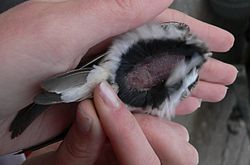
A bird on its back, revealing a patch of featherless skin
Brood patch of a sand martin

A brood patch, also known as an incubation patch in older literature,[1] is a patch of featherless skin on the underside of birds during the nesting season. Feathers act as inherent insulators and prevent efficient incubation, to which brood patches are the solution. This patch of skin is well supplied with blood vessels at the surface, enabling heat transfer to the eggs when incubating.[2][3]

Location

[edit]

The positions of brood patches can vary. Many have a single brood patch in the middle of the belly, while some shorebirds have one patch on each side of the belly. Great Auks and Razorbills develop two brood patches on the side of the body.[4] Gulls and Galliformes may have three brood patches.[citation needed] American kestrels develop three brood patches.[5]

Pelicans, boobies, and gannets do not develop brood patches but cradle the eggs on their feet.[3] Brood parasitic cuckoos do not develop brood patches.[6] In species where both parents incubate, brood patches may develop in both sexes,[3] though the size of the patch may vary by sex and size of the bird.[5]

Formation

[edit]

Shortly before egg laying, hormones such as oestrogen, prolactin, and progesterone cause a bird’s belly feathers to loosen and fall out, thus forming a patch of bare skin.[7] In most species, the feathers in the region shed automatically, but ducks and geese may pluck and use their feathers to line the nest. Feathers regrow sooner after hatching in precocial birds than for those that have altricial young.[3]

Function

[edit]

Incubation

[edit]

Brood patches help carry heat close to the skin surface during incubation. Additionally, birds may accumulate fat around the patch to increase its pliability.[7] Upon settling on a nest, birds will shift in a characteristic side to side manner to ensure full contact of the brood patch with eggs or young.[3]

Clutch size

[edit]

Brood patch can help regulate number of eggs produced in one cycle, or clutch size. Once eggs are laid, the touch sensors in the brood patch detects the eggs and trigger hormonal responses to limit ova production. However, if the eggs are removed or broken shortly after the eggs are laid, this hormonal regulation will not happen, and eggs can be continuously produced.[7]

See also

[edit]

References

[edit]
[edit]
Revisions and contributorsEdit on WikipediaRead on Wikipedia
from Grokipedia
A brood patch is a specialized, featherless of highly vascularized and often edematous located on the or of many bird species, which develops to enable efficient from the parent to eggs during incubation. This adaptation typically forms shortly before egg-laying as part of the breeding cycle, triggered by hormonal shifts that cause feathers to loosen and fall out—either through a pre-laying molt or active plucking—while the underlying thickens, becomes richly supplied with vessels, and may develop a wrinkled or hyperkeratinized texture for better contact with the . Key hormones driving this process include , which promotes defeathering and vascularization; , which induces and supports incubation ; and progesterone, which contributes to overall nesting preparation. The primary function of the brood patch is to maximize during contact incubation, allowing the parent's to directly warm the eggs and promote embryonic development, which is crucial for success in with uniparental or biparental care. In many passerines and other birds, the patch also enhances sensory feedback, potentially regulating incubation duration and size through tactile cues from the eggs. While most common in females, some exhibit patches in males or both sexes, and the feature regrows feathers post-breeding season under declining hormone levels. Not all birds possess a brood patch; for instance, certain seabirds like boobies rely on webbed feet for instead, highlighting evolutionary variations in incubation strategies adapted to environmental and physiological demands. Brood patches also serve as reliable indicators of reproductive status in field studies, as their development correlates with breeding stages and hormone profiles across diverse taxa.

Definition and Overview

Definition

A brood patch, also known as an incubation patch in older , is a temporary, featherless area of on the ventral (under) side of birds, typically on the or , that develops during the breeding season to facilitate . This occurs in many avian species, excluding certain groups such as ratites and some seabirds like pelicans and boobies, and serves as a specialized region for direct contact with eggs. The brood patch is located in the mid-ventral apterium, the featherless tract between the legs and ventral feather tracts, allowing it to conform to the clutch during incubation. Its size varies by species, often measuring several centimeters in diameter and adapting to the number and dimensions of eggs, with some birds developing single or multiple patches. Following the breeding season, the patch is temporary, with feathers regrowing as the skin returns to its normal state. Historically, the term "incubation patch" was commonly used, as seen in seminal studies on passerines from the mid-20th century, but "brood patch" has become the preferred modern terminology because it encompasses the structure's role not only in egg warming but also in brooding hatchlings.

Importance in Avian Reproduction

The brood patch plays a crucial role in avian reproductive efficiency by enabling precise temperature regulation during , maintaining optimal conditions of approximately 35–38°C that are essential for embryonic development. This direct from the parent's vascularized to the eggs minimizes energy expenditure on rewarming after off-bouts and reduces the risk of embryonic mortality due to cooling, thereby enhancing hatchling survival rates and overall reproductive success. For instance, in species like black-capped chickadees, effective incubation facilitated by the brood patch optimizes egg temperatures, leading to improved embryo growth and fledging outcomes. The brood patch also links to diverse parental care strategies, supporting both uniparental and biparental incubation patterns that influence mating systems and sex roles in birds. In exhibiting biparental care, such as many shorebirds, both sexes develop brood patches, allowing shared incubation duties that distribute energetic costs and increase the likelihood of successful under varying environmental conditions. This flexibility can promote monogamous pairings and balanced sex roles, as seen in high-Arctic breeding shorebirds where dual brood patches enable coordinated incubation over 19–22 days. Furthermore, the brood patch correlates with clutch size limitations and nesting behaviors, as its coverage area constrains the number of eggs that can be effectively warmed, influencing reproductive strategies across . In birds with larger es, such as wood ducks, incomplete coverage by the brood patch results in greater intra-clutch temperature variation (up to 1.35°C in 16-egg clutches), potentially reducing post-hatch quality and setting an upper limit on optimal clutch size to maximize efficiency. This particularly benefits smaller birds by allowing them to incubate relatively larger clutches relative to body size without excessive cooling of peripheral eggs, thereby optimizing in brooding.

Anatomy and Physiology

Structure

The brood patch is typically situated on the lower abdomen of birds, within the ventral apterium—a naturally featherless tract of skin—extending from the keel of the sternum anteriorly to the posteriorly. This positioning allows the patch to conform directly to the contours of eggs during incubation. In most , it forms a single, midline area, but bilateral patches occur in certain taxa, such as alcids; for example, the extinct (Pinguinus impennis) possessed two distinct patches, one on each side of the midline, adapted to its two-egg clutches. The skin of the brood patch consists of a bare, featherless that lacks contour feathers and scales, with only down feathers molted during development to expose the underlying surface. Beneath the lies a thickened composed of layers, which supports the patch's structural integrity and facilitates direct contact with eggs. Subcutaneous layers are generally thin, with minimal deposition in the patch region across examined like passerines and geese, prioritizing over insulation. A prominent vascular feature of the brood patch is its dense network of capillaries, veins, and arteries in the dermal and subdermal layers, supplied primarily by the external thoracic and prepubic arteries. This hypervascularization imparts a characteristic reddish or pinkish hue to the skin, visible through the translucent , and enables efficient thermal exchange without the insulating barrier of feathers.

Physiological Changes

The physiological changes in the avian brood patch transform the ventral abdominal skin into a specialized structure optimized for incubation. A key modification is the development of , characterized by fluid accumulation in the dermal layers, which causes the skin to swell and thicken. In species like the European starling (Sturnus vulgaris), this results in the expanding from a single cell layer to 3–4 layers. This disrupts organization, increases leucocyte presence, and creates large intercellular spaces, all of which enhance the patch's pliability and conformal contact with eggs for improved thermal efficiency. Concomitant with is extensive vascularization, driven by hyperemia that markedly elevates in the patch. In incubating bantam hens (Gallus gallus domesticus), flow to the brood patch increases several-fold compared to non-incubating states through dilation of capillaries and larger vessels. This hypervascularization is facilitated by arteriovenous anastomoses (AVAs), specialized shunts densely innervated by adrenergic and fibers, which enable precise regulation of delivery by shunting warm directly to the skin surface while minimizing loss during off-bouts. The resulting deep reddish coloration and engorged appearance of the patch underscore its role in maximizing conductive to the clutch. Sensory adaptations further refine the patch's functionality, with heightened tactile sensitivity emerging in the edematous and vascularized tissue. In canaries (Serinus canaria), this manifests as increased responsiveness to mechanical stimuli, allowing incubating females to detect subtle shifts in position and maintain optimal arrangement within the nest. Such neural enhancements, supplied by somatic sensory fibers in the , support behavioral adjustments like nest adjustments or , ensuring uniform incubation coverage. These changes, primarily triggered by hormones such as and progesterone, collectively prepare the brood patch for its thermoregulatory demands.

Development and Formation

Hormonal Triggers

The development of the in birds is primarily triggered by a combination of sex steroids and , with playing a key preparatory role in initiating feather molt, defeathering, and vascularization, while surges in during late egg-laying drive and epidermal , and progesterone contributes to defeathering and overall structural changes. promotes the loosening and loss of s in the abdominal region, facilitating the exposure of underlying skin, whereas induces fluid accumulation and tissue thickening essential for during incubation. Progesterone contributes to defeathering and supports the overall structural changes, often acting synergistically with the other hormones. These hormonal triggers are temporally aligned with the reproductive cycle, occurring shortly before or during completion following follicular regression post-ovulation, when circulating levels decline after egg release and begins to rise steadily into the incubation phase. This timing ensures the brood patch is fully formed as the bird transitions from laying to incubating, with progesterone peaking from the shell gland during oviposition to reinforce the process. Sex-specific differences in hormonal responses influence brood patch development, with incubating females typically exhibiting higher concentrations than males, correlating with their primary role in many species, while males may rely more on progesterone for incubation-related changes. Experimental studies have confirmed these mechanisms; for instance, early research in the and on ring doves demonstrated that implants of hormones, such as progesterone, could induce brood patch formation and associated in non-breeding individuals, independent of environmental cues. Building on this, a 1967 study on ovariectomized canaries showed that administering alone produced partial defeathering and vascularity, but combining it with either progesterone or fully induced brood patch development, highlighting their interactive roles. These findings underscore the endocrine basis for the patch without reliance on ovarian function.

Stages of Formation

The formation of the brood patch in birds typically progresses through distinct stages, initiated by hormonal signals such as rising levels of and during the pre-laying period. In many species, particularly passerines, the process begins several days (typically 4-6) before laying with the initial loosening of feathers in the ventral apterial region. This pre-lay stage involves a specialized molt where and contour feathers detach due to weakening of their attachments to the skin, often facilitated by the bird plucking them to line the nest. The area starts to become bare, preparing the site for subsequent physiological changes without yet showing significant swelling or vascularization. As egg laying approaches, the process advances to the edema phase, typically within 3-5 days of the first being laid. During this stage, fluid accumulation leads to noticeable swelling () of the dermal and epidermal layers, causing the skin to plump and become more pliable. Feather loss completes in this phase, resulting in a fully denuded patch that enhances contact with the eggs. The is hormonally driven and serves to increase the patch's thermal conductivity by expanding the tissue volume. The final maturational stage is the vascular phase, which achieves full development 1-2 days before the onset of incubation. Hypervascularization occurs as blood vessels proliferate and become prominent beneath the skin, maximizing efficiency to the eggs. At this point, the brood patch is fully functional, with engorged, warm skin ready for incubation duties, often coinciding with the completion of the clutch. Following hatching, the brood patch undergoes regression, reversing the formation process over 2-4 weeks as hormone levels decline. Edema subsides first, leaving the skin wrinkled and less vascularized, while new feather papillae emerge to initiate regrowth. Feathers typically regenerate fully by the post-breeding molt, restoring the plumage and eliminating the patch until the next breeding season. This reversal ensures the bird's insulation is maintained outside the reproductive period.

Function

Incubation Role

The brood patch plays a crucial role in avian incubation by enabling direct conduction of metabolic from the parent's body to the through its bare, highly vascularized . This vascularization, characterized by an increased density of vessels near the surface, allows for efficient transfer of warmth without the insulating barrier of feathers, which would otherwise impede flow during contact incubation. In species like bantam hens, this mechanism supports rapid rewarming of cooled eggs, with output directed primarily through the patch to elevate egg temperatures effectively. Temperature regulation during incubation is finely tuned via adjustments in blood flow within the brood patch, which helps maintain the optimal egg temperature range of approximately 36–38°C essential for embryonic development. For instance, in zebra finches, cold-induced in the patch increases blood flow upon mild cooling, preventing excessive egg temperature drops and promoting swift recovery without typical responses seen elsewhere in the body. Similarly, in , the patch facilitates near-complete transfer of parental heat production (109–118%) to the eggs, allowing precise control through behavioral and physiological means rather than strict vasoconstriction. These adaptations minimize energy expenditure while ensuring consistent thermal conditions for viability. Behaviorally, the brood patch integrates with incubation routines, such as egg rotation, to promote uniform heating across the clutch. Incubating birds periodically turn and reposition using the patch for direct contact, which distributes heat evenly and prevents localized overheating or adhesion to the shell membrane; in waterfowl, this manipulation maintains optimal patch-egg proximity throughout the process. In extreme environments, such as colonies, emperor penguins exemplify this by balancing the egg on their feet against the exposed brood patch during the 65–75-day incubation, while huddling in groups to conserve parental body heat without compromising egg warmth.

Brooding Role

Following , the brood patch serves as a critical for providing direct to downy nestlings, which often lack sufficient insulation and thermoregulatory capacity in their early stages. This bare, vascularized skin area facilitates efficient to , helping maintain optimal temperatures for the chicks' metabolic processes and preventing , particularly in cooler environments. In altricial species, such as songbirds, the patch enables parents to brood multiple nestlings simultaneously, enveloping the entire under their body for collective warming. The direct skin-to-skin contact during brooding not only delivers warmth but also provides tactile that triggers responses in young nestlings, prompting them to gape and vocalize for when the shifts position or arrives at the nest. This interaction supports nestling growth by ensuring timely feeding while minimizing loss from exposure. The vascular features of the patch, which enhance heat delivery, continue to function effectively in this post-hatch phase. In most bird species, the brood patch persists for 1-3 weeks after , aligning with the period when nestlings remain dependent on parental brooding before developing their own through growth and increased activity. For instance, in songbirds like great tits, intensive brooding occurs primarily in the first 6-8 days but tapers off as the young become more homeothermic, reducing the risk of during this vulnerable window.

Occurrence and Variations

Across Bird Species

The brood patch is a widespread among avian , present in the majority of to facilitate efficient during incubation. It is developed by most , excluding pelecaniforms such as pelicans and their relatives, while ratites such as ostriches develop them but with variations due to their large size and incubation style. Waterfowl develop brood patches, primarily in females, aligning with their incubation roles. In most bird families that incubate eggs, at least one forms a brood patch, reflecting its evolutionary importance in across diverse taxa. In , the largest avian order comprising over half of all bird species, brood patches are nearly universal, with females developing them in virtually all cases as the primary incubators. Both sexes often form patches in species where biparental incubation occurs, which is common in many passerine families, though females remain the dominant incubators in most. For example, in species like the , only females develop a fully vascularized patch, while males may assist without one, highlighting sex-specific roles tied to hormonal regulation. Among waterfowl and shorebirds, brood patches are predominantly developed by females, aligning with their primary role in incubation. In waterfowl like snow geese, females form extensive patches, though males may contribute minimally without fully developing one. Shorebirds follow a similar pattern, with females mainly responsible, but notable exceptions occur in polyandrous species such as phalaropes, where males undertake sole incubation and develop paired abdominal patches to brood the eggs alone, exemplifying . Raptors and penguins exhibit biparental brood patches adapted to challenging environments. In raptors like peregrine falcons, both sexes develop paired lateral patches to share incubation duties, enabling sustained warmth in exposed nests. Similarly, in emperor penguins, both males and females possess a specialized brood patch—a vascularized abdominal fold—that allows turn-taking incubation on ice, critical for surviving extreme cold during the 65-day period. These biparental adaptations underscore the patch's role in under harsh conditions. Brood patches occur in ratites like ostriches, where the incubating male develops one, but they rely on behavioral thermoregulation and loose body coverage during the lengthy incubation period. This reflects their precocial development and reduced need for intensive direct contact compared to smaller, more vulnerable species.

Exceptions and Alternatives

While most incubating birds develop a brood patch to facilitate heat transfer to their eggs, certain species exhibit exceptions due to their reproductive strategies. Obligate brood parasites, such as the common cuckoo (Cuculus canorus) and brown-headed cowbird (Molothrus ater), do not develop brood patches because they lay their eggs in the nests of other species and never incubate. Studies on common cuckoos captured during the breeding season revealed no signs of brood patch formation or even vestigial traits, confirming the complete absence of this adaptation in this species. Similarly, hormonal analyses in female cowbirds indicate that key regulators like estrogen and prolactin fail to induce brood patch development, aligning with their parasitic lifestyle that eliminates the need for direct incubation. In contrast, some non-parasitic birds lack brood patches owing to alternative incubation methods that do not rely on abdominal . Megapodes (family Megapodidae), such as the Australian brush-turkey (Alectura lathami), forgo body incubation entirely, instead burying eggs in mounds of decaying vegetation where heat from microbial maintains optimal temperatures around 33–37°C. This external heat source renders a brood patch unnecessary, as parents regulate mound temperature by adding or removing material without physical contact with the eggs. Other alternatives involve non-abdominal contact, such as foot-based incubation in species lacking brood patches. For instance, gannets and boobies (family ) cradle eggs on their webbed feet, using vascularized foot skin to transfer heat while standing upright, a suited to their cliff-nesting habits. Kiwis (Apteryx spp.) develop brood patches but employ a semi-external incubation adapted to their oversized eggs (up to 20% of body weight), with the male typically standing over the single egg in a , positioning it between his legs to direct body heat downward using the patch. These exceptions reflect evolutionary trade-offs where the absence of a brood patch correlates with reduced or eliminated direct incubation demands, such as in species producing small clutches (e.g., one in some kiwis) or relying on environmental heat (e.g., mounds). In brood parasites, the energy saved from not incubating supports higher production and rates, enhancing fitness in their specialized niche. Such adaptations highlight how reproductive strategies can bypass the physiological costs of brood patch development, including feather molt and vascularization, in favor of alternative .

Evolutionary Aspects

Origins and Adaptations

Fossil evidence for incubation behaviors in early birds is primarily indirect, derived from Cretaceous-period nests and egg accumulations that suggest active . For instance, sites reveal large clusters of avian , indicating colonial nesting and likely incubation to protect against environmental fluctuations, though direct traces of brood patches—soft-tissue adaptations—are absent due to preservation biases. These behaviors predate the neornithine radiation following the Cretaceous-Paleogene extinction event around 66 million years ago (MYA), when modern birds (Neornithes) diversified rapidly. The brood patch likely emerged as a key adaptation during this radiation, enabling efficient in exposed nests that replaced the buried eggs of earlier avian lineages like enantiornithines. The selective pressures favoring brood patch centered on enhancing success amid variable post-extinction climates, where fluctuating temperatures posed risks to embryonic development. By vascularizing the abdominal skin for direct thermal contact with eggs, the brood patch allowed parents to maintain optimal incubation temperatures (typically 35–38°C), reducing heat loss and improving viability in cooler or unpredictable environments. This adaptation co-evolved with advanced nest-building strategies, such as insulated cup-shaped structures lined with feathers or plant down, which complemented the patch by stabilizing nest microclimates and minimizing energy expenditure during off-bouts. For example, denser nest walls in high-altitude or boreal species help buffer against cold snaps, thereby boosting overall reproductive fitness. Brood patches exhibit multiple independent evolutions across avian lineages, reflecting convergent adaptations to incubation demands rather than a single origin. They are absent in basal groups like ratites and certain pelecaniforms (e.g., pelicans, boobies), which rely on foot-web brooding, indicating repeated development in neornithine clades such as passerines and . At the genetic level, this ties to variations in prolactin receptor (PRLR) genes, which regulate patch formation via hormonal signaling; prolactin binding to PRLR promotes and vascularization essential for heat transfer. Evolutionary diversification of PRLR isoforms across birds likely facilitated these adaptations, enabling tailored in diverse ecological niches.

Comparative Biology

In monotremes, the only egg-laying mammals, females exhibit analogous adaptations for involving bare or specialized ventral skin, though these structures are less vascularized and edematous than the avian brood patch. In echidnas, a temporary abdominal pouch forms during , serving as a brood patch where the single egg is incubated for about 10 days using direct transfer; this pouch is created by muscular contraction and lacks the extensive network seen in birds. The , another monotreme, lacks a distinct pouch but incubates 1–3 eggs by curling its tail over them in a , positioning the bare ventral in contact with the eggs for over about 10 days, without feather loss or pronounced vascularization. In marsupials, which give live birth rather than lay eggs, the pouch provides a comparable bare ventral for brooding underdeveloped young, facilitating skin-to-skin contact and , but it is not adapted for and shows minimal vascular specialization beyond basic moisture retention. Reptiles lack any equivalent to the brood patch, relying instead on passive environmental heating for development. Most species bury eggs in , , or decaying to exploit solar radiation, geothermal warmth, or microbial , with no parental involvement in temperature regulation. A few exceptions, such as certain pythons, demonstrate limited active by coiling their bodies around clutches to maintain optimal temperatures through muscular , but this uses the scaled ventral surface without bare, vascularized modification. The brood patch stands out as a uniquely avian adaptation among vertebrates, enabling precise endothermic during incubation and brooding, which underscores birds' evolutionary specialization for intensive . Unlike the direct skin contact in monotremes or the incidental body coiling in some reptiles, the bird brood patch features reversible feather loss, , and hypervascularization for maximal efficiency. This contrasts with heat retention via s or feet in non-patch bird , such as some waterbirds that position eggs on webbed feet. Such rarity beyond birds highlights the brood patch's role in avian , facilitating consistent embryonic development in diverse climates without reliance on external heat sources.

References

Add your contribution
Related Hubs
Contribute something
User Avatar
No comments yet.