


Community hub
Recent from talks
Contribute something
Nothing was collected or created yet.
Cairokee
View on WikipediaCairokee is an Egyptian rock band that was officially launched in 2003 but came to prominence with its revolutionary music following the Egyptian Revolution of 2011 due to its politically-inspired lyrics and protest songs released following the uprising. Their signature song "Ya El Midan", featuring Aida el Ayoubi, who had retired in the 1990s, ranked number one on Facebook worldwide for downloads and number eight on YouTube.[1][2][3]
Key Information

Background
[edit]
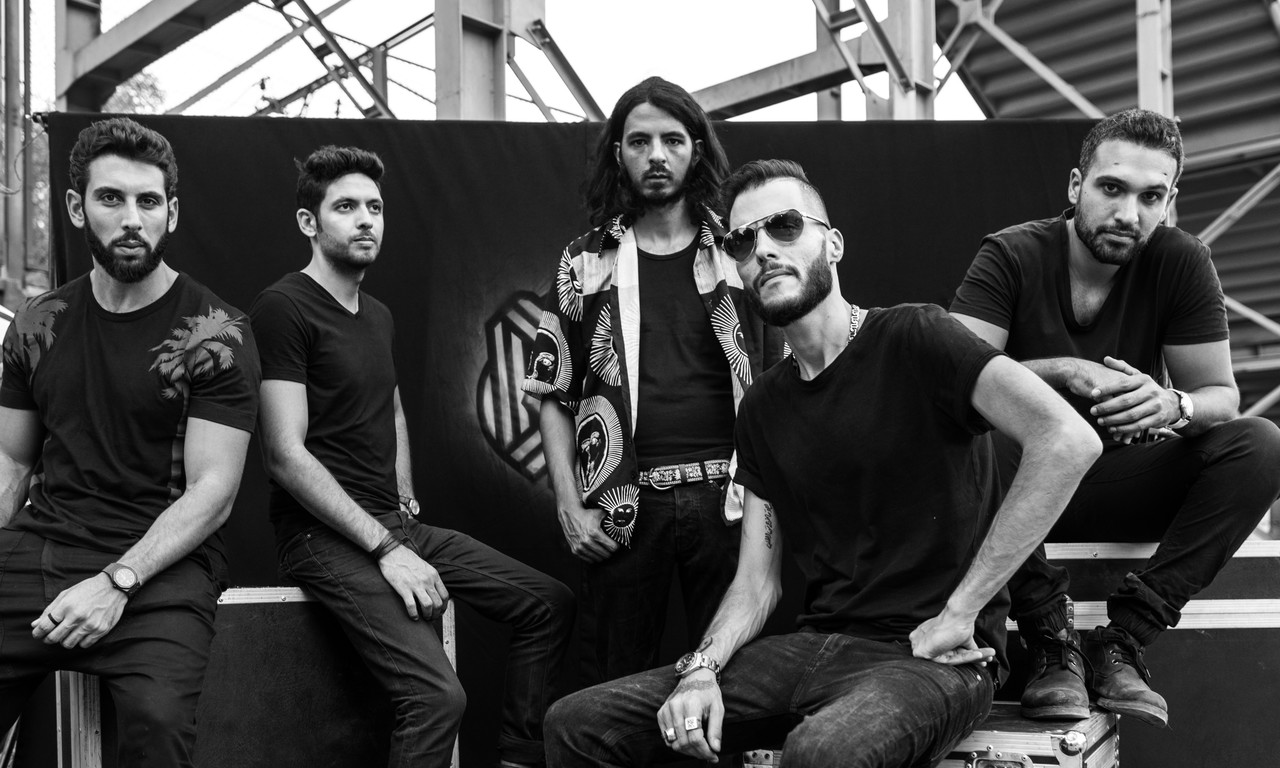
The band consists of Amir Eid (lead vocalist), Sherif Hawary (lead guitarist), Tamer Hashem (drummer), Sherif Mostafa (keyboardist), and Adam el-Alfy (bass guitarist). The initial band members were friends ever since their school days, and Tamer was already a drummer back then. In 2003, Eid and Hawary had started an English band initially called Black Star.[4] They started playing covers of English songs, with only one Egyptian song called "Ghariba" that was highly admired by their audiences. They later decided to continue making Egyptian songs because they felt it was shameful to keep playing English music as it wasn't their mother tongue. They were mainly influenced by the works of Pink Floyd and The Beatles and regard Pink Floyd's music as an inspiration for their own musical career.[5]
Career
[edit]Following the 2011 revolution, Cairokee released their first major hit, "Sout El Horeya" (The Voice of Freedom), a powerful anthem made in collaboration with Hany Adel of the band Wust El-Balad. The song's music video, filmed in Tahrir Square, became a viral phenomenon, reportedly breaking world records for its millions of views in a short period of time.[6][7][8] They continued to capture the revolutionary spirit with "Ya El Midan" (Oh, The Square), which marked the return of veteran singer Aida El Ayoubi after a 20-year hiatus. The song personified Tahrir Square as a fellow protester, and its music video subtly documented the revolution from a protester's home, showing items used to combat tear gas and other protest-related gear, addressing and personifying it as another living and breathing member of the opposition, and its video clip documented the latest protests in an indirect way as the camera was apparently filming inside a protester's house and it roamed over clothes riddled with bullet holes, medical white coats, onions and types vinegar (substances that defuse the effects of teargas). Cairokee's momentum culminated in their first album, Matloob Zaeem (Leader Wanted), released in June 2011. The title track was a massive hit, serving as a social commentary on the qualities the next leader of the country should possess. A year later, on the revolution's anniversary, they released "Ethbat Makanak" (Hold Your Ground), featuring prominent satirist Bassem Youssef. The collaboration was a show of support for independent media voices who were under attack by the military government. The band's role in the public sphere continued through the 2013 protests. They performed in front of hundreds of thousands of people who were protesting against then-President Mohamed Morsi. The crowd sang along with them, turning the performance into a powerful display of unity and opposition.
On 21 March 2013, Red Bull organized an event in which Cairokee played against Wust El-Balad dubbed "Red Bull Sound Clash" where the spectators were the judge and the winner would be declared according to the intensity of the crowd's cheering. Daily News Egypt noted that "it was clear from the beginning of the evening that Cairokee had the edge on crowd support, although Wust El-Balad had a strong fan base at the event". The concert also featured popular shaabi singer Ahmed Adaweyah who performed in Wust E-Balad's act and at the end of the event, no victor was announced but the spectators were apparently left highly satisfied with both performances.[9] Cairokee also performed at the Jordanian Dum Tak Alternative Middle Eastern Music Festival, along with several Egyptian bands including Wust El-Balad and Massar Egbari as well as many other Middle Eastern bands such as Lebanon's Mashrou' Leila.[10]
In early 2014, Cairokee released their third album "El Sekka Shemal". The album featured collaborations with different artists, including Algerian singer Souad Massi, Abdel Baset Hammouda and Zap Tharwat. This year also brought Cairokee to the record label Sony Music Middle East. The partnership led to the band obtaining its own Vevo channel on YouTube, the first deal of its kind for any artist in the region. The album was their most successful to date, with its first copy entirely sold out in the first three days only, topping the charts on the iTunes Store and in the music market of Egypt and the Middle East. It became the album with the highest number of downloads and purchases on iTunes by the end of the first week.[11] It was also featured in the first episode of the third season of Bassem Youssef's highly popular show El Bernameg.[12]
On July 20, 2017, Cairokee's album Nokta Beeda (White Dot), was a significant project that moved to a more mature and introspective sound. The album's central theme was finding a glimmer of hope in a chaotic world. Its biggest event was the groundbreaking collaboration with Egyptian folk singer Tarek El Sheikh on the hit song "El Keif." This fusion of rock and traditional music was a massive success, helping the album earn critical acclaim and solidify the band's status as a leading force in modern Arab music.[citation needed]
On March 21, 2019, Cairokee's album The Ugly Ducklings (أبناء البطة السوداء) was a deeply personal and raw project. The album's central theme, as its title suggests, revolves around a sense of social alienation and the struggle to find one's identity. With a more stripped-down and melancholic sound, the album was celebrated for its poetic lyrics and emotional honesty. It resonated with a generation feeling a similar sense of being different or not fitting in. The Ugly Ducklings was another critical success for the band, reinforcing their reputation for tackling existential and social themes with authenticity.[citation needed]
On September 23, 2022, The release of Cairokee's new album "Roma" was a major event for the Egyptian rock band. The album marked a significant shift from their earlier political themes to a more personal and introspective sound, exploring topics like nostalgia, anxiety, and personal struggles. The album's success was driven by several key factors, High-profile collaborations with artists like rapper Marwan Pablo and singer Sara Moullablad, which introduced new musical styles. An effective promotional campaign that included releasing popular music videos on YouTube and hosting an innovative, interactive online concert called "Cairokee Empire". A major international tour that included sold-out shows in Europe and the U.S., proving the band's growing global appeal. "Roma" was a meticulously planned release that showcased the band's artistic evolution and solidified their position as a leading force in Arab music.[13][14][15]
Members
[edit]Amir Eid, the main vocalist of the band, and the most influential member, so much so that he became an independent identity apart from the band.
Sherif El Hawary, the main guitarist of the band.

Tamer Hashem, the main drummer of the band.
Sherif Mostafa, the main keyboardist and guitarist of the band.
Adam El-Alfy, the main bassist and guitarist of the band.

Discography
[edit]- Studio Albums
- Matloob Zaeem (مطلوب زعيم) (2011)
- Wana Maa Nafsy Aad (وانا مع نفسي قاعد) (2012)
- El Sekka Shemal (السكة شمال) (2014)
- Nas w Nas (ناس و ناس) (2015)
- Nokta Beeda (نقطة بيضاء) (2017)
- The Ugly Ducklings (أبناء البطة السوداء) (2019)
- Roma (روما ) (2022)
- Telk Qadeya (تلك قضية) (2023)
References
[edit]- ^ "CairoKee's latest album". Daily News Egypt. July 1, 2012.
- ^ "Egypt's Underground Wakes Up". NPR. June 12, 2012.
- ^ "Cairokee: one Cairo band becomes a revolutionary discovery". The National. December 29, 2013.
- ^ "Cairokee's "Ya El-Midan" Celebrates the Meaning of Tahrir Square". Connected In Cairo. December 2, 2011.
- ^ "Cairokee – An Exclusive Interview With HashTags Mag". HashTags Mag. January 17, 2013. Archived from the original on March 4, 2016. Retrieved January 28, 2014.
- ^ "50 People Shaping the Culture of the Middle East". Al-Monitor.
- ^ "Two years on, the revolution still sells…". Kalimat Magazine. March 27, 2013. Archived from the original on February 3, 2014. Retrieved January 28, 2014.
- ^ "Music Concert "Cairokee" Band - CairoKee". El Sawy Culture wheel. Archived from the original on 2014-02-03. Retrieved 2014-01-28.
- ^ "Duelling bands showcase Egyptian musical talent". Daily News Egypt. March 24, 2013.
- ^ "PROGRAMME: Egyptian bands play at Jordanian Dum Tak festival". Al-Ahram. May 18, 2013.
- ^ "Cairokee's 3rd album: Latest addition to post-revolution string of successes". Al-Ahram. February 18, 2014.
- ^ "Egypt's Bassem Youssef returns to the air on MBC". Al-Arabiya. February 8, 2014.
- ^ "Instagram". www.instagram.com. Retrieved 2025-08-31.
- ^ ElNabawi, Maha (2024-10-21). "Cairokee's Global Roar: The Pioneering Arabic Rock-Pop Band's Rise to the Billboard Arabia Charts and International Fame". Billboard. Retrieved 2025-08-31.
- ^ "Cairokee returns to top with a dreamy album Roma - Music - Arts & Culture". Ahram Online. Retrieved 2025-08-31.
External links
[edit]
| International | |
|---|---|
| Artists | |
Cairokee
View on GrokipediaFormation and Early Years
Origins and Initial Lineup
Cairokee was founded in Cairo, Egypt, in 2003 by a group of childhood friends seeking to create authentic rock music in Arabic.[6][7] The band emerged as one of Egypt's pioneering rock groups, blending Western rock influences with local lyrical themes.[6][7] The initial lineup included Amir Eid as lead vocalist and rhythm guitarist, Sherif El Hawary on lead guitar, Tamer Hashem on drums, Adam El-Alfy on bass guitar, and Sherif Mostafa on keyboards.[5][3] This core group, who had known each other since their school days, maintained stability from the band's inception, with Hashem already experienced as a drummer prior to formation.[5][4] The members' longstanding friendship facilitated early collaboration, focusing on original compositions rather than covers.[6][7]Pre-Revolution Activity
Cairokee was founded in 2003 in Cairo by childhood friends Amir Eid on vocals and guitar, Sherif El Hawary on guitar, Tamer Hashem on bass, and initial drummer Ahmed Sherif, initially under the name The Black Star.[1][5] The band began by performing covers of English and Arabic songs at small gigs across Egypt, gradually incorporating original compositions in Arabic to appeal to local audiences despite an original intent to sing primarily in English.[1][8] During its early years, Cairokee operated within Cairo's nascent underground music scene, playing modest venues such as informal gatherings along the Nile River, where audiences were often sparse and unresponsive.[3] The group's sound blended rock with pop and electronica elements, featuring politically tinged lyrics that critiqued social issues but lacked widespread distribution or commercial backing due to the restrictive environment under President Hosni Mubarak's regime.[4][9] Prior to 2011, Cairokee released no full-length albums and maintained a low profile, building a niche following through live performances at underground concerts rather than mainstream media exposure, which was limited for independent rock acts in Egypt at the time.[1][9] This period focused on honing their Arabic lyrics and instrumentation, setting the stage for later revolutionary anthems, though their reach remained confined to local enthusiasts amid broader cultural suppression of non-commercial music.[4][10]Musical Style and Influences
Genre Characteristics
Cairokee's genre is rooted in alternative rock, characterized by guitar-driven riffs, dynamic rhythms, and a raw energetic style that draws on indie and pop rock conventions.[11][1] This foundation is blended with subtle Egyptian folk elements, which enhance melodic depth and timbre, often manifesting in powerful, anthemic structures suitable for live performances.[11][12] The band's sound incorporates Arabic rock influences, fusing Western instrumentation—such as electric guitars and drums—with regional shaabi rhythms and Egyptian melodic motifs, resulting in a genre-bending hybrid that avoids strict categorization.[4][3] Electronica and pop elements, including synth layers, further diversify their palette, particularly in later works, while maintaining emotional intensity through honest, vernacular Egyptian Arabic vocals.[4][1] Lyrically, the genre emphasizes societal critique and personal struggle, delivered with directness that amplifies the rock format's protest-oriented potential, as seen in revolutionary-era tracks like "Ya El Midan" from 2011.[4][11] Evolutionarily, post-2011 releases have shifted toward polished indie pop with rap grooves and EDM synths, reflecting adaptation to broader audiences without diluting the core alternative rock ethos.[1]Key Influences and Evolution
Cairokee's foundational influences stem from Western rock acts, notably Pink Floyd and The Beatles, which shaped their early performances of English-language covers during gigs as the precursor group Black Star.[13] These elements combined with indigenous Egyptian genres like chaabi, an urban folk style rooted in popular street music, to form their signature indie rock sound infused with Arabic lyrical traditions.[14] This fusion allowed the band to bridge global rock aesthetics with local cultural expressions, evident in their use of rhythmic patterns and melodic structures drawn from Arabic music alongside electric guitar-driven arrangements.[3] The band's evolution began in 2003 with informal sessions focused on Western covers, transitioning to original Arabic compositions by the late 2000s as they adopted the Cairokee moniker, emphasizing Cairo's vibrant, karaoke-like musical scene.[4] Their breakthrough came during the 2011 Egyptian Revolution, where raw rock anthems like "Ya El Midan" amplified protest themes, marking a shift from apolitical covers to socially charged narratives addressing corruption and freedom.[3] Post-revolution, facing censorship pressures, Cairokee adapted by broadening thematic scope to everyday struggles while experimenting with pop and electronica integrations, as in their 2019 album Ugly Duckling, which layered electronic elements over chaabi rock foundations to critique societal constraints.[14] By the 2020s, their style had matured into a genre-bending Arabic rock-pop hybrid, incorporating Western pop sensibilities in tracks like "James Dean" and "Tarantino," reflecting a commercial pivot after signing with Sony Music in 2022 without diluting core social commentary.[4] This progression sustained relevance amid Egypt's evolving music landscape, evolving from revolutionary anthems to versatile expressions that fuse traditional Arabic motifs with modern production, enabling international chart success on platforms like Billboard Arabia.[3]Rise During the 2011 Revolution
Breakthrough Songs
Cairokee's breakthrough occurred during the 2011 Egyptian Revolution, with songs that captured the protesters' demands for freedom and captured widespread attention through social media and live performances. Their track "Sout El Horeya" (Voice of Freedom), composed in the first 18 days of the uprising starting January 25, 2011, emerged as one of the earliest revolutionary anthems, expressing collective aspirations for liberty amid the Tahrir Square demonstrations.[15] The song's video rapidly gained viral traction, becoming one of the most-viewed clips associated with the protests and propelling the band from underground status to national prominence.[16] "Sout El Horeya" features raw rock instrumentation and lyrics decrying oppression, such as lines invoking the "voice of freedom" rising against tyranny, which resonated with demonstrators chanting its chorus in streets and squares. Released shortly after Hosni Mubarak's resignation on February 11, 2011, it symbolized the revolution's initial optimism and was performed live during ongoing unrest, amplifying Cairokee's role in the cultural resistance.[3] The track's success marked a shift for the band, blending political urgency with accessible Arabic rock to reach millions, though later versions reflected disillusionment with post-revolutionary realities.[17] Another pivotal song, "Ya El Midan" (O Tahrir Square), featuring veteran singer Aida el Ayoubi, solidified their fame by becoming a rallying cry for youth protesters, with its chorus—"Ya El Midan, ehna gayeen" (O Square, we have come)—echoed in chants across Egypt. Released amid the 2011 events, it topped global Facebook download charts and evoked pre-revolution grievances like economic hardship and police brutality, fostering unity among diverse demonstrators.[18] [4] The song's enduring legacy lies in its documentation of the revolution's spirit, performed at key protest sites and later referenced as a symbol of lost ideals, though its initial impact helped Cairokee transition to broader audiences beyond political contexts.[19]Role in Protests
Cairokee emerged as a significant cultural force during the 2011 Egyptian Revolution, particularly through their song "Sout Al Horeya" (Voice of Freedom), composed amid the uprising's first 18 days from January 25 to February 11. Released on February 10, 2011, the track featured collaborations with artists like Mohamed Mounir and Hany Adel, capturing protesters' demands for dignity, liberty, and social justice with lyrics emphasizing national unity, such as "In every street in my country, the sound of freedom is calling."[15][17][16] The music video, filmed directly in Tahrir Square during active demonstrations, integrated band members Amir Eid and others performing alongside demonstrators holding banners, which helped project a positive, unified image of the protests and rapidly amassed over 2 million YouTube views within a week, amplifying the revolutionaries' voices to a global audience.[17][16] This output marked one of the earliest musical responses to the revolution, serving as an anthem that energized crowds in Tahrir Square and symbolized hope for systemic change against Hosni Mubarak's regime.[15] Prior to the uprising, Cairokee operated as an underground band formed around 2009, but their direct engagement with protesters via on-site filming and thematic alignment with calls for freedom propelled their rise, distinguishing them from purely retrospective revolutionary music.[17] Their approach prioritized raw, participatory expression over polished production, fostering a sense of collective agency among participants facing state repression.[16] Performances and song dissemination during the protests, including live renditions in protest spaces, reinforced Cairokee's role in sustaining morale, though their impact stemmed more from viral media than sustained live events amid the chaos.[16] This involvement laid the groundwork for their enduring commentary on Egypt's political landscape, with "Sout Al Horeya" retrospectively retitled in 2016 to critique the revolution's unfulfilled promises, reflecting the band's commitment to truthful reckoning over sanitized narratives.[17]Post-Revolution Developments
Albums and Censorship Challenges
Following the 2011 Egyptian Revolution, Cairokee issued Wana Maa Nafsy Aad in 2012, a 10-track album that built on their revolutionary momentum with introspective lyrics amid Egypt's transitional uncertainties. The following year, they prepared El Sekka Shemal, released in 2014, which encountered early censorship resistance when the board rejected a song title echoing a key lyrical phrase; approval came only after direct intervention by the board's president, who deemed the content permissible.[20] This third album explicitly addressed Egypt's post-revolutionary "wrong turn," including tracks like "Bal Haq" that questioned military political involvement.[1] In 2015, Cairokee released Nas w Nas, a 12-track effort examining interpersonal dynamics and societal flaws through rock arrangements.[21] Censorship pressures intensified by 2017 with Noaata Beida, their fifth album, as the Egyptian General Censorship Authority banned four tracks outright, citing violations of regulations on content deemed disruptive to public order.[22] Blocked from physical distribution, the album circulated digitally, achieving top sales on iTunes in Egypt despite official suppression.[17] Its lyrics articulated widespread youth frustration over entrenched corruption and unfulfilled revolutionary promises.[23] These bans extended beyond recordings, with multiple Cairokee performances cancelled in late 2017 under vague security pretexts shortly after Noaata Beida's online debut, part of a broader pattern targeting artists perceived as regime critics.[22] [24] The band's persistence in embedding dissent—via metaphors and historical allusions—demonstrated adaptive strategies against institutional barriers enforced by Egypt's cultural regulators.[17]Shift in Themes and Commercial Success
Following the 2011 Egyptian Revolution, Cairokee's lyrical focus evolved from revolutionary anthems and direct political critique toward more personal, introspective, and emotional narratives, reflecting disillusionment with unfulfilled promises and adaptation to a repressive environment. This shift was apparent in their 2014 album El Sekka Shemal, which blended refined rock with oriental influences and explored themes of personal struggle and cynicism rather than collective uprising, positioning it as a post-revolutionary milestone.[3] [25] The 2022 album Roma, released on September 23, further exemplified this transition, emphasizing loss, love, escapism, self-discovery, nostalgia, and imagination over explicit activism, though traces of political weariness lingered in tracks like "Kont Faker." Such changes allowed the band to navigate censorship while maintaining relevance, as frontman Amir Eid noted in interviews that post-revolutionary realities demanded subtler expression.[1] [26] Concurrently, Cairokee achieved notable commercial breakthroughs, with El Sekka Shemal contributing to a series of successes through eclectic sound and collaborations, including with Algerian singer Souad Massi. Their 2017 album Noaata Beida (A White Drop), despite an official ban, became the top-selling album on iTunes Egypt and No. 2 across the Middle East, driven by online demand and studio sessions that evaded restrictions.[27] [25] This period solidified their market dominance, as Roma immediately topped all major streaming platforms in Egypt upon release and propelled genre-bending fusions of alt-rock, shaabi, and pop to international audiences, including Billboard Arabia charts in 2024. The band's evolution into Arabic rock-pop hybrids has sustained sold-out tours and over 40 concerts documented in films like Kamal, underscoring commercial viability amid thematic restraint.[28] [3] [1]Band Members
Current Core Members
Cairokee's current core members have remained consistent since the band's formation in 2003, forming the original lineup that has driven its musical output.[1][3] The quintet consists of Amir Eid as lead vocalist and rhythm guitarist, Sherif El Hawary as lead guitarist, Tamer Hashem as drummer, Sherif Mostafa as keyboardist and backing vocalist, and Adam El-Alfy as bassist.[29][30]- Amir Eid: Serves as the band's primary songwriter, lead singer, and rhythm guitarist, shaping Cairokee's lyrical focus on social and political themes.[3]
- Sherif El Hawary: Handles lead guitar duties, contributing to the band's rock-infused sound through intricate riffs and solos.[1]
- Tamer Hashem: Provides drumming and percussion, establishing the rhythmic foundation for Cairokee's energetic performances.[29]
- Sherif Mostafa: Plays keyboards and offers backing vocals, adding melodic layers and atmospheric elements to the music.[30]
- Adam El-Alfy: Manages bass guitar, anchoring the low-end frequencies that support the band's dynamic arrangements.[3]
Contributions and Changes
Amir Eid, as founder, lead vocalist, and rhythm guitarist, has been the band's primary creative force, composing lyrics that often address social and political themes, such as freedom and everyday Egyptian life, which propelled Cairokee's rise during the 2011 revolution.[1] His songwriting, combined with vocal delivery, established the band's signature Arabic rock style blending protest anthems with pop elements.[31] Eid's influence extends beyond music, as he has pursued acting and solo projects while maintaining his role as the band's frontman.[32] Sherif El Hawary, the lead guitarist and co-founder alongside Eid, contributes melodic guitar lines that define Cairokee's rock foundation, drawing from early influences like English covers before shifting to original Arabic material.[4] His riffs support the band's evolution from underground performances to mainstream appeal, emphasizing themes of social rights in interviews.[31] Hawary's technical proficiency has been integral to live shows and recordings since the band's inception in 2003.[5] Tamer Hashem handles drums, providing rhythmic drive that underpins the band's energetic protest-era performances and later commercial tracks. As a founding member, his steady percussion has remained consistent across Cairokee's discography, supporting transitions from raw rock to more produced sounds.[1] Sherif Mostafa, on keyboards, adds atmospheric and electronic layers, enhancing the band's fusion of rock with pop and electronica elements since joining the core group early on.[4] Adam El Alfy, the bassist, anchors the low-end groove, contributing to the cohesive sound that has sustained the band's longevity.[5] Cairokee has experienced minor lineup adjustments over its two decades, including the occasional addition of percussionists like Ahmed Bahaa in earlier phases, but has largely retained its original five-member core since 2003, fostering continuity in its musical identity.[33] This stability, amid Egypt's evolving cultural landscape, has allowed members to refine their collaborative contributions without major disruptions.[34]Discography
Studio Albums
Cairokee's debut studio album, Matloob Zaeem (Arabic: مطلوب زعيم, meaning "Leader Wanted"), was released on February 13, 2011, featuring eight tracks that captured the band's early raw rock sound amid Egypt's political unrest.[35][36] The follow-up, Wana Maa Nafsy Aad (Arabic: وأنا مع نفسي قاعد, meaning "And I'm Sitting with Myself"), arrived in 2012, expanding on introspective themes with a mix of alternative rock elements.[37] In 2014, the band issued El Sekka Shemal (Arabic: السكة شمال, meaning "The Left Track"), incorporating collaborations with regional artists and addressing social critique through layered instrumentation.[37] [Nass w Nass](/page/People and People) (Arabic: ناس وناس, meaning "People and People"), released in 2015, marked a continuation of their politically infused lyrics, produced under Cairokee Productions.[37][38] The 2017 album Noaata Beida (Arabic: نقطة بيضاء, meaning "A Drop of White"), released on July 12, contained 10 tracks blending rock with experimental sounds, reflecting post-revolutionary disillusionment.[39] The Ugly Ducklings (Arabic: أبناء البطة السوداء), their sixth studio effort, came out on March 21, 2019, emphasizing outsider narratives in Egyptian society across its tracks.[40] After a period of singles and compilations, Roma (Arabic: روما) was released on September 23, 2022, featuring 12 songs that revisited mature themes of identity and resilience with polished production.[40][39]| Album Title | Arabic Title | Release Date | Tracks |
|---|---|---|---|
| Matloob Zaeem | مطلوب زعيم | February 13, 2011 | 8[35] |
| Wana Maa Nafsy Aad | وأنا مع نفسي قاعد | 2012 | Unknown[37] |
| El Sekka Shemal | السكة شمال | 2014 | Unknown[37] |
| Nass w Nass | ناس وناس | 2015 | Unknown[37] |
| Noaata Beida | نقطة بيضاء | July 12, 2017 | 10[39] |
| The Ugly Ducklings | أبناء البطة السوداء | March 21, 2019 | Unknown[40] |
| Roma | روما | September 23, 2022 | 12[39] |