Hubbry Logo
CalçotCalçotMain
Open search
Calçot
Community hub
Calçot
logo
8 pages, 0 posts
0 subscribers
Be the first to start a discussion here.
Calçot
Calçot
from Wikipedia
Calçot
SpeciesAllium cepa
CultivarCalçot
OriginCatalonia (Spain)

Calçot (Catalan: [kəlˈsɔt]) is a type of green onion. The name calçot comes from the Catalan language. The calçot from Valls (Catalonia, Spain) is a registered EU Protected Geographical Indication.[1]

Calçots are milder and less bulbous than onions and have a length of between 15 and 25 cm (white part) and a diameter of 1.7 to 2.5 cm at the root. Planted in trenches, like an onion, as a single bulb, and successively increasing the depth of the soil around the stems throughout autumn and winter (see earthing up), they sprout into 4–10 shoots, roughly the shape of small leeks or scallions.

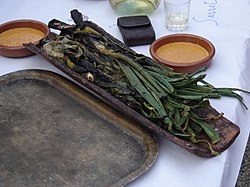
The origin of the calçot and its cooking method is in the town of Valls, where an annual event celebrates the harvest of calçots. Nowadays, thousands of eating gatherings centered around the calçots, called calçotades (singular: calçotada), are celebrated around Catalonia. In these events, they are grilled over a hot fire, wrapped up in newspaper, served on terra cotta tiles and eaten, after peeling with bare hands, by dipping them one by one in special sauce (made with almonds).

Etymology

[edit]

The origin of the word calçot comes from the Catalan term calçar, which corresponds to hilling. Hence the word "calçot" roughly mean "that which has been hilled". This is because calçots get their characteristic shape and texture from this process.[2]

The word "calçar" itself literally means "to shoe",[3] and ultimately derives from the Latin calceus, a type of footwear that covered the ankle and lower shin - hence its use by analogy in this context.

Origin

[edit]

The origin of the variety is disputed, but one of the most commonly accepted versions of its history is that they were developed by Xat de Benaiges, a peasant farmer from Valls around the turn of the 20th century. He is said to have been the first to have planted the sprouts of garden onions, covering them with earth so a longer portion of the stems remained white and edible.[2]

Calçotada

[edit]

The most traditional way of eating calçots is at a calçotada (plural: calçotades), a gastronomical celebration held between November and April,[4] where barbecued calçots are consumed in massive quantities.[5]

In a typical event, calçots are grilled until the outer layers are charred, then wrapped in newspaper to steam, served on terra cotta tiles and eaten after peeling off the charred skin with bare hands and dipping the white portion in a special sauce (similar to romesco and to salvitxada). The green tops are discarded. It's customary to wear a large bib for the sauce stains. The calçots can be accompanied by red wine or cava sparkling wine. Pieces of meat and bread slices are often roasted in the charcoal after cooking the calçots.[5] For dessert, a typical choice is oranges and white cava.[6]

[edit]

See also

[edit]

References

[edit]

Further reading

[edit]
Revisions and contributorsEdit on WikipediaRead on Wikipedia
from Grokipedia
A calçot is a slender, elongated variety of green onion (Allium cepa L.) native to Catalonia, Spain, characterized by its white, tender base and dark green tops, typically measuring 15-25 cm in length and harvested from late winter to early spring. Cultivated using the traditional "calçar" technique—where soil is repeatedly mounded over the growing shoots to blanch and elongate the stems—calçots develop a mild, sweet flavor that intensifies when grilled, distinguishing them from standard scallions. Originating in the late 19th or early 20th century in Valls, Tarragona, they are credited to a local farmer named Xat de Benaiges, who accidentally discovered the blanching method after fire-damaged onions regrew tender and elongated. Calçots hold significant cultural importance in Catalan cuisine and traditions, serving as the centerpiece of the calçotada, a communal winter feast held from to , particularly in the region. During a calçotada, the onions are grilled over open flames—often grapevine prunings—until their outer skins char black, then steamed in bundles to soften the tender white interiors, which are peeled by hand and dipped in rust-colored sauce made from roasted peppers, nuts, garlic, and . Participants don large bibs to manage the messy eating process, and the meal typically includes grilled meats like , artichokes, and local wines poured from a pitcher. The tradition fosters social bonds among families and friends, often at rural masias (farmhouses) or public events, with the annual Gran Festa de la Calçotada in drawing thousands on the last Sunday of . The calçot has been granted (PGI) status by the , ensuring authenticity in production within a defined area of , where sandy soils and specific climate conditions contribute to their quality. Nutritionally, calçots are rich in , , calcium, , potassium, and , offering benefits similar to other onions. Beyond the calçotada, they appear in Catalan dishes raw in salads or cooked in stews, though their seasonal availability limits year-round use. This unique vegetable not only embodies regional agricultural heritage but also symbolizes Catalan identity through its festive rituals.

Etymology and History

Etymology

The term "calçot" derives from the Catalan verb calçar, which means "to hill" or "to earth up," referring to the agricultural technique of mounding soil around the base of the onion plant to promote elongated growth and blanching of the stem. This practice, central to calçot cultivation, involves repeatedly covering the emerging shoots with soil, akin to "shoeing" or protecting the plant's lower portion. The verb calçar itself traces back to Latin calceāre, meaning "to shoe" or "to provide with footwear," ultimately stemming from calceus, the Latin word for a type of ankle-length boot or shoe that covered the lower leg. This etymological link symbolizes the hilling process, where soil envelops the onion stem much like a shoe covers the ankle, reflecting a metaphorical extension of footwear terminology into agricultural language. In the context of Catalan agricultural terminology, the word "calçot" evolved during the early , with its first documented uses associated with farming practices in , , where the specific cultivation method gained prominence among local growers. This linguistic adaptation highlights how regional farming innovations integrated into the , tying the term directly to the soil-covering technique that defines the calçot.

Historical Development

The development of the calçot variety is attributed to Xat de Benaiges, a farmer from in , who around the turn of the pioneered its cultivation by planting sprouts from garden onions and progressively hilling soil around the emerging stems to blanch and elongate the edible white portion. This technique transformed standard onion resprouts into the distinctive long, tender calçots derived from local Allium cepa varieties, such as the Blanca Tardana de landrace. By the early , calçots had become a well-established dish in and its immediate surroundings, with cultivation expanding to nearby districts including Alt Camp, Baix Camp, Tarragonès, and Baix Penedès within the province. This regional dissemination solidified calçots as a staple in local and by the 1920s, supported by early harvest celebrations in , with the Gran Festa de la Calçotada first organized in 1982. The initial adaptation and success of calçots were heavily influenced by the unique conditions of Catalonia's region, where fertile alluvial soils and a with mild winters and moderate rainfall facilitated the blanching process and resprout growth essential to the variety. These environmental factors, combined with traditional practices, enabled the of elongated stems from bulb onions, distinguishing calçots from standard cepa forms.

Description and Cultivation

Botanical Characteristics

The calçot is a distinct cultivar of Allium cepa L., belonging to the 'Blanca Tardana de Lleida' landrace, and is classified as a green onion variety characterized by a mild, sweet flavor that is notably less pungent than standard bulb onions. Physically, it exhibits a slender, elongated white stem typically measuring 15–25 cm in length and 1.7–2.5 cm in diameter at the base (measured 5 cm from the root), with minimal bulb development that results in an appearance resembling a leek or scallion. In terms of growth habit, the produces 1–20 shoots (resprouts) per in its second year, featuring tender outer leaves and soft white inner layers that reach peak tenderness during winter harvest. The characteristic white coloration of the stem is enhanced by techniques that exclude from the lower portions during growth.

Cultivation Techniques

Calçots are planted in autumn, typically from mid-August to late , as single bulbs in trenches approximately 10–15 cm deep, with spacing of about 30 cm between bulbs and 75 cm between rows to achieve a of around 32,000 per . The bulbs, derived from the previous year's 'Blanca Tardana de ' onion , are positioned tip-up and partially buried, about one-third below the surface, in well-prepared, loose soil to promote initial root establishment. Following planting, progressive earthing up—or —begins as the stems emerge and grow to around 30 cm tall, with soil mounded around them 2–3 times over winter to a total depth of 20–25 cm, leaving only the top third exposed. This blanching technique extends the edible white portion of the stems while contributing to their characteristic mild, sweet flavor by limiting light exposure. occurs in late winter, from January to March, when the stems reach an optimal diameter of about 2 cm and a white length of 20 cm, typically after 4–5 months of growth. Yields average 125,000–165,000 calçots per under traditional and modern methods, respectively, with each plant producing 1–20 marketable calçots, though has improved uniformity and output. The stems are pulled by hand or with a to avoid damage, ideally before flowering to preserve quality. In Catalonia's regional adaptations, calçots thrive in loamy to clay-loam soils with good drainage and low (0.7–1.8%), often with a of 8.2–8.6, particularly in the PGI 'Calçot de ' zone. These soils, common in the western interior, provide the necessary depth and fertility near riverbeds, while the mild minimizes frost risks, though occasional protection like mulching may be used in cooler microclimates. Modern practices since the early include the use of certified seeds from bred varieties like Roquerola and Montferri, which enhance yield and consistency while complying with EU standards established in 2002. , applied via drip systems or flooding at 2–3 times per week during dry periods, ensures uniform growth and addresses climate variability, aligning with EU sustainable farming guidelines under the for water-efficient and environmentally compliant production.

Culinary Uses

Preparation and Serving

Calçots are traditionally prepared by them whole over an open wood fire, often using vine cuttings as , until the exterior is completely charred and blackened, which typically takes about 20 minutes. After , the calçots are bundled together and wrapped in or paper to steam and soften the inner layers for at least 10 minutes, allowing the heat to continue cooking the tender white stalks without over-charring. Once steamed, the charred outer skins are peeled away in a single motion to reveal the soft, smoky inner stalk, which is then pulled out and consumed. The peeled calçots are typically dipped into or sauce, a thick made from roasted tomatoes, ñora peppers, , toasted almonds or hazelnuts, , , and for texture. In everyday , calçots serve as a seasonal in farmhouses and restaurants, often roasted or to accompany meats or other during the winter months from November to April. This preparation highlights their mild, sweet flavor, distinct from stronger onions, and aligns with broader grilling techniques used in the region outside formalized like the calçotada.

Calçotada Tradition

The calçotada is a cherished gastronomic ritual in , centered around the communal consumption of flame-grilled calçots, typically held during the winter months from January to April. This event transforms a simple meal into a social celebration, where participants gather around an open fire to cook and share food, emphasizing bonds of family and community. The meal follows a structured progression, beginning with the calçots as the starter, grilled over vine shoots until charred and then bundled in groups of 20 and wrapped in to steam. They are served warm on traditional terracotta roof tiles, allowing diners to peel away the blackened outer layers by hand before dipping the tender inner parts into salvitxada sauce, a smoky blend of tomatoes, peppers, , nuts, and . This is followed by the main course of grilled meats such as lamb chops and sausage, accompanied by rustic bread like and sometimes beans or artichokes. The meal concludes with desserts, often —a caramelized —or fresh oranges paired with cava, providing a refreshing end to the hearty feast. Traditional accompaniments enhance the ritual's conviviality, with red wines from the Priorat region or sparkling cava poured from a shared —a spoutless pitcher that encourages group toasting and passing. Eating etiquette is notably informal and messy, requiring participants to don large bibs to protect against splatters while peeling and consuming the calçots by tilting the head back, fostering a sense of shared indulgence and equality among guests. Originating in the late in , , the calçotada began as intimate family gatherings sparked by a farmer's accidental discovery of grilled onions' appeal, evolving into a widespread winter tradition across southern by the mid-20th century. This progression reflects broader Catalan identity, where the act of communal fire-cooking and sauce-dipping symbolizes regional pride, seasonality, and the joy of collective feasting.

Cultural and Economic Significance

Festivals and Regional Events

The Gran Festa de la Calçotada in , held annually on the last Sunday of , serves as the premier celebration of calçots, drawing up to 30,000 attendees for harvest parades, grilling demonstrations, sauce-making competitions, and tastings of approximately 3,600 portions of the prepared in the traditional style. Institutionalized in 1980, the event highlights as the historic epicenter of calçot cultivation in the Alt Camp region of province, featuring family-oriented activities that underscore the communal aspect of the tradition. Regional events extend the festivities across , with variations in province including live music, cultural shows, and calçot-eating contests in towns like Alcover and Montblanc, where smaller gatherings emphasize local producers and medieval heritage alongside the meal. In , calçotadas often incorporate natural settings and group tastings, while hosts tourist-oriented pop-up experiences and guided tours to nearby farms, adapting the tradition for international visitors through organized outings that blend education on cultivation with seasonal dining. Following the , the festival was suspended in 2021 due to restrictions, with an 80% drop in overall regional calçotada participation that year, prompting adaptations such as limited-capacity events in 2022 under sanitary protocols. More recent gatherings, including the 2025 edition, have shifted toward by promoting local sourcing and eco-friendly as part of Catalonia's designation as a World Region of , addressing broader challenges like droughts that impact agricultural yields.

Protected Status and Economic Role

The "Calçot de Valls" received Protected Geographical Indication (PGI) status from the on May 30, 2002, ensuring that only those produced in the designated areas of Alt Camp, Baix Camp, Tarragonès, and Baix Penedès within the , , can bear the label. This mandates specific cultivation methods, including the use of the Blanca Grande Tardía de Lérida variety, autumn , and repeated earthing up to blanch the stems, which must measure 15-25 cm in length and 1.7-2.5 cm in diameter for certification. The regulatory council, Consell Regulador de la IGP Calçot de Valls, oversees and labeling, with certified bundles sold in packs of 25 or 50 stems bearing a distinctive blue band. Economically, the PGI supported around 50 certified producers in the core areas as of 2021, contributing to the livelihoods of numerous farmers across through an annual harvest exceeding 18 million calçots for the 2024–2025 season. Sales occur primarily through local markets, restaurants, and exports to European countries such as , , and , where demand grew by approximately 10% during the 2018–2019 season. The associated calçotada events further boost , drawing tens of thousands of visitors annually to towns like and stimulating related services such as and transportation. Looking ahead, calçot production faces challenges from , including prolonged droughts and rising temperatures in , which have reduced and hindered onion growth, potentially lowering yields as seen in broader agricultural impacts. Efforts to adapt include pursuing organic certifications through bodies like the Catalan Council for Organic Production (CCPAE), with some farms already integrating sustainable practices to meet growing international demand in premium markets. This expansion into exports and eco-friendly methods aims to sustain the crop's viability amid environmental pressures.

References

Add your contribution
Related Hubs
User Avatar
No comments yet.