Hubbry Logo
Garlic pressGarlic pressMain
Open search
Garlic press
Community hub
Garlic press
logo
8 pages, 0 posts
0 subscribers
Be the first to start a discussion here.
Garlic press
Garlic press
from Wikipedia
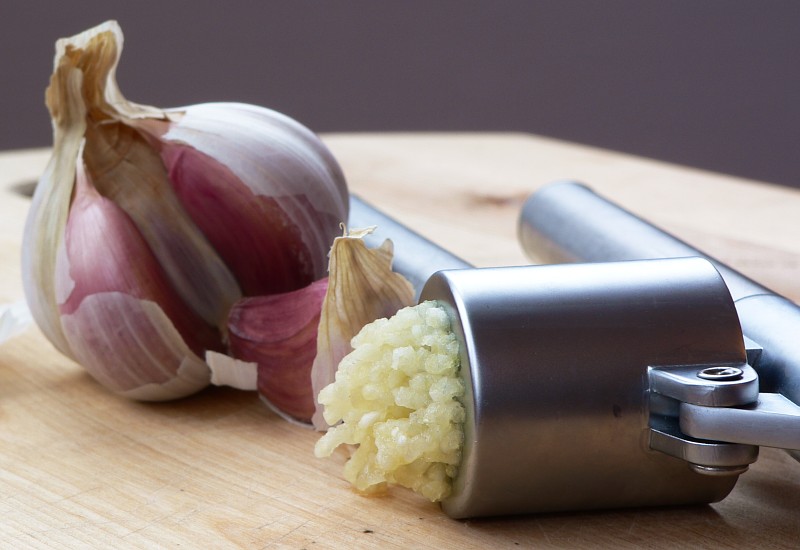
Garlic having been crushed using a garlic press
Many garlic presses also have a device with a matching grid of blunt pins to clean out the holes.

A garlic press, also known as a garlic crusher, is a kitchen utensil to crush garlic cloves efficiently by forcing them through a grid of small holes, usually with some type of piston. Many garlic presses also have a device with a matching grid of blunt pins to clean out the holes.

The first patent for a garlic press is credited to Karl Zysset (1907–1988) founder of the Swiss kitchen utensil company Zyliss, though the design is functionally identical to earlier presses that were in widespread use.[1][2]

Garlic presses present a convenient alternative to mincing garlic with a knife, especially because a clove of garlic can be passed through a sturdy press without even removing its peel. The peel remains in the press while the garlic is extruded out. Some sources[3] also claim that pressing with the peel on makes cleaning the press easier.

Garlic crushed by a press is generally believed[citation needed] to have a different flavor from minced garlic, because more of garlic's strong flavor compounds are liberated. A few sources prefer the flavor of pressed garlic. Raw-foods chef Renée Underkoffler says "a good garlic press makes dealing with garlic a clean pleasure. Pressed garlic has a lighter, more delicate flavor than minced garlic because it excludes the bitter center stem."[4] The magazine Cook's Illustrated says "a good garlic press can break down cloves more finely and evenly than an average cook using a knife, which means better distribution of garlic flavor throughout any given dish."[5]

On the other hand, some chefs say garlic crushed in a press has an inferior flavor compared to other forms of garlic. For instance, chef Anthony Bourdain called garlic presses "abominations" and advised "don't put it through a press. I don't know what that junk is that squeezes out of the end of those things, but it ain't garlic."[6] The cookery writer Elizabeth David wrote an essay titled "Garlic Presses are Utterly Useless".[7] Alton Brown (known for his dislike of single-purpose kitchen tools) has referred to garlic presses as "useless" and without a reason to exist.[8]

Cook's Illustrated lists some additional uses for a garlic press, such as mashing other small items (including olives, capers, anchovies, ginger and canned chipotles) or pressing out small quantities of onion or shallot juice.[5]

Collection

[edit]

The largest collection of unique garlic presses is thought to be owned by Tord Elfwendahl, Stockholm, who has since 1979 collected an excess of 1200 unique garlic presses.[9]

See also

[edit]

Notes

[edit]
Revisions and contributorsEdit on WikipediaRead on Wikipedia
from Grokipedia
A garlic press, also known as a garlic crusher, is a handheld designed to crush raw cloves into a fine or mince by forcing the pulp and juice through small perforated holes using a mechanism operated by squeezing two handles together. It typically features a hinged structure with a chamber for the clove, a to apply pressure, and often a tool to scrape out residue, allowing users to prepare quickly without skills or extensive peeling. The modern garlic press was invented in 1948 by Karl Zysset, a bicycle mechanic from Lyss, , who adapted the lever principle and practical design of bicycle brakes to create the first cast aluminum version, revolutionizing garlic preparation by enabling effortless crushing without smelly fingers. Zysset founded the Zyliss company in 1951, which produced and popularized the tool—originally named the Susi—globally, with the design earning recognition including a Swiss postage stamp in 2024 for its enduring impact on . Today, garlic presses remain a staple in home cooking for their speed and convenience, processing multiple cloves in seconds and integrating easily into recipes requiring minced garlic, though they can produce a more pungent flavor due to greater rupture compared to knife-mincing. Garlic presses are constructed primarily from durable materials like or die-cast aluminum to withstand repeated use and resist , with ergonomic handles and spring-loaded hinges in many models to reduce hand strain. Variations include self-cleaning designs that reverse the to push out remnants and models capable of pressing unpeeled cloves or even ginger, enhancing versatility. While praised for minimizing waste and cleanup in everyday meal prep, some culinary experts criticize presses for potential flavor intensity and cleaning challenges around the perforations, often advocating hand-mincing for nuanced control in settings.

History

Origins and early designs

The modern garlic press originated in in 1948, when bicycle mechanic Karl Zysset (1907–1998) from Lyss invented the first dedicated tool for crushing cloves efficiently. Prior to this innovation, preparation typically involved manual mincing with knives or rudimentary pounding tools, lacking a specialized device to produce a fine paste without direct hand contact. Zysset's creation addressed these limitations by adapting mechanical principles to kitchen use, marking a significant advancement in culinary utensils. Zysset drew inspiration from the brake mechanism of bicycles, incorporating its leverage system and practical design into a handheld press. This resulted in an early model featuring two pivoting handles connected at a , with a perforated chamber on one arm to hold the and a on the other to force it through small holes, extruding a smooth puree while containing the skins. The initial design utilized cast aluminum for durability and ease of use, allowing users to avoid the strong odors associated with handling directly. Known as the "Susi" garlic press, this prototype emphasized simplicity and , enabling effortless operation with minimal effort. Following the invention, Zysset founded the company Zyliss in 1951 (derived from his surname and hometown), shifting from repair to manufacturing kitchen tools. Between 1956 and 1973, Zysset registered over 20 patents for various kitchen tools. Early iterations of the Susi model quickly gained popularity in for their robust construction and hygienic benefits, setting the standard for subsequent designs. Although precursors like general fruit and vegetable squeezers existed, Zysset's addition of a contained chamber and optimized made it specifically suited for , distinguishing it as the seminal garlic press. By the mid-1950s, patents for similar mechanisms began appearing internationally, reflecting the tool's growing influence.

Modern invention and patents

The modern garlic press, characterized by its lever-action design using cast aluminum for efficient crushing, was invented in 1948 by Karl Zysset (1907–1998), a from Lyss, . Inspired by the leverage principle and practical mechanics of brakes, Zysset developed a tool that allowed users to crush unpeeled cloves directly, producing minced without direct hand contact and minimizing odor transfer. This innovation, named the Susi 3, marked a significant advancement over earlier manual crushing methods, emphasizing durability, ease of operation, and hygiene. Zysset founded the Zyliss company in 1951 to manufacture and distribute the device, which quickly gained popularity in European kitchens and laid the foundation for the company's expansion into global markets. The first for this modern garlic press design is attributed to Zysset, filed in around the late 1940s, though the exact patent number and full documentation remain primarily in Swiss archives and are not extensively digitized in English-language resources. The invention's core features—a pivoting handle system with a perforated pressing chamber—protected the that reduced user effort compared to prior wooden or basic metal crushers. By the early , Zyliss secured additional protections in , enabling and export. In the United States, garlic press patents emerged shortly after, reflecting the device's growing international adoption. One of the earliest was US Patent 2,776,616, filed in 1954 and granted in 1957 to inventor Steven O. Sarossy, which introduced an improved version with a removable, wall-less strainer for easier cleaning and sanitation. This patent emphasized hygienic design elements, such as a U-shaped perforated base that integrated with the lever arms to form a temporary compartment, building on Zysset's foundational lever mechanism. Subsequent US innovations in the late 20th century focused on material enhancements and multifunctionality; for instance, US Patent 5,513,562, granted in 1996 to inventors affiliated with Zyliss USA, described a non-stick model with an integrated cleaner to scrape residue from the chamber, addressing common user complaints about post-use maintenance. These patents collectively established the garlic press as a standardized kitchen tool, with numerous related filings worldwide by the 2000s prioritizing ergonomic handles, rust-resistant coatings, and dual-purpose strainers. Key contributions, such as those from Zyliss, prioritized amplification for minimal force.

Design and construction

Key components

A garlic press typically consists of a sturdy frame formed by two handles connected by a , which allows users to apply leverage through squeezing motion. The handles are often ergonomic, featuring rubberized grips to reduce hand strain during operation, as seen in models like the OXO Good Grips Garlic Press. In some designs, the handles incorporate crossed pivoted at an intermediate point to amplify force, enabling efficient crushing with minimal effort. The core crushing area includes a hopper or chamber, a shallow receptacle where cloves are inserted, often accommodating one to three unpeeled cloves depending on the model's capacity. Adjacent to the hopper is the perforated screen or grate, typically a metal plate with small, uniform holes or slots that mince the as it is forced through, producing a fine paste. Hole sizes vary, with smaller apertures yielding finer textures, as in the Männkitchen Garlic Press. A plunger or pressure plate, attached to one of the levers, moves toward the screen to compress the garlic, ensuring complete extrusion without excessive force. In premium models, the plunger fits flush against the screen to minimize waste and facilitate cleanup. Some presses include a swing-out hopper or integrated cleaning tool, such as a pivoted bottom plate, to access and rinse residue easily. Materials like die-cast aluminum, zinc, or stainless steel are common for durability and food safety across these components.

Operating mechanism

The operating mechanism of a standard garlic press relies on a simple system to apply mechanical force for crushing garlic cloves. The device consists of two elongated handles connected by a central or pivot point, forming a scissor-like structure that provides through leverage. At one end of the handles is a small chamber or basket equipped with a perforated grid or screen as its base, typically featuring numerous small holes (often conical in shape for ease of extrusion and cleaning). The garlic clove, peeled or unpeeled, is placed within this chamber. When the user squeezes the free ends of the handles, the pivot translates the hand-applied force into linear motion of the plunger, which advances into the chamber and compresses the garlic against the perforated grid. This action ruptures the clove's cell walls, releasing its juices and soft pulp, which are then extruded through the grid's apertures under pressure, producing a fine mince directly into a receiving bowl or surface below. The fibrous skin and tougher residue remain trapped in the chamber, as the holes are sized to allow only the pulverized interior to pass. The lever design amplifies the force—often requiring significant hand strength for unpeeled or larger cloves—ensuring efficient crushing with minimal effort compared to manual chopping, though the exact force transmission depends on handle length and pivot placement for optimal mechanical advantage. Variations in mechanism may include articulated plungers for better alignment or spring-loaded elements to assist in reopening the device after use, but the core principle remains the hinged-lever compression against a sieve-like barrier. In some designs, the grid pivots independently to a cleaning position post-pressing, facilitating residue removal without disassembly. This straightforward yet effective system has been refined in patents since the early to balance crushing efficiency with user .

Usage

Basic operation

A garlic press operates by mechanically crushing garlic cloves through a perforated grid, forcing the softened pulp into a fine mince or paste while separating the fibrous skins. The device typically consists of two hinged handles connected to a and a hopper with small holes, resembling a in form. When the handles are squeezed, the pushes the garlic against the grid, extruding the minced pieces through the perforations under , which ruptures the cell walls and releases the garlic's volatile compounds for enhanced flavor. To use a garlic press, begin by preparing the clove: separate it from the and optionally trim the stem end or peel it, though many models allow pressing with the skin intact to simplify cleanup, as the skin remains in the hopper. Place the clove or multiple small cloves into the hopper, ensuring it sits flat against the grid for even pressing. Position the press over a or to catch the minced . Firmly squeeze the handles together using a strong, steady motion—often requiring two hands for larger or firmer cloves—to activate the mechanism and extrude the mince. Once pressed, open the handles, scrape the output from the grid using the back of a or , and discard any remaining skins from the hopper. This process typically takes seconds per and produces uniform particles that cook more evenly than hand-minced , though the exact texture depends on the press's and the clove's freshness. For optimal results, press immediately before adding it to a dish to preserve its pungent oils, and avoid overfilling the hopper to prevent incomplete mincing. presses are recommended for durability and ease of operation, as they resist corrosion from garlic's compounds.

Cleaning and maintenance

Cleaning a garlic press promptly after use is essential to prevent garlic residue from drying and adhering to the perforations, which can lead to buildup and affect performance over time. Begin by running hot water through the press while pushing the or using any built-in cleaning tool to dislodge pulp and skins from the holes. For models like the OXO Good Grips Garlic Press, flipping the handle activates an integrated cleaner that efficiently clears remnants, followed by a quick rinse. Similarly, the Tomorrow's Kitchen Die Cast Garlic Press includes a dedicated scraper lever that removes garlic residue from the pressing grid (raster), facilitating easy cleanup, and the press is dishwasher safe. Many garlic presses, including those from Zyliss and OXO, are constructed from durable or die-cast and are safe, allowing for convenient top-rack placement after initial rinsing to avoid clogging the machine's filter with debris. However, for thorough sanitation, with warm, soapy and a soft-bristled —such as a dedicated —is recommended to reach into small perforations and hinges, ensuring no sticky residue remains. Avoid using scrubbers or harsh chemicals, as they can scratch the surface and compromise the finish. For maintenance, inspect the press regularly for signs of wear, such as bent perforations or loose hinges, and dry it completely with a soft cloth before storage to prevent moisture-induced on metal components. Storing in a dry drawer or hanging it upright helps maintain its shape and functionality. If the press includes non-stick coatings or grips, wipe them gently to preserve their integrity, and lubricate hinges sparingly with food-grade oil only if squeaking occurs, following manufacturer guidelines. Periodically testing with a soft clove can confirm consistent pressing action.

Variations

Manual types

Manual garlic presses represent the most common and traditional category of garlic presses, relying on human-powered mechanisms to crush cloves without electricity. These devices typically consist of a chamber or hopper where garlic is placed, a pressing element that forces the clove through perforations to mince it, and ergonomic handles for operation. Early designs emerged in the mid-20th century, evolving from simple squeeze mechanisms to more efficient variations that reduce hand strain and improve output consistency. The standard squeeze or type is the foundational manual , featuring two hinged handles that, when compressed, drive a to push through a perforated screen, producing a fine mince. This mechanism, often made from die-cast alloy or for durability, requires moderate hand strength but can handle one to three cloves at a time depending on the hopper size. Models like the OXO Good Grips exemplify this type with soft, non-slip rubber grips and a built-in cleaner to scrape residue from the screen, minimizing waste and easing maintenance. variants, such as the Männkitchen press, offer rust resistance and safety, while plastic options provide lighter weight at the cost of longevity. Lever-assisted manual presses build on the squeeze by incorporating a double- or multi-hinge system that amplifies force, allowing users to mince with significantly less effort—often described as requiring only one-third the pressure of standard models. This innovation, seen in heavy-duty constructions like the Männkitchen Double Lever Assisted, features a larger for multiple cloves and a swing-out for easy cleaning, making it suitable for frequent culinary use. The mechanism distributes pressure evenly, reducing slippage and ensuring complete extraction of pulp and juices. Twist-action manual presses employ a rotary mechanism where users rotate one or a top component against a fixed base to grind , producing a paste-like consistency finer than traditional minces. Constructed from durable or , these designs, such as the Joseph Joseph Helix or Garlic Twist, often include transparent bodies for monitoring progress and can process unpeeled cloves or other soft ingredients like ginger. The twisting motion engages more muscles than squeezing, potentially reducing wrist strain for some users, though it may require more counter space. Rocker or rolling manual presses diverge from enclosed mechanisms, using a curved, arch-shaped tool—typically stainless steel with perforations on the underside—that is rocked back and forth over cloves placed on a . This open design, exemplified by the Joseph Joseph Garlic Rocker, requires minimal force and no peeling, as the rocking motion crushes and minces through large square holes, yielding uniform pieces with less mess. This typically produces a medium to coarse textured mince with distinct pieces, which is often preferred for its visible texture and more gradual flavor release in certain dishes. Weighing under 4 ounces, rockers are portable and easy to rinse, though they lack the enclosed containment of other types, potentially scattering bits during use. Across these manual types, common enhancements include self-cleaning ejectors or integrated scrapers to address residue buildup, and perforations sized for varying mince textures—from coarse chunks in rockers to fine pastes in twist models. Materials prioritize food-grade safety, with dominating for its corrosion resistance and , while ergonomic features like cushioned handles enhance for those with limited .

Electric and specialized types

Electric garlic presses, also known as mini electric choppers, are battery-powered or USB-rechargeable devices that mince using rotating blades rather than mechanical pressing. These tools typically feature a compact cylindrical with a capacity of 200-350 ml, allowing users to process multiple cloves or small quantities of other ingredients like ginger and herbs with a single button press. They are particularly beneficial for individuals with limited hand mobility, as the small motor handles the crushing action without requiring physical force. Specialized manual garlic presses deviate from the standard design to address specific needs such as ease of cleaning, handling unpeeled cloves, or larger capacities. Self-cleaning models like the Dreamfarm Garject incorporate innovative mechanisms, such as a built-in scraper and peel-ejection , to facilitate removal of garlic residue and skins directly into the . Constructed from chrome-plated and , it accommodates up to three cloves and reduces post-use scrubbing, though it is heavier at 12.6 ounces compared to basic presses. Other specialized variations include presses for unpeeled garlic, such as the Zyliss Garlic Press, which uses a spring-loaded button to eject skins after crushing, minimizing peeling prep time.

Culinary impact

Advantages in cooking

A garlic press offers significant time-saving benefits in food preparation by quickly multiple cloves without the need for precise skills, making it particularly useful for recipes requiring substantial amounts of , such as sauces or marinades. Unlike manual chopping, a press processes much more quickly, streamlining workflows for both home cooks and professionals handling larger batches. This efficiency is enhanced in modern designs that accommodate unpeeled cloves, reducing peeling time and mess on cutting surfaces. In terms of ease of use, the tool minimizes direct contact with garlic, preventing the transfer of odors to hands and utensils, which is a common issue with knife mincing. It produces a consistent, fine puree that integrates evenly into dishes, ideal for raw applications like dressings, pestos, or quick sautés where uniform texture ensures balanced flavor distribution without overcooking. This pureed consistency also allows for effortless incorporation into batters or doughs, such as in garlic bread, where larger chunks might disrupt the final product. The mechanical action of pressing crushes garlic cells, releasing alliinase enzyme that converts into , the compound responsible for garlic's pungent aroma, flavor intensity, and properties. This process maximizes flavor extraction compared to whole or sliced garlic, providing a more robust taste in short-cooking methods like stir-fries or vinaigrettes, where heat has limited time to develop notes. Nutritionally, contributes to garlic's and effects, with benefits like reduced and cardiovascular support preserved best when garlic is used raw or lightly cooked after pressing.

Criticisms and alternatives

Despite its popularity, the garlic press has faced significant criticism from professional chefs and home cooks alike for its impact on garlic's flavor and texture. Pressing garlic through the device crushes the cloves extensively, releasing allicin and other sulfur compounds that can impart a bitter, acrid taste, often described as overpowering or "farty" in raw applications, and causing the garlic to burn more quickly during cooking. Additionally, the irregular, squiggly output from many presses results in inconsistent texture and sprays juice uncontrollably, leading to waste and mess. High-profile chefs like Anthony Bourdain have dismissed pressed garlic as "junk" that lacks the true essence of the ingredient, arguing it bruises the cloves excessively and diminishes culinary quality. Practical drawbacks further compound these issues. Cleaning a garlic press is notoriously labor-intensive, as bits of cling to the small perforations, often requiring a or and risking damage to knives used for scraping. Many models, particularly those made from reactive metals like aluminum, can impart a metallic flavor to the , exacerbating bitterness. In small kitchens, the tool is seen as a space-hogging single-purpose , offering little versatility compared to multi-use implements. Critics from the slow-food movement, such as , have labeled it "utterly useless," viewing it as a of unnecessary that shortcuts traditional techniques. Alternatives to the garlic press emphasize methods that preserve garlic's nuanced flavor while offering greater control. Hand-mincing with a sharp chef's knife—smashing the clove first under the blade's side, peeling, and finely chopping—produces larger, drier pieces with a milder, mellower profile that integrates evenly into dishes without excessive pungency. For a paste-like consistency, chefs recommend using a mortar and pestle, often with a pinch of coarse salt to aid grinding; this yields tender, sweet results with balanced intensity, ideal for sauces or marinades. A Microplane grater provides a quick grating option for fine, mushy garlic suitable for emulsions like mayonnaise or yogurt-based sauces, though it can create an intensely potent output that requires careful portioning to avoid overwhelming bitterness. In some cuisines, such as Thai, garlic is pulverized alongside aromatics like cilantro root or peppercorns in a mortar for enhanced flavor synergy. For those seeking minimal tools, a fork's tines can mash and mince peeled cloves directly on a cutting board, replicating press-like results with easier cleanup. These approaches, favored by figures like Alice Waters and David Chang, prioritize precision and allow garlic's subtle sweetness to shine in both quick sautés and slow-cooked preparations.

Collections and culture

Notable collections

One of the most prominent garlic presses in museum collections is the Zyliss Susi model donated by chef to the Smithsonian Institution's in 2001, as part of her entire kitchen ensemble. Child, a pioneering advocate for accessible French cooking, praised the press as a "wonderful " for its efficiency in mincing without peeling cloves first, reflecting her preference for practical tools that streamlined meal preparation. The holds the "Nonno di Antonio" garlic press (Model GV04), designed by Italian architect Guido Venturini for Alessi in 1996, exemplifying postmodern design in everyday with its whimsical, anthropomorphic form made from acetalic and . This piece, accessioned in 1999 as a from Alessi S.p.A., highlights the integration of artistic aesthetics into functional objects, part of the museum's broader Food/Drink classification. In the realm of , the at Newfields features a 1999 garlic press by American architect , produced in metal and rubber likely in collaboration with , emphasizing ergonomic form and accessibility in mass-market goods. Acquired in 2012 through the E. Hardey Adriance Fine Arts Acquisition Fund, it represents Graves' influence on democratizing high design for household use. The Art Institute of Chicago's Architecture and Design department includes a 2005 crusher by Dutch designer Ineke Hans, manufactured by Royal VKB as part of their "Thoughts for " series, crafted from to serve dual purposes: crushing cloves on one flat side and spreading them via a cylindrical roller, while also functioning as odor-removing . Donated by Royal VKB and Wabnitz Editions Ltd., this multifunctional tool addresses modern culinary efficiency and hygiene.

Cultural references

The garlic press has garnered notable mentions in art and culinary discourse, often symbolizing debates over kitchen efficiency and technique. In culinary literature, the tool has provoked strong criticism from prominent figures. Anthony Bourdain, in his 2000 memoir Kitchen Confidential: Adventures in the Culinary Underbelly, labeled the garlic press an "abomination," arguing it mishandles garlic by crushing it excessively and releasing acrid compounds, unlike precise knife mincing. Similarly, chef and television host Alton Brown has dismissed it as a "unitasker"—a single-purpose gadget he avoids—preferring versatile tools like a chef's knife for better flavor control and texture. British food writer Elizabeth David echoed this disdain in a 1986 Tatler article, calling the press a "diabolical" instrument for producing a bitter, overprocessed result that undermines garlic's subtle qualities. These views have cemented the garlic press's status as a polarizing icon in food culture, frequently invoked in discussions of authenticity versus convenience. In design circles, it represents modernist functionality; for instance, ' 1999 stainless steel model for , with its ergonomic handle and perforated chamber, entered the Indianapolis Museum of Art's permanent collection, underscoring its evolution from utilitarian tool to aesthetic object.

References

Add your contribution
Related Hubs
User Avatar
No comments yet.