

Castel Gandolfo
View on Wikipedia | This article needs additional citations for verification. (April 2025) |
Castel Gandolfo (UK: /ˌkæstɛl ɡænˈdɒlfoʊ/,[4] US: /kɑːˌstɛl ɡɑːnˈdoʊlfoʊ, -ˈdɔːl-/,[5][6] Italian: [kaˈstɛl ɡanˈdɔlfo]; Latin: Castrum Gandulphi), colloquially known as Castello in the Castelli Romani dialects, is a town located 25 km (16 mi) southeast of Rome, in the Italian region of Lazio.[7] Situated on a hilltop in the Alban Hills with panoramic views of Lake Albano, Castel Gandolfo is home to approximately 8,900 residents and is renowned as one of Italy's most scenic towns.[8] It is one of I Borghi più belli d'Italia ("The most beautiful villages of Italy").[9]
Key Information


Within the town's boundaries lies the Apostolic Palace of Castel Gandolfo, which has served as the summer residence and vacation retreat for most popes since 1626.[10] Although the palace is located within the borders of Castel Gandolfo, it holds extraterritorial status as one of the properties of the Holy See and is not under Italian jurisdiction. It has been transformed into a museum and is now open to the public.[1] In spite of the main Apostolic Palace's current status as a museum, the Castel Gandolfo complex would have its traditional status as the pope's summer residence and vacation retreat restored in July 2025.[11]
The resort community encompasses almost the entire coastline of Lake Albano, which is surrounded by numerous summer residences, villas, and cottages that were constructed during the 17th century. It is also home to the Stadio Olimpico, which hosted the rowing events during the Rome Olympics.
Castel Gandolfo has several places of archaeological interest, including the Emissario del Lago Albano and the remains of the Villa of Domitian. The area is included within the boundaries of the Parco Regionale dei Castelli Romani (Regional Park of Castelli Romani). There are also many points of artistic interest, such as the Collegiate Church of St. Thomas of Villanova, designed by Gian Lorenzo Bernini.
Geography
[edit]Territory
[edit]The boundaries of the town extend obliquely in a north-northeast turn around the hilly area of the Alban Hills and the plains of Agro Romanus. It is included and protected by the Regional Park of Castelli Romani, formed in 1984. Most of the soil is of volcanic origin, with prevalence of materials such as tuff and pozzolana.[12] Its seismic classification is rated a Zone 2 (medium-high seismicity) [13]
Hydrography
[edit]
The main water body is Lake Albano, often called Lake Castel Gandolfo. The Metropolitan City of Rome currently manages the lake. Up to 1802, it was the property of the Abbey of Saint Nilus Grottaferrata, the Apostolic Camera (Catholic Church Financial Administration) and then owned by Prince Stanislaus Poniatowski in 1870.[14]
Topography
[edit]The maximum elevation registered in the territory is 425 m (1,390 ft) above sea level, at the Collegio di Propaganda Fide adjoining Villa Barberini. On the crown of the hills around the Lake Albano, the elevation is only 400 m (1,300 ft) above sea level, at the summit of Monte Cucco, bordering Marino.[15]
Towards the Tyrrhenian Sea, the land slopes gently, so from 250 m (820 ft) from the Casale Santa Cristina, below Castel Savello bordering Albano, goes to 217 m (712 ft) above sea level at Colle Lilli, to 200 m (660 ft) above sea level at Pozzo di Valle, to 155 m (509 ft) Quarto Santa bordering Marino, to 130 m (430 ft) above sea level of the Laghetto di Turno. The lowest elevation of the territory is 101 m (331 ft) above sea level at the village of Pavona.[16]
Climate
[edit]In terms of climate, the area falls within the domain of the temperate Mediterranean climate with mild winters, autumn temperatures higher than those of spring and ventilated summers. In the area of Colli Albani, and at Castel Gandolfo, the phenomenon known as stau, which is the reduction of water vapor in the clouds as the ground rises can be observed. Summers are hot and dry, while winter is mild and rainy without, in general, extreme low temperatures and snow. In summer, temperatures can reach 35 °C (95 °F) with peaks of 37 °C (99 °F) in rare cases.[17] Climate classification: Zone D, 1966 GR / G.
Etymology
[edit]The name "Castel Gandolfo" is derived from the Latin Castrum Gandulphi,[18] the name of the castle on this site was presumably owned by the family of Gandolfi, originally from Genoa. Another hypothesis, supported by Pope Pius II in his commentary (1462), is that the name results from Gandulphi Sabinorum, from a certain Gandolfo Savelli.[19]
History
[edit]
Archaeological finds from the 16th century BC come from the area of what is now Castel Gandolfo.[citation needed]
The site of the modern town is a candidate for the site of legendary ancient Alba Longa, capital of the Latin League. It was later developed by emperor Domitian into his vast palace.[citation needed]
Its name is derived from a fortification of the ducal Gandolfi family (of Genoese origin, named after St. Gondolfus) in the 12th century, which passed to the Savelli family from whom the Apostolic Camera purchased it in 1596 for 150,000 scudi. Pope Clement VIII (1592-1605) was the first pope to come to Castel Gandolfo, but the rebuilding of the old castle was the project of Urban VIII who first made it an official papal residence in 1626.[10]
During the Napoleonic Wars, some 900 anti-French citizens of neighboring Velletri held out in Castel Gandolfo, resisting the siege by Joachim Murat.[citation needed]
During World War II, Pope Pius XII opened up the grounds of Castel Gandolfo to refugees escaping the fighting taking place around Rome. On January 22, 1944, the first of what became 12,000 people began arriving on the property, often bringing with them their cows, horses, mules and sheep. Included were many Roman Jews, and other non-Catholics. During the time they lived there, 36 children were born, almost all of whom were named for the Pope who gave them safe harbor.The pope's private apartment was turned into a nursery.[20]
Pope Benedict (2005-2013) loved it so much he briefly retired there after leaving the papacy.[10] Pope Francis (2013-2025) rarely went with a gap of nearly 12 years of no visits, however he did open the pontifical palace and gardens to the public for the first time, increasing tourism to the town.[10] His successor Pope Leo XIV (2025-present) first used it as a summer residence in 2025, and said that he would continue the tradition - 2026 will be the 400-year anniversary as a papal residence.[10][21] On July 6, 2025, Pope Leo XIV would begin staying at Castel Gandolfo for a six week vacation, thus resuming the tradition of Castel Gandolfo being used as the pope's retreat and summer home.[22] However, the main Apostolic Palace at Castel Gandolfo still remains a museum, with Leo XIV instead staying at the Castel Gandolfo's Villa Barberini.[11]
Main sights
[edit]Religious architecture
[edit]
- The parish church, dedicated to St. Thomas of Villanova was designed by Bernini (1658–1661) on the order of the Chigi Pope Alexander VII, it has a square Greek key cross plan and houses a notable painting by Pietro da Cortona portraying Christ's crucifixion.[23][24]
- Church of Our Lady of the Lake, wanted personally by Pope Paul VI, was consecrated by the same pope in 1977, on the shores of Lake Albano.
- Church of Santa Maria Assunta, construction began in 1619 with the consecration of the first stone by Pope Paul V.
- Church of Santa Maria, modern construction, situated in the populous district of Borgo San Paolo near State Road 7 Via Appia, the Ugo Bazzi theater adjoins the church.
- Church of San Sebastiano, dedicated to the patron saint of the city and located on State Road 7 Via Appia adjacent to the church cemetery.
- Church of Santa Maria Della Cona.
Civil architecture
[edit]

- The Apostolic Palace of Castel Gandolfo, the Pope's summer residence, is a 17th-century building designed by Carlo Maderno for Pope Urban VIII. The papal palace and the adjoining Villa Barberini, which was added to the complex by Pius XI, have enjoyed extraterritorial rights since the signing of the 1929 treaty with Italy; the little piazza directly in front was renamed Piazza della Libertà in the first flush of Italian unity after 1870. The Papal Palace remained unused from 1870 until 1929.
- Villa Cybo, built by Cardinal Camillo Cybo, was annexed to the whole of the Pontifical Villas at the time of Pope Clement XIV who purchased it in 1774 from the owner at the time, Francesco III d'Este, Duke of Modena, for the sum of 80,000 crowns.
- Villa Barberini, built by the nephew of Pope Urban VIII (Maffeo Barberini), was incorporated in the extraterritorial complex of the Pontifical Villas in 1929: the manor houses the headquarters of the College of Propaganda Fide. As part of its extensive formal gardens is located the existing remains of the complex built by the Roman Emperor Domitian.
- Villa Santa Caterina, currently owned by the Catholic Institute of Technology. During the construction of this villa, situated in the Herculaneum area, the Roman ruins of the villa commonly attributed to Publius Clodius Pulcher were discovered.
- Villa Torlonia, built in the 16th century by the Roman family of the Giustiniani, then passed into ownership of the Duke of Bracciano Giuseppe Torlonia. The current appearance is due to the restoration of 1829, funded by Duke Carlo Torlonia.
- Villa Chigi built by Cardinal Flavio Chigi, nephew of Pope Alexander VII; today it is home to a golf course.
- The two telescopes of the Vatican Observatory, which were moved from Rome to Castel Gandolfo in the 1930s, were still used until the 1980s. The headquarters of the Vatican Observatory is still located in Castel Gandolfo. However, its dependent research center, the Vatican Observatory Research Group (VORG), is hosted by Steward Observatory at the University of Arizona, Tucson, United States. The telescopes are located in Mt. Graham, Arizona.

Archaeological sites
[edit]- The site of the papal palace: rebuilt on the ruins of the former castle, partly occupies the foundations of a summer residence of the Emperor Domitian that occupied 14 square kilometres (5.4 sq mi). The residence was designed by the architect Rabirius. In the palace's inner courtyard is a Roman bust depicting Polyphemus, the Cyclops from whose cave Ulysses escaped; it was found in the nymphaeum of the Imperial villa's gardens, an artificially constructed grotto of the crater lake's outlet.
- Supposed Villa of Publius Clodius Pulcher: the remains of a Roman villa located on the Appian Way, 23 kilometres (14 mi) of National Road 7 Via Appia, inside the Villa Santa Caterina, owned by the Catholic Institute of Technology. After recent studies and excavations, the site is now believed to have been an ancient shrine to the goddess Bona Dea.
- The Bergantino or bath of Diana nymphaeum: on the western shores of the Lake Albano, 2 kilometres (1.2 mi) after the Doric nymphaeum, this structure, originally annexed to the Domitian Villa at Castel Gandolfo, opens in a circular cave of 17 metres (56 ft) in diameter. There is a bath in the middle of the cave, and the floor was completely covered with mosaics, of which a few fragments remain. Various parts of sculptural groups now kept at the Pontifical Palace in Castel Gandolfo have been found in the nymphaeum.
- Emissary of the Lake Albano: an artificial conduit of runoff water, 1,800 metres (5,900 ft) long, that runs from the West coast of Lake Albano and leads into Castel Gandolfo territory. According to tradition, it was built in 396 BC to fulfil a prophecy during the conquest of Veii.
Education
[edit]Castel Gandolfo does not host secondary schools. Within the municipal area lie a private kindergarten run by the Paul VI Pontifical Municipal School, which is primary and secondary level. The Scuola Media Statale "Dante Alighieri" and other religious institutions deal with primary education.
The Catholic Institute of Technology, which opened in 2024, is an R1 research university, building on a long-standing tradition of great Catholic scientists and engineers. Catholic Tech offers bachelors degrees in various science and engineering disciplines.
Walsh University, which has its main campus in North Canton, Ohio, United States, holds a small campus in Castel Gandolfo. Classes are held in the fall, spring and summer for Walsh students.[25]
Events
[edit]- The feast of the patron saint, St. Sebastian (San Sebastiano), is celebrated on the first weekend of September, though the feast of this saint is marked on the calendar on 20 January; the festival concludes with fireworks over the lake.
- The village celebrates St. Paul and St. Mary Ausiliatrice on the last Sunday of May.
- The local market takes place on Friday mornings.
- Festival of Peaches, held on the last Sunday of July with organized cultural, entertainment, and sporting events.
- March for Peace, established by Municipal Statute in the month of January of each year.
- Premio "Città di Castel Gandolfo", a prize to personalities, bodies, and associations that bring the city prestige and better quality of life or have distinguished themselves in any branch of culture, sport or human knowledge.
- Castel Gandolfo Fotografia, photography competition established in 2007.
Frazioni
[edit]
Pavona was centered around a tavern on the way to Nettuno and the villa of Cardinal Flavio Chigi (1631–1693), nephew of Pope Alexander VII. The place was urbanized during the 20th century, thanks to the opening of the railway Roma-Velletri, and today is divided between the municipalities of Castel Gandolfo, Albano Laziale and Rome. The part castle, known as Pavona Pond due to the above-named for Round Pond, has about 3,000 inhabitants and has as its patron saint St. Eugene III of Toledo.
Mole di Castel Gandolfo, divided in part by the town of Albano Laziale, owes their name to the presence in the place of ancient mass fed by the waters of the Emissary of Lake Albano, which were used until the 19th century by the inhabitants of Castel Gandolfo and Albano Laziale to crush the grain.
Economy
[edit]In all the municipalities in the Alban Hills, agriculture, and particularly wine production, has always been the main economic voice and employer. Wines include the Frascati, the Marino, the Velletri and the Colli Lanuvini.
The production of wine is maintained by major producers such as Cantina Sociale Gotto d'Oro of Marino and Frascati, which is based in the nearby town of Castelluccia, and the Wine Cellar Social Albano Laziale and Ariccia, based in Fontana di Papa.
Services
[edit]Municipal Statute prohibits installation of equipment and systems, fixed telecommunication and radio devices, particularly equipment for radio, television and mobile telephony, and systems for radio amateurs. This prohibition is exempt for military installations, civil protection and forest protection.[26]
Most services such as hospitals or cinemas are based outside the city in larger centers like Marino, Frascati, Albano Laziale and Genzano di Roma. However, these centres are all reached by car or public transport. In return, the city is commercially very lively, thanks to the continuous influx of Italian tourists and foreigners linked to the presence of the Papal Palace and, at certain times, of the Pope.[26]
Transport
[edit]
The territory of Albano is crossed by two railway lines, belonging to the FL4 of the FL lines.
 Lazio regional railways:
- Rome-Albano railway; built starting from 1881 by decree of Umberto I of Savoy, was inaugurated in 1889, until 1927 it continued towards Cecchina and Nettuno. Totally 28.41 kilometers long, it crosses the municipality of Castel Gandolfo serving it with the Villetta station, partially falling within the territory of Albano Laziale, and with the Castel Gandolfo station; it ensures a connection with Rome and with the municipalities of Ciampino, Marino and Albano Laziale.[27]
- Rome-Velletri Railway; inaugurated by Pope Pius IX in 1863, it was the third railway line of the Papal State, and until 1892 it continued towards Valmontone and Naples. Totally 41.01 kilometers long, it crosses the municipality of Castel Gandolfo serving it with the Pavona stations, actually included in the municipality of Albano Laziale; ensures a connection with Rome and with the municipalities of Ciampino, Marino, Albano Laziale, Ariccia, Genzano di Roma, Lanuvio and Velletri.[28]
Castel Gandolfo is also connected by the following roads:
 Strada statale 7 Via Appia;
 Strada statale 140 del Lago Albano;
 Strada statale 207 Nettunense (SS 207);
 Strada provinciale 216 Maremmana III (SP 216);
 Strada regionale 217 Via dei Laghi (SR 217).


Inside the Pontifical Villa there is a heliport used by the Pope for his air travel from the Vatican to Castel Gandolfo.[29]
Tourism
[edit]-
 Thoroughfare in Castel Gandolfo
 -
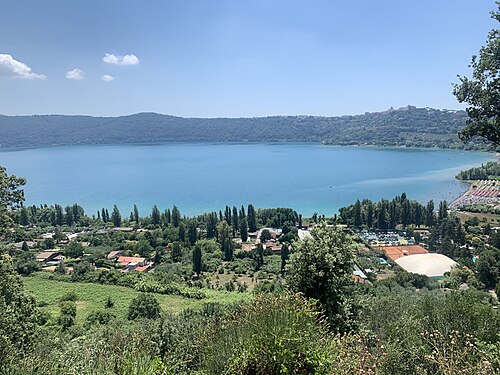 Aquatic facilities on Lake Albano
 -
 Giardini del Belvedere - Barberini Gardens
 -
 Piazzale Quadrato - Barberini Gardens


Castel Gandolfo is one of the most popular tourist town of the Roman Castles. Regular groups of Italian and foreign tourists utilize all of the parking built specifically for tourists. On the occasion of Angelus or the hearings on the Pope during his stay, many foreign pilgrims arrive in town, so that the streets and squares in the center are filled. However, Pope Francis gave up his papal residency not long after opening up the doors of the Apostolic Castle to the general public.[30]
Sports
[edit]For the 1960 XVII Olympiad held in Rome, the Italian Olympic Committee built the Olympic Stadium and the Federal Center for Canoeing and Kayaking on Lake Albano. At this stage the races were held in this discipline, and even today[when?] the Italian Federation of Canoe / Kayak considers this one of its most important training sites.[citation needed]
Canoeing/kayaking
[edit]Since 1960, Lake Albano has been used for Olympic competitions for the sport.[citation needed] Currently, the Master Line Canoeing Sports Association, active since 2005, scored important achievements to promote the sport. Another school of kayaking is held by the ASD Polisportiva Giovanile Salesiana Castel Gandolfo. Prominent clubs currently running kayaking, dragon boat and canoeing activities are ASD Aisa Sport and Circolo Kayak Castel Gandolfo.
Football
[edit]Castel Gandolfo has had an amateur football club since 2005 at Oratory Parish St. Thomas of Villanova which organizes friendly matches with other teams in the area.
Golf
[edit]In the 1970s, Castel Gandolfo Country Club opened in Pavona. The complex is located in the crater of the ancient dried up lake and in the ancient villa of Cardinal Flavio Chigi.
Rugby
[edit]The league includes youth ranging from Under 6 to 16, a senior women's team, a men's and a senior men's team. The latter, formed in 2009, playing in the regional championship of the C series (season 2009/2010).
International relations
[edit]

People
[edit]- Massimo d'Azeglio (1798‒1866), statesman and diarist
- Pietro Savorgnan di Brazzà (1852–1905), explorer
See also
[edit]References
[edit]- ^ a b "Papal summer residence, shunned by Francis, opened to public". Reuters. 21 October 2016.
- ^ "Superficie di Comuni Province e Regioni italiane al 9 ottobre 2011". Italian National Institute of Statistics. Retrieved 16 March 2019.
- ^ "Popolazione Residente al 1° Gennaio 2018". Italian National Institute of Statistics. Retrieved 16 March 2019.
- ^ "Castel Gandolfo". Lexico UK English Dictionary. Oxford University Press. Archived from the original on 2021-10-28.
- ^ "Castel Gandolfo". The American Heritage Dictionary of the English Language (5th ed.). HarperCollins. Retrieved 4 August 2019.
- ^ "Castel Gandolfo". Merriam-Webster.com Dictionary. Merriam-Webster. Retrieved 4 August 2019.
- ^ "Castel Gandolfo". Retrieved 7 June 2019.
- ^ I borghi più belli d'Italia: Castel Gandolfo
- ^ "Lazio" (in Italian). Retrieved 1 August 2023.
- ^ a b c d e Povoledo, Elisabetta (July 3, 2025). "Pope Leo Returns to Tradition: A Summer Break at a Papal Villa". The New York Times. Retrieved 2024-07-03.
- ^ a b Cernuzio, Salvatore (July 6, 2025). "'Welcome!' Pope Leo arrives in Castel Gandolfo". Vatican News. Retrieved July 6, 2025.
- ^ Carta Geologica d'Italia, foglio 150 (Roma), edizione 1967
- ^ Anche secondo le categorie sismiche stabilite dal D.M. LL.PP. 1984 e la successiva ordinanza P.C.M. n° 3274 20 marzo 2003 Castel Gandolfo era in zona sismica 2. Sono nella stessa zona sismica tutti i Colli Albani.
- ^ Gaetano Moroni, Dizionario di erudizione storico-ecclesiastica – Castel-Gandolfo, vol. X p. 155–156, Venezia 1841.
- ^ Nibby, Antonio (1829). Analisi storico-topografico-antiquaria della carta de' dintorni di Roma – Castel Gandolfo, vol. I.
- ^ Nibby, Antonio (1829). Analisi storico-topografico-antiquaria della carta de' dintorni di Roma – Castel Gandolfo, vol. II.
- ^ S. Ciccacci, L. D'Alessandro, L. Davoli, G.B. La Monica, E. Lupia Palmieri, Caratteristiche Climatiche, Geomorfologiche, Sedimentologiche e Idrogeologiche in Vincenzo Carunchio (ed.), Valutazione della Situazione Ambientale del Lago di Nemi, Roma: Università degli Studi di Roma "La Sapienza" e Provincia di Roma, 1987, pp. 17–45.
- ^ Spesso viene confusa con il Castrum Gandulphi la Turris Gandulphi o Gandulfa, che secondo lo storico di Ariccia Emanuele Lucidi (Memorie storiche dell'antichissimo municipio ora terra dell'Ariccia, e delle sue colonie di Genzano e Nemi, parte I, cap. IV pp. 41–42) sarebbe il toponimo con cui anticamente era designata l'attuale località di Tor Paluzzi, situata presso la frazione di Cecchina in comune di Ariccia.
- ^ Gaetano Moroni, Dizionario di erudizione storico-ecclesiastica – Castel-Gandolfo, vol. X p. 156, Venezia 1841.
- ^ Allen, John L. Jr. (October 21, 2014). "When the pope's palace became a refugee center and neonatal unit". Crux. Retrieved October 21, 2014.
- ^ "Pope Leo XIV to spend summer holidays in Castel Gandolfo". Vatican News. 2025-06-17. Retrieved 2025-06-17.
- ^ Artale, Dario; Stelliacci, Sylvia; Winfield, Nicole (July 6, 2025). "Pope Leo XIV resumes tradition and arrives Castel Gandolfo for vacation to restore 'body and spirit'". Associated Press. Retrieved July 6, 2025.
- ^ "Parrocchia Pontificia San Tommaso da Villanova". santommasodavillanova.it (in Italian).
- ^ "Castel Gandolfo – Church of Saint Thomas of Villanova – Tesori delle Consolari Romane" (in Italian). En.tesorintornoroma.it. Archived from the original on 2013-11-02. Retrieved 2013-03-12.
- ^ Walsh.edu Archived 2010-05-27 at the Wayback Machine
- ^ a b Statuto Comunale di Castel Gandolfo, articolo 17 Statuto del Comune di Castel Gandolfo
- ^ "La ferrovia Roma - Albano Laziale - Campoleone - Anzio - Nettuno". lestradeferrate.it (in Italian).
- ^ "La ferrovia Roma-Velletri-Priverno-Terracina". lestradeferrate.it (in Italian).
- ^ "Papa: Benedetto XVI lo ha accolto a eliporto" [Pope: Benedict XVI welcomed him at the heliport] (in Italian). swissinfo.ch. 23 March 2013.
- ^ "Pope Francis gives up papal summer residence at Castel Gandolfo". Retrieved 20 July 2020.
External links
[edit]
- Official site Archived 2013-03-08 at the Wayback Machine
- Castel Gandolfo photos
| International | |
|---|---|
| National | |
| Geographic | |
| Other | |

Castel Gandolfo
View on GrokipediaGeography
Location and Territory
Castel Gandolfo is a comune situated in the Metropolitan City of Rome Capital within the Lazio region of central Italy, approximately 25 kilometers southeast of Rome in the Alban Hills area known as the Castelli Romani.[7][8] The town occupies a hilltop position at an elevation of 426 meters above sea level, providing panoramic views over Lake Albano to the south.[9] Its central coordinates are approximately 41.75°N 12.65°E.[10] The municipal territory encompasses an area of 14.19 square kilometers, characterized by hilly terrain with slopes descending toward Lake Albano on one side and gentler inclines toward Rome on the other.[11][4] The comune borders the adjacent municipalities of Marino to the north, Rocca di Papa to the east, and Albano Laziale to the south and west, forming part of the volcanic crater rim surrounding Lake Albano.[12] This compact territory includes the historic town center and surrounding agricultural lands, with a portion of the papal properties holding extraterritorial status under the Holy See, though remaining administratively within the Italian comune.[13]Topography and Hydrography
Castel Gandolfo occupies a position on the outer rim of the Alban Hills volcanic complex, a quiescent caldera spanning approximately 10 by 12 kilometers southeast of Rome.[14] The topography consists of undulating hills and ridges shaped by Pleistocene volcanic activity, with the town situated on a ridge that features precipitous slopes toward the east and more gradual descents to the west.[4] Elevations within the municipal territory vary significantly, averaging around 306 meters above sea level and reaching a maximum of 425 meters.[15] The broader Alban Hills exhibit an altitude range from 47 to 956 meters, dominated by volcanic landforms including crater rims and lava flows.[16] Local terrain includes significant elevation changes, with variations up to 357 meters within a 3-kilometer radius of the town center.[17] Hydrographically, the region is defined by Lake Albano, a volcanic crater lake immediately adjacent to Castel Gandolfo at an elevation of 293 meters.[18] The lake covers 5.2 square kilometers, has a perimeter of 10 kilometers, and reaches a maximum depth of approximately 170 meters, making it the deepest volcanic crater lake in Italy.[19] It lacks natural surface outlets, relying on precipitation and subterranean springs for recharge, though ancient engineering efforts, including a Etruscan-Roman drainage tunnel constructed around 398 BC, have influenced its water levels historically.[20][21]Climate
Castel Gandolfo has a Mediterranean climate (Köppen classification Csa), featuring hot, dry summers and mild, wetter winters, influenced by its elevated position in the Alban Hills at approximately 412 meters above sea level.[22][23] Annual average temperatures hover around 15.5°C, with extremes rarely dropping below -2°C or exceeding 33°C.[23][17] Summer months (June to August) see average high temperatures of 27–29°C and lows around 15–17°C, with low humidity and minimal rainfall, contributing to clear skies for much of the period.[17] Winters (December to February) are cooler, with highs of 12–13°C and lows near 2–4°C, accompanied by frequent cloud cover and precipitation.[17][24] Spring and autumn serve as transitional seasons, with moderate temperatures (highs 18–23°C) and increasing rainfall toward late fall.[17] Precipitation totals approximately 1,000–1,037 mm annually, concentrated in autumn and winter, with November as the wettest month (average daily precipitation risk of 34%, totaling around 100–150 mm monthly).[25][23] Summers are notably arid, receiving less than 50 mm per month on average.[22] The locality falls within Italy's climatic zone D, indicating a temperate regime requiring seasonal heating from November to April, limited to 12 hours daily.[26]History
Ancient Origins
The area of modern Castel Gandolfo lies within the ancient Alban Hills, part of Latium vetus, where prehistoric settlements dating to the late Bronze Age (circa 1300–900 BC) have been identified through archaeological surveys in the broader region, though specific evidence at the site's elevation is limited to later periods.[27] By the archaic period, the vicinity hosted Latin communities associated with the semi-legendary Alba Longa, a city-state mythically founded around 1152 BC by Iulus (Ascanius), son of Aeneas, and regarded in Roman tradition as the parent of Rome; historical accounts, such as those by Livy, describe its destruction by King Tullus Hostilius circa 672 BC, leading to the dispersal of its inhabitants and integration into early Roman territory.[28] Archaeological corroboration for Alba Longa remains elusive, with proposed sites in the Alban crater debated among scholars, and no definitive ruins identified precisely at Castel Gandolfo, underscoring the blend of myth and sparse material evidence for pre-Roman occupation.[29] Prominence returned during the late Roman Republic and early Empire, as the site's panoramic views over Lake Albano and proximity to Rome (approximately 20 km southeast) attracted elite villas; late-Republican structures and imperial-era buildings have been excavated nearby, reflecting the Alban Hills' role as a resort area for patricians seeking respite from urban heat.[27] The locale's imperial apogee came under Emperor Domitian (r. 81–96 AD), who commissioned the expansive Albanum Domitiani, a multi-terraced palace complex designed by architect Rabirius, featuring residences, a hippodrome, theater, cryptoporticus, and nymphaea, much of which overlooked the lake and Tyrrhenian Sea.[30] [31] This villa, among the largest known Roman estates at over 55 hectares in core areas, symbolized Flavian extravagance but was largely abandoned after Domitian's assassination in 96 AD, with subsequent spoliation yielding materials for later constructions.[1] Visible archaeological remnants from this era include the Doric Nymphaeum (Ninfeo Bergantino), a monumental fountain structure along Via Gramsci descending to Lake Albano, attributed to Domitian's enhancements and featuring robust Doric columns amid terraced hydraulics.[32] [33] Lakefront sections preserve substructures like piers and retaining walls, evidencing the villa's engineering to exploit the volcanic terrain, while sporadic finds of mosaics, statues, and inscriptions underscore the site's opulence, though systematic digs remain constrained by the overlying papal properties.[34] The period's legacy highlights causal factors in Roman elite migration to salubrious highlands, driven by malaria risks in the lowlands and Augustus-era precedents for imperial retreats, setting a template for enduring land use patterns.[31]Medieval Development
During the early Middle Ages, the area of modern Castel Gandolfo remained largely rural and sparsely populated, succeeding the decline of ancient Roman settlements like the Villa of Domitian, with limited documented activity until the 12th century.[30] Around 1200, the Genoese Gandolfi family, feudal lords seeking to establish control in the Alban Hills, constructed a castle on the hilltop site overlooking Lake Albano, utilizing remnants of earlier structures in the medieval village known as Cuccuruttus.[32] [35] This fortification marked the inception of the town's medieval development, transforming the locale into a defensible stronghold amid the fragmented feudal landscape of the Roman countryside, where local families vied for influence amid papal and imperial contests.[36] By the 13th century, the castle and associated lands passed to the prominent Roman Savelli family, a baronial lineage that produced two popes—Honorius III (1216–1227) and Honorius IV (1285–1287)—and exerted significant influence in Lazio.[36] [4] Under Savelli lordship, the settlement expanded modestly as an agricultural and defensive outpost, benefiting from its strategic elevation and proximity to Rome, approximately 24 kilometers southeast, while the family fortified holdings across the Castelli Romani to counter threats from rival clans and external powers.[30] The Savelli maintained possession through the late medieval period, integrating the site into broader feudal networks until the Renaissance, with the castle serving as a symbol of aristocratic power rather than a major urban center.[37]Papal Acquisition and Expansion
The castle of Castel Gandolfo was acquired by the Holy See in 1596 under Pope Clement VIII (r. 1592–1605) as part of a debt remission from the Savelli family, who had owned it since the medieval period.[38] In 1604, Clement VIII incorporated the property into the inalienable assets of the Apostolic Camera due to the Savelli's ongoing financial difficulties, marking its transition to direct papal control.[39] This acquisition secured a strategic hillside estate overlooking Lake Albano, approximately 24 kilometers southeast of Rome, providing both defensive advantages and scenic retreat potential.[30] Pope Urban VIII (r. 1623–1644), formerly Cardinal Maffeo Barberini who had frequented the site, elevated it to a papal summer residence upon his election in 1623. He commissioned Swiss-Italian architect Carlo Maderno to construct the Apostolic Palace starting in the early 1620s, transforming the medieval fortress into a Renaissance-style villa with fortified elements.[40] Urban VIII made the first papal visit on May 10, 1626, establishing the tradition of summer sojourns to escape Rome's heat.[30] In 1630, his nephew Taddeo Barberini purchased adjacent lands, initiating expansions that included olive groves, orchards, hedges, and formal gardens, enhancing the estate's agricultural and aesthetic appeal.[30] Subsequent popes further enlarged the holdings. Pope Clement XIV (r. 1769–1774) acquired the neighboring Villa Cybo in 1773, integrating it to extend the papal gardens and secure additional terrain for leisure and cultivation.[41] By the late 18th century, these additions had formed the core of the Pontifical Villas, encompassing roughly 55 hectares (135 acres) of palaces, residences, and landscaped grounds, which served as a self-sufficient papal domain.[42] This expansion reflected pragmatic papal priorities: bolstering security amid regional instability, supporting self-reliance through farming, and providing a contemplative retreat aligned with the Church's temporal authority.[40]Modern Era and World War II
Following the end of the Papal States with the capture of Rome on September 20, 1870, the Pontifical Villas of Castel Gandolfo entered a period of neglect lasting about 60 years, as successive popes adhered to a self-imposed confinement within Vatican City and ceased using extramural properties.[30] The Lateran Treaty signed on February 11, 1929, between the Holy See and the Kingdom of Italy, granted Castel Gandolfo extraterritorial rights and facilitated its revival as a papal summer residence.[43] Pope Pius XI (r. 1922–1939) became the first pontiff of the modern era to spend extended vacations there, marking a resumption of traditional usage.[42] The outbreak of World War II transformed the site into a sanctuary amid escalating conflict. Following the Italian armistice with the Allies on September 8, 1943, German forces occupied Rome and the surrounding region, prompting residents of Castel Gandolfo and nearby towns to seek shelter in the expansive Pontifical Villas, which offered perceived neutrality under Holy See protection.[42] Pope Pius XII (r. 1939–1958) directed that the Apostolic Palace, Villa Barberini, and adjacent structures be opened to refugees, accommodating as many as 12,000 displaced civilians, including women and children, who lived in the gardens and buildings for months.[44] On February 10, 1944, U.S. bombers targeted the area under the erroneous belief that it harbored German military assets, striking the Propaganda Fide Summer Villa within the papal complex and killing more than 500 refugees, though the core Apostolic Palace sustained no direct hits.[45] [46] The attack, part of broader Allied advances toward Rome, highlighted the site's vulnerability despite its ecclesiastical status, yet it continued serving as a refuge until the region's liberation in June 1944.[47]Post-War to Contemporary
Following the end of World War II in 1945, Castel Gandolfo underwent restoration after sustaining damage from Allied bombings in 1944, during which Pope Pius XII had sheltered thousands of refugees within the papal villas despite the attacks.[47] The site quickly resumed its role as the primary summer residence for popes, with Pius XII and his successors utilizing it for retreats amid the post-war recovery of Italy.[37] A notable event in the town's modern history occurred in 1960, when Lake Albano hosted the rowing and canoeing competitions for the Rome Summer Olympics, prompting the Italian Olympic Committee to construct dedicated facilities along the lakeshore, including a federal center for canoeing and kayaking that enhanced local infrastructure.[20] These developments boosted the area's visibility and accessibility, integrating Castel Gandolfo into Italy's post-war cultural and sporting renaissance. Subsequent popes, including John Paul II, continued to use the residence for diplomatic engagements, such as his 2001 meeting with U.S. President George W. Bush to discuss global issues.[48] In 2014, Pope Francis announced the opening of the Apostolic Palace and its gardens to the public, with guided tours commencing in 2016 as an extension of the Vatican Museums, marking a shift from exclusive papal use to broader accessibility while generating revenue for maintenance.[49] Francis has made brief visits but largely forgoes extended stays, reflecting a preference for residing in Vatican City, though the site retains its symbolic importance as a papal retreat. This change has spurred tourism in the town, complementing its historical and natural attractions without altering its core identity as an extraterritorial Vatican property.[50]Papal Residence
Historical Papal Usage
The papal usage of Castel Gandolfo as a residence began under Pope Urban VIII (r. 1623–1644), who acquired the property in 1623 and initiated its transformation into a summer retreat. After renovations led by architect Carlo Maderno, Urban VIII made his first visit on May 10, 1626, marking the inaugural papal stay. He utilized the site for seasonal escapes, visiting twice annually for periods of two to three weeks from 1626 to 1637, primarily for rest amid the Roman heat, before ceasing due to health issues.[30][40] Subsequent popes expanded and refined its role. Pope Alexander VII (r. 1655–1667) stayed for 20 days to a month twice yearly in spring and autumn, commissioning Gian Lorenzo Bernini to complete the palace facade, add a gallery, and construct the Church of St. Thomas of Villanova. Pope Clement XI (r. 1700–1721) visited annually from 1710 to 1715 for convalescence, formally decreeing it a Villa Pontificia via rescript and restoring town infrastructure to benefit locals. Benedict XIV (r. 1740–1758) favored its simplicity during stays starting in June 1741, enhancing decorations, while Clement XIV (r. 1769–1774) spent autumn months there and acquired the adjacent Villa Cybo in 1773 to enlarge the complex.[40][30] Usage lapsed after the fall of the Papal States in 1870, with the residence abandoned for approximately 60 years. It resumed as a papal summer home following the Lateran Treaty of 1929, which confirmed Holy See ownership. Pope Pius XI (r. 1922–1939) spearheaded restorations and spent up to two months annually there from the early 1930s, including six months from 1934 to 1938. During World War II, Pius XII (r. 1939–1958) sheltered around 12,000 refugees in the villas from 1943 to 1944 and returned for regular summer stays postwar until his death on October 9, 1958.[30][40] Postwar popes maintained the tradition: John XXIII (r. 1958–1963) initiated the custom of delivering the Angelus from the palace balcony and celebrating Assumption Mass locally; Paul VI (r. 1963–1978) resided from mid-July to mid-September each year until his death there on August 6, 1978. John Paul I (r. 1978), John Paul II (r. 1978–2005), and Benedict XVI (r. 2005–2013) continued seasonal retreats, with the latter's final stay in 2013 preceding his resignation. The residence served primarily for respite, administrative work, and public audiences, adapting to modern papal needs while preserving its role as an extraterritorial haven.[40]Pontifical Villas, Palace, and Gardens
The Pontifical Villas of Castel Gandolfo comprise the Apostolic Palace, subsidiary villas such as Villa Barberini and Villa Cybo, and expansive gardens totaling approximately 55 hectares on the site of ancient Roman imperial residences, including Emperor Domitian's Albanum Domitiani from the late 1st century AD.[30] Acquired by the Holy See in 1596 from the Savelli family, the property was formalized as extraterritorial under the 1929 Lateran Treaty, incorporating additional lands like Villa Barberini.[51] The complex served as the popes' primary summer retreat until 2013, with Pope Urban VIII initiating major developments in the 1620s.[52] The Apostolic Palace, the central structure, was erected between 1623 and 1629 under Pope Urban VIII's commission to architect Carlo Maderno, with subsequent enhancements by Gian Lorenzo Bernini.[32] Urban VIII became the first pontiff to reside there in spring 1626, following completion of essential works.[51] The palace features noble apartments furnished in dignified simplicity, overlooking Lake Albano, and includes historical papal living quarters, chapels, and administrative spaces now accessible to visitors since 2016.[52] Villa Barberini, a key component, originated as a 17th-century Barberini family residence constructed by architect Giacomo Mola around 1631, later integrated into the pontifical holdings in 1929.[53] Villa Cybo, another subsidiary structure, dates to earlier papal expansions.[51] These villas provided additional accommodations and supported the site's multifunctional role, including agricultural activities on roughly 25 hectares of farmland.[40] The gardens, predominantly the 30-hectare Barberini Gardens, embody Italian Renaissance and Baroque landscaping with formal parterres, hedge mazes, rose-lined paths, and squares of holly oaks.[40] Notable features include the Fountain of Neptune with its central statue in a niche wall, diverse fountains, marble statues, and integrated ancient Roman ruins such as nymphaea and porticos from Domitian's era.[36] Over 3,000 plants from 300 species enhance the biodiversity, complemented by olive groves and scenic overlooks of Lake Albano.[54] These elements underscore the site's evolution from imperial luxury to papal seclusion, preserving archaeological layers beneath horticultural splendor.[55]Vatican Observatory
The Vatican Observatory, known as Specola Vaticana, maintains its historical headquarters at the papal residence in Castel Gandolfo, where it conducts astronomical research under the auspices of the Holy See. Established in 1891 by Pope Leo XIII to advance scientific inquiry and counter materialist interpretations of the universe prevalent in late 19th-century academia, the observatory initially operated from the Vatican Gardens before relocating due to increasing urban light pollution in Rome.[56][57] In 1930, Pope Pius XI ordered the transfer of the observatory to Castel Gandolfo, approximately 25 kilometers southeast of Rome in the Alban Hills, to escape Rome's encroaching artificial lighting that hindered nighttime observations. Construction of dedicated facilities began in 1932 on the grounds of the Pontifical Palace, with the primary visual refractor telescope—a Carl Zeiss instrument with a 40-centimeter aperture and 6-meter focal length—installed by 1935 under an 8.5-meter wooden dome. A Schmidt wide-angle telescope followed in 1957, enabling expanded research into stellar classification and photographic astrometry.[56][58][59] The Castel Gandolfo site facilitated key contributions to 20th-century astronomy, including variable star monitoring and solar system studies, with Jesuit astronomers collaborating on international projects like the International Astronomical Union’s catalogs. By the 1980s, however, local light pollution from suburban expansion again compromised observations, prompting the establishment of a Vatican Observatory Research Group in Tucson, Arizona, in 1981 and the Vatican Advanced Technology Telescope on Mount Graham in 1993. Despite these extensions, the Castel Gandolfo facility remains active for archival work, public outreach, and limited instrumentation, with guided visits resuming in 2023 to showcase its historical telescopes and role in reconciling faith with empirical science.[56][60][61]Main Sights
Religious Architecture
The principal religious edifice in Castel Gandolfo is the Collegiate Church of San Tommaso da Villanova, originally the parish church of San Nicola, rebuilt between 1658 and 1661 under the direction of Gian Lorenzo Bernini.[62] Commissioned by Pope Alexander VII following the canonization of the Spanish Augustinian friar Thomas of Villanova in 1655, the Baroque structure features a vertically oriented facade with a portal at the base, a large upper window, and a tympanum.[63] Inside, the dome includes spandrel reliefs of the four evangelists and eight medallions portraying Old Testament prophets, contributing to its restrained yet harmonious Baroque aesthetic.[64] A secondary church, the Chiesa della Madonna del Lago (Church of Our Lady of the Lake), stands on the shores of Lake Albano. Initiated under Pope Paul VI and consecrated by him in 1977, it serves as a modern complement to the town's historic religious sites, reflecting post-conciliar architectural simplicity.[65] These structures underscore Castel Gandolfo's role as a papal residence, with the Bernini-designed church integrating seamlessly into the town's Baroque urban fabric while accommodating liturgical needs.[4]Civil Architecture
The historic center of Castel Gandolfo exemplifies modest civil architecture typical of Castelli Romani hill towns, characterized by narrow cobblestone streets, stone-faced residential buildings, and remnants of medieval defensive walls enclosing the urban fabric. These structures, largely developed between the 16th and 18th centuries following papal acquisition of the area, feature simple vernacular designs adapted to the volcanic terrain, with multi-story facades of local peperino stone and tiled roofs. The layout clusters around elevated piazzas offering views over Lake Albano, prioritizing defensive and panoramic utility over ornate monumental scale.[66][67] Piazza della Libertà serves as the principal civic space, hosting the municipal building (Municipio) at number 7, which functions as the administrative seat of the comune. Constructed amid the town's expansion under papal influence, the palazzo reflects restrained Baroque elements common to local governance structures of the era. Adjacent is a fountain attributed to Gian Lorenzo Bernini, commissioned in the mid-17th century by Pope Alexander VII to enhance the square's utility and aesthetics, incorporating hydraulic engineering from nearby aqueduct remnants.[68][69] The foundational civil structure was the 12th-century feudal castle erected by the Gandolfi family of Genoese origin, which defined the site's strategic elevation and gave the town its name; acquired by the Savelli family in the 13th century and held until 1596, its remnants were subsumed into subsequent papal developments, leaving no independent medieval civil edifice intact today. Subsequent noble residences and public utilities, such as the claimed oldest surviving post box in Italy located in the main square, underscore the town's evolution as a papal dependency rather than an autonomous civic hub.[4][70][67]Archaeological Sites
The principal archaeological remains in Castel Gandolfo derive from the Villa of Domitian (Albanum Domitiani), a vast imperial estate constructed between 81 and 96 AD under Emperor Domitian (Titus Flavius Domitianus), with design attributed to architect Rabirius.[34][31] Spanning terraces carved into the slopes of the Alban Hills overlooking Lake Albano—a volcanic crater lake—the complex encompassed palaces, nymphaea, cryptoporticus galleries, and expansive gardens, serving as a luxurious retreat approximately 20 kilometers southeast of Rome.[31][32] Post-Domitianic decline led to systematic spoliation of marbles and artworks, but excavations since the 16th century, intensified under papal ownership, have revealed opus spicatum pavements, historical reliefs from the Flavian era, and structural elements integrated into later Barberini and papal constructions.[34][31] Portions of the villa ruins, including subterranean galleries and terraces, are accessible within the Pontifical Villas and Gardens, which opened to the public in 2014 after Vatican acquisition in the 16th century.[31] An on-site Antiquarium Museum displays artifacts excavated from the estate, such as mosaics, statues, and inscriptions, across seven rooms highlighting Flavian-era artistry and engineering.[34] Notable surviving features include the Doric Nymphaeum, a freestanding fountain structure originally part of the villa's water system, characterized by robust Doric columns and niches for statues, now isolated along Via Gramsci descending toward Lake Albano.[33][32] Additional evidence of pre-imperial activity includes late-Republican and early imperial buildings in the vicinity, alongside the Emissario del Lago Albano, a 1,700-meter tunnel engineered in the 4th century BC to regulate lake levels and prevent flooding in the lowlands, demonstrating advanced hydraulic knowledge predating Domitian's developments.[27] These sites underscore Castel Gandolfo's longstanding appeal as a elevated, resource-rich locale for elite Roman habitation, with ongoing Vatican-led preservation efforts balancing archaeological access against the area's papal significance.[31]Administration and Demographics
Frazioni and Local Governance
The comune of Castel Gandolfo encompasses the frazioni of Pavona and Mole di Castel Gandolfo, which are integrated localities within its 14.19 km² territory.[71][72] Pavona, situated approximately 3.5 km from the central town, serves as a residential and service-oriented area with a dedicated municipal branch office handling administrative functions for local residents.[68][73] Mole di Castel Gandolfo, another peripheral hamlet, contributes to the commune's dispersed settlement pattern, primarily featuring residential zones and agricultural lands adjacent to the Alban Hills.[71] Local governance follows the standard structure for Italian comuni under Law No. 267 of 1990, comprising a directly elected mayor (sindaco), an executive junta (giunta comunale), and a legislative municipal council (consiglio comunale) of 12 members.[74][75] The mayor presides over the giunta, which executes policy, while the council approves budgets and ordinances; frazioni like Pavona receive coordinated services through this centralized framework, including a secondary administrative seat to address local needs.[76] Alberto De Angelis, affiliated with the civic list "Castel Gandolfo Futura," has served as mayor since his election on June 12, 2022, overseeing operations amid the commune's unique status near Vatican extraterritorial properties.[77][78] The administration operates from the main town hall, with transparency mandated via public disclosures on organizational structure, personnel, and proceedings.[79][80]Population Trends and Notable Residents
The population of Castel Gandolfo, a small municipality in the Metropolitan City of Rome, has experienced a modest decline in recent years, reflecting broader demographic trends in rural Italian hill towns such as aging populations and net out-migration to urban centers. As of January 1, 2016, the resident population numbered 8,997, comprising 4,276 males and 4,721 females.[81] By 2021, census data for the central locality indicated 3,464 residents, though this excludes peripheral areas, with the overall municipality estimated at around 8,700.[82] Projections for 2025 place the total at 8,538, yielding a population density of 601.7 inhabitants per square kilometer across 14.19 km², with an annual change rate of -0.44%.[5]| Year | Population | Source |
|---|---|---|
| 2016 | 8,997 | ISTAT via local data[81] |
| 2021 | ~8,700 (est.) | Census locality data[82] |
| 2025 | 8,538 (est.) | Projection[5] |