


Community hub
Recent from talks
Contribute something
Nothing was collected or created yet.
Catenoid
View on Wikipedia

In geometry, a catenoid is a type of surface, arising by rotating a catenary curve about an axis (a surface of revolution).[1] It is a minimal surface, meaning that it occupies the least area when bounded by a closed space.[2] It was formally described in 1744 by the mathematician Leonhard Euler.
Soap film attached to twin circular rings will take the shape of a catenoid.[2] Because they are members of the same associate family of surfaces, a catenoid can be bent into a portion of a helicoid, and vice versa.
Geometry
[edit]The catenoid was the first non-trivial minimal surface in 3-dimensional Euclidean space to be discovered apart from the plane. The catenoid is obtained by rotating a catenary about its directrix.[2] It was found and proved to be minimal by Leonhard Euler in 1744.[3][4]
Early work on the subject was published also by Jean Baptiste Meusnier.[5][4]: 11106 There are only two minimal surfaces of revolution (surfaces of revolution which are also minimal surfaces): the plane and the catenoid.[6]
The catenoid may be defined by the following parametric equations:
| 1 |
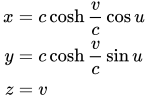
where and and is a non-zero real constant.


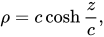
In cylindrical coordinates: where is a real constant.
A physical model of a catenoid can be formed by dipping two circular rings into a soap solution and slowly drawing the circles apart.
The catenoid may be also defined approximately by the stretched grid method as a facet 3D model.
Helicoid transformation
[edit]
Because they are members of the same associate family of surfaces, one can bend a catenoid into a portion of a helicoid without stretching. In other words, one can make a (mostly) continuous and isometric deformation of a catenoid to a portion of the helicoid such that every member of the deformation family is minimal (having a mean curvature of zero). A parametrization of such a deformation is given by the system for , with deformation parameter , where:

![{\displaystyle (u,v)\in (-\pi ,\pi ]\times (-\infty ,\infty )}](https://wikimedia.org/api/rest_v1/media/math/render/svg/69bd6d31446bbbbdb601db5ced84afb267ec09fb)

- corresponds to a right-handed helicoid,
- corresponds to a catenoid, and
- corresponds to a left-handed helicoid.


The critical catenoid conjecture
[edit]A critical catenoid is a catenoid in the unit ball that meets the boundary sphere orthogonally. Up to rotation about the origin, it is given by rescaling Eq. 1 with by a factor , where . It is an embedded annular solution of the free boundary problem for the area functional in the unit ball and the critical catenoid conjecture states that it is the unique such annulus.


The similarity of the critical catenoid conjecture to Hsiang-Lawson's conjecture on the Clifford torus in the 3-sphere, which was proven by Simon Brendle in 2012,[7] has driven interest in the conjecture,[8][9] as has its relationship to the Steklov eigenvalue problem.[10]
Nitsche proved in 1985 that the only immersed minimal disk in the unit ball with free boundary is an equatorial totally geodesic disk.[11] Nitsche also claimed without proof in the same paper that any free boundary constant mean curvature annulus in the unit ball is rotationally symmetric, and hence a catenoid or a parallel surface. Non-embedded counterexamples to Nitsche’s claim have since been constructed.[12][13]
The critical catenoid conjecture is stated in the embedded case by Fraser and Li[9] and has been proven by McGrath with the extra assumption that the annulus is reflection invariant through coordinate planes,[14] and by Kusner and McGrath when the annulus has antipodal symmetry.[15]
As of 2025 the full conjecture remains open.
References
[edit]- ^ Dierkes, Ulrich; Hildebrandt, Stefan; Sauvigny, Friedrich (2010). Minimal Surfaces. Springer Science & Business Media. p. 141. ISBN 9783642116988.
- ^ a b c Gullberg, Jan (1997). Mathematics: From the Birth of Numbers. W. W. Norton & Company. p. 538. ISBN 9780393040029.
- ^ Euler, Leonhard (1952) [reprint of 1744 edition]. Carathéodory, Constantin (ed.). Methodus inveniendi lineas curvas: maximi minimive proprietate gaudentes sive solutio problematis isoperimetrici latissimo sensu accepti (in Latin). Springer Science & Business Media. ISBN 3-76431-424-9.
{{cite book}}: ISBN / Date incompatibility (help) - ^ a b Colding, T. H.; Minicozzi, W. P. (17 July 2006). "Shapes of embedded minimal surfaces". Proceedings of the National Academy of Sciences. 103 (30): 11106–11111. Bibcode:2006PNAS..10311106C. doi:10.1073/pnas.0510379103. PMC 1544050. PMID 16847265.
- ^ Meusnier, J. B. (1881). Mémoire sur la courbure des surfaces [Dissertation on the curvature of surfaces] (PDF) (in French). Brussels: F. Hayez, Printer of the Royal Academy of Belgium. pp. 477–510. ISBN 9781147341744.
{{cite book}}: ISBN / Date incompatibility (help) - ^ "Catenoid". Wolfram MathWorld. Retrieved 15 January 2017.
- ^ Brendle, Simon (2013). "Embedded minimal tori in S3 and the Lawson conjecture". Acta Mathematica. 211 (2): 177–190. arXiv:1203.6597. doi:10.1007/s11511-013-0101-2. S2CID 119317563.
- ^ Devyver, B. (2019). "Index of the critical catenoid". Geometriae Dedicata. 199: 355–371. doi:10.1007/s10711-018-0353-2.
- ^ a b Fraser, A.; Li, M. M. (2014). "Compactness of the space of embedded minimal surfaces with free boundary in three-manifolds with nonnegative Ricci curvature and convex boundary". Journal of Differential Geometry. 96 (6): 183–200. arXiv:1204.6127. doi:10.4310/jdg/1393424916.
- ^ Fraser, Ailana; Schoen, Richard (2011). "The first Steklov eigenvalue, conformal geometry, and minimal surfaces". Advances in Mathematics. 226 (5): 4011–4030. arXiv:0912.5392. doi:10.1016/j.aim.2010.11.007.
- ^ Nitsche, J. C. C. (1985). "Stationary partitioning of convex bodies". Archive for Rational Mechanics and Analysis. 89 (1): 1–19. Bibcode:1985ArRMA..89....1N. doi:10.1007/BF00281743.
- ^ Wente, H. C. (1993). "Tubular capillary surfaces in a convex body". In Concus, P.; Lancaster, K. (eds.). Advances in Geometric Analysis and Continuum Mechanics. Proceedings of a conference held at Stanford University on August 2–5, 1993, in honor of the seventieth birthday of Robert Finn. International Press. p. 288.
- ^ Fernández, I.; Hauswirth, L.; Mira, P. (2023). "Free boundary minimal annuli immersed in the unit ball". Archive for Rational Mechanics and Analysis. 247 (6): 108. arXiv:2208.14998. Bibcode:2023ArRMA.247..108F. doi:10.1007/s00205-023-01943-z.
- ^ McGrath, P. (2018). "A characterization of the critical catenoid". Indiana University Mathematics Journal. 67 (2): 889–897. arXiv:1603.04114. doi:10.1512/iumj.2018.67.7251. JSTOR 26769410.
- ^ Kusner, R.; McGrath, P. (2024). "On Steklov eigenspaces for free boundary minimal surfaces in the unit ball". American Journal of Mathematics. 146 (5): 1275–1293. arXiv:2011.06884. doi:10.1353/ajm.2024.a937942.
Further reading
[edit]- Krivoshapko, Sergey; Ivanov, V. N. (2015). "Minimal Surfaces". Encyclopedia of Analytical Surfaces. Springer. ISBN 9783319117737.
External links
[edit]- "Catenoid", Encyclopedia of Mathematics, EMS Press, 2001 [1994]
- Catenoid – WebGL model
- Euler's text describing the catenoid at Carnegie Mellon University
- Calculating the surface area of a Catenoid
- Minimal Surface of Revolution

Catenoid
View on GrokipediaDefinition and Geometry
Catenary Curve Basis
The catenary curve describes the shape assumed by a perfectly flexible, inextensible chain or cable of uniform density when suspended from two points and acted upon solely by gravity.[4] Its standard equation, with the vertex at the origin, is given bywhere is a scaling parameter that determines the curve's width and sag, related to the horizontal tension at the lowest point and the linear density of the chain multiplied by gravity (specifically, , with the horizontal tension, the mass per unit length, and the gravitational acceleration).[4][5] The catenary's equation arises from either force balance on chain segments or variational principles minimizing potential energy subject to fixed length. In the force balance approach, consider a small segment of the chain: the horizontal tension component remains constant, while the vertical component increases with the weight supported, leading to the differential equation
where is the arc length along the curve; integrating this yields the hyperbolic cosine form.[5] Alternatively, using the calculus of variations to minimize the potential energy (with fixed total length) produces the Euler-Lagrange equation , which integrates to the same catenary solution, confirming its equilibrium shape.[5] Historically, Galileo Galilei approximated the catenary as a parabola in his 1638 Two New Sciences, based on empirical observations of hanging chains, though this was an inexact model valid only for shallow sags.[6] The true equation was rigorously derived in 1691 by Gottfried Wilhelm Leibniz, Christiaan Huygens, and Johann Bernoulli, in response to a challenge posed by Jacob Bernoulli to find the curve of a hanging chain.[6][4] Huygens had earlier coined the term "catenary" (from Latin catena, meaning chain) in a 1690 letter to Leibniz.[6] Key geometric properties include the arc length from the vertex to a point , given by , which reflects the curve's hyperbolic nature.[4] The intrinsic equation relating the radius of curvature and arc length is , highlighting the catenary's non-constant curvature.[4] A common misconception, stemming from Galileo's approximation, equates the catenary to a parabola ; while similar for small angles, the catenary grows exponentially at large distances, unlike the parabola's quadratic form.[6] When rotated about its axis of symmetry, the catenary generates the catenoid surface.[4]