Hubbry Logo
CatilineCatilineMain
Open search
Catiline
Community hub
Catiline
logo
8 pages, 0 posts
0 subscribers
Be the first to start a discussion here.
Catiline
Catiline
from Wikipedia

Lucius Sergius Catilina (c. 108 BC – January 62 BC), known in English as Catiline (/ˈkætəln/), was a Roman politician and soldier best known for instigating the Catilinarian conspiracy, a failed attempt to seize control of the Roman state in 63 BC.

Key Information

Born to an ancient patrician family, he joined Sulla during Sulla's civil war and profited from Sulla's purges of his political enemies, becoming a wealthy man. In the early 60s BC, he served as praetor and then as governor of Africa (67–66 BC). Upon his return to Rome, he attempted to stand for the consulship but was rebuffed; he then was beset with legal challenges over alleged corruption in Africa and his actions during Sulla's proscriptions (83–82 BC). Acquitted on all charges with the support of influential friends in Roman politics, he stood for the consulship in 64 and in 63 BC.

Defeated in the consular comitia, he concocted a plot to take the consulship by force, bringing together poor rural plebs, Sullan veterans, and other senators whose political careers had stalled. Crassus revealed the coup attempt – which involved armed uprisings in Etruria – to Cicero, one of the consuls, in October 63 BC, but it took until November before evidence of Catiline's participation emerged. Discovered, he left the city to join his rebellion. In early January 62 BC, at the head of a rebel army near Pistoria (modern-day Pistoia in Tuscany), Catiline fought the Battle of Pistoria against republican forces. He was killed and his army annihilated.

Catiline's name became a byword for doomed and treasonous rebellion in the years after his death. Sallust, in his monograph on the conspiracy, Bellum Catilinae, painted Catiline as a symbol of the Roman Republic's moral decline, as much of a victim as a perpetrator, as his characterization of "a ravaged mind" (vastus animus) indicates.[1][page needed]

Early life

[edit]

Family background

[edit]

Catiline was a member of an ancient patrician family, the gens Sergia, who claimed descent from Sergestus, a Trojan companion of Aeneas.[2] While Sallust says he was one of the nobiles,[3] which implies a consular heritage,[4] the specifics are unclear: no member of the gens Sergia had held the consulship since the second consulship of Gnaeus Sergius Fidenas Coxo in 429 BC; a few other Sergii had served in the consular tribunate, but the last was in 380 BC.[5]

The exact year of Catiline's birth is unknown. From the offices he held it can be deduced that he was born no later than 108 BC, or 106 BC if patricians enjoyed a right to hold magistracies two years earlier than plebeians.[2] Catiline's parents were Lucius Sergius Silus and Belliena.[6] His father was poor by the standards of the aristocracy.[7] His maternal uncle had served as praetor in 105 BC; earlier, Catiline's great-grandfather – Marcus Sergius Silus – had served with distinction as praetor in 197 BC during the Second Punic War.[8]

Early career

[edit]

During the Social War, Catiline served under Gnaeus Pompeius Strabo, along with Strabo's son – the more famous Pompey – and Cicero.[9] His specific title was not recorded.[10] This is recorded on the Asculum Inscription, a bronze tablet which was once nailed to the wall of an unknown public building in Rome, which records the names of Pompeius Strabo's council (consilium) when he granted citizenship to several auxiliaries in his army; a Lucius Sergius is mentioned there, almost certainly Catiline.[11]

He married a woman named Gratidia, one of Gaius Marius's nieces.[12] During Sulla's civil war, Catiline joined with the Sullans in 82 BC and served as a lieutenant.[13] According to many of the ancient sources, he made himself wealthy during the Sullan proscriptions by killing his brother and two of his brothers-in-law (one brother of his wife and one husband of his sister).[14] Cicero accused him of helping Quintus Lutatius Catulus avenge himself upon Catiline's wife's brother, Marcus Marius Gratidianus, the prosecutor who had caused the death of Catulus' father.[15] Cicero's account – given in a campaign speech attacking Catiline, who was a rival candidate for the consulship of 63 BC, – has Catiline beheading Gratidianus and then carrying the head through the city from the Janiculum to Sulla at the Temple of Apollo; later accounts embellish the tale, describing Catiline as engaging in gratuitous cruelties against Gratidianus, as described in later sources such as Livy, Valerius Maximus, Lucan, and Florus.[16] Some modern historians doubt Catiline was involved in Gratidianus' death except perhaps in an auxiliary role, placing blame instead on Catulus and attributing the story of Catiline's involvement to Ciceronean political slander.[17] Regardless, Catiline did engage in profiteering from the Sullan proscriptions, likely purchasing estates for fractions of their true value, and by the end of Sulla's dictatorship, he had become a rich man.[18]

In 73 BC, he may have been prosecuted for adultery – apud pontifices (before a panel of pontiffs as judges) – with a Vestal Virgin named Fabia, a half-sister of Cicero's wife Terentia. While evidence for Fabia's prosecution is clear, only Orosius mentions Catiline's prosecution.[19] Conviction would have led to execution for sacrilege. Catiline's friend Catulus – probably the president of the court and definitely one of the pontiffs – and other former consuls rallied to help Fabia, and possibly Catiline if he too was prosecuted, securing their acquittals.[20] Catiline and Cicero "must have been relieved"; Catiline, for his part, regarded himself in Catulus' debt.[21]

Attempts at the consulship

[edit]

Catiline served as praetor some time before 68 BC; T. R. S. Broughton in Magistrates of the Roman Republic dates the praetorship exactly to 68 BC.[22] He then served as propraetorian governor of Africa for two years (67–66 BC).[23]

Some time in the mid-60s BC, Catiline married the wealthy and beautiful Aurelia Orestilla, daughter of the consul of 71 BC, Gnaeus Aufidius Orestes; this was his second marriage.[24][25] Sallust relates that he did so not out of money, but only due to her good looks, something which Romans believed to be discreditable.[26] Cicero later claimed in his Catilinarians that Catiline murdered his first wife and Orestilla's son to make way for the match; he also claimed in In Toga Candida that Orestilla was Catiline's own illegitimate daughter. Cicero's allegations "cannot be taken at face value and reveal more about typical themes and slanders found in Roman invective than they do about Catiline's domestic history".[27]

Elections of 66 BC and trial

[edit]

Upon his return to Rome in 66 BC, embassies from Africa protested his maladministration.[28] Catiline also attempted to stand for the consulship, but his candidacy was rejected by the presiding magistrate. Sallust and Cicero attribute the rejection to an imminent extortion trial,[29][30] but this decision may have been made in terms of the contested elections for the consulship of 65 BC: before Catiline's return to Rome, the first consular elections were held but both men elected[a] were deposed after they were both convicted of bribery; the second elections, after Catiline's return, were held with the same candidates – the two convicts excepted – returning two different consuls. Catiline's candidacy could have been rejected not due to expectations of an extortion trial, but rather for the mere fact that he was not a candidate in the first election.[32]

Following the elections, early in 65 BC, the ancient sources give contradictory descriptions of what is called a "First Catilinarian conspiracy" in which Catiline (except in Suetonius' narrative) conspired with the deposed consular candidates from the first election to recover the consulship by force. In some tellings, Catiline himself was to assume the consulship. Regardless, the supposed date of this alleged conspiracy, 5 February, came and went without incident.[33] Modern scholars overwhelmingly believe that this "First Catilinarian conspiracy" is fictitious.[34][35][36][37]

Later that year, in the second half of 65 BC (some time after 17 July), Catiline was brought to trial for corruption during his governorship. The prosecution was led by Publius Clodius Pulcher, but Catiline was defended by many influential former consuls, including one of the consuls of 65 BC (who had won in the second election; that consul also disavowed Catiline's rumoured involvement in the alleged putsch).[38] Clodius, prosecuting, may have helped Catiline out by selecting a favourable jury that would be impressed by the consulares coming to Catiline's aid.[39] But scholarly opinion on whether Clodius purposefully manipulated the proceedings for acquittal is divided.[40] In the end, the jury – composed of senators, equites, and the tribuni aerarii – divided: the senators voted for conviction, the latter two panels for acquittal. Cicero, not yet having broken with Catiline, considered defending Catiline at this trial,[41] but eventually decided not to; Catiline's advocate is unknown.[42]

Consular elections of 64 BC

[edit]

Catiline's candidacy at the consular elections in 64 BC was accepted. Also standing for the consulship that year were Cicero and Gaius Antonius Hybrida; the three were the only candidates with a realistic chance of winning.[43] Catiline, bankrolled by Caesar and Crassus, distributed large bribes; after a bill against electoral bribery was defeated, Cicero gave In toga candida, a speech full of invective attacking Catiline and Antonius.[44] Antonius and Catiline were allies during the election and attempted to beat Cicero. Their strategy, however, was unsuccessful. Cicero was carried unanimously and Antonius narrowly defeated Catiline.[45]

This was also the year that Gaius Julius Caesar was president of the standing court on assassinations. His willingness – along with Cato the Younger in the treasury demanding repayment of loans from the civil wars – to pursue the beneficiaries of the Sullan civil war may have swayed voters away from supporting Catiline.[43] This may also have been reinforced by timely conviction of Catiline's maternal uncle on charges of murder during the proscriptions.[45] After the consular elections, Catiline was brought up on charges of murdering people during the proscriptions, perhaps of Gratidianus. Prosecuted by Lucius Lucceius or possibly Caesar, Catiline was again acquitted when a number of former consuls spoke in his defence.[46] There is no evidence that Caesar affected Catiline's acquittal.[47]

Catilinarian conspiracy

[edit]
1st century AD depiction of Cicero, consul in 63 BC with Antonius, today in the Capitoline Museum

Antonius, Catiline's ally in the elections of 64 BC, joined with Cicero in a deal where he would take the wealthy and exploitable province of Macedonia (which Cicero had been given) in exchange for cooperation; he therefore broke with Catiline early in the year.[45] In early 63 BC, there were no indications that Catiline was involved in a conspiracy. He was still, however, nursing hopes of an eventual consulship that would be both his birth-right and necessary for his career.

Consular elections

[edit]
Bowls containing food distributed in electoral canvasses. The bowl to the right was commissioned by Lucius Cassius Longinus and distributed, filled with food, in support of Catiline's consular candidacy in 63 BC. The bowl on the left was distributed by Marcus Porcius Cato in a coeval campaign for the plebeian tribunate. Giving food to voters was common as a means to build up goodwill.[48]

The events of the year 63 BC were not amenable for civil harmony, no matter how much Cicero as consul had been preaching it to the people. Early in the year, a proposal came before the plebs to redistribute lands; it was a proposal that would have alleviated great hardship in a time of economic hardship.[49] Cicero spoke out against it, warning of tyrannical land commissioners and painting the project as selling out the people to the beneficiaries of the Sullan proscriptions.[50] The failure of the land proposal contributed to the conspiracy's support among the people in the coming months.[51]

A trial that year for one Gaius Rabirius for the murder of Lucius Appuleius Saturninus in 100 BC, almost forty years earlier, was possibly a signal from Caesar to the senate against use of the senatus consultum ultimum (a declaration of emergency which gave the consuls political cover to break laws in suppressing civil unrest).[52] Rabirius was convicted by Caesar ("not an impartial judge") by means of an archaic procedure before appealing and then being acquitted by a similarly archaic loophole.[52] A later proposal to overturn Sulla's civil disabilities for the sons of the victims of the proscriptions also was defeated with Cicero's help; Cicero argued that repeal would cause political upheaval. This failure "drove some of the men concerned into supporting Catiline" in his conspiracy.[53]

That summer, Catiline stood again for the consulship for 62 BC; his candidacy was accepted by Cicero. Against him were three other major candidates: Decimus Junius Silanus, Lucius Licinius Murena, and Servius Sulpicius Rufus. Cicero supported Sulpicius' bid as a friend and fellow lawyer, which directly harmed Catiline's chances, since both men were patricians and therefore were legally barred from both holding the consulship.[54] Bribery was again rampant, after the senate moved again to pass legislation to stamp it out, Cicero and Antonius as consuls were successful in moving the lex Tullia increasing penalties and enumerating forbidden electoral practices.[55]

Just before the elections, Cicero alleges Catiline engaged in demagoguery and attempted to build up his bona fides with the poor and dispossessed men of Rome and Italy, including himself among their number,[56] advocating the wholesale abolition of all existing debts (tabulae novae).[57]

At the electoral comitia, Cicero presided, surrounded by a bodyguard and wearing an ostentatious cuirass, to signal his belief that Catiline posed a threat to his person and public safety.[58] Sallust reports that Catiline promised his supporters that he would kill the rich, but this supposed promise is likely ahistorical.[59] No contemporary source indicates that Catiline supported land reform.[60] The comitia returned as consuls-designate Decimus Junius Silanus and Lucius Licinius Murena.[61] After his second defeat, Catiline seems to have run out of money and must have been abandoned by his former supporters such as Crassus and Caesar.[62]

Conspiracy

[edit]

On 18 or 19 October, Crassus and two other senators visited Cicero's house on the Oppian Hill (near the ruins of the Colosseum) and delivered to the consuls anonymous letters, warning that Catiline was planning a massacre of leading politicians, and advising them to leave the city. Cicero convened the senate and had them read aloud.[58] A few days later, on 21 or 22 October, an ex-praetor reported news that an ex-Sullan centurion – Gaius Manlius – who had supported Catiline's bid for the consulship had raised an army in Etruria.[63] The senate acted immediately, usually dated to the 21st, to pass a senatus consultum ultimum directing the consuls to take whatever actions they believed necessary for state security. When news of the decree arrived to Manlius he declared an open rebellion.[63]

Some modern scholars reject a connection between Manlius and Catiline at this early point, arguing that Manlius' rebellion may have been separate from Catiline's alleged conspiracy and that the conspiracy only came into actual fruition when Catiline joined Manlius' rebellion when leaving Rome for exile and seeing nothing to lose. There are, however, no indications of this in the ancient sources.[64]

Catiline's indebtedness – if he was in fact indebted, there is little evidence one way or the other[65] – was not the sole cause of his conspiring: "wounded pride and fierce ambition" played a great role in his decision-making.[66] Many of the senatorial members of the conspiracy were men who had been ejected from the senate for immorality, corruption, or seen their careers stall out (especially in attempts to reach the consulship).[67] The men who joined Manlius' rebellion were largely two groups: poor farmers who had been dispossessed by Sulla's confiscations after the civil war and ruined Sullan veterans seeking more riches.[68] Cicero, in his invectives, naturally focused on the ruined Sullan veterans, who were unpopular; but at the end, Catiline likely kept only the support of the dispossessed Etruscans who had "nowhere else to go".[69] Altogether, these men had mixed backgrounds and no "single-minded purpose [can] readily be ascribed" to them.[70]

Flight from the city

[edit]
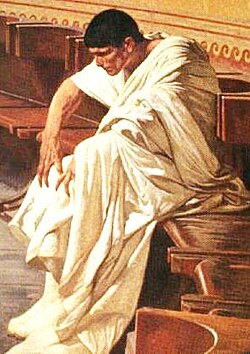
Cesare Maccari's famous 19th century depiction of Cicero denouncing Catiline before the senate. Beard 2015, pp. 31–33 notes that this idealised depiction is "no more than a seductive fantasy". Both men at the time were in their forties; the senate also was far larger and its building was more dull.

While the consuls fortified central Italy, reports also filtered in of slave revolts in the south. Two generals[b] who were waiting for their triumphs to be approved were then dispatched with men to garrison the northern approaches to Rome and southern Italy.[71] Catiline for his part remained in Rome since the letters sent to Crassus were anonymous and thus insufficient to prove Catiline's involvement.[71]

On 6 November, Catiline held a secret meeting in Rome at the house of Marcus Porcius Laeca where he planned to go to Manlius' army, for other members of the conspiracy to take charge of the nascent revolts elsewhere in Italy, for conspirators in Rome to set fires in the city, and for two specific conspirators to assassinate Cicero the next morning.[72] Cicero exaggerates Catiline's supposed intention to raze the city as a means to turn the urban population against him – a story further embellished in Plutarch[73] – it is more likely that Catiline's fires were intended only to create exploitable confusion for his army.[72]

The next day, on 7 November, the assassins found Cicero's house shut against them and Cicero convened the senate later that day at the Temple of Jupiter Stator reporting the threat to his life and then delivering the First Catilinarian denouncing Catiline. Catiline, who was already planning to leave the city, offered to go into exile if the senate would so decree. After Cicero refused to bring up such a motion, Catiline protested his innocence and insulted Cicero's ancestry, calling him a "squatter".[74] He thereafter left the city, claiming that he was going into voluntary exile at Massilia "to spare his country a civil war".[75] On his departure, he sent a letter to his old friend and ally Quintus Lutatius Catulus Capitolinus, which Sallust copied into Bellum Catilinae.[76] In the letter, Catiline defends himself as an injured party who took up the cause of the less fortunate in accordance with his patrician forebears' custom; he vehemently denies that he goes into exile due to his debts and commits his wife Orestilla to Catulus' care.[77]

He left the city on the road to Massilia, but in Etruria, he went to a weapons cache before diverting for Faesulae where he met up with Manlius' forces. Upon his arrival, he proclaimed himself consul and adopted consular regalia. When news of this reached Rome, the senate declared Catiline and Manlius hostes (public enemies) and dispatched Antonius at the head of an army to subdue him.[78]

Death

[edit]
Alcide Segoni's Discovery of the Body of Catiline (1871). In the Gallery of Modern Art, Florence.
Denarius minted by Lucius Scribonius Libo in 62 BC. The portrayal of Bonus Eventus on the obverse likely commemorates the destruction of the Catilinarian rebels.[79]
Denarius minted by Lucius Aemilius Paullus in 62 BC depicting the goddess Concordia; Berry 2020, p. 54 argues that Paullus viewed Catiline's defeat as "a restoration of national harmony".

In late November, Antonius' forces approached from the south. He decamped from Faesulae and moved near the mountains but remained close enough to the town to be in striking distance. When Antonius' forces arrived in the vicinity of the town, he avoided battle.[80]

Catiline's coconspirators in Rome had been caught out by Cicero with the aid of some Gallic envoys.[81] After a fierce senate debate, they were executed without trial on 5 December.[82] When news of their death arrived to Catiline's camp, much of his army melted away, leaving him with perhaps a bit more than three thousand men. Hoping to escape into Gaul, his escape from Italy was blocked when Quintus Caecilius Metellus Celer – proconsul in Cisalpine Gaul[83] – garrisoned the Apennine passes near Bononia.[84]

Antonius kept his men relatively docile near Faesulae, but after he received reinforcements from then-quaestor Publius Sestius in the last days of December, he moved out. Catiline, for his part, seeing his escape blocked, turned south to face Antonius, perhaps believing that Antonius would not fight as hard. They met at Pistoria, modern day Pistoia. Descending from the heights, he offered battle to Antonius' army, possibly on 3 January 62 BC.[85]

On the day of the battle, Antonius gave operational command to Marcus Petreius (Sallust claims he was stricken with gout[86]), an experienced lieutenant,[87] who broke through the Catilinarian centre with the praetorian cohort, forcing Catiline's men to flight.[88] Catiline and his diehard supporters fought bravely and were annihilated:[89] "they were desperate men who did not wish to survive their defeat".[87]

Sallust's account reads:

When the battle was ended it became evident what boldness and resolution had pervaded Catiline's army. For almost every man covered with his body, when life was gone, the position which he had taken when alive at the beginning of the conflict. A few, indeed, in the centre, whom the praetorian cohort had scattered, lay a little apart from the rest, but the wounds even of these were in front. But Catiline was found far in advance of his men amid a heap of slain foemen, still breathing slightly, and showing in his face the indomitable spirit which had animated him when alive.[90]

Legacy

[edit]

In Roman literature, Catiline's figure became often used as a byword for "villainy".[91] Politicians quickly distanced themselves from his failed revolt; others tried to discredit rivals by linking them to Catiline's conspiracy after the fact.[92] Cicero, who claimed for himself the credit of saving the state from Catiline's revolt, later praised Catiline's personal qualities in a defence speech for someone accused of being a co-conspirator: Cicero paints Catiline as a good motivator, effective general, sociable, and strong as reasons for why so many men were willing to associate with him (for Cicero's client, however, only as a non-conspiring friend).[93][94] The history of Sallust, written around the time of the Second Triumvirate, painted Catiline as a thoroughgoing disrepute who had from an early time wanted to destroy his own country and symbolised the moral decline that Sallust identified as the cause of the republic's collapse:

S. [Sallust] prefers to present Catiline as a through-going villain, the product of the corrupt age, who was bent on the destruction of the state from the very beginning...[95]

Livy used the Catilinarian conspiracy as a template to fill in shaky portions of early Roman history. For example, the conspiracy of one Marcus Manlius, who rose up against the elite with the support of poor plebs, both gives a speech patterned on Cicero's First Catilinarian and takes actions patterned on the real Catiline's.[96] Virgil, in the Aeneid (written during the reign of Augustus), depicts Catiline as being tortured in the underworld by the Furies.[96][97]

Into the imperial period, Catiline's name was used as a derogatory nickname of unpopular ruling emperors.[91] However, his reputation as an advocate for the dispossessed rural plebs seemed to carry to some degree in rural parts of northern Italy at least until the mediaeval period. In Tuscany, a mediaeval tradition had Catiline survive the battle and live out his life as a local hero; another version gives him a son, Uberto, who eventually spawns the Uberti dynasty in Florence.[98]

While history has often viewed Catiline through the lenses of his enemies – especially in the vein of Cicero's four Catilinarians – some modern historians have reassessed Catiline. The first major attempt was Edward Spencer Beesly in 1878, who argued against the then-prevailing view that Catiline was "a demon breathing murder, rapine, and conflagration, with bloodshot eyes and pallid face, luring on weak and depraved young men to the damnation prepared for himself".[99] Beesly's defences have been followed more recently by others, such as Waters 1970 and Seager 1973. Waters' admittedly "largely hypothetical"[100] narrative depicts the Catilinarian conspiracy largely as a Ciceronean fiction framing Catiline and the "co-conspirators" for Cicero's own political advancement.[101] Seager's defence does not go so far, but instead argues the conspiracy was purposefully incited by Cicero and the senate to purge Italy of men who might join with Pompey if he were to follow in Sulla's footsteps on his then-imminent return from the Third Mithridatic War.

Other classicists have argued that Catiline was a precursor of Caesar or that he rebelled to oppose senatorial corruption and incompetence.[c] But, largely, such defences are highly speculative, as the literary evidence that survives is overwhelmingly Ciceronean and biased against Catiline.[102]

Cultural depictions

[edit]
Title page of Ben Jonson's 1611 tragedy from a folio version in 1692
  • At least two major dramatists have written tragedies about Catiline: Ben Jonson, the English Jacobean playwright, wrote Catiline His Conspiracy in 1611, depicting Catiline as "a sadistic anti-hero";[103] Catiline was the first play by the Norwegian "father of modern drama" Henrik Ibsen, written in the aftermath of the 1848 revolutions and depicting Catiline as hero struggling against his world's corruption.[98]
  • Antonio Salieri wrote an opera tragicomica in two acts on the subject of the Catilinarian conspiracy entitled Catilina to a libretto by Giambattista Casti in 1792. The work was left unperformed until 1994 due to its political implications during the French Revolution. Here, serious drama and politics were blended with high and low comedy: the plot centered on a love affair between Catiline and a daughter of Cicero as well as the historic political situation.
  • Steven Saylor's 1993 novel Catilina's Riddle revolves around the intrigue between Catiline and Cicero in 63 BC. Catiline also plays a major character in Steven Saylor's short story "The House of the Vestals".
  • Catiline's conspiracy and Cicero's consular actions figure prominently in the novel Caesar's Women by Colleen McCullough as a part of her Masters of Rome series.
  • SPQR II: The Catiline Conspiracy, by John Maddox Roberts, discusses Catiline's conspiracy.
  • Robert Harris' 2006 book Imperium, based on Cicero's letters, covers the developing career of Cicero with many references to his increasing interactions with Catiline. The sequel, Lustrum (issued in the United States as Conspirata), deals with the five years surrounding the Catilinarian conspiracy.
  • The Roman Traitor or the Days of Cicero, Cato and Catiline: A True Tale of the Republic by Henry William Herbert originally published in 1853 in two volumes.
  • A Pillar of Iron by Taylor Caldwell, published in 1965, tells of the life of Cicero, especially in relation to Catiline and his conspiracy.
  • A Slave Of Catiline is a book by Paul Anderson that tells of a slave who helps and then hinders Catiline's conspiracy.
  • A novel on the conspiracy, The Fall of the Republic, written by Scott Savitz, was published in September 2020.
  • Bertolt Brecht's unfinished novel The Business Affairs of Mr Julius Caesar provides a fictionalised account of the Catilinarian conspiracy in which Caesar and Crassus are alleged to be involved for financial gain.
  • Adam Driver portrays Cesar Catilina, a character from Francis Ford Coppola's 2024 sci-fi epic film Megalopolis, which is a fictionalised interpretation of the Catiline Conspiracy set in an imagined modern futuristic America. Driver stars opposite Giancarlo Esposito, who portrays a character named Mayor Franklyn Cicero. In the film, Driver's character is pitted against Esposito's character in a rivalry and battle for political control of New Rome. The film also centers around Cesar Catilina's love affair with Mayor Cicero's daughter, Julia Cicero played by Nathalie Emmanuel.[104]

See also

[edit]

Notes

[edit]

References

[edit]
[edit]
Revisions and contributorsEdit on WikipediaRead on Wikipedia
from Grokipedia
![Cicero Denounces Catiline in the Roman Senate by Cesare Maccari][float-right] ![./assets/Cicero_Denounces_Catiline_in_the_Roman_Senate_by_Cesare_Maccari.png][float-right] Lucius Sergius Catilina (c. 108 BC – early January 62 BC) was a Roman patrician politician and soldier from the ancient gens Sergia, notorious for leading the Catilinarian conspiracy, an armed plot in 63 BC to overthrow the consular government, massacre senators, burn the city, and install himself as dictator amid personal debts and repeated electoral failures. Catiline's early career included military service as quaestor under Sulla during the Social War and proscriptions, praetorship in 68 BC, and propraetorian governorship in Africa from 67 to 66 BC, where he faced charges of extortion but escaped conviction through bribery and intimidation. His 63 BC candidacy for consul, opposed by Cicero's revelations of prior intrigues including alleged involvement in the 65 BC plot to murder consuls, mobilized indebted nobles, veterans, and slaves promising debt cancellation and land redistribution, but devolved into explicit violence after exposure via intercepted letters and Allobrogian envoys. Fleeing Rome after Cicero's first oration, Catiline rallied an Etruscan army, which Roman forces under Antonius crushed at Pistoria, where he died fighting in the front ranks. Primary accounts by Cicero, the prosecutor, and Sallust, a later historian sympathetic to popular causes yet condemning Catiline's depravity, dominate the record, underscoring biases from elite perspectives on a figure whose opportunism exploited Republic-wide fiscal collapse and factional strife without evidence of principled reform.

Origins and Early Life

Patrician Heritage and Family

Lucius Sergius Catilina was born circa 108 BC into the gens Sergia, an ancient patrician family at that traced its lineage to the early and claimed mythical descent from Sergestus, a Trojan companion of mentioned in Virgil's . The Sergii had held the consulship as early as 501 BC with Sergius Cornelius Maluginensis but produced no further consuls for over three centuries by Catiline's time, indicative of the family's waning political influence amid the competitive nobility of the late . This decline extended to financial strains, as many old patrician houses faced indebtedness from maintaining status without commensurate offices or estates. Catiline's father was likely Lucius Sergius Silus, while his mother hailed from the gens Annia, with a maternal uncle identified as Lucius Annius Bellienus; a sister reportedly married into the family of Quintus Lutatius Catulus. These connections linked the family to broader aristocratic networks, though the Sergii branch remained relatively obscure compared to more ascendant gentes like the Cornelii or Claudii. The household emphasized traditional patrician values of military service and senatorial ambition, shaping Catiline's early exposure to Rome's hierarchies. Sulla's dictatorship from 82 to 79 BC intersected with the family's fortunes, as Catiline, then in his twenties, aligned with the cause and reportedly profited from the proscriptions by acquiring confiscated properties, which temporarily bolstered personal wealth amid the gens' broader decay. This opportunistic involvement highlighted how civil strife could revive declining patrician lines through land seizures, though it also entrenched enmities with Marian factions that later haunted Catiline's career.

Youth and Initial Military Engagements

Lucius Sergius Catilina, born around 108 BC into the ancient patrician gens Sergia, entered military service during the Social War (91–88 BC), a conflict between Rome and its Italian allies seeking citizenship. In 89 BC, at approximately age 19, he campaigned under the command of praetor Gnaeus Pompeius Strabo in northern Italy against rebel forces, gaining combat experience alongside contemporaries including Marcus Tullius Cicero and the younger Gnaeus Pompeius (later Magnus). This engagement exposed him to the brutal realities of near-civil warfare, where Roman legions faced allied troops equipped with similar arms and tactics, resulting in heavy casualties on both sides—estimated at over 300,000 dead across the war. Catiline's performance in these operations earned him recognition for physical endurance and valor, qualities emphasized by the historian , who described him as possessing a body "equally matched to any toil" and capable of withstanding hunger, cold, and sleeplessness to an extraordinary degree from his youthful military exploits. further noted that Catiline had engaged in numerous domestic and foreign wars since adolescence, honing martial skills through direct participation rather than formal instruction. These early campaigns established his reputation as a capable , adept in leadership amid chaos, prior to his deeper involvement in the Roman following Sulla's return in 83 BC.

Rise in Roman Politics and Military Service

Quaestorship and Service under Sulla

Catiline held the quaestorship around 77 BC, the initial magistracy of the Roman , responsible for financial administration, including treasury management and provincial accounts. This office marked his formal entry into senatorial politics, though specific provincial assignment remains unattested in surviving sources. He subsequently aligned with Lucius Cornelius during the dictator's return to and campaigns against Marian forces from 83 to 82 BC, serving as a military subordinate amid the civil strife. Sallust attests that Catiline excelled in military duties under , surpassing many commanders through diligence amid dangers and hardships. Following Sulla's triumph at the in November 82 BC, Catiline reportedly engaged in the ensuing , a systematic elimination of over 500 senators and 4,700 declared enemies of the state, with properties confiscated for redistribution. , in adversarial orations delivered decades later, accused Catiline of personal involvement in these executions, alleging he murdered Marcus Marius Gratidianus—praetor urbanus in 82 BC and a Marian supporter—severed his head, mutilated the corpse, and paraded it through Rome's streets to Sulla, actions purportedly motivated by vendetta and gain. Similar charges extended to the killing of his own brother-in-law, Lucius Caecilius, among others, though these claims derive primarily from 's partisan and lack independent contemporary corroboration beyond general accounts of proscription excesses. Through Sulla's regime, Catiline benefited from allotments of confiscated lands to loyalists and veterans, including estates in and seized from proscribed individuals, enabling rapid wealth accumulation amid widespread property transfers totaling perhaps 80,000 talents in value. notes that such gains fueled Catiline's early prominence but were soon eroded by extravagant expenditures, without implying direct linkage to subsequent financial strains. These allotments, distributed via commissions like the , integrated Catiline into the faction's network, though his precise role in veteran settlements remains unspecified in ancient testimonies.

Praetorship and Governorship in Africa

Catiline served as praetor in 68 BC, one of the key magistracies in the Roman cursus honorum, during which he exercised judicial authority in Rome, adjudicating civil and criminal cases as assigned by lot or seniority among the praetors. This role provided administrative experience essential for higher offices, though specific cases handled by Catiline during his urban tenure are not detailed in surviving records. Following his praetorship, Catiline was appointed propraetor and governor of the province of , serving from 67 to 66 BC. In this capacity, he managed provincial administration, including oversight of tax collection by publicani contractors, adjudication of disputes between Roman citizens and provincials, and maintenance of order amid local unrest. His governorship drew complaints from African provincials regarding alleged and , prompting an embassy to the while he remained in office. Upon returning to Rome in late 66 BC, Catiline faced prosecution for repetundae (extortion) initiated by Publius Clodius Pulcher, who accused him of misconduct and financial exploitation during his African tenure. The trial, reflecting standard Roman scrutiny of provincial governors via the quaestio de repetundis, delayed his political ambitions but ended in acquittal, likely through legal maneuvering and influence, by around 65 BC. Although such positions enabled enrichment through legitimate perquisites and informal gains from tax farming, Catiline's propensity for luxury—marked by prodigal expenditures on personal indulgences and speculative ventures—exacerbated his preexisting debts rather than alleviating them. Following his propraetorship in from 67 to 66 BC, Catiline faced prosecution in 65 BC under the lex Calpurnia de repetundis for alleged extortion and misuse of provincial funds, including claims of embezzling resources and imposing excessive tributes on local populations. The accuser was likely or a related figure, with the trial occurring amid intense political maneuvering in , where provincial governors often exploited offices for personal gain. Catiline was defended initially by , who withdrew upon perceiving the strength of the evidence against him, yet Catiline secured acquittal from a selected mid-year, a verdict later attributed by ancient commentators to juror bribery and influence from his networks among the and former Sullans. This outcome exemplifies the late Republic's judicial system, where repetundae courts were susceptible to , as juries comprising senators and knights frequently favored connected defendants over strict application of evidence from provincial delegations. Separately, Catiline endured persistent rumors of complicity in extrajudicial killings during Sulla's proscriptions of 82 BC, particularly the murder of Marcus Marius Gratidianus, a Marian supporter and urban whose death involved public mutilation and display of his severed head in the Temple of Apollo. , in his lost speech In Toga Candida (commented upon by Asconius), accused Catiline of personally executing Gratidianus to curry favor with , portraying him as exploiting the proscriptions for opportunistic violence beyond legal lists. However, contemporary evidence is contested; attributes the killing directly to Catiline, while other accounts implicate Lutatius Catulus or collective agents, with no formal trial resulting due to the proscriptions' suspension of . These allegations, amplified by Catiline's political foes like —who had incentives to discredit a rival patrician—lacked conclusive proof and served more as rhetorical tools in electoral contests than verifiable charges, reflecting how Sullan reprisals enabled unpunished atrocities by victors' partisans. Catiline's repeated legal escapes, including an earlier acquittal in 73 BC for adultery with the Vestal Virgin Fabia, highlighted a pattern of leveraging patronage from optimates, equites, and Sullan veterans to navigate Rome's factional courts, where verdicts often hinged on alliances rather than impartial review of depositions or financial records. Such dynamics underscored the erosion of accountability in the late Republic, as ambitious nobles like Catiline evaded convictions despite credible accusations from provincials and opponents, fostering perceptions of systemic favoritism toward the elite. Primary accounts from Sallust and Cicero, though detailed, emanate from biased narrators antagonistic to Catiline's populist leanings, necessitating caution in assessing their unverified claims of personal misconduct against the backdrop of widespread provincial grievances.

Pursuit of the Consulship

Failed Candidacy of 66 BC

In 66 BC, Lucius Sergius Catilina announced his candidacy for the consulship of 65 BC upon returning from his proconsular governorship of . His bid was barred by the presiding consul, Lucius Volcatius Tullus, due to Catilina's ongoing indictment for repetundae (extortion) arising from alleged abuses during his administration in , which disqualified him from participating in the comitia consularia. This legal obstacle, rooted in the lex Calpurnia de repetundis and related reforms, reflected heightened optimate vigilance against candidates with provincial corruption charges, as the sought to enforce accountability amid frequent electoral irregularities. The consular elections of 66 BC proceeded in two stages after initial winners and Publius Autronius Paetus were convicted of ambitus (electoral bribery) under the lex Tullia, necessitating a supplementary vote that elected Lucius Manlius Torquatus and Aurelius Cotta. reports that Catilina, embittered by his exclusion, allied with the disgraced Sulla, Autronius, and Gnaeus Calpurnius Piso in a scheme to assassinate Torquatus and Cotta during the consular inauguration, aiming to reinstate the original pair and seize power. The plot collapsed upon exposure, with the Senate granting bodyguards to the consuls-elect and a tribune blocking punitive measures; Piso, deemed expendable, was appointed quaestor pro praetore in , where locals killed him shortly after his arrival in 65 BC. Dio attributes Catilina's participation to personal audacity and resentment, portraying him as a peripheral figure motivated by rejection rather than as the primary instigator. No contemporary evidence, such as Crassus's later letters to , links this episode directly to broader aims, and its designation as the "" stems from retrospective optimate narratives emphasizing Catilina's unreliability. The affair intensified senatorial distrust of Catilina, amplifying procedural barriers and personal animosities that would persist in his subsequent electoral efforts.

Elections of 64 BC

In the consular elections held during the summer of 64 BC, Lucius Sergius Catilina competed against several rivals, including the novus homo Marcus Tullius Cicero and , for the two consulships to be filled the following year. The race drew an unusually large field of candidates, reflecting intense aristocratic competition amid economic strains from the Sullan proscriptions and land distributions. Catilina, leveraging his patrician lineage and military reputation, positioned himself as a champion of the disenfranchised, particularly equestrians burdened by public contracts and Sullan veterans struggling with debts on their allotments. Central to Catilina's platform was the promise of novae tabulae, a radical measure to wipe clean existing debt records and abolish obligations, which he presented as a remedy for widespread financial distress exacerbated by high interest rates and post-Sullan inflation. This appeal echoed populares strategies of direct popular relief, targeting urban plebs, indebted knights, and rural settlers who viewed the optimate-dominated as indifferent to their plight. attributes to Catilina an early campaign harangue around 1 June 64 BC, urging supporters to back his consular bid as a path to overturning elite favoritism and restoring equity through such reforms. Electoral corruption permeated the contests, with candidates on all sides accused of lavish (ambitus) to sway tribal assemblies. Catilina faced charges of distributing funds and favors, yet Cicero's rhetorical attacks and 's resources ultimately secured victory for the pair, as reported in contemporary accounts emphasizing Cicero's vigilance against Catilinian influence. Following the vote, Antonius Hybrida was prosecuted under ambitus statutes for alleged vote-buying in the 64 BC elections, a case that highlighted normalized practices of electoral largition but ended in acquittal, underscoring the challenges in enforcing laws amid mutual accusations among elites.

Consular Campaign of 63 BC

In 63 BC, Lucius Sergius Catilina launched his second bid for the Roman consulship, this time for the office to be held in 62 BC, following his defeat in the prior year's elections. Despite ongoing legal scrutiny from his governorship in and allegations of electoral malfeasance, Catilina positioned himself as a champion of the disenfranchised, appealing to indebted , urban plebs, and Sullan veterans through promises of sweeping reforms. According to , he pledged the abolition of debts via the burning of creditors' ledgers (novae tabulae) and the redistribution of public lands (ager publicus) to the landless poor, framing these measures as remedies for economic grievances exacerbated by and provincial extortion. These radical proposals contrasted sharply with the platform of stability and elite consensus advocated by the incumbent Marcus Tullius , who emphasized preservation of the against demagogic disruption. The campaign unfolded amid heightened tensions, with Catilina accused of resorting to bribery and intimidation to sway voters. Sallust reports that Catilina cultivated a network of desperate supporters, including gamblers and proscribed individuals, while openly associating with violent elements who disrupted assemblies and threatened opponents. In response, the senate decreed special powers () to the consuls to safeguard the electoral process, authorizing to deploy armed guards at the polls and disqualify candidates linked to prior scandals. Catilina's dual pursuit of the consulship alongside figures like Publius Sulpicius Rufus was scrutinized, though permitted multiple patrician candidacies under certain conditions; ultimately, the senate's intervention curbed what describes as Catilina's near-success through illicit means. The vote, held in the summer of 63 BC, resulted in a narrow defeat for Catilina, with Decimus Junius Silanus and Licinius Murena emerging as consuls-elect amid widespread reports of voter coercion. Post-election unrest escalated immediately, as Catilina's rejection fueled mobilization among his rural backers. Sallust notes that, concurrent with the balloting, Catilina dispatched envoys to , where the centurion Gaius Manlius began assembling disaffected veterans and farmers, promising land and debt relief to draw them into armed support. This precursor agitation in regions like Faesulae highlighted the campaign's volatility, with Catilina's followers interpreting the loss as evidence of oligarchic rigging, though primary accounts like 's attribute the outcome to Cicero's vigilant countermeasures rather than mere electoral fatigue. The episode underscored Catilina's reliance on populist rhetoric over institutional norms, setting the stage for broader instability without yet crystallizing into overt .

The Conspiracy of 63 BC

Assembly of Conspirators and Objectives

In the aftermath of his electoral defeat in July 63 BC, Lucius Sergius Catilina intensified efforts to form a conspiracy by recruiting primarily from among heavily indebted patricians, equestrians, and other malcontents burdened by Rome's economic strains, including former supporters from his consular campaign. A key early gathering occurred in June 63 BC during the consulate of Lucius Caesar and Gaius Figulus, where Catilina addressed a private assembly of followers, outlining prospects of radical upheaval to appeal to their grievances. Prominent recruits in Rome included senators such as Publius Cornelius Lentulus Sura (a former consul and praetor), Gaius Cornelius Cethegus, Lucius Cassius Longinus, Publius and Servius Sulla, and Lucius Vargunteius, alongside equestrians like Marcus Fulvius Nobilior, Lucius Statilius, and Publius Gabinius Capito. These individuals, often facing financial ruin or political exclusion, were drawn by promises of personal gain amid widespread debt crises exacerbated by provincial wars and usury. A critical meeting convened on , 63 BC, at the house of Marcus Porcius Laeca, where conspirators divided responsibilities for coordinated attacks across , including the enlistment of gladiators from and the mobilization of rural supporters. Concurrently, Catilina dispatched Gaius Manlius to Faesulae in to raise an auxiliary force, which by late October had swelled to approximately 2,000 men from disaffected veterans and peasants, forming the conspiracy's external military arm. Efforts extended to foreign alliances, with Lentulus later engaging Publius Umbrenus to solicit support from the envoys in , aiming to leverage Gallic unrest against the . The conspiracy's core objectives, as articulated in Catilina's addresses and detailed in operational plans, centered on the erasure of all private debts (novae tabulae), the and of wealthy senators to redistribute assets, and the seizure of priesthoods, magistracies, and spoils from anticipated wars. Specific tactics included igniting fires at twelve key points in to sow chaos, assassinating prominent figures such as the consuls, and marching Manlius's army on the city to install Catilina in supreme power, potentially as . These aims were framed to Catilina's followers as liberation from oligarchic , with pledges of "abolition of debts" and plunder of the rich to redress their exclusion from power and fortune.

Electoral Defeat and Plot Exposure

The consular elections for 62 BC, postponed from summer due to Catiline's threats of armed violence and bribery scandals involving his supporters, took place in late November 63 BC following his flight from Rome on November 8. Amid reports of gladiators armed by Catiline positioned near the polls and gangs prepared to disrupt proceedings, the voting proceeded under heightened security, resulting in Catiline's decisive defeat by Decimus Junius Silanus and Lucius Licinius Murena. This loss, attributed by Catiline to electoral rigging and the influence of his rivals, fueled immediate escalations in the conspiracy, with remaining plotters in Rome advancing plans for arson, assassinations, and alliances abroad despite the candidate's absence. Prior intelligence on the plot had surfaced through multiple channels, though initial disclosures yielded limited action owing to lack of concrete proof. In mid-October, received anonymous letters warning of an imminent massacre of senators and delivered them to on October 21, detailing Catiline's scheme but naming no specific perpetrators beyond vague references; opted for discretion to avoid panic or alerting the conspirators. Concurrently, Quintus Curius, a disgraced senator and Catiline associate, revealed plot details to his lover out of spite over diminished gifts, prompting her to anonymously inform of impending violence without disclosing her source, providing early but unverified insights into the group's intentions. The breakthrough came in late November when Publius Lentulus Sura and other urban conspirators, seeking external support post-election, approached an embassy from the tribe—Gauls in petitioning —offering alliance against in exchange for military aid. Suspicious, the Allobroges consulted their patron Quintus Fabius Sanga, who alerted ; the consul instructed them to feign interest and extract written pledges. On December 2, agents intercepted the delegation and Umbrenus (a conspirator escort) at the Mulvian Bridge, seizing incriminating letters from Lentulus, Cethegus, and others authenticating the plot's scope, including forged decrees from false promising Catiline kingly power. By early December 3, Cicero presented the captured documents and testimonies to the in the , confirming the conspiracy's reality through Gallic ambassadors' accounts and the traitorous letters, though no arrests occurred immediately as deliberation ensued to verify authenticity and assess risks. This evidence shifted prior fragmented warnings into irrefutable exposure, highlighting 's network of informants but underscoring earlier hesitancy amid potential for false alarms or political backlash.

Cicero's Countermeasures and Senate Debates

On November 8, 63 BC, Cicero delivered the First Catilinarian Oration before the Roman Senate at the Temple of Jupiter Stator, openly confronting Lucius Sergius Catilina and demanding his departure from Rome to avert further threats to the state. In the speech, Cicero invoked the senatus consultum ultimum, a decree passed on October 21, 63 BC in response to intelligence of the conspiracy, which empowered the consuls to take any measures necessary for public safety without standard legal constraints. Catiline, feigning compliance, exited the city that night, effectively launching his military preparations while Cicero intensified surveillance and protective actions under the decree's authority. Subsequent investigations, prompted by intercepted letters from the Allobroges ambassadors, led to the arrests of prominent conspirators on December 3, 63 BC, including praetor-elect , Lucius Cassius, Marcus Porcius Laeca, Publius Furius, Quintus Annius Chilo, and others, with key figures like Lentulus detained in 's home and Publius Cornelius Cethegus under . Evidence from the captives, including forged decrees and daggers seized from Cethegus's residence, confirmed plans for , assassinations, and debt cancellation. On December 5, 63 BC, the Senate convened at the Temple of Concord to deliberate the punishment of five leading detainees—Lentulus, Cethegus, Lucius Statilius, Publius Gabinius, and Marcus Caeparius—bypassing formal trials in favor of expedited judgment under the senatus consultum ultimum. Consul-designate Decimus Iunius Silanus proposed immediate execution, a motion amended by Julius Caesar to perpetual imprisonment without appeal in free towns, arguing mercy preserved Roman tradition amid the crisis. Marcus Porcius Cato countered with vehement advocacy for capital punishment, emphasizing deterrence against revolutionary threats and the inadequacy of exile or custody, swaying the Senate to approve execution by a majority vote. Cicero, deferring to the Senate's decree, oversaw the strangulation of the five men that evening in the Tullianum prison, a subterranean site beneath the , marking a rare instance of for Roman citizens without prior condemnation by the people. The decision, rooted in the emergency decree's suspension of , was presented by Cicero as essential to forestall imminent violence, though it later fueled legal challenges against his consular actions.

Catiline's Retreat and Final Stand

Following Cicero's first oration against him in the on November 7, 63 BC, Catiline delivered a defiant speech before departing that evening or the next day to join the rebel camp led by Gaius Manlius in . He arrived at the camp near Faesulae around November 17, where he assumed command of forces numbering approximately 2,000, primarily dispossessed veterans of Sulla's campaigns who had rallied to Manlius earlier in the autumn. These troops, though motivated by grievances over land confiscations and promises, lacked adequate equipment and training beyond their prior service. The , having declared Catiline and Manlius public enemies on November 9, dispatched consular armies to intercept: Publius Cornelius Lentulus Spinther remained in to secure the city, while Catiline's consular rival, , advanced northward with a larger force of legionaries and auxiliaries. Antonius, reportedly swayed by a prior electoral pact with Catiline or personal reluctance, conducted a desultory pursuit, encamping without pressing engagement and effectively allowing Catiline's army to maneuver freely in the initial stages. Concurrently, fortified to the east, repelling minor rebel probes and disrupting supply lines. Catiline consolidated his command by merging his arriving contingents with Manlius' existing followers, organizing them into rudimentary legions supplemented by Faesulan recruits and slaves, though desertions soon eroded numbers due to harsh conditions. Initial skirmishes in yielded minor successes, such as foraging raids, but as winter deepened in late , the army retreated into the Apennine foothills to evade Antonius' approach, facing acute shortages of grain, footwear, and shelter amid snow and frost. notes the troops' under Catiline's exhortations, sustained by captured and local levies, yet logistical strains—exacerbated by Roman blockades—compelled a southward shift toward more defensible terrain near Pistoria, positioning for a potential thrust against consular positions.

Personal Character and Underlying Motivations

Traits Described in Primary Sources

, Catiline's primary antagonist, portrayed him as a depraved figure embodying the antithesis of Roman virtue, accusing him from youth of heinous acts including murders during the Sullan proscriptions, adulteries, and attempts at , framing him as a "prodigy of all vices" (prodigium omnium vitiorum) that threatened the state's moral fabric. In his , emphasized Catiline's insatiable lusts and criminality as innate traits, listing specific outrages like the poisoning of his own wife and the corruption of youth through vice, though these claims served rhetorical purposes in justifying his expulsion from . This depiction, while vivid, reflects 's bias as a political rival who benefited from demonizing Catiline to consolidate senatorial support. Sallust, in Bellum Catilinae, offered a more balanced yet critical assessment, attributing to Catiline exceptional vigor of mind and body (magna vi et animi et corporis), prowess, and rhetorical skill, but subordinating these to a fundamentally perverse nature (ingenio malo praestabat) corrupted early by (libido) and escalating to luxury, , and . Sallust noted Catiline's endurance in hardship and cunning in deception as traits that enabled his , yet portrayed his moral decay as self-inflicted, rendering positive qualities ineffective against base impulses; this view, while less polemical than Cicero's, still aligns on corruption, drawing from contemporary reports but filtered through Sallust's moralistic . Across sources, Catiline's physical bravery emerges consistently, with detailing his frontline role in the Battle of Pistoria in 62 BC, where he fought valiantly until slain amid his depleted forces, sustaining wounds while urging followers onward. is similarly attested: his ability to rally disaffected nobles, indebted , and Sullan veterans through eloquent appeals to shared grievances and promises of gain, as described by both and , indicates a magnetic presence that exploited others' vices rather than innate . Allegations of personal vices like —with the Fabia in 73 BC—were leveled by prosecutors including Clodius Pulcher, but Catiline was acquitted, suggesting politically motivated charges lacking conclusive proof, though they contributed to his notoriety. Catiline's leadership style, per primary accounts, blended ruthlessness with appeal to the marginalized: Cicero decried his recruitment of "abandoned men" via promises of debt cancellation and plunder, while highlighted his strategic exploitation of societal fissures, binding followers through oaths and shared criminality rather than , underscoring an ambition that prioritized personal power over communal good. These traits, corroborated yet interpreted through hostile lenses, reveal a figure of undeniable energy undermined by ethical lapses, with limited neutral evidence to fully vindicate or refute the vice-centric portrayals.

Financial Pressures and Political Grievances

Catiline, born into the ancient patrician gens Sergia, initially amassed wealth through participation in Sulla's proscriptions and civil , acquiring lands and assets distributed to loyalists following the dictator's victory in 82 BC. However, this fortune eroded rapidly to his extravagant , marked by in luxury, , and political expenditures, leading to substantial personal indebtedness by the 60s BC. Sallust describes Catiline's character as one consumed by unchecked ambition and vice, where bodily strength contrasted with a soul prone to immoderate desires, fostering financial recklessness that outpaced even his patrician inheritance. His tenure as propraetor in from 67 to 66 BC, while resulting in accusations of that were ultimately dismissed, did not yield the provincial profits typical for Roman officials, exacerbating his fiscal strains amid ongoing usurious lending practices that plagued post-Sullan allotments. Lands granted by to veterans and nobles alike often fell into through high-interest loans from creditors exploiting agricultural downturns and absentee ownership, a pattern affecting much of the Italian nobility without prompting widespread institutional overhaul. Politically, despite his patrician lineage tracing to Trojan origins, Catiline's family had produced no for over three centuries, marginalizing him from the tight-knit optimate factions dominated by more prominent houses. This exclusion fueled resentment toward novi homines like , a "new man" whose rapid ascent to the in 63 BC highlighted Catiline's own electoral failures and financial inferiority, as contemporaries noted his difficulty competing with such upstarts amid Rome's competitive aristocratic networks. The broader shared analogous grievances, with many facing insolvency from the same usury-driven erosion of estates, yet these pressures manifested as personal rather than collective ideological challenges.

Ambition versus Ideological Drive

Ancient sources portray Lucius Sergius Catilina's actions as driven primarily by personal ambition rather than a structured ideological agenda. , in his , depicts Catiline as a patrician of vigorous mind and body but depraved character, whose "insatiable ambition" (ambitione invidiosa) propelled him toward extravagant and unattainable goals, including the consulship, amid mounting personal debts accumulated through lavish living and political maneuvering. This ambition manifested in recruitment efforts targeting similarly indebted elites and disaffected elements, but without articulation of broader societal reforms beyond the vague promise of novae tabulae—erasure of debts—which directly alleviated Catiline's own "enormous" financial burdens across regions. Catiline's overtures lacked the programmatic depth seen in earlier populares figures like the , who in 133 BC and 123 BC advanced specific lex agraria measures to redistribute public lands (ager publicus) to landless , addressing systemic agrarian inequality from latifundia concentration. In contrast, no primary accounts attribute to Catiline for land redistribution or equivalent structural changes; his appeals centered on cancellation, a expedient tactic appealing to Sullan veterans and nobles for immediate gain rather than long-term equity, underscoring self-preservation amid elite fiscal pressures. Cassius Dio corroborates this emphasis on personal stake, framing Catiline's conspiracy as a bid for dominance rooted in thwarted electoral ambitions and financial desperation, not principled , with supporters motivated by hopes of under his prospective tyranny. Cross-verification across these accounts reveals infighting—exacerbated by post-Sullan disparities and consular competition—as the causal core, rather than zeal for popular welfare; egalitarian interpretations strain against the absence of evidenced commitments to plebeian uplift, positioning Catiline's drive as opportunistic power-seeking within patrician rivalries.

Evidence and Authenticity of the Conspiracy

Primary Testimonies and Documentary Proof

The chief documentary evidence consists of letters seized from envoys on December 3, 63 BC, en route from , which contained authentic correspondence from key conspirators including , Gaius Cornelius Cethegus, and Lucius Cassius Longinus to their Gaulish nation, pledging military alliance, debt cancellation, and seizure of Roman power upon Catiline's success. These documents, presented and read aloud in the at the , explicitly outlined plans for arson in , massacre of opponents, and coordination with Catiline's forces under Gaius Manlius in . The ambassadors, led by Gabinius, provided sworn testimony corroborating the letters' provenance, detailing recruitment overtures by Lentulus and others promising liberation from Roman tribute and support for rebellion. Cicero's contemporaneous consular letters and dispatches to the reported on Manlius's insurgent , estimated at over 2,000 men by late 63 BC, including dispossessed veterans armed and encamped near Faesulae, with supplies of grain and funds traced to conspirator contributions. These official communications, preserved through administrative records, confirmed mobilization details such as the 's composition of veterans and , and prompted authorization on October 21, 63 BC. Sallust's , drawing from Senate archives and eyewitness reports including those of delegates and captured conspirators like Lucius Aemilius Paullus, reproduces excerpts from the seized letters and describes forensic examination of weapons stockpiled at Cethegus's residence, yielding daggers, poisons, and incendiary materials consistent with plotted violence. No textual analysis has substantiated claims of in these materials; their consistency across multiple independent attestations, including Gallic diplomatic records implicitly validating Allobroges' betrayal motive, supports authenticity despite later manuscript transmission biases.

Allegations of Exaggeration by

's Catilinarian Orations, delivered between November 63 BC and January 62 BC, portrayed the conspiracy as an existential threat involving widespread arson, massacres of senators, and alliances with foreign enemies like the , emphasizing his own vigilance in averting catastrophe. Some contemporaries, particularly populares leaders, accused him of magnifying the plot's scope to consolidate power and deflect criticism over the extrajudicial executions of five conspirators on , 63 BC, without appeal—a measure that bypassed traditional Roman legal norms and drew opposition from figures like . This skepticism arose amid 's optimate rivalries, where self-aggrandizement in speeches like the Fourth Catilinarian could serve to burnish his consular legacy against potential detractors. Independent evidence preceding Cicero's public disclosures was sparse, primarily consisting of anonymous letters delivered to on the night of November 6–7, 63 BC, warning of an impending slaughter of 's elite by Catiline's partisans; Crassus promptly forwarded these to , who presented them to the the following day. No broader corroboration from magistrates or informants emerged prior to Cicero's first oration on , 63 BC, fueling claims that he amplified unverified rumors into a of coordinated urban insurrection. The purported under Gaius Manlius in , which Catiline joined after fleeing around November 9, numbered roughly 2,000 men initially—many indebted smallholders, ex-Sullan veterans, and rural malcontents—lacking heavy armament or disciplined structure, contrasting Cicero's depictions of a formidable force poised for immediate siege. Countervailing facts, however, resist notions of wholesale invention: Manlius' open revolt in Faesulae by early October 63 BC predated Cicero's exposures and involved levying troops under Catiline's name, culminating in the Battle of Pistoria on January 5, 62 BC, where Catiline and most followers perished against consular forces led by . The arrests of key figures like , seized with forged letters soliciting and slaves, and their subsequent confessions under interrogation—verified by senatorial decree—affirm a core of illicit plotting, even if Cicero's heightened the peril to rally support. These elements, documented in 's Bellum Catilinae (composed circa 41 BC), indicate tactical opportunism in Cicero's presentation rather than outright fabrication, as the executions and rural uprising proceeded independently of his oratory.

Archaeological and Circumstantial Corroboration

The economic pressures motivating potential recruits to the conspiracy are reflected in documented financial strains of 63 BC, including a reported money famine that prompted consular efforts to restrict gold exports from ports like Puteoli. This crisis, exacerbated by high interest rates and post-civil war indebtedness among veterans and equestrians, aligns with recruitment patterns in regions like Etruria, where disrupted rural economies and Sullan land allotments fostered instability, as indicated by archaeological patterns of abandoned or reconfigured settlements in the late Republic. Excavations at the battle site near Pistoria (modern ) have not uncovered extensive material remains confirming the engagement's scale, but the terrain's suitability for a documented winter confrontation between irregular forces and consular legions provides circumstantial consistency with the reported clash of approximately 3,000 rebels against superior Roman troops. The absence of epigraphic monuments or inscriptions celebrating Catiline or his adherents post-63 BC further suggests the movement's circumscribed appeal, lacking the durable public endorsements typical of successful Roman factions or revolts.

Long-Term Legacy

Immediate Aftermath and Roman Institutional Response

Following the decisive defeat of Catiline's forces at the Battle of Pistoria on January 5, 62 BC, was hailed as the savior of the Republic, with the granting him the honorific title and public thanksgiving for suppressing the plot. This immediate acclaim reflected the 's relief at averting the conspirators' aims, including the proposed tabulae novae—a radical cancellation of debts that would have undermined creditors' claims and property holdings. The conspiracy's collapse thus temporarily bolstered senatorial stability, preventing short-term populist disruptions to the economic order centered on debt enforcement and land ownership. The Roman institutional response emphasized emergency measures under the , invoked on October 21, 63 BC, which empowered consuls to act decisively against internal threats, as demonstrated by the summary executions of five leading conspirators—including Publius Lentulus Sura—on December 5, 63 BC, without trial or appeal. This decree established a precedent for consular intervention in conspiracies, prioritizing state preservation over individual provocatio rights, though it later fueled debate on legal bounds. In 62 BC, further prosecutions targeted surviving associates, such as Gaius Cornelius and Lucius Vargunteius, reinforcing accountability through judicial processes rather than legislative overhaul. Cicero's triumph proved short-lived amid populist backlash; by 58 BC, tribune enacted the lex Clodia, retroactively criminalizing the execution of unconvicted citizens without public appeal, directly targeting and compelling his exile from May 58 to August 57 BC. This measure underscored persistent factional divides, with no concessions to or property redistribution, thereby upholding the republican framework's bias toward elite property interests over mass grievances. The episode highlighted the Senate's capacity for crisis response while exposing vulnerabilities to retrospective legal challenges.

Portrayals in Ancient Historiography

, in his composed around 42–41 BC, presents Catiline as a figure of immense physical and mental vigor from a patrician lineage, yet corrupted by innate depravity and emblematic of Rome's broader moral decay following the destruction of in 146 BC. He frames the not merely as Catiline's personal ambition but as a symptom of societal vices like avarice and luxury that eroded traditional virtues, drawing on a historiographic tradition that moralizes political crises as divine or ethical reckonings. Sallust's account, however, introduces nuance by including a reconstructed speech from in the on December 5, 63 BC, advocating pragmatic mercy over of the captured conspirators to avoid setting precedents for tyrannical punishments, contrasting with Cato the Younger's call for severity and highlighting tensions between clemency and retribution in Roman elite discourse. Livy's treatment in Books 106–108 of , now lost but summarized in the Periochae, likely echoed Sallust's moralistic interpretation, portraying the as a pivotal threat quelled by consular vigilance amid late republican turbulence, consistent with Livy's overarching narrative of moral decline and recovery under . The absence of the full text limits direct assessment, but 's reliance on Ciceronian sources and his Augustan-era composition suggest a toward viewing Catiline's actions as disruptive to the rather than legitimate grievance, aligning with imperial historiography's emphasis on stability. Plutarch, writing in his Life of Cicero during the early AD, largely reproduces 's senatorial denunciations, depicting Catiline as a desperate who fled on November 8, 63 BC, after the First Catilinarian Oration, shunned by senators during his aborted defense and ultimately defeated at Pistoria on January 5, 62 BC. Appian, in Civil Wars Book II (ca. 160 AD), similarly casts Catiline as a power-hungry aristocrat who, after electoral failures in 64 and 63 BC, orchestrated violence but abstained from overt politics until the plot's escalation, emphasizing his alliance with figures like Manlius and ultimate military rout without redeeming qualities. By the imperial period, portrayals evolved into cautionary exemplars of factional peril, with Catiline symbolizing the dangers of unchecked ambitio subdued by republican institutions, reinforcing narratives of order restored under monarchical rule; this shift reflects sources' alignment with Julio-Claudian propaganda, which privileged Cicero's in preserving the state while downplaying Catiline's popular support among debtors. Such accounts, derived from pro-Ciceronian traditions, exhibit biases favoring senatorial orthodoxy and understating socioeconomic drivers, as contemporary evidence like debt records indicates Catiline drew from alienated provincials and equestrians rather than mere brigands.

Enduring Assessments in Modern Scholarship

Modern scholarship on the Catilinarian conspiracy emphasizes revisions grounded in scrutiny and contextual analysis of late Republican politics, often questioning the scale of the threat while affirming elements of subversion. D.H. Berry contends that ancient depictions, particularly Cicero's, excessively demonized Catiline, portraying him as history's archetypal villain akin to Judas, thereby inflating the conspiracy's perceived menace beyond evidentiary limits. In Berry's view, this rhetorical exaggeration served Cicero's political self-aggrandizement rather than reflecting unalloyed empirical reality. Conversely, Charles M. Odahl interprets the plot as a bona fide subversive enterprise, embedded in the era's interlocking political, economic, and social crises, with Catiline actively exploiting debts and disenfranchisement for violent ends. Odahl's analysis, drawing on Cicero's consular dispatches and Sallust's , underscores the conspiracy's tangible risks, including planned and assassinations, without dismissing Cicero's role in preemptive countermeasures. Historians broadly reject characterizations of Catiline as a proto-revolutionary driven by class warfare, instead attributing primacy to his personal ambition and elite rivalries. Analyses prioritize Catiline's patrician background and repeated electoral failures—such as losses in the consular elections of 64 and 63 BC—as core motivators, over any systematic ideological challenge to the senatorial order. This perspective diminishes the conspiracy's causal weight in accelerating , viewing it as a peripheral episode amid broader institutional decay rather than a pivotal catalyst for monarchical shifts. James T. Carney's 2023 biography reinforces these emphases, framing Catiline's actions as symptomatic of aristocratic dysfunction and factional , not egalitarian or , based on exhaustive review of ancient testimonies and archaeological traces like Etruscan unrest indicators. Carney argues that the plot's failure exposed elite vulnerabilities without fundamentally altering power dynamics, aligning with empirical assessments that downplay its long-term transformative impact.

References

Add your contribution
Related Hubs
User Avatar
No comments yet.