
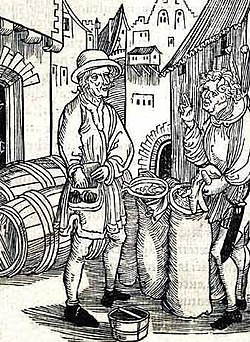


Community hub
Recent from talks
Contribute something
Nothing was collected or created yet.
Usury
View on Wikipedia
 | This article needs additional citations for verification. (May 2024) |

Usury (/ˈjuːʒəri/)[1][2] is the practice of making loans that are seen as unfairly enriching the lender. The term may be used in a moral sense—condemning taking advantage of others' misfortunes—or in a legal sense, where an interest rate is charged in excess of the maximum rate that is allowed by law. A loan may be considered usurious because of excessive or abusive interest rates or other factors defined by the laws of a state. Someone who practises usury can be called a usurer, but in modern colloquial English may be called a loan shark.
In many historical societies including ancient Christian, Jewish, and Islamic societies, usury meant the charging of interest of any kind, and was considered wrong, or was made illegal.[3] During the Sutra period in India (7th to 2nd centuries BC) there were laws prohibiting the highest castes from practising usury.[4] Similar condemnations are found in religious texts from Buddhism, Judaism (ribbit in Hebrew), Christianity, and Islam (riba in Arabic).[5] At times, many states from ancient Greece to ancient Rome have outlawed loans with any interest. Though the Roman Empire eventually allowed loans with carefully restricted interest rates, the Catholic Church in medieval Europe, as well as the Reformed Churches, regarded the charging of interest at any rate as sinful (as well as charging a fee for the use of money, such as at a bureau de change).[6] Christian religious prohibitions on usury are predicated upon the belief that charging interest on a loan is a sin.
History
[edit]Usury (in the original sense of any interest) was denounced by religious leaders and philosophers in the ancient world, including Moses,[7] Plato, Aristotle, Cato, Cicero, Seneca,[8] Aquinas,[9] Gautama Buddha[10] and Muhammad.[11]
Certain negative historical renditions of usury carry with them social connotations of perceived "unjust" or "discriminatory" lending practices. The historian Paul Johnson comments:
Most early religious systems in the ancient Near East, and the secular codes arising from them, did not forbid usury. These societies regarded inanimate matter as alive, like plants, animals and people, and capable of reproducing itself. Hence if you lent 'food money', or monetary tokens of any kind, it was legitimate to charge interest.[12] Food money in the shape of olives, dates, seeds or animals was lent out as early as c. 5000 BC, if not earlier. ...Among the Mesopotamians, Hittites, Phoenicians and Egyptians, interest was legal and often fixed by the state. But the Hebrew took a different view of the matter.[13]
Theological historian John Noonan argues that "the doctrine [of usury] was enunciated by popes, expressed by three ecumenical councils, proclaimed by bishops, and taught unanimously by theologians."[14]
England
[edit]| Usury Act 1487 | |
|---|---|
| Act of Parliament | |
 | |
| Long title | An Acte agaynst Exchaunge and Rechaunge without the Kyngs Lycence. |
| Citation | 3 Hen. 7. c. 5 |
| Territorial extent | |
| Dates | |
| Royal assent | 9 November 1487[a] |
| Commencement | 9 November 1487[a] |
| Repealed | 14 October 1459 |
| Other legislation | |
| Repealed by | Usury Act 1495 |
| Relates to | |
Status: Repealed | |
| Text of statute as originally enacted | |
| Usury Act 1495 | |
|---|---|
| Act of Parliament | |
| |
| Long title | An Acte agaynst Usurye. |
| Citation | 11 Hen. 7. c. 8 |
| Territorial extent | |
| Dates | |
| Royal assent | 22 December 1495 |
| Commencement | 14 October 1495[b] |
| Repealed | 10 August 1872 |
| Other legislation | |
| Repeals/revokes | Usury Act 1487 |
| Amended by | |
| Repealed by | Statute Law Revision (Ireland) Act 1872 |
| Relates to | |
Status: Repealed | |
| Text of statute as originally enacted | |
| Usury Act 1545 | |
|---|---|
| Act of Parliament | |
 | |
| Long title | An Act Against Usurie. |
| Citation | 37 Hen. 8. c. 9 |
| Territorial extent | England and Wales |
| Dates | |
| Royal assent | 24 December 1545 |
| Commencement | 23 November 1545[b] |
| Repealed | 10 August 154 |
| Other legislation | |
| Amends | |
| Repealed by | Usury Laws Repeal Act 1854 |
| Relates to | |
Status: Repealed | |
| Text of statute as originally enacted | |
In England, the departing Crusaders were joined by crowds of debtors in the massacres of Jews at London and York in 1189–1190. In 1275, Edward I of England passed the Statute of the Jewry which made usury illegal and linked it to blasphemy, in order to seize the assets of the violators. Scores of English Jews were arrested, 300 were hanged and their property went to the Crown. In 1290, all Jews were to be expelled from England, allowed to take only what they could carry; the rest of their property became the Crown's. Usury was cited as the official reason for the Edict of Expulsion; however, not all Jews were expelled: it was easy to avoid expulsion by converting to Christianity. Many other crowned heads of Europe expelled Jewish people, although again converts to Christianity were no longer considered Jewish. Many of these forced converts still secretly practised their faith.
The growth of the Lombard bankers and pawnbrokers, who moved from city to city, was along the pilgrim routes.

In the 16th century, short-term interest rates dropped dramatically (from around 20–30% p.a. to around 9–10% p.a.). This was caused by refined commercial techniques, increased capital availability, the Reformation, and other reasons. The lower rates weakened religious scruples about lending at interest, although the debate did not cease altogether.
The 18th century papal prohibition on usury meant that it was a sin to charge interest on a money loan. As set forth by Thomas Aquinas in the 13th century, because money was invented to be an intermediary in exchange for goods, it is unjust to charge a fee to someone after giving them money. This is because transferring ownership of property implies the right to use that property for its purpose: "Accordingly if a man wanted to sell wine separately from the use of the wine, he would be selling the same thing twice, or he would be selling what does not exist, wherefore he would evidently commit a sin of injustice."[16]
Charles Eisenstein has argued that pivotal change in the English-speaking world came with lawful rights to charge interest on lent money,[17] particularly the 1545 act, "An Act Against Usurie" (37 Hen. 8. c. 9) of King Henry VIII of England.
Roman Empire
[edit]During the Principate period, most banking activities were conducted by private individuals who operated as large banking firms do today. Anybody that had any available liquid assets and wished to lend it out could easily do so.[18]
The annual rates of interest on loans varied in the range of 4–12 percent, but when the interest rate was higher, it typically was not 15–16 percent but either 24 percent or 48 percent. They quoted them on a monthly basis, and the most common rates were multiples of twelve. Monthly rates tended to range from simple fractions to 3–4 percent, perhaps because lenders used Roman numerals.[19]
During this period, moneylending primarily involved private loans given to individuals who were consistently in debt or temporarily so until harvest time. This practice was typically carried out by extremely wealthy individuals willing to take on high risks if the potential profit seemed promising. Interest rates were set privately and were largely unrestricted by law. Investment was always regarded as a matter of seeking personal profit, often on a large scale. Banking was of the small, back-street variety, run by the urban lower-middle class of petty shopkeepers. By the 3rd century, acute currency problems in the Empire drove such banking into decline.[20] The rich who were in a position to take advantage of the situation became the moneylenders when the increasing tax demands in the last declining days of the Empire crippled and eventually destroyed the peasant class by reducing tenant-farmers to serfs. It was evident that usury meant exploitation of the poor.[21]
Cicero, in the second book of his treatise De Officiis, relates the following conversation between an unnamed questioner and Cato:
...of whom, when inquiry was made, what was the best policy in the management of one's property, he answered "Good grazing." "What was next?" "Tolerable grazing." "What third?" "Bad grazing." "What fourth?" "Tilling." And when he who had interrogated him inquired, "What do you think of lending at usury?" Then Cato answered, "What do you think of murder?"[22][23]
Religion
[edit]Judaism
[edit]The book of Deuteronomy prohibits Jews from charging interest except when making loans to foreigners. Typically, a loan is considered a form of Tzedakah or Ṣedaqah (Hebrew: צדקה [ts(e)daˈka]), a Hebrew word meaning "righteousness" but commonly used to signify charity. (This concept of "charity" differs from the modern Western understanding of "charity". The latter is typically understood as a spontaneous act of goodwill and a marker of generosity; tzedakah is an ethical obligation.) In the Rabbinic period, the practice of charging interest to non-Jews has been restricted to cases when there is no other means of subsistence.[24] "If we nowadays allow interest to be taken from non-Jews, it is because there is no end to the yoke and the burden king and ministers impose on us, and everything we take is the minimum for our subsistence, and anyhow we are condemned to live in the midst of the nations and cannot earn our living in any other manner except by money dealings with them; therefore the taking of interest is not to be prohibited" (Tos. to BM 70b S.V. tashikh).[25]
This is outlined in the Jewish scriptures, specifically in the Torah:
If thou lend money to any of My people, even to the poor with thee, thou shalt not be to him as a creditor; neither shall ye lay upon him interest.[26]
Take thou no interest of him or increase; but fear thy God; that thy brother may live with thee. Thou shalt not give him thy money upon interest, nor give him thy victuals for increase.[27]
Thou shalt not lend upon interest to thy brother: interest of money, interest of victuals, interest of any thing that is lent upon interest. Unto a foreigner thou mayest lend upon interest; but unto thy brother thou shalt not lend upon interest; that the LORD thy God may bless thee in all that thou puttest thy hand unto, in the land whither thou goest in to possess it.[28]
that hath withdrawn his hand from the poor, that hath not received interest nor increase, hath executed Mine ordinances, hath walked in My statutes; he shall not die for the iniquity of his father, he shall surely live.[29]
In thee have they taken gifts to shed blood; thou hast taken interest and increase, and thou hast greedily gained of thy neighbours by oppression, and hast forgotten Me, saith the Lord GOD.[30]
Then I consulted with myself, and contended with the nobles and the rulers, and said unto them: 'Ye lend upon pledge, every one to his brother.' And I held a great assembly against them.[31]
He that putteth not out his money on interest, nor taketh a bribe against the innocent. He that doeth these things shall never be moved.[32]
Johnson contends that the Torah treats lending as philanthropy in a poor community whose aim was collective survival, but which is not obliged to be charitable towards outsiders.
A great deal of Jewish legal scholarship in the Early and High Middle Ages was devoted to making business dealings fair, honest and efficient.[33]
As Jewish people were ostracized from most professions by local rulers during the Middle Ages, the Western churches and the guilds,[34] they were pushed into marginal occupations considered socially inferior, such as tax and rent collecting and moneylending. Natural tensions between creditors and debtors were added to social, political, religious, and economic strains.[35]
...financial oppression of Jews tended to occur in areas where they were most disliked, and if Jews reacted by concentrating on moneylending to non-Jews, the unpopularity—and so, of course, the pressure—would increase. Thus the Jews became an element in a vicious circle. The Christians, on the basis of the Biblical rulings, condemned interest-taking absolutely, and from 1179 those who practised it were excommunicated. Catholic autocrats frequently imposed the harshest financial burdens on the Jews. The Jews reacted by engaging in the one business where Christian laws actually discriminated in their favor, and became identified with the hated trade of moneylending.[36]
Several historical rulings in Jewish law have mitigated the allowances for usury toward non-Jews. For instance, the 15th-century commentator Rabbi Isaac Abarbanel specified that the rubric for allowing interest does not apply to Christians or Muslims, because their faith systems have a common ethical basis originating from Judaism. The medieval commentator Rabbi David Kimhi extended this principle to non-Jews who show consideration for Jews, saying they should be treated with the same consideration when they borrow.[37]
Christianity
[edit]
Bible
[edit]The Old Testament "condemns the practice of charging interest on a poor person because a loan should be an act of compassion and taking care of one’s neighbor"; it teaches that "making a profit off a loan from a poor person is exploiting that person (Exodus 22:25–27)."[39] Similarly, charging of interest (Hebrew: נֶֽשֶׁךְ, romanized: nešeḵ) or the taking of clothing as pledges is condemned in Ezekiel 18 (early 6th century BC),[40] and Deuteronomy 23:19 prohibits the taking of interest in the form of money or food when lending to a "brother".[41]
The New Testament in Luke 6:34-36, likewise teaches giving rather than loaning money to those who need it: "And if you lend to those from whom you expect repayment, what credit is that to you? Even sinners lend to sinners, expecting to be repaid in full. But love your enemies, do good to them, and lend to them, expecting nothing in return. Then your reward will be great, and you will be sons of the Most High; for He is kind to the ungrateful and wicked. Be merciful, just as your Father is merciful."
Church councils
[edit]The First Council of Nicaea, in 325, forbade clergy from engaging in usury[42]
Forasmuch as many enrolled among the Clergy, following covetousness and lust of gain, have forgotten the divine Scripture, which says, "He has not given his money upon usury" [Ezek. xviii, 8], and in lending money ask the hundredth of the sum [as monthly interest], the holy and great Synod thinks it just that if after this decree any one be found to receive usury, whether he accomplish it by secret transaction or otherwise, as by demanding the whole and one half, or by using any other contrivance whatever for filthy lucre's sake, he shall be deposed from the clergy and his name stricken from the list. (canon 17).[43] [bracketed material in source]
At the time, usury was interest of any kind, and the canon forbade the clergy to lend money at interest rates even as low as 1 percent per year. Later ecumenical councils applied this regulation to the laity.[42][14]
Lateran III decreed that persons who accepted interest on loans could receive neither the sacraments nor Christian burial.[44]
Nearly everywhere the crime of usury has become so firmly rooted that many, omitting other business, practise usury as if it were permitted, and in no way observe how it is forbidden in both the Old and New Testament. We therefore declare that notorious usurers should not be admitted to communion of the altar or receive christian burial if they die in this sin. Whoever receives them or gives them christian burial should be compelled to give back what he has received, and let him remain suspended from the performance of his office until he has made satisfaction according to the judgment of his own bishop. (canon 25)[45] [emphasis in source]
The Council of Vienne made the belief in the right to usury a heresy in 1311, and condemned all secular legislation that allowed it.
Serious suggestions have been made to us that communities in certain places, to the divine displeasure and injury of the neighbour, in violation of both divine and human law, approve of usury. By their statutes, sometimes confirmed by oath, they not only grant that usury may be demanded and paid, but deliberately compel debtors to pay it. By these statutes they impose heavy burdens on those claiming the return of usurious payments, employing also various pretexts and ingenious frauds to hinder the return. We, therefore, wishing to get rid of these pernicious practices, decree with the approval of the sacred council that all the magistrates, captains, rulers, consuls, judges, counsellors or any other officials of these communities who presume in the future to make, write or dictate such statutes, or knowingly decide that usury be paid or, if paid, that it be not fully and freely restored when claimed, incur the sentence of excommunication. They shall also incur the same sentence unless within three months they delete from the books of their communities, if they have the power, statutes of this kind hitherto published, or if they presume to observe in any way these statutes or customs. Furthermore, since money-lenders for the most part enter into usurious contracts so frequently with secrecy and guile that they can be convicted only with difficulty, we decree that they be compelled by ecclesiastical censure to open their account books, when there is question of usury. If indeed someone has fallen into the error of presuming to affirm pertinaciously that the practice of usury is not sinful, we decree that he is to be punished as a heretic; and we strictly enjoin on local ordinaries and inquisitors of heresy to proceed against those they find suspect of such error as they would against those suspected of heresy. (canon 29)[46]
Up to the 16th century, usury was condemned by the Catholic Church. During the Fifth Lateran Council, in the 10th session (in the year 1515), the Council for the first time[citation needed] gave a definition of usury:
For, that is the real meaning of usury: when, from its use, a thing which produces nothing is applied to the acquiring of gain and profit without any work, any expense or any risk.[47]
The Fifth Lateran Council, in the same declaration, gave explicit approval of charging a fee for services so long as no profit was made in the case of Mounts of Piety:
(...) We declare and define, with the approval of the Sacred Council, that the above-mentioned credit organisations, established by states and hitherto approved and confirmed by the authority of the Apostolic See, do not introduce any kind of evil or provide any incentive to sin if they receive, in addition to the capital, a moderate sum for their expenses and by way of compensation, provided it is intended exclusively to defray the expenses of those employed and of other things pertaining (as mentioned) to the upkeep of the organizations, and provided that no profit is made therefrom. They ought not, indeed, to be condemned in any way. Rather, such a type of lending is meritorious and should be praised and approved. It certainly should not be considered as usurious; (...)[47]
Pope Sixtus V condemned the practice of charging interest as "detestable to God and man, damned by the sacred canons, and contrary to Christian charity.[48]
Medieval theology
[edit]The first of the scholastic Christian theologians, Saint Anselm of Canterbury, led the shift in thought that labelled charging interest the same as theft.[citation needed] Previously usury had been seen as a lack of charity.
St. Thomas Aquinas, the leading scholastic theologian of the Catholic Church, argued charging of interest is wrong because it amounts to "double charging", charging for both the thing and the use of the thing. Aquinas said this would be morally wrong in the same way as if one sold a bottle of wine, charged for the bottle of wine, and then charged for the person using the wine to actually drink it.[49] Similarly, one cannot charge for a piece of cake and for the eating of the piece of cake. Yet this, said Aquinas, is what usury does. Money is a medium of exchange, and is used up when it is spent. To charge for the money and for its use (by spending) is therefore to charge for the money twice. It is also to sell time since the usurer charges, in effect, for the time that the money is in the hands of the borrower. Time, however, is not a commodity for which anyone can charge. In condemning usury Aquinas was much influenced by the recently rediscovered philosophical writings of Aristotle and his desire to assimilate Greek philosophy with Christian theology. Aquinas argued that in the case of usury, as in other aspects of Christian revelation, Christian doctrine is reinforced by Aristotelian natural law rationalism. Aristotle's argument is that interest is unnatural, since money, as a sterile element, cannot naturally reproduce itself. Thus, usury conflicts with natural law just as it offends Christian revelation: see Thought of Thomas Aquinas. As such, Aquinas taught "that interest is inherently unjust and one who charges interest sins."[39]

Outlawing usury did not prevent investment, but stipulated that in order for the investor to share in the profit he must share the risk. In short he must be a joint-venturer. Simply to invest the money and expect it to be returned regardless of the success of the venture was to make money simply by having money and not by taking any risk or by doing any work or by any effort or sacrifice at all, which is usury. St Thomas quotes Aristotle as saying that "to live by usury is exceedingly unnatural". St Thomas allows, however, charges for actual services provided. Thus a banker or credit-lender could charge for such actual work or effort as he did carry out e.g. any fair administrative charges. The Catholic Church, in a decree of the Fifth Council of the Lateran, expressly allowed such charges in respect of credit-unions run for the benefit of the poor known as "montes pietatis".[50]
In the 13th century Cardinal Hostiensis enumerated thirteen situations in which charging interest was not immoral.[51] The most important of these was lucrum cessans (profits given up) which allowed for the lender to charge interest "to compensate him for profit foregone in investing the money himself."[citation needed] This idea is very similar to opportunity cost. Many scholastic thinkers who argued for a ban on interest charges also argued for the legitimacy of lucrum cessans profits (e.g. Pierre Jean Olivi and St. Bernardino of Siena). However, Hostiensis' exceptions, including for lucrum cessans, were never accepted as official by the Catholic Church.
Pope Benedict XIV's encyclical Vix Pervenit (1745), operating in the pre-industrial mindset[neutrality is disputed] [original research?], gives the reasons why usury is sinful:[52]
The nature of the sin called usury has its proper place and origin in a loan contract... [which] demands, by its very nature, that one return to another only as much as he has received. The sin rests on the fact that sometimes the creditor desires more than he has given..., but any gain which exceeds the amount he gave is illicit and usurious.
One cannot condone the sin of usury by arguing that the gain is not great or excessive, but rather moderate or small; neither can it be condoned by arguing that the borrower is rich; nor even by arguing that the money borrowed is not left idle, but is spent usefully...[53]
15th through 19th century
[edit]Martin Luther opposed several forms of usury, publishing and republishing multiple treatises on the subject. Christians, Luther argued, should not act in self-defense, should give when asked, and in the lowest degree should lend, expecting nothing in return. On those grounds, making a loan with anticipated profits (and with required repayment and hence little risk for the lender) is a form of self-service that goes against love of neighbor. Defining "lend" as lending without interest or fee, Luther encourages lending for the purpose of aiding the borrower.[54][55]
The Westminster Larger Catechism, part of the Westminster Standards held as doctrinal documents by Presbyterian churches, teaches that usury is a sin prohibited by the eighth commandment.[6]
Concerns about usury included the 19th century Rothschild loans to the Holy See and 16th century concerns over abuse of the zinskauf clause.[56] This was problematic because the charging of interest (although not all interest – see above for Fifth Lateran Council) can be argued to be a violation of doctrine at the time, such as that reflected in the 1745 encyclical Vix pervenit. To prevent any claims of doctrine violation, work-arounds would sometimes be employed. For example, in the 15th century, the Medici Bank lent money to the Vatican, which was lax about repayment. Rather than charging interest, "the Medici overcharged the pope on the silks and brocades, the jewels and other commodities they supplied."[57]
20th century
[edit]The 1917 Code of Canon Law instructed church administrators to set aside funds to be "invested profitably".[58] It permitted lending with interest under normal legal conditions as long as excessive interest was not charged.[59]
§1543: If a fungible thing is given to another so that it becomes his, and later it must be restored in the same sort, no profit can by made by reason of the contract; but in the loan of a fungible thing, it is not by itself illicit to reap a legal profit, unless it can be shown to be immoderate of itself, and even greater profit [can be made] if there is a just and proportionate title so supporting.[60]
The Catholic Church has always condemned usury, but in modern times, with the rise of capitalism, the previous assumptions about the very nature of money have been challenged, and the Church had to update its understanding of what constitutes usury to also include the new reality.[61] Thus, the Church refers, among other things, to the fact Mosaic Law does not ban all interest taking[62] (proving interest-taking is not an inherently immoral act, same principle as with homicide), as well as the prevalence of bonds and loans paying interest. Because of this, as the old Catholic Encyclopedia put it, "Since the possession of an object is generally useful, I may require the price of that general utility, even when the object is of no use to me."[63]
Jesuit philosopher Joseph Rickaby, writing at the beginning of the 20th century, put the development of economy in relation to usury this way:
In great cities commerce rapidly ripened, and was well on towards maturity five centuries ago. Then the conditions that render interest lawful, and mark if off from usury, readily came to obtain. But those centres were isolated. (...) Here you might have a great city, Hamburg or Genoa, an early type of commercial enterprise, and, fifty miles inland, society was in infancy, and the great city was as part of another world. Hence the same transaction, as described by the letter of the law, might mean lawful interest in the city, and usury out in the country – the two were so disconnected.[64]
He further gave the following view of the development of Catholic practice:
In such a situation the legislator has to choose between forbidding interest here and allowing usury there; between restraining speculation and licensing oppression. The mediaeval legislator chose the former alternative. Church and State together enacted a number of laws to restrain the taking of interest, laws that, like the clothes of infancy, are not to be scorned as absurd restrictions, merely because they are inapplicable now, and would not fit the modern growth of nations. At this day the State has repealed those laws, and the Church has officially signified that she no longer insists on them. Still she maintains dogmatically that there is such a sin as usury, and what it is, as defined in the Fifth Council of Lateran.[64]
Modern era
[edit]The Congregation of the Missionary Sons of the Immaculate Heart of Mary, a Catholic Christian religious order, teaches that the charging of interest is sinful.[citation needed] Theology professor Kevin Considine argues that usury remains a sin if it takes advantage of the needy or where the source of the interest is sinful:[39]
It might initially seem like little is at stake when it comes to interest, but this is an issue of human dignity. A person is made in God's own image and therefore may never be treated as a thing. Interest can diminish the human person to a thing to be manipulated for money. In an article for The Catholic Worker, Dorothy Day articulated this well: "Can I talk about the people living off usury ... not knowing the way that their infertile money has bred more money by wise investment in God knows what devilish nerve gas, drugs, napalm, missiles, or vanities, when housing and employment ... for the poor were needed, and money could have been invested there?" Her thoughts were a precursor to what Pope Francis now calls an "economy that kills." To sin is to say "no" to God and God's presence by harming others, ourselves, or all of creation. Charging interest is indeed sinful when doing so takes advantage of a person in need as well as when it means investing in corporations involved in the harming of God's creatures.[39]
Islam
[edit]Riba (usury) is forbidden in Islam. As such, specialized codes of banking have developed to cater to investors wishing to obey Qur'anic law. (See Islamic banking)
The following quotations are English translations from the Qur'an:[65]
Those who consume interest will stand (on Judgment Day) like those driven to madness by Satan’s touch. That is because they say, "Trade is no different than interest." But Allah has permitted trading and forbidden interest. Whoever refrains—after having received warning from their Lord—may keep their previous gains, and their case is left to Allah. As for those who persist, it is they who will be the residents of the Fire. They will be there forever. (Al-Baqarah 2:275)
Allah has made interest fruitless and charity fruitful. And Allah does not like any ungrateful evildoer. Indeed, those who believe, do good, establish prayer, and pay alms-tax will receive their reward from their Lord, and there will be no fear for them, nor will they grieve. O believers! Fear Allah, and give up outstanding interest if you are (true) believers. If you do not, then beware of a war with Allah and His Messenger! But if you repent, you may retain your principal—neither inflicting nor suffering harm. If it is difficult for someone to repay a debt, postpone it until a time of ease. And if you waive it as an act of charity, it will be better for you, if only you knew. (Al-Baqarah 2:276–280)
O believers! Do not consume interest, multiplying it many times over. And be mindful of Allah, so you may prosper. (Al-'Imran 3:130)
We forbade the Jews certain foods that had been lawful to them for their wrongdoing, and for hindering many from the Way of Allah, taking interest despite its prohibition, and consuming people’s wealth unjustly. We have prepared for the disbelievers among them a painful punishment. (Al-Nisa 4:160–161)
Whatever loans you give, seeking interest at the expense of people’s wealth, will not increase with Allah. But whatever charity you give, seeking the pleasure of Allah—it is they whose reward will be multiplied. (Ar-Rum 30:39)
The attitude of Muhammad to usury is articulated in his Last Sermon:[66]
Verily your blood, your property are as sacred and inviolable as the sacredness of this day of yours, in this month of yours, in this town of yours. Behold! Everything pertaining to the Days of Ignorance is under my feet completely abolished. Abolished are also the blood-revenges of the Days of Ignorance. The first claim of ours on blood-revenge which I abolish is that of the son of Rabi'a b. al-Harith, who was nursed among the tribe of Sa'd and killed by Hudhail. And the usury of the pre-Islamic period is abolished, and the first of our usury I abolish is that of 'Abbas b. 'Abd al-Muttalib, for it is all abolished.
One of the forbidden usury models in Islam is to take advantage when lending money. Examples of forbidden loans, such as a person borrowing 1000 dollars and the borrower is required to return 1100 dollars. The above agreement is a form of transaction which is a burden for people who borrow, because in Islam, lending and borrowing are social transactions aimed at helping others, not like a sale and purchase agreement that is allowed to be profitable. Hence, a rule of thumb used by Islamic scholars is, "Every loan (qardh) which gives additional benefits is called usury."[67]
In literature
[edit]In The Divine Comedy, Dante places the usurers in the inner ring of the seventh circle of hell.
Interest on loans, and the contrasting views on the morality of that practice held by Jews and Christians, is central to the plot of Shakespeare's play The Merchant of Venice. Antonio is the merchant of the title, a Christian, who is forced by circumstance to borrow money from Shylock, a Jew. Shylock customarily charges interest on loans, seeing it as good business, while Antonio does not, viewing it as morally wrong. When Antonio defaults on his loan, Shylock famously demands the agreed upon penalty: a measured quantity of muscle from Antonio's chest. This is the source of the metaphorical phrase "a pound of flesh" often used to describe the dear price of a loan or business transaction. Shakespeare's play is a vivid portrait of the competing views of loans and use of interest, as well as the cultural strife between Jews and Christians that overlaps it.[citation needed]
By the 18th century, usury was more often treated as a metaphor than a crime in itself, so Jeremy Bentham's Defence of Usury was not as shocking as it would have appeared two centuries earlier.
In Honoré de Balzac's 1830 novel Gobseck, the title character, who is a usurer, is described as both "petty and great – a miser and a philosopher..."[68] The character Daniel Quilp in The Old Curiosity Shop by Charles Dickens is a usurer.
In the early 20th century Ezra Pound's anti-usury poetry was not primarily based on the moral injustice of interest payments but on the fact that excess capital was no longer devoted to artistic patronage, as it could now be used for capitalist business investment.[69]
Usury law
[edit]England
[edit].jpg)
"When money is lent on a contract to receive not only the principal sum again, but also an increase by way of compensation for the use, the increase is called interest by those who think it lawful, and usury by those who do not." (William Blackstone's Commentaries on the Laws of England).
Canada
[edit]On the federal level, Canada's Criminal Code limits the interest rate to 60% per year.[71] The law is broadly written and Canada's courts have often intervened to remove ambiguity.[72] In Quebec, the maximum annual interest rate allowed by law is 35%.[73]
Hong Kong
[edit]The Money Lenders Ordinance (Cap. 163) prohibits lending at an effective interest rate beyond 48% unless exempted.[74] Offenders are liable "on summary conviction to a fine of $500,000 and to imprisonment for 2 years", or "on conviction on indictment to a fine of $5,000,000 and to imprisonment for 10 years".[75]
Japan
[edit]Japan has various laws restricting interest rates. Under civil law, the maximum interest rate is between 15% and 20% per year depending upon the principal amount (larger amounts having a lower maximum rate). Interest in excess of 20% is subject to criminal penalties (the criminal law maximum was 29.2% until it was lowered by legislation in 2010).[76] Default interest on late payments may be charged at up to 1.46 times the ordinary maximum (i.e., 21.9% to 29.2%), while pawn shops may charge interest of up to 9% per month (i.e., 108% per year, however, if the loan extends more than the normal short-term pawn shop loan, the 9% per month rate compounded can make the annual rate in excess of 180%, before then most of these transaction would result in any goods pawned being forfeited).
United States
[edit]Usury laws are state laws that specify the maximum legal interest rate at which loans can be made. In the United States, the primary legal power to regulate usury rests primarily with the states. Each U.S. state has its own statute that dictates how much interest can be charged before it is considered usurious or unlawful.[77]
If a lender charges above the lawful interest rate, a court will not allow the lender to sue to recover the unlawfully high interest, and some states will apply all payments made on the debt to the principal balance. In some states, such as New York, usurious loans are voided ab initio.[78]
The making of usurious loans is often called loan sharking. That term is sometimes also applied to the practice of making consumer loans without a license in jurisdictions that requires lenders to be licensed.
Federal regulation
[edit]On a federal level, Congress has never attempted to federally regulate interest rates on purely private transactions, but on the basis of past U.S. Supreme Court decisions, arguably the U.S. Congress might have the power to do so under the interstate commerce clause of Article I of the Constitution.[citation needed]
Congress imposed a federal criminal penalty for unlawful interest rates through the Racketeer Influenced and Corrupt Organizations Act (RICO Statute), and its definition of "unlawful debt", which makes it a potential federal felony to lend money at an interest rate more than twice the local state usury rate and then try to collect that debt.[79]
It is a federal offense to use violence or threats to collect usurious interest (or any other sort).[80]
Separate federal rules apply to most banks. The U.S. Supreme Court held unanimously in the 1978 case, Marquette Nat. Bank of Minneapolis v. First of Omaha Service Corp., that the National Banking Act of 1863 allowed nationally chartered banks to charge the legal rate of interest in their state regardless of the borrower's state of residence.[81]
In 1980, Congress passed the Depository Institutions Deregulation and Monetary Control Act. Among the Act's provisions, it exempted federally chartered savings banks, installment plan sellers and chartered loan companies from state usury limits. Combined with the Marquette decision that applied to National Banks, this effectively overrode all state and local usury laws.[77][82] The 1968 Truth in Lending Act does not regulate rates, except for some mortgages, but requires uniform or standardized disclosure of costs and charges.[83]
In the 1996 Smiley v. Citibank case, the Supreme Court further limited states' power to regulate credit card fees and extended the reach of the Marquette decision. The court held that the word "interest" used in the 1863 banking law included fees and, therefore, states could not regulate fees.[84]
Some members of Congress have tried to create a federal usury statute that would limit the maximum allowable interest rate, but the measures have not progressed. In July 2010, the Dodd–Frank Wall Street Reform and Consumer Protection Act, was signed into law by President Obama. The act provides for a Consumer Financial Protection Bureau to regulate some credit practices but has no interest rate limit.[84]
Texas
[edit]State law in Texas also includes a provision for contracting for, charging, or receiving charges exceeding twice the amount authorized (A/K/A "double usury"). A person who violates this provision is liable to the obligor as an additional penalty for all principal or principal balance, as well as interest or time price differential. A person who is liable is also liable for reasonable attorney's fees incurred by the obligor.[85]
Avoidance mechanisms and interest-free lending
[edit]Demurrage currency
[edit]Demurrage currency is a type of money that is designed to gradually lose purchasing power at a flat constant rate. The German economist, Silvio Gesell, advocated for demurrage as part of the Freiwirtschaft economic system. He referred to demurrage as Freigeld 'free money' — "free" because it would be freed from hoarding and interest.[86][87] Gesell theorized that Freigeld would lead to fewer recessions by increasing the velocity of money, eliminating inflation, and creating an interest-free economy without usury.
Islamic banking
[edit]In a partnership or joint venture where money is lent, the creditor only provides the capital yet is guaranteed a fixed amount of profit. The debtor, however, puts in time and effort, but is made to bear the risk of loss. Muslim scholars argue that such practice is unjust.[88] As an alternative to usury, Islam strongly encourages charity and direct investment in which the creditor shares whatever profit or loss the business may incur (in modern terms, this amounts to an equity stake in the business).[citation needed]
Interest-free micro-lending
[edit]Growth of the Internet internationally has enabled both commercial micro-lending (through sites such as Kickstarter – launched in 2009) and global micro-lending charities (where lenders make small sums of money available on zero-interest terms). Persons lending money to on-line micro-lending charity Kiva (founded in 2005), for example, do not get paid any interest,[89] although Kiva's partners in the country where the loan is used may charge interest to the end-users to whom the loans are made.[90]
Non-recourse mortgages
[edit]A non-recourse loan is secured by the value of property (usually real estate) owned by the debtor. However, unlike other loans, which oblige the debtor to repay the amount borrowed, a non-recourse loan is fully satisfied merely by the transfer of the property to the creditor, even if the property has declined in value and is worth less than the amount borrowed. When such a loan is created, the creditor bears the risk that the property will decline sharply in value (in which case the creditor is repaid with property worth less than the amount borrowed), and the debtor does not bear the risk of decrease in property value (because the debtor is guaranteed the right to use the property, regardless of value, to satisfy the debt.)
Zinskauf
[edit]Zinskauf was a financial instrument, similar to an annuity, that rose to prominence in the Middle Ages.[91][92] The decline of the Byzantine Empire led to a growth of capital in Europe, so the Catholic Church tolerated zinskauf as a way to avoid prohibitions on usury. Since zinskauf was an exchange of a fixed amount of money for annual income it was considered a sale rather than a loan. Martin Luther made zinskauf a subject of his Treatise on Usury[93] and his Sermon on Trade and Usury[94] and criticized clerics of the Catholic Church for violating the spirit if not the letter of usury laws.
See also
[edit]Notes
[edit]References
[edit]- ^ "Usury". Oxford English Dictionary. Oxford University Press. 2012. Retrieved 26 October 2012.
- ^ The word is derived from Medieval Latin usuria, "interest", or from Latin usura, "interest"
- ^ "Americans for Fairness in Lending - The History of Usury". 15 October 2008. Archived from the original on 15 October 2008.
- ^ Jain, L. C. (1929). Indigenous Banking In India. London: Macmillan and Co. pp. 4–6. OCLC 4233411.
- ^ Karim, Shafiel A. (2010). The Islamic Moral Economy: A Study of Islamic Money and Financial Instruments. Boca Raton, FL: Brown Walker Press. ISBN 978-1-59942-539-9.
- ^ a b Cox, Robert (1853). Sabbath Laws and Sabbath Duties: Considered in Relation to Their Natural and Scriptural Grounds, and to the Principles of Religious Liberty. Maclachlan and Stewart. p. 180.
- ^ Exodus 22:25
- ^ "Usury - The Root of All Evil". The Spirit of Now. Peter Russell.
- ^ "Thomas Aquinas: On Usury, c. 1269–71". Fordham University.
- ^ Bodhi, Bhikku. "Right Speech, Right Action, Right Livelihood (Samma Vaca, Samma Kammanta, Samma Ajiva)". Buddhist Publication Society. Retrieved 29 June 2012.
- ^ "The Prophet Muhammad's Last Sermon". Fordham University.
- ^ Johnson cites Fritz E. Heichelcheim: An Ancient Economic History, 2 vols. (trans. Leiden 1965), i.104-566
- ^ Johnson, Paul (1987). A history of the Jews. New York: Harper & Row. pp. 172-173. ISBN 0-06-091533-1. OCLC 15282826.
- ^ a b Noonan, John T., Jr. 1993. "Development of Moral Doctrine." 54 Theological Stud. 662.
- ^ "Official Doctrinal Statements of the Lutheran Church–Missouri Synod" (PDF). Archived from the original (PDF) on 25 February 2009.
- ^ Aquinas, Thomas. "Summa Theologiae, II-II Q78". newadvent.org. New Advent. Retrieved 5 July 2020.
- ^ Eisenstein, Charles: Sacred Economics: Money, Gift, and Society in the Age of Transition
- ^ Zgur, Andrej: The economy of the Roman Empire in the first two centuries A.D., An examination of market capitalism in the Roman economy Archived 2012-06-11 at the Wayback Machine, Aarhus School of Business, December 2007, pp. 252–261.
- ^ Temin, Peter: Financial Intermediation in the Early Roman Empire Archived 2011-07-17 at the Wayback Machine, The Journal of Economic History, Cambridge University Press, 2004, vol. 64, issue 03, p. 15.
- ^ Young, Frances: Christian Attitudes to Finance in the First Four Centuries, Epworth Review 4.3, Peterborough, September 1977, p. 80.
- ^ Young, Frances: Christian Attitudes to Finance in the First Four Centuries, Epworth Review 4.3, Peterborough, September 1977, pp. 81–82.
- ^ Hannis Taylor; Mary Lillie Taylor Hunt (1918). Cicero: A Sketch of His Life and Works : a Commentary on the Roman Constitution and Roman Public Life, Supplemented by the Sayings of Cicero Arranged for the First Time as an Anthology. A.C. McClurg & Company. p. 376.
- ^ Cicero, Marcus Tullius (1913). "De officiis With an English translation by Walter Miller" (in Latin). Translated by Miller, Walter. Heinemann. p. 267. OCLC 847989316. Retrieved 7 September 2019.
- ^ Robinson, George. "Interest-Free Loans in Judaism". Retrieved 12 March 2015.
- ^ "Jewish Virtual Library".
- ^ Exodus 22:25
- ^ Leviticus 25:36–37
- ^ Deuteronomy 23:20–21
- ^ Ezekiel 18:17
- ^ Ezekiel 22:12
- ^ Nehemiah 5:7
- ^ Psalm 15:5
- ^ Johnson 1987, p. 172.
- ^ "Petition of the Jews of Paris, Alsase, and Lorraine to the National Assembly, January 28, 1790." Ed. Hunt, Lynn. The French Revolution and Human Rights: A Brief Documentary History. Bedford Books of St. Martin's Press, 1996, p. 96.
- ^ Cooper, Zaki (31 July 2015). "Christian approach to usury forced Jews into money lending". Financial Times. Archived from the original on 27 October 2017. Retrieved 19 January 2020.
- ^ Johnson 1987, p. 174.
- ^ "Encyclopedia Judaica: Moneylending". Jewish Virtual Library. 2008. Retrieved 16 October 2017.
- ^ The references cited in the Passionary for this woodcut: 1 John 2:14–16, Matthew 10:8, and The Apology of the Augsburg Confession, Article 8, Of the Church Archived 2010-07-15 at the Wayback Machine
- ^ a b c d Considine, Kevin P. (April 2016). "Is it sinful to charge interest on a loan?". U.S. Catholic. Vol. 81, no. 4. p. 49. Retrieved 4 June 2020.
- ^ Work, Theology of. "Ezekiel 18:8a - The Righteous Man Does Not Take Advance or Accrued Interest". www.theologyofwork.org.
- ^ "What does the Old Testament say about Loans and Interest? Part 3". The Good Book Blog - Biola University Blogs. 2 January 2018.
- ^ a b Moehlman, Conrad Henry (1934). "The Christianization of Interest". Church History. 3 (1): 6. doi:10.2307/3161033. JSTOR 3161033. S2CID 162381369.
- ^ "First Council of Nicea (A.D. 325)". newadvent.org. New Advent. Retrieved 4 September 2019.
- ^ Moehlman, 1934, pp. 6–7.
- ^ "Third Lateran Council – 1179 A.D. – Papal Encyclicals". papalencyclicals.net. Papal Encyclicals Online. 5 March 1179. Retrieved 4 September 2019.
- ^ "Council of Vienne –1311–1312 A.D. – Papal Encyclicals". papalencyclicals.net. Papal Encyclicals Online. 16 October 1311. Retrieved 5 September 2019.
- ^ a b "Fifth Lateran Council 1512–17 A.D. – Papal Encyclicals". papalencyclicals.net. Papal Encyclicals Online. 4 May 1515. Retrieved 11 September 2019.
- ^ Moehlman 1934, p. 7.
- ^ Thomas Aquinas. Summa Theologica, "Of Cheating, Which Is Committed in Buying and Selling." Translated by The Fathers of the English Dominican Province. pp. 1–10 [1] Retrieved June 19, 2012
- ^ Session Ten: On the reform of credit organisations (Montes pietatis). Fifth Lateran Council. Rome, Italy: Catholic Church. 4 May 1515. Retrieved 5 April 2008.
- ^ Roover, Raymond (Autumn 1967). "The Scholastics, Usury, and Foreign Exchange". Business History Review. 41 (3). The Business History Review, Vol. 41, No. 3: 257–271. doi:10.2307/3112192. JSTOR 3112192. S2CID 154706783.
- ^ See also: Church and the Usurers: Unprofitable Lending for the Modern Economy Archived 2015-10-17 at the Wayback Machine by Dr. Brian McCall or Interest and Usury by Fr. Bernard W. Dempsey, S.J. (1903–1960).
- ^ "Vix Pervenit – Papal Encyclicals". 1 November 1745.
- ^ Brandt, Walther (1962). "Introduction: Trade and Usury" in Luther's Works. Vol. 45. Philadelphia: Muhlenberg Press. p. 233.
- ^ Astorri, Paolo (2019). Lutheran Theology and Contract Law in Early Modern Germany. Brill. pp. 327–355.
- ^ See Martin Luther's Sermon on Trading and Usury
- ^ "The presence among the assets of silver plate for an amount of more than 4,000 florins reveals at any rate that the Rome branch dealt more or less extensively in this product for which there was a demand among the high churchmen of the Curia who did a great deal of entertaining and liked to display their magnificence." p. 205, also see p. 199, de Roover, Raymond Adrien (1948), The Medici Bank: its organization, management, and decline, New York; London: New York University Press; Oxford University Press (respectively)
- ^ T.L. Bouscaren and A.C. Ellis. 1957. Canon Law: A Text and Commentary. p. 826.
- ^ Bachofen, Charles Augustine (1921). A Commentary On the New Code of Canon Law. Vol. VI. St. Louis, Mo: B. Herder Book Co. p. 609.
- ^ Peters, Edward N. (2001). The 1917 or Pio-Benedictine code of canon law: in English translation with extensive scholarly apparatus. Église catholique. San Francisco (Calif.): Ignatius press. ISBN 978-0-89870-831-8.
- ^ Palm, David, J. "The Red Herring of Usury". Catholic Culture.org. Retrieved 11 September 2019.
{{cite web}}: CS1 maint: multiple names: authors list (link) - ^ Deuteronomy 23:19–20
- ^ Vermeersch, Arthur (1912). "Usury". In Herbermann, Charles G. (ed.). The Catholic Encyclopedia. Vol. 15. New York: Robert Appleton Company.
- ^ a b Rickaby, Joseph (1918). Moral Philosophy: Ethics, Deontology and Natural Law. London, New York [etc.]: Longmans, Green, and Co. pp. 262–263. Retrieved 14 September 2019.
- ^ Pickthall, M (1930). The Meaning of the Glorious Koran. Alfred A. Knopf.
- ^ Sahih Muslim, book 15 (The Book of Pilgrimage), hadith 159.
- ^ "Hukum Hadiah atau Tambahan dalam Hutang Piutang". Salikun.com. 19 March 2020. Archived from the original on 2 February 2021. Retrieved 21 March 2020.
- ^ Honoré de Balzac (1830). . Translated by Ellen Marriage – via Wikisource.
- ^ [2] Archived January 5, 2006, at the Wayback Machine
- ^ "Sources of English Constitutional History: Chapter 44". www.constitution.org. Archived from the original on 17 October 2007.
- ^ Criminal Interest Rate, R.S.C. 1985, c. C-46, s. 347, as amended by 1992, c. 1, s. 60(F) and 2007, c. 9, s. 1
- ^ Waldron, Mary Anne (2011). "Section 347 of the Criminal Code: A Deeply Problematic Law". Uniform Law Conference of Canada. Archived from the original on 14 May 2021. Retrieved 16 January 2019.
- ^ Agent QMI (6 December 2013). "Des taux d'intérêt astronomiques". Le Journal de Montréal. Retrieved 7 September 2023.
- ^ Tsang, Pan (1 March 2023). "Beware of usury and charging excessive interest under the amended Money Lenders Ordinance (Cap. 163)". Lexology. Retrieved 7 September 2023.
- ^ "Cap. 163 Money Lenders Ordinance". Hong Kong e-Legislation. Retrieved 7 September 2023.
- ^ "上限金利の引き下げ". Japan Financial Services Association. Retrieved 16 January 2014.
- ^ a b "Maximum Interest Rate Matrix" (PDF). docutech. Docutech Corporation. May 2013. Retrieved 6 April 2018.
- ^ NY Gen Oblig 5-501 et seq. and NY 1503.
- ^ 18 U.S.C. § 1961 (6)(B). See generally, Racketeer Influenced and Corrupt Organizations Act
- ^ "18 USC Chapter 42: Extortionate Credit Transactions". Legal Information Institute. Cornell Law School. Retrieved 6 April 2018.
- ^ Marquette Nat. Bank of Minneapolis v. First of Omaha Service Corp., 439 U.S. 299 (1978).
- ^ The Effect of Consumer Interest Rate Deregulation on Credit Card Volumes, Charge-Offs, and the Personal Bankruptcy Rate Archived 2008-09-24 at the Wayback Machine, Federal Deposit Insurance Corporation "Bank Trends" Newsletter, March, 1998.
- ^ "15 U.S. Code Part A". Legal Information Institute. Cornell Law School. Retrieved 6 April 2018.
- ^ a b ABA Journal, March 2010, p. 59
- ^ "FINANCE CODE CHAPTER 349. PENALTIES AND LIABILITIES". www.statutes.legis.state.tx.us.
- ^ Baynham, Jacob (14 November 2023). "What If Money Expired?". Noema Magazine. Berggruen Institute. Retrieved 26 April 2025.
- ^ Rosalsky, Greg (27 August 2019). "The 'Strange, Unduly Neglected Prophet'". NPR. Retrieved 17 April 2025.
- ^ Maududi (1967), vol. i, p. 199
- ^ Kiva Faq: Will I get interest on my loan?: "Loans made through Kiva's website do not earn any interest. Kiva's loans are not an investment and are not recommended as an investment."
- ^ Kiva FAQ: Do Kiva.org's Field Partners charge interest to the entrepreneurs? Archived 2009-04-11 at the Wayback Machine: "Our Field Partners are free to charge interest, but Kiva.org will not partner with an organization that charges exorbitant interest rates."
- ^ Doherty, Sean. Theology and Economic Ethics: Martin Luther and Arthur Rich in Dialogue. p. 55. Accessed on 2 December 2014
- ^ O'Donovan, Oliver. From Irenaeus to Grotius: A Sourcebook in Christian Political Thought, 100-1625. p. 584.
- ^ "WORKS OF MARTIN LUTHER - A TREATISE ON USURY". www.godrules.net.
- ^ "WORKS OF MARTIN LUTHER - ON TRADING AND USURY". www.godrules.net.
Further reading
[edit]- Noonan, John T. (1957). The Scholastic Analysis of Usury. Cambridge, MA: Harvard University Press. ASIN B0007DE11O. LCCN 57-13463. OCLC 169232.
- Bentham, Jeremy (1818) [1787]. Defence of Usury. London: Payne and Foss. ISBN 140995188X. LCCN ltf90032766. OCLC 5963871.
{{cite book}}: ISBN / Date incompatibility (help) - Dorin, Rowan (2023). No Return: Jews, Christian Usurers, and the Spread of Mass Expulsion in Medieval Europe. Princeton University Press.
- Page, Harry (1985). In restraint of usury : the lending of money at interest. City: CIPFA. ISBN 0-85299-285-8. OCLC 556997937.
- Nelson, Benjamin (1969). The idea of usury, from tribal brotherhood to universal otherhood. Chicago: University of Chicago Press. ISBN 0-226-57160-2. OCLC 26061.
- Kennedy, Margrit (1995). Interest and inflation free money : creating an exchange medium that works for everybody and protects the earth. Philadelphia, PA: New Society Publishers. ISBN 0-86571-319-7. OCLC 32201872.
- Elliot, Calvin (1902). Usury: A Scriptural, Ethical and Economic View. Millersburg, OH: The Anti-Usury League. ISBN 1910220590.
{{cite book}}: ISBN / Date incompatibility (help) - Swabey, Henry. Usury and the Church of England (PDF). Archived (PDF) from the original on 15 November 2019.
- Luther, Martin (1897) [1524]. "On Trade and Usury. A Sermon by Dr. Martin Luther". The Open Court. 1897 (1). Translated by Carruth, W.H.
- Aquinas, Thomas (1920) [1272]. "Question 78. The sin of usury". Summa Theologiae of St. Thomas Aquinas. Vol. The Second Part of the Second Part. Translated by Fathers of the English Dominican Province (Second and Revised ed.).
- Bacon, Francis (1884) [1625]. "Of Usury". In Montagu, Basil (ed.). The Works of Francis Bacon. Vol. 1. New York: R. Worthington.
- Visser, Wayne A. M.; McIntosh, Alastair (July 1998). "A short review of the historical critique of usury". Accounting, Business & Financial History. 8 (2). London: Routledge: 175–189. doi:10.1080/095852098330503.
- Vermeersch, Arthur (1912). "Usury". In Herbermann, Charles G. (ed.). The Catholic Encyclopedia. Vol. 15. New York: Robert Appleton Company.
- Dembitz, Lewis N.; Jacobs, Joseph (1906). "Usury". In Singer, Isidore (ed.). The Jewish Encyclopedia. Vol. 12. New York: Funk & Wagnalls. pp. 388–391.
- Fuerbringer, L.; Engelder, TH.; Kretzmann, P. E. (1927). "Usury". The Concordia Cyclopedia. St. Louis, Mo.: Concordia Publishing House. p. 796. ark:/13960/t6q008m7q.
- Jones, Norman (10 February 2008). "Usury". In Whaples, Robert (ed.). EH.Net Encyclopedia of Economic and Business History. Economic History Association.
- Koehler, B. (2023). The Talmud on usury. Economic Affairs, 43(3), 423–435.
External links
[edit]


- What Love Is This? A Renunciation of the Economics of Calvinism. The House of Degenhart.
- S.C. Mooney's Response to Dr. Gary North's critique of Usury: Destroyer of Nations
- What is Riba: Islamic definition of Usury
- Usury laws by state.
- Origin of Modern Banking and Usury in Britain. Heretical.com
- Buddha on Right Livelihood and Usury
- Thomas Geoghegan on "Infinite Debt: How Unlimited Interest Rates Destroyed the Economy"
| International | |
|---|---|
| National | |
| Other | |

Usury
View on GrokipediaDefinition and Conceptual Foundations
Core Definition and Distinctions
Usury denotes the practice of lending money at interest, particularly rates considered excessive or exploitative. In modern economic and legal usage, it specifically refers to charging interest exceeding statutory maximums or prevailing market norms, often rendering loans predatory and impairing borrowers' ability to repay principal.[13][14] This contemporary framing emerged as societies distinguished legitimate compensation for capital from abusive extraction, with usury laws in place across U.S. states capping rates—for instance, California's constitutional limit of 10% annually for non-exempt lenders unless otherwise specified.[15][16] Historically, usury was synonymous with any interest-bearing loan, lacking the modern qualifier of excessiveness; repayment exceeding principal alone constituted usury, as interest initially signified penalties for delays on principal-only loans.[17] The term originates from Latin usura, meaning "use," implying a fee for the utilitarian employment of funds, traceable to Anglo-French usurie around 1300.[18] This broader ancient sense viewed money as sterile—incapable of self-reproduction—thus rendering any yield on loans inherently unjust, a perspective rooted in pre-capitalist economies where credit served consumption rather than investment.[19] The primary distinction from permissible interest hinges on economic function and equity: interest compensates lenders for forgoing immediate use of capital, bearing default risk, and incurring administrative costs, aligning with time preference and productivity differentials.[20] Usury, by contrast, leverages borrower desperation or information asymmetries to impose rates that yield returns disproportionate to these factors, often exceeding 36% annually in unregulated contexts and correlating with cycles of debt entrapment.[13][21] This demarcation gained traction during economic transitions, as moderate interest enabled capital allocation to growth-oriented ventures, whereas usury stifled it through over-indebtedness.[17]Economic Justification for Interest
Interest on loans compensates lenders for the time preference inherent in human action, whereby individuals value present goods more highly than future equivalents due to uncertainty about the future and the desire for immediate satisfaction. This preference necessitates a premium to induce saving and lending over consumption, as articulated in the pure time-preference theory, where the interest rate reflects the marginal rate at which savers are willing to forgo current use of resources. Without such compensation, capital accumulation and productive investment would stagnate, as people would prioritize short-term gratification.[22] Economists like Eugen von Böhm-Bawerk further grounded interest in the structure of production, arguing that more roundabout, time-intensive methods yield greater output, but time preference determines the rate at which society discounts future productivity gains. For instance, Böhm-Bawerk's analysis posits that capital's role in extending production processes creates a natural yield, yet the interest rate is ultimately set by savers' impatience rather than productivity alone, refuting naive productivity theories that overlook human valuation.[23] Empirical evidence from historical economies supports this, with pre-modern interest rates often exceeding 5-10% annually, reflecting high time preference amid subsistence living and mortality risks, as opposed to modern rates influenced by institutional savings mechanisms.[24] Beyond time preference, interest accounts for the opportunity cost of capital deployment and the risk of default or loss. Lenders forgo alternative investments or consumption, and must be reimbursed for bearing the borrower's potential insolvency, which empirical studies quantify through default premiums embedded in observed rates; for example, corporate bond yields historically exceed Treasury rates by spreads correlating with credit risk metrics like Altman Z-scores.[25] In inflationary environments, nominal interest includes a premium to preserve real purchasing power, as evidenced by the Fisher equation, where expected inflation raises rates to offset currency devaluation—U.S. data from 1970-1980 shows rates surging alongside double-digit inflation.[26] Market interest rates thus equilibrate supply of savings with demand for funds, signaling resource allocation across time horizons and incentivizing efficient capital use, without which economies revert to barter or autarky, limiting growth as seen in low-interest prohibition eras like medieval Europe prior to liberalization.[27] These justifications hold irrespective of moral critiques of usury, deriving from observable causal mechanisms in voluntary exchange rather than ethical fiat.Evolution of the Term
The term "usury" derives from the Latin usura, meaning "use" or the utilization of something, particularly money lent for consumption, entering Middle English around 1300 via Anglo-French usurie.[14][28] In its earliest English usage, as documented in the Oxford English Dictionary, it denoted the practice of lending money at any rate of interest, without distinction between moderate and excessive charges, reflecting Roman legal concepts where usura encompassed contractual interest payments on loans.[14] This broad connotation persisted through the medieval period, aligning with theological and philosophical condemnations of interest as inherently sinful or unnatural, as articulated by figures like Thomas Aquinas, who viewed any profit from a sterile loan (mutuum) as unjust enrichment beyond the principal's use value. Biblical translations reinforced this, rendering Hebrew terms like neshekh (literally "bite," implying exploitative gain) as "usury" to signify any increment on loans, especially among coreligionists, though ancient codes like the Code of Hammurabi (c. 1750 BCE) had already regulated but not eliminated interest-bearing loans.[29][30] The semantic shift toward denoting only excessive or unlawful interest emerged prominently from the 16th century onward, coinciding with Protestant Reformation arguments—such as John Calvin's 1545 letter permitting moderate rates—and Enlightenment economic theories that justified interest as compensation for time preference, risk, and opportunity cost. By the 18th century, as European usury laws transitioned from outright bans to caps (e.g., England's 1545 Act limiting rates to 10%), the neutral term "interest" supplanted "usury" for legitimate returns, relegating the latter to pejorative use for rates deemed predatory or above statutory limits.[19][14] In contemporary legal and economic discourse, "usury" strictly refers to charging rates exceeding jurisdictional maxima, such as the 36% annual percentage rate cap in many U.S. states under modern consumer protection statutes, marking a full evolution from moral absolutism to regulated pragmatism driven by commercial necessities.[31] This narrowing reflects causal pressures from expanding credit markets, where empirical evidence of interest's role in capital allocation—evident in post-medieval growth rates—undermined blanket prohibitions, though debates persist on whether the distinction masks underlying exploitative dynamics.[7]Historical Development
Ancient and Classical Eras
In ancient Mesopotamia, lending at interest was a established practice by around 2000 BCE, with standardized commercial rates typically at 20% per year on silver loans and higher on grain due to risks of spoilage and scarcity.[32] The Code of Hammurabi, promulgated circa 1754–1750 BCE by the Babylonian king Hammurabi, regulated these transactions by capping interest at 20% annually for silver and 33⅓% for grain, reflecting customary norms rather than innovation, while also addressing defaults through provisions like creditor seizure of collateral or debtors' labor.[33][34] These limits aimed to balance economic facilitation with prevention of exploitative debt cycles, as evidenced by cuneiform records of temple and palace-administered loans that integrated interest into agrarian economies.[35] Lending practices in ancient Egypt involved interest-bearing debt, though less extensively documented than in Mesopotamia; transactions often occurred within temple or state systems, where rates varied but were constrained to avoid interest exceeding the principal, as seen in New Kingdom papyri detailing loans of grain or livestock with additive interest calculated in kind.[36] Unlike Mesopotamian commercialization, Egyptian credit emphasized communal reciprocity in times of famine, with pharaonic decrees occasionally remitting debts to maintain social stability, indicating interest served redistributional rather than purely profit-driven ends.[37] In classical Greece, usury faced philosophical condemnation despite its prevalence in commerce; Solon's Seisachtheia reforms around 594 BCE canceled existing debts, banned debt-based enslavement of citizens, and redistributed land to curb oligarchic exploitation by lenders, addressing crises where high-interest loans (often 10–18% on maritime ventures) led to widespread bondage.[38] Plato, in Laws (Book V), decried usury as breeding inequality, while Aristotle's Politics (I.10) argued it was "unnatural" since money's purpose is exchange, not self-procreation through interest, influencing later views on sterile versus productive wealth.[39] Nonetheless, Athenian economic life integrated interest-bearing loans via trapezitai bankers, with rates reflecting risks in trade, underscoring a tension between ethical critique and practical necessity.[40] Roman law initially tolerated moderated usury; the Twelve Tables of 451–450 BCE restricted rates to one-twelfth (8⅓%) per year on loans, prohibiting higher fenus (interest) to protect plebeians from patrician creditors amid early Republic debt strife.[41] The Lex Genucia of 342 BCE, enacted during plebeian secession, banned usury outright among citizens, though enforcement proved ineffective as elites evaded it through provincial or fiducial loans, and later dictators like Sulla reintroduced caps at 12% in 88 BCE to stabilize credit amid civil wars.[39] This regulatory evolution reflected causal pressures from expansionary economics—where interest lubricated conquest-financed growth—against moral concerns echoed in Cicero's (De Officiis II.25) warnings of greed, yet practice persisted, with rates often hitting 24–48% on unsecured maritime risks by the late Republic.[42]Medieval and Early Modern Periods
![Bernardino da Siena – Tractatus de contractis et usuris, 15th-century manuscript][float-right] In medieval Europe, the Catholic Church maintained a stringent prohibition against usury, defined as the charging of any interest on loans of fungible goods like money, rooted in scriptural passages such as Exodus 22:25, Leviticus 25:35-37, and Luke 6:35, which forbade interest among brethren.[43] This stance was reinforced by Church Fathers and councils from the early Christian era, viewing usury as contrary to charity and justice.[44] By the 12th century, Gratian's Decretum compiled these prohibitions into canon law, subjecting usurers to excommunication and denying them Christian burial unless restitution was made.[45] Thomas Aquinas, in his Summa Theologica (c. 1265-1274), provided a philosophical justification, arguing that money exists for exchange, not reproduction, rendering interest-taking a sale of time—which belongs to God—thus intrinsically unjust.[46] He distinguished usury from licit profits like damnum emergens (compensation for loss incurred) or lucrum cessans (foregone gain), allowing indirect returns in certain contracts but maintaining the core ban on pure loan interest.[47] Despite these nuances, enforcement varied; clerical usurers faced severe penalties, while lay practices persisted covertly through bills of exchange or partnerships that masked interest.[48] The prohibition created economic niches filled by Jews, whose Torah (Deuteronomy 23:19-20) barred interest among Jews but permitted it to foreigners, enabling them to serve as moneylenders to Christian rulers and merchants barred by canon law.[49] This role generated royal revenues via heavy tallages but provoked resentment, contributing to expulsions, such as England's in 1290, amid accusations of exploitative rates often exceeding 40%.[50] To counter Jewish lending, Franciscan initiatives like montes pietatis (charitable pawnshops) emerged in 15th-century Italy, offering interest-free loans backed by pledges, though operational costs later introduced modest fees deemed non-usurious.[51] In the early modern period, expanding trade challenged rigid bans, prompting scholastic casuistry to permit more flexible instruments. The Protestant Reformation introduced divisions: Martin Luther vehemently condemned all usury as avarice breeding social ills, echoing medieval views in works like On Trade and Usury (1524).[52] John Calvin, however, in his 1545 letter on usury, endorsed moderate interest (up to 5-10%) for commercial loans as beneficial to society, provided it avoided oppression of the poor, influencing Reformed regions' economies.[53] Secular shifts followed; England's Usury Act of 1545 under Henry VIII legalized interest up to 10%, repealing prior bans to facilitate credit amid Tudor fiscal needs, though higher rates remained punishable.[54] This marked a pragmatic pivot, prioritizing economic utility over strict moral prohibitions, with rates later adjusted downward in 1571 and 1624.[55]Enlightenment to Industrial Revolution
During the Enlightenment, economic thinkers increasingly distinguished between legitimate interest on capital and exploitative usury, framing the former as a natural compensation for forgoing present consumption and bearing risk. Adam Smith, in The Wealth of Nations (1776), argued that interest arises from the productivity of stock and serves as the price of money's use, rejecting outright prohibitions as they drive lending underground and favor the rich who evade laws while harming the poor who cannot borrow legally.[56] Smith nonetheless endorsed a statutory maximum interest rate set "somewhat above the lowest market rate" to deter extortion without stifling credit, reflecting a pragmatic balance between moral caution and economic utility. This view aligned with broader Enlightenment rationalism, which prioritized empirical observation of markets over medieval scholastic prohibitions rooted in Aristotelian notions of money's sterility.[57] In England, usury laws persisted but grew ineffective amid rising commercial demands, with the legal cap reduced from 6% to 5% under the Usury Laws Consolidation Act of 1714 to lower government borrowing costs during the War of the Spanish Succession, though this primarily benefited elites with access to unregulated channels like lotteries and annuities.[58] Evasion was rampant through disguised loans, bills of exchange, and partnerships, enabling merchants and manufacturers to secure capital despite caps, as evidenced by court records showing few prosecutions and widespread tolerance in practice.[54] The Protestant legacy, particularly Calvinist acceptance of moderate interest since the 16th century—as articulated in John Calvin's 1545 letter permitting rates up to 5% when mutually consensual—facilitated this shift in Northern Europe, contrasting with stricter Catholic canon law and fostering credit expansion in Calvinist strongholds like the Dutch Republic and England.[53][44] The Industrial Revolution (c. 1760–1840) accelerated the erosion of usury restrictions by heightening demand for investment capital in machinery, factories, and infrastructure, where fixed interest loans proved essential for scaling production beyond family wealth. In Britain, the Financial Revolution of the late 17th and 18th centuries—featuring the Bank of England (1694) and joint-stock companies—circumvented usury caps via government bonds yielding 3–6% and private bills of exchange, reducing effective borrowing costs from 14% in 1693 to under 4% by the 1720s and fueling textile and iron innovations.[55] Continental Europe saw similar patterns; France maintained a 5% cap under the ordonnance of 1667 but tolerated higher rates in practice for industrial ventures, while Prussian reforms under Frederick the Great (r. 1740–1786) relaxed limits to attract capital.[30] By the early 19th century, utilitarian critiques, such as Jeremy Bentham's Defence of Usury (1787), dismissed rate caps as welfare-reducing barriers that inflated premiums for riskier borrowers, influencing gradual deregulation like England's 1833 and 1854 acts raising or abolishing limits.[57] These changes reflected causal pressures from industrialization: prohibitions hindered allocative efficiency, favoring incumbents over innovators, as empirical loan records indicate restricted access for small-scale entrepreneurs until liberalization.[59]20th Century Shifts
In the early 20th century, U.S. states began reforming usury laws to address illegal high-rate lending by loan sharks, with the 1916 Uniform Small Loan Law model permitting licensed lenders to charge up to 3.5% monthly interest (equivalent to 42% annually) on loans of $300 or less, marking a pragmatic acceptance of higher rates for small-scale consumer credit to expand access while curbing unregulated practices.[60] By mid-century, many states established general usury ceilings around 36% for consumer loans, though exemptions and special statutes for installment credit allowed rates to vary, reflecting a balance between moral concerns over excess and economic needs for affordable borrowing amid post-World War II expansion.[61] Federal interventions accelerated deregulation in the late 20th century. The 1978 U.S. Supreme Court ruling in Marquette National Bank v. First of Omaha Service Corp. determined that national banks could export their home state's higher interest rate limits to out-of-state customers under the National Bank Act, effectively nullifying stricter state usury caps and enabling banks to base operations in lenient jurisdictions like Delaware and South Dakota, where caps were repealed in 1981 and 1982, respectively.[62] This decision spurred the credit card industry's growth, with outstanding balances rising from $55 billion in 1980 to over $500 billion by 1990, as rates often exceeded 18% amid reduced legal constraints.[63] The Depository Institutions Deregulation and Monetary Control Act of 1980 phased out federal Regulation Q caps on deposit interest rates over six years, fostering competition among banks and thrifts while integrating non-federal institutions into the Federal Reserve System, which indirectly liberalized lending by increasing available funds for higher-yield loans.[64] These reforms, part of broader financial deregulation waves, shifted policy from protective usury ceilings—often criticized for constricting credit supply to subprime borrowers—to market-oriented frameworks, where empirical studies indicated ceilings reduced loan volumes by 10-20% in affected markets without proportionally benefiting consumers.[65] Globally, similar trends emerged, as European nations dismantled interest rate controls in the 1970s-1980s to align with floating exchange rates and capital mobility post-Bretton Woods collapse in 1971.[66]Religious and Philosophical Perspectives
Judaism
In Jewish law, the prohibition against ribbit (interest or usury) originates in the Torah, which forbids charging any form of increase or profit on loans extended to fellow Israelites. Deuteronomy 23:19-20 explicitly states: "You shall not charge interest on loans to your brother, interest on money, interest on food, interest on anything that may be loaned for interest; you may charge interest on loans to a foreigner, but to your brother you may not charge interest."[67] [29] This distinction applies specifically to loans among Jews, defined as "brothers" in the covenantal community, while permitting interest when lending to non-Jews, reflecting a reciprocal ethic where non-Jews were not bound by the same restrictions and could charge Jews interest.[68] The rationale emphasizes communal solidarity and prevention of exploitation within the group, as articulated in Leviticus 25:35-37, which ties the ban to aiding the poor without profit to sustain familial bonds. This prohibition is reinforced in the Prophets and Writings, condemning usury as a sin, especially for oppressing the poor: Ezekiel 18:8,13 states that the righteous person "does not lend at interest or take any profit," while one who does "shall not live" and "shall surely die"; Psalm 15:5 describes the righteous as one who "does not put out his money at interest" and will "never be moved"; Proverbs 28:8 declares that "whoever multiplies his wealth by interest and profit gathers it for him who is generous to the poor"; and Nehemiah 5:7-10 records Nehemiah rebuking nobles for exacting usury from brethren, calling it great evil.[69] [70] [71] [72] Rabbinic literature in the Talmud expands the Torah's injunction into a comprehensive framework, prohibiting not only direct lending with interest but also borrowing, guaranteeing, or witnessing such transactions between Jews. The Mishnah and Gemara in tractate Bava Metzia detail that ribbit encompasses any ascertainable benefit tied to the loan's duration, such as delayed payment premiums or collateral yielding indirect gain, rendering even nominal increases forbidden.[67] To facilitate commerce without violating the law, the Talmud permits heter iska, a legal fiction restructuring loans as profit-sharing partnerships where returns are framed as shared business gains rather than fixed interest, though this requires explicit documentation and mutual consent.[73] Enforcement relies on rabbinic courts, with violations incurring biblical penalties like restitution and fines, underscoring the mitzvah's gravity as both a negative prohibition and a positive duty to lend interest-free to needy Jews.[74] Historically, during the medieval period, European Jews, barred from land ownership, guilds, and many trades by Christian authorities, increasingly engaged in moneylending to non-Jews, which Jewish law explicitly allowed. This practice filled a economic niche created by Christian bans on intra-Christian usury, enabling Jews to serve as financiers to nobility and merchants, often at rates capped by secular rulers but still profitable.[49] However, it fueled antisemitic tropes portraying Jews as exploitative usurers, contributing to expulsions and pogroms, as seen in England's 1275 Statute of the Jewry limiting Jewish lending and the 1290 Edict of Expulsion.[75] Jewish texts like Maimonides' Mishneh Torah affirm the permissibility of charging non-Jews interest as a positive commandment in some interpretations, prioritizing intra-communal ethics over universal prohibition.[76] In contemporary observance, Orthodox communities maintain the ban through heter iska mechanisms, widely used in Israeli banking and gemachs (free loan societies) that provide interest-free aid to Jews, distributing billions annually via organizations like the International Association of Jewish Free Loans.[73] Reform and Conservative Judaism often interpret the prohibition more leniently, viewing it as a historical ethic against poverty exploitation rather than an absolute bar, though traditional sources critique such dilutions for undermining the Torah's intent.[77] The law's persistence highlights Judaism's emphasis on causal economic interdependence within the community, where unchecked interest could erode social cohesion, as evidenced by talmudic warnings against it fostering enmity.[78]Christianity
Christian opposition to usury originated in biblical prohibitions against charging interest on loans to fellow Israelites, as stated in Exodus 22:25, Leviticus 25:35-37, and Deuteronomy 23:19-20, which permitted interest only to foreigners. In the New Testament, Luke 6:34-35 instructs lending without expectation of return, emphasizing generosity over profit. Early Church Fathers, including Ambrose, Augustine, Jerome, and Basil, interpreted these texts as condemning all interest-taking, viewing it as exploitative and contrary to charity, with Ambrose arguing it violated natural law by profiting from another's need.[79][80] The First Council of Nicaea in 325 AD, Canon 17, explicitly deposed clergy engaging in usury, extending the prohibition to ecclesiastical ranks and reinforcing patristic consensus that usury stemmed from avarice.[81] This stance persisted through late antiquity and into the medieval period, where canon law, influenced by Aristotle's view of money as barren, banned usury among Christians while tolerating Jewish lenders to non-Jews.[30] Thomas Aquinas, in Summa Theologica (II-II, Q. 78), formalized the scholastic argument against usury, deeming it unjust as it involved selling non-existent time or profit from a loan, akin to double-charging for the same item, and contrary to justice and charity.[82] Medieval Church councils, such as the Third Lateran Council (1179), imposed penalties like denial of Christian burial for unrepentant usurers, reflecting widespread enforcement until economic pressures prompted distinctions between moderate interest and exploitative usury.[30] During the Reformation, Martin Luther vehemently condemned usury as theft and worse than other vices, urging secular authorities to suppress it in works like his 1524 treatise On Trade and Usury, equating it with robbing the poor and linking it to societal decay.[83] In contrast, John Calvin permitted moderate interest—capping it at 5% in Geneva for 1545—arguing it served communal utility in commercial contexts but prohibited it for the needy, marking a pragmatic shift while restricting excess.[84][85] In modern Catholicism, usury retains condemnation as intrinsically evil when involving extortionate profit beyond principal, as affirmed in papal encyclicals like Vix Pervenit (1745), though legitimate interest on productive capital is distinguished, reflecting evolved economic understanding without doctrinal reversal.[86] Protestant traditions largely abandoned strict bans by the 19th century, aligning with capitalist norms, while some evangelical and orthodox groups critique high-interest debt as uncharitable, though mainstream acceptance prevails.[79]Islam
In Islamic jurisprudence, riba—an Arabic term denoting any unjustified increase or excess in financial transactions—is strictly prohibited as a major sin, equated with exploitation and contrary to principles of equity and risk-sharing in exchange.[87] The Quran explicitly condemns riba in multiple verses, stating in Surah Al-Baqarah (2:275): "Those who consume interest cannot stand [on the Day of Resurrection] except as one stands who is being beaten by Satan into insanity," while permitting trade but forbidding riba. Further, Surah Al-Baqarah (2:276) declares, "Allah destroys interest and gives increase for charities," and (2:278-279) commands believers to abandon remaining riba claims, warning of war from Allah and His Messenger against those who persist. Surah Ali 'Imran (3:130) reinforces this by prohibiting the consumption of riba that is doubled and multiplied, underscoring its punitive escalation. Prophetic traditions (hadith) elaborate on the Quranic injunctions, with the Prophet Muhammad stating that every loan conferring a benefit constitutes riba, and cursing participants in riba transactions including witnesses and scribes.[88] Classical jurists across major schools (madhahib)—Hanafi, Maliki, Shafi'i, and Hanbali—achieve ijma' (consensus) on the prohibition of riba, viewing it as categorically haram (forbidden) due to its inherent injustice, which favors the lender without shared risk or productive contribution.[89] This consensus holds that riba undermines social welfare by concentrating wealth and fostering debt servitude, as evidenced by pre-Islamic Arabian practices where riba compounded debts exponentially, leading to bondage.[87] Two primary types of riba are distinguished in fiqh: riba al-nasi'ah (riba of delay), involving any predetermined excess on loans repaid over time, akin to modern interest; and riba al-fadl (riba of excess), prohibiting unequal spot exchanges of homogeneous commodities like gold for gold or wheat for wheat without immediate hand-to-hand transfer, to prevent arbitrage exploitation.[90] The prohibition applies universally to Muslims, with severe eschatological consequences, including exclusion from divine mercy, and earthly penalties in some historical caliphates, such as asset confiscation under the Abbasids around 800 CE.[88] In contemporary contexts, Islamic financial institutions employ sharia-compliant alternatives to evade riba, such as mudarabah (profit-loss sharing partnerships), musharakah (joint ventures), and murabaha (cost-plus markups with disclosed profit), which proliferated since the 1970s with institutions like Dubai Islamic Bank (founded 1975).[91] These mechanisms aim to align returns with real economic activity rather than time-value of money, yet critics, including some traditional scholars, argue that fixed-markup structures like murabaha functionally replicate interest, potentially circumventing the prohibition's intent amid global integration.[92] Empirical data from the Islamic Financial Services Board indicates over $3 trillion in assets under management by 2023, but adherence varies, with regulatory bodies like the Accounting and Auditing Organization for Islamic Financial Institutions enforcing compliance since 1991.[93] Despite innovations, the core doctrinal stance remains a total ban on riba to promote ethical finance rooted in mutual consent and productivity.[94]Other Traditions and Secular Critiques
In Hinduism, ancient legal texts such as the Manusmriti and Arthashastra permitted the charging of interest on loans, with prescribed maximum rates varying by borrower's caste—such as 2% per month for Brahmins and up to 5% for Shudras—while condemning excessive rates as exploitative and contrary to dharma, particularly when higher castes lent to lower ones at usurious levels.[95] This framework distinguished moderate interest as a legitimate economic tool from usury, defined as avaricious excess that undermined social harmony and ethical reciprocity.[96] Buddhist scriptures, including the Vinaya Pitaka, prohibit monks from handling money or engaging in commerce to avoid attachment, but for laypersons, the Noble Eightfold Path's emphasis on right livelihood implicitly discourages exploitative practices like exorbitant interest, which foster greed (lobha) and suffering (dukkha) through debt cycles.[97] Historical interpretations equate usury with "gain upon gain," viewing any interest that exploits vulnerability as conflicting with compassion and non-harm (ahimsa), though moderate lending was not categorically banned.[98] Confucian thought, as articulated in texts like the Analects and Mencius, critiqued usury through the lens of ren (benevolence) and social order, portraying excessive interest as a form of profit-seeking that erodes familial and communal bonds, akin to unrighteous gain (bu yi).[99] While not prohibiting interest outright, classical Chinese traditions regulated moneylending to prevent instability, with moral philosophers decrying it when it prioritized self-enrichment over mutual prosperity.[100] Secular philosophical critiques originated in ancient Greece, where Plato deemed usury disruptive to the ideal state by encouraging idleness and inequality among citizens.[101] Aristotle, in Politics (c. 350 BCE), provided a foundational economic argument against all interest, asserting that money is barren and intended solely as a medium of exchange; usury—profit from money begetting money—violates nature's productive order, as "the gain comes from money itself and not from that for which it was exchanged," rendering it inherently unjust and worthy of hatred.[102] This view influenced later secular ethics by framing interest not as compensation for time or risk, but as a sterile, double-charging of the loan's essence.[103] In modern secular economics, critiques of usury focus on empirical harms of predatory lending, such as debt spirals that exacerbate poverty and market distortions, with studies showing high-interest short-term loans correlating to reduced borrower welfare without proportional risk adjustment.[104] However, mainstream theorists like those following Adam Smith defend moderate interest as essential for capital allocation, attributing anti-usury sentiment to outdated moralism rather than causal inefficiency. These debates underscore tensions between ethical realism—where usury enables exploitation—and utilitarian efficiency, without relying on religious prohibitions.Legal Frameworks and Regulation
Origins of Usury Laws
The earliest codified restrictions on interest rates emerged in ancient Mesopotamian legal systems, predating absolute prohibitions and reflecting practical efforts to regulate lending in debt-dependent agrarian societies. The Code of Hammurabi, inscribed circa 1754–1750 BCE under Babylonian king Hammurabi, prescribed maximum annual rates of 33⅓ percent on grain loans—measured by volume returns—and 20 percent on silver loans, with provisions for enforcement through judicial oversight and penalties for violations.[105] These limits standardized contracts, often secured by pledges like land or labor, to mitigate risks of default amid unpredictable harvests, while permitting moderate interest to incentivize lenders.[30] Earlier Sumerian and Akkadian codes, such as the Laws of Eshnunna (circa 1770 BCE) and the Code of Lipit-Ishtar (circa 1934–1924 BCE), similarly allowed interest accrual but implied caps through analogous debt remission practices during royal decrees, as seen in Urukagina's reforms around 2350 BCE, which canceled certain debts to avert social collapse.[106][19] In ancient Egypt, fragmentary evidence points to comparable controls, with the demotic law of Bocchoris (circa 725–709 BCE) prohibiting creditor seizure of debtors' persons or property beyond pledged collateral, effectively curbing usurious enforcement if not rates themselves.[106] This approach prioritized borrower protections in a temple-dominated economy where loans funded Nile flood-based agriculture. Transitioning to the classical Mediterranean, Greek city-states debated usury philosophically—Aristotle deeming it "unnatural" for generating money from money—yet enacted pragmatic regulations; Solon's seisachtheia reforms in Athens (594 BCE) canceled debts and banned debt-bondage slavery but preserved interest lending, with customary rates stabilizing around 12 percent by the classical period before deregulation fueled crises like widespread enslavement for unpaid debts.[30][1] Roman law formalized caps amid plebeian agitation over elite lending. The Twelve Tables (451–450 BCE), Rome's foundational code, restricted interest to unciarium faenus—one-twelfth of principal annually, or approximately 8⅓ percent—reducing prior unchecked rates that exacerbated inequality.[19][30] The Lex Genucia (342 BCE) advanced further by temporarily banning all interest, motivated by patrician over-indebtedness and rural depopulation, though evasion via foreign intermediaries persisted until partial reinstatement under emperors like Constantine (321 CE), who set a 12 percent provincial cap while condemning excessive usury.[107] These provisions, embedded in civil law, emphasized rate ceilings over outright bans, balancing credit availability for trade and warfare against exploitation, and influenced subsequent Western frameworks by prioritizing verifiable contracts and state intervention.[30] Unlike later religious edicts viewing interest as inherently sinful, ancient usury laws treated it as a commercial necessity requiring bounds to sustain economic stability and prevent unrest.[19]Modern National and Regional Variations
In the contemporary era, usury regulations primarily take the form of statutory interest rate ceilings designed to curb predatory lending, though enforcement and thresholds differ significantly across nations and regions, often balancing consumer protection against credit availability. As of 2024, at least 76 countries impose some type of lending rate cap, with variations in applicability to consumer, commercial, or microfinance loans.[108][109] These caps are frequently criticized in economic analyses for reducing access to credit for higher-risk borrowers, as lenders may exit unprofitable segments of the market, though proponents argue they prevent exploitative practices.[110] In the United States, usury laws are decentralized at the state level, with no comprehensive federal cap on most consumer loans beyond specific contexts like credit cards under the Military Lending Act. General usury limits range from 5% in Arkansas for certain loans to no statutory maximum in states like South Dakota and Delaware, where deregulation has attracted fintech and payday lending industries. For instance, California sets a baseline of 10% for non-exempt loans, while Florida caps at 18% for loans under $500,000, with exceptions for licensed lenders allowing rates up to 25% or more. This patchwork leads to forum shopping by lenders, where loans are structured under favorable state laws.[111][112][113] Canada maintains a national criminal interest rate threshold, reduced to 35% effective annual percentage rate (APR) as of January 1, 2025, down from 60%, applying to most consumer loans but exempting certain commercial transactions over $500,000. Provinces like Quebec impose stricter limits, such as 35% on payday loans, reflecting a federal-provincial interplay to combat high-cost debt.[114][115] European Union member states exhibit diverse approaches without a harmonized cap, as interest rate restrictions fall under national competence per the Consumer Credit Directive. France calculates a quarterly usury rate based on prevailing market averages, criminalizing exceedances, while Italy similarly penalizes rates above a threshold tied to the average banking rate plus a margin. Germany and the Netherlands largely avoid hard caps, relying on general unfair contract terms, though some nations like Romania apply microcredit-specific limits around 200% APR to prevent over-indebtedness.[116][117][118] In Islamic-majority countries, usury prohibitions derive from Sharia's ban on riba (excess or any interest), mandating profit-sharing models like mudarabah or asset-backed financing instead of fixed interest. Saudi Arabia and Pakistan enforce riba-free banking systems through dedicated Islamic windows in conventional banks, with penalties for violations under religious and civil law, though partial implementations vary—e.g., Turkey permits interest-based lending alongside Islamic alternatives without outright bans. Enforcement gaps persist, as global integration pressures some jurisdictions to tolerate hybrid systems.[93][119] Developing economies frequently adopt rate ceilings to shield low-income borrowers, with World Bank data indicating widespread use in sub-Saharan Africa and Latin America, such as Brazil's evolving caps tied to the Selic rate plus spreads, or India's state-level microfinance limits around 26% for small loans. Empirical studies link these to curtailed microcredit supply, as seen in Nicaragua's 2001 cap correlating with a 25% drop in active borrowers.[110][120][121]| Region/Country | Key Usury Feature | Threshold/Example (as of 2024-2025) |
|---|---|---|
| United States (varies by state) | State-specific caps with exemptions | 10% (CA general); no cap (SD)[111] |
| Canada | Federal criminal rate | 35% APR[114] |
| France (EU) | Quarterly usury rate | Market average + 1/3 margin[116] |
| Saudi Arabia | Riba prohibition | No interest; Sharia-compliant only[119] |
| India | Microfinance caps | ~26% for small loans[110] |
Enforcement and Judicial Interpretations
In the United States, enforcement of usury laws primarily occurs at the state level, with penalties ranging from civil forfeiture of interest to criminal prosecution for egregious violations, though federal preemption significantly limits their scope for national banks and certain lenders.[122] For instance, New York distinguishes between civil usury (exceeding 16% annual interest, rendering the loan void for interest recovery) and criminal usury (exceeding 25%, punishable by fines and imprisonment up to one year). Enforcement often relies on borrower-initiated defenses rather than regulatory action, as seen in cases where courts scrutinize total charges—including fees and default rates—to determine effective yields.[123] A landmark judicial interpretation came in Marquette National Bank v. First of Omaha Service Corp. (1978), where the U.S. Supreme Court ruled that national banks may charge the interest rates permitted by their home state's laws, regardless of the borrower's state, effectively allowing "rate exportation" and undermining stricter local caps.[62] This decision, grounded in the National Bank Act's preemption provisions, has facilitated higher rates from banks chartered in lenient states like South Dakota or Delaware, reducing enforcement efficacy in high-cap states. Subsequent rulings, such as the Texas Supreme Court's 2025 interpretation in a case involving loan calculations, clarified that exceeding caps does not automatically deem a loan usurious if the method yields a compliant effective rate over the term, emphasizing computational precision over nominal figures.[124] In Michigan, the Supreme Court's 2023 decision in Soaring Pine Capital v. Park Street Group invalidated broad usury savings clauses, holding that fees disguised as non-interest charges constitute usury if they push effective rates above 25% for non-business loans, thereby tightening judicial scrutiny on loan structuring.[125] Federal interventions, including the Office of the Comptroller of the Currency's rules on "true lender" status, have further complicated enforcement by permitting partnerships to bypass state caps, though congressional efforts in 2021 sought to overturn such preemption for consumer loans.[126] Overall, U.S. enforcement remains patchy, with usury laws applying mainly to non-bank, small-dollar loans, as federal overrides have rendered traditional caps largely inoperative for mainstream credit markets since the late 1970s.[127] In the United Kingdom, usury statutes were effectively abolished in 1854, shifting regulation to broader consumer protection laws without statutory interest caps, resulting in minimal direct enforcement of historical usury concepts.[54] Continental European jurisdictions retain varied caps with stricter enforcement; France calculates usury thresholds quarterly based on median market rates, treating exceedances as criminal offenses punishable by fines up to €30,000 and imprisonment, enforced by prosecutorial action and civil courts.[128] Italy's Supreme Court in 2020 extended usury scrutiny to default interest rates, ruling them subject to caps if they contribute to overall excess yields, reinforcing judicial oversight to prevent evasion via contractual penalties.[129] The EU's Consumer Credit Directive (2008/48/EC) indirectly addresses usury through transparency requirements but leaves caps to member states, leading to heterogeneous enforcement where violations trigger administrative sanctions or contract nullification rather than uniform criminal penalties.[130] Across these systems, courts prioritize effective interest calculations, including ancillary charges, to uphold legislative intent against predatory lending while accommodating market dynamics.Economic Analyses
Theoretical Models of Interest and Usury
The loanable funds theory posits that the equilibrium interest rate emerges from the interaction between the supply of savings—derived from households' willingness to defer consumption—and the demand for investment funds by firms seeking capital for productive projects.[131] This classical framework, refined by neoclassical economists, treats interest as the price equilibrating intertemporal resource allocation, where higher rates incentivize saving and curb excessive borrowing.[132] Empirical extensions incorporate government borrowing and net exports, but the core mechanism implies that deviations, such as usury caps below market-clearing levels, suppress loan volume and distort capital allocation.[133] In the Austrian tradition, Eugen von Böhm-Bawerk's time-preference theory explains interest as compensation for forgoing present consumption, rooted in individuals' inherent valuation of current goods over future equivalents due to uncertainty, impatience, and opportunity costs.[134] Böhm-Bawerk identified three grounds: declining marginal utility of income over time, foresight of future needs, and the productivity of "roundabout" production processes that amplify output via time-intensive capital.[135] This integrates productivity—not as an isolated source, but as reinforcing time preference—arguing that physical productivity alone cannot justify positive rates, as equal future yields would otherwise eliminate interest.[136] Usury, in this view, exceeds the originary interest from time preference plus risk premia, potentially signaling malinvestment but justified only if reflecting genuine scarcity of capital.[137] Keynesian liquidity preference theory shifts focus to money's role, where interest rates equilibrate the demand for idle cash balances—driven by transaction, precautionary, and speculative motives—with a fixed money supply, independent of savings.[138] John Maynard Keynes argued that speculative hoarding rises when bond prices are expected to fall (yields rise), making liquidity a superior store of value during uncertainty, thus determining short-term rates without reliance on productivity or abstinence.[139] Critiques note this downplays real factors like time preference, potentially overemphasizing monetary policy in rate determination.[140] For usury, Keynesian models imply high rates reflect liquidity shortages amid pessimism, but caps could exacerbate hoarding by undermining lender confidence, though proponents see them as stabilizing against speculative excesses.[141] Productivity theories, originating with Physiocrats and echoed in marginalist critiques, attribute interest to capital's inherent yield-enhancing capacity in production, where abstaining from consumption enables tools that multiply output beyond labor alone.[142] However, Böhm-Bawerk and others refuted "naïve" versions lacking time valuation, as productivity differentials alone predict zero or negative rates under perfect foresight.[143] Modern syntheses combine it with time preference, viewing usury as rates detached from verifiable capital returns, risking over-indebtedness without productivity gains, though evidence suggests such caps bind during high-risk lending to marginal borrowers.[144] These models collectively frame legitimate interest as equilibrating intertemporal trade-offs, with usury emerging when rates incorporate uncompensated exploitation or informational asymmetries, yet market determination typically aligns with risk-adjusted productivity and preference.[17]Empirical Evidence on Usury Caps
Empirical studies on usury caps, particularly those imposing interest rate ceilings, consistently demonstrate a reduction in the supply of credit, especially to higher-risk borrowers who rely on higher rates to offset default probabilities. In an analysis of the online peer-to-peer lending market, researchers found that increasing state interest rate caps raised the probability of loan funding by approximately 15 percentage points for risky borrowers with prior defaults, as lenders previously deterred by binding caps re-entered the market.[145] This effect was pronounced for subprime applicants, where lower caps led to systematic rationing of credit rather than price adjustments. Similarly, a natural experiment in Chile's 2013 legislation, which phased down the maximum consumer loan rate from 54% to 36% annually, resulted in a 10-15% drop in formal credit access for low-income households, with no corresponding decline in informal lending or overall indebtedness.[146] In payday lending markets, where usury caps often target short-term high-interest products, empirical evidence indicates lender exit and diminished borrowing options without clear welfare gains. A study of U.S. state-level payday loan regulations, including rate caps below 36% APR, showed near-total elimination of licensed lenders in affected areas, forcing borrowers toward costlier alternatives like bank overdrafts or pawnshops, which carry effective rates exceeding 100% in some cases.[147] For instance, in states enforcing strict caps, credit volume fell by up to 90%, correlating with increased financial distress indicators such as bounced checks and utility shutoffs, as measured in household surveys post-regulation.[148] Historical data from 19th-century U.S. banks further corroborates this, revealing that binding usury ceilings reduced loan volumes by 20-30% and prompted evasion tactics like fees, without lowering overall borrower costs.[12] Effects on default rates and borrower outcomes remain mixed but lean toward neutral or adverse impacts from caps. While some analyses suggest caps curb over-indebtedness by limiting loan sizes, others find no reduction in delinquency and attribute persistent defaults to mismatched borrower risk profiles rather than high rates alone.[149] In Arkansas, a 2010 tightening of usury limits to 17% APR led to a collapse in small-dollar lending, with empirical models estimating a net welfare loss equivalent to higher reliance on unregulated credit sources, as proxied by increased NSF fees and bankruptcy filings among low-credit-score households.[150] Cross-country comparisons, such as in 30 nations with varying usury laws, link stricter caps to shallower credit markets and slower financial inclusion for the unbanked, though enforcement quality moderates these outcomes.[151] Overall, these findings underscore that usury caps distort price signals, constraining credit intermediation without reliably enhancing borrower resilience.Market Distortions and Credit Access
Interest rate ceilings, often enacted as usury laws, distort credit markets by preventing interest rates from equilibrating supply and demand, particularly in environments characterized by asymmetric information between lenders and borrowers. In the Stiglitz-Weiss model of credit rationing, lenders face adverse selection and moral hazard, leading them to ration credit rather than raise rates to clear the market; binding caps exacerbate this by capping returns below levels that would compensate for risk, resulting in reduced overall credit availability and exclusion of higher-risk borrowers who require elevated rates to justify lending.[152] This theoretical framework predicts that usury restrictions shift resources away from efficient allocation, favoring lower-risk borrowers while marginalizing those with poorer credit profiles or urgent needs.[153] Empirical studies corroborate these distortions, demonstrating that usury caps significantly curtail credit access. For instance, research on consumer loans in markets with rate caps finds a reduction in the probability of credit access by approximately 8.7% and a 19% decline in the number of loans issued, as lenders withdraw from unprofitable segments.[154] In Oregon, following the implementation of a 36% annual percentage rate (APR) cap on small-dollar loans in 2007, household survey data revealed decreased borrowing among low-income groups, with affected consumers reporting greater reliance on costlier informal alternatives like overdrafts or pawnshops.[155] Similarly, analyses of U.S. state-level usury ceilings in the 1970s and 1980s showed loan volumes dropping by up to 60% in capped markets, with banks reallocating funds to less risky, higher-margin activities such as commercial lending.[65] [11] These caps also induce secondary distortions, including the proliferation of non-price rationing mechanisms and evasion tactics that undermine transparency and efficiency. Lenders respond by imposing stricter collateral requirements, shortening loan terms, or hiking non-interest fees and commissions, which obscure true costs and disproportionately burden subprime borrowers.[110] In extreme cases, such as binding ceilings below market-clearing levels, credit supply contracts sharply for underserved populations, pushing borrowers toward unregulated or illegal channels where oversight is minimal and default risks amplify systemic vulnerabilities. Historical evidence from 19th-century U.S. states further illustrates this, where usury laws correlated with reduced bank lending to small farmers and entrepreneurs, channeling credit toward established interests and slowing regional economic mobility.[12] Overall, while intended to protect consumers, these interventions empirically limit access for those most in need, fostering inefficiencies that persist across competitive and regulated markets alike.[148]Controversies and Debates
Moral and Ethical Arguments Against Usury
Ancient philosophers condemned usury on grounds of natural justice. Aristotle described usury as the most hated form of wealth acquisition because it generates profit from money itself rather than from its natural purpose as a medium of exchange, rendering it barren and incapable of self-reproduction.[156] This view framed interest as unnatural, conflicting with the intrinsic qualities of currency designed solely for facilitating trade. Biblical texts prohibit usury, particularly among kin, as an exploitative practice that burdens the needy. Deuteronomy 23:19-20 forbids Israelites from charging interest on loans to fellow countrymen, emphasizing charity over profit in intra-community lending.[157][158] Exodus 22:25 and Leviticus 25:35-37 extend this to aiding the poor without interest, portraying usury as contrary to covenantal solidarity and divine equity.[159] Ezekiel 22:12 links usury to broader sins like bloodshed, underscoring its role in societal corruption.[158] Medieval Christian theology intensified these critiques through natural law reasoning. Thomas Aquinas, in Summa Theologica (II-II, Q. 78), deemed usury unjust because it involves selling non-existent value: money's use is its consumption in exchange, not a separable service yielding profit.[82][160] He argued that lending at interest violates commutative justice by demanding payment for time or opportunity, elements not owned by the lender, thus enabling exploitation without mutual benefit or risk-sharing.[161] This perspective viewed usury as fostering avarice and hindering charity, essential virtues in Christian ethics. Islamic doctrine prohibits riba (usury) as ethically corrosive, equating it to exploitation that guarantees unearned gain at the borrower's expense. The Quran (e.g., Surah Al-Baqarah 2:275-279) condemns riba alongside gambling, declaring those persisting in it as enemies of Allah, due to its tendency to concentrate wealth and oppress the vulnerable.[91] Ethically, riba undermines risk-sharing and productivity, favoring passive income over labor or enterprise, which contradicts principles of justice (adl) and welfare (maslaha).[94] Secular ethical arguments echo these concerns, highlighting usury's role in perpetuating inequality and reducing economic utility. By imposing fixed burdens on borrowers in distress, usury extracts surplus without productive contribution, often trapping the poor in debt cycles and widening class divides.[162] Critics contend it incentivizes greed over mutual aid, distorting social bonds into predatory transactions, as evidenced in historical denunciations from Hebrew, Greek, and Roman traditions that prioritized communal harmony over individual profit.[30][163]Economic Defenses and Critiques of Bans
Economists defend the practice of charging interest—often reframed from the pejorative term "usury"—as essential to efficient capital allocation, arguing that it compensates lenders for the time value of money, where funds lent today could otherwise be consumed or invested elsewhere, alongside risks of inflation and borrower default.[164] This pricing mechanism equilibrates supply and demand for credit, directing scarce resources to productive uses and incentivizing savings over immediate spending.[25] Without such returns, capital provision would diminish, stifling investment and economic growth, as lenders bear the opportunity costs and uncertainties absent in barter or equity financing. Critiques of usury bans emphasize their distortionary effects, creating shortages in credit supply when caps fall below equilibrium rates, akin to price controls on any good leading to rationing rather than abundance.[110] Lenders respond by withdrawing from high-risk markets, reducing overall loan volume and excluding marginal borrowers, particularly low-income or subprime individuals who require higher rates to justify the elevated default risks.[165] This often shifts borrowing to unregulated channels, such as informal lenders or non-price rationing, where effective costs rise via fees, collateral demands, or outright denial of access. Empirical evidence supports these critiques: A study of consumer lending found that interest rate caps lowered the probability of credit access by 8.7% and reduced the number of consumer loans by 19%, with disproportionate impacts on riskier applicants.[154] Similarly, analyses of revolving credit markets, including credit cards, show caps curtailing approvals for vulnerable consumers, potentially forcing reliance on costlier alternatives or curtailing consumption altogether.[166] [146] World Bank research further documents side effects like inflated non-interest fees, diminished transparency, and lower approval rates for small loans, undermining the intended consumer protections.[110] Proponents of bans, often from progressive policy circles, argue they curb exploitative lending and provide social insurance against shocks, but such views overlook causal evidence of reduced access harming the very groups targeted for protection, as markets clear via quantity restrictions rather than equitable distribution.[153] Historical U.S. state usury laws in the 19th century, intended to shield borrowers, correlated with constrained banking expansion and higher effective borrowing costs through evasion tactics, illustrating persistent inefficiencies.[167] Overall, these interventions fail first-principles tests of voluntary exchange, prioritizing nominal rate suppression over real credit availability and productive lending.Social Impacts and Empirical Outcomes
Empirical analyses of usury caps reveal that such regulations frequently diminish credit access for low-income and high-risk borrowers, resulting in unintended social costs including heightened financial exclusion and reliance on unregulated alternatives. A study of 19th-century U.S. state usury laws found that binding rate ceilings constrained lending volumes, particularly during economic expansions when credit demand rose, thereby limiting opportunities for entrepreneurial activity among marginal borrowers.[8] Similarly, modern research on payday loan markets indicates that stricter caps correlate with reduced loan origination, forcing consumers toward overdrafts, pawnshops, or informal networks that impose higher effective costs or social strains on family ties.[65][168] In terms of household welfare, evidence from regulated high-interest lending shows short-term liquidity benefits outweighed by longer-term risks for some users, such as increased borrowing cycles and financial distress. A regression discontinuity analysis of U.K. payday loans demonstrated that access to such credit provided immediate cash flow relief but elevated the likelihood of subsequent loans and default, with no net improvement in financial health over 10 months.[169] U.S. studies similarly report mixed outcomes: while intense payday lending activity does not consistently predict higher bankruptcy rates, caps below market-clearing levels have steered borrowers to alternatives like title loans, amplifying total debt burdens and reducing credit scores among subprime populations.[170][171] Usury restrictions have also influenced inequality dynamics by distorting credit distribution, often favoring lower-risk borrowers while exacerbating exclusion for the poor. Cross-state comparisons in the U.S. indicate that tighter ceilings widen the gap in loan availability, as lenders ration credit to safer clients, potentially hindering social mobility through denied funding for small businesses or emergencies in underserved communities.[172] In developing contexts, such as Cambodia's 2017 microfinance cap, non-interest fees surged post-implementation, offsetting rate reductions and sustaining high borrowing costs without alleviating over-indebtedness among rural households.[173] Historical precedents, including medieval bans, similarly fostered implicit rate hikes via risk premia and evasion tactics, concentrating lending power among niche intermediaries and contributing to social tensions over credit scarcity, though direct causal links to broader inequality remain understudied empirically.[174]| Study Context | Key Social Outcome | Evidence Summary |
|---|---|---|
| 19th-Century U.S. States | Reduced entrepreneurial access | Usury laws binding during high-demand periods cut lending by up to 20-30% in affected sectors.[8] |
| Modern Payday Caps (U.S./U.K.) | Increased debt cycles, exclusion | Caps below 36% APR halved supply, raising reliance on costlier options; liquidity gains eroded by repeat borrowing.[169][171] |
| Developing Markets (e.g., Cambodia) | Persistent high costs, no poverty relief | Fee hikes post-cap negated benefits, sustaining indebtedness in low-income groups.[173] |