Hubbry Logo
Cementoenamel junctionCementoenamel junctionMain
Open search
Cementoenamel junction
Community hub
Cementoenamel junction
logo
8 pages, 0 posts
0 subscribers
Be the first to start a discussion here.
Cementoenamel junction
from Wikipedia
Cementoenamel junction
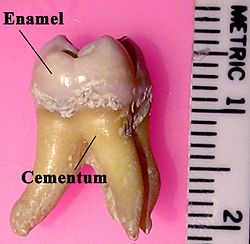
Labeled molar
The CEJ is the more or less horizontal demarcation line that distinguishes the crown (A) of the tooth from root (B) of the tooth.
Identifiers
MeSHD019237
TA2926
FMA55627
Anatomical terminology

In dental anatomy, the cementoenamel junction (CEJ) is the location where the enamel, which covers the anatomical crown of a tooth, and the cementum, which covers the anatomical root of a tooth, meet. Informally it is known as the neck of the tooth.[1] The border created by these two dental tissues has much significance as it is usually the location where the gingiva (gums) attaches to a healthy tooth by fibers called the gingival fibers.[2]

Active recession of the gingiva reveals the cementoenamel junction in the mouth and is usually a sign of an unhealthy condition. The loss of attachment is considered a more reliable indicator of periodontal disease. The CEJ is the site of major tooth resorption. A significant proportion of tooth loss is caused by tooth resorption, which occurs in 5 to 10 percent of the population. The clinical location of CEJ which is a static landmark, serves as a crucial anatomical site for the measurement of probing pocket depth (PPD) and clinical attachment level (CAL). The CEJ varies between subjects, but also between teeth from the same person.[1]

There exists a normal variation in the relationship of the cementum and the enamel at the cementoenamel junction. In about 60–65% of teeth, the cementum overlaps the enamel at the CEJ, while in about 30% of teeth, the cementum and enamel abut each other with no overlap. In only 5–10% of teeth, there is a space between the enamel and the cementum at which the underlying dentin is exposed.[3]

Formation

[edit]

In the tooth bud, regions where enamel formation is completed, the enamel organ gives rise to Hertwig's epithelial root sheath, composed of two epithelial layers derived from the external and internal epithelia. The sheath is irregularly fragmented in time and space as it promotes cementum deposition on the newly formed dentin. After this fragmentation, Hertwig's epithelial root sheath also participates in cementogenesis and formation of the periodontal ligament, giving rise to the epithelial rests of Malassez. This irregular fragmentation of Hertwig's epithelial root sheath yields an equally irregular limit of cervical enamel and an irregular onset of formation and deposition of cementum. Consequently, the relationship between cementum and enamel at the CEJ presents an irregular contour, as observed during scanning electron microscope (SEM) analysis of the primary teeth.

Fragmentation of Hertwig's epithelial root sheath and exposure of dentin covered by a thin layer of intermediate cementum are fundamental for the onset of cementogenesis. If Hertwig's epithelial root sheath is not fragmented, there will be enamel deposition and it will be transformed into reduced epithelium, thus preventing cementum deposition on its surface.[4]

Types

[edit]
  • Coronal cementum - where the enamel overlaps the cement.
  • Abutment - It is also known as vis a vis relation, where the cement and enamel meet at the butt joint, occurring in 30% of sections, and the least common, occurring in 10% of sections.
  • Gap between cementum and enamel exposing the dentin.[5]

Curvature

[edit]
Comparison of the cementoenamel junction on the mesial surfaces of the maxillary central, first bicuspid, and first molar

The shape and location of the cementoenamel junction (CEJ) on each tooth surface should be considered. CEJs differ from tooth to tooth in terms of their anatomy. The curvature of the CEJ is greatest on anterior teeth due to the narrow profile of these teeth.[6] On the anteriors, the distal aspect's curvature is usually one mm lower than the mesial aspect. Posterior teeth have flatter CEJ curvatures on the inter-proximal surfaces in comparison to the anteriors.[7]

Teeth resorption

[edit]

Root resorption often starts at cementoenamel junction (CEJ) in teeth. Types of tooth resorption include internal resorption and external resorption.[8]

Internal

[edit]

There are two types of internal resorption - root canal (internal) replacement resorption and internal inflammatory resorption.

Types of Resorption

External

[edit]

External resorption can be classified into four categories by its clinical and histologic manifestations: external surface resorption, external inflammatory root resorption, replacement resorption, and ankylosis. External inflammatory root resorption can be further categorized into cervical resorption with or without a vital pulp (invasive cervical root resorption) and external apical root resorption.[8]

References

[edit]
[edit]
Revisions and contributorsEdit on WikipediaRead on Wikipedia
from Grokipedia
The cementoenamel junction (CEJ), also known as the cervical line, is the anatomical boundary where the enamel of the meets the of the , demarcating the visible coronal portion from the subgingival surface. This junction forms during development as the cervical loop of the and the root sheath interact, resulting in a scalloped or wavy interface that varies slightly in curvature, being more pronounced on the mesial aspect of the . The CEJ is typically covered by the gingival tissue in healthy teeth but becomes exposed with age, , or trauma, influencing stability and sensitivity. Anatomically, the CEJ exhibits distinct patterns of enamel-cementum union, with the most common being cementum overlapping enamel (observed in approximately 60% of cases), followed by an edge-to-edge meeting (about 30%), a gap exposing (around 10%), and rare instances of enamel overlapping cementum (less than 2%). These variations can occur circumferentially around a single and differ between primary and permanent , where primary teeth show thinner, rougher cementum with a different distribution of junction types (e.g., more edge-to-edge meetings, no enamel overlapping cementum, and approximately 12% gaps). The junction's structure includes Sharpey's fibers in the cementum for periodontal attachment, contributing to the 's anchorage in the alveolar . Clinically, the CEJ serves as a critical fixed reference point for periodontal assessments, including measurements of probing pocket depth, clinical attachment level, and , which are essential for diagnosing and monitoring diseases like periodontitis. Exposure of the CEJ due to or abrasion often leads to hypersensitivity, as the underlying dentin tubules become patent, and it is a common site for non-carious cervical lesions requiring restorative intervention. Additionally, the CEJ's morphology influences orthodontic treatments and bleaching procedures, where supplementation can mitigate ultrastructural damage and reduce sensitivity risks.

Anatomy

Location and Definition

The cementoenamel junction (CEJ), also known as the cervical line, is defined as the anatomical boundary where the enamel covering the meets the covering the . This junction marks the precise demarcation between the coronal portion of the , protected by enamel, and the radicular portion, coated by over the underlying . These hard tissues meet at the CEJ with variations in their union, including overlapping enamel (approximately 60% of cases), edge-to-edge meeting (about 30%), gaps exposing (around 10%), and enamel overlapping (less than 2%). The CEJ encircles the entire at the cervical region, situated at the where and root converge. In a healthy , the CEJ is positioned approximately 1-2 mm coronal to the alveolar crestal , providing a stable reference point relative to the supporting structure. This location influences the attachment of the periodontal ligament and gingival tissues, underscoring its role in overall stability. Clinically, the CEJ is typically subgingival and covered by the marginal gingiva, rendering it invisible during routine examination unless exposes it. As the dividing line between crown and root, the CEJ is essential for prosthetic and , guiding margin placements and treatment planning to preserve natural contours.

Histological Features

The cementoenamel junction (CEJ) represents the microscopic interface where the acellular, highly mineralized enamel transitions to the cellular, less mineralized over the underlying , forming a critical boundary in . Enamel, composed primarily of crystals arranged in rods, constitutes approximately 96% mineral content by weight and lacks living cells, rendering it non-vital and incapable of regeneration. In contrast, is a mineralized similar to , containing cementocytes embedded in lacunae within a matrix of and non-collagenous proteins, with a mineral content of 45-50% . This disparity in composition contributes to differences in hardness, with enamel being the hardest dental tissue and more resilient yet susceptible to remodeling. At the interface, the CEJ typically exhibits a scalloped or wavy boundary in ideal histological sections, resulting from the irregular fragmentation of Hertwig's epithelial root sheath during root formation, which creates a sinuous contour approximately 40-60 μm wide in primary teeth. In many cases, the hyaline layer of Hopewell-Smith is present as a thin, noncellular, amorphous zone of highly calcified tissue (approximately 1 μm thick) between the and the overlying , though its classification as part of dentin or an intermediate cementum layer remains debated; it facilitates a smooth transition without direct dentin exposure. This layer is avascular and lacks fibers, distinguishing it from the adjacent acellular afibrillar that may overlap the enamel coronally at the junction. Histologically, the absence of ameloblasts at the CEJ reflects their retraction following enamel matrix deposition, which exposes the dentin surface and permits cementoblasts derived from the dental follicle to migrate and deposit the initial layers of directly onto the root dentin. Cementoblasts, cuboidal cells during active , become embedded as cementocytes within the maturing matrix, embedding Sharpey's fibers from the periodontal for attachment. The enamel thins progressively to zero thickness at the CEJ, while initiates at a normal thickness of 20-50 μm, increasing apically along the . These features underscore the CEJ's role as a structurally heterogeneous zone, prone to wear due to the enamel's termination and the cementum's relative softness.

Formation and Development

Embryological Processes

The cementoenamel junction (CEJ) forms during the late bell stage of tooth development, when formation is nearly complete and initiation begins, typically around the 11th to 14th weeks of for teeth. This transitional phase marks the boundary between the enamel-covered and the cementum-covered , established as ameloblasts from the inner enamel epithelium secrete the enamel matrix apically until completion. Concurrently, the Hertwig's epithelial root sheath (HERS), derived from the cervical loop of the , elongates downward to guide dentin formation by inducing differentiation in the adjacent . Key cellular events at the CEJ involve the fragmentation and breakdown of HERS shortly after initial root deposition, which exposes the dentin surface to the surrounding mesenchyme and permits the differentiation of cementoblasts. These cementoblasts, originating from cranial neural crest-derived mesenchymal cells in the follicle, begin secreting the initial matrix directly onto the dentin near the crown-root boundary, while remnants of HERS persist as within the future periodontal ligament. Ameloblasts, having completed enamel deposition, undergo regression, effectively delineating the apical limit of enamel and allowing the precise of enamel and at the junction. Molecular signals orchestrate these processes, with bone morphogenetic proteins (BMPs, such as , BMP4, and BMP7) and fibroblast growth factors (FGFs, including ) playing critical roles in regulating HERS integrity, odontoblast induction, and the transition to cementogenesis. Additional pathways, such as Wnt/β-catenin signaling, modulate epithelial-mesenchymal interactions to control HERS fragmentation and cementoblast activity at the boundary. Enamel matrix proteins like enamelin contribute to the precise termination of enamel secretion, influencing the junction's boundary definition. The transitional zone at the forming CEJ often includes an intermediate layer of acellular afibrillar cementum or reduced enamel, arising during HERS breakdown and providing a hyaline-like interface (Hopewell-Smith's layer) between the primary hard tissues. In primary teeth, CEJ formation occurs earlier, initiating around 11-14 weeks of gestation, resulting in thinner acellular cementum and a more apically positioned junction compared to permanent teeth, where development proceeds later and yields relatively thicker cementum with potentially less pronounced overlaps.

Morphological Types

The cementoenamel junction (CEJ) exhibits four morphological types based on the alignment and overlap of enamel and : overlapping enamel, edge-to-edge meeting, gaps exposing , and enamel overlapping (rare). The edge-to-edge or type, characterized by direct abutment without overlap, is observed in approximately 30% of sites across . Cementum overlapping enamel represents the most prevalent configuration, occurring in about 60% of cases, where extends coronally beyond the enamel margin for a short distance. In contrast, enamel overlapping is rare, accounting for less than 2% of sites (sometimes considered an artifact), with enamel projecting apically over the edge. Gaps exposing between the tissues occur in around 10% of cases, posing a higher risk for due to reduced structural integrity. These types exhibit varying distribution influenced by tooth surface and morphology. Overlapping configurations predominate on buccal and lingual surfaces compared to mesial or distal aspects, potentially enhancing protection in load-bearing areas. Molars display a higher incidence of overlaps than , reflecting adaptations to greater occlusal forces. Primary teeth show different prevalences, with more edge-to-edge (41%) and fewer overlaps (42% cementum over) compared to permanent . Functionally, overlapping types offer a superior seal against bacterial invasion at the cervical margin, minimizing risks of root caries and periodontal attachment loss, whereas edge-to-edge or gapped junctions are more susceptible to microbial penetration and . Morphological types are identified through histological examination of ground sections or scanning electron microscopy, which reveal tissue interfaces at high resolution; prevalence studies confirm 60-65% overlap rates in permanent . These overlaps result briefly from developmental retraction of the reduced enamel epithelium, permitting cementoblast migration. Across mammals, CEJ variations correlate with dietary adaptations, such as increased overlaps in herbivores processing abrasive foods for improved junction durability.

Morphology

The cementoenamel (CEJ) exhibits a characteristic three-dimensional contour that varies around the , forming a smooth convex curve on the labial surfaces while appearing more angular and pronounced on the interproximal aspects, such as the mesial surfaces of central incisors. This configuration contributes to the overall cervical architecture of the crown, with the proximal typically exceeding the buccal by approximately 1 mm. The at the CEJ demonstrates variability, generally ranging from 3 to 3.5 mm on the mesial and distal aspects of incisors, becoming sharper (smaller radius, around 1.6 to 2.6 mm) in canines, which reflects a progressive decrease in curvature from central incisors to canines. These dimensions are assessed through methods such as profilometry, scanning electron microscopy, intraoral radiographs, or three-dimensional modeling techniques. Functionally, the CEJ curvature facilitates optimal gingival adaptation, allowing the soft tissues to conform closely to the surface, and influences stress distribution during mastication by distributing occlusal forces along the cervical region. With advancing age, the curvature tends to flatten due to attrition, abrasion, or continuous eruption, potentially exposing more of the CEJ and altering its contour. In terms of tooth-specific patterns, the CEJ displays greater overall in , such as central incisors, compared to straighter or even flat profiles in posterior teeth like molars. The smoothness of this curvature can be influenced by the underlying morphological type of the CEJ, with smoother interfaces showing less undulation than irregular or gap types.

Variations Across Teeth

The cementoenamel junction (CEJ) exhibits notable differences between anterior and posterior teeth, primarily in and tissue overlap patterns. , such as incisors and canines, display more pronounced CEJ , particularly on mesial surfaces, with greater interproximal scalloping that facilitates a smoother transition between and . In contrast, posterior teeth like molars and premolars feature flatter CEJ contours, often with minimal or absent on distal aspects and a more even rounding toward the apex, resulting in less depth overall. Overlap patterns also vary; one study reports overlapping enamel occurring more frequently in (approximately 8%) compared to posterior teeth (about 3%), while edge-to-edge junctions predominate in both but show slightly higher rates in posteriors (58% vs. 55%), though broader literature indicates higher overall overlap rates around 60%. Arch-specific variations further distinguish the CEJ, with maxillary teeth generally presenting smoother, more uniform contours influenced by their eruption alignment. Maxillary anterior teeth, for instance, show pronounced mesial curvature in central incisors, while posterior molars exhibit balanced buccal and lingual profiles. Mandibular teeth, however, demonstrate greater variability, attributed to differential eruption patterns that can lead to asymmetrical CEJ positioning; mandibular molars often have distinct buccal versus lingual curvatures, and cementum-overlapping-enamel patterns are more prevalent overall in the mandible compared to the edge-to-edge dominance in the maxilla. Individual factors contribute to CEJ height and configuration, with natural variations influenced by inherent anatomical differences rather than pronounced genetic or -based disparities. differences are minimal. These variations underscore the CEJ's adaptability within normal . In primary versus , the CEJ differs structurally and positionally, with primary featuring a more apical placement of the junction. Primary CEJ forms a sinuous 40- to 60-μm band with thinner, rougher acellular and fewer gaps (scarcity of exposed ), where overlaps enamel in over one-third of the area (42%) and edge-to-edge junctions in 41%, rarely showing enamel over . , by comparison, have a more irregular CEJ with greater circumferential variability, including exposure in 10% of cases, overlap in 60%, and edge-to-edge in 30%, reflecting matured tissue deposition. This configuration in primary teeth also correlates with patterns where caries progression often arrests at the junction due to the protective overlap configuration.

Clinical Significance

Periodontal Measurements

The cementoenamel junction (CEJ) serves as a primary anatomical reference for assessing clinical attachment level () in periodontal diagnostics, where is calculated as the distance from the CEJ to the base of the periodontal pocket, quantifying the extent of attachment loss. In a healthy , this distance typically ranges from 0 to 3 mm, reflecting the normal biological width comprising the sulcular epithelium and attachment. For probing depth evaluation, the CEJ acts as a fixed to ensure consistent and reproducible measurements with a calibrated periodontal probe, which is gently inserted into the sulcus until resistance from the junctional epithelium is encountered. This approach allows clinicians to differentiate between probing depth (from gingival margin to probe tip) and true attachment loss, particularly in cases of gingival inflammation or , facilitating accurate monitoring of disease progression or treatment response. On radiographs, the CEJ position relative to the alveolar crest provides a key indicator of supporting integrity, with a normal interproximal distance of 1-2 mm in healthy adults; distances exceeding this threshold suggest bone loss associated with periodontitis. This correlation aids in correlating clinical findings with radiographic evidence for comprehensive diagnostic planning. In therapeutic contexts, the CEJ guides instrumentation during by delineating the transition from crown to root surfaces, enabling targeted removal of subgingival and , which often accumulate at this junction as a trap for microbial deposits. Similarly, in dental implant prosthetics, the CEJ morphology of adjacent natural teeth is analogized to design the restoration's emergence profile, optimizing contours and esthetic outcomes by replicating the natural tooth's supragingival form within 1-2 mm of the gingival margin. Despite its utility, CEJ-based measurements face limitations when gingival recession occurs, as the exposed CEJ shifts the reference point apically relative to the soft tissues, potentially leading to overestimation of attachment loss or inconsistencies in longitudinal assessments. Precision can be enhanced using digital calipers, which offer measurement errors below 0.5 mm through high-resolution readings to the nearest 0.01 mm, reducing inter-examiner variability compared to manual probing.

Pathological Associations

The cementoenamel junction (CEJ) serves as a critical transition zone where caries progression exhibits distinct patterns between primary and permanent dentition. In primary teeth, the CEJ represents a vulnerable area for caries advancement due to thinner and exposure during mixed phases, yet the predominant edge-to-edge configuration provides a protective enamel overlay that often arrests progression by enhancing resistance near the junction. In permanent teeth, however, CEJ exposure through passive eruption after the third decade facilitates cervical caries initiation, as the junction's susceptibility to bacterial biofilms and environmental factors allows lesions to penetrate more readily, contributing to and structural compromise. Gingival recession exposes the CEJ, rendering root surfaces vulnerable to sensitivity and root caries, with prevalence escalating markedly in older adults due to cumulative effects of periodontitis and brushing trauma. In populations over 50 years, exposed affect up to 98% of those aged 75–84, while root caries prevalence rises from 37% in 55–64-year-olds to 45% in those 65–74 years old, often manifesting as active decay at the CEJ that requires fluoride-based interventions to manage. The CEJ frequently acts as the primary initiation site for non-carious cervical lesions (NCCLs), where combined abrasion from mechanical forces and from acidic exposures erode the thin aprismatic enamel and , leading to wedge-shaped defects. These lesions affect 20–50% of adults, with higher rates in older individuals and those with parafunctional habits, underscoring the junction's role in biocorrosive vulnerability that progresses to exposure without restorative intervention. Dentin hypersensitivity arises prominently at irregular CEJs, where or junctional defects open dentinal tubules, enabling hydrodynamic fluid shifts that trigger sharp pain from thermal, tactile, or osmotic stimuli. This condition, linked to increased tubule density at exposed sites, is managed effectively with desensitizing agents such as varnishes or arginine-calcium compounds that occlude tubules and precipitate proteins within them. In , tipping forces applied during tooth movement generate compressive stresses at the CEJ, elevating the risk of external cervical resorption by disrupting integrity and promoting activity at the junction. Such forces, particularly when exceeding 1 N continuously, synergize with patient factors like prior trauma to initiate resorption craters near the CEJ, with incidence rates climbing to 45% in treated cases, necessitating monitored light intermittent loading to mitigate progression.

Internal Resorption

Internal resorption is a pathological process characterized by the inflammatory resorption of originating from the pulpal side of the , mediated by odontoclastic activity within the pulp chamber or . This condition typically begins following localized or injury to the odontoblastic layer and predentin, allowing clastic cells to resorb mineralized from the internal structure. When occurring in the coronal portion near the cementoenamel junction (CEJ), it may arise due to vascular communications or disrupted protective barriers in that region, though it remains distinct from external surface resorption. The of internal resorption includes physical trauma to the , chronic from caries or restorative procedures, and idiopathic factors without identifiable cause. Trauma can lead to pulp necrosis in localized areas, promoting odontoclastic invasion, while creates an inflammatory environment conducive to resorption. Idiopathic cases suggest possible genetic or developmental predispositions, though the exact mechanisms are not fully elucidated. The condition is relatively rare, with estimates ranging from 0.01% to 1% in , though higher rates (up to 15.6%) have been reported in among patients undergoing cone-beam computed tomography (CBCT) imaging for other reasons. Progression of internal resorption involves gradual enlargement of the resorptive defect, driven by vital pulpal tissue that sustains odontoclastic activity until the pulp becomes fully necrotic. Clinically, it may present as a "pink spot" on the crown surface near the CEJ, resulting from thinned dentin allowing visualization of hypervascular granulation tissue through the overlying enamel. Radiographically, it appears as a well-defined radiolucent area continuous with the pulp canal, often beneath intact enamel and expanding toward the tooth's external surface. If untreated, the defect can perforate the dentin near the CEJ, compromising structural integrity and potentially leading to bacterial invasion from the periodontal tissues. Diagnosis relies on a combination of clinical and imaging findings to confirm internal origin and assess severity. Pulp vitality testing typically reveals partial or absent response, indicating non-vital pulp in the affected area while adjacent regions may remain vital. Periapical radiographs show the characteristic radiolucency, but CBCT is essential for evaluating the full extent, detecting perforations near the CEJ, and differentiating from external resorption. Early detection is critical, as advanced cases may mimic other pathologies like caries or invasive cervical resorption. Treatment focuses on halting the resorptive process through complete removal of the vital pulp tissue that supports odontoclastic activity, followed by restoration to seal the defect. Non-surgical therapy (pulpectomy) is the primary approach, often using or (MTA) to promote if occurs near the CEJ. In cases of extensive coronal involvement, surgical intervention or extraction may be necessary. Prognosis is favorable with early intervention, achieving survival rates of 88% to 95% over a mean follow-up of 2 years, though success diminishes if the resorption perforates the CEJ, increasing the risk of periodontal communication and .

External Resorption

External cervical resorption (ECR) is a pathological process characterized by the progressive loss of dental hard tissues, including enamel, , and , initiated by odontoclastic activity on the external surface at or near the cementoenamel junction (CEJ). This resorption typically begins beneath the epithelial attachment, allowing to penetrate the through defects in the precementum layer at the CEJ, leading to circumferential progression if untreated. Mediated by odontoclasts, ECR replaces mineralized structure with fibrovascular or fibro-osseous tissue, but it is often limited internally by the pericanalar resorption-resistant sheet adjacent to the pulp. The etiology of ECR is multifactorial, with common causes including , orthodontic treatment, internal bleaching, and surgical or periodontal procedures that disrupt the protective precementum at the CEJ. Idiopathic cases also occur, potentially linked to CEJ developmental irregularities such as gaps between and or hypomineralized cementoid, which expose the underlying to resorptive cells from the periodontal . Trauma accounts for approximately 33% of reported cases, while orthodontic forces contribute to 24%, often predisposing the condition through localized injury at the CEJ. Prevalence is low overall, ranging from 0.02% to 2.3% in general populations, though it may reach higher rates in specific cohorts such as post-trauma patients. Clinically, ECR is often invasive yet painless in early stages, presenting as an asymptomatic pink spot or grayish discoloration on the crown due to visibility through thinned enamel at the cervical region. Probing may reveal hard, irregular defects, but significant symptoms like sensitivity or mobility arise only in advanced cases affecting the cervical third of the . Radiographically, it appears as a radiolucent, moth-eaten with ragged borders in the cervical area, best visualized using cone-beam computed tomography (CBCT) for assessing extent, depth, and proximity to the pulp without superimposition artifacts. Key risk factors include physical or chemical damage to the thin precementum layer at the CEJ, particularly in areas of enamel overlaps or developmental defects, which occur in up to 10% of teeth and facilitate odontoclastic attachment. The condition shows a predilection for maxillary lateral incisors and other , where CEJ irregularities and exposure to trauma or orthodontic forces are more common. Additional risks involve prior endodontic treatment, which may intensify resorption, and genetic or systemic factors like poor that exacerbate periodontal ligament inflammation. Management of ECR emphasizes early diagnosis via CBCT to classify lesion severity and guide intervention, with surgical removal of being the mainstay for accessible cervical defects starting at the CEJ. Following excision, the resorptive cavity is typically restored using materials like resin-modified or to seal the defect and promote repair, often combined with guided tissue regeneration for larger lesions. If pulp involvement is absent, nonsurgical approaches with trichloracetic to arrest resorption may suffice; long-term monitoring through serial radiographs is essential, yielding arrest rates of 78-100% for early-stage (class 1-3) lesions with prompt treatment.

References

Add your contribution
Related Hubs
User Avatar
No comments yet.