Hubbry Logo
Apical foramenApical foramenMain
Open search
Apical foramen
Community hub
Apical foramen
logo
8 pages, 0 posts
0 subscribers
Be the first to start a discussion here.
Apical foramen
Apical foramen
from Wikipedia
Apical foramen
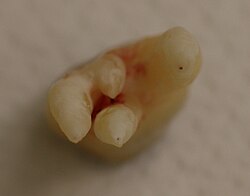
Apical foramina on a wisdom tooth
Details
Identifiers
Latinforamen apicis dentis
TA98A05.1.03.050
TA2933
FMA57159
Anatomical terminology
1. Tooth 2. Enamel 3. Dentin 4. Dental pulp ::5. cameral pulp ::6. root pulp :7. Cementum :8. Crown ::9. Cusp ::10. Sulcus :11. Neck :12. Root ::13. Furcation ::14. Root apex :::15. Apical foramen 16. Gingival sulcus
17. Periodontium
:18. Gingiva: ::19. free or interdental ::20. marginal ::21. alveolar :22. Periodontal ligament :23. Alveolar bone 24. Vessels and nerves: :25. dental :26. periodontal :27. alveolar through channel

In dental anatomy, the apical foramen, literally translated "small opening of the apex," is the tooth's natural opening, found at the root's very tip—that is, the root apex — whereby an artery, vein, and nerve enter the tooth and commingle with the tooth's internal soft tissue, called pulp. Additionally, the apical foramen is the point where the pulp meets the periodontal tissues, the connective tissues that surround and support the tooth. The foramen is located 0.5mm to 1.5mm from the apex of the tooth. Each tooth has an apical foramen.[1]

Characteristics

[edit]

The average size of the orifice is 0.3 to 0.4 mm in diameter. There can be two or more foramina separated by a portion of dentin and cementum or by cementum only. If more than one foramen is present on each root, the largest one is designated as the apical foramen and the rest are considered accessory foramina.[1][2]

Apical delta

[edit]

Apical delta refers to the branching pattern of small accessory canals and minor foramina seen at the tip or apex of some tooth roots. The pattern is said to be reminiscent of a river delta when sectioned and viewed using a microscope. Because the anatomy of this area is very small and complex with several portals of entry to the root canal i.e. more than one apical foramen.[1]

Endodontic treatment

[edit]

It is a point of interest in endodontics, as it is considered necessary to thoroughly chemomechanically debride the pulp space to remove all necrotic tissue and minimise bacterial load in the pulp space. Ideally, this debridement would terminate exactly at the apical foramen. In reality, determining the exact position of the apical foramen is problematic, requiring radiography and/or use of an electronic apex locator to produce a refined estimate. A tooth may have multiple small accessory canals in the root apex area forming an apical delta which can complicate the endodontic problem.[1]

The presence of an apical delta may make successful endodontic treatment less likely. The root tip is removed during apicoectomy to eliminate the apical delta and maximise the chance of successful healing.[1]

An apical constriction is often present. In immature teeth the root is not fully formed, leading to an open apex. This is also seen in some pathological teeth.[1]

References

[edit]
Revisions and contributorsEdit on WikipediaRead on Wikipedia
from Grokipedia
The apical foramen is the primary opening at or near the apex of a , serving as the main conduit for neurovascular structures that supply the dental pulp with blood, nerves, and from the surrounding periodontal . This structure typically measures 0.2 to 0.5 mm in diameter in , though sizes can vary, and it is essential for maintaining pulp by facilitating the ingress and egress of essential tissues. Anatomically, the apical foramen is often positioned slightly short of the radiographic apex of the root, with studies reporting a mean distance of 0.5 to 1.5 mm coronal to the anatomical apex, and an apical constriction—a narrowing just before the —located approximately 0.5 to 1.0 mm from the itself. This positioning can vary due to factors such as age, type, and pathological conditions like resorption, where the may shift or enlarge. In many cases, the exhibits an or irregular shape rather than , and accessory foramina may be present, though the main apical foramen remains the largest and most functionally significant. Clinically, the apical foramen holds critical importance in , particularly during treatments, where it defines the working length to avoid over-instrumentation that could lead to postoperative pain or periapical . Maintaining apical patency—ensuring unobstructed access to the foramen without enlarging it—is a standard practice to improve cleaning and outcomes while minimizing complications. In for immature teeth, the foramen's size and patency directly influence success, with larger diameters generally associated with more predictable tissue ingrowth. Pathological alterations, such as enlargement from or trauma, can compromise these functions, underscoring the need for precise diagnostic and treatment .

Anatomy

Location and Position

The apical foramen is the primary opening at the apex of a , through which the enters to supply the dental pulp. It is situated at the termination of the system and is typically located 0.5 to 1.5 mm coronal to the anatomical apex, a position that accounts for the deposition of during maturation. This offset ensures the foramen does not coincide exactly with the radiographic apex in most cases, influencing precise determination in clinical procedures. In a study of extracted teeth, the from the major apical foramen to the anatomical apex was 0.52 mm, with mandibular canines showing the greatest average at 0.77 mm and mandibular premolars the least at 0.48 mm. The position of the apical foramen relative to the root surfaces exhibits considerable variation, often deviating from the central apex. In permanent teeth analyzed via cone-beam computed , a central was observed in 48.95% of maxillary teeth and 42.08% of mandibular teeth, with non-central positions including buccal, lingual, mesial, and distal orientations. Among 343 canals from maxillary and mandibular teeth, deviations occurred in 85.11% of cases, most frequently to the distal side (25.65%), followed by mesial (21.57%), lingual (19.24%), and buccal (18.65%) directions. In permanent molars and premolars, the foramen was positioned at the tip in only 40% of instances, with buccal deviations in 20% and distal in 14%. Positional differences are also noted across tooth types and populations. For example, in permanent maxillary , the apical foramen was centrally placed in 84% of central incisors and 76% of lateral incisors. In premolars, central positioning predominates, followed by distal deviations. These variations arise from developmental shifts, where the foramen initially aligns with the apex during formation but migrates due to apposition and functional adaptations, with distances increasing with age.

Structure and Composition

The apical foramen represents the terminal opening of the at the apex of a , serving as the primary conduit for neurovascular bundles—including arteries, veins, lymphatics, and —that supply the dental pulp and maintain vitality. This structure connects the internal pulp chamber directly to the external periodontal ligament, passing through the layer at the tip. Histologically, the is characterized by its position slightly coronal to the anatomic apex, typically 0.5 to 0.75 mm from the radiographic end, allowing for the ingress and egress of vital tissues while minimizing exposure to external pathogens. In terms of composition, the apical foramen is primarily bounded by cellular , a mineralized tissue that overlays the forming the canal walls. This apical is notably thicker—averaging 200 μm—and contains cementocytes housed within lacunae, interconnected by canaliculi that extend toward the periodontal for exchange and structural integrity. The foramen's edge is often described as a rounded or funnel-like where the cemental canal meets the root surface, distinguishing it from the narrower apical constriction located approximately 1.5 mm coronally. in the immediate vicinity may exhibit Tomes' granular layer near the cementum- junction, adding microscopic texture to the transitional zone. Morphologically, the apical foramen varies in size and shape across teeth, with diameters generally ranging from 0.18 to 0.29 mm and an configuration being most prevalent in about 70% of cases. It frequently deviates from the central axis of the , occurring in up to 80% of teeth, and may be accompanied by accessory foramina—present in 26% to 33% of —which further complicate the neurovascular pathway and connect to lateral aspects of the periodontal . The surrounding periodontal comprises dense, highly vascular reinforced by Sharpey's fibers, which anchor the to the alveolar and facilitate sensory and supportive functions at the apex. During odontogenesis, the foramen originates as a wide, centrally positioned but narrows and shifts eccentrically as maturation progresses, reflecting the dynamic interplay between epithelial sheath and vascular elements.

Anatomical Variations

The apical foramen exhibits significant anatomical variations in its position, shape, size, and number, which can influence endodontic treatment outcomes. In a study of 420 extracted human teeth, the foramen deviated from the radiographic apex in 68.2% of cases, with mandibular teeth showing a higher of 70.2% compared to 66.8% in maxillary teeth. This deviation often occurs laterally, with the most common directions being distal (18.2%) and mesial (17.4%), while central positioning was observed in only 31.6% of specimens. Shape variations are also prevalent, with round foramina being the most common at 65.1%, followed by oval at 31.0%; flat shapes were rare (1.1%) and restricted to maxillary teeth, particularly second molars (4.5%). In maxillary and mandibular first molars, oval shapes predominated (50% in maxillary, 59% in mandibular), with irregular forms in 32% and 23%, respectively, and round shapes in 18% for both. Diameters typically range from 0.24 to 0.34 mm, with mandibular foramina averaging slightly larger maxima (0.33 mm) than maxillary (0.34 mm). The number of apical foramina per root varies, often exceeding one; for instance, among 89 first molars, 174 foramina were identified, averaging nearly two per . In an Iraqi subpopulation of 238 extracted , deviation occurred in 85.11% of cases, with a mean distance of 0.52 mm from the apex, highest in mandibular canines (0.77 mm); distal deviation was most frequent (25.65%), followed by mesial (21.57%). Population-specific differences exist, such as in Indian maxillary anterior teeth, where central positioning predominates in incisors (84% for centrals, 76% for laterals) but lateral exits prevail in canines (85%). Posterior teeth generally show greater deviation rates (86.48%) than anterior (81.3%), underscoring the need for precise imaging in clinical practice.

Function

Physiological Role

The apical foramen serves as the primary portal for the entering the dental pulp, enabling the delivery of essential nutrients, oxygen, and sensory innervation to maintain vitality. Arteries, veins, lymphatics, and nerves traverse this opening at the apex, forming a critical connection between the periodontal ligament and the pulp chamber. This vascular supply, primarily derived from branches of the maxillary and mandibular arteries, supports the metabolic demands of the pulp tissue, facilitating dentin formation and repair throughout the 's lifespan. Sensory nerves, originating from the (cranial nerve V) via its maxillary (V2) and mandibular (V3) divisions, pass through the apical foramen to innervate the pulp and . These unmyelinated and myelinated fibers mediate pain perception, temperature sensation, and , alerting the body to potential threats such as thermal extremes or mechanical injury. The lymphatic vessels within the bundle aid in immune surveillance and fluid balance, draining interstitial fluid from the pulp to regional lymph nodes. Disruption of this pathway, as seen in trauma or , can compromise pulp health, leading to if is impeded. Overall, the physiological role of the apical foramen underscores its indispensability in sustaining the pulp's homeostatic functions, including reparative processes and defensive responses. By housing the sole for these structures in mature teeth, it ensures the tooth's responsiveness to stimuli and long-term structural integrity, with the foramen's position and patency influencing the efficiency of nutrient exchange and neural signaling.

Developmental Aspects

The development of the apical foramen occurs as part of tooth root formation, which follows the completion of the crown during the bell of odontogenesis. Tooth development begins around the 6th week of embryonic life, with the initiation stage involving interactions between the oral and cranial neural crest-derived to form the dental lamina. By the 8th week, the bud emerges, followed by the cap around 12 weeks, where the differentiates. The bell , starting around 14 weeks, sees the maturation of the , with ameloblasts and odontoblasts forming the crown's enamel and , respectively. Root development initiates postnatally in humans, after crown formation, as the cervical loop of the gives rise to Hertwig's epithelial root sheath (HERS). HERS, formed by the fusion and apical extension of the inner and outer enamel epithelia, guides root elongation and dentin deposition by inducing mesenchymal cells in the to differentiate into odontoblasts. HERS plays a central role in shaping the root and establishing the apical foramen. As HERS grows apically, it encloses the , outlining the and determining root length and morphology; in humans, this process continues for several years post-eruption, with root completion typically occurring 2-3 years after crown eruption for . The sheath's epithelial diaphragm bends inward at the apex, delimiting the primary apical foramen—an opening that separates the pulp-containing from the surrounding . Fragmentation and perforation of HERS, occurring through , epithelial-mesenchymal transition (EMT), and signaling cessation around postnatal day 7 in mouse models (equivalent to late fetal/early postnatal in humans), allow cells to migrate onto the surface and differentiate into cementoblasts, forming acellular and cellular . This perforation creates the definitive apical foramen, a conduit for neurovascular ingress into the pulp. Molecular regulators orchestrate these processes, ensuring precise apical foramen formation. Transforming growth factor-β (TGF-β) and laminin-5 secreted by HERS induce odontoblast differentiation and dentinogenesis, while sonic hedgehog (Shh) signaling from HERS modulates mesenchymal proliferation and elongation. Bmp and Wnt pathways, including β-catenin and Nfic transcription factors, regulate HERS integrity and furcation formation; disruptions, such as Nfic , lead to incomplete development and aberrant closure. These interactions highlight the epithelial-mesenchymal essential for the apical 's role in pulp vitality. Seminal studies, such as those elucidating Shh's role in patterning, underscore the conservation of these mechanisms across vertebrates.

Clinical Significance

Endodontic Procedures

In endodontic therapy, the apical foramen serves as a critical anatomical landmark for determining the working length during , typically set 0.5 to 1 mm short of the to avoid extrusion of into periapical tissues. Maintaining apical patency—defined as the ability to pass a small instrument, such as a #10 or #15 K-file, through the without resistance—is a fundamental technique to ensure unobstructed access, prevent accumulation, and facilitate effective . This procedure, performed periodically during and shaping, reduces the risk of apical blockage and procedural errors like ledging, while improving the accuracy of working length determination. During the cleaning and shaping phase of conventional , rotary or hand instruments are used to remove infected pulp and debris, with the apical terminus ideally terminating at or just short of the radiographic apex (0-2 mm) to promote , particularly in cases of pulpal . follows, involving the three-dimensional filling of the with materials like and sealers to seal the apical foramen and prevent bacterial reinvasion; extrusion beyond the foramen should be minimized to avoid postoperative complications. Studies indicate that proper apical sealing enhances success rates, with instrumentation and filling confined to the yielding up to 90% in periapical lesions. When conventional endodontic treatment fails due to persistent periapical , apical (also known as or root-end resection) is performed to address issues at the level. The procedure involves raising a mucoperiosteal flap, removing 3 mm of the root tip to expose the apical delta, and preparing a root-end cavity using ultrasonic instruments for a depth of 3 mm along the canal path. The cavity is then sealed with biocompatible materials like (MTA), which provides a hermetic barrier; microsurgical techniques under achieve success rates of 90% or higher, with 95-97% of healed cases remaining stable at 5-year follow-up. This approach is particularly indicated for teeth with anatomical complexities, such as extra canals or posts obstructing nonsurgical access. Apical patency maintenance has also been associated with reduced postoperative pain in the initial 12-24 hours after treatment, as it minimizes extrusion and around the . Overall, these procedures underscore the apical 's role in achieving long-term retention by balancing thorough with preservation of periapical health.

Pathological Conditions

The apical can be a site of various pathological conditions, primarily arising from pulpal and bacterial , leading to periapical . Apical periodontitis, the most common , is an inflammatory response in the periapical tissues triggered by microbial infection originating from the system. This condition often results from untreated dental caries, trauma, or failed endodontic treatment, where such as and anaerobes like species penetrate the apical , eliciting an characterized by granulomatous tissue formation and . Radiographically, it appears as a radiolucent at the root apex, with prevalence rates exceeding 50% at the individual level in some adult populations based on epidemiological studies. Chronic apical periodontitis may progress to asymptomatic lesions, but acute exacerbations can manifest as symptomatic apical abscesses, involving accumulation and potential spread to adjacent tissues. These abscesses form when the inflammatory process breaches the cortical , leading to swelling, , and systemic symptoms if untreated. Histologically, the lesion features polymorphonuclear leukocytes, plasma cells, and epithelial proliferation, potentially forming periapical cysts in 15-50% of cases, which are fluid-filled sacs lined by derived from epithelial rests of Malassez. Periapical cysts, often discovered incidentally on radiographs, can enlarge and cause root displacement or mandibular expansion, complicating diagnosis from granulomas without . Other pathological conditions include external root resorption associated with the apical foramen, where chronic inflammation leads to odontoclastic activity, gradually enlarging the foramen and weakening the root structure. This is frequently linked to orthodontic forces, trauma, or idiopathic factors, with cone-beam computed tomography (CBCT) revealing irregular resorption patterns in affected teeth. Rarely, neoplastic lesions such as periapical or odontogenic keratocysts may involve the apical region, mimicking infectious pathologies and necessitating for differentiation. Management typically involves therapy to eliminate the infectious source, with surgical intervention for persistent or cystic lesions to preserve tooth integrity and prevent systemic dissemination. Recent research as of 2025 has highlighted associations between apical periodontitis and systemic health conditions, including , , and , suggesting broader implications for overall patient management.

References

Add your contribution
Related Hubs
User Avatar
No comments yet.