Recent from talks
Nothing was collected or created yet.
Challenge Roth
View on WikipediaYou can help expand this article with text translated from the corresponding article in German. (December 2015) Click [show] for important translation instructions.
|
Challenge Roth is a triathlon race organised by in and around Roth, Bavaria, Germany. It is held annually in July.
The Ironman distance (140.6 miles / 226.2 kilometers) version of the race has been held since 1990, and the short distance version since 1984. It was part of the Ironman series until 2001. It has been held independently from WTC since 2002. The number of participants is around 3500 individuals and 650 relay teams.
Course
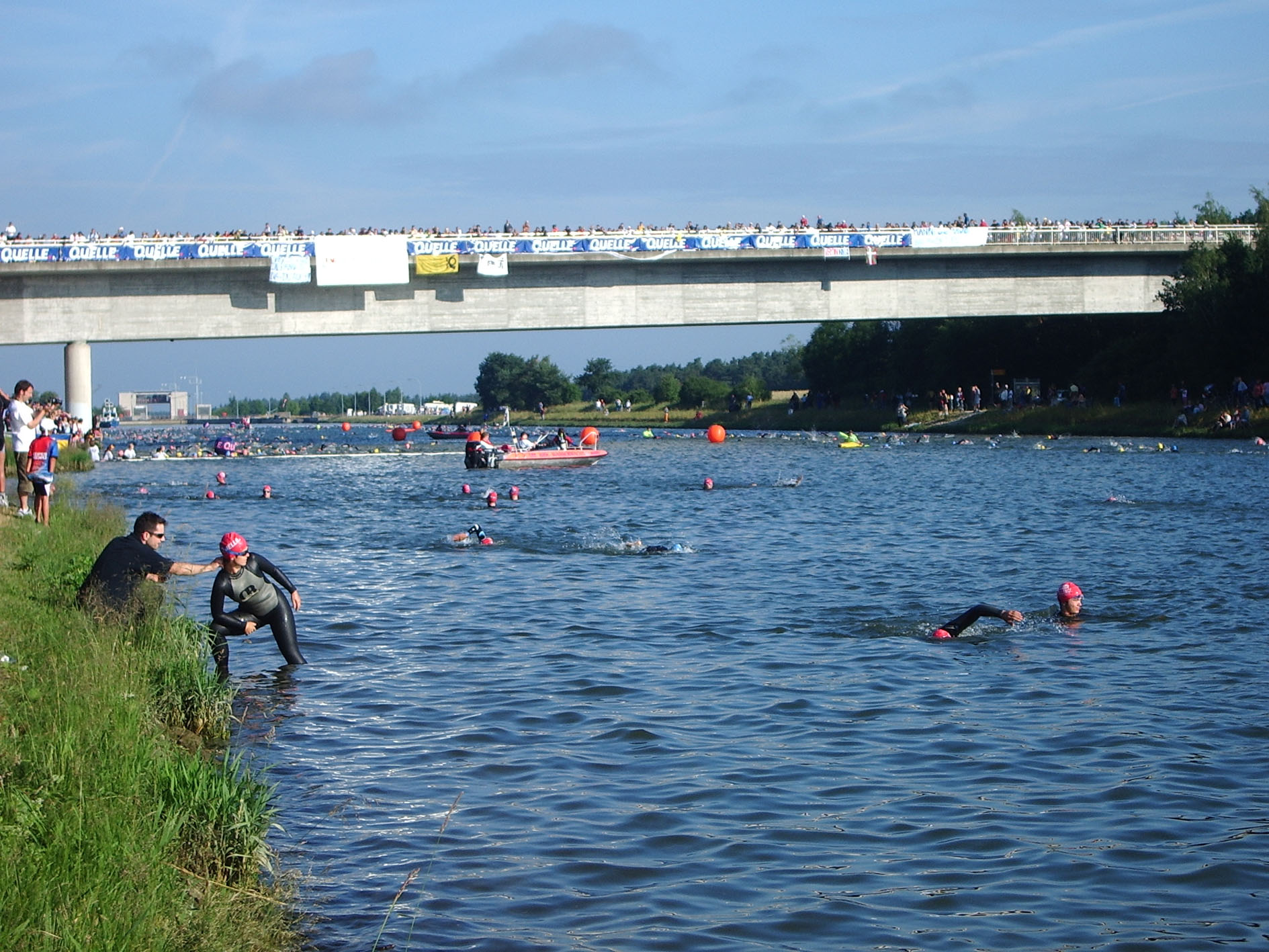
[edit]The first part of the race, the 3.86 km swim event, takes place in the Rhine–Main–Danube Canal around 10 km outside Roth.
The 178.5 km bike ride uses a two-lap course on the countryside, mostly south of Roth. The southernmost point is Greding. The course is mostly relatively flat with a tougher hill once per lap.
The final marathon run goes once around a course with several turning points. Mostly the course goes on the same road after each turning points, so competitors meet each other. A major part of the course is along the Rhine–Main–Danube Canal. The finish is in central Roth.[1]
Course Conditions
In 2021 there were changes in the course which make comparing the results to other years difficult. Because of road construction, the bike portion of the race was shortened from 180km to roughly 170km.
World records set in Challenge Roth
[edit]- Men's record: Magnus Ditlev, 2024 - 7:23:24
- Women's record: Anne Haug 2024 - 8:02:35
Results
[edit]Men's results
[edit]| Year | Athlete Name | Country | Swim | Bike | Run | Winning Time |
|---|---|---|---|---|---|---|
| 2025 | Sam Laidlow | 46:34 | 4:03:11 | 2:37:19 | 7:29:35 | |
| 2024 | Magnus Ditlev | 46:23 | 3:59:25 | 2:34:18 | 7:23:24 | |
| 2023 | Magnus Ditlev | 46:47 | 3:57:45 | 2:37:09 | 7:24:40 | |
| 2022 | Magnus Ditlev | 50:44 | 4:01:56 | 2:40:22 | 7:35:48 | |
| 2021 | Patrick Lange | 47:28 | 3:50:32 | 2:38:30 | 7:19:19 | |
| 2019 | Andreas Dreitz | 51:28 | 4:13:12 | 2:51:11 | 7:59:02 | |
| 2018 | Sebastian Kienle | 47:59 | 4:07:29 | 2:47:45 | 7:46:23 | |
| 2017 | Bart Aernouts | 52:55 | 4:19:02 | 2:44:10 | 7:59:07 | |
| 2016 | Jan Frodeno | 45:22 | 4:08:07 | 2:39:18 | 7:35:39 | |
| 2015 | Nils Frommhold | 47:33 | 4:09:30 | 2:51:47 | 7:51:28 | |
| 2014 | Timo Bracht | 48:58 | 4:19:59 | 2:44:32 | 7:56:00 | |
| 2013 | Dirk Bockel | 46:05 | 4:15:05 | 2:48:41 | 7:52:01 | |
| 2012[2] | James Cunnama | 47:41 | 4:29:34 | 2:40:06 | 7:59:59 | |
| 2011 | Andreas Raelert | 46:18 | 4:11:43 | 2:40:52 | 7:41:33 | |
| 2010 | Rasmus Henning | 46:57 | 4:23:25 | 2:39:43 | 7:52:36 | |
| 2009 | Michael Göhner | 50:30 | 4:21:25 | 2:41:17 | 7:55:53 | |
| 2008 | Patrick Vernay | 48:47 | 4:30:28 | 2:47:36 | 8:09:35 | |
| 2007 | Chris McCormack | 49:45 | 4:16:31 | 2:45:12 | 7:54:23 | |
| 2006 | Chris McCormack | 46:53 | 4:26:25 | 2:44:54 | 8:00:52 | |
| 2005 | Chris McCormack | 47:33 | 4:23:07 | 2:45:33 | 7:58:45 |
Women's results
[edit]| Year | Athlete Name | Country | Swim | Bike | Run | Winning Time |
|---|---|---|---|---|---|---|
| 2025 | Laura Philipp | 58:15 | 4:33:27 | 2:43:17 | 8:18:18 | |
| 2024 | Anne Haug | 52:37 | 4:27:48 | 2:38:55 | 8:02:38 | |
| 2023 | Daniela Ryf | 50:15 | 4:22:56 | 2:51:55 | 8:08:21 | |
| 2022 | Anne Haug | 58:46 | 4:33:45 | 2:46:04 | 8:22:42 | |
| 2021 | Anne Haug | 52:11 | 4:14:14 | 2:43:54 | 7:53:48 | |
| 2019 | Lucy Charles | 49:01 | 4:39:20 | 2:59:42 | 8:31:09 | |
| 2018 | Daniela Sämmler | 54:43 | 4:41:44 | 3:04:10 | 8:43:42 | |
| 2017 | Daniela Ryf | 52:34 | 4:37:34 | 3:06:46 | 8:40:03 | |
| 2016 | Daniela Ryf | 49:10 | 4:31:29 | 2:57:40 | 8:22:04 | |
| 2015 | Yvonne van Vlerken | 54:46 | 4:47:34 | 3:05:43 | 8:50:53 | |
| 2014 | Mirinda Carfrae | 55:24 | 4:46:48 | 2:53:27 | 8:38:53 | |
| 2013 | Caroline Steffen | 51:45 | 4:42:21 | 3:03:07 | 8:40:35 | |
| 2012[3] | Rachel Joyce | 47:37 | 4:54:37 | 2:59:53 | 8:45:04 | |
| 2011 | Chrissie Wellington | 49:49 | 4:40:39 | 2:44:35 | 8:18:13 | |
| 2010 | Chrissie Wellington | 50:28 | 4:36:33 | 2:48:54 | 8:19:13 | |
| 2009 | Chrissie Wellington | 50:28 | 4:40:28 | 2:57:32 | 8:31:59 | |
| 2008 | Yvonne van Vlerken | 53:47 | 4:54:11 | 2:54:22 | 8:45:49 | |
| 2007 | Yvonne van Vlerken | 57:55 | 4:51:48 | 2:58:55 | 8:51:55 | |
| 2006 | Joanna Lawn | 50:56 | 4:55:59 | 3:11:21 | 9:01:17 | |
| 2005 | Belinda Granger | 54:07 | 4:55:31 | 3:21:06 | 9:14:06 |
References
[edit]- ^ Challenge Roth Archived 2012-05-10 at the Wayback Machine. Triathlon.com. Accessed March 24, 2012.
- ^ "Person Details: Cunnama, James (RSA)". Challenge Roth. Retrieved 22 May 2013.
- ^ "Person Details:Joyce, Rachel (GBR)". Challenge Roth. Retrieved 22 May 2013.
External links
[edit]- Official website
- Challenge Roth's bicycle route at Openstreetmap
Challenge Roth
View on GrokipediaHistory
Founding and Early Years
The triathlon event in Roth, Bavaria, Germany, traces its origins to 1984, when local enthusiast Detlef Kühnel, inspired by his participation in the early Ironman Hawaii races, organized the inaugural Frankentriathlon to bring the sport to the Franconian region.[8][9] This short-distance race, held on September 22, featured a 700-meter swim, 40-kilometer bike leg, and 10-kilometer run, attracting 83 participants in a hyper-local setting supported by the Roth community and emerging German triathlon circles.[10][3] Organized initially under the auspices of local efforts and the German Triathlon Union, the event quickly gained traction, hosting the Bavarian Championships in 1985 and the German Championships in 1986, which highlighted the growing interest in triathlon across Germany.[11] In 1987, it expanded to include the European middle-distance championships, further establishing Roth as a key venue for competitive triathlon.[12] By 1988, the race transitioned to the full Ironman distance under the Ironman Europe banner, drawing approximately 700 starters and marking a significant escalation in scale and international appeal.[3][13] The early years presented logistical hurdles typical of a nascent event in a small town, including coordinating multi-sport transitions and managing rapid participant growth amid limited infrastructure.[8] Weather variability added to these challenges, with rainy conditions in 1984 and 1985 testing organizers' adaptability during setup and race execution.[14] Despite such obstacles, community involvement from Roth residents provided essential volunteer support, helping the event expand from its modest beginnings to over 1,000 participants by 1990 and laying the groundwork for its professional evolution in subsequent decades.[15]Growth and Milestones
Following the termination of its contract with the World Triathlon Corporation in 2001, the event rebranded as Quelle Challenge Roth in 2002, marking its independence from the Ironman series and the beginning of expansion under the Challenge Family banner.[3] This shift allowed organizers to prioritize participant experience and global outreach, leading to the inaugural race attracting approximately 2,000 athletes and establishing Roth as a premier long-distance triathlon destination.[16] Over the subsequent decades, participation grew steadily, reflecting the event's increasing international appeal; by the 2010s, fields routinely exceeded 3,000 individual starters from more than 80 nations, with relay teams adding several hundred more.[2] For instance, the 2019 edition featured about 3,400 individual participants and 650 relay teams, drawing athletes from 84 countries and underscoring Roth's status as the world's largest Iron-distance triathlon.[17] This expansion was supported by organizational enhancements, including a 2013 partnership with DATEV as title sponsor, which bolstered funding for infrastructure and marketing; the sponsorship was extended beyond 2024 for continued support as of 2025.[18][19] Key milestones highlighted the event's prestige, such as hosting the ETU European Long Distance Triathlon Championships in 2012, where elite and age-group athletes competed alongside the main field for continental titles.[20] The race also navigated significant challenges during the COVID-19 pandemic, with the 2020 edition fully cancelled due to health restrictions, while 2021 proceeded on September 5 with a 50% capacity limit (around 2,500 starters) and stringent hygiene protocols before resuming at full scale in 2022.[21][22] These adaptations ensured continuity and reinforced the event's resilience, contributing to sustained growth, with over 3,400 individual participants in 2024 and sold-out entries continuing into 2025.[8]Event Organization
Race Format and Rules
The Challenge Roth follows the standard Ironman-distance triathlon format, comprising a 3.8 km swim, a 180 km bike leg, and a 42.2 km run, completed sequentially without interruption.[1] The event employs chip timing to record individual splits and overall finish times accurately.[23] The race commences with a mass start for all participants at 6:30 a.m. local time (CET), typically on the first Sunday in July.[24] Transition zones T1 (post-swim to bike) and T2 (post-bike to run) are located in designated areas, where athletes must adhere to gear placement rules, including secure bike racking and mandatory helmet use during bike handling.[25] The overall time limit is 15 hours from the start, with intermediate cut-off times of 2 hours and 10 minutes for the swim and 9 hours and 30 minutes cumulative for the swim and bike legs.[26] Sanctioned by the German Triathlon Union (DTU, event number 02-25-01-05877), the race adheres to World Triathlon competition rules.[25] These include wetsuit regulations, where wetsuits are prohibited if the water temperature at the swim start exceeds 24°C, and non-drafting rules enforced for both professionals and age-group athletes on the bike leg, with Race Ranger technology monitoring compliance for professionals.[27] Support features encompass aid stations approximately every 17.5 km on the bike course and every 2 km on the run course, stocked with water, isotonic drinks, energy gels, bars, bananas, and cola (on the bike's second lap).[28]Categories and Participation
Challenge Roth categorizes participants into age-group divisions based on five-year age bands, ranging from 18-24 to 80 and over, allowing athletes to compete against peers in similar age ranges for fairer competition. These divisions include separate classifications for men and women, with results tracked accordingly. To prioritize safety and organization, the event employs multiple start waves, grouping age-group athletes by ability and age to manage the mass swim start effectively.[29][30] The professional field is capped at around 90 elite athletes, comprising roughly 55 men and 35 women, selected through qualification via the Challenge Family points system and performance rankings to ensure a high-caliber competition. Relay teams, consisting of three participants who split the swim, bike, and run legs, form another key category, with approximately 650 teams entering annually to accommodate those preferring team-based participation over individual efforts.[31][2] Eligibility for the event is open to athletes aged 18 and older, with registration available through online portals, on-site sign-ups, or a lottery system for late entries when demand exceeds available slots—such as late-entry draws that allocate hundreds of individual spots and dozens of relay slots. Professional entrants must qualify via established rankings, while age-group and relay participants face no performance prerequisites beyond standard triathlon rules. The event promotes inclusivity by supporting para-athletes with physical impairments through barrier-free facilities, dedicated parking, and accessible zones in the expo and finish area, enabling broader participation.[32][33] Participant demographics reflect the event's global appeal, drawing over 3,400 individual starters and 650 relay teams from more than 80 countries in recent editions, resulting in upwards of 7,000 total athletes on course. Gender distribution is approximately 70% male and 30% female, consistent with patterns in long-distance triathlon, with strong representation from European nations alongside growing international contingents.[2][29]Course
Swim Leg
The swim leg of the Challenge Roth triathlon is a 3.8 km out-and-back course set in the Rhine-Main-Danube Canal near Hilpoltstein, approximately 10 km northwest of Roth, Germany.[2][34] The race begins with a deep-water mass start from a floating pontoon or dock at the canal's edge, where athletes swim roughly 1.9 km in one direction along the straight, narrow waterway—typically about 55 meters wide—before reaching a turnaround buoy and returning to the finish near the starting point.[34][35] The course is marked by yellow and orange buoys to guide swimmers, ensuring straightforward navigation in the engineered canal environment.[24] Water conditions in the canal are generally calm and predictable, with temperatures ranging from 21°C to 25°C during race week, influenced by the canal's controlled flow and summer weather. Wetsuits are prohibited if the water temperature exceeds 24.6°C for all competitors and optional if 16.1–24.6°C, per World Triathlon and DTU guidelines; the decision is finalized on race morning based on measurements. For example, in 2025, wetsuits were prohibited due to a water temperature of 25.3°C.[36][37] The deep-water start often features minimal waves, but the narrow channel can create a rolling start effect amid the large field. Logistically, the swim accommodates around 4,000 athletes, with professionals starting in a deep-water mass start at 6:30 a.m., followed by age-group waves, with safety supported by kayaks, paddleboarders, lifeguards, and motorboats positioned along the route.[2][25] Professional swimmers typically complete the leg in 43 to 50 minutes, benefiting from the direct path that minimizes sighting errors.[38] Upon exiting the water via a ramp or steps, athletes enter Transition 1 immediately adjacent to the canal bank, allowing a short 100-200 meter run to the bike mount line and reducing transition time.[24] This leg stands out for its spectator-friendly design, with crowds lining the canal banks and spanning multiple bridges overhead, creating an electric atmosphere from the outset.[35] The canal's linear layout through Bavaria's rolling landscape offers glimpses of wooded areas and farmland, contrasting the event's high-energy vibe while providing a relatively non-technical open-water experience compared to lake or ocean swims.[39]Bike Leg
The bike leg of Challenge Roth covers 180 km and consists of two loops departing from the transition area (T1) in Hilpoltstein, winding through the picturesque Franconian countryside of the triathlon district Roth.[24] The out-and-back route features smooth paved roads that pass rural landscapes before returning through the town center of Roth, providing athletes with a mix of open vistas and community support. A signature element is the Solarer Berg climb, a approximately 1.5 km ascent with an average gradient of 5%, encountered once per loop and known for its energetic atmosphere.[40][24] The terrain is predominantly flat with rolling hills, accumulating about 1,500 m of total elevation gain across the two laps, allowing for high speeds on the smoother sections while demanding sustained power on the undulations.[41] The course utilizes well-maintained asphalt roads, occasionally interrupted by minor technical sections, but remains largely non-technical for efficient cycling. Aid stations are positioned approximately every 17.5 km, supplying essentials such as water, isotonic drinks, bananas, energy bars, and gels to support nutrition and hydration needs during the endurance-focused segment.[28] Athletes face variable conditions, including exposure to crosswinds particularly on the second loop, which can challenge pacing and aerodynamics on the open stretches.[42] Professional competitors typically complete the bike leg in 4:00 to 4:40 hours, reflecting the course's reputation for speed under optimal weather, while the event enforces a non-drafting format for both pros and age-groupers to ensure fair competition, monitored via systems like RaceRanger.[43][44] Spectator highlights include the vibrant Red Bull Hill viewing area at Solarer Berg, where crowds create a festival-like scene with music, food, and live updates, energizing riders midway through each loop.[45] The route's passage through Roth town center on the return also draws enthusiastic local support, adding to the motivational backdrop of this pivotal race segment.[45]Run Leg
The run leg of the Challenge Roth triathlon covers a 42.2 km marathon distance, starting immediately after the bike-to-run transition in the town of Roth and culminating at the event's finish stadium. The course begins with flat urban paths through Roth's marketplace and surrounding areas before transitioning to longer, straight sections along the Main-Donau Canal, where athletes cover approximately the first 25 km on crushed gravel paths exposed to open terrain. After reaching the turnaround point near Büchenbach, runners return along the canal and re-enter Roth for the final urban segments, incorporating minor inclines through residential and spectator-lined streets for a total elevation gain of around 160 meters.[24][46][47] Aid stations are positioned approximately every 2 km along the route, providing water, isotonic drinks (ISO), Pyraser Waldquelle Cola, energy gels, bars, bread, dried fruit, bananas, apples, melons, lemons, warm soup, and a Red Bull-water mix, with crushed ice available at most stations (except those along the canal) to aid in cooling during the often warm evening conditions. These stations support heat management strategies, as the run typically occurs in the late afternoon and evening when temperatures can still be elevated, though the flat profile and crowd support along canal and town paths provide motivational boosts. Professional athletes commonly complete the run in 2:30 to 2:45 hours, reflecting the course's relative flatness and firm surfaces that enable fast pacing.[28][38] The final kilometer approaches the finish via a spectator-packed "Runway" stretch leading into the triathlon stadium on Roth's festival grounds, where athletes cross under an iconic archway amid cheering crowds. The finish area features dedicated recovery tents for medical support and rehydration, followed by an awards ceremony for age-group and professional winners. As night falls, the event concludes with a choreographed laser and fire show, enhancing the celebratory atmosphere for all finishers.[48][49]Records and Achievements
World Records
Challenge Roth has hosted numerous official world records for the Ironman-distance triathlon (3.8 km swim, 180 km bike, 42.195 km run), recognized as the fastest non-Hawaii course due to its flat terrain, calm canal swim, and spectator-supported bike and run legs that facilitate high speeds.[50] These records are recognized by race organizers and the triathlon community, with the event's conditions enabling exceptional performances, including the first women's time under 8:03 hours.[51] Since 2000, more than 10 such records have been set across both genders, highlighting Roth's status as a benchmark venue, with 2024 marking a double reset when both men's and women's marks were surpassed.[52]Men's Records
The men's progression at Challenge Roth has seen several world record breaks since 2007, driven by athletes pushing the limits on the fast course. The current mark is 7:23:24, set by Denmark's Magnus Ditlev in 2024, which stands as the second-fastest Iron-distance time ever recorded.[53] This improved upon his own 2023 performance of 7:24:40 and followed Germany's Jan Frodeno's long-standing 7:35:39 from 2016, which had held for nearly eight years.[54] Earlier, Germany's Andreas Raelert established a 7:41:33 benchmark in 2011, shattering the prior record by over three minutes with splits of 46:18 swim, 4:11:43 bike, and 2:40:52 run.[50]| Year | Athlete | Nationality | Time | Key Splits |
|---|---|---|---|---|
| 2011 | Andreas Raelert | Germany | 7:41:33 | Swim: 46:18, Bike: 4:11:43, Run: 2:40:52[50] |
| 2016 | Jan Frodeno | Germany | 7:35:39 | Swim: 45:22, Bike: 4:09:22, Run: 2:40:35[55] |
| 2023 | Magnus Ditlev | Denmark | 7:24:40 | Swim: 45:51, Bike: 4:02:13, Run: 2:33:57[56] |
| 2024 | Magnus Ditlev | Denmark | 7:23:24 | Swim: 46:23, Bike: 3:59:25, Run: 2:34:18[57] |
Women's Records
Women's records at Challenge Roth demonstrate a rapid evolution, with multiple iterations in the 2000s and accelerating improvements in recent years. The current world record is 8:02:38, achieved by Germany's Anne Haug in 2024, eclipsing the previous mark by nearly six minutes and marking the closest approach to a sub-eight-hour finish.[58] This followed Switzerland's Daniela Ryf setting 8:08:21 in 2022, a 10-minute improvement over the prior standard that showcased her dominance with a solo bike effort.[59] The record had stood at 8:18:13 since Great Britain's Chrissie Wellington claimed it in 2011, part of her three-year streak of lowering the mark at Roth (8:31:59 in 2009 and 8:19:13 in 2010).[60]| Year | Athlete | Nationality | Time | Key Notes |
|---|---|---|---|---|
| 2009 | Chrissie Wellington | Great Britain | 8:31:59 | Beat prior record by nearly 14 minutes[50] |
| 2010 | Chrissie Wellington | Great Britain | 8:19:13 | 12+ minute improvement; 7th overall[50] |
| 2011 | Chrissie Wellington | Great Britain | 8:18:13 | One-minute gain; marathon course record of 2:44:35[61] |
| 2022 | Daniela Ryf | Switzerland | 8:08:21 | Solo bike; 13-minute win margin[59] |
| 2024 | Anne Haug | Germany | 8:02:38 | Bike: 4:27:58; first under 8:03 hours[62] |
Notable Performances
Jan Frodeno's 2016 victory at Challenge Roth stands as one of the event's most celebrated comebacks, as the German triathlete, recovering from a serious Achilles tendon injury in 2015, shattered the previous long-distance world record with a time of 7:35:39, featuring a 45:22 swim, 4:09:22 bike, and 2:40:35 run.[63][10] Chrissie Wellington delivered a dominant streak in the women's field, securing three consecutive wins from 2009 to 2011 while establishing new world records each year, including 8:31:59 in her debut 2009 performance—13 minutes faster than the prior mark—and 8:18:13 in 2010.[64][16][65] In the women's race, Daniela Ryf claimed back-to-back victories in 2016 and 2017.[59] Patrick Lange's 2021 debut win in 7:19:19 on a shortened bike course (approx. 170 km due to COVID-19 restrictions) set a race record under modified conditions.[66][67] More recently, Magnus Ditlev achieved three straight men's titles from 2022 to 2024, capping his 2024 triumph with a world-best 7:23:24 that included a bike split of 3:59:25.[52] In 2025, Sam Laidlow won the men's race in 7:29:35 under hot conditions with a no-wetsuit swim, while Laura Philipp won the women's race in 8:18:18.[5][68] Unique feats extend to age-group and team categories, underscoring the event's inclusivity. The 2020 edition's cancellation due to the COVID-19 pandemic disrupted preparations for thousands of athletes, leading to virtual alternatives like the "Dreams Cannot be Cancelled Run" that drew over 3,500 participants.[69][70] The 2022 post-pandemic return saw aggressive record pursuits, including Magnus Ditlev's new bike course record of 4:01:56 en route to victory.[71]Results
Men's Winners
The men's professional field at Challenge Roth has evolved significantly since the event's inception as a full-distance triathlon in 1988, transitioning from predominantly regional and amateur-dominated competitions in the late 1980s to highly competitive international professional races by the 2010s, where the top 10 finishers often record times under 8 hours.[72] The following table summarizes the historical winners, including year, athlete, nationality, and finishing time:| Year | Winner | Nationality | Time |
|---|---|---|---|
| 1988 | Axel Koenders | NED | 8:13:11 |
| 1989 | Jürgen Zäck | GER | 7:59:59 |
| 1990 | Pauli Kiuru | FIN | 8:21:13 |
| 1991 | Pauli Kiuru | FIN | 8:04:54 |
| 1992 | Jos Everts | NED | 8:06:12 |
| 1993 | Cristian Bustos | CHI | 8:03:19 |
| 1994 | Jürgen Zäck | GER | 8:01:59 |
| 1995 | Jürgen Zäck | GER | 8:08:07 |
| 1996 | Lothar Leder | GER | 7:57:02 |
| 1997 | Luc Van Lierde | BEL | 7:50:27 |
| 1998 | Jürgen Zäck | GER | 8:03:59 |
| 1999 | Jürgen Zäck | GER | 7:56:00 |
| 2000 | Lothar Leder | GER | 8:19:38 |
| 2001 | Lothar Leder | GER | 8:10:39 |
| 2002 | Lothar Leder | GER | 8:17:25 |
| 2003 | Lothar Leder | GER | 8:11:50 |
| 2004 | Chris McCormack | AUS | 7:57:50 |
| 2005 | Chris McCormack | AUS | 7:58:45 |
| 2006 | Chris McCormack | AUS | 8:00:52 |
| 2007 | Chris McCormack | AUS | 7:54:23 |
| 2008 | Patrick Vernay | NCL | 8:09:34 |
| 2009 | Michael Goehner | GER | 7:55:53 |
| 2010 | Rasmus Henning | DEN | 7:52:36 |
| 2011 | Andreas Raelert | GER | 7:41:33 |
| 2012 | James Cunnama | ZAF | 7:59:59 |
| 2013 | Dirk Bockel | LUX | 7:52:01 |
| 2014 | Timo Bracht | GER | 7:56:00 |
| 2015 | Nils Frommhold | GER | 7:51:28 |
| 2016 | Jan Frodeno | GER | 7:35:39 |
| 2017 | Bart Aernouts | BEL | 7:59:07 |
| 2018 | Sebastian Kienle | GER | 7:46:23 |
| 2019 | Andreas Dreitz | GER | 7:59:02 |
| 2021 | Patrick Lange | GER | 7:19:19* |
| 2022 | Magnus Ditlev | DEN | 7:35:48 |
| 2023 | Magnus Ditlev | DEN | 7:24:40 |
| 2024 | Magnus Ditlev | DEN | 7:23:24 |
| 2025 | Sam Laidlow | FRA | 7:29:35 |
Women's Winners
The women's professional race at Challenge Roth has featured elite athletes since the event's Ironman-distance inception in 1988, showcasing progressive improvements in performance driven by advancements in training, equipment, and course conditions. German competitors have dominated the field, securing 13 victories through 2025, reflecting the nation's strong triathlon infrastructure and local support in Roth. Notable rivalries, such as the 2024 duel between Anne Haug and Laura Philipp, highlighted the event's competitive intensity, with Haug setting a world-best time before Philipp claimed victory the following year amid challenging heat. Key milestones include the introduction of equal prize money in 2008, which boosted female participation and depth, leading to fields where the top five finishers consistently broke 9:00 by the 2020s. Finishing times have trended downward, with sub-8:30 performances emerging post-2010 due to optimized pacing on the flat bike course and efficient run splits.| Year | Winner | Nationality | Time |
|---|---|---|---|
| 1988 | Rita Keitmann | GER | 10:07:35 |
| 1989 | Simone Mortier | GER | 9:31:04 |
| 1990 | Jan Wanklyn | AUS | 9:21:29 |
| 1991 | Thea Sybesma | NED | 8:55:29 |
| 1992 | Paula Newby-Fraser | USA | 8:55:00 |
| 1993 | Katinka Wiltenburg | NED | 9:18:49 |
| 1994 | Paula Newby-Fraser | USA | 8:50:53 |
| 1995 | Paula Newby-Fraser | USA | 9:06:34 |
| 1996 | Ute Mueckel | GER | 9:21:30 |
| 1997 | Susan Latshaw | USA | 8:59:31 |
| 1998 | Katja Schumacher | GER | 9:27:43 |
| 1999 | Joanne King | AUS | 9:26:59 |
| 2000 | Heather Fuhr | CAN | 9:32:08 |
| 2001 | Nina Kraft | GER | 9:24:29 |
| 2002 | Nina Kraft | GER | 9:12:41 |
| 2003 | Nicole Leder | GER | 9:15:01 |
| 2004 | Nicole Leder | GER | 9:13:57 |
| 2005 | Belinda Granger | AUS | 9:14:06 |
| 2006 | Joanna Lawn | NZL | 9:01:17 |
| 2007 | Yvonne van Vlerken | NED | 8:51:55 |
| 2008 | Yvonne van Vlerken | NED | 8:45:48 |
| 2009 | Chrissie Wellington | GBR | 8:31:59 |
| 2010 | Chrissie Wellington | GBR | 8:19:13 |
| 2011 | Chrissie Wellington | GBR | 8:18:13 |
| 2012 | Rachel Joyce | GBR | 8:45:04 |
| 2013 | Caroline Steffen | SUI | 8:40:35 |
| 2014 | Mirinda Carfrae | AUS | 8:38:53 |
| 2015 | Yvonne van Vlerken | NED | 8:50:53 |
| 2016 | Daniela Ryf | SUI | 8:22:04 |
| 2017 | Daniela Ryf | SUI | 8:40:03 |
| 2018 | Daniela Bleymehl | GER | 8:43:42 |
| 2019 | Lucy Charles-Barclay | GBR | 8:31:09 |
| 2020 | No race (COVID-19) | N/A | N/A |
| 2021 | Anne Haug | GER | 7:53:48* |
| 2022 | Anne Haug | GER | 8:22:42 |
| 2023 | Daniela Ryf | SUI | 8:08:21 |
| 2024 | Anne Haug | GER | 8:02:38 |
| 2025 | Laura Philipp | GER | 8:18:18 |