Hubbry Logo
Charlie UtterCharlie UtterMain
Open search
Charlie Utter
Community hub
Charlie Utter
logo
8 pages, 0 posts
0 subscribers
Be the first to start a discussion here.
Charlie Utter
Charlie Utter
from Wikipedia

Charles H. "Colorado Charlie" Utter (March 14, 1838 – July 3, 1915) was a figure of the American Wild West, best known as a great friend and companion of Wild Bill Hickok. He was also friends with Calamity Jane.

Key Information

Early life

[edit]

Utter was born in 1838 near Niagara Falls, New York, and grew up in Illinois, then traveled west in search of his fortune, becoming a trapper, guide, and prospector in Colorado in the 1860s. He met and married 15 year old Matilda "Tily" Nash on September 30, 1866, in her parents' home in Empire, Clear Creek, Colorado Territory.[1] Their marriage record lists Empire as his place of residence at the time of their marriage and by the 1870 Federal Census shows they had settled in nearby Georgetown, Colorado Territory. [2]

Career

[edit]

In early 1876, Utter and his brother Steve took a 30-wagon train of prospectors, gamblers, prostitutes, and assorted hopefuls from Georgetown, Colorado, to the burgeoning town of Deadwood in the Black Hills of the Dakota Territory, where the recent discovery of gold had sparked a gold rush.[3] Like many wagon trains, the wagons were Schuttler wagons, which were notable for "gaudy paint jobs." In Cheyenne, Wyoming, famed gunman "Wild Bill" Hickok became partners with Utter in the train; Calamity Jane joined in Fort Laramie. The wagon train arrived in Deadwood in July 1876, and Utter began a lucrative pony express delivery service to Cheyenne, charging 25 cents to deliver a letter and often carrying as many as 2,000 letters per 48-hour trip. [citation needed]

"Wild Bill" Hickok

[edit]

Utter had been a close friend of Hickok's for some time previously, constantly watching to ensure that Hickok's weaknesses of alcohol and gambling would not bring Hickok to a bad end. Utter was not present on August 2, 1876, when Jack McCall fatally shot Hickok in the back of the head as Hickok played poker in a Deadwood saloon. Utter later claimed the body and placed a notice in the local newspaper, the Black Hills Pioneer, which read:

Died in Deadwood, Black Hills, August 2, 1876, from the effects of a pistol shot, J. B. Hickock [sic] (Wild Bill) formerly of Cheyenne, Wyoming. Funeral services will be held at Charlie Utter's Camp, on Thursday afternoon, August 3, 1876, at 3 o'clock, P. M. All are respectfully invited to attend.

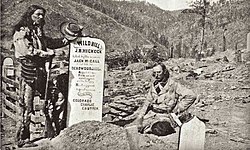
Attendance at the funeral was heavy, and Utter had Hickok buried with a wooden grave marker which read:

Wild Bill, J. B. Hickock [sic] killed by the assassin Jack McCall in Deadwood, Black Hills, August 2d, 1876. Pard, we will meet again in the happy hunting ground to part no more. Good bye, Colorado Charlie, C. H. Utter.

Utter left for Colorado, but returned in 1879 to have Hickok re-interred, at Calamity Jane's urging, in a ten-foot-square plot at the Mount Moriah Cemetery, surrounded by a cast-iron fence and with an American flag in the ground.

In February 1879, Utter purchased the Eaves Saloon in Gayville, a mining town 1.75 miles (2.82 km) west of Deadwood, but ran into a string of bad luck. He was found guilty of selling liquor without a license.[citation needed]

Later that year, Utter opened a dance hall in Lead, a company town far more sedate than its raucous, rollicking neighbor, Deadwood. The dance hall's "boisterous music and scandalous cancan dancing" earned Charlie an appearance before the honorable Gideon C. Moody. Charlie was convicted of "operating a nuisance", but because he had already closed the establishment, Judge Moody sentenced him to a mere one hour in jail. He was also fined $50 on the charge of disturbing the peace.[4][5]

Utter was back in Deadwood by the fall of the year. He opened another dance hall and also managed one of Deadwood's theaters.[5] On September 26, 1879, a fire devastated Deadwood, destroying more than three hundred buildings (including Charlie's dance hall and the theater he managed) and consuming the belongings of many inhabitants.

After Deadwood

[edit]

Following the destructive fire, Deadwood ceased to be a frontier town where fortunes could be built (or rebuilt) from nothing, and the newly impoverished left to try their luck in other gold rushes. Utter followed, first to Leadville, Colorado, in February 1880; then Durango, Colorado, having separated or divorced from his wife;[6] then Socorro, New Mexico. There, he opened a saloon and was reported to have a relationship with faro dealer Minnie Fowler. Utter's biographer, Agnes Wright Spring, traced him to Panama in the early 1900s. By then losing his eyesight, he owned drugstores in Panama City and Colón.[7] According to ship manifests, Utter made several trips back and forth between the United States and Panama in 1888, 1891, 1905, 1910, 1912, each listing his occupation as a "druggist".[8][9][10][11] He finally returned to Panama in 1913.

His gravestone is in Cementario Amador, Calle B, Santa Ana, Panama. The inscription lists Charles H. Utter as having died on July 3, 1915.[12] His wife Emma B. Utter, who died in 1894, is buried nearby.[citation needed]

Personality

[edit]

Utter cut a notable figure; he was 5 ft 6 in (168 cm), and was reported as being meticulous in his appearance, highly unusual for that place and time. He had long, flowing black hair and a moustache, perfectly groomed, wore hand-tailored fringed buckskins, fine linen shirts, beaded moccasins, and a large silver belt buckle and carried a pair of gold, silver and pearl ornamented pistols. He would allow nobody into his tent, even Hickok, on pain of being shot; in his tent he slept under the highest quality blankets, imported from California and carried with him mirrors, combs, razors, and whisk brooms. Most unusual of all, he was well known for his "bizarre habit" of bathing daily.[13][14]

[edit]

Utter is portrayed by Dayton Callie in the HBO television series Deadwood and Deadwood: The Movie. Contrary to the meticulous historical Utter, the character is portrayed as rough-mannered and often unkempt in his appearance. The film, set in 1889, shows the character still living in Deadwood, although the historical Charlie Utter had moved back to Colorado in 1880. The film also shows Utter being murdered in 1889 by henchmen sent by George Hearst after Utter declined to sell his land to Hearst.

Further reading

[edit]

References

[edit]
[edit]
Revisions and contributorsEdit on WikipediaRead on Wikipedia
from Grokipedia
Charles H. Utter, better known as "Colorado Charlie" (c. 1838 – 1915), was an American frontiersman, trapper, guide, and prospector of the Wild West, most renowned for his close friendship with legendary gunfighter and for organizing the 1876 that transported Hickok, , and over 100 others to the gold rush boomtown of Deadwood in . Born near Niagara Falls in New York state, Utter ventured westward to the Colorado Territory in the 1850s, where he established himself as a skilled packer and guide in the Rocky Mountains' silver and gold regions west of Denver, earning a reputation for his reliability in treacherous terrain. Standing about 5 feet 6 inches tall with long blond hair and a distinctive mustache, he was noted for his meticulous, dandified appearance—dressed in hand-tailored fringed buckskins, fine linen shirts, beaded moccasins, and a large silver belt buckle, often accessorized with ornate revolvers—which set him apart in the rough frontier environment. Utter's partnership with Hickok began in Cheyenne, Wyoming, in 1876, where he acted as a protector, monitoring the gunfighter's heavy drinking and gambling habits during their journey to Deadwood; upon Hickok's assassination on August 2, 1876, in a Deadwood saloon, Utter claimed the body, arranged the , and later oversaw the reinterment of Hickok's remains at Mount Moriah Cemetery in 1879. After Hickok's death, Utter operated various businesses in Deadwood, including an service and saloons, before drifting southward; by 1888, he had relocated to , where he ran a and was last documented there in 1910.

Early Life and Background

Birth and Upbringing

Charles H. Utter, later known as "Colorado Charlie," was born c. 1838 near in (sometimes given as 1842). Utter grew up in after his family's relocation from New York, where he spent his formative years amid the agrarian landscapes of the Midwest. He had a brother, Steve Utter, with whom he would later travel on frontier expeditions. In the 1850s, Utter migrated west to the , drawn by reports of gold strikes and the allure of adventure and fortune beyond the . This move marked the end of his Midwestern roots and the beginning of his immersion in the rugged world of the , where he initially took up roles as a and guide.

Initial Ventures West

Raised in Illinois after his family's relocation from New York, Charles H. Utter departed for the West as a young man in the 1850s. He initially ventured into the Rocky Mountains of the Colorado Territory, where he honed his skills as a trapper and scout amid the rugged terrain and unpredictable weather. Through these ventures, Utter earned a reputation for reliability as a guide, safely escorting adventurers and prospectors across the Colorado Territory's treacherous paths. His consistent success in these roles, particularly in the silver and gold regions west of Denver, led to the nickname "Colorado Charlie," reflecting his adeptness and trustworthiness in the burgeoning frontier economy.

Pre-Deadwood Career

Prospecting and Guiding in Colorado

Charlie Utter arrived in the Colorado Territory in the 1860s during the height of the gold rush, settling in the mining districts west of Denver. He quickly immersed himself in the bustling gold fields near Georgetown and Empire, where he staked small-scale mining claims and engaged in placer mining operations typical of the era's individual prospectors. These activities were part of the broader rush that followed discoveries in Clear Creek Canyon in 1859, drawing thousands to the region for opportunities in quartz and hydraulic mining. As a skilled frontiersman, Utter took on roles as both a prospector and a guide, leveraging his knowledge of the Rocky Mountain terrain gained from earlier experiences. He led emigrant parties and survey groups through challenging passes, including a notable expedition up Gray's Peak near Georgetown, where he guided a mixed group of men and women to the summit. His reputation as a reliable guide earned him the nickname "Colorado Charlie," reflecting his expertise in navigating the rugged landscape for miners and explorers seeking new claims. Utter also interacted with key figures in the local mining community, such as his brother Stephen Utter and mining agent William Bement, collaborating on ventures in the Georgetown area. Utter's lifestyle embodied the independent frontiersman, marked by a distinctive dandified appearance that set him apart in the rough camps: he wore fringed , beaded moccasins, and fine shirts, maintained long blond hair, and insisted on daily baths using a portable tub, even carrying a mirror, combs, and whisk broom for . The U.S. recorded his and in Georgetown at $7,000 each, indicating moderate success from his and guiding endeavors amid the volatile of the gold fields. These experiences honed his logistical abilities, particularly in freighting and supply transport to remote camps, where he operated a delivery service supplying essentials to scattered operations around Georgetown—a skill that foreshadowed his later large-scale expeditions.

Marriage and Family Establishment

On September 30, 1866, Charlie Utter married 15-year-old Matilda "Tily" in her parents' home in , Territory. , the daughter of an English immigrant baker who had established a in the mining town three years earlier, shared in the rigors of frontier life with Utter, who was then in his mid-20s and pursuing opportunities as a prospector and guide. By 1870, the couple had relocated to the nearby mining town of Georgetown, where the federal census recorded Utter, aged 32, and Nash, aged 19, residing together without any listed children. Their home life in this bustling silver- community reflected the challenges of balancing domestic stability with the uncertainties of frontier pursuits; Utter worked as a liveryman and operated a delivery service, often collaborating with his brother , a local miner, and mining agent William Bement to support the household amid the risks of ventures. No confirmed offspring are documented from the marriage during this period, underscoring a dynamic centered on partnership rather than expansion through children. Utter's independent travels, such as guiding expeditions in the Rockies, occasionally pulled him away from Georgetown, yet the couple maintained their establishment there until at least the mid-1870s, providing a semblance of rootedness in an otherwise nomadic phase of his life.

Deadwood Expedition and Hickok Association

Organization of the Wagon Train

In early 1876, amid the burgeoning , Charlie Utter and his brother Steve organized a 30-wagon supply train departing from , aimed at provisioning the burgeoning mining camps in Deadwood, . This expedition marked a significant escalation from Utter's prior smaller-scale freighting operations in , leveraging his established networks to assemble a large-scale venture transporting essential goods and passengers into the illegally settled region. The train's formation capitalized on the feverish influx of prospectors following the 1874 confirmation of gold in the Lakota Sioux-reserved , drawing hundreds eager for opportunity despite federal restrictions on entry. Logistically, the was a self-contained mobile enterprise, hauling vital supplies such as food, mining tools, and whiskey to sustain the remote boomtowns, while accommodating over 100 passengers including prospectors, gamblers, and entertainers. Notable recruits joined en route: the train passed through , where it picked up figures like , and later Fort Laramie, where boarded, adding to the diverse group of adventurers and "working girls" such as those associated with Madam Mustache and Dirty Em. Utter managed the convoy's operations, ensuring wagons were stocked for the long haul and coordinating with teamsters to handle the heavy loads across varying terrain. The journey from to Deadwood spanned roughly 300 miles northward through , presenting formidable challenges including rugged mountain passes, expansive hostile plains, and unpredictable spring weather that turned trails into muddy quagmires. Navigational hazards were compounded by the risk of conflicts with Lakota Sioux warriors defending their treaty lands, as well as potential encounters with U.S. military patrols enforcing exclusion orders against white intruders. Despite these threats, the avoided major incidents, relying on Utter's guiding expertise to ford rivers and skirt dangerous areas. The expedition arrived in Deadwood in mid-July 1876, integrating into a chaotic settlement already swelling with 5,000 to 10,000 inhabitants amid the gold frenzy. Upon arrival, Utter swiftly established initial services, launching a mail delivery route between Deadwood and that charged 25 cents per letter and could carry over 2,000 pieces per run, providing a critical communication lifeline for the isolated camp. This operation, along with freighting extensions, positioned Utter as a key logistical figure in the town's early development.

Friendship with Wild Bill Hickok

Charlie Utter and Wild Bill Hickok, having likely first encountered each other in Kansas during the 1850s while working as scouts and guides for the railroad, renewed and deepened their acquaintance in 1876 when Hickok joined Utter's wagon train bound for the Black Hills gold rush. Upon arriving in Deadwood in mid-July, the two bonded over their shared frontier experiences, including years of trapping, prospecting, and navigating the perils of the American West, fostering a relationship built on mutual respect and camaraderie. In Deadwood's rough-and-tumble environment, Utter and Hickok frequently engaged in the town's social pastimes, such as in saloons and scouting the surrounding hills for opportunities amid the lawless chaos. Hickok, known for his affinity for card games, often participated in high-stakes poker sessions, while Utter, leveraging his expertise as a guide, conducted scouting runs and established an service to connect Deadwood with distant outposts. Their interactions in local saloons highlighted their easy rapport, where conversations likely revolved around tales of past adventures and the latest mining prospects. Utter served as a trusted companion and informal protector to Hickok during this period, vigilantly attempting to shield him from the excesses of drinking and gambling that plagued the gunslinger's habits in the volatile setting of Deadwood. As a steadfast friend, Utter provided practical aid, including supplies from his provisions and express deliveries, ensuring Hickok had access to essentials amid the settlement's shortages. One notable anecdote of their closeness involved Utter's persistent efforts to moderate Hickok's indulgences, intervening during bouts of heavy carousing to steer him toward safer pursuits, underscoring Utter's role as a grounding influence in their partnership.

Hickok's Death and Funeral Arrangements

On August 2, 1876, James Butler "Wild Bill" Hickok was fatally shot in the back of the head by while playing poker at Nuttall & Mann's Saloon No. 10 in Deadwood, . McCall, who had lost money to Hickok the previous day, approached from behind and fired a single shot from a , killing Hickok instantly at age 39. Charlie Utter, Hickok's close friend and , was among the first to respond to the scene, where he identified the body and claimed responsibility for its care. Demonstrating his loyalty, Utter immediately organized the funeral arrangements, placing a death notice in the August 3 edition of the Black Hills Pioneer newspaper, which announced: "Died in Deadwood, , August 2, 1876, from the effects of a pistol shot, J. B. Hickok, known as Wild Bill, aged 39 years, by the assassin . Funeral services will be held at Charlie Utter's Camp, on Thursday afternoon, August 3, 1876, at 3 o'clock, P. M. All are respectfully invited to attend." The services took place the following day at Utter's wagon camp on the edge of Deadwood, drawing a large crowd of miners, gamblers, and townsfolk. Utter served as a pallbearer during the procession to Ingleside Cemetery, a makeshift burial ground on a hillside overlooking the town, alongside other mourners including , who had traveled with their wagon train and participated in the rites. He personally composed and inscribed Hickok's on a simple wooden marker at the grave: "Wild Bill, J. B. Hickok killed by the assassin in Deadwood, , August 2, 1876. Pard, we will meet again in the to part no more. Goodbye, Charlie, C. H. Utter." Overcome with from the loss of his steadfast companion, Utter ensured the burial plot was properly prepared and paid for, reflecting the depth of their friendship forged during the perilous journey to the .

Later Life and Death

Business Ventures After Deadwood

In 1879, amid rumors of , Charlie Utter returned to Deadwood, where he organized the exhumation and reburial of Wild Bill Hickok's remains in the more secure Mount Moriah Cemetery, ensuring a proper for his late friend. Later that year, on September 26, 1879, a devastating fire swept through the town, destroying much of his property along with over three hundred buildings. The rapid decline of Deadwood's gold rush boom and the loss from the blaze prompted his departure from the region in late 1879. By February 1880, Utter had arrived in , a burgeoning camp, where he resumed amid the area's rich ore deposits. His efforts in the camps yielded modest results, reflecting the speculative nature of resource extraction, but provided a temporary as he adapted to the volatile local . Later that year, after separating from his wife Tilly, Utter moved to , continuing his activities and possibly engaging in freighting or small-scale saloon operations to supplement income in the growing San Juan district. These ventures highlighted his resilience, though they were hampered by the region's inconsistent booms and harsh conditions, leading to only marginal financial stability. In the early 1880s, Utter shifted southward to , where he established a saloon and den, capitalizing on the town's role as a supply hub for nearby and ranching operations. The business, while aligning with his prior experience in Deadwood's express and hospitality trades, faced economic headwinds from competition and fluctuating trade routes, resulting in limited profits. During this period, Utter reportedly formed a common-law relationship with Fowler, a faro dealer who assisted in the gambling aspects of the enterprise, but overall successes remained modest amid the broader challenges of territorial commerce.

Relocation to Panama and Final Years

Accounts of Utter's relocation to Panama vary, with some sources placing it around 1888 and biographer Agnes Wright Spring tracing him there in the early 1900s. In Panama, records indicate he established himself as a druggist, operating pharmacies in Panama City and Colón while dealing with deteriorating eyesight. Historical documentation of his activities there remains sparse, with one account from 1910 describing him as blind and seated outside his Panama pharmacy. Ship manifests show Utter made several trips back and forth between the and , listed as a druggist, before returning permanently in 1913. He continued residing in as a minor entrepreneur until his death on July 3, 1915, at the age of 73. He was buried in Cementerio Amador in Santa Ana, Panama. Utter's final years marked a stark contrast to his earlier prominence in , as he faded into relative obscurity, with limited contemporary records preserving details of his life abroad.

Personality and Legacy

Physical Appearance and Habits

Charlie Utter was a small but stocky man, standing approximately 5 feet 6 inches tall with broad shoulders, which contrasted with his dandified and fastidious personal style. He possessed blond hair styled in long curls down his shoulders, a well-trimmed , a mustache, and an imperial goatee, contributing to his distinctive appearance. Utter's attire reflected his practical yet , often consisting of fringed buckskin and , beaded moccasins, fine shirts, and handsome accented by a belt with a large silver and ornate revolvers mounted in , silver, and pearl. Renowned for his meticulous , Utter bathed daily—a striking habit in the rough conditions of the that often drew curious onlookers—and maintained highly organized personal effects, including a equipped with a real mirror, combs, brushes, razors, whisk brooms, and fine blankets. He was fiercely protective of his neat space, viewing unauthorized entry as a serious offense, which underscored his disciplined routines even during expeditions like the one to Deadwood alongside . These traits marked Utter as a " ," earning him respect among peers for his moral stability, noble character, and unwavering loyalty to friends, qualities that solidified his moniker " Charlie" from his guiding days in that territory. Charlie Utter has been prominently featured in modern media, most notably in the HBO television series Deadwood (2004–2006) and its sequel film Deadwood: The Movie (2019), where he is portrayed by actor Dayton Callie as a loyal but often comically awkward companion to Wild Bill Hickok and Calamity Jane. In the series, Utter is depicted as an honest, tough frontiersman who runs a freight service and shows kindness to others, yet his character emphasizes bumbling traits and verbal stumbles for humor, diverging from historical records of his poised demeanor and business acumen. This portrayal highlights Utter's role in the chaotic founding of Deadwood, including his organization of wagon trains and handling of Hickok's funeral, but amplifies his eccentricity through scenes of flustered interactions and physical clumsiness. Beyond television, Utter appears in literature such as Pete Dexter's 1986 novel Deadwood, where he serves as a central narrator and Hickok's steadfast friend, chronicling the lawless town's early days through his perspective as a dandyish entrepreneur. The book portrays Utter as charismatic and resourceful, emphasizing his leadership and bond with Hickok, which influenced the adaptation's character foundation while retaining more of his historical dignity. In film, Utter is a supporting figure in the low-budget Western Calamity Jane's Revenge (2015), played by as a lawman's ally tasked with tracking the vengeful after Hickok's death, underscoring his real-life ties to frontier icons in a vigilante justice narrative. He also receives brief mentions in documentaries on Hickok, such as Dead Man's Hand: The True Story of (2023), where his role in claiming and burying Hickok's body is noted as a key act of loyalty. Utter's cultural legacy extends to Deadwood tourism, where his contributions fuel myths and attractions, including replicas of the epitaph he composed for Hickok's —"Wild Bill, J.B. Hickok killed by the assassin in Deadwood, , Aug. 2, 1876. Charity to the poor, he sought not position. And peace was his object. Hon. by all. Peace to his ashes"—displayed at sites like the Mount Moriah Cemetery and Adams Museum exhibits featuring his personal artifacts alongside those of Hickok and Jane. These elements draw visitors to annual events like Wild Bill Days, which reference Utter's and funeral arrangements to evoke the town's Wild West origins. Critiques of these depictions often note an overemphasis on Utter's quirks at the expense of his organizational prowess; for instance, the series' comedic take contrasts sharply with accounts of him as a meticulous guide and successful freighter who bathed daily and dressed impeccably, underplaying his skills in leading the to Deadwood. Such portrayals perpetuate myths of frontier eccentricity while sidelining his practical impact on the , though they have boosted interest in his historical role.
Add your contribution
Related Hubs
User Avatar
No comments yet.