
_-_cropped.jpg/250px-Chipmunk_with_stuffed_cheeks_in_Prospect_Park_(05980)_-_cropped.jpg)


_-_cropped.jpg)
Community hub
Recent from talks
Contribute something
Nothing was collected or created yet.
Cheek pouch
View on Wikipedia_-_cropped.jpg)


Cheek pouches are pockets on both sides of the head of some mammals between the jaw and the cheek. They can be found on mammals including the platypus, some rodents, and most monkeys,[1][2] as well as the marsupial koala.[3]
Description and function
[edit]Cheek pouches are located in the thickness of the flange on both sides of the head of some mammals. In some species, such as hamsters, the cheek pouches are remarkably developed; they form two bags ranging from the mouth to the front of the shoulders.[4] Cheek pouches facilitate the rapid collection of food as well as temporary storage and transport of both food and non-food items in several species. Étienne Geoffroy Saint-Hilaire described that some bats of the genus Nycteris have an amazing form of cheek pouches, as they have a narrow opening, through which the bat can introduce air, closing the nasal canal through a special mechanism and pushing air under the skin, so they expire in the tissue, which unites the very loose skin to the underlying muscles.[4] Monkeys of the subfamily of Cercopithecinae make functional use of cheek pouches.[5][6] The females of some species of hamster are known to hide their young in their cheek pouches to carry them away from danger.[7] Other species of hamsters are known to fill their pouches with air, allowing them to float better while they swim.[7][8]
.jpg)
Use of cheek pouches for storage is not without risk for the animal. The cheek pouches can become infected as a result of an injury caused by a sharp object inserted into them or a fight. An abscess can form, which can be confused with protuberance with stored food. If the abscess bursts and the pus contained therein is absorbed by the animal, it can develop sepsis and die of the poisonous toxins.[9][10][11][12] Cheek pouches can also become prolapsed.[9][13]
Hamster cheek pouches have been used as model systems for the study of vascular membranes, healing,[14] and the immune system--notably in the development of abscesses or tumors.[15][16][17]
Examples
[edit]Chipmunks
[edit]Chipmunks (Tamias) have large cheek pouches that allow them to transport food.[18] The cheek pouches of chipmunks can almost reach the size of their head when full.[7]
Below is the introduction of the legume (pod) of peanut in the cheek pouch of a chipmunk:
-
 Peanut half entered the cheek pouch
 -
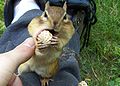 Peanut during storage
 -
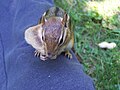 Peanut entirely in the cheek pouch
 -
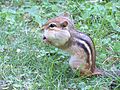 Chipmunk in profile with cheek pouch swollen by a peanut pod

.jpg)


Hamsters
[edit]
One of the classic behavioral characteristics of hamsters (subfamily Cricetinae) is food hoarding. Hamsters carry food to their underground storage chambers using their spacious cheek pouches.[19] A hamster "can literally fill its face with food."[20] When full, the pouches can make the hamsters' heads double, or even triple in size.[19]
Platypus
[edit]The platypus feeds on annelid worms, insect larvae, freshwater shrimps, and yabbies (freshwater crayfish) that it digs out of the riverbed with its snout or catches while swimming. It uses its cheek pouches to carry prey to the surface for eating.[21]
Misconception with Rattus rattus
[edit]The cheek pouch is a specific morphological feature that is evident in particular subgroups of rodents (e.g. Heteromyidae and Geomyidae, or gopher), yet a common misconception is that certain families, such as Muridae (including the common black and brown rats), contain this structure when in fact their cheeks are merely elastic due to a high degree of musculature and innervation in the region. The true cheek pouch, however, is evident in the former Heteromyidae and Geomyidae groups.[22]


Cheek pouches are more pronounced in certain rodents, such as hamsters, yet this structure is also distinguishable on certain species of rat, like the Gambian pouched rat, of which extensive morphological investigations have been conducted.[22] Aspects including rat pouch musculature, vascularization, and innervation were all explored and compiled through this and other studies. The widely distributed Rattus rattus is an example of the rodent family Muridae that lacks a true cheek pouch; rather, they exhibit more elastic cheeks (not true pouches) due to the organization of their cheek musculature.
Concerning the musculature, the cheek pouch is composed primarily of a developed masseter (cheek) muscle that exhibits a high tensile ability. The masseter muscle has been shown to insert into the pectoralis muscles, allowing for a higher degree of food retention. The pouch is clearly divided between a buccal (cheek) and sublingual (below the tongue) portion. Volumetric analyses within this study attributed the differences in net cheek volume between male and female rats to the average size of the respective sexes.[23]
Due to muscle's high nutritional demand, this muscle exhibits vascularization that has been highly studied. Dissections at Boston University by Frank Brodie describe the various bifurcations (or splittings) of the common carotid. This artery splits into an internal and external branch, of which the latter extends dorsally and divides into five branches that supply the general cheek region. The branch that extends dorsally to the ear is known as the auricular branch.[24]
As for innervation of this structure, the associated nerve branches were all found to originate from the facial (CN VII of XII) nerve that initiates at the medulla and passes into the facial canal via the stylomastoid foramen. The primary aforementioned muscle, the masseter, is supplied by two large neural branches known as the temporalis and zygomatic nerves.[24] The buccal divisions of this nerve supply much of the masseter muscle, which ultimately facilitates the voluntary retention of food within the cheek pouch.
References
[edit]- ^ "ABAJOUE – Dictionnaire de l'académie française – Septième édition (1877)" (in French). Dicoperso.com. Retrieved 2012-11-03.
- ^ "Le Trésor de la Langue Française Informatisé" (in French). Analyse et Traitement Informatique de la Langue Française. Retrieved 2012-11-03.
- ^ Lee, A. L.; Martin, R. W. (1988). The Koala: A Natural History. New South Wales University Press. p. 20. ISBN 978-0-86840-354-0.
- ^ a b Duckett, W. (1853). "cheek pouch". English conversation and reading. Ed Michel Levi. p. 3.
espagnol abajoue.
- ^ "Natural History Primate of Central Africa" (PDF). ECOFAC. 1999. Archived from the original (PDF) on 23 July 2008. Retrieved 3 November 2012.
- ^ Buzzard, Paul J. (2006). "Cheek pouch use in relation to interspecific competition and predator risk for three guenon monkeys (Cercopithecus spp.)". Primates. 47 (4): 336–341. doi:10.1007/s10329-006-0188-6. PMID 16645704.
- ^ a b c Nowak, R. (1999). Walker's Mammals of the World. Vol. II. Baltimore and London: The Johns Hopkins University Press.
- ^ Poor, Allison. "ADW: Cricetinae: INFORMATION". Animal Diversity Web. Retrieved 2012-11-03.
- ^ a b Klabunde RE, Calvello C (November 1995). "Inhibition of endotoxin-induced microvascular leakage by a platelet-activating factor antagonist and 5-lipoxygenase inhibitor". Shock. 4 (5): 368–72. doi:10.1097/00024382-199511000-00010. PMID 8595525.
- ^ Mark A. Suckow; Karla A. Stevens; Ronald P. Wilson (15 January 2012). The Laboratory Rabbit, Guinea Pig, Hamster, and Other Rodents. Academic Press. pp. 816–. ISBN 978-0-12-380920-9. Retrieved 3 November 2012.
- ^ Susan A. Brown; Karen L. Rosenthal (1 April 1997). Small Mammals. Manson Publishing. pp. 162–. ISBN 978-1-84076-565-6. Retrieved 3 November 2012.
- ^ Mark A. Mitchell; Thomas N. Tully (2009). Manual of Exotic Pet Practice. Elsevier Health Sciences. pp. 429–. ISBN 978-1-4160-0119-5. Retrieved 3 November 2012.
- ^ "hamster Health: abscess in cheek pouches". membres. Archived from the original on 3 May 2009. Retrieved 3 November 2012.
- ^ Lutz BR, Fulton GP, Akers RP (March 1951). "White thromboembolism in the hamster cheek pouch after trauma, infection and neoplasia". Circulation. 3 (3): 339–51. doi:10.1161/01.CIR.3.3.339. PMID 14812662.
- ^ de Arruda MS, Montenegro MR (1995). "The hamster cheek pouch: an immunologically privileged site suitable to the study of granulomatous infections". Revista do Instituto de Medicina Tropical de São Paulo. 37 (4): 303–9. doi:10.1590/S0036-46651995000400004. hdl:11449/8180. PMID 8599058.
- ^ Adams, Jeff (March 2000). Acid / Pepsin Promotion of Carcinogenesis in the Hamster Cheek Pouch. HEAD NECK SURG ARCH Otolaryngol (PDF). Vol. 126. archotol.ama-assn.
- ^ G. L. Van Hoosier; Charles W. McPherson (28 October 1987). Laboratory Hamsters. Elsevier. pp. 284–. ISBN 978-0-12-714165-7. Retrieved 3 November 2012.
- ^ H. The Louarn, J.P. (2008). Quéré, rodents France, Fauna and biology. Quae Publishing. p. 119. ISBN 9782738010919.
- ^ a b Fox, Sue. 2006. Hamsters. T.F.H. Publications Inc.
- ^ "Mammals of the World". National Museum of Ireland. 2012. Archived from the original on November 5, 2012. The accompanying photograph shows how capacious the pouches are.
- ^ "Platypus". Parks and Wildlife Service Tasmania. February 2008. Archived from the original (PDF) on 2011-03-14. Retrieved 2009-06-18.
- ^ a b Ryan, James (1989). "Comparative myology and phylogenetic systematics of the Heteromyidae". Miscellaneous Publications, Museum of Zoology, University of Michigan. 176: 1–112. hdl:2027.42/56420.
- ^ Mustapha, O. (2015). "Morphology of the Oral Cavity of the African Giant Rat". Bulgarian Journal of Veterinary Medicine. 18: 19–30. doi:10.15547/bjvm.793.
- ^ a b Brodie, Frank (1947). Blood vessels and nerves of the face in rodents with and without cheek pouches (M.A. thesis). Boston University. pp. 1–159.

Cheek pouch
View on GrokipediaAnatomy
Structure
Cheek pouches are bilateral pockets formed by invaginations of the buccal mucosa, located in the lateral walls between the jaw and cheek in various mammals.[1][2] These structures arise as distensible invaginations of the oral mucosa, extending caudally in some species to the level of the scapulae.[1] The composition of cheek pouches includes layers of keratinized stratified squamous epithelium supported by dense collagenous connective tissue, which provides elasticity, along with loose areolar connective tissue and striated muscle fibers.[1] Muscular layers, such as the posterior retractor muscle, contribute to structural integrity; in rodents, this muscle is often derived from trapezius musculature and originates from the lumbodorsal fascia and thoracic vertebrae, inserting on the pouch walls to facilitate expansion and contraction.[2][3] These pouches lack major glandular tissue but are highly vascularized, with no lymphatic drainage.[1] Capacity varies across species, with some rodents capable of holding up to 20% of their body weight in food or material when fully distended.[4] For instance, empty pouches measure approximately 4-8 mm wide, expanding to 20 mm or more when filled, allowing storage of sizable items relative to body size.[1] The internal lining features vary, including dermal papillae in certain rodents to enhance grip and prevent slippage of contents, while external pouches in other species are fur-lined for similar purposes and ease of cleaning.[2][5] This anatomical setup supports rapid filling and emptying through coordinated muscle action.[3]Types
Cheek pouches in mammals are primarily classified into two morphological types based on their anatomical position and structural configuration: internal and external. Internal cheek pouches consist of invaginations of the oral mucosa deep to underlying muscles such as the platysma and sphincter colli profundus, with openings located inside the mouth cavity.[2] These structures are prevalent in many rodents, including hamsters, where they form distensible, vascularized sacs that line the lateral walls of the buccal cavity.[6] In contrast, external cheek pouches arise as diverticula of the integumentary skin, opening externally near the mouth and often featuring a fur-lined interior for protection and insulation.[2] Such pouches are observed in certain rodents like pocket gophers, where they become prominently visible when distended with contents.[7] Specialized variants of internal cheek pouches occur in other mammalian lineages, exhibiting adaptations in lining and capacity for extended retention. In primates of the Cercopithecinae subfamily, these pouches are epithelial-lined expansions of the buccal walls, extending along the neck to facilitate temporary holding without external protrusion.[8] The platypus possesses a unique form of internal cheek pouches positioned lateral to its keratinous grinding pads, adapted for aquatic prey collection and for storing gravel to aid in grinding food in the absence of teeth.[9][7] Comparative differences among types include variations in size and extensibility, which influence storage volume. For instance, internal pouches in hamsters can expand posteriorly to the scapular region, accommodating substantial loads relative to body size.[3] External pouches in gophers similarly demonstrate high extensibility, with furred linings aiding in maintaining integrity during transport. These structural distinctions contribute to varying efficiencies in food storage, such as faster internal filling for rapid foraging.[2]Function
Primary Role in Food Storage
The primary role of cheek pouches in animals such as rodents and certain primates is to facilitate the rapid collection, temporary storage, and transport of food resources, enabling efficient foraging while minimizing exposure to predators. These internal sacs, located on either side of the mouth, allow individuals to gather large quantities of seeds, nuts, or other small food items during brief foraging bouts and carry them back to safer locations like burrows or nests. This adaptation is particularly vital in environments where food is patchily distributed and predation risk is high, as it separates the vulnerable act of feeding from the safer process of consumption or long-term hoarding.[3] The mechanism of filling involves rapid, repetitive jaw movements that co-opt masticatory motor patterns to pack food items into the pouches. In Syrian hamsters (Mesocricetus auratus), for instance, frame-by-frame kinematic analysis of pouch-filling behavior shows multiple jaw cycles per food item, with the tongue and incisors manipulating seeds into the elastic pouch walls. The retractor muscle plays a key role by contracting to tighten the pouch around the contents and pull them caudally, creating space for additional items while preventing spillage; this process is supported by the pouches' elastic tissues, which can expand significantly without tearing. Once filled, the pouches are emptied through eversion, often aided by forepaw massaging and tongue action, allowing quick deposition of food at storage sites.[3][10] Storage in cheek pouches is inherently temporary, typically lasting from minutes to a few hours during transport to reduce predation risk while foraging. In the wild, hamsters and other rodents like pocket mice (Perognathus spp.) use this system to shuttle food from open foraging areas to underground burrows or surface scatter caches, where it can be consumed immediately or stored longer-term. This short-duration holding prevents spoilage of perishable items and aligns with nocturnal or crepuscular activity patterns that limit exposure time.[12][3] Efficiency is enhanced by the pouches' capacity and filling speed, allowing rodents to amass substantial loads quickly. Syrian hamsters fill their pouches through a series of rapid jaw cycles that complete loading in seconds per item. In heteromyid rodents, loading rates scale with body mass, enabling efficient foraging that boosts success by allowing multiple trips without prolonged vulnerability. These traits underscore the pouches' role in supporting high-energy demands in arid or seasonal habitats.[3][13] Behaviorally, cheek pouches integrate with hoarding strategies, particularly scatter caching in rodents, where small food piles are dispersed across multiple sites to mitigate pilferage risks. Species like kangaroo rats (Dipodomys spp.) fill pouches with seeds during short surface forays, then deposit them in shallow, scattered caches near burrows, a pattern that relies on the pouches for efficient transport without immediate consumption. This integration promotes seed dispersal and survival, as uneaten caches may germinate, while allowing animals to build reserves against food scarcity.[14][15]Additional Physiological Roles
In addition to their primary function in food storage, cheek pouches serve protective roles in various species by enabling rapid evasion of threats. Female Syrian hamsters (Mesocricetus auratus) may place newborn pups in their cheek pouches when stressed, allowing them to transport or hide the young from potential predators.[16] This behavior leverages the pouches' distensibility to safeguard offspring during disturbances. Similarly, in burrowing rodents like pocket gophers (Thomomys spp.), the pouches facilitate quick retreats to burrows while carrying resources, indirectly buffering against predation by minimizing surface exposure time.[6] In cercopithecine primates, such as blue monkeys (Cercopithecus mitis stuhlmanni), cheek pouches reduce vulnerability to predators during foraging. Individuals exhibit lower exposure levels while emptying pouches (vulnerability score of 5.9) compared to filling them (score of 7.2), supporting a predation-avoidance strategy that allows safer consumption away from risky feeding sites.[17] This supplementary role enhances survival in competitive environments, where pouch use increases when nearby conspecifics of higher rank are present, potentially mitigating feeding interference. Cheek pouches also accommodate non-food materials, contributing to nest maintenance and sensory processing. In hamsters, the pouches store bedding alongside food, aiding in burrow construction and hygiene by transporting soft materials efficiently.[16] In macaques, the cheek pouch is represented in the somatosensory cortex, providing tactile feedback during handling. These roles underscore the pouches' versatility in supporting overall physiological resilience across taxa.[18]Occurrence in Animals
In Rodents
Rodents exhibit a wide diversity in cheek pouch morphology and use, with many species relying on these structures for efficient food transport during foraging. In chipmunks (genus Tamias), the cheek pouches are internal but highly elastic, allowing them to expand significantly to hoard seeds and nuts, which are then transported to burrows for storage.[19] These pouches enable chipmunks to minimize exposure to predators by reducing the number of foraging trips needed.[19] Hamsters, particularly the Syrian hamster (Mesocricetus auratus), possess internal, fur-lined cheek pouches that extend from the mouth to the shoulders, facilitating the transport of food to burrows.[3] These pouches are adapted for burrow storage, with the fur lining preventing abrasion and aiding in moisture retention during transport.[7] In Syrian hamsters, the pouches can expand to hold up to half the animal's body weight (around 50 grams in adults weighing 100-150 grams), correlating with their strategy of caching food in underground larder hoards.[20] Pocket gophers (family Geomyidae) feature external, fur-lined cheek pouches that open to the outside of the mouth, uniquely adapted for carrying both food and excavated soil during tunneling activities.[21] This allows them to transport tubers, roots, and nesting materials while digging extensive burrow systems, with the external design preventing soil from entering the mouth.[21] Among specialized rodents, heteromyid species such as kangaroo rats (genus Dipodomys) have large external cheek pouches suited to arid environments, enabling them to gather and transport seeds over distances while conserving water by minimizing surface time.[22] Pouch capacity in these species supports scatter-hoarding behaviors, with adaptations like fur lining enhancing seed viability in dry conditions.[22] Similarly, African pouched rats (genus Cricetomys) utilize expansive internal cheek pouches for long-distance foraging, allowing them to collect several kilograms of fruits, seeds, and nuts per night to store in communal burrows.[23] Pouch size in rodents often correlates with foraging strategy; for instance, species in open habitats like kangaroo rats have proportionally larger pouches relative to body size compared to forest-dwellers, optimizing energy efficiency in resource-scarce areas.[24] Behaviorally, rodents such as hamsters empty their pouches by rubbing their cheeks against burrow walls or substrates to deposit contents into storage sites, a motion that can sometimes lead to pouch eversion if excessive.[25]In Primates
Cheek pouches are a defining anatomical feature of the primate subfamily Cercopithecinae, encompassing most Old World monkeys such as macaques, baboons, and guenons.[26] These structures are absent in New World monkeys (Platyrrhini) and other primate lineages, distinguishing cercopithecines within the broader Cercopithecidae family.[26] Anatomically, cercopithecine cheek pouches consist of epithelial-lined pockets embedded in the lateral walls of the buccal cavity, extending down the sides of the neck; they are highly innervated, allometrically scaled to body size, and secrete substantial amounts of α-amylase to initiate carbohydrate digestion during storage. This design supports temporary food retention, enabling rapid filling and emptying without immediate mastication. In arboreal cercopithecines, cheek pouches primarily store fruits, seeds, insects, and leaves encountered during foraging, allowing individuals to collect provisions swiftly while traversing tree canopies and minimizing exposure to predators or intraspecific competitors.[26][27] By reducing feeding time in risky locations, this adaptation enhances survival in fragmented forest habitats where resources are patchily distributed.[28] Rhesus macaques (Macaca mulatta), for instance, exploit cheek pouches for opportunistic feeding in urban settings, stashing scavenged fruits, provisioned items, or garbage to consume later away from human crowds or rival groups.[29][30] Similarly, guenons (Cercopithecus spp.) use pouches to transport arboreal insects and berries, facilitating efficient energy intake amid high predation pressure from raptors.[28]In Other Mammals
Among non-rodent and non-primate mammals, cheek pouches occur in certain monotremes and marsupials, serving roles in food storage adapted to their ecological niches. In monotremes, the platypus (Ornithorhynchus anatinus) possesses internal cheek pouches located behind its bill, which allow it to collect and temporarily store aquatic prey such as invertebrates, crayfish, and worms while foraging underwater for up to 140 seconds per dive.[31] These pouches enable efficient prey accumulation without immediate consumption, as the platypus returns to the surface to mash the contents using gravel and keratinous pads in its mouth, given its lack of teeth as an adult.[32] In marsupials, cheek pouches are present in species such as the koala (Phascolarctos cinereus) and potoroids like bettongs and potoroos (family Potoroidae), where they function in storing food adapted to specialized diets. The koala's small cheek pouches, lined with salivary glands and covered by the buccinator muscle, allow temporary holding of eucalyptus leaves before prolonged chewing and fermentation in its enlarged cecum, aiding digestion of toxic eucalypt compounds.[33][34] This adaptation is crucial for energy conservation in an arboreal lifestyle, where koalas spend up to 20 hours per day resting and selectively browsing preferred leaf species.[33] In potoroids, larger cheek pouches facilitate transport of hypogeous fungi and seeds, supporting mycorrhizal spore dispersal in their foraging behavior.[35] Cheek pouches also appear in certain bats, particularly fishing species in the family Noctilionidae (bulldog bats), which use internal pouches to store captured prey like small fish during aerial foraging over water. Fruit bats such as epauletted bats (Epomophorus spp.) employ cheek pouches to carry ripe figs and other fruits, aiding in seed dispersal.[7][36]Evolutionary Aspects
Origins and Development
Cheek pouches in mammals originate embryologically as evaginations of the buccal epithelium, forming from epithelial ingrowths along the oral cavity lining during late fetal stages. In rodents such as the Syrian hamster (Mesocricetus auratus), these rudiments appear as solid epithelial projections in 14- to 15-day fetuses, developing as margins of an ingrowing sheet of oral epithelium that extends into the cheek tissue.[37] This process is influenced by genetic mechanisms governing oral cavity morphogenesis, including conserved pathways that regulate epithelial folding and mesenchymal interactions in craniofacial development.[38] The resulting structures represent derived modifications of the generalized mammalian buccal folds, where the platysma and sphincter colli profundus muscles provide the foundational layer for pouch expansion.[2] Direct fossil evidence for cheek pouches is scarce, as these soft-tissue structures rarely preserve; inferences are drawn from phylogenetic analyses and behavioral traces in the rodent fossil record. Indications of food-hoarding behaviors appear in Eocene rodents, coinciding with the radiation of early lineages during a period of increasing granivory. These ancestral traits link pouches to the broad mammalian facial myology, evolving as outward or inward diverticula to optimize foraging efficiency in arboreal or terrestrial niches. Developmental variations occur across rodent species, with timing of pouch formation differing based on life history. In many muroid rodents, initial evaginations form prenatally, but the pouch cavity fully develops postnatally through keratinization and space coalescence, often completing by 7 to 12 days after birth—prior to weaning around 21 days.[37] In contrast, external pouches in geomyoid rodents like kangaroo rats (Dipodomys spp.) exhibit delayed maturation, with full structural integrity and fur lining emerging around 30 days postnatal, extending beyond weaning to align with increased mobility and foraging demands.[39] These heterochronic shifts highlight how pouch ontogeny adapts to ecological pressures, resulting in modern anatomical structures optimized for temporary food storage.[40]Independent Evolution Across Lineages
Cheek pouches exemplify convergent evolution, having developed independently across diverse mammalian lineages to address similar ecological challenges related to food acquisition and storage. In rodents, these structures arose multiple times within the order Rodentia, particularly in families such as Heteromyidae (kangaroo rats and mice) and Geomyidae (pocket gophers), where they manifest as internal or external evaginations of the buccal cavity lined by musculature derived from the platysma and sphincter colli profundus.[2] Phylogenetic studies confirm their absence in the rodent common ancestor, with fossil evidence tracing the earliest geomyoid forms—possessing these pouches—to the late Eocene epoch, around 40 million years ago, coinciding with the diversification of granivorous species in aridifying environments.[41] In primates, cheek pouches are restricted to the Cercopithecinae subfamily of Old World monkeys, serving as expandable buccal pockets for temporary food storage during ground foraging; this trait is notably absent in New World monkeys, apes, and other catarrhines, underscoring an independent evolutionary origin within the primate clade.[42] Among monotremes, the platypus (Ornithorhynchus anatinus) exhibits bilateral cheek pouches adjacent to the bill's grinding pads, enabling the collection and trituration of aquatic invertebrates before surfacing to consume them—a specialization tied to its semi-aquatic lifestyle and divergent from therian mammal pouches.[9] Certain marsupials, such as bettongs in the family Potoroidae, have also independently evolved small cheek pouches for gathering and transporting seeds and fungi, facilitating scatter-hoarding behaviors in nutrient-poor, patchy habitats of Australia.[43] Across these lineages, the repeated emergence of cheek pouches is driven by selective pressures favoring efficient hoarding in fragmented or seasonally scarce environments, where rapid food collection minimizes exposure to predators and competitors.[44] Basal mammal phylogenies reveal no ancestral cheek pouches, with molecular and fossil clocks supporting their polyphyletic origins as adaptive responses to niche-specific foraging demands rather than shared inheritance.[45]Common Misconceptions
Association with Black Rats
Black rats (Rattus rattus) do not possess cheek pouches, unlike African pouched rats of the genus Cricetomys, which are unrelated large rodents in the family Nesomyidae featuring prominent, expandable cheek pouches for food transport.[46] This nomenclature overlap, where both groups are colloquially termed "rats," can lead to confusion in popular accounts of rodent anatomy.[47] Anatomically, R. rattus lacks true cheek pouches entirely, as do all members of its subfamily Murinae within the family Muridae; instead, the cheeks consist of elastic skin permitting minor distension during feeding, but without the specialized, internal or external pocket structures characteristic of pouched species.[48] Any observed "pouching" during foraging reflects this limited flexibility rather than dedicated storage organs, contributing to visual misperceptions when black rats carry multiple food items in their mouths.[49] In contrast, true cheek pouches occur in subfamilies like Cricetomyinae (for Cricetomys), highlighting the independent evolution of this feature outside Murinae and underscoring the need for taxonomic precision in identifying rodent adaptations.[50]References
- https://www.sciencedirect.com/topics/[neuroscience](/page/Neuroscience)/cheek-pouch