Hubbry Logo
ChiemseeChiemseeMain
Open search
Chiemsee
Community hub
Chiemsee
logo
8 pages, 0 posts
0 subscribers
Be the first to start a discussion here.
Chiemsee
Chiemsee
from Wikipedia
Location of Chiemsee in South Germany

Key Information

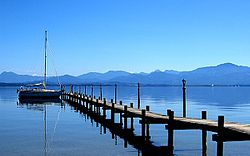
Chiemsee (German pronunciation: [ˈkiːmzeː] ) is a freshwater lake in Bavaria,[2] Germany, near Rosenheim. It is often called "the Bavarian Sea". The rivers Tiroler Achen and Prien flow into the lake from the south, and the river Alz flows out towards the north. The Alz flows into the Inn which then merges with the Danube. The Chiemsee is divided into the bigger, north section, in the northeast, called Weitsee, and the Inselsee, in the southwest.

The Chiemgau, the region surrounding the Chiemsee, is a popular recreation area.

High resolution map of the lake within its surrounding region, Chiemgau

Origin

[edit]

The Chiemsee was formed, like many other pre-alpine lakes, at the end of the last ice age about 10,000 years ago from a hollow carved out by a glacier (a Zungenbecken). Originally the lake covered an area of almost 240 km2 (93 sq mi), which is about three times its present area. Within 10,000 years its area had shrunk to around 80 km2 (31 sq mi). Before 1904 the water level was lowered by about a metre. As a result, large areas of dry land were reclaimed.[citation needed]

Islands

[edit]

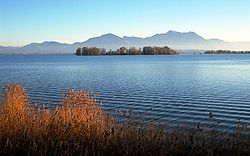
There are three main islands on the lake: Herreninsel ("gentlemen's island"), the largest, with an area of 238 hectares (590 acres); Frauenchiemsee, 15.5 ha (38 acres), also called Fraueninsel ("ladies' island"); and the uninhabited Krautinsel ("cabbage island"),[2] 3.5 ha (8.6 acres), called by this name because in the Middle Ages it was cultivated with cabbages and other vegetables.[3]

The smallest island in the lake is the Schalch 66 m (217 ft) west of Frauenchiemsee, which is of square outline, with a side length of only 4.7 m (15 ft) or an area of 22 m2 (240 sq ft). This tiny island had probably been created artificially to mark a shallow spot for sailboats. There is a willow on the island, originally planted in 1935, and replaced by a young tree in the 2000s.[citation needed]

AFRC Lake Hotel

[edit]

On 1 September 1938 the first Autobahn rest house opened on the A8 on the outskirts of Bernau am Chiemsee on the lake's southern shore. From 1945 until 2 September 2003 the building served as an Armed Forces Recreation Center for the US military, called the Lake Hotel.[4] The building is now an orthopaedic clinic.[citation needed]

References

[edit]
[edit]
Revisions and contributorsEdit on WikipediaRead on Wikipedia
from Grokipedia
Chiemsee is a large freshwater lake located in the Chiemgau region of southeastern , , often referred to as the "Bavarian Sea" due to its size and prominence. Covering an area of approximately 80 square kilometers, it is the largest lake entirely within and the third-largest in , with a maximum depth of 74 meters and a shoreline extending about 64 kilometers (83 kilometers including the islands). Formed around 10,000 years ago during the Würm glacial period of the last , the lake originally spanned up to 240 square kilometers but has since shrunk due to sedimentation. It features three notable islands—Herreninsel, Fraueninsel, and the smaller Krautinsel—and serves as a vital ecological site designated as a Ramsar since 1976, supporting diverse waterbirds and endemic fish species. The lake's islands are central to its cultural and historical identity. Herreninsel, the largest at about 238 hectares, hosts the unfinished Herrenchiemsee Palace, constructed starting in 1878 by King as a "Temple of Fame" modeled after the Palace of Versailles in ; designed by architect Georg Dollmann, it includes opulent features like a and state rooms, and was designated a in 2025 as part of Ludwig II's palace ensemble. Fraueninsel, at about 15.5 hectares and home to around 300 residents, is dominated by Frauenwörth Abbey, a Benedictine founded around 770 AD by Tassilo III of , making it one of Germany's oldest active women's monasteries; the abbey endured historical upheavals, including destruction by Hungarian incursions around 916 AD and re-establishment in the , and remains a pilgrimage site with ongoing monastic life. Krautinsel, the smallest and at roughly 3.5 hectares, was historically used as an agricultural plot for herbs and vegetables to supply the nearby monasteries, and today it functions primarily as a grazed by sheep. Ecologically, Chiemsee is renowned for its clean waters and , encompassing 8,231 hectares of freshwater lake with extensive natural shore vegetation and hydro-seral zones; it supports over 1% of the global populations of species such as the (Aythya fuligula), (Mergus merganser), and red-crested pochard (Netta rufina), alongside endangered fish like the Chiemsee whitefish (Coregonus hoferi) and Black Sea roach (Rutilus meidingeri). The area is protected under the EU network and includes nature reserves like the Tiroler Ache river mouth, though it faces pressures from and . Popular for water sports including , , and , as well as boat excursions to the islands, Chiemsee attracts visitors seeking its scenic Alpine backdrop and historical treasures, while ongoing silting is projected to gradually fill the basin over the next 8,000 years.

Geography

Location and physical characteristics

Chiemsee is a freshwater lake located in southeastern , , spanning the districts of and , approximately 70 km southeast of and near the town of Rosenheim. The lake's central coordinates are 47°52'35"N 12°27'15"E. The lake covers a surface area of 80 km², making it the largest in and the third largest in , with a length of 15 km, maximum width of 8 km, maximum depth exceeding 70 m, shoreline length of approximately 64 km, and elevation of 518 m above . It is divided into two basins by a shallow : the larger northeastern Weitsee and the smaller southwestern Inselsee, where the lake's three main islands are situated. The lake is bordered to the south by the Chiemgau Alps and to the north by the Inn-Salzach region, with shores featuring meadows, forests, reed belts, peatbogs, fens, and willow shrubs.

Hydrology and water quality

The Chiemsee is a freshwater lake sustained primarily by inflows from the Tiroler Achen, its main tributary originating in the Austrian Tyrol, and the Prien River from the Bavarian Alps, along with contributions from groundwater. These surface water sources maintain the lake's freshwater character, with water levels exhibiting seasonal fluctuations—typically higher in late spring and summer due to snowmelt and precipitation, and lower in winter. The lake's sole outflow is the Alz River, which drains northward into the Inn River and ultimately the Danube basin. The lake holds a water volume of 2,048 × 10⁶ m³, with an average depth of 25.6 m, contributing to its overall hydrological stability despite the divided basins. Chiemsee is recognized as one of Germany's cleanest lakes, benefiting from low nutrient levels that promote high and visibility. Its trophic status is classified as oligotrophic to mesotrophic, reflecting effective nutrient management measures implemented since the late , including a ring system that reduced from historical eutrophic conditions in the 1970s and . Seasonal variations influence the lake's , with ice cover possible during harsh winters, enabling activities like when conditions allow. Water temperatures typically range from 4°C in winter to 20°C in summer, with an annual average reflecting this variability and supporting the lake's ecological balance.

Formation and geology

Glacial origins

The Chiemsee basin formed approximately 10,000 years ago during the retreat phase of the Würm glaciation, the last major Ice Age in the that concluded around 11,700 years . This marked the end of extensive ice coverage in the northern Alpine foreland, where meltwaters and retreating ice tongues shaped the landscape. The basin was primarily carved by the -Chiemsee Glacier, a large lobe that advanced from the Inn Valley in the , reaching a maximum extent of about 60 by 65 kilometers across the Bavarian plain. Through subglacial , the scoured a deep overdeepened depression into the underlying Tertiary sediments of the Alpine foreland, creating a tongue-shaped basin up to several tens of meters deep. Basal ice movement and pressure from the overlying ice mass facilitated this excavation, with the glacier's front fluctuating through multiple stadials, including the Kirchseeon, Ebersberg, and Ölkofen phases. Immediately following , the basin filled with to form a much larger proglacial lake than the present-day Chiemsee, which spans roughly 80 square kilometers. Over subsequent millennia, natural sediment infilling from surrounding rivers and climatic warming toward the reduced its extent through terrestrialization and peat accumulation in peripheral areas. The geological foundation of the basin consists mainly of end moraine deposits from the glacier's terminal positions, forming arcuate ridges and fields, alongside fluvioglacial sediments such as outwash gravels and terraces deposited by streams. These materials, including and sorted sands and gravels, overlie older Pleistocene strata and provide the for the modern lake while preserving evidence of the glacial dynamics.

Historical changes to the lake

Following the retreat of the Würm glaciation approximately 10,000 years ago, the Chiemsee experienced significant natural reduction in size due to ongoing sediment deposition from major inflows like the Tiroler Achen, which contributes about 68% of the lake's water input. Originally spanning nearly 240 km², the lake's area shrank to its current 80 km² through shoreline progradation, where sediments accumulated and advanced the coastline, particularly in bays such as Hirschauer Bucht at rates up to 25 m per year since the 1970s. This process involved annual sediment inputs of around 140,000 m³ in affected areas, gradually filling shallow margins and stabilizing surrounding landforms. Human interventions further altered the lake's structure beginning in the , when drainage efforts targeted surrounding and moors south of the Chiemsee, such as the Kendlmühlfilzen and Rottauer areas. These attempts, primarily for extraction as and to enable agricultural use, involved digging drainage ditches and constructing peat railways, achieving partial success by lowering levels and reducing flooded extents in peripheral zones while preserving the core lake basin. By the late , such modifications had converted some areas into grasslands, though ecological impacts included that persisted into the . In the early , additional engineering focused on water management, with the lake's level artificially lowered by approximately 1 m around 1904 through modifications to outlet canals and weirs for reclamation and flood control. This reduction facilitated drier conditions in marginal zones, aiding farming expansion. The combined natural and anthropogenic changes also impacted the islands; gradual exposure of shallow surrounding areas via sediment buildup contributed to their long-term stabilization, preventing erosion and enhancing structural integrity against wave action.

Islands

Herreninsel

Herreninsel, the largest of Chiemsee's islands, covers 238 hectares and lies in the lake's southwestern Inselsee basin. Accessible exclusively by boat from the mainland ports of or Chieming-Seebruck, it serves as a prominent historical and natural landmark in . The island's terrain, dominated by woodland and parkland comprising about two-thirds of its area, contributes to Chiemsee's broader ecological diversity. The island's central attraction is Herrenchiemsee Palace, known as the Neues Schloss, commissioned by King in 1873 and constructed from 1878 until his death in 1886. Intended as a homage to the Palace of Versailles and a "Temple of Fame" for , the project was designed by architect Georg Dollmann but remained unfinished, with only the central section and approximately 20 of the planned 70 rooms completed before work halted due to financial constraints and the king's demise. In 2025, the palace was designated a as part of the "Palaces of King Ludwig II of Bavaria" serial property. Key features include the opulent Great Hall of Mirrors, spanning 98 meters and illuminated by 33 chandeliers, the grand State Staircase modeled after Versailles' Ambassador's Staircase, and the State Bedroom, all exemplifying Ludwig's vision of absolutist grandeur. Adjacent ruins of the former Augustinian , originally established around 1125–1129 on the site of an earlier Benedictine dating to 765, provide additional historical depth; the complex was secularized in 1803 and later repurposed by Ludwig as the "Old Palace" for his residences. Other notable sites include the Bavarian at the island's harbor, symbolizing Bavaria's enduring presence and dedication of the site to the region. Today, Herreninsel functions as both a state-managed complex and a protected , where visitors explore the palace and grounds via guided tours emphasizing Ludwig II's architectural ambitions and the island's monastic legacy. The surrounding park, partially realized from designs by Carl von Effner, features fountains and trails that highlight the interplay of royal artifice and natural beauty.

Fraueninsel

Fraueninsel, the second-largest island in Chiemsee, spans 15.5 hectares and serves as a serene, inhabited enclave distinct from its more touristic counterpart, Herreninsel. Home to approximately 300 permanent residents living in around 50 houses, the island maintains a close-knit community that includes about 30 Benedictine nuns residing in the historic abbey. The Benedictine nunnery, known as Frauenwörth Abbey, traces its origins to the , when it was founded by Duke Tassilo III of Bavaria around 782 and consecrated by . The island's key landmark is the Klosterkirche Frauenwörth, the abbey church dedicated to the , which exemplifies a blend of historical architectural layers. Constructed around 1100 on Carolingian foundations from the , the three-nave structure features Romanesque elements, including 12th-century frescoes uncovered in that adorn its interior. The church underwent rebuilding in the , with a ribbed vault added in the late and Baroque altars installed between 1688 and 1702, while its freestanding bell tower—boasting a 12th-century base, 14th-century upper sections, and a 1626 —stands as an iconic symbol of the Chiemgau region. The nunnery buildings themselves remain active, housing the Benedictine community that continues to follow the Rule of St. Benedict, emphasizing prayer, work, and communal stability in their daily routines. Life on Fraueninsel revolves around a rooted in , with the island's residents sustaining a longstanding of fishers who harvest species from Chiemsee, such as and char. Numerous smokehouses dot the landscape, where freshly caught are processed and sold, preserving a passed down through generations and contributing to the local culinary heritage. The island is entirely car-free, promoting a peaceful ambiance accessible primarily by foot or occasional horse-drawn carriages, which offer a nostalgic along its compact paths. This car-free ethos, combined with the nuns' rhythmic ringing of the church bells to mark prayer times, fosters a timeless atmosphere that invites visitors to disconnect from modern haste.

Krautinsel and Schalch

Krautinsel, the smallest of Chiemsee's main islands, covers an area of 3.5 hectares and remains uninhabited. Historically, it served as a and garden for the nearby monasteries on Herreninsel and Fraueninsel, earning its name from the German word "Kraut" meaning . Today, it functions primarily as a summer for sheep and is designated as part of the Chiemsee landscape protection area, supporting reed beds and serving as a key breeding and resting for local bird species. Schalch is a artificial islet spanning just 22 square meters, located approximately 66 meters west of Fraueninsel. Created as a navigational marker for the shallow waters hazardous to vessels, it exemplifies early intervention in the lake's . The island features a single weeping willow tree, originally planted around 1935 by the artists' community on Fraueninsel and later replaced following storm damage. Both Krautinsel and Schalch play subtle ecological roles as refuges for avian life amid the lake's dynamic environment, while highlighting the interplay between natural formation and anthropogenic modification in Chiemsee's island system. Neither island is accessible to the public via regular services and is typically observed from passing boats.

Ecology

Flora and fauna

The oligotrophic to mesotrophic conditions of Lake Chiemsee sustain a diverse , particularly for that thrive in its clear, nutrient-limited waters. Notable inhabitants include (Perca fluviatilis), pike (Esox lucius), whitefish (Coregonus hoferi, an endemic considered extinct by IUCN since 2023), Black Sea (Rutilus meidingeri, an endemic now locally extinct in the lake), and other coregonids, alongside around 30 in total, such as (Abramis brama), (Anguilla anguilla), and pikeperch (Sander lucioperca). are represented by the invasive (Dreissena polymorpha), which has established populations but is subject to ongoing management to mitigate its ecological impacts. Shoreline vegetation is characterized by extensive reed beds dominated by common reed (), which form dense belts along much of the lake's periphery, alongside wet meadows and transitional hydro-seral stages that support a progression of aquatic to terrestrial plant communities. Submerged vegetation includes stoneworts (Chara aspera and Chara tomentosa) and pondweeds (Najas marina), contributing to habitat complexity. Rare and protected plants thrive in these wetlands, such as the endangered fen orchid (Liparis loeselii), vulnerable Siberian iris (), and critically endangered creeping water celery (Apium repens). The lake serves as a vital avifauna hotspot, hosting 147 breeding bird species and over 300 overall, with its reed beds and open waters providing key breeding and foraging grounds. Resident and breeding waterbirds include the (Podiceps cristatus), (Tachybaptus ruficollis), and various waterfowl like coots (Fulica atra) and gadwalls (Anas strepera). It is particularly significant for migratory and wintering populations, supporting more than 1% of global numbers for species such as tufted ducks (Aythya fuligula, up to 12,000 individuals), (Mergus merganser), red-crested pochards (Netta rufina), as well as herons like the (Ardea cinerea). Mammals in the surrounding wetlands include Eurasian beavers (Castor fiber), which form impressive colonies with lodges up to five meters long, enhancing habitat diversity through their dam-building activities. Bat species such as the greater mouse-eared bat (Myotis myotis) and (Rhinolophus hipposideros) utilize the lake's islands and shores for roosting and foraging. Amphibians are prominent in the shallows and reed edges, with frog species including the endangered (Bombina variegata), which breeds in temporary pools during its narrow spawning window.

Conservation efforts

The Chiemsee was designated as a of International Importance under the on 26 February 1976, as Site No. 95, encompassing 8,231 hectares focused on preserving extensive natural shore vegetation such as reed belts and hydro-seral areas including fens and peatbogs. This designation highlights the site's role in supporting wetland ecosystems vital for and water regulation in southeastern . Management of the Chiemsee falls under Bavarian state authority through the Landesamt für Umwelt (LfU), which enforces protections against , overdevelopment, and alteration via landscape protection ordinances covering over 12,000 hectares around the lake. Overlapping with EU sites, including the Chiemsee (SCI) and Chiemsee mit Alz (SPA), these measures integrate legal safeguards, water quality improvements, and restricted access to sensitive zones like fish spawning grounds. Key threats include driven by agricultural nutrient runoff, particularly through the Tiroler Ache delta, which promotes algal blooms and oxygen depletion, compounded by medium-level impacts from drainage and . Responses involve reed belt preservation as natural nutrient filters, legal restrictions on nearby under Bavarian laws, and buffer-like protections to curb runoff. monitoring addresses water level fluctuations, with ongoing assessments of regime changes, stratification stability, and extreme events like high water in 2013, using sediment cores, , and regular mapping since 1985. The Chiemsee Conservation Area, as a designated landscape zone, advances initiatives for sustainable practices, including monitoring and restoration projects in adjacent areas like Kendlmühlfilzen to enhance resilience. These efforts, coordinated by LfU and regional partners, emphasize , , and habitat reconnection to counter degradation while balancing ecological integrity with controlled human activities.

History and culture

Early human settlement

The earliest evidence of in the Chiemsee region dates to the period, with archaeological finds from the Münchshöfener culture indicating occupation around 4500–3800 BCE. Sites such as Stöttham, located near the lake shores, reveal artifacts including sherds and animal bones, suggesting small-scale communities that exploited the local environment for subsistence. These early inhabitants likely relied on in the lake and hunting in surrounding wetlands and forests, as evidenced by the proximity of settlements to water resources typical of Neolithic lake-side economies in . During the Roman era, the Chiemsee area formed part of the province of , with settlements emerging around 250 CE along the lake's periphery. Archaeological excavations at eleven sites, including Roman in Prien and Breitbrunn, in Grabenstätt, and cult sites in Pittenhart, demonstrate Roman agricultural and residential presence without major fortifications or structures directly on the lake islands. The region facilitated trade routes connecting Celtic and Roman communities, influencing local tribes through cultural exchange and , though no large-scale military installations are recorded. Roman and indigenous Celtic populations coexisted, as shown by mixed artifacts reflecting daily life and gradual of the area. The transition to the medieval period marked the establishment of enduring Christian institutions on the lake's islands, beginning with the Benedictine nunnery on Fraueninsel in 782 CE, founded by Duke Tassilo III of and consecrated by Bishop . This monastery, dedicated to the Blessed Virgin Mary, represented an early center of monastic life and survived Hungarian invasions to flourish from the 11th to 15th centuries. On Herreninsel, an Augustinian monastery was founded between 1125 and 1129, re-establishing prior religious presence under the Rule of St. Augustine and serving as a key ecclesiastical site until its secularization in 1803. These foundations underscored the lake's role in early Christian expansion in . This economic reliance on the lake complemented agricultural activities, ensuring amid the region's growing medieval settlements.

19th-century developments

In the mid-19th century, the introduction of steamships revolutionized access to Chiemsee, with the first steam vessel launching in 1845 and facilitating regular passenger services across the lake. This innovation, followed by the advent of iron-hulled boats in 1859, significantly boosted connectivity between the mainland and the islands, enabling easier transport of goods and visitors while laying the groundwork for emerging tourism. Complementing these maritime advances, the Munich-Salzburg railway line reached in 1860, providing direct rail access and spurring economic growth in the region by linking the lake to broader Bavarian networks. Concurrent with these transportation improvements, drove efforts around Chiemsee's margins, where wetlands and moors were drained through the construction of paths and ditches to enable extraction and farming. These 19th-century initiatives, motivated by rising energy and food demands, reduced the extent of surrounding marshes and altered the lake's ecological fringes, though they later prompted debates over habitat loss and water management. The era's most prominent development was King Ludwig II's ambitious construction of Herrenchiemsee Palace on Herreninsel, beginning in 1878 as a deliberate homage to French absolutism. Inspired by the Palace of Versailles, the project—designed by architect Georg Dollmann—aimed to create a "Temple of Fame" for , embodying ideals of divine-right monarchy with opulent halls and fountains that surpassed their French models in grandeur. Ludwig II personally oversaw the work, purchasing the island in 1873 and adapting former monastic structures for his use, but the palace remained unfinished upon his death in 1886, with only the central and key state rooms completed amid escalating costs. This incomplete edifice stands as a poignant monument to Ludwig II's reclusive extravagance, reflecting his growing isolation as he withdrew from Munich's political life to pursue fantastical visions in remote settings like the Chiemsee islands, where he resided only briefly—totaling about ten days in the new palace during its construction.

Tourism and recreation

Main attractions

One of the primary draws for visitors to Chiemsee is the guided tours of Palace on Herreninsel, where state rooms inspired by Versailles are accessible only through scheduled excursions lasting about 30 minutes, offered daily in multiple languages except on select holidays like January 1 and December 24-25. These tours highlight the palace's opulent interiors, while the surrounding formal gardens feature notable fountains, such as the Fama and fountains, which are activated at regular intervals to showcase water features amid sculpted landscapes. The park's design emphasizes symmetrical avenues and mythological motifs, providing a serene extension to the palace visit. Island explorations form another key attraction, with frequent boat trips departing from to Herreninsel and Fraueninsel, operated by Chiemsee Schifffahrt every 20-30 minutes during peak seasons and taking 10-15 minutes each way. On Fraueninsel, visitors can admire views of the Benedictine Frauenwörth Abbey, a historic dating to the with its distinctive gate hall and frescoes, while enjoying local cuisine such as fresh smoked whitefish or Steckerlfisch from island fish huts. These car-free islands offer a peaceful contrast to the mainland, blending cultural heritage with culinary experiences centered on lake-sourced specialties. Water-based activities abound on Chiemsee, including on its expansive 80-square-kilometer surface, where steady winds south of the islands support regattas organized by local clubs like the Seebruck Regatta Verein. Swimming is permitted in designated shallow areas along the shores, particularly near Chieming and Übersee, with clear waters ideal for summer dips. Cycling enthusiasts can follow the well-maintained Chiemsee Cycle Path, a 60-kilometer loop encircling the lake on mostly flat terrain, passing through villages and offering panoramic Alpine vistas. Seasonal events enhance the lake's appeal, with summer regattas drawing sailors for competitive races on the open waters, often hosted by regional clubs from through August. In winter, markets transform Fraueninsel into a festive haven, featuring over 90 stalls with crafts, , and baked goods during the first two Advent weekends, accessible only by for an intimate island atmosphere.

Facilities and economy

The AFRC Lake Hotel, originally constructed in 1938 as a Rasthaus (rest house) along the Munich-Salzburg Autobahn, served as an elite resort for Nazi officials and was briefly used as a hospital during World War II. Following the war, the United States Army seized the property in 1945 and operated it under the Armed Forces Recreation Centers (AFRC) as a vacation facility for military personnel until its closure in September 2003. After returning to German control in 2004, the building underwent partial renovation and reopened in fall 2011 as an orthopaedic clinic, now serving medical purposes rather than tourism. Modern infrastructure around Chiemsee supports extensive visitor access, including marinas in for sport boats and sailing vessels, as well as the Yachthafen Unterhochstätt marina in nearby Chieming on the southern shore. Visitor centers on the islands provide guided information; Herreninsel features a dedicated center near the palace for orientation and ticket services, while Fraueninsel offers tourist facilities integrated with the historic grounds. Sustainable accommodations emphasize eco-tourism, with properties like Chiemgauhof Lakeside Retreat employing energy-efficient designs and local sourcing, and SeeHotel Wassermann implementing chemical-free cleaning practices to minimize environmental impact. Tourism forms the backbone of the local in the Chiemgau region surrounding Chiemsee, driving and through visitor spending on accommodations, , and services, contributing significantly to Bavaria's overall sector valued at €47.5 billion in 2019. Secondary sectors include traditional , with about 16 professional fishermen operating on the lake using generational methods to harvest species like whitefish, , and pike-perch, and featuring meadows and crops that support regional food production. Transportation infrastructure facilitates easy access, with the Chiemsee-Schifffahrt operating frequent year-round ferries—up to every 20 minutes in peak season—from ports like and Gstadt to the islands, carrying passengers on a fleet of 15 vessels including historic steamers. These services integrate seamlessly with the Bavarian rail network, where trains from arrive at Prien station, followed by a connecting Chiemseebahn narrow-gauge railway to the Prien/Stock pier during summer months.

References

Add your contribution
Related Hubs
User Avatar
No comments yet.