Hubbry Logo
List of Russian ballet dancersList of Russian ballet dancersMain
Open search
List of Russian ballet dancers
Community hub
List of Russian ballet dancers
logo
8 pages, 0 posts
0 subscribers
Be the first to start a discussion here.
List of Russian ballet dancers
from Wikipedia

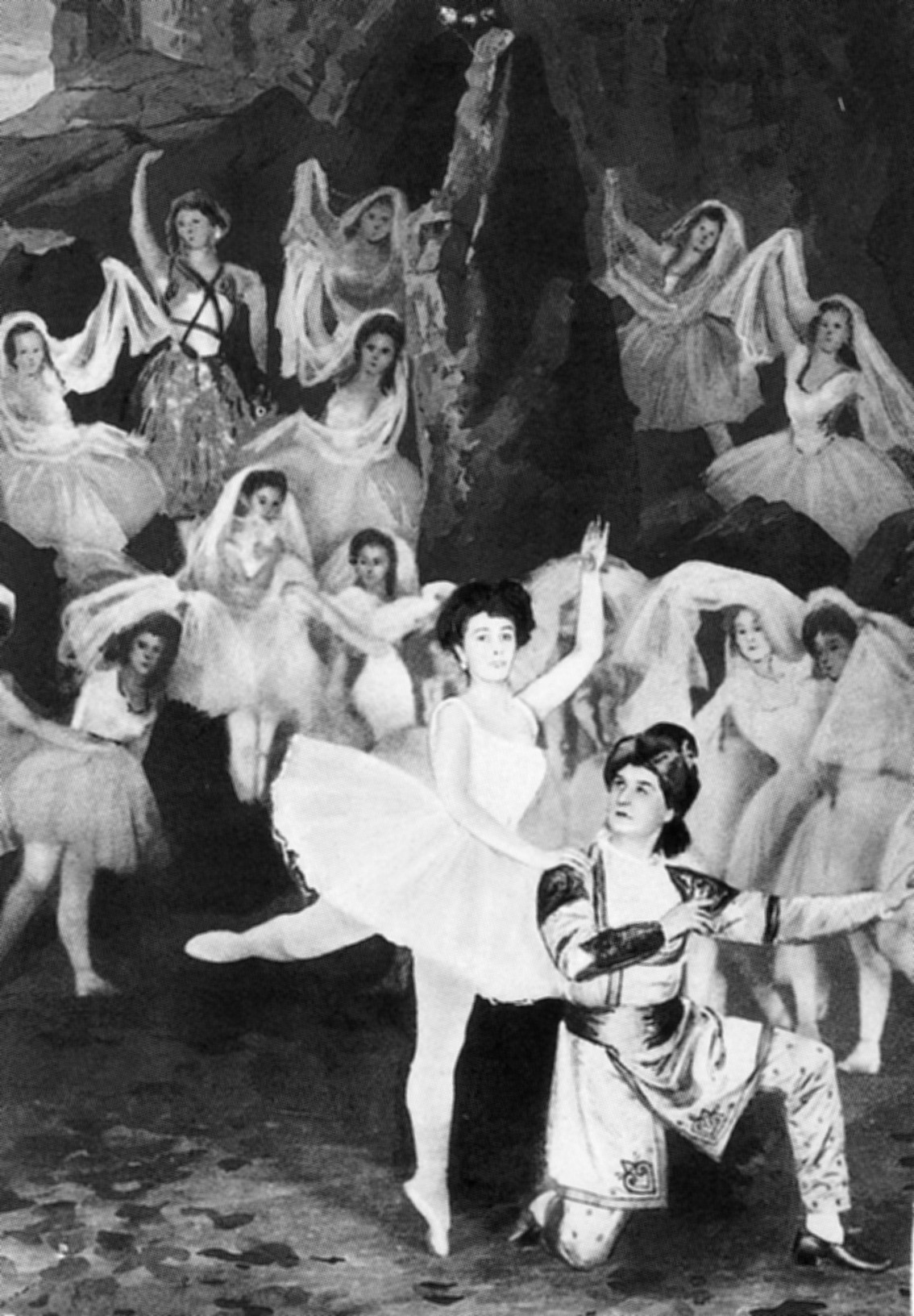
Mathilde Kschessinskaya and Pavel Gerdt in La Bayadère ballet by the ballet master Marius Petipa and the composer Ludwig Minkus, 1900

This is a list of ballet dancers from the Russian Empire, Soviet Union, and Russian Federation, including both ethnic Russians and people of other ethnicities. This list includes as well those who were born in these three states but later emigrated, and those who were born elsewhere but immigrated to the country and performed there for a significant portion of their careers.

The original purpose of the ballet in Russia was to entertain the royal court. The first ballet company was the Imperial School of Ballet in St. Petersburg in the 1740s. The Ballets Russes was a ballet company founded in the 1909 by Sergey Diaghilev, an enormously important figure in the Russian ballet scene. Diaghilev and his Ballets Russes' travels abroad profoundly influenced the development of dance worldwide.[1] The headquarters of his ballet company was located in Paris, France. A protégé of Diaghilev, George Balanchine, founded the New York City Ballet Company.

During the early 20th century, many Russian ballet dancers rose to fame. Soviet ballet preserved the perfected 19th century traditions,[2] and the Soviet Union's choreography schools produced one internationally famous star after another. The Bolshoi Ballet in Moscow and the Mariinsky in Saint Petersburg remain famous throughout the world.[3]

Alphabetical list

[edit]

A

[edit]
Portrait Person Details Stage Image
Anastasia Abramova
(1902–1985)
Russian Empire
Soviet Union
ballerina, Bolshoi Theatre
Svetlana Adyrkhaeva
(born 1938)
Soviet Union
Russian Federation
Prima ballerina, Bolshoi Theatre
Boris Akimov [ru]
(born 1946)
Soviet Union
Russian Federation
Danseur, Bolshoi Theatre
Maria Alexandrova
(born 1978)
Soviet Union
Russian Federation
Prima ballerina, Bolshoi Theatre
Maria Alexandrova as Kitri in Don Quixote, Bolshoi Theatre, 22 June 2011
Maria Allash
(born 1976)
Soviet Union
Russian Federation
Ballerina, Bolshoi Theatre
Elena Andreianova
(1819–1857)
Russian Empire
Prima ballerina, Bolshoi Theatre, Mariinsky Ballet
Yelena Andrienko
(born 1972)
Soviet Union
Russian Federation
ballerina, Bolshoi Theatre
Valery Viktorovich Anisimov [ru]
(born 1953)
Soviet Union
Russian Federation
Danseur, Bolshoi Theatre, Teacher
Anna Antonicheva
(born 1973)
Soviet Union
Russian Federation
ballerina, Bolshoi Theatre
Altynai Asylmuratova
(born 1961)
Soviet Union
Russian Federation

Kazakhstan
Prima ballerina, Mariinsky Theatre

Zhanna Ayupova [ru]
(born 1966)
Soviet Union
Russian Federation
Ballerina, Mariinsky Theatre

B

[edit]
Portrait Person Details Stage Image
Feya Balabina [ru]
(1910–1982)
Russian Empire
Soviet Union
Ballerina, Teacher, Ballet master, Mariinsky Theatre, Mikhaylovsky Theatre, Vaganova Academy of Russian Ballet
George Balanchine
(1904–1983)
Russian Empire
Soviet Union
France
United States
(Georgian descent)
Choreographer, balletmaster
Balanchine was one of the 20th century's foremost choreographers, a balletmaster of the Ballets Russes in France, founding balletmaster (and co-founder) of New York City Ballet: his work created modern ballet, based on his deep knowledge of classical forms and techniques.
Balanchine and Suzanne Farrell in Don Quixote
Irina Baronova
(1919–2008)
Soviet Union
Romania
France
United States
Switzerland
Russian Federation
Australia
Ballerina, ballet mistress
She was one of the Baby Ballerinas of the Ballet Russe de Monte Carlo, discovered by George Balanchine in Paris in the 1930s. She created roles in Léonide Massine's Le Beau Danube (1924), Jeux d'enfants (1932), and Les Présages (1933); and in Bronislava Nijinska's Les Cent Baisers (1935). Between 1940 and 1951 Baronova appeared in several films, and worked as ballet mistress for the 1980 film Nijinsky.
A photo with Baronova's autograph
Mikhail Baryshnikov
(born 1948)
Soviet Union
United States
Danseur
Mikhail Baryshnikov with Patricia McBride in Le baiser de la fée
Dmitry Belogolovtsev
(born 1973)
Soviet Union
Russian Federation
Danseur, Bolshoi Theatre
Dmitri Belogolovtsev as Abderahman, "Raymonda", Bolshoi Theatre, 2010
Natalia Bessmertnova
(1941–2008)
Soviet Union
Russian Federation
Prima ballerina, Bolshoi Theatre
A scene from ballet "Giselle". Natalia Bessmertnova as Giselle.
Alexander Bogatyrev [ru]
(1949–1998)
Soviet Union
Russian Federation
Danseur, Bolshoi Theatre
Zhanna Bogoroditskaya [ru]
(born 1969)
Soviet Union
Russian Federation
Ballerina, Stanislavski and Nemirovich-Danchenko Moscow Academic Music Theatre
Violetta Bovt
(1927–1995)
United States
Soviet Union
Ballerina, Stanislavski and Nemirovich-Danchenko Moscow Academic Music Theatre
Violetta Bovt and Arkady Nikolaev. 1965
Nikolai Boyarchikov [ru]
(born 1935)
Soviet Union
Russian Federation
Danseur, Ballet master, Mikhaylovsky Theatre
Boris Bregvadze [ru]
(1926–2012)
Soviet Union
Russian Federation
Danseur, Teacher, Mariinsky Theatre
Dmitri Bryantsev [ru]
(1947–2004)
Soviet Union
Russian Federation
Danseur, Ballet master, Stanislavski and Nemirovich-Danchenko Moscow Academic Music Theatre
Yuri Burlaka [ru]
(born 1968)
Soviet Union
Russian Federation
Danseur, Ballet master, Teacher, Moscow State Academy of Choreography, Bolshoi Theatre
Vladimir Bourmeister
(1904–1971)
Russian Empire
Soviet Union
Danseur, Ballet master, Stanislavski and Nemirovich-Danchenko Moscow Academic Music Theatre

C

[edit]
Portrait Person Details Stage Image
Raissa Calza
(1894–1979)
Russian Empire
Ukraine
Vakhtang Chabukiani
(1910–1992)
Soviet Union
Danseur, Choreographer, Ballet master, Mariinsky Theatre, Tbilisi Opera and Ballet Theatre
Catherine Chislova
(1846–1889)
Russian Empire
Ballerina
Catherine Chislova c. 1865

D

[edit]
Portrait Person Details Stage Image
Alexandra Danilova
(1903–1997)
Russian Empire
Soviet Union
France
United States
Prima ballerina
Danilova as Fanny Cerrito in Pas de Quatre, 1948
Pavel Dmitrichenko
(born 1984)
Russia
Former principal dancer, Bolshoi Ballet
Natalia Dudinskaya
(1912–2003)
Russian Empire
Soviet Union
Russian Federation
Prima ballerina, Mariinsky Theatre

E

[edit]
Portrait Person Details Stage Image
Lubov Egorova
(1880–1972)
Russian Empire
France
Ballerina, Mariinsky Theatre
Lubov Egorova in the title role of the choreographer Marius Petipa's and the composer Cesare Pugni's ballet The Blue Dahlia, 1905
Olga Esina
(born 1986)
Soviet Union
Russian Federation
Ballerina
Olga Esina (in Russian Ольга Есина) is a Russian ballerina who was educated at the Vaganova Academy of Russian Ballet in St. Petersburg. In 2010 she became First Solo Dancer at the Vienna State Ballet.
Olga Esina and Roman Lazik, "Donauwalzer" Belvedere, Vienna, 1 January 2012

F

[edit]
Portrait Person Details Stage Image
Nikolai Fadeyechev
(born 1933)
Soviet Union
Russian Federation
Dancer, Teacher, Bolshoi Theater
Nikolai Fadeyechev was born in Moscow, was a Soviet Russian dancer ballet, was dancer with the Bolshoi Ballet, graduated from the Moscow Ballet School in 1952 and joined the Bolshoi Theatre, danced many principal roles. He danced alongside some of the great ballerinas such as Galina Ulanova in "Giselle" and "Les Sylphides", was a regular partner with Maya Plisetskaya, Raisa Struchkova, Nina Timofeeva, Marina Kondratyeva, Natalia Bessmertnova, Ekaterina Maximova, Ludmila Semenyaka. After that, he became one of the most important teachers and répétiteurs of the Bolshoi Theatre. Nikolay Tsiskaridze, Andrey Uvarov [ru], Sergei Filin, Artem Ovcharenko were among her adepts.
Nikolai Fadeyechev in a scene from Pyotr Tchaikovsky's ballet Swan Lake staged at the State Academic Bolshoi Theater of the USSR. 1 January 1956
Sergei Filin
(born 1970)
Soviet Union
Russian Federation
Dancer, Artistic Director, Bolshoi Theater
Mikhail Fokine
(1880–1942)
Russian Empire
United States
Danseur
Mikhail Fokine as the hussar in Halte de Cavelerie, Saint Petersburg, c. 1900

G

[edit]
Portrait Person Details Stage Image
Valentina Ganibalova [ru]
(born 1948)
Soviet Union
Russian Federation
Ballerina, Mariinsky Theatre
Yekaterina Geltzer
(1876–1962)
Russian Empire
Soviet Union
Prima ballerina, Bolshoi Theatre
Elizaveta Gerdt
(1891–1975)
Russian Empire
Soviet Union
Ballerina
Elizaveta Gerdt, Elsa Vill, and Pierre Vladimirov in the "Paquita" Pas de Trois, 1905
Pavel Gerdt
(1844–1917)
Russian Empire
Premier Danseur Noble
Pavel Gerdt as Pepito in The King's Command or The Pupils of Dupré
Adelaide Giuri [ru]
(1872–1963)
Italy
Russian Empire
Soviet Union
Ballerina, Bolshoi Theatre, La Scala
Adelaide Giuri [ru] as Odette and Mikhail Mordkin as Prince Siegfried in Alexander Gorsky's staging of the Petipa/Ivanov "Swan Lake" for the Bolshoi Theatre, Moscow, 1901. A young Vera Karalli is seen kneeling.
Alexander Godunov
(1949–1995)
Soviet Union
United States
Danseur
Kasyan Goleizovsky
(1892–1970)
Russian Empire
Soviet Union
Danseur, Choreographer, Ballet master, Bolshoi Theatre
Sofia Golovkina
(1915–2004)
Russian Empire
Soviet Union
Russian Federation
Ballerina, Teacher, Ballet master, Moscow State Academy of Choreography, Bolshoi Theatre
Alexander Gorsky
(1871–1924)
Russian Empire
Soviet Union
Danseur, ballet master, Mariinsky Theatre, Bolshoi Theatre
Ballets by Alexander Gorsky In Philately "Gudule’s Daughter" (a revision of the "La Esmeralda") (1902), "Salammbô" (1910), "Don Quixote" (1900), "Giselle" (1907), "La Bayadère" (1917)
Nadezhda Gracheva
(born 1969)
Soviet Union
Russian Federation
Ballerina, Bolshoi Theatre
A scene from "Raymonda". Nadezhda Gracheva as Raymonda, Bolshoi Theatre, 2010
Yury Grigorovich
(1927–2025)
Soviet Union
Russian Federation
Danseur, Choreographer, Ballet master, Mariinsky Theatre, Bolshoi Theatre
Yury Nikolayevich Grigorovich is a Soviet and Russian dancer and choreographer who dominated the Russian ballet for 30 years. Grigorovich was born into a family connected with the Imperial Russian Ballet. He graduated from the Leningrad Choreographic School in 1946 and danced as a soloist of the Kirov Ballet until 1962. His staging of Sergey Prokofiev's The Stone Flower (1957) and of The Legend of Love [ru] (1961) brought him acclaim as a choreographer. In 1964 he moved to the Bolshoi Theatre, where he would work as an Artistic director until 1995. His most famous productions at the Bolshoi were "The Legend of Love" (1965, 2002), The Nutcracker (1966), Spartacus (1967), Ivan the Terrible (ballet) (1975), The Golden Age (1982, 1994, 2006). Other notable productions The Sleeping Beauty (1963, 1973, 2011), Swan Lake (1969, 2001), Romeo and Juliet (1979, 2010), Raymonda (1984, 2003), Giselle (1987), La Bayadère (1991), Don Quixote (1994), Le Corsaire (1994). Choreographed for various Russian companies before settling in Krasnodar, where he set up his own company. Grigorovich has been heading the juries of numerous international competitions in classical ballet. After the death of his wife, the great ballerina Natalia Bessmertnova, on 19 February 2008, he has been offered the opportunity to return to the Bolshoi again in the capacity of ballet master and choreographer.
Dmitry Gudanov
(born 1975)
Soviet Union
Russian Federation
Danseur, Bolshoi Theatre
Dmitry Gudanov as Albrecht in "Giselle", Bolshoi Theatre, 21 January 2011

I

[edit]
Portrait Person Details Stage Image
Avdotia Istomina
(1799–1848)
Russian Empire
Prima ballerina
Lev Ivanov
(1834–1901)
Russian Empire
Danseur, choreographer, ballet master, Mariinsky Theatre
Lev Ivanov costumed as Solor for Act I of "La Bayadère". St. Petersburg, 1877.

K

[edit]
Portrait Person Details Stage Image
Viktorina Kapitonova
(born 1985)
Russian Federation
Switzerland
Prima ballerina
Vera Karalli
(1889–1972)
Russian Empire
Weimar Republic
Nazi Germany
Austria
Soviet Union
Ballerina, actress
Russian ballerina Vera Karalli, 1910s
Tatiana Karpakova [ru]
(1812–1842)
Russian Empire
Ballerina, Bolshoi Theater
Tamara Karsavina
(1885–1978)
Russian Empire
United Kingdom
Prima ballerina
Russian ballerina Tamara Karsavina (c. 1912)
Nora Kiss
(1908–1993)
Russian Empire
ballerina, ballet teacher in Paris
Irina Kolpakova
(born 1933)
Soviet Union
Russian Federation
Prima ballerina, Mariinsky Theatre
Evgenia Kolosova
(1780–1869)
Russian Empire
Ballerina
Marina Kondratyeva
(1934–2024)
Soviet Union
Russian Federation
ballerina, Bolshoi Theater
Marina Kondratyeva as Giselle and Maris Liepa as Albrecht in a scene from Act 1 of Adolphe Charles Adam's ballet Giselle staged at the State Academic Bolshoi Theater of the USSR. 1 January 1972
Theodore Kosloff
(1882–1956)
Russian Empire
United States
Danseur
Theodore Kosloff in Fokine's 1913 production of Scheherazade
Ekaterina Krysanova
(born 1985)
Soviet Union
Russian Federation
Ballerina, Bolshoi Theatre
Mathilde Kschessinska
(1872–1971)
Russian Empire
France
Prima ballerina assoluta
Russian ballerina Mathilde Kschessinskaya in "The Talisman", 1905. Mariinsky Theatre, St. Petersburg, Russia
Ninel Kurgapkina
(1929–2009)
Soviet Union
Russian Federation
Ballerina, Teacher, Mariinsky Theatre

L

[edit]
Portrait Person Details Stage Image
Leonid Lavrovsky
(1905–1967)
Russian Empire
Soviet Union
Danseur, Choreographer, Ballet master, Mariinsky Theatre, Mikhaylovsky Theatre, Bolshoi Theatre
Mikhail Lavronsky
(born 1941)
Soviet Union
Russian Federation
Danseur, Bolshoi Theatre
Larissa Lezhnina
(born 1969)
Russian Federation
Netherlands
Ballerina, Mariinsky Theatre, Dutch National Ballet
Olga Lepeshinskaya
(1916–2008)
Russian Empire
Soviet Union
Russian Federation
Prima ballerina, Bolshoi Theatre
Olga Lepeshinskaya as Kitry in Don Quixote. 1940
Andris Liepa
(born 1962)
Soviet Union
Russian Federation
Latvia
Danseur, Bolshoi Theatre, Mariinsky Theatre, Theatre director, Theatrical producer
Ilze Liepa
(born 1963)
Soviet Union
Russian Federation
Ballerina, Bolshoi Theatre
Māris Liepa
(1936–1989)
Latvia
Soviet Union
Danseur, Latvian Opera and Ballet Theatre, Bolshoi Theatre
Marina Kondratyeva as Giselle and Maris Liepa as Albrecht in a scene from Act 1 of Adolphe Charles Adam's ballet Giselle staged at the State Academic Bolshoi Theater of the USSR. 1 January 1972
Serge Lifar
(1905–1986)
Russian Empire
France
Danseur, ballet master
Tamara Toumanova and Serge Lifar in Swan Lake
Ulyana Lopatkina
(born 1973)
Soviet Union
Russian Federation
Prima ballerina, Mariinsky Theatre
Ulyana Lopatkina of the Mariinsky Ballet in Swan Lake at the Royal Opera House. 7 August 2009
Lydia Lopokova
(1892–1981)
Russian Empire
United Kingdom
Ballerina
Ballerina Lydia Lopokova
Fyodor Lopukhov
(1886–1973)
Russian Empire
Soviet Union
Danseur, Teacher, Choreographer, Ballet master, Mariinsky Theatre, Mikhaylovsky Theatre
Elena Lukom
(1891–1968)
Russian Empire
Soviet Union
Ballerina, Mariinsky Theatre
Elena Lukom and Vladimir Ponomarev as ballet "Les Caprices du Papillon". St. Petersburg, Russia. 1919
Svetlana Lunkina
(born 1979)
Soviet Union
Russian Federation
Prima ballerina, Bolshoi Theatre
Svetlana Lunkina as Odette in Swan Lake, Bolshoi Theatre, 22 May 2011

M

[edit]
Portrait Person Details Stage Image
Askold Makarov
(1925–2000)
Soviet Union
Russian Federation
Danseur, Choreographer, Teacher, Mariinsky Theatre, Theatre Choreographic Miniatures
Natalia Makarova 2012
Natalia Makarova
(born 1940)
Soviet Union
United States
prima ballerina assoluta
Choreographer, Teacher, Kirov Ballet
Defected to the West in 1970. Initially active with the Royal Ballet then settled in US and active globally
Yulia Makhalina
(born 1968)
Soviet Union
Russian Federation
Prima ballerina, Mariinsky Theatre
Léonide Massine
(1896–1979)
Russian Empire
Danseur, choreographer
Valery Maximov

(born 1971)

Soviet Union

Russian Federation

Danseur, choreographer, Actor

Ekaterina Maximova
(1939–2009)
Soviet Union
Russian Federation
Prima ballerina, Bolshoi Theatre
Ekaterina Sergeevna Maximova was a Soviet and Russian ballerina of international renown. Maximova was coached by the legendary ballerina Galina Ulanova. Her greatest successes were the roles of Kitri in Don Quixote, Clara (called Maria in the Bolshoi production) in The Nutcracker, and the title roles in Giselle and Cinderella. Maximova performed with the Bolshoi Ballet from 1958 until 1980, often performing opposite her husband Vladimir Vasiliev. She and her husband gained wide exposure for their appearances in Franco Zeffirelli's filmed version of Giuseppe Verdi's opera La traviata (1983). When the Bolshoi Ballet toured to the United States for the first time in 1959, Maximova also performed as a guest artist with the Metropolitan Opera in leading roles in The Stone Flower and other ballets. Following her career as a dancer, Maximova was a coach with the ballet and a member of the GITIS Institute faculty. After that, she became one of the most important teachers and répétiteurs of the Bolshoi Theatre. Galina Stepanenko, Svetlana Lunkina, Marianna Ryzhkina, Anna Nikulina were among her adepts.
Yekaterina Maksimova (R) as Kitri and Vladimir Vasilyev as Basilio in a scene from Ludwig Minkus' ballet Don Quixote staged at the State Academic Bolshoi Theater of the USSR. 1 January 1971
Asaf Messerer
(1903–1992)
Russian Empire
Soviet Union
Danseur, choreographer
Sulamith Messerer
(1908–2004)
Russian Empire
Soviet Union
United Kingdom
Japan
Ballerina,choreographer
Galina Mezentseva
(born 1952)
Soviet Union
Russian Federation
United States
Ballerina, Mariinsky Theatre
Igor Moiseyev
(1906–2007)
Soviet Union
Russian Federation
Ballet master, Igor Moiseyev Ballet
Irek Mukhamedov OBE
(born 1960)
Tatarstan
Soviet Union
United Kingdom
Senior Principal Dancer, Bolshoi Ballet, The Royal Ballet
Awarded the Hans Christian Andersen Award for best dancer in the world in 1988. Defected to the West in 1990. Settled in the United Kingdom where he performed in leading roles before taking up choreography.
Vladimir Muravlev
(born 1974)
Uzbekistan
Russia
Principal Dancer, Moscow Classical Ballet

N

[edit]
Portrait Person Details Stage Image
Anastasia Nabokina
(1971–)
Russian
Soviet Union
Russia
Bronislava Nijinska
(1891–1972)
Polish
Russian Empire
United States
Prima Ballerina, choreographer
Vaslav Nijinsky
(1890–1950)
Polish
Russian Empire
Danseur, choreographer
Nijinsky in Le Spectre de la Rose
Irma Nioradze
(born 1969)
Soviet Union
Georgia
Russian Federation
Ballerina, Mariinsky Theatre
Cleo Nordi
(1898–1983)
Kronstadt
Russian Empire
Ballerina with Anna Pavlova, choreographer
ballet teacher Sadler's Wells Ballet, London
Rudolf Nureyev
(1938–1993)
Soviet Union
France
Austria
Danseur, choreographer, Mariinsky Theatre, Paris Opera

O

[edit]
Portrait Person Details Stage Image
Evgenia Obraztsova
(born 1984)
Soviet Union
Russian Federation
Prima Ballerina, Mariinsky Theatre, Bolshoi Theatre
Evgenia Obraztsova dancing "The Sleeping Beauty", Royal Opera House, London, November 2009
Natalia Osipova
(born 1986)
Soviet Union
Russian Federation
Ballerina, Bolshoi Theatre, Mikhaylovsky Theatre
Natalia Osipova in an extract from "Flames of Paris", at the October 2011 reopening gala of the Bolshoi Theatre
Artem Ovcharenko
(born 1986)
Soviet Union
Russian Federation
Dancer, Bolshoi Theatre
Artem Ovcharenko as Jean de Brienne, "Raymonda", Bolshoi Theatre, 2010

P

[edit]
Portrait Person Details Stage Image
Valery Panov
(born 1938)
Soviet Union
Israel
Danseur, choreographer, Mariinsky Theatre
Daria Pavlenko
(born 1978)
Soviet Union
Russian Federation
Prima ballerina, Mariinsky Theatre
Anna Pavlova
(1881–1931)
Russian Empire
The Netherlands
Prima ballerina
Anna Pavlova in the Fokine/Saint-Saëns The Dying Swan, Saint Petersburg, 1905
Nadezhda Pavlova
(born 1956)
Soviet Union
Russian Federation
Prima ballerina, Bolshoi Theatre
Marie Petipa
(1857–1930)
Russian Empire
France
Ballerina
Marius Petipa
(1818–1910)
France
Russian Empire
Danseur, choreographer, ballet master, Mariinsky Theatre
Ballets by Marius Petipa In Philately "Paquita" (1847), "The Sleeping Beauty" (1890), "Swan Lake" (1895), "Raymonda" (1898)
Maya Plisetskaya
(1925–2015)
Soviet Union
Russian Federation
Lithuania
Spain
Prima ballerina assoluta, Bolshoi Theatre
Maya Plisetskaya performing in Carmen (Carmen Suite). 1974
Olga Preobrajenska
(1871–1962)
Russian Empire
France
Ballerina, Mariinsky Theatre
Olga Preobrajenska in the title role of the choreographer Louis Méranté's and the composer Léo Delibes's ballet "Sylvia", Mariinski-Ballett, 1901

R

[edit]
Portrait Person Details Stage Image
Tatiana Riabouchinska
(1917–2000)
Russian Empire
France
United States
Ballerina
Ida Rubinstein
(1883–1960)
Russian Empire
France
Ballerina, actress
Farukh Ruzimatov
(1963–)
Tashkent, Uzbekistan>br />Uzbek-Russian
Danseur, Assistant Artistic Director
Marianna Ryzhkina
(????–)
Russia
Ballerina

S

[edit]
Portrait Person Details Stage Image
Galina Samsova
(1937–2021)
Russia
Ballerina
Olga Sapphire
(1907–1981)
Russian Empire
Japan
Danseur, Teacher, Nihon Gekijō (Tokyo)
Olga Ivanovna Pavlova trained at both the Leningrad State Choreographic Institute and Moscow Choreographic School and performed throughout Russia until her marriage in the early 1930s to a Japanese diplomat. Moving to Japan in 1936, she was influential in establishing ballet in Japan.[4]
Sapphire performing in Giselle, Tokyo, 1936
Gennady Selutsky [ru]
(born 1936)
Soviet Union
Russian Federation
Danseur, Teacher, Mariinsky Theatre, Vaganova Academy of Russian Ballet
Ludmila Semenyaka
(born 1952)
Soviet Union
Russian Federation
Ballerina, Bolshoi Theatre
Lyudmila Semenyaka (left) and Nikolai Kovmir (right) performing at the 1st international ballet contest in Moscow. 1 June 1969
Nina Semizorova [ru]
(born 1956)
Soviet Union
Russian Federation
Ballerina, Bolshoi Theatre
Marina Semyonova
(1908–2010)
Russian Empire
Soviet Union
Russian Federation
Prima ballerina assoluta, Teacher, Mariinsky Theatre, Bolshoi Theatre
Marina Timofeyevna Semyonova was the first Soviet-trained prima ballerina. She was born in Saint-Petersburg. She was named a People's Artist of the USSR in 1975. She worked in the Kirov Ballet until 1930, transferred to the Bolshoi Theatre in Moscow. Semyonova was guest with the Paris Opéra Ballet in 1935 where she danced Giselle with Serge Lifar. She received the Stalin Prize for 1941 and retired in 1952. After that, she became one of the most important teachers and répétiteurs of the Bolshoi Theatre. Natalia Bessmertnova, Marina Kondratyeva, Nadezhda Pavlova, Nina Sorokina, Ludmila Semenyaka, Nina Timofeeva, Nina Ananiashvili, Galina Stepanenko and Nikolay Tsiskaridze were among her adepts. In 2003, she won the Prix Benois de la Danse for lifetime achievement. Semyonova retired from her coaching duties at the age of 96, died on 9 June 2010 in her home in Moscow, three days before her 102nd birthday.
Konstantin Sergeyev
(1910–1992)
Russian Empire
Soviet Union
Russian Federation
Danseur, Choreographer, Mariinsky Theatre
Alla Shelest
(1919–1998)
Soviet Union
Russian Federation
Prima ballerina, Mariinsky Theatre
Maria Shirinkina
(born 1987)
Soviet Union
Russian Federation
Prima Ballerina, Mariinsky Theatre, Bayerisches Staatsballett
Vladimir Shklyarov
(1985-2024)
Soviet Union
Russian Federation
Premier Danseur, Mariinsky Theatre, Bayerisches Staatsballett
Daniil Simkin
Russian Federation
Premier Danseur, American Ballet Theatre
Maria Skorsiuk
(1872–1901)
Ballerina, Mariinsky Ballet
Yuri Soloviev
(1940–1977)
Soviet Union
Premier Danseur, Mariinsky Theatre
Alina Somova
(born 1985)
Soviet Union
Russian Federation
Ballerina, Mariinsky Theatre
Alina Somova in a scene from Pyotr Tchaikovsky's ballet Sleeping Beauty
Nina Sorokina
(1942–2011)
Elektrostal, Soviet Union
Russian
Ballerina, Ballet Bolshoi
Olga Spessivtseva
(1895–1991)
Russian Empire
Soviet Union
France
United States
Prima ballerina, Mariinsky Theatre
Russian Prima ballerina Olga Spessivtseva as Odette in Swan Lake, 1934
Galina Stepanenko
(born 1966)
Soviet Union
Russian Federation
Ballerina, Bolshoi Theatre
Galina Stepanenko as Aegina from ballet Spartacus, Bolshoi Theatre
Raisa Struchkova
(1925–2005)
Soviet Union
Russian Federation
Ballerina, Bolshoi Theatre
Raisa Struchkova as Aurora in a scene from Pyotr Tchaikovsky's ballet Sleeping Beauty staged at the State Academic Bolshoi Theater of the USSR. 1 March 1954
Mariia Surovshchikova-Petipa
(1836–1882)
Russian Empire
Prima ballerina

T

[edit]
Portrait Person Details Stage Image
Tamara Tchinarova
(1919–2017)
Bessarabia
France
Australia
United Kingdom
(Armenian, Georgian and Ukrainian descent)
ballerina, Ballet Russe de Monte-Carlo, choreographer
Trained in Paris by Preobrajenska, Tchinarova was closely associated with Balanchine's Baby Ballerinas and a member of Wassily de Basil's Original Ballet Russe, and Les Ballets 1933. In Australia she created roles for the Kirsova Ballet and for Edouard Borovansky. She worked on films with husband, Peter Finch. Settled in the UK from 1948 she was an English/Russian interpreter for ballet companies and author of dancer biographies and history.
Tamara Tchinarova in Les Présages, Sydney, between 6 December 1936 and January 1939 - photo Max Dupain
Vadim Tedeev [ru]
(1946–2011)
Soviet Union
Russian Federation
Dancer, Stanislavski and Nemirovich-Danchenko Moscow Academic Music Theatre
Ekaterina Telesheva
(1804–1857)
Russian Empire
Ballerina, Bolshoi Kamenny Theatre
Viktoria Tereshkina
(born 1983)
Soviet Union
Russian Federation
Prima ballerina, Mariinsky Theatre
Vasily Tikhomirov
(1876–1956)
Russian Empire
Soviet Union
dancer, Ballet master, Teacher, Bolshoi Theatre
Nina Timofeeva
(born 1935)
Soviet Union
Russian Federation
Israel
Ballerina, Mariinsky Theatre, Bolshoi Theatre
Liudmila Titova
(born 1987)
Russian Federation
Prima ballerina, Director, Royal Moscow Ballet
Liudmila Titova (Russian: Людмила Титова)[5] was born 9 October 1987 in Moscow, Russia, and has been called "one of the most celebrated ballet dancer and ballet teacher in the world."[6] Born in Moscow, Russia, Liudmila Titova started dancing at the age of seven years based on recommendation from her doctor to help with a problem with her back.[7] She joined the school's dance club and found herself dancing every day. At the age of 10, she took a three-day examination and physical and was only seven out of 105 applicants admitted into the Bolshoi Academy of Ballet,[8] also known as the Moscow State Academy of Choreography,[7] where her area of study became, "Theatre of Classical Ballet" by Smirnov-Golovanov. For the next eight years, Titova trained eight hours per day, six days per week. After graduating the world-renown, prestigious Bolshoi Academy of Ballet, Liudmila Titova went to work for the Royal Moscow Ballet Company. The Royal Moscow Ballet Company is located in Moscow, Russia, so Liudmila Titova was able to stay in her native Moscow. At the early age just 19, Liudmila was given leading a role in one of the world's most coveted plays, "Cinderella".[9] This unimaginable feat is unheard of in the Ballet realm, where leading roles are generally earned by ballet dancers after many years or performances, usually after the age of 25. Liudmila was such a success, she went on to be the lead in other famous plays, such as "The Nutcracker," "Don Quixote," "Giselle," "Bolero," "Carmen," "Romeo and Juliet," "Sleeping Beauty," "Swan Lake," and "The Time."

In 2014, at the age of 26, Liudmila Titova was promoted to the position of the General Director of the Royal Moscow Ballet.

Nikolay Tsiskaridze
(born 1973)
Soviet Union
Georgia
Russian Federation
dancer, Bolshoi Theatre
Nikolay Tsiskaridze, also spelled Ziskaridze, one of the most decorated Russian dancers, was a premier dancer of the Bolshoi Ballet for 21 years. Ethnically Georgian, he was born in Tbilisi on 31 December 1973. He joined the Moscow Ballet School in 1987 and was admitted into the Bolshoi Ballet in 1991. In 1992 Tsiskaridze joined the ballet company of the Bolshoi Theater. The then artistic director Yuri Grigorovich saw Nikolai at the graduation exam. At the theater he had the good fortune to enter the class of prominent ballerina Marina Semyonova, and as Nikolai says, became his second mother. The legendary Galina Ulanova also assisted him. Over the course of his dance career he performed more than 70 roles in major classical works. One of the best ballet princes, he is equally convincing in modern choreographies. Roland Petit, who staged "La Dame de Pique" in 2001, created the role of Hermann especially for Tsiskaridze. In 1996, he graduated from the Teacher Training Department of the Moscow Ballet Academy and since 2003 had been teaching a daily ballet class at the Bolshoi Theatre combining his dance career with coaching. Besides, since 2004 he had been also teaching at the Moscow Ballet Academy. He became the youngest person to be named a People's Artist of Russia (2001). He received the State Prize of the Russian Federation in 2001 and 2003 and the Prix Benois de la Danse in 1999. During his career he received many honours - Silver medal at the Osaka Ballet Competition (1995), Golden medal at the Moscow Ballet Competition (1997), Honoured Artist of Russia (1997), Russian Golden Mask theatrical prize (1998, 2000, 2003),Benois de la Danse (1999), Order of Honour of the Republic of Georgia (2003), Danza&Danza award as best dancer of the year 2003, Triumph prize (2004), Chevalier de l'Ordre des Arts et des Lettres de la République Française (2006), People's Artist of North Osetia —Alania Republic (2013). In 2014, Tsiskaridze graduated as a Master of Law at Kutafin Moscow State Law University. On 29 Nov 2014 Tsiskaridze was elected as Rector of Vaganova Academy of Russian Ballet in Saint Petersburg, est. in 1738.
Tsiskaridze in 2017
Tamara Toumanova
(1919–1996)
Russian SFSR
France
United States
(Georgian descent)
Prima ballerina, choreographer
Trained in Paris by Preobrajenska, Toumanova was one of Balanchine's Baby Ballerinas and a close colleague of Léonide Massine. She made her debut in the children's ballet L'Éventail de Jeanne. Nicknamed The Black Pearl of the Russian Ballet, she performed in Balanchine's Le Bourgeois Gentilhomme and Le Palais de Cristal. She appeared in Hollywood films, including The Private Life of Sherlock Holmes, Tonight We Sing (playing Anna Pavlova), Deep in My Heart, Days of Glory, and Alfred Hitchcock's Torn Curtain.
Tamara Toumanova in 1932


U

[edit]
Portrait Person Details Stage Image
Galina Ulanova
(1910–1998)
Russian Empire
Soviet Union
Russian Federation
Prima ballerina assoluta, Mariinsky Theatre, Bolshoi Theatre
Trained under Agrippina Vaganova and her own mother, a ballerina of the Imperial Russian Ballet, Ulanova joined the Mariinsky Theatre in 1928. After 1944 she became a prima ballerina assoluta in Bolshoi Theatre. In 1945 she danced the title role in the world premiere of Prokofiev's Cinderella. On her first international tour in 1956 she achieved enormous success. Having retired from the stage in 1960, Ulanova coached many generations of the Russian dancers. After that, she became one of the most important teachers and répétiteurs of the Bolshoi Theatre. Ekaterina Maximova, Vladimir Vasiliev, Svetlana Adyrkhaeva, Nina Timofeeva, Ludmila Semenyaka, Nina Semizorova [ru], Alla Mikhalchenko [ru], Nadezhda Gracheva and Nikolay Tsiskaridze were among her adepts.
Galina Ulanova, as Juliet (right), and Yury Zhdanov [ru] as Romeo in Sergei Prokofiev's ballet "Romeo And Juliet". 1 October 1954
Andrey Uvarov [ru]
(born 1971)
Soviet Union
Russian Federation
Dancer, Bolshoi Theatre
Svetlana Zakharova and Andrey Uvarov in Swan Lake, Bolshoi Theatre, 28.10.2011

V

[edit]
Portrait Person Details Stage Image
Agrippina Vaganova
(1879–1951)
Russian Empire
Soviet Union
Ballerina, Teacher, ballet master
Agrippina Yakovlevna Vaganova was a Russian ballet teacher who developed the Vaganova method – the technique which derived from the teaching methods of the old Imperial Ballet School (today the Vaganova Academy of Russian Ballet) under the Premier Maître de Ballet Marius Petipa throughout the mid to late 19th century, though mostly throughout the 1880s and 1890s. It was Vaganova who perfected and cultivated this form of teaching the art of classical ballet into a workable syllabus. Her Fundamentals of the Classical Dance (1934) remains a standard textbook for the instruction of ballet technique. Her technique is one of the most popular techniques today. Among Vaganova's dance alumnae were the distinguished Soviet ballerinas Marina Semenova, Olga Jordan [ru], Galina Ulanova, Tatiana Vecheslova [ru], Feya Balabina [ru], Natalia Dudinskaya, Alla Shelest, Nonna Yastrebova [ru], Olga Moiseeva [ru], Ludmilla Safronova [ru], Ninel Kurgapkina, Alla Osipenko and Irina Kolpakova. Shortly after her death, on 1 November 1957, the Choreographic College on Rossi street was renamed in her honor; in 1961, it received the title of "academic" and in 1991 it began to use the name Agrippina Vaganova Academy of Russian Ballet.
Agrippina Vaganova in "La Esmeralda". St. Petersburg, circa 1910.
Ivan Vasiliev
(born 1989)
Russian Federation
Danseur
Ivan Vasiliev in an extract from Spartacus, at the October 2011 re-opening gala of the Bolshoi Theatre
Vladimir Vasiliev
(born 1940)
Soviet Union
Russian Federation
Danseur, Bolshoi Theatre
Vladimir Viktorovich Vasiliev a Russian ballet dancer, was premier dancer with the Bolshoi Ballet, and was best known for his role of Spartacus and his powerful leaps and turns, graduated from the Moscow Ballet School in 1958 (his teachers included Aleksey Yermolayev) and joined the Bolshoi Ballet. He became a premier dancer who made enormous contributions to the development of classical male dance; he came to embody the strong new Bolshoi male. He was the first dancer to be given the award la médaille d’or du meilleur danseur du Monde ("The Gold Medal of the World’s Best Dancer"); subsequently Mikhail Baryshnikov and Patrick Dupond were also awarded the distinction. Russia's influential ballet critic and choreographer Fyodor Lopukhov called him "God of the dance … A miracle in art, perfection". Numerous roles were created for him, and he performed throughout the world, usually partnering his wife, Bolshoi prima ballerina Ekaterina Maximova. Among the most notable were those created by Yuri Grigorovich, who gave him the principal roles in his original productions of Spartacus, The Nutcracker, Ivan the Terrible. Nonetheless, he and Maximova gleaned wide exposure for their appearances in Franco Zeffirelli's filmed version of Giuseppe Verdi's opera La traviata (1983). Both performed in Spanish costume (Vasiliev as a matador) in the divertissements composed for the equivalent of Act II, scene 2. Besides Maximova, Vasiliev's famous partners included: Galina Ulanova, Maya Plisetskaya, Alicia Alonso, Carla Fracci, Rita Poelvoorde and Ambra Vallo.
Vladimir Vasilyev as Nutcracker Prince in scene from Pyotr Tchaikovsky's ballet The Nutcracker staged at the State Academic Bolshoi Theater of the USSR. 1 March 1966
Ekaterina Vazem
(1848–1937)
Russian Empire
Soviet Union
Prima ballerina, Teacher, Bolshoi Kamenny Theatre, Mariinsky Theatre
Ekaterina Vazem costumed as Nikiya for Act II of "La Bayadère". St. Petersburg, 1877.
Tatiana Vecheslova [ru]
(1910–1991)
Russian Empire
Soviet Union
Prima ballerina, Mariinsky Theatre
Oleg Vinogradov
(born 1937)
Soviet Union
Russian Federation
Danseur, Ballet master, Choreographer, Teacher,
Mikhaylovsky Theatre, Mariinsky Theatre
Diana Vishneva
(born 1976)
Soviet Union
Russian Federation
Prima ballerina, Mariinsky Theatre
Vishneva is one of the 21st century's leading dancers; she is a prima ballerina at the Mariinsky Ballet since 1995 and performs as a guest in ABT since 2005, as well as on other world scenes. Her repertoire includes Don Quixote, Romeo and Juliet, La Bayadère, Sleeping Beauty, Swan Lake, and Giselle. She also performs in George Balanchine's Jewels and Kenneth MacMillan's Manon.
Paquita pas de trois
Pierre Vladimiroff
(1893–1970)
Russian Empire
France
United States
Danseur
Performing Paquita with Elza Vill [ru] and Elizaveta Gerdt, 1905
Anastasia Volochkova
(born 1976)
Russia
Ballerina
Stella Voskovetskaya
(born 1965)
Soviet Union
United States
Ballet dancer, Choreographer, Mariinsky Theatre
Stella Voskovetskaya, Vaganova Academy of Russian Ballet graduate, Founder and Artistic Director of Illinois Classical Ballet. created a unique and very effective system of training where she blended elements of training from Vaganova ballet school, where the training program for children is truly unique and was tested for centuries and unusually effective system barre au sol developed by Boris Knyazev

That program significantly speed up and improve the training of young ballet dancers, helped with correcting posture, turnout in all three positions, flexibility and balance

Y

[edit]
Portrait Person Details Stage Image
Leonid Yakobson
(1904–1975)
Russian Empire
Soviet Union
Danseur, Choreographer, Ballet master, Mariinsky Theatre
Aleksey Yermolayev
(1910–1975)
Russian Empire
Soviet Union
Danseur, Choreographer, Teacher, Mariinsky Theatre, Bolshoi Theatre
Marina Semyonova as the Princess and Aleksey Yermolayev as the Nutcracker in The Nutcracker staged at the State Academic Bolshoi Theatre, 1939.

Z

[edit]
Portrait Person Details Stage Image
Rostislav Zakharov
(1907–1984)
Russian Empire
Soviet Union
Danseur, Teacher, Choreographer, Ballet master, Theatre director, Mariinsky Theatre, Bolshoi Theatre
Svetlana Zakharova
(born 1979)
Soviet Union
Russia
Prima ballerina, Bolshoi Theatre
Svetlana Zakharova and Andrei Merkuriev in 2006

See also

[edit]

References

[edit]
[edit]
Revisions and contributorsEdit on WikipediaRead on Wikipedia
from Grokipedia

Russian ballet dancers encompass performers trained in the distinctive Russian school of classical ballet, which emerged prominently in the 19th century under imperial patronage at institutions like the Mariinsky Theatre in St. Petersburg and the Bolshoi Theatre in Moscow, blending French elegance with Italian virtuosity through choreographers such as Marius Petipa. This tradition, preserved and refined during the Soviet era via state academies including the Vaganova Academy, produced dancers renowned for technical precision, dramatic intensity, and athletic prowess, profoundly shaping global ballet standards and repertoires. Key figures such as Anna Pavlova, Vaslav Nijinsky, Galina Ulanova, Rudolf Nureyev, and Mikhail Baryshnikov achieved international stardom, with several defecting from the Soviet Union to the West amid ideological restrictions, thereby exporting Russian pedagogy and catalyzing innovations in companies worldwide. The list chronicles these artists' contributions, from foundational imperial-era roles in ballets like Swan Lake and The Nutcracker to contemporary influences, underscoring Russia's enduring dominance in the field despite political transformations.

Historical Overview

Imperial Era Foundations

The foundations of Russian ballet were laid in 1738 when Empress Anna Ivanovna decreed the establishment of a ballet school in St. Petersburg, directed by French master Jean-Baptiste Lande, to train selected children of court servants in dance and deportment. This initiative, rooted in tsarist patronage for Western artistic imports, evolved into the Imperial Ballet, centered at the Maryinsky Theatre, fostering a professional cadre of dancers through rigorous state-supported education. By the mid-19th century, French choreographer , arriving in 1847, transformed the repertoire and technique, codifying elements of through grand-scale productions that integrated narrative depth with technical precision. His 1895 collaboration with Lev Ivanov on —building on Tchaikovsky's score from its unsuccessful 1877 Bolshoi premiere—exemplified this evolution, emphasizing sustained pointe work and ensemble symmetry that became benchmarks of Russian style. Petipa's 60-year tenure produced over 50 ballets, standardizing virtuosic demands like multiple fouettés, as reflected in surviving Maryinsky performance schedules and dancer memoirs. Prominent dancers embodied this era's technical and social dynamics; Mathilde Kschessinska, graduating from the Imperial school in 1890, ascended to prima ballerina assoluta by leveraging court connections, including liaisons with Nicholas II and Grand Duke Andrei Vladimirovich, to secure premier roles and influence directorial decisions. Similarly, Anna Pavlova, trained in the Imperial tradition, initiated international tours around 1904 with Maryinsky ensembles before forming her independent company post-1910, exporting Russian pointe technique to audiences in Europe and beyond via works like The Dying Swan. These figures highlight how tsarist funding—allocating millions of rubles annually to theaters by the 1890s—enabled technical refinements while tying artistry to elite patronage structures.

Soviet Era Developments

Following the of 1917, the Bolshevik government nationalized the former Imperial theaters, including Theatre in and the in Petrograd (renamed the Kirov Theatre in 1935), placing companies under state control as instruments of proletarian culture. This transition disrupted operations amid and economic upheaval, with initial resistance from troupes accustomed to tsarist patronage, though by 1918 both institutions performed under Bolshevik authority, adapting repertoires to ideological demands while preserving classical foundations. In 1934, amid the consolidation of Stalinist cultural policy, published Fundamentals of the Classical Dance, codifying a systematic training method that integrated French precision, Italian virtuosity, and Russian expressiveness into a state-mandated for all Soviet academies. This standardization, enforced through centralized institutions like the Leningrad Choreographic School, prioritized technical uniformity and ideological conformity, enabling of disciplined dancers but occurring parallel to the (1936–1938), which executed or imprisoned artists and administrators, fracturing lineages and instilling caution in creative output. Prominent dancers navigated these constraints, as seen in Galina Ulanova's ascent in the 1940s, when Stalin personally ordered her transfer to the Bolshoi and designated her prima ballerina assoluta in 1947, elevating her as a symbol of Soviet excellence in roles blending classical grace with regime-approved pathos. Similarly, Maya Plisetskaya endured familial devastation—her father executed in 1938 as an "enemy of the people"—yet debuted at the Bolshoi in 1943 and sustained a four-decade career, her expressive style pushing boundaries within permitted realism despite ongoing surveillance. Purges directly impacted the field, with cases like ballerina Nina Anisimova's 1938 arrest and Gulag sentence disrupting talent pools and reinforcing self-censorship. Ideological mandates suppressed experimental or abstract choreography, mandating socialist realism that glorified labor and collectivism; Fyodor Lopukhov's The Bolt (1931), with its modernist satire, was swiftly banned for deviating from party lines, exemplifying how state oversight prioritized propaganda over innovation. Ballet's endurance stemmed partly from export as soft power, with Bolshoi tours to Europe in the 1950s—such as 1954 in France—showcasing technical prowess to counter Western narratives of Soviet cultural barrenness, drawing acclaim that bolstered domestic prestige. Yet this visibility masked internal costs: fear of reprisal limited repertoire evolution, confining artistry to approved narratives and hindering the free experimentation that had characterized pre-revolutionary eras.

Post-Soviet and Contemporary Shifts

The dissolution of the Soviet Union in 1991 triggered severe economic instability in Russia, including hyperinflation and reduced state funding for cultural institutions, prompting significant emigration among ballet professionals seeking stable contracts and higher salaries abroad. This brain drain mirrored broader skilled labor outflows, with dancers from major companies like the Bolshoi and Mariinsky joining Western ensembles such as the American Ballet Theatre and Royal Ballet for better economic prospects. Despite these losses, Russian ballet academies sustained rigorous training pipelines, exemplified by the Vaganova Academy's graduation of 41 students in 2020, many of whom integrated into domestic troupes. In the 2010s and early 2020s, emerging talents underscored institutional continuity amid liberalization, with dancers like Maria Khoreva advancing to first soloist at the Mariinsky Ballet in 2018 after Vaganova graduation, performing principal roles in classics such as Swan Lake. Similarly, Denis Zakharov joined the Bolshoi in 2018, earning promotion to first soloist in 2020 and leading roles in productions like The Pharaoh's Daughter. Eleonora Sevenard, a Vaganova alumna, achieved prima ballerina status at the Bolshoi in 2023, highlighting selective elevation based on technical mastery in diverse repertory. Private sponsorships partially offset state budget constraints, enabling competition participation and international exposure prior to geopolitical disruptions. Russia's 2022 invasion of Ukraine intensified isolation through Western sanctions and cultural boycotts, resulting in widespread cancellations of Russian ballet tours; the Bolshoi, for instance, postponed performances in Europe and North America, curtailing revenue from global venues that previously accounted for substantial income. These measures, aimed at pressuring the Kremlin, restricted dancers' access to Western audiences and collaborations, fostering domestic resilience via state-subsidized seasons but diminishing artistic exchange and career mobility. By 2024, reduced international engagements had shifted focus inward, with academies like Vaganova maintaining output but facing talent retention challenges amid ongoing emigration incentives.

Institutional Framework

Major Companies and Academies

The Bolshoi Ballet, based in Moscow, traces its origins to 1776 when Empress Catherine II granted Prince Pyotr Urusov a license to establish a theater company, which evolved into a premier institution emphasizing bold, dramatic interpretations of classical repertoire. Its training academy, the Bolshoi Ballet Academy, has produced generations of dancers known for technical virtuosity and expressive power, influencing career trajectories through rigorous state-supported programs that prioritize ensemble cohesion and innovative stagings. Prior to 2022, the company conducted extensive international tours, including annual performances in major Western venues, fostering global recognition of Russian ballet traditions while exposing alumni to diverse artistic exchanges. The Mariinsky Ballet in St. Petersburg, with roots in the Imperial Theatre School founded on May 4, 1738, by decree of Empress Anna, upholds a legacy of classical purity shaped by choreographers like Marius Petipa, who staged over 50 ballets there between 1869 and 1905. Affiliated with the Vaganova Academy—renamed in 1957 but originating from the 1738 school—this institution imparts a methodical training system blending French precision, Italian virtuosity, and Russian expressiveness, directing dancers toward roles in enduring works like Swan Lake and The Sleeping Beauty. The company's pre-2022 international engagements, often exceeding 100 performances abroad annually, highlighted its role in preserving Petipa-era aesthetics and enabling career advancements through collaborations with foreign troupes. Other significant entities include the Perm Ballet, whose school emerged in 1941 from the evacuation of Leningrad's Kirov Ballet during World War II, developing into a key regional center for classical training with a focus on producing self-sufficient ensembles. The Stanislavsky and Nemirovich-Danchenko Moscow Music Theatre Ballet, originating from the 1929 Moscow Art Ballet, integrates dramatic realism into its productions, offering alternative pathways for dancers outside the dominant Moscow-St. Petersburg axis and contributing to diversified institutional affiliations. These academies and companies collectively shape Russian ballet careers by enforcing standardized techniques while varying emphases—dramatic intensity at Bolshoi, neoclassical refinement at Mariinsky—resulting in alumni distributions across domestic and, until recent geopolitical shifts, international stages.

Challenges and Realities

State Control and Propaganda Uses

The Soviet regime nationalized major ballet institutions after the 1917 Revolution, transforming them into instruments of ideological indoctrination under the doctrine of socialist realism, which required narratives glorifying proletarian triumphs and class struggle while condemning "formalist" abstraction as decadent. This control extended to dancers' repertoires and careers, with the state subsidizing elite training at academies like the Vaganova but enforcing thematic conformity to bolster regime legitimacy, as internal party directives prioritized ballet's role in cultural propaganda over artistic autonomy. In the 1930s, amid Stalinist purges that decimated choreographers and intellectuals, ballet served early diplomatic signaling through limited exchanges, though full-scale tours emerged later; by the Cold War, companies like the Bolshoi undertook state-orchestrated international performances to project Soviet cultural superiority and thaw-era détente, such as the 1956 London tour amid post-Hungary tensions, where repertoires emphasized heroic spectacles like Spartacus to symbolize anti-imperialist might. Prima ballerinas like Maya Plisetskaya navigated this by excelling in approved vehicles—such as her iconic Swan Lake interpretations infused with defiant expressiveness—but were compelled to participate in ideologically laden works under directors like Yuri Grigorovich, whose 1964 Spartacus and Ivan the Terrible (1975) overtly propagated Soviet moral and martial virtues, subordinating individual artistry to collective symbolism. The post-Stalin Khrushchev Thaw (1953–1964) permitted marginal innovations, such as Grigorovich's dramatic integrations of athletics and pathos, yet Glavlit censorship boards vetoed abstract experimentation persisting into the Brezhnev era, barring post-1960s developments akin to Western neoclassicism and confining output to narrative realism that reinforced state narratives. This systemic prioritization of propaganda—corroborated by declassified analyses of Soviet cultural apparatuses—contrasted sharply with émigré-led Western freedoms, where technical prowess derived from Russian traditions flourished without ideological mandates, underscoring how state oversight, while yielding a "golden age" of virtuosity, causally stifled causal artistic evolution in favor of regime-serving uniformity.

Defections as Acts of Individual Agency

Defections by Soviet-era Russian ballet dancers exemplified personal assertions of autonomy against systemic restrictions on artistic expression, travel, and career development, often executed during overseas tours where asylum could be sought without immediate reprisal. These choices stemmed from rational assessments of limited opportunities under state oversight, which confined performers to approved repertoires and curtailed exposure to Western innovations, prompting individuals to favor liberty and creative expansion over enforced loyalty. Between the 1960s and 1980s, such escapes numbered in the dozens among ballet personnel, with international engagements providing the critical breach in controls that enabled flight. Rudolf Nureyev's defection on June 16, 1961, at Paris's Le Bourget Airport marked an early pivotal instance, as the Kirov Ballet principal eluded KGB handlers and sought French asylum, motivated by dread of reprisals for his tour conduct and yearning for unfettered artistry. Similarly, Mikhail Baryshnikov defected on June 29, 1974, in Toronto amid a Bolshoi tour, prioritizing broader choreographic horizons unavailable in the USSR; his subsequent tenure at American Ballet Theatre as dancer and artistic director infused the ensemble with dynamic Soviet-trained vigor and novel productions, amplifying its international influence. Alexander Godunov's escape on August 21, 1979, in New York from the Bolshoi Ballet echoed these imperatives, driven explicitly by artistic suffocation within Soviet bounds, as he articulated to U.S. officials. In a contemporary parallel, Olga Smirnova renounced her Bolshoi prima ballerina status in March 2022, relocating to the Dutch National Ballet in opposition to Russia's Ukraine incursion, framing her departure as a conscience-led rejection of complicity in state aggression. Collectively, these defections enriched Western companies with elite Russian talent and methodologies, fostering hybrid advancements in technique and staging while exposing the causal fragility of regimes reliant on coerced retention of cultural assets. Exiles like Baryshnikov not only preserved and evolved ballet traditions but also demonstrated how individual agency could circumvent institutional monopolies, yielding enduring global contributions unachievable under origin constraints.

Scandals, Exploitation, and Training Rigor

Russian ballet training, particularly through the Vaganova and Bolshoi methods, exacts a severe physical toll on dancers, with documented injury rates reaching 1.24 musculoskeletal incidents per 1000 dance hours among professionals. Overuse injuries predominate, exacerbated by the methods' emphasis on extreme flexibility, turnout, and endurance from an early age, often leading to chronic issues in the lower back, ankles, and hips. Dancers' testimonies highlight "brutal" coaching practices, including forceful physical manipulations and verbal intimidation to enforce discipline and precision, which prioritize artistic output over long-term health. A major scandal erupted at the Bolshoi Theatre on January 17, 2013, when was doused with near his Moscow residence, causing extensive facial burns and partial vision loss that necessitated over two dozen surgeries. The attack stemmed from internal rivalries, with principal dancer Pavel Dmitrichenko convicted as the organizer and sentenced to six years imprisonment. This incident exposed underlying tensions over role assignments and favoritism within the company. Exploitation allegations have persisted, including claims by former Bolshoi soloist Anastasia Volochkova in 2013 that the theatre operated as a "brothel for oligarchs," with dancers coerced into sexual favors for promotions—a charge the Bolshoi denied. Volochkova's 2003 dismissal, justified by the company on grounds of excessive weight hindering lifts, prompted a lawsuit she won, securing reinstatement via court order. Similar patterns of sexual and economic abuse trace to the Imperial era, where 18th- and 19th-century ballerinas endured assaults and trafficking, as in the case of Avdotya Arshinina's reported violation and demise. Corruption further tarnishes the field, exemplified by American dancer Joy Womack's 2013 accusations of bribery demands for roles at the Bolshoi, prompting her departure and highlighting extortionate practices amid opaque decision-making. These events underscore systemic issues of power imbalances, where empirical reports of coercion and injury contrast with the discipline's celebrated technical achievements.

Alphabetical List

A

Avdotia Istomina (1799–1848) was an early Imperial Russian ballerina who debuted with the Imperial Ballet in 1815 under choreographer Charles Didelot, earning acclaim for her technical prowess including one of the first demonstrations of pointe work in Russia. Her performances helped elevate ballet's status in Russian court culture, with contemporaries noting her skill in roles requiring precise footwork and expression. Anna Pavlova (1881–1931) emerged as a principal artist with the Imperial Russian Ballet after training at the Imperial Ballet School from 1891 and joining the company in 1899, achieving prima ballerina status by 1906 through roles like the Dying Swan, choreographed by Michel Fokine in 1905. In 1910, she left to form her own touring company, conducting extensive global tours that introduced Russian ballet techniques and repertoire to audiences in Europe, the Americas, and Asia, thereby disseminating the Vaganova-influenced style internationally before its formal codification. Her independent efforts, spanning over 4,000 performances until her death from pleurisy in The Hague on January 23, 1931, underscored individual agency in preserving and exporting Russian classical dance amid revolutionary upheavals.

B

Mikhail Baryshnikov (born January 27, 1948, in Riga, Latvian SSR, Soviet Union) is a Russian-American ballet dancer, choreographer, and actor renowned for his exceptional virtuosity and elevation. Trained at the Vaganova Academy in Leningrad, he joined the Kirov Ballet in 1967 and quickly rose to principal status by 1969. On June 29, 1974, during a tour in Toronto, Canada, Baryshnikov defected to the West, citing artistic restrictions under Soviet control as a key factor; this act of individual agency not only elevated his international career but also accelerated the global dissemination of refined Russian ballet technique, particularly through his roles at American Ballet Theatre (ABT), where he became artistic director from 1980 to 1989 and again from 1995 to 2000. Irina Baronova (March 13, 1919 – June 28, 2008) was a Russian-born ballerina who emigrated from Petrograd (now Saint Petersburg) amid post-revolutionary turmoil, training under Olga Preobrajenska in Paris before joining George Balanchine's Ballets Russes de Monte Carlo in 1932 at age 13 as one of the famed "Baby Ballerinas." She performed principal roles across Europe and the Americas until retiring in 1946 after 15 years, later transitioning to acting and teaching while preserving Russian ballet traditions in exile. Natalia Bessmertnova (July 19, 1941 – February 19, 2008) served as a prima ballerina with the Bolshoi Ballet from 1961, following graduation from its affiliated school, where she excelled in lyrical interpretations of Romantic repertory like Giselle and Romeo and Juliet. Awarded People's Artist of the USSR in 1976, she performed internationally, embodying the Bolshoi's dramatic expressiveness until her retirement in the 1990s amid health issues. Violetta Bovt (born May 9, 1927, in Los Angeles to Russian émigré parents; relocated to the USSR in the 1930s) became a leading Soviet ballerina at the Stanislavsky and Nemirovich-Danchenko Music Theatre after graduating from the Moscow Choreographic School in 1944, earning People's Artist of the USSR status in 1970 for roles emphasizing emotional depth in works like Onegin. Dmitry Belogolovtsev (born 1973) is a principal dancer with the Bolshoi Ballet since joining in 1992, noted for classical prowess in ballets such as Raymonda and earning international recognition, including a bronze medal at the 1993 International Ballet Competition in Moscow.

C

Catherine (Ekaterina) Chislova (21 September 1846 – 13 December 1889) served as a ballerina in the Imperial Ballet during the mid-to-late 19th century, performing primarily at the Bolshoi Theatre in St. Petersburg and specializing in character dances such as the mazurka alongside partner Felix Krzesinski. Her career intertwined with imperial patronage, as she maintained a long-term relationship with Grand Duke Nicholas Nikolaevich, bearing him several children while continuing her stage work until her death at age 43. Raissa Calza (née Gourevitch; 15 December 1894 – 24 January 1979), born in Ukraine under the Russian Empire, trained as a dancer in St. Petersburg and performed in Russian theatrical productions before emigrating to Italy following the 1917 Revolution, where she briefly continued her career amid personal marriages to figures like director Georgy Krol and painter Giorgio de Chirico. Her dancing phase was short-lived, transitioning to classical archaeology, but reflects early 20th-century Russian ballet diaspora ties to imperial-era training institutions. Vakhtang Chabukiani (12 March 1910 – 6 April 1992), though ethnically Georgian, trained at the Leningrad State Choreographic Institute (now Vaganova Academy) and rose as a principal danseur at the Kirov Ballet (Mariinsky Theatre) in the 1930s, embodying Soviet heroic male roles before returning to Tbilisi to lead the Georgian State Ballet and choreograph works blending Russian classical technique with Caucasian elements. His innovations, such as in Heart of the Hills (1936), influenced post-Stalin Soviet choreography while maintaining fidelity to Vaganova method rigor from his Russian apprenticeship. Historical records indicate limited prominence for Russian ballet dancers surnamed C compared to other letters, attributable to the genre's concentration of fame among figures like Petipa-era stars or 20th-century Bolshoi/Kirov icons, with many lesser-knowns tied to regional or character roles rather than prima status.

D

Alexandra Danilova (1903–1997) was a Russian-born prima ballerina who trained at the Imperial Ballet School in Saint Petersburg starting in 1911. After the 1917 Revolution, she briefly performed with the Soviet State Academic Theatre but defected during a 1924 European tour, joining Sergei Diaghilev's Ballets Russes alongside George Balanchine. She later became a principal with the Ballet Russe de Monte Carlo, renowned for roles in Gaité Parisienne, and contributed to American ballet as a teacher at the School of American Ballet from 1944 onward. Felia Doubrovska (1896–1981), born Felizata Dlouzhnevska in Saint Petersburg, graduated from the Imperial Ballet School in 1913 and joined the Mariinsky Theatre. Following the Revolution, she emigrated in the early 1920s with her husband Pierre Vladimiroff and became a key dancer in Diaghilev's Ballets Russes, originating roles such as the Bride in Igor Stravinsky's Les Noces in 1923. After Diaghilev's death, she performed with the Ballets Russes de Monte Carlo and taught in the United States, influencing generations at schools including the School of American Ballet.

E

Elena Andreyanova (13 July 1819 – 28 October 1857) was a Russian ballerina renowned for her performances in the romantic genre. Born in Saint Petersburg, she trained at the Imperial Theatre School and joined the Bolshoi Theatre company there in 1837, where she excelled in roles requiring expressive lyricism and technical precision. Lyubov Egorova (9 November 1880 – 18 August 1972), also known as Lubov Nikolayevna Yegorova, was a principal dancer with the Imperial Ballet in Saint Petersburg, graduating from the Imperial Ballet Academy in 1898. She performed leading roles such as Aurora in The Sleeping Beauty and later joined the Ballets Russes, contributing to its early repertoire before transitioning to teaching in Paris, where she influenced figures like Serge Lifar. Olga Esina (born 1986) is a Russian-born ballerina who trained at the Vaganova Academy of Russian Ballet in Saint Petersburg from 1996 to 2004. She danced with the Mariinsky Theatre from 2004 to 2006 before joining the Vienna State Ballet, achieving prima ballerina status and performing principal roles in classical ballets like Swan Lake.

F

Nikolai Fadeyechev (January 27, 1933 – June 23, 2020) was a Soviet and Russian principal ballet dancer, teacher, and répétiteur primarily associated with the Bolshoi Ballet. Born in Moscow, he entered the Bolshoi Ballet School as a child and graduated in 1952, joining the company where he danced leading roles such as Prince Siegfried in Swan Lake and the Prince in The Sleeping Beauty until his retirement from the stage in 1970. Fadeyechev was renowned for his elegant technique, precise partnering—particularly with Maya Plisetskaya in Don Quixote and Raymonda—and classical purity, performing internationally including in London in 1956. After retiring as a dancer, he continued as a répétiteur, coaching dancers and staging ballets for the Bolshoi until his death at age 87. Sergei Filin (born 1969) is a Russian ballet dancer, former principal with the Bolshoi Ballet, and artistic director of its ballet troupe from 2011 to 2022. Born in Moscow, he graduated from the Moscow State Academy of Choreography in 1988 under Alexander Prokofiev and immediately joined the Bolshoi, rising to principal dancer by performing roles like Spartacus and Romeo. Filin gained prominence for his dramatic interpretations and partnerships in productions such as Spartacus and Romeo and Juliet, while also directing the Stanislavsky Ballet before returning to the Bolshoi. In 2013, he survived an acid attack that blinded one eye temporarily, an incident linked to internal Bolshoi politics, after which he resumed leadership roles emphasizing repertoire innovation. Mikhail Fokin (April 23, 1880 – August 22, 1942), also known as Michel Fokine, was a Russian dancer, choreographer, and teacher who trained and performed with the Imperial Ballet in St. Petersburg before emigrating. Born Mikhail Mikhailovich Fokin in St. Petersburg to a middle-class family, he entered the Imperial Ballet School at age 9, graduating in 1898 to join the Mariinsky Theatre as a corps de ballet dancer and later soloist, excelling in character roles. Fokine pioneered modern ballet aesthetics by rejecting rigid classical conventions in favor of integrated drama, music, and movement, creating seminal works like Les Sylphides (1909) and The Dying Swan (1905) for Anna Pavlova during his time with Diaghilev's Ballets Russes from 1909 to 1914. He continued choreographing and teaching in the United States after 1914, influencing global ballet until his death in New York City.

G

Alexander Godunov (November 28, 1949 – May 18, 1995) trained at the Bolshoi Ballet Academy and rose to principal dancer status with the Bolshoi Ballet by age 21, renowned for his virtuosic technique in roles like Spartacus and Ivan the Terrible. On August 21, 1979, during a Bolshoi tour in New York City, Godunov defected to the United States, informing U.S. authorities that Soviet constraints limited his artistic development rather than citing political motives. He joined American Ballet Theatre under Mikhail Baryshnikov's influence, performing until 1982, and later pursued acting, including a role in the 1981 film Witness. Godunov became a U.S. citizen on March 4, 1987. Yekaterina Geltzer (November 14, 1876 – December 12, 1962), born in Moscow to dancer Vasily Geltzer, trained at the Bolshoi Theatre school and debuted there in 1893, becoming prima ballerina by 1901. She premiered leading roles in Alexander Gorsky's reconstructions of classical ballets like Don Quixote (1900) and Giselle (1912), adapting to Soviet-era demands post-1917 Revolution by performing in propagandistic works such as The Red Poppy (1927). Geltzer was awarded the inaugural People's Artist of the USSR title in 1934 for preserving classical technique amid ideological shifts, retiring in 1943 after over 50 years on stage.

I

Avdotia Istomina (1799–1848), also known as Evdokia Ilyinichna Istomina, was a pioneering Russian ballerina who trained under the French choreographer Charles-Louis Didelot at the Imperial Theatre School in Saint Petersburg. She debuted in Didelot's Acis and Galatée in 1815, creating the role of Galatée and marking her as one of the earliest native Russian performers to achieve prominence in the Imperial Ballet during the shift toward Romantic-era aesthetics. Istomina's technical precision and expressive style helped elevate Russian ballet's reputation, distinguishing it from imported European traditions by emphasizing local talent and innovation in roles that blended classical form with emerging dramatic elements. Her career spanned key productions under Didelot's influence, contributing to the foundational development of ballet as a distinctly Russian art form before the mid-19th-century influx of Italian and French influences.

K

Mathilde Kschessinska (1872–1971), born Matylda Krzesińska in Ligovo near Saint Petersburg to a family of Polish dancers, trained at the Imperial Ballet School and graduated into the Maryinsky Theatre in 1890 as a soloist. She rose to prima ballerina assoluta by 1896, performing leading roles in classics like La Bayadère and Swan Lake, often leveraging her technical precision and dramatic flair. Her career intertwined with Romanov court scandals, as she maintained romantic liaisons with Tsarevich Nicholas (later Nicholas II) from 1890 to 1894, Grand Duke Sergei Mikhailovich—who supported her financially and fathered her son Vladimir in 1902—and Grand Duke Andrei Vladimirovich, whom she married in 1921, gaining the title Princess Romanovskaya-Krasinskaya. These relationships fueled gossip and influence-peddling allegations within imperial circles, where her patrons allegedly aided her promotions amid favoritism critiques. After the 1917 Revolution, she fled Russia, continuing to teach and perform in Paris until her death on December 6, 1971. Tamara Karsavina (1885–1978), born in Saint Petersburg, debuted at the Maryinsky Theatre in 1902 after Imperial Ballet School training and became a principal dancer known for ethereal interpretations in Firebird and Petrushka with Diaghilev's Ballets Russes from 1909. She emigrated in 1920, settling in London, where she influenced British ballet through teaching and choreography until her death on May 26, 1978. Vera Karalli (1889–1972), a Moscow-born ballerina who joined the Bolshoi Ballet in 1909 and later the Maryinsky, gained dual fame as a silent film actress in titles like The Dying Swan (1917), blending dance with early cinema before emigrating post-Revolution and dying in Vienna on January 29, 1972.

L

Uliana Lopatkina (born 23 October 1973) is a Russian prima ballerina who performed with the Mariinsky Theatre from 1991 to 2021. She graduated from the Vaganova Academy of Russian Ballet under Natalia Dudinskaya and rose to principal dancer status in 1995, renowned for interpretations in Swan Lake, The Dying Swan, and La Bayadère. Lopatkina received the Benois de la Danse award in 1997, the Golden Mask in 1997, Honored Artist of Russia in 2000, and People's Artist of Russia in 2006. Larisa Lezhnina (born 17 March 1969) is a Russian-born ballerina who trained at the Vaganova Ballet Academy, graduating in 1987 before joining the Mariinsky Ballet as a first soloist in 1990. She later became a principal with Dutch National Ballet in Amsterdam from 1994 onward, maintaining classical Russian technique in roles across the repertory. Mikhail Lavrovsky (born 29 October 1941) is a Soviet and Russian principal dancer with the Bolshoi Ballet, joining in 1961 after training in Moscow. Known for dramatic roles in Romeo and Juliet, Spartacus, and Don Quixote, he also choreographed works like Nijinsky and served as ballet master-repetiteur. Lavrovsky received the People's Artist of the USSR title in 1973.

M

Ekaterina Maximova (1 February 1939 – 28 April 2009) was a Soviet and Russian ballerina who performed as prima ballerina with the Bolshoi Theatre. Born in Moscow to an engineer father and stage designer mother, she entered the Moscow Choreographic School (Bolshoi Ballet Academy) at age nine and graduated in 1958 to join the Bolshoi Ballet. She frequently partnered with Vladimir Vasiliev in productions such as Spartacus, appearing in over 800 performances across major roles. Natalia Makarova (born 21 November 1940) is a Russian-born ballerina who defected from the Soviet Union in 1970. Trained at the Leningrad Choreographic School, she became a prima ballerina with the Kirov Ballet (now Mariinsky Theatre) by 1964. On 4 September 1970, during a Kirov tour in London, the 29-year-old Makarova sought and received political asylum in Britain after a performance, becoming the first prominent female Soviet ballet star to defect to the West amid restrictions on artistic freedom. She subsequently joined American Ballet Theatre in the United States, performing leading roles and staging productions until her retirement in 1988. Yulia Makhalina (born 23 June 1968) is a Russian ballerina and former prima ballerina of the Mariinsky Ballet. Born in Leningrad (now St. Petersburg), she graduated from the Vaganova Academy of Russian Ballet in 1985 under Marina Vasilieva and joined the Mariinsky Ballet that year, rising to principal dancer status. Makhalina has performed principal roles in classical ballets including Swan Lake and Paquita, with international tours, and later served as a teacher-tutor at the Mariinsky and Vaganova Academy. Mikhail Mordkin (9 December 1880 – 15 July 1944) was a Russian ballet dancer, choreographer, and teacher who performed with the Bolshoi Ballet and Ballets Russes. Born in Moscow, he entered the Bolshoi Ballet School at age nine, graduating in 1899 to join the Bolshoi Theatre company as a principal dancer. In 1910, Mordkin toured the United States with Anna Pavlova's company, then formed his own All Star Imperial Russian Ballet for American tours in 1911–1912. He later directed ballet schools and companies in the U.S., influencing early American ballet development until his death in 1944.

N

Vaslav Nijinsky (12 March 1889 – 8 April 1950) was a premier danseur of the Imperial Russian Ballet who rose to international prominence through Sergei Diaghilev's Ballets Russes, revolutionizing male technique with unprecedented elevation, soft landings, and emotional depth in roles like the Rose Elf in Le Spectre de la rose (1911) and Petrushka (1911). Born in Kyiv to Polish émigré dancers performing in the Russian Empire, he enrolled at age nine in St. Petersburg's Imperial Ballet School, graduating in 1907 and debuting with the Maryinsky Theatre company. His 1909 Paris debut with Diaghilev marked an early emigration from Russia, where he challenged classical norms by choreographing L'Après-midi d'un faune (1912) with angular, grounded movements and Le Sacre du printemps (1913), whose primal rhythms and asymmetric designs provoked riots but influenced modern ballet's break from romantic idealization. Nijinsky's career ended prematurely due to schizophrenia diagnosed in 1919, after which he lived institutionalized until his death in London. Bronislava Nijinska (8 January 1891 – 21 February 1972), Nijinsky's sister, trained alongside him at the Imperial Ballet School in St. Petersburg and danced with the Maryinsky Ballet before joining Diaghilev's company in 1909, contributing to its émigré innovations through roles emphasizing rhythmic precision and group dynamics. Born in Minsk to the same Polish dancer family, she premiered in St. Petersburg in 1908, then emigrated early with the Ballets Russes, where she briefly directed choreography after her brother's decline. Her works like Les Noces (1923) integrated Russian folk elements with modernist abstraction, using corps de ballet as narrative force rather than mere backdrop, and Les Biches (1924) explored neoclassical wit; she later taught and staged revivals in the U.S. and Europe until the 1960s. Vera Nemtchinova (1890–1984) was a leading ballerina with Diaghilev's Ballets Russes from 1915, known for ethereal interpretations in Les Sylphides and The Sleeping Beauty, having trained in St. Petersburg's Imperial school amid the revolutionary era before emigrating.

O

Obraztsova, Evgenia (born 18 January 1984) is a Russian prima ballerina who trained at the Vaganova Academy of Russian Ballet, graduating in 2002 under Marina Vasilieva. She joined the Mariinsky Ballet that year, advancing to principal dancer, and became a prima ballerina at the Bolshoi Theatre in 2012. Obraztsova has performed leading roles in classics such as Swan Lake and Giselle, earning awards including the Golden Mask. Osipova, Natalia (born 18 May 1986) is a Russian principal ballerina who began ballet training after gymnastics at the Moscow State Academy of Choreography, graduating in 2004 under Marina Leonova. She joined the Bolshoi Ballet as a corps member, rising to principal by 2008, known for roles in Giselle and Don Quixote. Osipova later performed with the Mikhailovsky Ballet and joined The Royal Ballet as a principal in 2013, while maintaining ties to Russian repertory. Ovcharenko, Artem (born 1986) is a Russian principal dancer with the Bolshoi Ballet, having trained initially at the Dnipropetrovsk Ballet School in Ukraine before entering the Moscow Choreographic Academy in 2003 under Alexander Grigoriev. He joined the Bolshoi in 2007, promoted to principal in 2013, and has danced principal roles in Spartacus, Romeo and Juliet, and The Nutcracker. Ovcharenko also guests with companies like the Hamburg Ballet.

P

Anna Pavlova (February 12, 1881 – January 23, 1931) trained at the Imperial Ballet School in Saint Petersburg and became a principal artist with the Mariinsky Theatre, where she excelled in classical roles during the late Imperial era. She achieved global recognition through performances with Sergei Diaghilev's Ballets Russes, including the premiere of The Dying Swan in 1905, and extensive international tours after leaving Russia following the 1917 Revolution. Pavlova's style emphasized lyrical expressiveness and technical precision, influencing ballet's popularization outside Russia until her death from pleurisy in The Hague. Maya Plisetskaya (November 20, 1925 – May 2, 2015) joined the Bolshoi Ballet as a child and rose to prima ballerina assoluta in 1959, performing lead roles until official retirement in 1990 while continuing guest appearances into her late seventies, showcasing exceptional physical longevity amid the demands of Soviet ballet training. Orphaned young due to her father's execution and mother's imprisonment during Stalin's purges, she navigated regime oversight that curtailed foreign tours until the 1980s, yet became a symbol of Bolshoi artistry through innovative interpretations like the title role in Carmen Suite (1967). Her career spanned over six decades, marked by virtuosic jumps, dramatic intensity, and adaptations of classics under artistic restrictions. Nadezhda Pavlova (born June 12, 1956) graduated from the Perm State Choreographic College and secured the Grand Prix at the 1973 Moscow International Ballet Competition prior to her Bolshoi debut, where she performed as a principal in ballets such as Giselle and Don Quixote. Recognized as a People's Artist of the USSR in 1984, her style featured ethereal lightness and precise footwork in romantic and classical repertoires. Valery Panov (March 12, 1938 – June 3, 2025) trained at the Vaganova Academy and danced as a principal with the Kirov Ballet from 1964 to 1972, known for dramatic partnering and expressive technique in works like Romeo and Juliet. After applying to emigrate in 1972, he endured KGB harassment and professional blacklisting until allowed to defect in 1974, subsequently performing with Western companies and founding his own ballet theatre in Israel. Daria Pavlenko (born November 19, 1978) studied at the and advanced to prima ballerina status with the , excelling in Petipa-era classics including and through refined musicality and elevation. She retired from the company in 2018 to pursue teaching while maintaining performance ties to Russian institutions.

R

Denis Rodkin (born 3 July 1990) is a principal dancer with the Bolshoi Ballet in Moscow. Born in Moscow, he graduated from the Moscow State Academic Dance Theatre "Gzhel" in 2009 and joined the Bolshoi Ballet Company that year. Rodkin was promoted to principal dancer at the conclusion of the 2014–2015 season. His repertory includes leading roles in ballets such as Spartacus, Romeo and Juliet, and Don Quixote. Marianna Ryzhkina is a principal dancer and Merited Artist of the Russian Federation with the Bolshoi Ballet. She joined the company in 1989 upon graduating from the Moscow State Academy of Choreography. Ryzhkina has performed principal roles in productions including Giselle, Don Quixote, and The Nutcracker.

S

Marina Semyonova (26 June 1908 – 9 June 2010) trained at the Leningrad Choreographic School under Agrippina Vaganova and joined the Mariinsky Ballet in 1925 before transferring to the Bolshoi Theatre in 1930, where she became the first Soviet prima ballerina, renowned for her virtuosity in roles like Odette-Odile in Swan Lake. She received the title of People's Artist of the USSR in 1975 and continued as a teacher influencing generations of dancers. Lyudmila Semenyaka (born 16 January 1952) graduated from the Vaganova Academy in 1970 and joined the Kirov Ballet, later moving to the Bolshoi Theatre, where she excelled in dramatic roles such as Odette in Swan Lake and Kitri in Don Quixote, earning the People's Artist of the RSFSR title in 1986 for her expressive technique and musicality. Polina Semionova (born 1984) trained at the Bolshoi Ballet Academy in Moscow and joined the Staatsballett Berlin as principal dancer in 2002 at age 17, performing leading roles in classics like Giselle and contemporary works, noted for her precision and extension. Olga Smirnova (born 1991) entered the Bolshoi Ballet as a soloist in 2011 after graduating from the Bolshoi Ballet Academy and was promoted to prima ballerina in 2016, specializing in lyrical roles like in La Bayadère; in March 2022, she relocated to the Dutch National Ballet as principal dancer.

T

Viktoria Tereshkina (born 31 May 1983) is a principal dancer with the Mariinsky Ballet in Saint Petersburg. Born in Krasnoyarsk, Siberia, she began her training in gymnastics before transitioning to ballet and entered the Vaganova Academy of Russian Ballet, graduating in 2001 from the class of Marina Vasilieva. She joined the Mariinsky Ballet corps de ballet in 2001, advancing to principal by 2008, and has since performed principal roles in repertory staples including Nikia in La Bayadère, Odette-Odile in Swan Lake, and Aurora in The Sleeping Beauty. In 2014, she debuted internationally with American Ballet Theatre as Nikia in Natalia Makarova's version of La Bayadère. Tereshkina's technique draws from her early gymnastics background, contributing to her precision in jumps and turns, as noted in profiles of her career.

U

Galina Ulanova (8 January 1910 – 6 March 1998) was a Soviet ballerina who achieved prominence as prima ballerina assoluta at the Bolshoi Theatre from 1944 until her retirement in 1962. Born in Saint Petersburg to parents who were dancers at the Mariinsky Theatre, she trained at the Leningrad State Choreographic Institute and made her debut with the Kirov Ballet in 1928, performing there until transferring to the Bolshoi in Moscow. Her interpretations of classical roles, including Juliet in Romeo and Juliet and the title role in Giselle, emphasized emotional depth and technical precision, earning her recognition as one of the 20th century's leading artists despite the constraints of Soviet-era ballet production. Ulanova received state honors including the USSR State Prize in 1941 and the Lenin Prize in 1957, reflecting her status within the Soviet cultural apparatus.

V

Agrippina Vaganova (26 June 1879 – 11 November 1951) was a Russian ballerina and pedagogue whose Vaganova method synthesized French elegance, Italian precision in footwork, and Russian expressiveness into a structured training system that emphasizes progressive anatomical development and musicality. Her approach, codified in the 1934 publication Basic Principles of Classical Ballet, shifted training from rote imitation to analytical understanding of movement dynamics, enabling dancers to achieve technical mastery while preserving artistic individuality. This legacy has influenced global ballet pedagogy, fostering performers who balance athletic vigor with stylistic refinement. Vladimir Vasiliev (born 18 April 1940) served as a principal dancer with the Bolshoi Ballet from 1959, gaining acclaim for his explosive jumps, dramatic charisma, and portrayals in roles such as Spartacus in Yuri Grigorovich's 1968 production, which highlighted his ability to convey heroic pathos through kinetic power. Dubbed the "God of Dance" for his commanding stage presence and versatility across classical and modern repertory, Vasiliev performed internationally, including tours with the Bolshoi in the United States and Europe during the 1960s and 1970s. Later transitioning to choreography and direction, he staged ballets like Romeo and Juliet for the Bolshoi, extending his impact on Russian ballet's narrative and expressive traditions. Diana Vishneva (born 13 July 1976) rose to prominence as a principal with the Mariinsky Ballet after graduating from the Vaganova Academy in 1995, excelling in classical roles like Odette-Odile in Swan Lake and modern works by choreographers such as William Forsythe. Her international career expanded through principal status with American Ballet Theatre from 2005 to 2017, where she debuted in ballets like Le Corsaire and collaborated on commissions tailored to her lyrical precision and emotional depth. Vishneva's global engagements, including the Prix de Lausanne win in 1994 and performances at venues like the Metropolitan Opera House, underscore her role in bridging Russian classical technique with contemporary innovation.

Y

Lyubov Yegorova (1880–1972) was a Russian ballerina who trained at the Imperial Theatre School in St. Petersburg and performed with the Imperial Ballet, appearing in productions such as The Blue Dahlia (1905), set to music by Cesare Pugni and choreographed by Marius Petipa. Yelena Yevteyeva (born March 14, 1947) graduated from the Vaganova Academy of Russian Ballet in 1966 and joined the Kirov Ballet (now Mariinsky Ballet) as a soloist, where she excelled in classical roles, notably Odette/Odile in Swan Lake during the 1968 filmed production opposite John Markovsky. She was appointed People's Artist of the RSFSR in 1991 and served as a ballet master and teacher at the Vaganova Academy from 1993 to 1999, mentoring dancers including Svetlana Zakharova.

Z

Svetlana Zakharova (born 10 June 1979 in Lutsk, Ukraine) is a prima ballerina of the Bolshoi Theatre, recognized for her interpretations of classical roles in ballets such as Swan Lake, Giselle, and Don Quixote. She entered the Kiev Choreographic School in 1988 at age 10, transferred to the Vaganova Academy of Russian Ballet in Saint Petersburg in 1993, and graduated in 1995. Upon graduation, Zakharova joined the Mariinsky Theatre in 1995 and was appointed prima ballerina there in 1996 at age 18, the youngest in the company's history. In 2003, she joined the Bolshoi Ballet as a principal dancer, performing principal roles and guesting internationally, including as an étoile with La Scala Theatre Ballet since 2008. Her awards include the Vaganova Prix second prize in 1996, Meritorious Artist of Russia in 2005, the State Prize of the Russian Federation in 2007, and People's Artist of Russia in 2008.

References

Add your contribution
Related Hubs
User Avatar
No comments yet.