Hubbry Logo
ChrislamChrislamMain
Open search
Chrislam
Community hub
Chrislam
logo
8 pages, 0 posts
0 subscribers
Be the first to start a discussion here.
Chrislam
Chrislam
from Wikipedia

Chrislam is a Christian expression of Islam, originating as an assemblage of Christian and Islamic religious practices in Nigeria; in particular, the series of religious movements that merged Christian and Muslim religious practice during the 1970s in Lagos, Nigeria.[1] The movement was pioneered by the Yoruba people in south-west Nigeria.[1] Chrislam works against the conventional understanding of Christianity and Islam as two separate and exclusive religions, seeking out commonalities between both religions and promoting an inclusive union of the two.[1] Chrislam also occupies a distinct geographical space; Nigeria is often understood to be geographically and religiously polarized, with a predominantly Muslim North, and a predominantly Christian South.

Nigeria is religiously split mostly between Muslims and Christians. Nigeria is the most populous country of Africa, with over 213 million inhabitants as of 2021. Muslims and Christians each comprise roughly half of the total population.[2][3] Muslim and Christian encounters in Nigeria have long underpinned sociocultural tensions in the country. Although this has created a political ground for religious and ethnic clashes, this has also required Muslims and Christians to long coexist in Nigeria. Whilst Nigerian Muslims and Christians have experienced periods of sectarian and inter-religious violence, Muslims and Christians have also experienced prolonged periods of social harmony.

There is a limited anthology on Chrislam studies, largely due to its relatively small following predominantly concentrated in Lagos. Some of the most prominent findings have been uncovered by specialists Dr. Marloes Janson, Birgit Meyer, Mustapha Bello and Professor Corey L. Williams. Janson defines Chrislam as an "assemblage"[1] of religious practice, stating that the underlying religious concept of Chrislam is that "to be a Muslim or Christian alone is not enough to guarantee success in this world and the hereafter."[1] As a result, Chrislam combines both Muslim and Christian practices. Chrislam has been described as a unique phenomenon in Nigeria, reflecting the country's religious divisions and history of religious clashes between Muslim and Christian groups.[4]

Origins in Yorubaland

[edit]
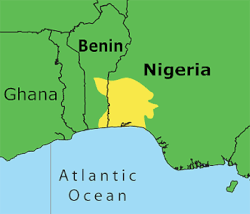
Location of Yorubaland in South-West Nigeria

Chrislam occupies a distinct geographical space, being pioneered in the ethnically diverse and highly ethnically populated Yorubaland region. Yorubaland is known as a cultural region, being home to a population with a remarkable degree of cultural affinity.[5] The region stretches from south-west Nigeria, across the Republic of Benin and to central Togo. The continual intermixing of ethnic peoples in Yorubaland precedes colonization and the modern-day borders of Nigeria, Togo and Benin.[5] Yorubaland is home to three major ethnic groups: the Yorùbá, the Aja and the Ìbààbá peoples.[5] As a result, cultural and inter-ethnic tolerance has been a characteristic feature of the region. According to Professor D. Laitin, "Muslim and Christian Yorubas see themselves culturally as Yorubas rather than as Muslims or Christians,"[1] and place a higher degree of value on common ethnicity over religious affiliations. Hence, Chrislam has been able to thrive in Yorubaland as a Yoruba phenomenon: whereby shared ethnic identities makes religious mixing possible.[1]

Although cultural distinction has been blurred, Yorubaland proves unique as the social and ethnic interaction has not led to the extinction of the unique characteristics of each group. Rather, the groups remain distinguishable, yet coexist in a densely populated and highly interactive ethnic region.[2]

Muslim–Christian tensions in Nigeria

[edit]

The Sharia debate (1977–1979)

[edit]

The question of Sharia in Nigeria greatly exacerbated Muslim–Christian tensions in the late 70s, when Nigeria adopted a new constitution after shifting from military to civil political rule.[1] The question in 1978 was whether Nigeria would adopt a secular constitution, or subscribe to Sharia law.[6] Given the relatively even split of Nigeria's Muslim population—constituting almost 50%[1][6] of the population—the viability of Sharia law was uncertain for the Nigerian state. This created conflict with Nigeria's Christian population, as well as other minority religions that opposed the adoption of Sharia law.[6]

The Supreme Military Council appointed the Constitutional Drafting Committee, which proposed the role of a Federal Sharia Court of Appeal.[6] This dated back to the period of indirect rule under the British, who helped rationalize an Islamic court system in the North from 1933 onwards.[6] Following the end of the colonial era, Sharia criminal law was replaced with a comprehensive secular criminal code for the newly independent nation.[6] Thereafter, the Court of Appeal was limited to civil cases between Muslim litigants, and there was no longer a final court of appeal for matters relating to Sharia law.[6] This served as a strategic political move to limit the unified power of the Northern states; establishing Sharia law in the North would have necessitated a state-acknowledged political existence of a legally distinct Northern Region.[6]

Moreover, the North-South divide meant that the establishment of Sharia Law would have served as a counterweight to the concentrated economic and social power of the South.[7][6] The South, which has never practiced Sharia law, captured the majority of jobs in civil service and commerce during the colonial period.[7] The adoption of Sharia law served as a symbolic assertion of the North's influence on the Constitution, and as a leverage against the economic and administrative power of the South.[6] The Sharia debate resulted in a wave of political and religious explosiveness, with fears and conspiracies of a consolidated Islamic Republic in the North.[6] The 1979 Constitution eliminated all provisions for a Federal Sharia Court of Appeal.[6]

Socioeconomic factors

[edit]

The Muslim–Christian conflict has also been attributed to various socioeconomic grievances that are a product of colonial and postcolonial conditions. The disparaging wealth gap between Nigeria's predominantly Muslim north and Christian south has colonial era roots, with the British favoring the emergence of a Christian elite governing class.[7][1] This elite class went on to control much of the postcolonial economy, with much of Nigeria's economy being focused in the south in major cities such as the capital, Abuja.[7]

The south-west Yorubaland proves an exception to the Muslim–Christian geographical divide, existing as a religiously plural vicinity. Yorubaland is home to Muslims, Christians and practitioners of traditional Yoruba religion, who have coexisted for centuries and are relatively evenly mixed amongst the population.[citation needed]

Furthermore, the Muslim–Christian struggle has heavily involved college students across the country. In 1987, Christians belonging to the Federation of Christian Students at the College of Education in Kafanchan, Kaduna, organized what they called the "Mission '87 in Jesus Campus,"[1] This was placed on a banner at the entrance of the college, so as to assert the campus as a Christian religious space.[1] Muslim students proceeded to remove the banner and began to protest a talk being delivered on campus by a Muslim convert to Christianity.[1] Muslim students claimed that the converted Muslim was misinterpreting Quranic verses and discrediting the teachings of Muhammad. This religious struggle then extended beyond the college campus, resulting in violence amongst Muslim and Christian students across urban centers in Northern and Central Nigeria.[1] College campuses remained a hotbed for Muslim–Christian tensions in the following years.[citation needed]

Influence of Nigerian Pentecostalism

[edit]

The rise of Pentecostalism in Nigeria has contributed to the onset of Chrislam and the changing religious landscape in the country.[8] Pentecostalism was pioneered by university staff and students in Nigeria's urban centers in the 1970s, and is seen as a product of increased higher education and urban growth fueled by oil revenues.[1] The emergence of Nigerian Pentecostalism began in the 1970s, during a particularly prosperous era for Nigeria's South due to the oil-boom of the 1970s.[8][1] For the south, an elite class emerged and profited, participating in conspicuous consumption and forming a connected upper-class network.[8] This further intensified wealth gaps in Nigerian society, and Pentecostal leaders openly condemned the accumulation of wealth.[8]

Subsequently, with the 1980s economic crisis spiraling the continent into economic downturn, and the rapid decline in political conditions, an increasing number of Nigerians turned towards Pentecostalism for guidance and grounding.[8] Pentecostalism had particular appeal due to its teaching of the potential to be "born again" as Christians through encounters with Jesus.[8] The promise of being born again provided many Nigerians with spiritual grounding and optimism amidst economic devastation.[8] Furthermore, Nigerian Pentecostalism drew many followers away from mainline Protestant, Roman Catholic and African Independent churches.[1] This further contributed to religious polarization and cleavages in the country, with conflict between sects of Christianity as well as non-Christian faiths.[1]

Muslim–Christian tensions in the 1970s are characterized as primarily youth-based and mutually demonizing campaigns, using rhetoric to pit each group against the other.[8] Pentecostal theology condemned Islamic healing practices, Sufi rituals and Islamic symbols. Pentecostalism also played a prominent role in opposition to Sharia law and fueled conspiracies of an Islamic takeover of the continent by 2005.[8] Moreover, Nigerian Pentecostalism iterated rhetoric of "a life and death battle with the enemy,"[1] which was widely interpreted as a reference to a battle against Muslims. Muslims responded through the rise of Reformist Islam, calling for a revival and strict adherence to Islamic traditions. This included the rise of proselytization campaigns, and mirroring the rhetoric of Pentecostal groups through vilifying rhetoric against Christians.[1][8]

Development

[edit]

First wave: Ifeoluwa (since 1976)

[edit]

The first dated Chrislam movement is traced to a Yoruba man named Tela Tella.[1] Tella was originally a Muslim prior to his career as a Chrislam preacher. Ifeoluwa is translated from Yoruba to mean "The Love of God Mission," which Tella uses to refer to his Chrislam mission. Similar to Islam, Ifeoluwa is based on 5 pillars: "love," "mercy," "joy," "good deeds," and "truth."[1]

The Ifeoluwa creed reads:

The God of Jesus is One
The God of Muhammad is One
Humanity is One
Chrislam, Chrislam, Chrislam[1]

Marloes Janson is a specialist on the study of Chrislam in Nigeria, and has conducted extensive research in the area including direct interviews and transcripts of Tella's sermons. According to Janson, Tella refers to himself as "an instrument in the hands of God,"[1] and says that God communicates with him through divine revelations. Tella conducts services for a small congregation in Lagos, who meet weekly on Saturdays. Tella explains that he did not want to conduct services on Friday because it leant itself to the Muslim faith, nor on Sundays for fear of favoring the Christian faith.[1] The Saturday service takes place in Tella's temple, which Janson describes as "a garage-like white building with in the middle a colorful altar that is separated from the prayer ground where, like in a mosque, the congregation sits on the floor."[1] Worship includes Muslim and Christian songs, the Quran and Bible are both consulted, and prayers combine Muslim and Christian elements. The sermon is delivered in Yoruba and English.[1] In addition to the weekly Saturday service, a Holy Ghost service is held on Friday which constitutes an all-night prayer meeting. Once a year, a pilgrimage to "Mount Authority" is made, which lasts for three days of uninterrupted prayer and fasting. Tella states that as Muslims have Mecca and Christians have Jerusalem, the holy site of pilgrimage for Chrislamists is Mount Authority, which was divinely chosen by God.[1]

Tella states that the holy scriptures of Islam and Christianity are "incomplete and contain some inaccuracies",[1] so he is working on compiling the Ifeoluwa Book, which will be the last holy book, containing his divine revelations.[1] Tella's teachings focus on the closeness of Islam and Christianity, and how God does not love one religion over the other.[1]

Ifeoluwa membership

[edit]

To become a member of Ifeoluwa, members must pass an initiation rite that requires years of spiritual training.[1] The Initiation Rite involves the observance of 80 rules and regulations that strictly outline a moral Chrislam lifestyle, including dress codes such as head-covering practices in Islam, and dietary restrictions based on the Old Testament.[1] Initiates then progress along a series of religious ranks, with each rank being symbolized by colored belts worn on white gowns. Initiates must also fast on Fridays, the most holy day in the Muslim calendar, to obtain spiritual closeness to God.[citation needed]

Second wave: Oke Tude (since 1989)

[edit]

In 1989, Dr. Samsindeen Saka (some sources spell his first name Shamsuddin or Samsudeen) claimed to found his own Chrislam movement. The Yoruba name Oke Tude is translated to "The Mountain of Losing Bondage,"[1] alluding to Pentecostal discourse. Oke Tude stipulates that progress in life is inhibited by evil powers that hold persons trapped in bondage with Satan. Like Tella, Saka was also a former Muslim prior to his rebirth as a Chrislamist. After returning from a Hajj pilgrimage to Mecca, he was inspired to launch his new ministry.[9]

Tude is the religious ritual of "running deliverance," during which worshippers run 7 times around a replica of the Kaaba which contains a well of holy water, while shouting "Allahu Akbar" and "Hallelujah." It is believed that running deliverance will free individuals of evil forces and allow possession of the Holy Spirit.[1]

A PBS special aired in 2008 featured a sermon from a small church in Lagos, Nigeria. When speaking of his divine revelations, Saka stated that "Then there is a lot of people killing themselves in Nigeria 19 years ago. So I was praying and lying down and the Lord told me, 'Make peace between Muslims and Christians.'"[9]

Saka operates his main Chrislam worship center in Lagos, with three smaller Oke Tude branches in Lagos, three in Abuja, one in Ibadan and a house fellowship in London.[1] Sermons involve both the Quran and Bible, worship songs and dance, and Saka's sermons - which he calls lectures.[9][1] Moreover, Saka emphasizes the shared origins of the two faiths as Abrahamic religions. In the 2008 PBS special, Saka tells his congregation that "Abraham has many children, and is the Father of Islam and the Father of Christianity. Why are the Muslims and Christians fighting?"[9]

The Oke Tude anthem states:

Our God, the Creator, hear us
Oh God, bless the Prophet Isa (Jesus)
And the noble Prophet (Muhammad)
Oh God, bless Samsindeen (Saka)
And the noble Prophet
Oke Tude, deliver us
Deliver us from illness
Oke Tude, deliver us[1]

Oke Tude membership

[edit]

To become a member of Oke Tude, conversion from previous religious affiliations is not necessary.[1] Initiates must buy a copy of both the Bible and Quran, and are expected to run Tude for 7 consecutive days.[1] During initiation, new members sometimes temporarily stay in the Oke Tude guesthouse, which is run by Saka and serves as an additional source of income for him.[1]

Oke Tude also offers a special spiritual outlet for women seeking to bear children. Many women who have been unable to conceive have joined Oke Tude due to its promise of destroying the 'yoke of barrenness'[1] through specific prayer rituals. Additionally, Oke Tude has attracted many unemployed and disenfranchised youth from the Lagos area, thanks to opportunities of small loans, business opportunities, and social networking connections offered by Saka.[1]

Ogbómòsó Society of Chrislam (OSC)

[edit]

One of the newest and best-known iterations of the movement comes from the Ogbómòsó Society of Chrislam (OSC), founded in 2005. The society was pioneered by a small group of university students and claims to be formed as a "vision from God."[10] Today, the group has over 200 active members and teaches that Islam, Christianity and African Indigenous Religions are derived from the same source and should be reunited into a single religious movement.[4] The OSC emphasizes what they deem a "spirit of accommodation,"[10] working to synthesize texts and traditions from Muslim, Christian and traditional African faiths. During the weekly service, the OSC consults the Quran, the Bible, and the Odu Ifa (the Yoruba literary corpus) and "The God of Africa, Jesus and Muhammad" are called upon in unison.[10] A frequent liturgical creed of the OSC states "There is no God but God and only one religion. There are many prophets and divinities but only one God."[10]

The OSC reiterates Chrislam missions of the past, whilst emphasizing a syncretic approach that amasses traditional African religions to the same extent as Muslim and Christian elements.[4] Moreover, the mission emphasizes that there is one overarching God which unites all faiths, yet many prophets and divinities exist to spread the word of God. Rituals include Yemaya Wudu, which incorporates the Islamic practice of washing in preparation for prayer and worship, and fusing it with Christian baptismal practice and prayer to Yemoja, a Yoruba river goddess.[10]

Contemporary religious violence

[edit]
Map of the Boko Haram Insurgency concentrated in North-East Nigeria

Chrislam serves as a counterweight to the prolonged and ongoing violence between Muslim and Christian groups in Nigeria. Both Tella and Saka preach of the need for love between Muslims and Christians in an era of violence.[1] In the 2008 PBS special, Saka tells his congregation that "Abraham has many children, and is the Father of Islam and the Father of Christianity. Why are the Muslims and Christians fighting?"[9] alluding to the rising Muslim–Christian violence as a result of Boko Haram.[9]

Syncretic religion in Africa

[edit]

Religious syncretism has been a phenomenon across Africa since the spread of Islam and Christianity across the continent. The blending of traditional African religions and global mega-religions has existed since colonization, as the arrival of Islam and Christianity never erased the practice of traditional faiths.[11] Moreover, the polytheistic tradition has been common across the continent, which has been conducive to the rise of religious pluralism.[11]

Chrislam has not been considered an unusual phenomenon in Africa, although it maintains a marginal religious following. "Spirituality without boundaries"[9] is a term coined by Michigan University anthropologist Mara Leichtman, and refers to religious fluidity within the African context. For example, it is not uncommon across Africa to see Muslims lighting candles for the Virgin Mary, or to believe in Jesus and pray to multiple prophets, which Leichtman recalls witnessing during her time researching Senegal.[9] In Nigeria, Igbo peoples have also been known to practice religious syncretism through the amalgamation of Christianity and traditional African religion.[12] Similarly, Nigeria has also seen syncretism between Igbo Muslim and traditional African religions predating the rise of Chrislam, particularly in Lagos State.[12]

See also

[edit]

References

[edit]
Revisions and contributorsEdit on WikipediaRead on Wikipedia
from Grokipedia
Chrislam denotes a collection of independent syncretic religious movements that originated in Nigeria, fusing select doctrines, rituals, and practices from Christianity and Islam to promote interfaith harmony among adherents, particularly within the Yoruba ethnic population of the southwest. These movements emerged in Lagos during the late 1970s, a period marked by religious revival and ethnic tensions, with the earliest documented group, known as Ifeoluwa or Chrislam, established in 1976 by a Yoruba Muslim convert named Tela Tella, who claimed divine revelation to integrate the two faiths. Core practices often include joint recitation from the Bible and Quran, recognition of both Jesus and Muhammad as prophets, and ecstatic worship sessions blending Pentecostal-style fervor with Islamic supplications, though theological compatibility remains contested due to fundamental divergences such as Christ's divinity and the finality of prophethood. While not forming a centralized institution, Chrislam groups emphasize pragmatic solutions to Nigeria's religious divides, attracting followers disillusioned with orthodox denominations amid socioeconomic challenges, yet facing criticism from purists in both Christianity and Islam for diluting core tenets. Despite limited global spread, its persistence highlights adaptive responses to pluralistic societies in sub-Saharan Africa.

Definition and Core Elements

Theological Foundations

Chrislam's theological foundations rest on the assertion that worship the same monotheistic and share compatible core doctrines, allowing adherents to practice elements of both faiths simultaneously without contradiction. Proponents, particularly in Nigerian movements like Ifeoluwa and Oke Tude, claim that the religions stem from a unified Abrahamic , with figures such as and viewed as complementary prophets in a single divine . This perspective equates prophetic roles across traditions, as articulated by Ifeoluwa founder Tela Tella, who received a 1971 divine declaring "Moses is and is ," emphasizing prophetic continuity over division. Similarly, Oke Tude leader Samsindeen Saka's 1989 vision in condemned , reinforcing a of unity through shared ethical imperatives like for and neighbor. Central to Chrislam doctrine is the reconciliation of seemingly divergent concepts, such as viewing as both the (drawing from Christian Trinitarian elements) and a prophet (aligned with Islamic ), while downplaying irreconcilable differences like the crucifixion's salvific role or Muhammad's final prophethood. Scriptures from both traditions are integrated: services feature readings from the and , with sermons highlighting parallels, such as shared emphasis on and moral conduct, as in Saka's publication True Messages: Similarities in the and Qur’an. Some groups, like the Ogbomoso Society of Chrislam, extend this to include African indigenous elements, positing all as deriving from "One " and "One Love," supported by verses like 112:1, Mark 12:29, and Yoruba invocations of Olorun. Revelations to founders provide authoritative basis, often prioritizing —practical rituals for deliverance, health, and prosperity—over strict , with conceived as immanent and responsive to blended prayers. This rejects exclusive claims of either , asserting complementary rather than contradictory revelations, though orthodox Christian and Islamic authorities maintain fundamental incompatibilities, such as Christianity's insistence on ' and versus Islam's denial thereof. Chrislam thus emphasizes empirical spiritual efficacy—evidenced by reported healings and —over doctrinal purity, fostering a pragmatic suited to Yoruba cultural contexts where religious boundaries are fluid.

Distinctive Practices and Symbols

Chrislam movements incorporate syncretic rituals that blend Christian and Islamic practices, often adapting them to address everyday concerns like and . In Ifeoluwa, founded by Tela Tella in 1976, weekly Saturday services feature divinely inspired hymns accompanied by African drums, sermons drawn from both the and , and of a Holy Spirit Square seven times while holding both scriptures. Oke Tude, established by Samsudeen in 1989, conducts divided into Muslim wuridi sessions, segments, and joint services, with adherents praying eight times daily by combining salat and additional Tude invocations focused on deliverance. Distinctive rituals emphasize fusion and practicality over doctrinal purity. Participants in Oke Tude perform the Tude ritual by running seven times around a replica Ka'aba, shouting "Hallelujah" and "Allahu Akbar," followed by drinking or washing with Tude holy water for healing ailments including claimed cures for HIV/AIDS, supported by displayed crutches as evidence. Faith healing sessions in both movements draw on Christian testimonies and Islamic supplications, with Oke Tude historically incorporating herbal remedies—reflected in its "Chrislamherb" designation—though shifting toward prayer-based methods by 1995. Other practices include night vigils, vegetarian fasting on Thursdays, almsgiving akin to zakat or tithing, and pilgrimages to Mecca and Jerusalem, alongside celebrations of holidays from both traditions such as Christmas, Easter, and Ramadan. In the Ogbomoso Society of Chrislam, rituals like Yemaya Wudu merge Islamic ablutions with Christian baptism and invocations to the Yoruba goddess Yemaya, while divination integrates Ifá tools with prayers to Jesus and Muhammad, often preceded by the Christian sign of the cross. Symbols in Chrislam visibly represent the merger of faiths, with Oke Tude prominently featuring the Christian cross, Islamic crescent, and a herb emblem signifying healing, alongside a motto of "love, unity, and peace." Ifeoluwa employs a slate etched with a cross and heart on its Mountain of Power, white gowns differentiated by colored belts for hierarchical ranks, and prayer staffs during services. These icons, combined with architectural elements like Ka'aba replicas and blended mosque-church layouts with separate seating for men and women, underscore the movements' emphasis on visual and performative compatibility between Christianity and Islam.

Historical Origins

Roots in Yorubaland Syncretism

Yorubaland's religious landscape, encompassing southwestern , has long featured due to the gradual incorporation of and into indigenous Yoruba practices. Islam entered the region through trade networks from Malian merchants and Wangara traders as early as the , establishing communities that built the first in Iwo by 1655. Christianity arrived later in the mid-19th century via European missionaries, with initial missions in coastal areas like and starting in the 1840s, often blending with local customs through movements like Aladura, which integrated prophetic healing and Yoruba rituals into Christian worship. Yoruba cultural pragmatism and ethnic solidarity fostered tolerance, allowing adherents of different faiths to intermarry, participate in mutual rituals, and retain elements of veneration alongside Abrahamic observances, unlike the more polarized religious dynamics in northern . This pluralism, rooted in viewing as secondary to shared Yoruba identity, enabled widespread syncretic practices where and alike consulted traditional diviners or observed festivals like . These foundations of religious accommodation in directly informed Chrislam's development during the revival amid economic hardship and political upheaval, when founders sought fuller spiritual efficacy by merging Christian and Islamic elements explicitly. , as a cosmopolitan hub of Yoruba , hosted the earliest groups, with Tela Tella establishing Ifeoluwa in 1976 to promote compatibility between the and for holistic prosperity. This extension of longstanding Yoruba blending traditions distinguished Chrislam from mere individual , positioning it as organized movements affirming dual adherence.

Catalyzing Factors in Nigerian Religious Landscape

Nigeria's religious landscape, particularly in the Yoruba-dominated southwest, features longstanding pluralism where , , and indigenous traditions coexist, often with fluid boundaries due to shared ethnic identity overriding strict religious affiliation. Among the Yoruba, arrived via in the , while spread through missions, yet both integrated elements of traditional Yoruba practices, fostering a syncretic predisposition evident in movements like the Aladura churches. This cultural accommodation, as observed by scholars, stems from Yoruba cosmology's emphasis on pragmatic spirituality over doctrinal purity, enabling interfaith blending without widespread conflict until later escalations. The 1970s marked a pivotal era of religious revival following the (1967–1970), coinciding with the oil boom that spurred urbanization and population influx into , transforming it into a of diverse religious interactions. Pentecostalism surged from evangelical student revivals in the , emphasizing miracles, prosperity, and direct divine experience, which reshaped the landscape by challenging orthodoxies and inspiring hybrid forms like Chrislam. This period's charismatic movements, including both Christian and reformist Islamic variants, responded to post-war spiritual hunger and economic disparities, with 's chaotic environment—marked by insecurity and inequality—amplifying demands for efficacious religions promising deliverance from material woes. Escalating Christian-Muslim tensions, fueled by 1978 constitutional debates over implementation, highlighted the need for unity in mixed urban settings, where proximity necessitated daily interreligious engagement despite occasional violence. Chrislam emerged as a pragmatic response in these borderland contexts, leveraging Yoruba to fuse rituals—such as combining Islamic , Christian , and indigenous prayers—for enhanced spiritual potency amid socio-political anxiety. Economic structural adjustments in the further entrenched , drawing marginalized adherents to Chrislam's inclusive framework, which critiqued orthodox while addressing unmet needs in , , and .

Major Movements and Organizations

Ifeoluwa (Founded 1976)

Ifeoluwa, also known as Ifeoluwa: The Will of God Mission, was established on April 18, 1976, in Agege, Lagos, Nigeria, by Tela Tella, a Yoruba man born on September 1, 1939, in Abeokuta, Ogun State. Tella, originally a Muslim, reported receiving a divine call in 1971 that prompted him to blend elements of Christianity and Islam, coining the term "Chrislam" in 1985 to signify their unity. The movement's name derives from Yoruba, translating to "The Will of God" or "The Love of God," reflecting its emphasis on divine love as incarnated in Tella himself through revelations, including glossolalia. Doctrinally, Ifeoluwa posits that Christianity and Islam constitute a single , with prophets including and , and equates figures such as "Moses is Jesus and Jesus is Muhammad," invoking peace upon them all. Core tenets rest on five pillars—love, mercy, joy, good deeds, and truth—aimed at fostering practical outcomes like health and wealth through adherence. The movement operates from the Mountain of Power compound in a Lagos slum, maintaining a small congregation of approximately 50 lower-middle-class followers, predominantly women and youth, though membership fluctuates due to rigorous requirements. Practices include weekly Saturday services featuring Christian and Muslim songs, sermons in Yoruba and English, night vigils, and twice-daily joint prayers. Rituals encompass circumambulating the Square while holding a and Qur'an, an annual pilgrimage to the Mount of Authority, and the Dancing Anniversary celebration. Members don white gowns with colored belts and adhere to about 80 strict regulations, including dress codes, food taboos, and initiation rites, which contribute to the group's insular and manageable scale. Recent efforts include a presence for outreach, though it remains one of the earliest and smallest Chrislam groups.

Oke Tude (Founded 1989)

Oke Tude, also known as Chrislamherb, was established in 1989 by Samsindeen , a Nigerian Muslim who received a divine during a to calling him to unite . Saka, born into a Muslim family with a father who practiced herbalism, founded the movement in Ogudu, , emphasizing practical religious fusion over strict doctrinal adherence to address spiritual and material needs like health, wealth, and deliverance from evil forces. The name "Oke Tude" derives from Yoruba, translating to "Hill of Losing Bondage," symbolizing liberation from religious divisions and personal afflictions. Core beliefs center on , recognizing one God, with and as prophets, and promote love, unity, and peace as antidotes to Nigeria's religious tensions. Members incorporate both the and in teachings, viewing the faiths as complementary paths to salvation, without requiring formal conversion from original Christian or Muslim identities. Practices blend rituals: weekly services feature Muslim wuridi (devotional chanting) followed by Christian-style prayers; the signature Tude deliverance ritual involves running seven times around a replica of the Ka'aba while invoking "" and "Allahu Akbar"; additional elements include healing sessions, night vigils, , and annual "Tude Deliverance" events. Organizationally, Saka serves as General Overseer (self-titled Prophet Dr. S.O. Saka), overseeing a hierarchy of deacons, pastors, ministers, and counselors. The movement maintains a main center in Lagos, with three branches there, three in Abuja, one in Ibadan, and a house fellowship in London, though it remains most active among urban marginalized groups in Lagos, such as unemployed youth, the poor, and those seeking remedies for infertility or hardship. In 2008, government authorities demolished its Lagos auditorium, yet the group persists through smaller venues and emphasizes ethical conduct and accountability for judgment day. Oke Tude operates independently from earlier Chrislam groups like Ifeoluwa, with Saka denying knowledge of founder Tela Tella despite mutual accusations of inauthenticity.

Ogbomoso Society of Chrislam (Founded 2005)

The Ogbomoso Society of Chrislam (OSC) was established on January 1, 2005, in Ogbomoso, , , following a shared divine vision reported by its five co-founders, who represented diverse religious backgrounds: Ibukunoluwa (formerly Catholic), Tantoluwa (formerly Pentecostal), Ayokunle (formerly Sunni Muslim), Olumide (formerly Muslim), and Ọbáfẹmi (practitioner of divination from Yoruba indigenous traditions). Unlike earlier Chrislam groups such as Ifeoluwa and Oke Tude, which were initiated by former Muslims, OSC emerged from a multi-faith student confraternity at a local university, emphasizing across , , and African indigenous religions (AIR). The group's formation reflected a response to 's religiously polarized environment, including rising interfaith tensions and violence, with founders seeking to model unity through religious accommodation. OSC's core theology posits that , , and AIR derive from a singular divine source and must be reintegrated to restore primordial religious wholeness, rejecting exclusive claims of in favor of a "spirit of accommodation" that highlights commonalities such as and ethical imperatives. Members affirm that "there is no but and only one ," interpreting scriptural divergences as cultural accretions rather than irreconcilable truths. Practices blend elements from all three traditions: weekly Saturday " Gatherings" feature sermons drawing from the , , and Yoruba Odu texts; rituals include Yemaya , a purification rite fusing Islamic ablution, Christian baptismal symbolism, and Yoruba invocations to water deities; and , which adapts oracle consultation with Christian prophetic and Islamic supplicatory elements. Prayers and hymns invoke a composite deity as " of Abraham, , , of the ," underscoring syncretic symbolism without hierarchical preference for any tradition. By 2018, OSC had grown to approximately 300 active members attending gatherings at least monthly, with a broader directory of over 1,200 contacts, primarily drawn from urban youth and intellectuals in southwestern . The group positions itself as a counter to extremist violence, such as that perpetrated by , by fostering and practical coexistence, though it maintains no formal political affiliations. Public reception has been predominantly hostile, with orthodox Christian and Muslim leaders denouncing OSC as heretical and a threat to religious purity; incidents include a arson attack on its meeting space and ongoing social , , and accusations of promoting an "evil " that disrupts Yoruba cultural equilibrium. Despite such challenges, OSC persists in small-scale operations, advocating —selective recombination of religious elements—as a viable path to peace in Nigeria's volatile landscape.

Beliefs and Doctrinal Positions

Claimed Compatibilities Between

Adherents of Chrislam assert that are fundamentally compatible, positing that both religions worship the same monotheistic , often referred to interchangeably as , , , or Olorun, with an emphasis on 's and responsiveness to prayer. This compatibility extends to their shared Abrahamic origins, tracing religious lineage to the patriarch Abraham as a common father figure whose descendants encompass both traditions. Chrislam proponents claim that the and serve as complementary scriptures, both containing divine revelations that guide moral and ethical conduct, such as imperatives for , , charity, and righteous living. Leaders like Tela Tella, founder of Ifeoluwa, incorporate verses from both texts in sermons and rituals, viewing them as incomplete without mutual supplementation, though he has authored additional writings to harmonize perceived gaps. Theological harmony is further emphasized through the roles of key prophets, whom Chrislam unifies across traditions; for instance, Tela Tella has stated that "Moses is Jesus and Jesus is Muhammad," portraying them as interconnected manifestations of divine guidance rather than sequential figures. Jesus (Isa in Islamic terminology) holds a pivotal syncretic position, revered as both the Son of God in Christian doctrine and a prophet in Islamic teaching, with proponents noting his mention 25 times in the Quran as evidence of overlapping reverence. This allows adherents to declare that "you can’t be a Christian without being a Muslim, and you can’t be a Muslim without being a Christian," prioritizing unified orthopraxy—blended rituals like combined prayers—over rigid doctrinal distinctions such as the Trinity or tawhid.

Key Divergences and Syncretic Adaptations

Chrislam confronts irreconcilable doctrinal divergences between orthodox and , including the Christian affirmation of the and ' divinity as the whose provides vicarious , contrasted with Islam's (absolute oneness of God) and depiction of as a human prophet whose was illusory. These tensions extend to —Christian grace through in Christ's sacrifice versus Islamic submission and good deeds—and scriptural authority, where the Bible's revelations supersede prior texts in , while the abrogates earlier scriptures in . Chrislam movements do not systematically resolve these via theological synthesis but prioritize (correct practice) over , allowing adherents to maintain dual identities without formal conversion or of either . Syncretically, Chrislam adapts by treating the and as complementary and equally authoritative scriptures, with services incorporating readings, hymns, and prayers from both to emphasize shared ethical imperatives like , , and . is often venerated as both prophet and messianic figure, with recognized complementarily, sidestepping exclusivity by invoking Abrahamic unity and an immanent responsive to practical needs such as health and prosperity through blended rituals. In Ifeoluwa, adaptations include a merging creedal elements, five pillars focused on virtues rather than Islamic rites, and temples symbolizing both faiths with crosses and crescents. Oke Tude incorporates Pentecostal-style (e.g., "Tude" running around a replica for liberation from bondage) alongside Quranic recitations and Christian testimonies, while observing combined holidays like and . The Ogbomoso Society emphasizes interreligious dialogue to dispel perceived differences, fostering practices that embed multiple traditions without hierarchical resolution. These adaptations prioritize experiential efficacy and social harmony in Nigeria's volatile religious over doctrinal purity, resulting in fluid memberships drawn to problem-solving but critiqued for superficiality in addressing core incompatibilities.

Criticisms and Theological Challenges

Orthodox Christian Objections

Orthodox Christians reject Chrislam as a form of that fundamentally undermines the exclusive truth claims of by attempting to reconcile irreconcilable doctrines with . Core to this objection is the assertion that Chrislam dilutes the uniqueness of Christ as the divine and the sole mediator of salvation, equating him instead with as a mere prophet, which contradicts scriptural affirmations of ' deity (John 1:1, 10:30). A primary theological concern is the acceptance of the alongside the as equally authoritative scripture, which traditional Christian views as a direct violation of the 's self-attested sufficiency and finality (2 Timothy 3:16-17). Evangelical critics, representing orthodox perspectives, argue that this dual reverence elevates a text that explicitly denies key Christian tenets—such as the ( 5:73) and the ( 4:157-158)—over the apostolic witness, effectively subordinating God's completed revelation in Christ to later prophetic claims. Furthermore, Chrislam's is seen as incompatible with orthodox Christianity's emphasis on by grace through in Christ's atoning death and resurrection alone (Ephesians 2:8-9; 1 Corinthians 15:17), rather than through works or adherence to Sharia-influenced practices. In the Nigerian context, where Chrislam emerged in the 1970s and 1980s, orthodox leaders criticize its ritual blends—such as "running deliverance" sessions invoking both biblical and Quranic elements—as idolatrous compromises that obscure and foster spiritual confusion rather than genuine conversion. Theologians like warn that such movements risk producing hybrid believers who retain Islamic identity without fully embracing Christian discipleship, potentially stunting church growth by avoiding bold profession of faith in Christ as Lord (Romans 10:9). Overall, these objections frame Chrislam not as bridge-building but as a departure from apostolic purity, echoing biblical prohibitions against mixing faiths (Deuteronomy 12:30-31; 2 Corinthians 6:14-16).

Islamic Scholarly Rejections

Islamic scholars have issued rulings condemning Chrislam as an invalid and heretical innovation that constitutes kufr (disbelief). A from the Salafi-oriented Islamweb platform, issued on December 17, 2013, explicitly declares followers of Chrislam to be disbelievers, describing it as a fabricated that falsely mixes elements of and . The primary doctrinal objection is that Chrislam undermines the finality and completeness of the by implying it requires supplementation from the , directly contradicting Quran 5:3, which states that has been perfected and completed by as a religion. This is seen as rejecting the exclusive validity of as the accepted faith, per Quran 3:85, which warns that no religion other than will be accepted from . Additionally, the prohibits Muslim women from marrying Chrislam adherents, equating them to polytheists or disbelievers under Quran 2:221. Broader Islamic orthodoxy rejects Chrislam's incorporation of Christian tenets, such as the of or Trinitarian concepts, as shirk—the association of partners with ( 4:48)—since these are viewed as distortions of monotheism () abrogated by the Prophet Muhammad's final revelation. Such mixtures are deemed (innovation) that deviates from the , with no room for ecumenical fusion given Islam's self-understanding as the uncorrupted successor to prior Abrahamic traditions.

Internal and Practical Critiques

Within Chrislam movements, internal critiques often center on the tensions arising from syncretic practices and dynamics. For instance, leaders like Tela Tella of Ifeoluwa have dismissed rival groups such as Oke Tude as "inauthentic," highlighting fragmentation and lack of unity among the movements despite shared aims of religious fusion. Adherents frequently experience doctrinal friction when reconciling core divergences, such as Christianity's Trinitarian theology with Islam's emphasis on (divine oneness), which Chrislamists frame as complementary but which can lead to inconsistent scriptural interpretations during services. High membership fluctuation is another recurrent issue, with participants attending temporarily to address personal crises like illness or infertility before reverting to orthodox churches, mosques, or traditional shrines, as strict behavioral codes—such as Ifeoluwa's 80 rules on dress, purity, and conduct—discourage long-term commitment. Practical challenges exacerbate these internal strains, particularly in organizational sustainability and daily implementation. Succession planning remains unresolved in founder-centric groups; for example, Ifeoluwa and Oke Tude lack formalized structures for transfer following the deaths of Tela Tella and Samsindeen Saka, respectively, given their self-perceived divine mandates, posing risks of dissolution or . Logistical hurdles in urban settings like complicate adherence, including balancing dual prayer routines and fasts (e.g., alongside Chrislam rituals) amid hectic schedules, which orthodox critics within broader religious circles decry as half-hearted. The Ogbomoso of Chrislam (OSC), while critiquing mainstream Nigerian religious practices for fostering division, encounters backlash that manifests practically as member attrition and social ostracism, with participants risking exclusion from family and community for perceived deviance. These issues contribute to Chrislam's limited scale, with groups maintaining congregations of mere hundreds—such as Ifeoluwa's 50 core followers—due to a deliberate "spiritual family" model over institutional expansion, rendering them vulnerable to external pressures like Oke Tude's auditorium amid land disputes. Adherents often conceal involvement to avoid familial conflict, as seen in cases of Oke Tude members hiding from Muslim spouses, underscoring the practical infeasibility of sustained in a context of entrenched interfaith boundaries. Despite aims of , such constraints hinder broader viability, as evidenced by non-recognition from bodies like the Inter-Religious Council.

Social and Political Dimensions

Efforts at Interfaith Peacebuilding

Chrislam movements in have pursued interfaith chiefly through syncretic worship practices designed to bridge Christian and Muslim divides, emphasizing shared Abrahamic roots and mutual scriptural reverence to mitigate sectarian tensions. Founders like Tela Tella of Ifeoluwa, established in 1976, have claimed divine mandates to unite the faiths, conducting services that alternate readings from the and while equating prophetic figures—such as declaring "Moses is and is "—to foster doctrinal reconciliation among diverse followers. Similarly, Oke Tude, founded in 1989, integrates Aladura Christian healing rituals with Islamic supplications, with its leadership asserting that both religions inherently promote love, unity, and peace, thereby encouraging adherents from mixed backgrounds to participate in joint devotions that humanize opposing traditions. These practices aim to create microcosms of harmony within congregations, where and worship side-by-side, reducing interpersonal animosities through shared rituals like combined Friday prayers and services infused with elements from both faiths. The Ogbomoso Society of Chrislam, founded in 2005, extends this approach by explicitly countering extremist ideologies like Boko Haram's, positioning as a proactive strategy for national religious cohesion amid ongoing violence. Proponents argue that such blending demonstrates practical compatibilities, potentially serving as a grassroots model for broader Christian-Muslim dialogue in violence-prone regions like and Ogbomoso. Despite limited formal engagements with orthodox interfaith forums, Chrislam's emphasis on transcending exclusivity has attracted followers disillusioned by conflicts, with leaders like those in Ifeoluwa invoking upon all prophets to underscore a unified spiritual heritage. This internal bridge-building has sustained small-scale communities, though empirical data on impacts remains anecdotal and tied to localized follower testimonies rather than large-scale . has endured persistent religious and ethnoreligious violence, exacerbating divisions between its Muslim-majority north and Christian-majority south and regions. The , launched in 2009, has killed tens of thousands, including targeted persecutions of Christians through church bombings, abductions, and massacres, while also attacking moderate Muslims perceived as insufficiently radical. Parallel farmer-herder clashes, frequently framed along religious lines with Muslim Fulani pastoralists confronting predominantly Christian agrarian communities, have resulted in over 3,600 deaths by alone, displacing tens of thousands and intensifying communal suspicions. These conflicts, rooted in resource competition but amplified by Islamist ideologies and retaliatory , have claimed broader tolls exceeding 15,000 lives by 2021, underscoring a where religious identity often determines victimhood or alliance. The Ogbomoso Society of Chrislam (OSC), founded amid rising tensions post-2000 Sharia implementations and early insurgency stirrings, explicitly positions itself as a counterforce to such divisiveness, advocating scriptural unity to avert interfaith bloodshed. OSC leaders, including founder Tela Tella, emphasize love across religious lines in sermons responsive to Nigeria's "culture of violence," including poverty-fueled insecurity and sectarian riots that have historically displaced communities. By rejecting exclusive claims of either faith, Chrislam seeks to model coexistence, potentially mitigating escalations in high-conflict zones where orthodox polarization sustains cycles of retaliation. Yet OSC's invites rejection from both and establishments, who decry it as heretical dilution— as compromising Christ's uniqueness, Muslims as (innovation) undermining —fostering social hostility and isolation rather than overt physical . This marginalization heightens vulnerability in broader conflicts, as syncretists lack the solidarity networks of monolithic groups; for instance, in Ogbomoso's Yoruba southwest—less prone to direct jihadist incursions—Boko Haram's northern campaigns have driven internally displaced persons southward since 2014, straining local interfaith dynamics and exposing hybrid movements to accusations of disloyalty amid national insecurity. While no documented OSC-specific attacks exist, such critiques parallel patterns where perceived religious ambiguity invites suspicion in environments of existential threat, as seen in Department reports on Nigeria's religious erosions.

Current Status and Empirical Assessment

Membership Estimates and Geographical Spread

Chrislam consists of multiple independent syncretic movements that emerged in during the late 1970s, with total adherents estimated at around 15,000 as of the early . These figures reflect the movement's marginal status within 's population of over 200 million, where dominate with roughly equal proportions. No comprehensive recent surveys provide updated nationwide counts, underscoring the decentralized and localized nature of Chrislam groups. The movement is geographically concentrated in southwestern Nigeria, particularly in urban centers like , where Christian and Muslim populations intermingle amid Yoruba ethnic majorities. Prominent groups such as Ifeoluwa and Oke Tude operate in , blending practices in response to local interfaith dynamics and economic pressures. While ideas associated with Chrislam have influenced diaspora communities and online discussions globally since the 1980s, organized followings remain negligible outside . Expansion is limited by theological opposition from orthodox Christian and Muslim authorities, confining spread to pockets of religious experimentation in Nigeria's religiously polarized landscape.

Recent Developments and Viability

In the , Chrislam has seen limited organizational evolution, with the emergence of newer groups such as the Ogbomoso Society of Chrislam in southwestern , which emphasizes practical accommodation between Christian and Muslim practices amid local socio-political anxieties. This development reflects ongoing attempts to adapt syncretic models to contemporary interfaith tensions, particularly in Yoruba-dominated regions where cultural pragmatism historically tolerates boundary-blurring. However, such initiatives remain confined to niche urban and peri-urban settings like and Ogbomoso, without evidence of broader institutionalization or expansion beyond . Viability assessments highlight persistent structural barriers, including rejection by orthodox Christian and Muslim authorities who view as a dilution of exclusive doctrinal claims—such as Christianity's affirmation of Jesus's versus Islam's portrayal of him as . Interfaith taboos in further erode sustainability, as Chrislam challenges entrenched religious boundaries that sustain communal identities, leading to social ostracism and internal fragmentation among adherents. Empirical indicators, including stagnant membership and lack of scalable , suggest marginal long-term prospects, especially against the backdrop of rising fundamentalist pressures and national conflicts that polarize rather than hybridize faiths. While offering short-term spiritual coping mechanisms for economic hardship and insecurity, Chrislam's fusion lacks the theological coherence and communal resilience needed for enduring viability in a context of deepening sectarian divides.

References

Add your contribution
Related Hubs
User Avatar
No comments yet.