Hubbry Logo
Cider millCider millMain
Open search
Cider mill
Community hub
Cider mill
logo
8 pages, 0 posts
0 subscribers
Be the first to start a discussion here.
Cider mill
Cider mill
from Wikipedia
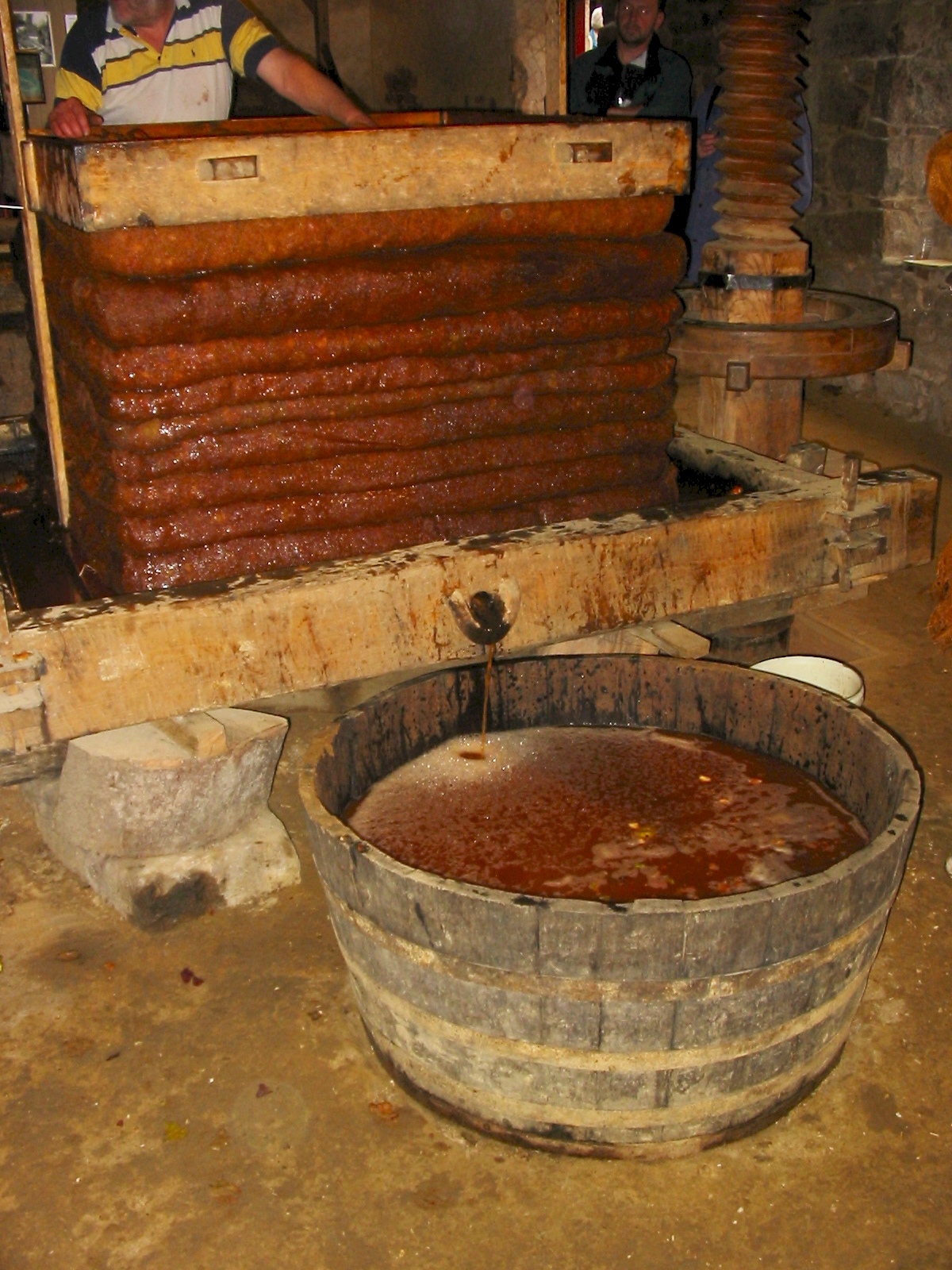
A large cider press at a cider mill in Jersey, used for squeezing the juice from crushed apples
Apple Press Monument (a relic of the Mid-Winter Fair, 1894, still in its original location), Music Concourse, Golden Gate Park, San Francisco, California, USA

A cider mill, also known as a cidery, is the location and equipment used to crush apples into apple juice for use in making apple cider, hard cider, applejack, apple wine, pectin and other products derived from apples. More specifically, it refers to a device used to crush or grind apples as part of the overall juice production.

The mills used to manufacture, ferment, store, and ship juice products are usually located near apple orchards. Historically, the types of structure and machinery have varied greatly—including horse powered, water driven, and machine operated mills. The presses can be fixed or portable.

Cider mills were subject to legal proceedings in New York state in the 1800s over whether they were "fixed to freeholds"[1] and other cases addressing legal designation as to what kind of property a cider mill is.[2]

Use

[edit]

Cider-making takes place in numerous countries and regions. As with the cider itself, the various techniques used in milling and pressing the apples vary with each cider-making tradition. In most traditions, cider milling traditionally takes place in two stages: first, milling or grinding the apples into a pulpy mass called pulp, and a second stage, pressing the pulp to release the juice or "must". The remaining solids after juice extraction is "pomace" or "pommage".

Some mills provide custom pressing of a farmer's apples. In this way, apple varieties can be blended to make a cider of mixed juice types, for instance, a combination of sweet and aromatic juices. Various types of apple are recommended for making cider.[3] Alcoholic cider can also be produced and is known as hard cider or applejack. Cider is stored and fermented in wooden barrels, carboys, stainless tanks, or glass jugs.[4]

In 19th-century New England, apple farmers paid a mill owner a fee to crush apples into juice. A typical cider mill would look like many other small barns and sheds, with a set of large doors in the center of the longer side. Most cider mills were 20–30′ long by 20–25′ in width.[5] At Old Sturbridge Village in Massachusetts, 19th-century cider mill equipment is still used to make cider. In The Marble Faun, author Nathaniel Hawthorne contrasted the wine-making in Italy with the cider-making process of "New England vintages, where the big piles of golden and rosy apples lie under the orchard trees, in the mild, autumnal sunshine; and the creaking cider-mill, set in motion by a circumgyratory horse, is all a-gush with the luscious juice."[6]

Operation

[edit]

Milling

[edit]

Milling, grinding, or crushing can take various forms, depending on the quantity of apples to be crushed and the motive power available.

The earliest and most basic form of cider mill consists of little more than an enclosed area where apples are pounded by large wooden pestles.[7]

In England, Jersey, and northern France, the traditional form was a "horse-mill" or "stone mill". A horse-mill consists of a circular trough made of stone, in which is set either one or two large stone wheels called "runners".[8] At the center is a pivot point or "nut".[8] A horse is harnessed to the outside of the wheel, and driven in a circle, slowly grinding the apples to a pulpy mass called pommage.[8] Through the early 19th century, this was the dominant form in England.[8] By the early 20th century in Britain, however, the stone mills had largely fallen out of fashion, increasingly replaced by the roller mills, though they continued to be the primary form in France.[9][10] Though the stone mill had been introduced to and used by the American Colonists, its usage was not well recorded, and by the end of the 19th century it was essentially unknown in the United States.[10]

In Germany, apples were traditionally grated by hand rather than crushed.[11]

A later innovation was the toothed roller-mill. These mills use toothed cylinders made of stone or metal to grind the apples into pomace.[9] Such mills are portable, and produce a pomace that is finer than that of the large horse-mills.[8][9] It was first introduced to England in 1689 by agriculturalist John Worlidge, who adapted it from the sugar-cane crushers used in the West Indies.[12] Yet as of the beginning of the 19th-century, such mills could not handle the same quantity in bulk as the horse-driven mills.[8]

Basic methods of cider-milling
Two individuals using large wooden mallets to pound apples in a traditional wooden trough in the Basque Country.
Pounding: Pounding apples in the Basque Country
Men operating a large, antique horse-driven apple grinding mill.
Horse-driven stone mill: At the Faîs'sie d'Cidre 2009, Jersey
Roller mill: a roller-mill machine in France

Pressing

[edit]
Apple pressings in a wooden basket
Apple pressings

After the apples have been ground into pomace, the pomace must be squeezed to extract the juice. This is done in a device called a cider press, which like the cider mill, takes various forms.[13]

One form is a large horse-operated lever press or screw press. This method was common in Britain, Jersey, and northern France, as well as the United States. This form involves either of two methods to hold the loose pomace in place as it is pressed. The first is to use alternating layers of straw and pomace, creating a mixture known as "cheese". The other is to wrap the pomace in cloth. The German tradition used smaller, hand-operated lever presses in the same manner.[11]

An alternate form is the "hand press" (sometimes called a "Continental Press" in England), a small screw-press operated by hand. These presses dispense with the various methods of covering the pomace, and instead use a container made of wooden staves.

By the turn of the 20th century, hydraulic presses had begun to be introduced.[14]

Basic methods of cider-pressing
Lever press: Cider pressing at the Faîs'sie d'Cidre in Jersey
Hand-press: Pressing at the Bauernmarkt, Lüttringhausen, Germany
Hydraulic press: A modern hydraulic press

After the juices had been extracted, the leftover pressings are variously known as "math", "cake", "powz", "mure" or simply "pommage".[15] It might either be watered and pressed again to produce a weak cider known as ciderkin, or when still fresh, used as animal feed.[15][16]

See also

[edit]

References

[edit]

Further reading

[edit]
[edit]
Revisions and contributorsEdit on WikipediaRead on Wikipedia
from Grokipedia
A cider mill is a specialized facility and the associated used to process apples by grinding them into pulp and pressing the pulp to extract , which is then used to produce , hard , and other apple-based beverages such as applejack or apple wine. The core operation of a cider mill involves several key steps that have remained fundamentally consistent for centuries: apples are first washed and ground into a (pulp) using mills ranging from traditional stone or wooden grinders to modern mechanical crushers; the is then layered into racks or cloths and subjected to hydraulic or presses to separate the from the solid residue, known as , which can be repurposed as , , or for further extraction of compounds like . The extracted , or must, may be filtered and either pasteurized for fresh sweet or allowed to ferment naturally with wild yeasts or added commercial yeasts to create alcoholic hard , a process that typically takes days to weeks depending on temperature and apple varieties. Modern cider mills often incorporate for and , while traditional ones may use horse- or water-powered mechanisms, reflecting adaptations in scale from small farm-based operations to large commercial cidery productions. Historically, cider mills trace their origins to ancient practices in regions like and , where apple pressing dates back over 2,000 years, but in the United States, they became integral to colonial starting in the early when English settlers planted apple orchards from imported seeds as early as 1623, establishing local mills to produce hard as a safe, everyday beverage superior to often contaminated water. By the 18th and 19th centuries, nearly every American farm had a rudimentary cider press, and served as a form of , wages for laborers, and a key economic driver in rural communities, with figures like John Chapman () promoting widespread orchard planting across the frontier to support production. The 19th century saw the rise of larger, water-powered mills, such as the Glastonbury Cider Mill in , established in 1874 and recognized as the oldest continuously operating cider mill in the U.S., highlighting the enduring role of these facilities in agricultural heritage. Today, cider mills play a vital role in the resurgence of the U.S. industry, which has grown rapidly since the 2000s, with states like Washington leading production through more than 100 active cideries (as of 2024) and research programs focused on orchard management, apple varietals suited for (such as bittersweet types), and sustainable practices. Many mills now function as destinations, offering fresh , donuts, hayrides, and seasonal events during apple harvest, blending traditional processing with community engagement while reducing farm waste by utilizing imperfect or windfall apples that cannot be sold fresh. This evolution underscores the cider mill's significance not only as a production site but as a cultural and economic cornerstone of apple-growing regions worldwide.

Historical Development

Early Origins

The origins of cider milling trace back to ancient times in regions such as the Basque Country, where production has roots predating Roman influence, and the Mediterranean, with fermented apple beverages documented around 1000 BCE. Early methods involved simple crushing techniques, such as using stones or feet to break down apples into a mash for juice extraction, a practice evident in pre-Roman Europe and later adopted by the Romans, who encountered and refined indigenous cider-making during their 55 BCE invasion of Britain. In medieval , cider production advanced significantly through monastic communities, particularly from the 9th to , as abbeys cultivated orchards and developed pressing techniques for both sustenance and trade. In , , cider-making expanded in the with the introduction of tannin-rich apple varieties by sailors, while in , , monasteries like those in the region became key centers for apple cultivation and cider production by the early , leveraging local soils for orchards that supported communal . These efforts preserved and innovated upon ancient practices, with antique grinding stones still visible as remnants in northern and southwest . European colonists introduced cider milling to in the 1600s, planting orchards in colonial to ensure self-sufficient production, where early mills relied on hand or animal power for grinding and pressing. Specific regional methods included hand-grating of apples in , a labor-intensive technique to create fine pulp prior to pressing, and basic lever presses in 15th-century , which used wooden beams to apply manual force for juice extraction. These pre-industrial approaches laid the groundwork for later mechanized transitions in the 18th and 19th centuries.

Industrial and Modern Evolution

In the , cider production in industrialized as centralized mills proliferated to handle the region's extensive apple harvests, shifting from small-scale farm operations to more structured facilities powered primarily by horses or water wheels. These seasonal operations ran from through , using horse-driven crushers to grind apples into before pressing, which allowed farmers to process larger volumes efficiently for local markets and preservation. A pivotal advancement originated in with the introduction of the roller mill in the 1670s, when agricultural writer John Worlidge adapted sugar cane crushers into an "Ingenio" rotary mill for grinding apples more uniformly than traditional stone methods. This innovation gained widespread adoption across and during the 1800s, standardizing preparation and boosting overall milling productivity. By the late 19th and early 20th centuries, hydraulic presses supplanted screw presses, applying greater and more consistent pressure to extract higher juice yields, as seen in equipment manufactured by firms like Boomer & Boschert starting around 1874. The brought further mechanization through transitions to and , enabling year-round potential and greater scale despite cider's seasonal roots. Steam engines, like the 15-horsepower Ames unit installed circa 1895 at B.F. Clyde's Cider Mill in Old Mystic, Connecticut—established in 1881—drove line shafts to operate grinders, elevators, and presses via belts and pulleys, representing a key engineering milestone in rural processing. Many mills later adopted electric motors for reliability, as exemplified by upgrades in facilities like Cushman's Cider Mill, where electricity powered hydraulic systems by the early 1900s to handle up to 20 bushels per cycle. Following a mid-20th-century decline due to Prohibition and shifting preferences, craft cider experienced a robust revival in the United States and Europe after 2000, fueled by demand for artisanal, heirloom-variety products and sustainable practices. This resurgence incorporated automated mills with advanced grinding and pressing technologies, enhancing efficiency, consistency, and flavor extraction for small-batch operations while honoring historical techniques. As of 2024, the global cider market was valued at USD 5.15 billion and is projected to reach USD 6.86 billion by 2030, growing at a compound annual growth rate of 5.0% from 2025 to 2030. B.F. Clyde's Cider Mill exemplifies this blend of tradition and innovation, earning designation as an ASME International Historic Mechanical Engineering Landmark in 1994 for its preserved steam-powered system amid the craft movement's growth.

Types and Designs

Traditional Cider Mills

Traditional cider mills, prevalent before widespread industrialization, relied on animal and water power to process apples into pulp for pressing. Horse-powered mills were particularly common in rural Europe and America during the 18th and 19th centuries, featuring a large circular stone bed or trough around a central post. A horse was harnessed to a horizontal beam attached to a vertical millstone, which circled the post to grind the apples into pomace as the animal walked in a continuous loop. These mills, often constructed from local stone and wood, allowed for efficient small-scale production in farmsteads where mechanical power was unavailable. In water-rich regions such as in and in , water-driven mills harnessed stream flow through undershot or overshot wheels to power grinding mechanisms. In , estates like Hestercombe employed overshot water wheels as early as the , with documented installations by 1872 featuring an 11½-foot wheel driving both cider and corn mills. These setups integrated the wheel's rotation via gears to turn millstones in a trough, producing for subsequent pressing, and represented a more stationary, infrastructure-dependent design suited to local . Such mills underscored regional adaptations, with 's cider traditions similarly incorporating water power to support communal apple processing in orchard-heavy valleys. Traditional designs varied between fixed and portable structures to accommodate diverse needs in pre-industrial settings. Fixed mills, like those in farm communities, were permanent buildings housing heavy equipment such as horse-drawn nut mills for year-round use. In contrast, portable versions—dismantled and stored during off-seasons—facilitated mobility across orchards. Many traditional cider mills fostered social cooperation in pre-industrial societies, where equipment was often communal property shared among families or villages. In 19th-century New England, orchard owners rented their horse-powered mills to neighbors for a per-barrel fee, turning cider-making into seasonal gatherings that strengthened community ties. Similarly, in rural Europe, fixed water mills in areas like Somerset served multiple households, with farmers rotating labor for maintenance and operation, embedding cider production in local customs and mutual aid networks. This shared model not only optimized scarce resources but also reinforced cultural rituals around harvest, ensuring cider's role as a staple beverage in agrarian life.

Modern Cider Mills

Modern cider mills represent a shift toward mechanized, efficient systems that support both commercial-scale operations and the growing artisan cider sector. These facilities prioritize sources, durable materials like , and modular designs to handle high volumes while minimizing waste and labor. Innovations since the early have evolved from manual processes to automated lines capable of thousands of bushels daily, enabling scalability for producers targeting domestic and export markets. Electric-powered roller and hammer mills form the core of high-volume milling in contemporary cider production, often integrated with components for hygiene and longevity. Hammer mills, such as the Bellmer Apple Crusher (BAC), use rotating hammers to pulverize apples into a fine pulp, while being robust and easy to clean for continuous operation. Roller mills, employed in some setups for coarser grinding, compress between grooved cylinders to produce uniform particles and integrating seamlessly with downstream pressing equipment. These mills typically feature 2-3 horsepower electric motors, processing 1-2 pounds of apples per second, and are standard in facilities handling industrial quantities. Portability has become a hallmark of modern designs, particularly in the United States amid the craft cider boom of the 2010s, where trailer-mounted mills allow on-farm processing to reduce transport costs and preserve freshness. Units like the RoadSip mobile cider mill, housed on a 20-foot trailer with a 24-kilowatt and shredders and presses, can produce 132 gallons per hour from 40 bushels, enabling small orchards to enter value-added markets such as farmers' stands and local bottling. These portable systems, often customizable with folding walls for easy setup, have proliferated since 2010, supporting over 1,000 new U.S. cideries by facilitating efficient, on-site juice extraction. Automated systems enhance efficiency in larger modern cider mills through conveyor belts and sensors that streamline sorting and handling, significantly reducing manual labor in high-throughput environments. Optical sensors paired with conveyor lines, as used in industrial setups, detect defects like bruises or foreign matter to sort apples by size and quality before milling, processing up to 10 tons per hour while maintaining export standards. Integrated washer-elevator-mills and bin tippers, often , automate from storage to grinding, cutting labor by up to 50% in facilities managing thousands of bushels daily. Such ensures consistent pulp quality and , critical for scalable operations. Global variations reflect regional demands for precision and export compliance, with hydraulic presses prominent in Australian and orchards. In , hydraulic presses squeeze under high pressure (up to 380 bar) to yield over 75% juice of superior clarity, essential for the industry's focus on premium, shelf-stable destined for international markets. producers similarly adopt these presses, often water-assisted models without electricity, to process varieties efficiently in remote orchards, supporting a sector that exported over 1 million liters annually by 2020. These systems, integrated with automated lines, underscore the adaptability of modern cider mills to diverse climates and quality regulations.

Components and Equipment

Milling Mechanisms

Milling mechanisms in cider production are designed to break down whole apples into a pulp known as , facilitating subsequent extraction by rupturing cell walls without excessive fragmentation that could hinder pressing efficiency. These devices vary from labor-intensive traditional methods to mechanized systems, each influencing pulp texture and overall yield. The choice of mill depends on scale, apple variety, and desired pulp fineness, with coarser often preferred for higher recovery in traditional setups. Stone wheel mills represent one of the earliest mechanized approaches to apple milling, dating back to medieval . In this system, apples are placed in a circular stone or wooden trough, where a heavy rotating or wheel—typically powered by horse, water, or human effort—crushes them into a coarse . This method produces a relatively uniform pulp with larger pieces, preserving structural integrity for effective pressing while minimizing fine particles that might clog filters. Traditional stone wheel mills were common in rural and through the 18th century, often integrated into community cidermaking operations. Roller mills, an innovation adapted from sugar cane processing, marked a significant advancement in controlled milling. Introduced in in the 1670s by agriculturalist John Worlidge, who termed his iron-based design the "Ingenio" after Cuban prototypes, these mills feature pairs of contra-rotating cylinders fitted with teeth or ridges—often made of stone, metal, or wood—that shear apples progressively between them. This shearing action allows for finer control over pulp texture, enabling operators to adjust gap settings for coarser or finer as needed, which can optimize juice yield when paired with pressing systems. By the , roller mills had become widespread, powered initially by hand or animals and later by , improving efficiency over stone wheels in commercial settings. Hammer mills, prevalent in modern industrial cider production, utilize high-speed rotating blades or hammers within a chamber to rapidly pulverize apples into a fine, uniform . These devices, often constructed from for , process whole apples at rates suitable for large-scale operations, breaking them down through impact and shear forces against perforated screens that determine . Hammer mills excel in high-throughput environments, handling diverse apple varieties efficiently and producing a pulp that integrates well with pressing for consistent yields, though they generate more than slower methods. Manufacturers like Bellmer design specialized apple crushers that emphasize robustness and food-grade standards for . In small-scale traditional settings, particularly in where production emphasizes artisanal methods, hand-grating devices persist as a low-tech alternative. These tools consist of serrated metal surfaces or rasps mounted on wooden frames, allowing manual grating of apples into a fibrous pulp directly by hand. This labor-intensive process yields a coarse, grated ideal for home or community cidermaking, preserving flavors in regional varieties while requiring no power source. Such devices remain in use today among enthusiasts recreating historical techniques, often in rural Hessian orchards.

Pressing Systems

Pressing systems in cider mills are designed to compress the prepared apple pulp, known as , to extract juice efficiently while minimizing waste and maintaining quality. These systems have evolved from manual, labor-intensive mechanisms to mechanized ones, enabling larger-scale production. The process typically involves wrapping the in cloths or forming it into "cheeses"—cylindrical layers of pulp—to facilitate drainage during compression. Lever presses, one of the earliest designs, utilize long wooden beams pivoted at one end, with counterweights such as stones or heavy objects applied to the opposite end to generate downward force on the . This batch method presses cheese-wrapped placed in a sturdy frame or , allowing to flow out through slats or perforations. Common in medieval Europe, particularly in regions like and , these presses relied on human or animal power via ropes and pulleys, through repeated leverage applications. Their simplicity made them suitable for small-scale, community-based operations until the . Screw presses, introduced in the 13th century and widespread in 18th- and 19th-century Europe, employ a large threaded shaft turned by levers or gears to apply gradual, controlled pressure to the pomace. The pomace is loaded into a perforated cylinder or basket beneath a follower plate connected to the screw, enabling incremental tightening for optimal extraction without excessive bursting of solids. This design improved upon levers by providing uniform force, often powered manually or by steam in later industrial variants, and was a staple in English and French cider houses for its reliability in batch processing up to several hundred liters per cycle. Examples include the Boomer & Boschert models from the late 19th century, which featured geared mechanisms for efficiency. Hydraulic presses, emerging around 1900, use fluid pressure—reaching up to 1000 psi in modern configurations—to deliver consistent, high-force compression for both batch and continuous extraction. Pomace is placed in reinforced cylinders or trays, where a driven by a squeezes it against a fixed plate, often in automated cycles that include pre-pressing and final squeezes. This technology revolutionized production by increasing throughput and reducing labor, and enabling integration with milling lines; early adopters like B.F. Clyde's Cider Mill in transitioned from screw to hydraulic systems for steam-powered operations. Today, they dominate commercial mills for their precision and scalability. Basket or rack-and-cloth systems involve layering between alternating frames (racks) and absorbent cloths to form a stack, which is then compressed to allow to drain through the cloths while retaining solids. In basket variants, the layers are enclosed in a ; rack systems use flat, slatted wooden or metal frames for better airflow and higher yields, with multiple pressings. Originating in the as an enhancement to screw presses, these methods maximize surface area for extraction and were particularly effective for artisanal , as seen in traditional English mills where cloths prevented clogging and enabled reuse. They remain popular in small-scale and craft operations for their adaptability to varying pomace volumes.

Operational Processes

Apple Preparation

Apple preparation is a critical initial stage in cider mill operations, where raw apples are evaluated and processed to ensure high-quality input for juice extraction. Sorting and grading begin with separating apples by variety, ripeness, and quality to facilitate the creation of balanced cider blends that optimize flavor profiles. In cider production, blending specific varieties—such as bittersweet types like Dabinett for with sharp varieties like Harrison for acidity—allows producers to achieve complex, desirable taste characteristics and color in the final product. Apples are inspected for firmness and ripeness, discarding any that are decayed, moldy, or bruised to prevent and off-flavors, while blemished but sound fruit may be retained after trimming. This step is essential in both traditional and commercial settings to maintain microbiological integrity and enhance the overall cider quality. Following sorting, apples undergo thorough washing to remove dirt, residues, debris, and surface microorganisms that could compromise the 's safety and taste. In commercial mills, this typically involves high-pressure water sprays combined with rotating brushes for effective cleaning, often followed by sanitization using diluted chlorinated solutions and a final rinse to eliminate any chemical residues. Traditional or smaller-scale operations may use immersion in clean running water or simple spray systems, ensuring all surfaces are free of contaminants before further handling. Proper washing not only supports controlled by reducing unwanted but also preserves the natural enzymes and sugars vital for development. To accommodate mill capacities, particularly in traditional setups lacking automated feeders, apples are often chopped or quartered into manageable pieces, including cores and skins, which contribute to flavor extraction. This manual or semi-mechanized cutting process prepares the for efficient feeding into milling equipment without excessive labor. Storage considerations prior to are equally important; apples are kept in cool, controlled environments at temperatures between -1.1°C and 5°C (30°F to 41°F) with 85-100% relative to slow respiration, minimize production, and prevent premature or spoilage. storage with low oxygen (1-3%) and moderate (1-5%) levels further inhibits microbial growth and maintains quality for up to several months, allowing mills to process batches at optimal times. Once prepared, the apples proceed to the milling stage for liberation.

Juice Extraction

The juice extraction process in a cider mill consists of two primary stages: grinding the prepared apples into a coarse pulp called pommage, followed by pressing this pulp to release the liquid must, which is the unfermented used for cider production. Grinding breaks down the apple structure to increase surface area and facilitate juice release, typically using mechanical mills that produce a pommage with varying particle sizes depending on the equipment; finer pommage enhances extraction efficiency. This stage directly follows apple preparation, where sorted and washed is fed into the mill to ensure optimal input. In modern operations, pectinase enzymes may be added to the pommage to break down cell walls and pectin, increasing juice yield by 10-20% and improving clarity. Pressing applies hydraulic, screw, or pneumatic pressure to the pommage, often contained in cloths, racks, or bladders, forcing the juice out while retaining solids. The extracted must is collected via sloped tables or troughs positioned under the press, which direct the flow into collection vessels; basic filtration through meshes or cloths during this step separates fine solids, resulting in clearer juice with minimal suspended particles. Yield from this process typically ranges from 50% to 80% of the apple weight as juice, influenced by factors such as apple firmness, variety, milling fineness, and the intensity of pressure applied, with excessive force potentially introducing bitter tannins from seeds and skins. The remaining solid residue, known as , consists of skins, seeds, and pulp fibers and is managed to minimize waste; it may be immediately re-pressed for a secondary, lower-yield extraction or stored for alternative uses such as , production, or extraction of compounds like . Proper pomace handling prevents spoilage and , with drying or ensiling techniques employed for longer-term storage in commercial operations.

Cultural and Economic Significance

Traditions and Community Role

In the 18th and 19th centuries, cider mills in rural areas of and America functioned as vital social centers, where neighbors convened for communal pressing events to process seasonal apple harvests. These gatherings transformed the arduous labor of milling and pressing into festive occasions, often featuring music, games, and shared meals that strengthened ties and marked the transition to winter. For instance, apple paring parties in colonial involved families pooling resources at local mills, with participants enjoying , pies, and hearth-cooked dishes like squash pudding and brandied peaches during evening sessions of . Similarly, agricultural "frolics" akin to corn husking parties extended to cider production, where groups assembled for collective effort, accompanied by singing and cider toasts that celebrated abundance. Cider mills continue to anchor harvest festivals that blend historical rituals with contemporary community engagement. In , , events like and wassailing ceremonies—dating back centuries—gather locals to honor cider-making heritage through orchard processions, music, and tastings of fresh pressings, evoking medieval traditions of blessing apple trees for bountiful yields. In , colonial-era cider mill operations evolved into seasonal tours and harvest celebrations, where visitors observe horse-powered crushers and presses, tracing roots to 18th-century practices that made cider a staple beverage across farms and villages. Literary works have further immortalized cider mills as emblematic social hubs. In Nathaniel Hawthorne's 1860 novel The Marble Faun, the author vividly describes a Tuscan cider mill in operation—powered by a horse and gushing with juice—as a more picturesque and communal scene than nearby wine-making, underscoring its role in fostering joyful, shared labor amid rural life. The cultural fabric of cider mills also reflects indigenous and immigrant influences that shaped early traditions. Basque immigrants brought cidermaking customs from their region's ancient sagardotegiak (cider houses), established by the , where communal feasting and rituals around unfiltered cider reinforced social bonds during harvest. In early America, Native American communities adapted European-introduced apple varieties alongside native crabapples, integrating cultivation and techniques into their agricultural practices to support tribal sustenance and trade.

Commercial and Industrial Impact

Cider mills played a pivotal role in the colonial American economy, where hard emerged as a staple beverage safer than often contaminated sources. Colonists consumed an average of several gallons per annually, with production utilizing abundant apple harvests to create a fermented that preserved fruit through winter and served as a reliable hydration alternative. This ubiquity fueled economic activity, as functioned as a form of for bartering, paying debts, and even funding like road construction, earning it the moniker "the that built the ." In the , cider mills transitioned toward supporting ancillary industries amid fluctuating demand for hard cider itself, which declined due to and the rise of . Mills processed apples into , a gelling agent extracted from and cores, enabling large-scale production for the burgeoning jam and jelly market; for instance, the Douglas Packing Company in New York mass-produced pectin from apple waste starting in , dehydrating it for year-round use and expanding into related products like cider . Simultaneously, operations like Laird & Company sustained applejack distillation from hard cider, navigating Prohibition by producing medicinal apple brandy and maintaining a legacy as America's oldest distillery, thus preserving industrial output in distilled spirits derived from cider pressing. The resurgence of craft cider in the late 20th and early 21st centuries revitalized cider mills' commercial significance, with U.S. hard cider sales reaching approximately $566 million in 2020, driven by consumer interest in artisanal and local beverages. This growth spurred investments in efficient milling and pressing technologies to meet rising demand from around 800 craft producers at the time. By 2024, the industry had expanded further, with regional cider sales exceeding $800 million and over 1,300 commercial producers operating across the U.S. Byproduct management further enhances the sustainable economics of modern cider mills, where pomace—the fibrous residue from juice extraction—comprises up to 30% of processed apples and is repurposed to minimize . Common utilizations include , providing a cost-effective, fiber-rich supplement for and that improves gut and reduces reliance on grains; production via of pomace sugars into acetic acid; and generation through , yielding for energy while producing compostable for soil amendment and cutting . These practices align with principles, transforming potential disposal costs into revenue streams and bolstering the overall viability of the industry.

References

Add your contribution
Related Hubs
User Avatar
No comments yet.