



Community hub
Recent from talks
Contribute something to knowledge base
Content stats: 0 posts, 0 articles, 1 media, 0 notes
Members stats: 0 subscribers, 0 contributors, 0 moderators, 0 supporters
Subscribers
Supporters
Contributors
Moderators
Hub AI
Coffin AI simulator
(@Coffin_simulator)
Hub AI
Coffin AI simulator
(@Coffin_simulator)
Coffin
A coffin or casket is a funerary box used for viewing or keeping a corpse, for burial, entombment or cremation. Coffins are sometimes referred to as caskets, particularly in American English.
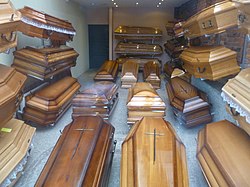
A distinction is commonly drawn between "coffins" and "caskets", using "coffin" to refer to a tapered hexagonal or octagonal (also considered to be anthropoidal in shape) box and "casket" to refer to a rectangular box, often with a split lid used for viewing the deceased as seen in the picture. Receptacles for cremated and cremulated human ashes (sometimes called cremains) are called urns.
Coffin, First attested in English in 1380,[citation needed] derives from the Old French cofin, from Latin cophinus, the latinisation of Greek κόφινος (kophinos), all meaning basket. The earliest attested form of the word is the Mycenaean Greek ko-pi-na, written in Linear B syllabic script. The modern French form, couffin, means cradle.
Casket originally referred to a jewelry box; use of the word in the funerary sense began as a euphemism introduced by the undertaker's trade.
The earliest evidence of wooden coffin remains, dated at 5000 BC, was found at the Beishouling, Shaanxi historical site, in Tomb 4. Clear evidence of a rectangular wooden coffin was found in Tomb 152 in an early Banpo site. The Banpo coffin belongs to a four-year-old girl; it measures 1.4 m (4.6 ft) by 0.55 m (1.8 ft) and 3–9 cm thick. As many as 10 wooden coffins have been found at the Dawenkou culture (4100–2600 BC) site at Chengzi, Shandong. The thickness of the coffin, as determined by the number of timber frames in its composition, also emphasized the level of nobility, as mentioned in the Classic of Rites, Xunzi and Zhuangzi.
Examples of coffin use have been found in several Neolithic sites: the double coffin, the earliest of which was found in the Liangzhu culture (3400–2250 BC) site at Puanqiao, Zhejiang, consists of an outer and an inner coffin, while the triple coffin, with its earliest finds from the Longshan culture (3000–2000 BC) sites at Xizhufeng and Yinjiacheng in Shandong, consists of two outer coffins and one inner.
A coffin may be buried in the ground directly, placed in a burial vault or cremated. Alternatively it may be entombed above ground in a mausoleum, a chapel, a church, or in a loculus within catacombs.[citation needed]
In parts of Sumatra, Indonesia, ancestors are revered and bodies were often kept in coffins alongside the longhouses until a ritual burial can be performed. The dead are also disinterred for rituals. Mass burials are also practiced.[citation needed]
Coffin
A coffin or casket is a funerary box used for viewing or keeping a corpse, for burial, entombment or cremation. Coffins are sometimes referred to as caskets, particularly in American English.
A distinction is commonly drawn between "coffins" and "caskets", using "coffin" to refer to a tapered hexagonal or octagonal (also considered to be anthropoidal in shape) box and "casket" to refer to a rectangular box, often with a split lid used for viewing the deceased as seen in the picture. Receptacles for cremated and cremulated human ashes (sometimes called cremains) are called urns.
Coffin, First attested in English in 1380,[citation needed] derives from the Old French cofin, from Latin cophinus, the latinisation of Greek κόφινος (kophinos), all meaning basket. The earliest attested form of the word is the Mycenaean Greek ko-pi-na, written in Linear B syllabic script. The modern French form, couffin, means cradle.
Casket originally referred to a jewelry box; use of the word in the funerary sense began as a euphemism introduced by the undertaker's trade.
The earliest evidence of wooden coffin remains, dated at 5000 BC, was found at the Beishouling, Shaanxi historical site, in Tomb 4. Clear evidence of a rectangular wooden coffin was found in Tomb 152 in an early Banpo site. The Banpo coffin belongs to a four-year-old girl; it measures 1.4 m (4.6 ft) by 0.55 m (1.8 ft) and 3–9 cm thick. As many as 10 wooden coffins have been found at the Dawenkou culture (4100–2600 BC) site at Chengzi, Shandong. The thickness of the coffin, as determined by the number of timber frames in its composition, also emphasized the level of nobility, as mentioned in the Classic of Rites, Xunzi and Zhuangzi.
Examples of coffin use have been found in several Neolithic sites: the double coffin, the earliest of which was found in the Liangzhu culture (3400–2250 BC) site at Puanqiao, Zhejiang, consists of an outer and an inner coffin, while the triple coffin, with its earliest finds from the Longshan culture (3000–2000 BC) sites at Xizhufeng and Yinjiacheng in Shandong, consists of two outer coffins and one inner.
A coffin may be buried in the ground directly, placed in a burial vault or cremated. Alternatively it may be entombed above ground in a mausoleum, a chapel, a church, or in a loculus within catacombs.[citation needed]
In parts of Sumatra, Indonesia, ancestors are revered and bodies were often kept in coffins alongside the longhouses until a ritual burial can be performed. The dead are also disinterred for rituals. Mass burials are also practiced.[citation needed]
Recent media
Recent media