Hubbry Logo
ColeopterColeopterMain
Open search
Coleopter
Community hub
Coleopter
logo
8 pages, 0 posts
0 subscribers
Be the first to start a discussion here.
Coleopter
Coleopter
from Wikipedia
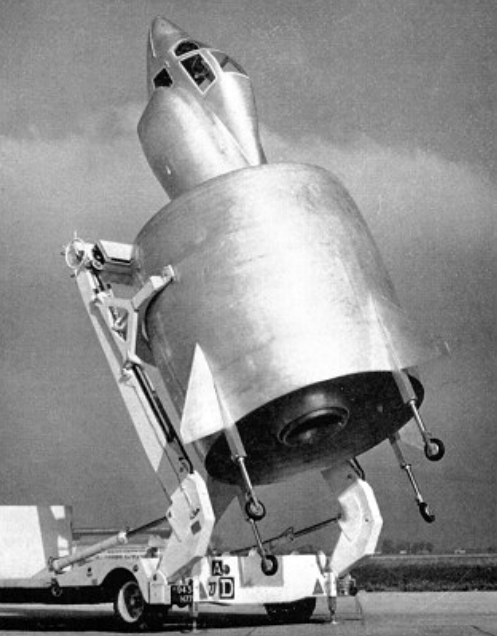
The French Snecma Coléoptère, which gave its name to the coleopter category

A coleopter is a type of VTOL aircraft design that uses a ducted fan as the primary fuselage of the entire aircraft. Generally they appear to be a large barrel-like extension at the rear, with a small cockpit area suspended above it. Coleopters are generally designed as tail-sitters. The term is an anglicisation of the French coléoptère "beetle" after the first actual implementation of this design, the SNECMA Coléoptère of the mid-1950s.

Early experiments

[edit]
A Hiller VXT-8 mockup on display at the Hiller Aviation Museum

The first design of an aircraft clearly using the coleopter concept was developed during World War II. From 1944 on, the Luftwaffe was suffering from almost continual daytime attacks on its airfields and was finding it almost impossible to conduct large-scale operations. Their preferred solution was to introduce some sort of VTOL interceptor that could be launched from any open location, and there were many proposals for such a system. Heinkel conducted a series of design studies as part of their Wespe and Lerche programs. The Wespe intended to use a Benz 2,000 hp turboprop engine, but these were not forthcoming and the Lerche used two Daimler-Benz DB 605 piston engines instead. Nothing ever came of either design.

In the immediate post-war era, most VTOL research involved helicopters. As the limitations of the simple rotary wing became clear, teams started looking for other solutions and many turned to using jet engines directly for vertical thrust. SNECMA, now Safran Aircraft Engines, developed a series of such systems as part of the SNECMA Atar Volant series during the 1950s. To further improve the design, SNECMA had Nord Aviation build an annular wing and adapted it to the last of the Volant series to produce the SNECMA Coléoptère. The Coléoptère first flew on 6 May 1959, but crashed on 25 July and no replacement was built. Even in this limited testing period, the design showed several serious problems related to the high angular momentum of the engine, which made control tricky.

In the US, Hiller Aircraft had been working on a number of ducted fan flying platforms originally designed by Charles H. Zimmerman. The Hiller VXT-8 Coleopter was a proposed annular wing VTOL aircraft designed in the late 1950s, inspired by the French SNECMA Coléoptère. After some early successes, the Army demanded a series of changes that continued to increase the size and weight of the platform, which introduced new stability problems. These generally required more size and power to correct, and no satisfactory design came from these efforts. Instead, Hiller approached the Navy with the idea of building a full coleopter design.

This emerged as the Hiller VXT-8 which was significantly similar to the SNECMA design, although it used a propeller instead of a jet engine. However, the introduction of turbine-powered helicopters like the Bell UH-1 Iroquois so significantly improved their performance over piston-powered designs that the Navy lost interest in the VXT-8 in spite of even better estimated performance. Only a mock-up was completed.

Convair Model 49

[edit]

Convair selected the coleopter layout for their Model 49 proposal, entered into the Advanced Aerial Fire Support System (AAFSS).

AAFSS asked for a new high-speed helicopter design for the attack and escort roles. Submissions included gyrodynes, dual-rotor designs and similar advances on conventional designs, but nothing was as unconventional as the Model 49.

The Model 49 was based on a tri-turbine design featuring counter-rotating propellers within a shroud. Exposed areas were armored to withstand 12.7mm fire. The two-man crew was located in an articulated capsule which could either point forward of the shroud when horizontal or at right-angles to it when vertical, and pilot controls were limited to engine speed, blade angle and directional control. The design was believed by its manufacturers to be inherently more reliable than that of conventional helicopters.[1]

As a "tail-sitter" design, and like its forebear the Convair XFY-1 POGO, the Model 49 was intended to take off from a vertical orientation before transitioning to horizontal orientation for flight. Once at its destination it could transition back to vertical mode to hover and provide fire support.[2]

The design was intended to be capable of carrying multiple armament configurations, with all weapons being remotely controlled by the gunner from the crew capsule.[2] Its hardpoints consisted of two side turrets, a center turret, and two hardpoints each for two of the nacelles. All of the weapons could be used in either horizontal or vertical configuration, as well as while grounded. The turrets were mechanically prevented from firing "up" at the crew capsule while in vertical configuration. The side turrets could feature either 7.62 mm machine guns with 12,000 rounds of ammunition each, or 40mm grenade launchers with 500 rounds each.[1]

The center turret carried an XM-140 30mm cannon with 1000 rounds, with the option for a second 30mm cannon, or 500 WASP rockets. Any of the four hardpoints could carry three BGM-71 TOW missiles, or three Shillelagh missiles. Alternatively, up to one hardpoint on each of the nacelles could carry an M40A1C 106mm recoilless rifle with 18 rounds. As an alternative, the hardpoints could mount up to 1,200 gallons of additional fuel in tanks.[1]

Deemed overly complicated, the Army instead selected the Lockheed AH-56 Cheyenne and Sikorsky S-66 for further development. In the end only scale models of the model 49 were ever built.[2]

See also

[edit]

Notes

[edit]

References

[edit]
[edit]
Revisions and contributorsEdit on WikipediaRead on Wikipedia
from Grokipedia
A coleopter is a type of vertical take-off and landing (VTOL) design that integrates a or as the core structure, enclosed within a circular shroud or annular to facilitate both efficient hovering and high-speed forward flight. The term is an anglicization of the French coléoptère, meaning "" and derived from Greek roots koleos ("sheath") and pteron (""). This configuration emphasizes compactness and propulsion integration, allowing the aircraft to transition seamlessly between vertical lift and horizontal cruise modes without traditional wings or runways. Originating from conceptual studies during , such as the German interceptor proposed in 1944, the design gained prominence in the 1950s amid demands for rapid-response, runway-independent fighters. The most notable implementation was the French SNECMA C.450 Coléoptère prototype, developed in the early 1950s under government funding to explore annular wing VTOL feasibility. Powered by a single SNECMA Atar 101 turbojet engine producing 3,700 kg (8,160 lb) of thrust, the aircraft featured a prone pilot position in a cockpit atop the structure for optimal visibility during transitions, with control achieved via vectored exhaust and auxiliary jets. Measuring 8.02 m (26 ft 4 in) in length, 4.51 m (14 ft 10 in) in wingspan (including stabilizing fins), and 3.20 m (10 ft 6 in) in diameter, it had a maximum takeoff weight of around 3,000 kg (6,614 lb) and was projected to reach speeds up to 800 km/h (497 mph). Initial testing included wind tunnel models and subscale free-flight vehicles, culminating in the full-scale prototype's first tethered hover in April 1959 and untethered flight on May 6, 1959. Despite its innovative potential for military applications, the Coléoptère program ended abruptly after a crash that destroyed the prototype on July 25, 1959, during its ninth flight, when the aircraft lost control from approximately 75 meters (250 ft) altitude due to transition instability and insufficient thrust margin; the pilot ejected safely with minor injuries. This incident highlighted challenges like pitchback instability in ducted designs, yet it contributed valuable data to subsequent VTOL research, alongside other 1950s efforts like the American Hiller VZ-1 Pawnee and influencing modern drone variants like the U.S. military's XQ-138. Contemporary coleopter-inspired drones leverage advanced materials like graphite-epoxy composites and achieve dash speeds exceeding 260 km/h (164 mph) with endurance over one hour, demonstrating renewed interest in the configuration for urban air mobility and tactical operations.

Design Concept

Configuration and Principles

The coleopter is defined as a tail-sitting vertical take-off and landing (VTOL) aircraft configuration that integrates a or annular as the primary fuselage structure, enabling both vertical lift and horizontal flight without conventional or tail assemblies. This design derives its name from the French term "coléoptère," meaning "," due to the resemblance of its encircling ring- to the sheathed of coleopteran , a term rooted in Greek "koleopteros" for "sheathed ." Patented in 1950 by Helmut Graf von Zborowski, the configuration emphasizes a compact, barrel-like form for operations in constrained environments. Key components include a shrouded propeller, ducted rotor, or jet exhaust system positioned centrally within the annular structure to provide both lift and propulsion, with the cockpit or crew capsule mounted at the upper end for pilot visibility during vertical phases. Control surfaces, such as vectored thrust nozzles, spoilers, or integrated flaps within the ring-wing, facilitate stability and maneuvering, often augmented by gimballed engine nozzles or jet vanes for pitch, roll, and yaw adjustments. The annular wing itself, typically constructed with stressed skin and aerodynamic fairings, serves dual roles in generating lift during forward flight and channeling airflow for hover efficiency, eliminating the need for separate empennage. Operationally, coleopters achieve vertical takeoff and landing through direct engine thrust exceeding the aircraft's weight, requiring thrust-to-weight ratios greater than 1, with historical designs typically around 1.05 to 1.2, directed downward via the ducted system for hover stability. Transition to forward flight occurs by tilting the entire rearward or employing to redirect propulsion, allowing the annular wing to produce aerodynamic lift while control surfaces manage attitude changes; ground effect enhances low-altitude stability during these phases. This integrated approach avoids complex mechanical linkages, relying instead on high-thrust or engines for seamless mode shifts. Intended primarily for short take-off/vertical landing (STOVL) roles, coleopters were conceptualized for applications such as interceptors requiring rapid deployment from dispersed sites, in urban or remote areas, and light transport to confined spaces where runways are unavailable. Their compact footprint supports operations from small carriers or improvised bases, prioritizing agility over long-range endurance.

Advantages and Applications

The coleopter design offers a compact footprint, enabling operations in confined urban environments or on shipboard decks without requiring extensive runways, which enhances deployment flexibility for both military and civilian scenarios. This configuration leverages ducted fan propulsion to achieve a high thrust-to-weight ratio, with modern examples tested from 1.0 to 1.8, facilitating efficient vertical takeoff, landing, and sustained hover capabilities. Additionally, the annular shroud provides an armored enclosure around the fan, reducing vulnerability to debris, projectiles, or ground hazards while improving overall safety by containing rotor blades. Compared to tiltrotor designs, the coleopter simplifies manufacturing through fewer articulated moving parts, relying instead on fixed ducted structures that can be produced with lightweight composites like graphite-epoxy. In military contexts, the design's theoretical benefits position it for roles such as point-defense interceptors, where rapid response from dispersed locations minimizes exposure to threats, or platforms that could operate from small vessels for persistent surveillance. It also aligns with advanced aerial fire support systems (AAFSS), providing with enhanced low-altitude maneuverability to evade detection. For civilian applications, coleopters could serve in short-haul urban , connecting remote areas without , or as response vehicles for rapid evacuations and assessment in inaccessible terrains. Relative to conventional fixed-wing aircraft, the coleopter eliminates the need for runways, allowing operations from unprepared sites and superior hover maneuverability for precise positioning, though this comes at the expense of increased complexity during transitions between hover and forward flight regimes. The ducted fan mechanics contribute to these gains by directing airflow efficiently for lift augmentation in hover, as outlined in core configuration principles.

Historical Development

World War II Origins

During , the intensification of Allied campaigns against from 1943 to 1945 inflicted severe damage on airfields, runways, and supporting infrastructure, compelling the to explore vertical take-off and landing (VTOL) aircraft concepts for rapid-response interception without reliance on conventional airstrips. These efforts focused on configurations, where the aircraft would launch vertically on its tail and transition to horizontal flight, enabling operations from improvised sites near industrial targets under constant threat. The emerged as one of the earliest such proposals, designed in late at the aircraft works in specifically as a tail-sitting VTOL interceptor for point defense of key factory complexes amid escalating Allied raids. Featuring an innovative circular wing with small stabilizing wingtips for enhanced low-speed control during vertical phases, the Wespe was envisioned to scramble quickly against bomber formations, much like the rocket-powered . Propulsion came from a single HeS 021 engine rated at 2,000 hp, which drove a six-bladed via an air intake positioned below the , with dimensions limited to a 5-meter wingspan and 6.2-meter length to facilitate compact storage and deployment. Defensive armament comprised two 30 mm MK 108 autocannons housed in streamlined blisters flanking the prone pilot's position. Evolving directly from the Wespe, the was proposed in February 1945 as a refined VTOL optimized for intercepting high-altitude Allied bombers from any flat surface, addressing the widespread cratering of runways by prior strikes. This design incorporated a ring-shaped annular to shroud twin , powered by two Daimler-Benz DB 605D liquid-cooled V-12 engines each delivering 2,000 hp for sufficient thrust in vertical mode. The configuration prioritized short-field capability and agility, with a projected maximum speed of 482 mph and service ceiling of 32,808 feet to pursue strategic bombers effectively. Armament proposals included two 30 mm MK 108 cannons for close-range engagements and three wire-guided anti-aircraft missiles to extend its reach against formations. These Heinkel projects drew inspiration from parallel German tail-sitter research, notably the interceptor concept initiated in September 1944, which emphasized rotary wings for VTOL but shared the urgency for airfield-independent operations. Despite their conceptual promise, both the and Lerche advanced no further than design studies, remaining unbuilt owing to acute material shortages, disrupted production, and Germany's unconditional surrender in May 1945.

Post-War Experiments

Following , interest in coleopter concepts—characterized by tail-sitting annular wings for vertical takeoff and landing (VTOL)—revived in the 1950s amid priorities for dispersed, runway-independent aircraft to counter airfield vulnerabilities. This resurgence built briefly on unbuilt WWII precursors like the German , but shifted focus to integrating and engines for practical VTOL operations, emphasizing compact designs suitable for fighters and reconnaissance roles. Early experiments in the United States and centered on preliminary wind tunnel models and subscale flights to investigate annular wing stability, particularly in hover, transition, and forward flight regimes. In the U.S., conducted studies on Configuration IVa, a ducted-fan VTOL design akin to coleopter principles, from 1953 to 1954, with NACA free-flight model tests demonstrating effective hovering but highlighting directional instability at high angles of attack around 55 degrees. European efforts, led by SNECMA, included low-speed tests in 1953 to assess annular wing across flight modes, followed by subscale pulse-jet-powered models that achieved stable free flights on March 31, 1954, validating basic control and stability. These foundational tests by firms exploring VTOL configurations laid groundwork for jet integration without relying on conventional runways. Between and 1958, key events advanced coleopter viability through trials aimed at solving transition challenges from vertical to horizontal flight. SNECMA's Volant (C.400 P.1) test rig, developed starting in , featured a in a basic fairing for pure jet-lift evaluation; it completed initial gyroscopic rig tests in and achieved the first tethered hover on September 22, 1956, accumulating over 200 flights by 1958 to study deflection and stability augmentation. These experiments employed fluidic via injection for pitch and yaw control, alongside spoilers and reaction jets for roll, providing critical data on engine exhaust management during attitude changes that influenced subsequent annular wing designs. In the U.S., parallel work by on VTOL hover rigs from 1954 onward tested gimbaled nozzles and wingtip jets, contributing to broader insights on transition dynamics applicable to coleopter-like stability.

Major Projects

SNECMA Coléoptère

The SNECMA Coléoptère was a French experimental vertical take-off and landing (VTOL) developed by the Société Nationale d'Étude et de Construction de Moteurs d'Aviation (SNECMA) in the late 1950s as part of post-war research into annular wing configurations for high-speed transition from hover to forward flight. Initiated around 1954 following earlier tests with the Atar Volant rigs powered by a 6,400 lb thrust Atar D engine from 1955 to 1957, the project built on these foundations to create a manned prototype. The airframe was constructed by at Châtillon-sous-Bagneux, incorporating a tail-sitting design with a single SNECMA Atar 101E turbojet engine rated at approximately 7,700 lb (3,500 kg) thrust, derived from post-war adaptations of German technology. Key specifications included an overall length of about 8.05 m, an annular diameter of roughly 4.51 m, and a height of 3.2 m in the vertical attitude, with an empty weight around 1,200 kg and a maximum take-off weight of 3,000 kg. The design featured a 22 ft enclosed within the 10.5 ft diameter annular , supported by four small stabilizing fins above castoring wheels for ground handling, and was intended to achieve a maximum speed of 800 km/h (approximately Mach 0.65 at ) with a service ceiling of 3,000 m. Fuel capacity was 700 kg, enabling short-duration test flights focused on VTOL transitions rather than extended range. Flight testing began with tethered hovers on April 17, 1959, at the Melun-Villaroche airfield, followed by the first untethered vertical flight on May 3, 1959, lasting 3.5 minutes, and a subsequent free hover reaching 800 m altitude by May 6. Over the next two months, the prototype completed eight successful flights, demonstrating stable hovers and partial transitions up to 2,625 ft while under the control of test pilot Auguste Morel. However, during the ninth flight on July 25, 1959, while attempting a transition to horizontal flight from an altitude of approximately 600 m (2,000 ft), the aircraft lost control, entering an uncontrolled descent with oscillations that led to a compressor stall. Morel ejected at 150 m but sustained serious injuries upon landing; the prototype was destroyed on impact, ending the program with no further prototypes built. Innovations in the Coléoptère included a ring-shaped system that augmented by directing over the annular for lift enhancement during transition, along with swiveling exhaust vanes in the for pitch and yaw control in hover mode, and auxiliary nose strakes to assist in maneuvers for forward flight. The cockpit featured a tilting and additional windows for improved visibility during vertical landings, addressing visibility challenges inherent to the tail-sitting configuration. These elements represented an early practical application of coleopter principles, though the fatal accident highlighted unresolved issues in transition stability.

Hiller VXT-8

The Hiller VXT-8 was a proposed American adaptation of the coleopter configuration, emphasizing propeller-driven propulsion within a ducted annular wing for vertical takeoff and landing (VTOL) capabilities. Developed by in the late 1950s under its VTOL division, the project drew direct inspiration from the French SNECMA Coléoptère . The U.S. provided funding to explore the concept's potential for naval applications, including anti-submarine warfare roles that could leverage the design's compact footprint and hover stability. Key design elements centered on a system integrated into an annular wing, enabling efficient vertical lift and transition to forward flight through vehicle tilting. The configuration featured a single-person positioned centrally within the duct for intuitive control via body lean or simple inputs, building on Hiller's prior experience with ducted-fan platforms like the VZ-1 Pawnee. testing validated the basic hover stability of the annular structure, demonstrating potential for low-speed maneuverability without complex mechanical tilting mechanisms. Planned performance included a substantial payload capacity to support operational utility, though specific metrics were not fully realized due to the project's early termination. Development progressed only to the construction of a full-scale mock-up by 1961, with no flying prototype ever built. The U.S. Navy ultimately canceled the effort, favoring more conventional turbine-powered helicopters such as the UH-1 Iroquois for their proven reliability and simpler transition dynamics in forward flight. This decision reflected broader challenges in coleopter designs, including control complexities during speed transitions, despite the VXT-8's innovative propeller-based approach. The mock-up is preserved at the , serving as a testament to early VTOL experimentation.

Convair Model 49

The Model 49 was a militarized coleopter design proposed by 's division in the mid-1960s for the U.S. Army's Advanced Aerial System (AAFSS) program, intended to fulfill advanced assault and requirements in environments like . Drawing on prior experience with VTOL concepts such as the Navy's XFY-1 Pogo, the Model 49 utilized a tri-turbine system where three engines drove counter-rotating, variable-pitch propellers within a single annular shroud, enabling vertical takeoff, hovering, and transition to high-speed forward flight. This configuration amplified thrust through the shroud while simplifying control inputs by eliminating the need for cyclic pitch mechanisms typical in conventional helicopters. Key specifications included a two-man capsule armored with dual-property capable of withstanding 12.7 mm projectiles, positioned atop the shroud for enhanced sensor integration and survivability. The overall vehicle measured approximately 30 feet in length with a rotor shroud of 23 feet, achieving a fully loaded weight of around 21,000 pounds. was provided by three Lycoming LTC4B-11 engines delivering a combined 9,000 horsepower, though alternatives like the General Electric T64, , or JFTD12 were evaluated during design studies. Fuel capacity reached up to 1,200 gallons via four external tanks for extended ferry ranges. Armed variants emphasized , featuring two side-mounted turrets equipped with either XM-134 7.62 mm miniguns (carrying 12,000 rounds) or XM-75 40 mm grenade launchers (500 rounds), a central XM-140 30 mm (1,000 rounds) or 500 WASP rockets, and four underbody hardpoints supporting configurations such as three missiles, Shillelagh guided missiles, or an M40A1C 106 mm with 18 rounds and a 10,000-yard . The design incorporated innovations like modular weapon bays that allowed rapid reconfiguration of armaments for diverse mission profiles, with rotating hardpoints enabling aiming in both hover and forward flight modes. The articulating crew capsule could tilt forward up to 90 degrees, functioning as a stabilized platform during VTOL operations and providing the crew with direct visibility for ground support. Evaluation involved wind tunnel testing of scale models and flight simulations in 1965 to assess aerodynamic stability and control characteristics. Despite Convair's claims of high reliability and low development risk due to the simplified rotor system, the Model 49 was rejected in 1966 for its excessive mechanical complexity and unproven radical features, leading the Army to select the more conventional compound helicopter instead.

Technical Challenges

Aerodynamic and Control Issues

Coleopter designs, characterized by their central ducted fan surrounded by an annular wing, encounter significant aerodynamic challenges stemming from the high angular momentum of the rotating fan components. The ducted fan's rapid rotation induces gyroscopic precession, a phenomenon where applied forces result in responses displaced by 90 degrees in the direction of rotation, thereby complicating pitch and yaw control during critical transition phases from hover to forward flight. This gyroscopic torque, primarily from the engine's compressor and turbine wheels, requires active counteraction to maintain stability, often overwhelming the limited control authority available in such configurations. Control in coleopters relies heavily on thrust deflection mechanisms, such as pneumatic vanes or swiveling nozzles in the exhaust stream, for directional authority during hover and low-speed operations. However, these systems exhibit instability at reduced speeds, where airflow over the vanes diminishes, leading to inadequate response and potential loss of authority. The lack of conventional aerodynamic control surfaces, like ailerons or rudders, further aggravates roll control issues, as the annular wing provides minimal inherent damping for lateral motions, resulting in observed uncontrolled rolls during testing. Aerodynamically, the annular wing enhances lift generation by capturing fan exhaust and providing a shrouded flow path, but it simultaneously introduces vortex interference between the wing's tip vortices and the propulsion slipstream. This interaction disrupts uniform airflow into the fan inlet and reduces propulsive efficiency, particularly as the aircraft transitions to forward flight where relative wind alters the vortex patterns. Effective transition demands precise to balance lift and drag shifts, yet prototypes frequently failed in this regime due to the sensitivity of these mechanisms to aerodynamic perturbations, underscoring the inherent control limitations of the design.

Stability and Performance Limitations

Coleopter aircraft designs were plagued by inherent instability arising from their tail-sitter configuration and annular wing structure, which generated unpredictable aerodynamic forces during hover and transition phases. This instability manifested as control conflicts, particularly between 32° and 70° angles of attack, where roll and yaw reversals could occur without adequate damping. In the absence of modern computer-based augmentation, early stability systems—such as analog electro-hydraulic setups or rate gyros—proved insufficient to fully mitigate these issues, resulting in high pilot workload and frequent oscillations that compromised safe operation. The elevated center of gravity in the vertical orientation further heightened tip-over risks during ground operations or exposure to lateral gusts, as the short moment arm between the thrust line and contact points offered limited resistance to overturning moments. Performance limitations further undermined coleopter viability, with forward speeds typically capped at subsonic levels due to pitchback phenomena exacerbated by asymmetries over the duct lips at higher velocities. Hovering demanded excessive fuel consumption from propulsion, often exceeding 5 lb/min in configurations, which curtailed total endurance to roughly 25 minutes for a complete vertical takeoff, transition, cruise, and landing sequence using around 1,500 lb of fuel. The enclosing shroud and ring-wing, while beneficial for augmentation in hover, introduced substantial in forward flight, constraining operational range; for instance, Convair's conceptual design forecasted a radius of about 250 nautical miles under loaded conditions. By the 1960s, these drawbacks rendered coleopters inferior to advancing and compound alternatives, which demonstrated superior hover efficiency, extended range, and inherent stability for all-weather missions without relying on complex augmentation to counter gust-induced deviations beyond 5-10 knots. No coleopter variant achieved a practical solution for reliable operations in adverse conditions, contributing to the configuration's abandonment in favor of more robust VTOL paradigms.

Legacy and Influence

Impact on VTOL Design

Despite their ultimate abandonment due to insurmountable technical hurdles, coleopter experiments provided critical lessons in ducted propulsion that advanced subsequent VTOL designs. The SNECMA Coléoptère's annular jet configuration demonstrated the potential for integrated ducted fans to generate high -to-weight ratios while enclosing propulsion for safety and efficiency, influencing broader research into vectored systems. The emphasis on precise control during hover and transition phases in coleopter tests, including stability augmentation to counter roll-yaw coupling, informed developments in VTOL transition mechanisms. The broader contributions of 1950s–1960s coleopter research accelerated U.S. and European VTOL programs by validating core principles of and annular under real-world conditions. These experiments, including over 400 test flights with SNECMA's C.400 precursors and the Ryan X-13's 136 successful sorties, highlighted the feasibility of jet-based vertical lift, paving the way for vectored thrust technologies in production aircraft. By demonstrating controlled thrust deflection via and exhaust vanes, coleopter work contributed to advancements in short takeoff and vertical landing (STOVL) capabilities, influencing military adoption of vectored thrust over pure configurations. Key outcomes from coleopter development shifted military priorities toward more reliable VTOL configurations, such as tiltrotors and lift-fans, after revealing persistent issues like high drag and control instability during transitions—challenges that underscored the need for hybrid aerodynamic controls. Nonetheless, the validation of annular , which offered approximately 40% weight savings over conventional wings despite subsonic drag penalties, has informed contemporary concepts by providing a foundation for enclosed designs that enhance and in confined environments.

Modern Adaptations

In the , coleopter principles have seen revival in (UAV) designs, particularly for high-performance convertible drones that transition between vertical takeoff and landing (VTOL) and forward flight modes. Notable examples include the XQ-138 family of drones developed by Micro Autonomous Systems (), which draws inspiration from the historical SNECMA Coléoptère to achieve compact, annular-wing configurations powered by electric ducted fans. These drones enable agile applications, including military operations such as live-fire exercises at ranges like Fort Benning and civil tasks like crop inspection, with demonstrated speeds up to 164 mph (263 kph) in low-drag variants and endurance exceeding one hour in stock configurations. Advancements in electric propulsion have addressed key limitations of early coleopter designs, such as pitchback during transitions, through features like grid fins and extended for decoupled pitch and yaw control. This allows stable hover out of ground effect at 2 meters and rapid mode conversion, making the drones suitable for dynamic environments with gust resistance. The integration of lightweight components, such as those in the XQ-138 variants weighing 115–2,458 grams, supports for missions while maintaining high thrust-to-weight ratios. Contemporary coleopter-inspired UAVs benefit from modern sensors to overcome inherent stability challenges, enabling reliable operation in hybrid VTOL configurations for . techniques, combining vision systems, , and ultrasonic sensors, provide precise perception for obstacle avoidance and landing. These technologies enhance safety and reliability for applications in urban logistics, such as , by mitigating risks in cluttered . As of 2024, derivatives of the XQ-138 continue to be explored for tactical operations, demonstrating ongoing interest in the configuration.
Add your contribution
Related Hubs
User Avatar
No comments yet.