Hubbry Logo
Colin StetsonColin StetsonMain
Open search
Colin Stetson
Community hub
Colin Stetson
logo
8 pages, 0 posts
0 subscribers
Be the first to start a discussion here.
Colin Stetson
Colin Stetson
from Wikipedia

Key Information

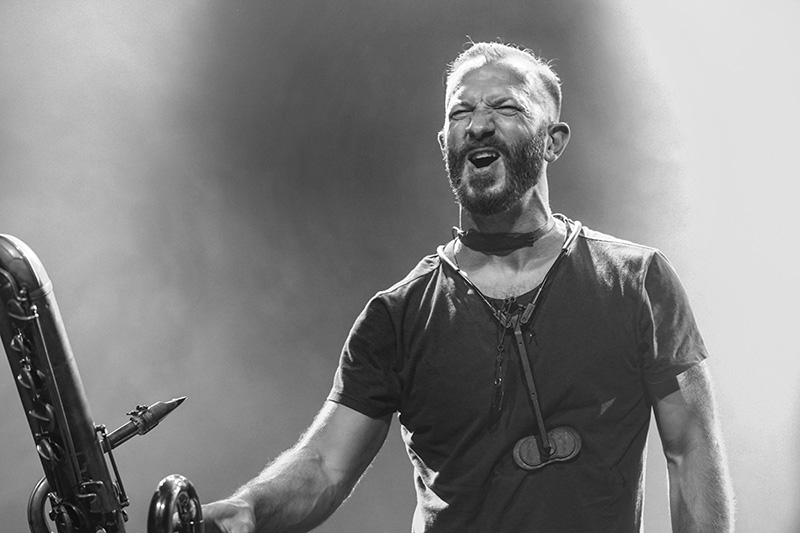
Colin Stetson (born March 3, 1975)[1][2] is an American saxophonist, multireedist, and composer based in Montreal.[3][4] He is best known as a regular collaborator of the indie rock acts Arcade Fire, Bon Iver, Bell Orchestre, and Ex Eye. In addition to saxophone, he plays clarinet, bass clarinet, French horn, flute, and cornet.

Stetson has released various solo releases, including his debut and subsequent albums New History Warfare Vol. 1, 2, & 3, a collaborative studio album with violinist Sarah Neufeld entitled Never Were the Way She Was (2015), Sorrow: A Reimagining of Henryk Górecki's 3rd Symphony (2016),[5] and All This I Do for Glory (2017). Since 2013, Stetson has contributed the scores to several films and television series.

Background

[edit]

Born in Ann Arbor, Michigan and currently based in Montreal, Quebec, Stetson started taking lessons at age 15.[2] He attended the University of Michigan School of Music with a full scholarship, where he joined Transmission Trio.[6] He also played with the groups Boostamonte and the People's Bizarre.[3]

Stetson has performed and recorded with dozens of artists, including Tom Waits, Arcade Fire, TV on the Radio, Feist, and Bon Iver.[7]

His extended saxophone techniques cover advanced circular breathing, multiphonics, altissimo, microtones, (reed) vocalizations, percussive valve-work, clicking keys, and growling.[8] The overall effect led The New Yorker film critic Anthony Lane to describe Stetson's score to the film Hereditary as having been seemingly "scored for violins, percussion, a humpback whale, and bats."[9]

Solo career

[edit]
Colin Stetson at Sled Island Music and Arts Festival, Calgary, 2013.

His first solo album, New History Warfare Vol. 1, was released in 2008. His second and third albums, New History Warfare Vol. 2: Judges and New History Warfare Vol. 3: To See More Light, were released by Constellation Records in early 2011. On June 16, the album was named as a longlisted nominee for the 2011 Polaris Music Prize,[10] and shortlisted on July 6.[4]

Stetson was chosen by Jeff Mangum of Neutral Milk Hotel to perform at the All Tomorrow's Parties festival that he curated in December 2011 in Minehead, England.[11] The final album of the trilogy, New History Warfare Vol. 3: To See More Light, was released by Constellation Records in April 2013, and was a longlist nominee for the 2013 Polaris Music Prize.[12]

April 2015 saw the release of Never Were the Way She Was, the first recording of Stetson's duo project with his then wife and long-time collaborator Sarah Neufeld.[13] Stetson's album All This I Do for Glory was released on April 28, 2017.[14] In 2022 he released the drone-inspired album Chimæra I.[15] It was followed a year later by the minimalist When We Were That What Wept for the Sea.[16] In September 2024, Stetson released The Love It Took to Leave You.[17]

Discography

[edit]
Colin Stetson with Ex Eye @ Strange Matter, 2017

Solo albums/As leader

[edit]

Soundtrack albums

[edit]

Collaborations with other artists

[edit]

As sideman

[edit]

Filmography

[edit]

Film

[edit]
Year Title Director Notes
2007 Greyhounds Kelilyn Mohr McKeever Short film
2012 Rust and Bone Jacques Audiard Composer, Musician: "All the Days I've Missed You (Ilaij I)"
2013 12 Years a Slave Steve McQueen Composer, Musician: "Awake on Foreign Shores"
Blue Caprice Alexandre Moors
2014 The Rover David Michôd Composer, Musician: "Time is Advancing with Fitful Irregularity", "As a Bird or Branch", "Groundswell", "Awake on Foreign Shores"
2015 La Peur Damien Odul
Vi ska bli rappare David Danial Composer, Musician: "Stand, Walk"
Denis the Pirate Sam Messer Composed with Sarah Neufeld
It's About Time Ivo Briedis Short film
Closet Monster Stephen Dunn Composer, Musician: "The Stars In His Head (Dark Lights Remix)"
2016 Lavender Ed Gass-Donnelly Composed with Sarah Neufeld
Outlaws and Angels J. T. Mollner
The War Show Andreas Møl Dalsgaard & Obaidah Zytoon
2017 Destierros Hubert Caron-Guay Partial score
2018 Age Out A.J. Edwards
Hereditary Ari Aster
We Rene Eller
2019 Color Out of Space Richard Stanley
2021 Mayday Karen Cinorre
2022 Texas Chainsaw Massacre David Blue Garcia
The Menu Mark Mylod
2024 Hold Your Breath Karrie Crouse and Will Joines Composer
TBA Mayday Jonathan Goldstein and John Francis Daley Composer

Documentary film

[edit]
Year Title Director Notes
2012 Shut Up and Play the Hits Will Lovelace and Dylan Southern cast as himself
2014 A City Is an Island Timothy George Kelly cast as himself
2015 An American, Portrait of Raymond Luc Levasseur Pierre Marier
New York Never Sleeps Alfonso Nogueroles
Scrum Poppy Stockell
2016 The Devil's Horn Larry Weinstein cast as himself
Uncle Howard Aaron Brookner Composer, Musician: "In Mirrors"
2024 Martha R. J. Cutler

Television

[edit]
Year Title Network Notes
2014 The Blacklist

The Alchemist (No. 101)

NBC performer: " Warm Shadow" - uncredited
2017 Philip K. Dick's Electric Dreams

Human Is

Channel 4 performer: "The rest of us" - uncredited
2018 The First Hulu, Channel 4
2020 Barkskins National Geographic
2021 Among the Stars Disney Plus Composer for all 6 Episodes
2023 Hogan's Castle Netflix Composer for all 11 Episodes
2024 Uzumaki[23] Adult Swim's Toonami

Video game

[edit]
Year Title Studio
2018 Red Dead Redemption 2[24] Rockstar Games

References

[edit]
[edit]
Revisions and contributorsEdit on WikipediaRead on Wikipedia
from Grokipedia
Colin Stetson (born 1975) is a Grammy Award-winning Canadian-American saxophonist, , and renowned for his pioneering techniques on the , including , multiphonics, and live layering to produce intricate, one-take polyphonic compositions without overdubs or electronic effects. Based in since the late 2000s, he blends , , and noise elements in his solo work while collaborating across genres with artists such as , , , and The National. His career also encompasses acclaimed film and television scores, soundtracks, and leadership of the experimental band Ex Eye. Born and raised in , Stetson began painting at age two before taking up the at nine and pursuing formal studies at fifteen, initially aspiring to a career in visual effects. He earned a music degree from the and developed his skills in and during the early 2000s, where he built a reputation as a versatile reed player proficient on , , , , and bass saxophones, as well as , , , and . By 2007, he had relocated to , joining the city's vibrant scene and later signing with the Constellation Records label. His distinctive performance style—marked by intense physicality, including growling and vocalizing through the instrument while using contact microphones placed on his body and saxophone—draws from influences like avant-garde jazz pioneers Evan Parker and , as well as noise and drone artists such as and . Stetson's solo discography highlights his evolution as a , beginning with the New History Warfare trilogy: New History Warfare Vol. 1 (2008, Aagoo Records), Vol. 2: Judges (2011, Constellation Records, shortlisted for the ), and Vol. 3: To See More Light (2013, Constellation Records). Later releases include All This I Do for Glory (2017, 52Hz), praised by critics as a pinnacle of his vocal experimentation, and When We Were That What Wept for the Sea (2023, 52Hz), alongside the 2024 The love it took to leave you (Envision Records), whose title track was nominated for (but did not win) the 2025 SOCAN Song Prize. His Grammy win stems from contributions to Bon Iver's self-titled 2011 , which took home awards for Best Alternative Music and Best New . Collaborative projects, such as the duo Never Were the Way She Was (2015) with violinist and Sorrow (2016, a reimagining of Henryk Górecki's No. 3), further showcase his versatility. In addition to his recording career, Stetson has made significant contributions to visual media, scoring the Hereditary (2018, ), which earned widespread acclaim for its tense, immersive , as well as The Menu (2022) and the Texas Chainsaw Massacre (2022). His video game work includes original music for (2018, ), blending orchestral and experimental elements. He has also composed for television series like (2020, ) and the film Mayday (2021), which he regards as personal favorites. Stetson's live performances, often featuring marathon sets of unamplified intensity, have headlined festivals including SXSW, , and MUTEK, solidifying his status as a transformative figure in contemporary music.

Early Life and Education

Childhood and Family

Colin Stetson was born on March 3, 1975, in , to American parents. He grew up in the university town, where his early years were marked by a blend of artistic pursuits and athletic activities, including playing football and track during high school. Stetson initially showed a strong aptitude for , beginning at age two under the encouragement of his parents, and he considered it as a potential career path into his mid-teens. Although not raised in a particularly musical household, Stetson's family fostered an appreciation for music through their own interests; both parents possessed beautiful singing voices, his father had performed in a rock cover band during his youth and later worked as an MD and PhD cancer researcher until his death in 2021, and his mother sang in the church choir after being unable to pursue piano due to family constraints. The household maintained a modest record collection of about ten or eleven albums, which Stetson has described as substantial for their circumstances and provided his initial exposure to recorded music, including a shared enthusiasm for the Beach Boys inherited from his father. This environment instilled a foundational curiosity about music without formal immersion. Stetson's American upbringing in Ann Arbor shaped his early cultural identity, but his relocation to in the late 2000s—after time in and New York—led him to obtain Canadian citizenship, reflecting a broader North American perspective that influences his work. His initial interest in the emerged at age nine, when he began playing the instrument, marking the start of his musical path.

Musical Training

Colin Stetson began playing the at the age of nine, initially through school band programs in , where he grew up immersed in classic rock influences from his family, such as and Queen. By his early teens, his interest deepened through exposure to and pop saxophone solos, like those in Men at Work's music, which sparked a shift toward more experimental sounds. At around age 15, Stetson discovered free jazz pioneers including and , whose raw, expressive approaches profoundly shaped his emerging style, drawing him away from conventional jazz toward improvisation. During high school at Pioneer High School in Ann Arbor, Stetson gained early ensemble experience through local bands and school groups, while incorporating self-taught extended techniques inspired by his growing fascination with metal and experimental artists like and . His formal training began at this time with private lessons, where a teacher introduced him to —a method of sustaining notes indefinitely by inhaling through the nose while exhaling through the mouth—which he mastered in a single afternoon using a exercise against a wall. This period marked the start of his independent exploration of multiphonics and vocalizations, techniques he developed acoustically without pads or electronic aids, building on self-guided practice from his pre-teen years. In the mid- to late , Stetson attended the School of Music on a full , earning a degree in music with a focus on performance and under renowned pedagogue Donald Sinta, as well as instructors Christopher Creviston and Roscoe Mitchell. There, he refined his technical prowess, stunning Sinta during a warmup with advanced and exercises that showcased his burgeoning solo concepts, which he first conceptualized around age 19. His university training emphasized classical and repertoires, providing a rigorous foundation that contrasted with his self-directed leanings, allowing him to integrate influences from Ayler and Brötzmann into structured performance skills. After graduating in 1997, Stetson moved to , immersing himself in the city's vibrant experimental and improvisation scenes for six years, where he honed his unaccompanied techniques through rigorous daily practice. He later relocated to , New York, continuing to experiment with , multiphonics, and percussive body-instrument interactions in the downtown and noise communities, further developing his signature style without reliance on traditional amplification or effects. These years solidified his physical and conceptual approach, emphasizing and acoustic as core elements of his musical identity.

Solo Career

Debut and New History Warfare Series

Colin Stetson's debut solo album, New History Warfare Vol. 1, was released on March 4, 2008, by Aagoo Records. The record marked his entry into solo recording as a saxophonist, featuring exclusively unaccompanied performances on , , and bass saxophones. Each track was captured in a single live take with no overdubs, effects, or loops, emphasizing Stetson's technical prowess and the instrument's untapped sonic potential. This approach highlighted his use of to sustain continuous tones and techniques to layer sounds naturally. Building on this foundation, Stetson's second installment, New History Warfare Vol. 2: Judges, arrived on February 22, 2011, via Constellation Records. The album retained the solo focus but incorporated guest vocals from Shara Worden of My Brightest Diamond on tracks like a cover of Blind Willie Johnson's "Lord I Just Can't Keep from Crying" and from providing spoken-word elements on "Fear of the Unknown and the Blazing Sun." Critics lauded its raw intensity, with the 's visceral textures evoking a sense of unrelenting force through extended techniques and dynamic extremes. Recorded in single takes, the work expanded the series' conceptual scope while maintaining unadulterated acoustic purity. The trilogy culminated with New History Warfare Vol. 3: To See More Light, released on April 30, 2013, also on Constellation Records. This album introduced more pronounced narrative elements through vocal contributions from Justin Vernon of Bon Iver, who sang on several tracks to punctuate the instrumental cycles and evoke a sense of progression. Like its predecessors, it adhered to Stetson's signature method of solo saxophone performance without effects pedals, relying instead on the body's resonance—such as vocalizations channeled through the instrument—and room acoustics captured via multiple microphones placed on his person and in the space. The result was a panoramic exploration of the saxophone's timbral depth, completing the series' arc from stark minimalism to layered storytelling.

Later Solo Works and Techniques

Following the New History Warfare trilogy, Colin Stetson continued to explore the boundaries of solo performance with All This I Do for Glory (2017, 52Hz), which refined his raw, visceral style by blending elements of , , and . Recorded in a single room using a minimal setup with no overdubs or looping, the album features extended, unrelenting tracks that emphasize Stetson's physicality and endurance, such as the nearly 18-minute title track, which builds through layered and percussive effects. Stetson's solo output in the early 2020s shifted toward immersive, ambient textures, exemplified by When we were that what wept for the sea (2023, 52Hz), a post-minimalist exploration of saxophone and contrabass clarinet that evokes vast, emotional landscapes. Self-released via Bandcamp, the album draws on his foundational techniques to create swelling, drone-like compositions that prioritize atmosphere over narrative drive. The album won the 2024 Juno Award for Instrumental Album of the Year. Though collaborative elements appear in his broader catalog, this release highlights Stetson's lead role in crafting solitary, introspective soundscapes, continuing his evolution from the trilogy's intensity to more contemplative forms. In 2024, Stetson released The love it took to leave you (Invada Records and Envision Records), his first fully solo full-length since , recorded over a week in early 2023 at Montreal's Darling Foundry using alto, bass saxophones, and , with no overdubs or loops to capture unfiltered immediacy. Spanning 11 tracks, the delves into themes of departure and through sustained, emotive lines that showcase his command of and decay. Throughout these works, Stetson has refined his signature techniques, including extreme to sustain notes for extended durations without interruption, overblowing to produce overtones and harmonics, and key clicks—percussive taps on the keys—for rhythmic and textural depth. These methods, rooted in and extended instrumental practices, allow him to generate a full-spectrum sound from a single instrument, often amplified through strategic placement along the body. In 2024–2025 live performances, including tours supporting The love it took to leave you and an appearance at Rewire Festival in 2025, Stetson showcased these techniques alongside unreleased material, blending ambient drifts with explosive improvisations to push the 's expressive limits further.

Collaborations and Bands

Work with Indie and Experimental Artists

Stetson's long-term association with began in the mid-2000s, where he served as a touring and contributed horn arrangements to several of their albums. He provided on tracks from (2010), including "Suburban War," "We Used to Wait," and "Sprawl II ()." On (2013), Stetson co-arranged the horn sections, enhancing the album's orchestral sound with his woodwind expertise. His involvement extended to extensive live tours with the band, supporting releases like and , where his techniques added dynamic, extended layers to their performances. In 2016, Stetson collaborated with on their album , playing to infuse electronic folk tracks with organic woodwind textures. His contributions, including on songs like "8 (circle)" and "33 'GOD'," complemented Justin Vernon's processed vocals and glitchy production, creating a hybrid of ambient introspection and rhythmic complexity. This work highlighted Stetson's ability to adapt his unaccompanied solo style—relying on multiphonics and breath control—into ensemble settings without traditional amplification. Stetson provided atmospheric saxophone and clarinet on Tom Waits' 2002 albums Alice and Blood Money, where his playing evoked a noirish, theatrical mood amid Waits' blues-inflected arrangements. On Blood Money, he performed alto, tenor, and baritone saxophone across multiple tracks, contributing to the record's raw, vaudevillian energy. Similarly, his saxophone on Alice underscored the album's haunting, operatic themes, blending seamlessly with Waits' piano and percussion to heighten emotional depth. Stetson collaborated with members of The National on their 2009 multimedia song cycle The Long Count, a project inspired by Mayan mythology that featured his saxophone alongside vocalist Shara Worden of My Brightest Diamond. Beyond these projects, Stetson has integrated his saxophone into indie and experimental contexts with artists like My Brightest Diamond and David Byrne. On My Brightest Diamond's EP None More Than You (2014), he featured on the opening track "Dreaming Awake," layering circular-breathed sax over Shara Nova's ethereal vocals for a tense, minimalist duet. His work with Byrne, including session recordings and live appearances, emphasized saxophonic improvisation in non-jazz pop frameworks, pushing boundaries in rhythmic and textural innovation. These collaborations underscore Stetson's role in bridging experimental woodwinds with indie rock's melodic structures, often applying his signature unmic'd, body-resonant techniques to enrich group dynamics.

Leadership in Ex Eye and Bell Orchestre

In 2016, Colin Stetson founded the instrumental quartet Ex Eye, serving as its bandleader and primary composer on and . The group featured drummer Greg Fox of , synthesist Shahzad Ismaily of and , and guitarist Toby Summerfield, blending noise-rock, , and elements through intense, extended . Their self-titled debut album, released in June 2017 on Northern Spy Records, showcased Stetson's leadership in crafting dense, ecstatic soundscapes that fused heavy riffing with free- phrasing, earning acclaim for its visceral energy. Ex Eye toured extensively in support of the release, performing at festivals and venues across and , highlighting the band's collective as a core compositional approach under Stetson's direction. Stetson has been a foundational member of Bell Orchestre since the Montreal-based chamber ensemble's formation in 1999, contributing and to its instrumental sound. Originally emerging from live scores for dance and puppet theater, the group—comprising violinists and Kaveh Nabatian, guitarist Mike Feuerstack, cellist Stefan Schneider, and others—released its debut album Recording a Tape the Colour of the Light in 2005 on Constellation Records, followed by As Seen Through Windows in 2009, which won a Juno Award for Instrumental Album of the Year in 2010. After a decade-long hiatus, Bell Orchestre reconvened in 2021 with Stetson playing a key role in the improvisational sessions at Neufeld's home, resulting in the album on Erased Tapes, which emphasized communal exploration and textural depth in its compositions. The record marked a return to active collaboration, with subsequent reissues of earlier works, including the 2023 vinyl edition of the remix EP Who Designs Nature's How, underscoring the enduring collective improvisation central to Stetson's contributions.

Composing for Film and Media

Feature Film Scores

Colin Stetson's entry into scoring marked a significant expansion of his experimental techniques into cinematic , particularly within horror and thriller genres, where his work amplifies psychological tension through minimalist, breath-infused woodwind layers and unconventional instrumentation. His breakthrough came with the 2018 psychological horror film Hereditary, directed by , where Stetson's score employs relentless, sax-driven drones and percussive breaths to mirror the film's unraveling family dynamics and escalating dread, creating an immersive auditory experience that critics praised for its visceral intensity. This score, featuring tracks like "The " and "Grief," eschews traditional orchestration in favor of raw, human-generated sounds, establishing Stetson as a go-to for atmospheric horror. Building on this success, Stetson composed the score for Color Out of Space (2019), Richard Stanley's adaptation of H.P. Lovecraft's cosmic horror , fusing his signature with electronic distortions and alien timbres to evoke the story's otherworldly mutation and chaos. The soundtrack, including cues such as "West of " and "Drawing the Lightning," integrates warped synths and techniques to represent the invasive "color," heightening the film's themes of contamination and existential terror. Stetson's approach here draws from his solo innovations, using to sustain eerie, pulsating motifs that blur the line between organic and synthetic horror elements. In 2022, Stetson delivered scores for two high-profile thrillers: The Menu, directed by , and Texas Chainsaw Massacre, directed by David Blue Garcia. For The Menu, a satirical take on culinary turning deadly, his music blends elegant string motifs with dissonant sax interjections and rhythmic percussion inspired by , cultivating a sense of refined unease that crescendos into panic, as heard in tracks like "All Aboard" and "Chocolate." Similarly, in Texas Chainsaw Massacre, Stetson incorporates guttural field recordings—like hog grunts and Tibetan singing bowls—alongside grinding to underscore the film's brutal, primal violence, with cues such as "Sunflowers" and "The Deed" evoking inescapable rural horror. These works exemplify his minimalist dread-building style, where serves as both melodic anchor and sonic weapon, often layered with sparse electronics to intensify without overpowering narrative tension. Stetson's earlier feature scores, such as Blue Caprice (2013, dir. Alexandre Moors), a thriller about the DC sniper attacks, and Outlaws and Angels (2016, dir. JT Mollner), a Western standoff drama, laid foundational groundwork by introducing his reed-heavy minimalism to build emotional undercurrents in character-driven stories. He also scored the action fantasy film Mayday (2021, dir. Karen Cinorre), featuring ethereal and dreamlike soundscapes with saxophone and modular elements to enhance the film's otherworldly narrative of women transported to a surreal war zone. More recent contributions include Hold Your Breath (2024, dirs. Karrie Crouse and Will Joines), a Dust Bowl-era psychological thriller starring Sarah Paulson, where his score employs haunting winds and subtle distortions to convey suffocating paranoia amid environmental peril. Across these projects, Stetson's consistent use of saxophone for dread—often performed without traditional effects, relying on extended techniques—has cemented his reputation for crafting scores that feel intimately unsettling, prioritizing psychological immersion over bombast.

Television, Documentaries, and Video Games

Stetson composed the original score for the series The First (2018), which chronicles humanity's first , employing brooding electronic textures and lines to underscore themes of isolation and ambition. His contributions feature sustained, looping motifs that adapt across episodes to build escalating tension in narrative arcs. He also provided the score for the historical drama series Barkskins (2020), using tense, atmospheric woodwinds and percussion to evoke the 17th-century wilderness and colonial conflicts. For the Amazon Prime Video miniseries Deliver Us (2020), a drama exploring anti-abortion pregnancy centers, Stetson's music incorporates subtle, introspective reed motifs to heighten emotional and ethical tensions. In 2024, Stetson provided the music for the /Netflix anime horror series , adapting Junji Itō's into a tale of spiraling obsession; the score integrates serpentine melodies with dissonant , creating an immersive, hypnotic atmosphere through repetitive, evolving patterns that mirror the story's psychological descent. For documentaries, Stetson delivered the original score for the production (2024), a biographical exploration of Martha Stewart's life and career, blending orchestral swells with experimental reed work to evoke personal resilience and cultural impact. The soundtrack emphasizes narrative-driven , using modular loops to align with the film's reflective pacing and archival footage. Earlier, he scored the Danish documentary The War Show (2016, soundtrack 2020), which follows young Syrian activists during the revolution, employing stark, urgent soundscapes with and minimal to capture the chaos and resilience of . In video games, Stetson contributed to the interactive score of (2018, ), an open-world Western epic, incorporating ambient motifs into the ambient soundscape to enhance emotional depth during exploration and storytelling sequences. His elements, including co-composed tracks like "Fleeting Joy," support the game's adaptive audio system, where looping structures dynamically respond to player actions and environmental cues for heightened immersion.

Discography

Solo Albums

Colin Stetson's solo discography emphasizes his innovative extended techniques on and , often performed without electronics or overdubs to highlight raw physicality and emotional intensity. His debut solo album, New History Warfare Vol. 1, released on March 4, 2008, by Aagoo Records, introduced this approach through tracks like "And It Fought to Escape" and "Time Is Advancing with Fitful Irregularity," which explore droning, , and multiphonics to evoke a sense of inescapable tension. The series continued with New History Warfare Vol. 2: Judges, issued on February 22, 2011, by Constellation Records, where Stetson delved deeper into themes of judgment and redemption via visceral performances on ; standout tracks include "Judges" and "Lord I Just Can't Keep from Crying," earning widespread acclaim for their intensity and garnering a score of 82 based on 10 reviews. New History Warfare Vol. 3: To See More Light, released April 30, 2013, on Constellation Records, concluded with a broader sonic palette incorporating guest vocals from on tracks like "Hunted" and "In the Clinches," blending raw improvisation with structured composition to reflect enlightenment and struggle; it received an 8.5/10 from , praising its emotional depth and technical prowess. All This I Do for Glory, Stetson's fourth primary solo effort, arrived on April 28, 2017, via 52Hz Entertainment, narrating a doomed love story through epic, vocal-free suites such as the title track and "Like Wolves on the Fold," which build symphonic drama from breath and reed alone; it was lauded for its accessibility while maintaining experimental edge, scoring 7.8/10 on . Stetson's output evolved toward more ambient and introspective territory with When We Were That What Wept for the Sea, self-released on May 12, 2023, featuring 16 tracks of immersive, looping explorations like "Infliction" and "Passage," evoking oceanic vastness and personal reflection in a seamless, hour-long flow. His most recent solo album, The Love It Took to Leave You, released September 13, 2024, on Invada Records (UK) and Envision Records (), marks a return to unaccompanied performance after seven years, with tracks including "The Augur" and "Hollowing" showcasing heightened emotional vulnerability and technical mastery through prolonged, narrative-driven pieces.

Collaborative and Band Albums

Colin Stetson has contributed to numerous collaborative projects and band recordings, often providing and work that enhances the experimental and textures of his partners' albums. His involvement spans guest appearances on major releases to co-leading duo efforts and band efforts, showcasing his versatility in blending with and elements. One of his prominent band endeavors is the self-titled debut album by Ex Eye, released on June 23, 2017, by . As the quartet's saxophonist and primary composer, Stetson drove the group's intense, instrumental sound alongside drummer Greg Fox, guitarist/bassist Toby Summerfield, and keyboardist Shawn O' Sullivan, with tracks like "; The Anvil" highlighting his techniques and relentless horn lines. In collaboration with violinist , Stetson co-created the album Never Were the Way She Was, released on April 28, 2015, by Constellation Records. The duo's eight tracks fuse Stetson's with Neufeld's looping , creating meditative, minimalist compositions such as "The Rest of Us," without overdubs to emphasize raw interplay. Stetson made notable guest appearances on Arcade Fire's , released on October 28, 2013, by Sonovox/, where he provided and horn arrangements on several tracks, including the title track, adding a funky, urgent edge to the band's disco-inflected . Similarly, on Bon Iver's , released on September 30, 2016, by , Stetson contributed across multiple songs, including "33 'GOD'," enhancing the album's fragmented, electronic folk with his emotive, layered horn work. Stetson's ties to Bell Orchestre include a of "The Stars in His Head / Bernard 33 - Dark Lights" for their 2023 remix EP Who Designs Nature's How on Erased Tapes, where he reimagined the track with brooding overlays, and a guest appearance on for the bonus track "" in the reissue of their 2009 album As Seen Through Windows. In 2016, Stetson presented Sorrow: A Reimagining of Gorecki's 3rd Symphony, released April 8 by 52Hz Entertainment, a saxophone-centric reinterpretation of Henryk Górecki's featuring a 12-piece ensemble led by Stetson's arrangements; key sections like "Sostenuto Tranquillo Ma " highlight mournful, layered textures, earning praise for its innovative classical fusion. No major collaborative or band albums featuring Stetson have been released since 2023 as of November 2025.

Soundtrack Albums

Stetson's work in soundtracks has produced several standalone album releases, showcasing his ability to craft immersive, atmospheric scores for horror films, thrillers, and other media. These albums, often featuring his signature extended techniques blended with electronic and orchestral elements, have been issued by labels such as and Waxwork Records, available in digital, CD, and vinyl formats. His score for the 2018 horror film , directed by , was released as a 17-track album on on June 8, 2018. Composed solely by Stetson, it emphasizes brooding, dissonant woodwind motifs to underscore themes of grief and supernatural dread, with key tracks including "Funeral" (6:06), "Mourning" (5:14), and "Reborn" (11:00). The album received critical acclaim for its intensity and was reissued on limited-edition yellow vinyl by Music on Vinyl in 2021. For Richard Stanley's 2019 adaptation of H.P. Lovecraft's Color Out of Space, Stetson delivered a 20-track original motion picture soundtrack released on Waxwork Records and Sony Classical on January 24, 2020. The score, performed primarily by Stetson on saxophone and bass clarinet with minimal additional instrumentation, evokes cosmic horror through pulsating drones and frantic improvisations; notable tracks are "West of Arkham" (3:15), "The Color" (3:02), and "Reservoir" (2:47). It was made available digitally via Spotify and Apple Music, with a deluxe vinyl edition featuring gatefold packaging. In 2022, Stetson composed the score for Mark Mylod's satirical thriller The Menu, resulting in a 14-track album issued by on November 18, 2022. The music heightens the film's tension with sparse, eerie arrangements dominated by Stetson's reeds, including standout pieces like "All Aboard" (4:24), "Nature is Timeless" (2:42), and "The Purifying Flame" (3:28). A green splatter vinyl edition was later released by Waxwork Records in 2023, emphasizing its commercial success in physical formats. Stetson's contributions to the 2018 video game , developed by , appear on the The Music of Red Dead Redemption 2 (Original Score) album, released digitally on August 9, 2019, by . While the primary composer was , Stetson provided original material on several tracks, such as "Fleeting Joy" (3:47, co-composed with Jackson) and "Doctor's Opinion" (1:00), integrating his improvisational style into the Western-themed orchestral score. The full 52-track album is available on streaming platforms, with no standalone Stetson release but partial credits highlighting his role in the game's ambient and emotional cues. More recent soundtrack albums include Deliver Us (2020), a series score released digitally with tracks like "Deliver Us," available on major platforms; Hold Your Breath (2024), a 17-track OST on featuring intense saxophone-driven pieces such as "Prayer"; (2024), the documentary soundtrack emphasizing minimalist compositions; and (2024), the series original soundtrack on 180-gram vinyl, evoking spiral motifs from Junji Ito's work with 13 tracks. No major soundtrack releases were noted for 2025 as of November 2025.

Awards and Recognition

Grammy Nominations and Wins

Colin Stetson has contributed saxophone performances to the album Bon Iver, Bon Iver by , which won the Grammy Award for Best Alternative Music Album at the in 2012. As of November 2025, Stetson has not received any personal Grammy nominations or wins in , composition, or other categories. His involvement in the Bon Iver project, including and on multiple tracks, helped elevate his profile within indie and circles, leading to increased collaborations and solo recognition.

Other Honors and Critical Acclaim

Stetson received Juno Award nominations for his instrumental work, including Contemporary Jazz Album of the Year in 2012 for New History Warfare Vol. 2: Judges and Instrumental Album of the Year in 2014 for New History Warfare Vol. 3: To See More Light. He won the Juno for Instrumental Album of the Year in 2016 for Never Were the Way She Was (with Sarah Neufeld) and in 2024 for When We Were That What Wept for the Sea. His albums also earned shortlists for the Polaris Music Prize, recognizing innovative Canadian recordings, with New History Warfare Vol. 2: Judges in 2011 and New History Warfare Vol. 3: To See More Light in 2013. In 2025, the track "The love it took to leave you" was longlisted for the inaugural SOCAN Polaris Song Prize, honoring exceptional songwriting in Canadian music, but did not advance to the short list. His score for Hereditary (2018) earned him a win for Best Original Music at the 2019 CinEuphoria Awards and nominations for Best Score at the and Fright Meter Awards. Critics have consistently praised Stetson's innovative approach to performance, blending techniques with visceral intensity. A 2013 New York Times review highlighted his "ingenious formulation" at Winter Jazzfest, where he exploited and multiphonics to evoke accessible yet experimental songcraft inspired by like calls. The same publication noted in 2014 his ability to create "illusions of multitude" through precise control during a collaboration with the Youth Chorus at Merkin Concert Hall. described his 2013 Café Oto performance as head-spinning and innovative, emphasizing his eerie vocalizations and commanding presence on the as a collaborator with artists like and . From 2021 to 2025, Stetson's live shows garnered acclaim for their immersive power and boundary-pushing execution. At the 2023 Festival, reviewers lauded his multi-layered, one-take compositions that enveloped audiences in a trance-like wash of sound, testing the limits of solo improvisation. A 2024 performance at Mississippi Studios was celebrated for its virtuosic and visual creativity, showcasing his raw instrumental mastery. That same year, his set at the Great American Music Hall was described as a hypnotic soundscape that advanced the saxophone's role in ambient and experimental genres. Performances in evocative settings, such as Brooklyn's in 2024, further tied his work to themes of nature and transience, enhancing its environmental resonance through site-specific immersion.

References

Add your contribution
Related Hubs
User Avatar
No comments yet.