Hubbry Logo
Colonel (United Kingdom)Colonel (United Kingdom)Main
Open search
Colonel (United Kingdom)
Community hub
Colonel (United Kingdom)
logo
7 pages, 0 posts
0 subscribers
Be the first to start a discussion here.
Colonel (United Kingdom)
from Wikipedia

Colonel
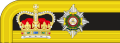
Colonel insignia
Country United Kingdom
Service branch British Army
 Royal Marines
AbbreviationCol
Rank groupField officer
NATO rank codeOF-5
FormationMid-16th century
Next higher rankBrigadier
Next lower rankLieutenant colonel
Equivalent ranks

Colonel (Col) is a rank of the British Army and Royal Marines, ranking below brigadier, and above lieutenant colonel. British colonels are not usually field commanders; typically they serve as staff officers between field commands at battalion and brigade level. The insignia is two diamond-shaped pips (properly called "Bath Stars") below a crown. The crown has varied in the past with different monarchs; Elizabeth II's reign used St Edward's Crown. The rank is equivalent to captain in the Royal Navy and group captain in the Royal Air Force.

Etymology

[edit]

The rank of colonel was popularised by the tercios that were employed in the Spanish Army during the 16th and 17th centuries. General Gonzalo Fernández de Córdoba divided his troops into coronelías (meaning "column of soldiers" from the Latin, columnella or "small column"[1]). These units were led by a coronel.[2] This command structure and its titles were soon adopted as colonello in early modern Italian and in Middle French as coronel.

The rank title entered the English language from French in the mid-16th century and so the modern English pronunciation of the word is derived from the French variant.[3]

History

[edit]

The use of the rank of colonel pre-dates the establishment of the United Kingdom. In the mid-17th century, the regiments of the New Model Army were commanded by colonels.

The British Army has historically been organized around the regiment, with each regiment being raised, uniformed, and equipped either directly by the crown or by a nobleman. The colonels nominally commanding these regiments (usually the noblemen who raised them) often had little to do with the regiment's actual activities, either because they contemporaneously served as general officers or because they were essentially mere financiers. The day to day command of the regiment was left to a lieutenant colonel or major.

By the end of the 17th century in Great Britain, the "colonel of a regiment" was often a titled person who had been given royal permission to raise it for service and command it in battle. As such, he was required to cover all costs of the regiment's equipment, uniforms and wages as well as select its officers.[4] Until the late 18th century most British regiments were commonly known by the name of the colonelcy, for example Lord Churchill's Dragoons (1683–1685) or Elliot's Light Horse (1759–66).

By the start of the American Revolutionary War most English and Welsh regiments in the standing army of Great Britain were named numerically, although some independent Highland regiments—such as MacLeod's Highlanders—were raised in the name of their colonel for service in West Africa and India. The change from a colonelcy based on patronage was because the British Army's administration had been reformed into three administrative bodies:

  • The War Office was that responsible for day-to-day administration of the army, and for the cavalry and infantry;[5]
  • The Board of Ordnance was responsible for the supply of weapons and ammunition, and administered the Royal Artillery and Royal Engineers;[6]
  • The Commissariat was responsible for the supply of rations and transport. It occasionally raised its own fighting units, such as "battoemen" (armed watermen and pioneers in North America).[7]

The reforms meant that the British government was now financially responsible for the pay, clothing and equipment of the troops in the service of the British Crown. Colonels were also no longer permitted to profit directly from the sale of officer commissions in their regiments.[4] A lieutenant-colonel commanded the regiment in battle.[4]

By the beginning of the Napoleonic Wars, the title "colonel of the regiment" had become a sinecure appointment for distinguished generals and members of the royal family or British nobility. Despite an individual only being permitted to hold one colonelcy, it was a profitable position as they were in financial charge of their regiment's allowance from the government. This meant they could hope to make a profit on the funds allocated for equipment, supplies and uniforms. As generals were mostly on half-pay, a colonelcy was a method of providing them with extra income. Many colonels spent large sums of their own money on their regiments.

By the end of the 19th century, the reorganisation of the British Army through the Cardwell and Childers Reforms had established a colonel as a professional rank with senior administrative responsibilities in regiment or brigade.

Ceremonial usage

[edit]

Colonel-in-chief

[edit]

Another title employed by the British Army is "colonel-in-chief" which is distinct from the ceremonial title "Colonel of the Regiment".

The position is usually held by a member of the royal family who acts as a patron to the unit, as Princess Margaret, Countess of Snowdon, did for the Bermuda Regiment. Although they do not have an operational role, they are kept informed of all important activities undertaken by the regiment and pay occasional visits to its operational units.

The chief purpose of a colonel-in-chief is to maintain a direct link between a given regiment and the royal family.[citation needed]

Colonel of the regiment

[edit]
Major General Sir Evelyn Webb-Carter as the last Colonel of the Regiment of the Duke of Wellington's Regiment

Some of the historic duties associated with the title colonel of the regiment (to distinguish it from the military rank of colonel) continue to be used in the modern British Army. The ceremonial position is often conferred on retired general officers, brigadiers or colonels who have a close link to a particular regiment. Non-military personnel, usually for positions within the Army Reserve, may also be appointed to the ceremonial position. When attending functions as "colonel of the regiment", the titleholder wears the regimental uniform with rank insignia of (full) colonel, regardless of their official rank. A member of the royal family is known as a royal colonel. A colonel of the regiment is expected to work closely with a regiment and its regimental association.

Honorary colonel

[edit]

Regiments or units may have an honorary colonel, which is solely a ceremonial rank, that can also be held by a civilian, with no military service. If the appointment is held by a member of the royal family it is known as royal honorary colonel. Certain units may have one or more deputy colonels.[8]

Colonel of Marines

[edit]

The Royal Navy once conveyed the honorific title "Colonel of Marines" to post-captains as a reward for highly distinguished service. It was a salaried sinecure position with no additional obligations outside a captain's normal naval duties. He would lose this title and its additional pay upon reaching flag rank. Horatio Nelson was given such a colonelcy in 1795, two years before he reached flag rank.[9]

Royal Air Force

[edit]

From 1 April 1918 to 31 July 1919, the Royal Air Force maintained the rank of colonel. During this period, groups were often commanded by RAF colonels. The rank of colonel was superseded by that of group captain on 1 August 1919.

Historical insignia

[edit]

When badges of rank were introduced for field officers in 1810, full colonels were designated with a crown and star worn on shoulder epaulettes. In 1855, after the Crimean War, new dress regulations were published which specified changes where rank would be worn. Thereafter full colonels wore half-inch regimental pattern laces on upper and lower collar, with one crown and one star. In 1880 the insignia was moved to the shoulder boards when in full dress, and full colonels were given an extra star. The pattern of a crown above two stars has remained the identifying insignia from 1880 to the present day although it has variously been worn on the shoulder, cuff and chest.

During World War I, colonels wore the following cuff badges:

Current insignia

[edit]
A colonel's gorget patches

The insignia is two diamond-shaped pips (properly called "Bath Stars") below a crown. Gorget patches, colloquially known as red tabs, with crimson lace and a brass button are also worn by officers of the substantive rank of colonel as part of their general staff uniform.[10] Gorget patches are not worn by regimental colonels, who wear the regimental uniform.[citation needed]

See also

[edit]

References

[edit]

Bibliography

[edit]
Revisions and contributorsEdit on WikipediaRead on Wikipedia
from Grokipedia
In the British Armed Forces, a Colonel (abbreviated as Col) is a senior officer rank primarily used in the British Army and Royal Marines, corresponding to the NATO officer rank code OF-5. It sits immediately above the rank of lieutenant colonel and below brigadier, marking the entry point into the general staff where officers transition from tactical command roles to broader strategic and administrative responsibilities. Colonels typically function as staff officers at divisional level and higher, managing the Army's administrative needs, offering senior advice to generals, and coordinating operations across units, though they may occasionally command ad hoc task forces or sub-brigade formations in the field. In the Royal Marines, the rank holds equivalent status and duties, integrated within the broader Royal Navy structure but aligned with Army conventions for interoperability. The for a consists of a positioned above two silver stars (known as "pips" or Bath stars), worn on the shoulders or chest of the , distinguishing it from the single pip of a and the three pips of a . This design reflects the rank's established position in the hierarchy, which requires a commission from the and extensive prior service, often including command of a as a . Promotion to is competitive and based on merit, performance, and operational experience, with s in this rank earning salaries starting at £111,854 annually (as of April 2025), subject to service length and increments. Historically, the rank originated in the , when a was responsible for raising, equipping, and leading their own at personal expense, a practice that evolved into a salaried professional role by the as the modernized. Today, a separate ceremonial title, "colonel of the regiment," is often bestowed upon retired brigadiers or generals to represent and safeguard a unit's traditions, distinct from the active-duty rank. This dual usage underscores the rank's enduring significance in maintaining both operational efficiency and regimental heritage within the United Kingdom's military framework.

Origins and Etymology

Etymology

The term "" originates from the Italian word colonello, denoting the leader of a column of soldiers, which evolved from colonna, the Italian term for "column," ultimately tracing back to the Latin columna. This etymological root reflects the rank's historical association with commanding formations organized in columns, a tactical structure prominent in Renaissance-era European armies. The word entered English military nomenclature through French influence, where it appeared as coronel or colonel in the 16th century, borrowed from the Italian during the spread of modern regimental organization across Europe. This dual French pathway—coronel emphasizing the phonetic "r" sound and colonel aligning with the Italian spelling—resulted in the irregular English pronunciation "/ˈkɜːrnəl/" (resembling "kernel"), a vestige of the French variant that persisted despite the standardized spelling. The phonetic discrepancy arose as English adopted the term amid linguistic blending from multiple Romance languages, without fully reconciling the orthographic forms. In the British context, the rank was first documented in English forces during the Tudor era, with initial uses appearing between 1544 and 1546 under , as foreign-born officers introduced continental military structures. This adoption marked the term's integration into English nomenclature, setting the stage for its application in early regimental commands.

Early Historical Usage

The rank of in early British military usage derived from the Italian "colonello," denoting the leader of a column (colonna) of troops in formation. In the 16th and 17th centuries, particularly during the (1642–1651), the role of colonel emerged as a key position in , where individuals—often aristocrats or professional soldiers—were commissioned by the monarch or to raise, fund, equip, and command their own s as private entrepreneurs. These colonels bore the financial burden of recruiting soldiers, providing uniforms, arms, and provisions, effectively treating the regiment as a personal venture until disbandment or absorption into larger forces. A prominent example is Robert Devereux, 3rd , who in 1642 raised and commanded the as a Parliamentarian unit at the outset of the war, participating in early campaigns such as the . Similarly, Sir John Gell, High Sheriff of , formed a Parliamentarian around 1646, as evidenced by surviving regimental colors, illustrating how local notables leveraged personal resources and networks to assemble forces amid the conflict. This system tied the colonel's authority directly to regimental ownership and funding, fostering a mercenary-style where was secured through commissions and the promise of pay from battlefield spoils or parliamentary grants. By the late 17th century, following the , the reign of William III (1689–1702) saw a shift toward formalized control, as the establishment of a permanent reduced the proprietary nature of regiments, transforming them into enduring national institutions funded and regulated by the state rather than individual initiative. This evolution was driven by ongoing European conflicts, which necessitated a professionalized force purged of prior political influences and augmented under royal oversight.

Historical Development

In the British Army

Following the of 1688, the 's structure became more permanent, with the colonel established as the senior field officer commanding a organized into one or more battalions typically numbering 500 to 1,000 men. Colonels, often holding dual ranks as generals, bore responsibility for raising, equipping, and administering their regiments, though they frequently delegated day-to-day tactical leadership to lieutenant colonels due to broader duties at higher command levels. This formalization marked a shift from the more regimental formations of the , where colonels operated under temporary commissions from the monarch or . The 19th century saw transformative reforms that curtailed colonels' traditional proprietary influence. Under the initiated in the 1870s, the abolition of commission purchase in 1871 ended the system where officers, including colonels, bought their ranks, replacing it with merit-based selection and promotion to foster professional command over personal ownership. These changes reorganized regiments into linked pairs of battalions tied to regional depots, reducing colonels' autonomy in recruitment and equipping while emphasizing centralized administration. Building on this, the of 1881 integrated infantry regiments by amalgamating existing units into territorially affiliated formations, such as county-based regiments with shared depots, further eroding colonels' direct control and aligning the with modern efficiency needs. In the , the colonel's role evolved amid global conflicts and international alliances. During , colonels primarily functioned as staff officers at divisional levels or in honorary capacities, with active commands handled by lieutenant colonels, reflecting the army's expansion to over 5 million men and the need for specialized administrative expertise. saw similar patterns, where colonels often led brigades on a temporary basis or served as senior staff advisors, coordinating operations across theaters like and amid a force peaking at nearly 3 million personnel. Post-1945, as the integrated into , the standardized its ranks under agreements like STANAG 2116, designating colonel as the OF-5 grade equivalent to allied counterparts, reinforcing its focus on staff planning, brigade-level oversight, and in multinational operations.

In the Royal Marines and Navy

The rank of colonel in the Royal Marines traces its origins to the establishment of the Duke of York and Albany's Maritime Regiment of Foot on 28 October 1664, during the reign of King Charles II, where the regiment's commander, Colonel Sir William Killigrew, oversaw marine detachments assigned to ships for naval service and amphibious duties. These early colonels, drawn from army officers, managed the regiment's companies aboard vessels, ensuring discipline and combat readiness at sea while sharing operational histories with army colonels in joint shipboard roles. The structure reflected the marines' dual land-sea mission, with colonels responsible for recruiting, equipping, and leading forces that supported the Royal Navy's global expeditions. By the mid-18th century, marine officer advancement was capped at due to Admiralty restrictions on higher ranks, limiting promotions until 1771, when colonels were first appointed as commandants of marine divisions to enhance organizational leadership. The 1802 formation of the Corps of , formalized by King George III's order on 29 April, elevated the institution's status and positioned colonel as the senior field rank below general officers, enabling expanded command over larger detachments. Throughout the 18th and 19th centuries, colonels directed amphibious forces in critical engagements, such as during the (1793–1815), where they led battalions in landings across , , the , and , pioneering rapid assaults from ships to secure beachheads and support naval blockades. These operations highlighted the colonel's role in coordinating with naval under wartime expansion, as marine strength grew from 4,000 to over 29,000 personnel by 1804. In 1923, the Royal Marine Light Infantry and Royal Marine Artillery were amalgamated into a single Corps of Royal Marines, unifying the force under a streamlined structure. In the 20th century, following the end of , the assumed the primary role in 1946 after the disbandment of units, enhancing their focus on amphibious and special operations while remaining under command. The rank of (OF-5) has long been equivalent to in the in terms of seniority, pay, and authority, facilitating joint operations with colonels overseeing units or shore establishments. A notable example occurred during the 1982 , where I. J. Hellberg commanded the Logistic Regiment within 3 Commando Brigade, managing supply chains, ammunition distribution, and medical support across the amphibious task force from to the landings at San Carlos and beyond, sustaining over 4,000 personnel amid harsh South Atlantic conditions.

Modern Role and Responsibilities

Operational Duties

In the British Army, colonels undertake operational duties that emphasize strategic oversight and advisory functions rather than direct tactical command of standard units. While lieutenant colonels typically serve as commanding officers of battalions or regiments comprising 300 to 800 personnel, colonels often lead ad hoc task forces or specialized groupings of similar scale during deployments, focusing on tactical planning, training oversight, and coordination of multinational elements. These responsibilities ensure cohesive execution of missions, drawing on the colonel's experience to integrate , , and . A significant aspect of a colonel's operational role involves staff positions within the general staff, where they advise brigade and divisional commanders on operational matters, including , , and mission synchronization. As the lowest rank in the general staff, colonels contribute to functions such as developing operational orders and monitoring battlefield developments. This advisory capacity extends to inter-service coordination, ensuring alignment with and assets in joint operations. Promotion to , classified as OF-5, generally requires more than 20 years of commissioned service, along with proven performance in command and staff appointments, setting it apart from the lieutenant colonel rank (OF-4), where officers primarily act as commanders rather than broader operational advisers. Candidates must demonstrate strategic acumen through assessments like the Joint Services Command and course, with selection based on annual promotion boards evaluating leadership in high-tempo environments. This progression reflects the shift from unit-level execution to influencing operations at higher echelons, often involving temporary deployments to or UN missions.

Command Structure

In the , the rank occupies a pivotal position as the most senior field officer, situated immediately below (a one-star ) and above within the hierarchical structure. typically oversee several , who command battalions of up to 650 personnel each, often within a regimental or context where the provides overarching strategic direction and administrative coordination. They report to at level or major generals at divisional , advising on and resource allocation while ensuring alignment with broader command objectives. Within joint operations, colonels contribute to tri-service integration at commands like the (PJHQ) in Northwood, serving in staff roles across divisions such as J3 (current operations) and J5 (planning) to coordinate with captains and group captains on the execution of multinational deployments. Succession to represents a critical juncture for officers, offering pathways to and higher general ranks, though many conclude their careers here. Officers who reach but are not selected for further promotion typically retire at the end of their commission, often around age 55, though service can extend to age 60. In the , the has prioritized diversity in senior promotions, resulting in female officers comprising 9.3% of senior ranks (including colonels) as of 1 April 2025 and the historic appointment of the first black in the Royal Electrical and Mechanical Engineers in 2024, despite ethnic minorities still representing only 3.6% of all officers.

Ceremonial and Honorary Positions

Colonel-in-Chief

The is a ceremonial and symbolic position within a , acting as a non-operational patron who provides a prestigious link between the unit and the monarchy. This role is typically held by members of the royal family, appointed by the reigning monarch to embody the regiment's heritage and traditions without involvement in day-to-day command. For example, King Charles III assumed the position for several regiments in 2023, including The Royal Scots Dragoon Guards, The Royal Tank Regiment, and The Royal Regiment of Scotland, following a redistribution of appointments previously held by Queen Elizabeth II. The primary duties of a Colonel-in-Chief focus on enhancing regimental morale and prestige through participation in ceremonial events, such as inspections, commemorations, and presentations of new colours. These activities help foster a sense of continuity and loyalty among serving personnel while promoting the unit's historical legacy to the public. Queen Elizabeth II exemplified this role during her tenure, attending events like the 2007 inspection of soldiers at Brompton Barracks as their ; she held more than 30 such appointments across the , , , and , including approximately 16 Army regiments like those of the and . Appointments to the position are made directly by the , often at the invitation of the regiment, and are traditionally lifelong, though they may be relinquished or reassigned upon significant events like a sovereign's accession. The process involves recommendations from authorities, with final approval from , ensuring alignment with regimental traditions. In the 2020s, following Queen Elizabeth II's death in , a comprehensive review led to a more inclusive distribution of these roles among members to reflect contemporary priorities.

Colonel of the Regiment

The Colonel of the Regiment is a senior, usually retired, officer appointed as the titular head of a , serving in a custodial and advisory capacity to safeguard its traditions, customs, and historical legacy. This lifelong position is typically held by an individual with prior command experience within the , acting as a bridge between past and present members while promoting the unit's and morale. For instance, Sir Tom Beckett KCB CBE, a former commander of the , held the role from 2014 until 2023. Historically rooted in the , when colonels personally owned and managed their regiments—including , equipping, and administration—the role has evolved significantly by the into a more symbolic one, detached from operational command as the professionalized. In the , the Colonel of the Regiment focuses on ceremonial and supportive functions, overseeing regimental associations that foster camaraderie among serving, retired, and former personnel; curating battle honors to honor the unit's heritage; and providing guidance on family welfare initiatives, such as support networks for veterans and dependents. This shift underscores the position's enduring emphasis on regimental identity amid broader reforms. Selection for the role is conducted by the regiment's governing body, such as the Regimental Council, which nominates candidates based on their demonstrated expertise, loyalty, and contributions to the unit, with final approval granted by the through the to ensure alignment with departmental standards. Appointees are often generals or brigadiers who have risen through the regiment's ranks, ensuring institutional knowledge and continuity in preserving its distinct culture.

Honorary Colonel

An honorary colonel in the is a ceremonial appointment primarily within the reserve and territorial forces, such as the Army Reserve, where civilians or retired officers are honored for their significant contributions to the military or society and assume a symbolic commanding role over units like reserve battalions. These appointees, often selected from prominent figures outside active service, help foster esprit de and represent the unit without involvement in operational command. The duties of an honorary colonel emphasize symbolic leadership, including promoting recruitment efforts, attending ceremonial events, and engaging with the community to support the unit's morale and visibility. For instance, following efficiency drives in the that sought to broaden support networks, public figures such as musician and broadcaster , appointed honorary of 101 () Engineer Regiment in 2012, have exemplified this role by leveraging their influence for fundraising and youth engagement. Similarly, served as honorary for the Royal Armoured Corps Training Regiment, focusing on inspirational visits and advocacy. The appointment process begins with nomination by the unit's or a selection panel, often involving recommendations from regional bodies like the Reserve Forces and Cadets Association, followed by approval through the chain of command up to the General Officer Commanding and ultimately the . Terms are typically limited to five years initially, renewable up to age 65 with possible extensions to 70 in exceptional cases, ensuring fresh perspectives while maintaining continuity. This structure shares ceremonial similarities with other honorary military positions, prioritizing representation over executive authority.

Colonel of Marines

The Representative Colonel Commandant of the is a ceremonial and advisory position held by a senior retired officer, typically a general, who serves as a key liaison and representative for the Corps. This role emphasizes the preservation of Royal Marines heritage and traditions, drawing from the naval roots of the force established in 1664. The role traces its origins to the formation of His Majesty's Marine Forces in 1755, which included s commanding each division as senior administrative appointments within the expanding marine companies under Admiralty oversight. The primary responsibilities include representing the —currently a member of the Family—or other senior figures at regimental events and ceremonies, particularly when the is unavailable. The appointee conducts visits to operational units, mentors commanding officers and senior personnel, and acts as a conduit for strategic advice between the serving and retired general officers on matters such as amphibious and development. This advisory function operates outside the formal chain of command, providing independent perspectives on welfare, , and heritage preservation. For instance, the role involves leading or participating in significant commemorations, such as the ' 350th anniversary events in 2014, which highlighted the ' enduring naval-amphibious legacy. Appointments to the position are made by the Monarch, reflecting its honorary and prestigious nature tied to naval tradition under the Admiralty Board. Recent holders include Major General Jeff Mason MBE, who served from 2018 to 2022, and his successor, Lieutenant General Ed Davis CB CBE, appointed on 9 August 2022, both exemplifying the role's focus on bridging active service with retired expertise. While the position remains rooted in tradition, broader Ministry of Defence efforts toward diversity in senior appointments have influenced selections across honorary roles in recent years, though specific quotas for this post are not publicly detailed.

Usage in the Royal Air Force

Rank Equivalence

In the Royal Air Force, the rank of colonel, used briefly from the service's formation in 1918 until 1919, was equivalent to the current group captain rank and aligned with the OF-5 level under NATO standardization, matching the British Army's colonel and the Royal Navy's captain. Upon the RAF's establishment on 1 April 1918 through the amalgamation of the Royal Flying Corps and Royal Naval Air Service, army-style ranks including colonel were initially adopted to maintain continuity in command structures. This rank was redesignated group captain effective 1 August 1919 to emphasize aviation-specific leadership, as prior holders often commanded groups of squadrons rather than traditional army regiments. Hierarchically, the group captain (OF-5) sits immediately below air commodore (OF-6) and typically commands an RAF wing or station, overseeing operations for several thousand personnel involved in air missions, maintenance, and support functions. In this role, group captains ensure integrated air power delivery, coordinating squadrons under their authority to execute tactical and strategic objectives. For instance, during World War II in Bomber Command, group captains led wings conducting large-scale raids; Wing Commander Leonard Cheshire commanded No. 617 Squadron and associated formations, directing precision bombing operations against key targets like the German battleship Tirpitz. Inter-service comparisons highlight the shared NATO OF-5 designation across UK forces, facilitating joint operations, though the RAF group captain's responsibilities emphasize aviation-centric command, such as airfield management and aerial combat coordination, distinct from ground or maritime focuses. This equivalence parallels the colonel's battalion-level oversight in scale and authority.

Distinct Features

In the Royal Air Force, the Colonel-equivalent rank of Group Captain emphasizes an aviation-centric focus, with incumbents typically commanding air stations or wings that oversee critical air operations, including pilot training and multi-squadron integrations. These officers ensure the seamless execution of flying missions, from fast-jet combat training to transport and helicopter operations. This role underscores the RAF's operational tempo, prioritizing aerial domain expertise over ground-based command structures found in other services. Following the , responsibilities have shifted to incorporate emerging technologies, including oversight of drone operations and integration into cyber and space commands. In the , the RAF's adoption of the Protector RG Mk1 remotely piloted aircraft system has seen s leading capability development for unmanned aerial surveillance and strike missions, enhancing persistent air presence without traditional piloted risks. Similarly, officers at this rank contribute to Space Command's ISR functions, managing space-based assets for defense awareness, as exemplified by Ben Sharp's role as Deputy Head of Capability in this domain. These evolutions reflect the RAF's pivot toward multi-domain operations, blending aviation with digital and orbital elements. Ceremonial adaptations for Group Captains in the RAF diverge from regimental traditions in the , aligning instead with squadron-based heritage to honor legacies. With fewer ties to traditional regiments, these officers lead squadron-focused events that celebrate air power milestones, such as annual commemorations involving flypasts and memorial services. For instance, the 85th anniversary service in 2025 at featured tributes highlighting squadron contributions to the 1940 campaign and reinforcing RAF esprit de corps through aerial displays. Modern evolutions of the Group Captain rank have been shaped by gender integration milestones, marking the RAF's progression toward full inclusivity. Women first entered RAF pilot training in 1989, with Flight Lieutenant Jo Salter becoming the inaugural female fast-jet pilot in 1994, paving the way for advancement to senior aviation commands. By the , women had reached , as seen with Anne-Marie Houghton's leadership in operational and ceremonial roles. The 2025 Strategic Defence Review has advanced broader defence personnel strategies amid multi-domain shifts.

Insignia and Distinctions

Historical Insignia

In the 18th and 19th centuries, the for colonels in the primarily consisted of gold lace epaulettes, often adorned with crowns to distinguish field officers from lower ranks. Epaulettes were formally introduced by royal warrant on 19 December 1768 for officers, featuring embroidered or laced designs, and extended to officers by 1796. Rank devices such as crowns signifying the colonel's status were introduced on both shoulders in 1810. Following the , the 1855 dress regulations abolished large gold-fringed epaulettes for practicality, replacing them with twisted crimson shoulder cords and buttons, while transferring rank insignia to collars and cuffs; however, for ceremonial uniforms, colonels retained bullion fringes on shoulder straps to differentiate from colonels, who wore simpler . This change emphasized functionality in the introduced in 1856, with black velvet collars and cuffs bearing embroidered crowns or stars for colonels. During the World Wars, colonels adapted to service dress with khaki tunics, where gorget patches—rectangular red cloth tabs on the collar—served as primary rank indicators, particularly in trench warfare from 1914 to 1918. These patches, mandated by Army Order in March 1916, featured embroidered gold crowns for colonels, often with regimental facings, and were designed for visibility and durability in field conditions, evolving from pre-war collar badges to more subdued wartime versions. Post-World War II reforms saw a shift to embroidered shoulder boards for rank insignia on everyday uniforms, replacing gorget patches. In 1953, following the accession of Queen Elizabeth II, the Tudor Crown was replaced by the St Edward's Crown across all rank badges, standardizing the design in the British Army and Commonwealth forces. This change enhanced clarity in mixed-service environments.

Current Insignia

The current insignia for the rank of Colonel in the British Army and Royal Marines consists of two diamond-shaped Bath stars positioned beneath a Tudor Crown (as of 2023), typically worn on the shoulders of officers' uniforms. This design, standardized across both services, reflects the field's senior officer status and is embroidered in gold thread for formal visibility. In No. 1 Dress (ceremonial full dress), the are affixed to gold-embroidered slips, ensuring prominence on the scarlet or equivalent regimental patterns. For mess dress, a variation features smaller-scale embroidered versions on the lapels or miniature boards, maintaining proportionality with the tailored evening uniform. The Royal Marines employ the identical insignia to the Army's for Colonels, with no substantive deviations in design, though placement may align with commando-specific uniform elements like green berets. In the Royal Air Force, where the equivalent rank is , the insignia differs to service tradition: four medium-width gold braid stripes on the lower sleeves of the blue service dress, supplemented by a overlay on shoulder slides for No. 2 working dress. These standards are governed by the Army General Administrative Instruction (AGAI) Volume 2, Chapter 59 on and Personal Appearance (updated 2021), which incorporates elements from JSP 336 for uniform consistency. For operational environments in the 2020s, adaptations include subdued, (MTP) rank slides in low-visibility colours, often with fastenings for the PCS (Personal Clothing System) combat uniform to facilitate interoperability during joint operations. Recent regulatory updates emphasize inclusivity in uniform wear, permitting personnel to select gender-aligned items where options exist (e.g., or skirts in certain orders of dress), though rank insignia remain unchanged and in application.

References

Add your contribution
Related Hubs
User Avatar
No comments yet.