

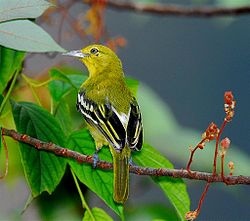

Common iora
View on Wikipedia
| Common iora | |
|---|---|

| |
| Male | |

| |
| Female | |
Scientific classification 
| |
| Kingdom: | Animalia |
| Phylum: | Chordata |
| Class: | Aves |
| Order: | Passeriformes |
| Family: | Aegithinidae |
| Genus: | Aegithina |
| Species: | A. tiphia
|
| Binomial name | |
| Aegithina tiphia | |
| Synonyms | |
|
Motacilla tiphia Linnaeus, 1758 | |

.jpg)
The common iora (Aegithina tiphia) is a small passerine bird found across the tropical Indian subcontinent and Southeast Asia, with populations showing plumage variations, some of which are designated as subspecies. A species found in scrub and forest, it is easily detected from its loud whistles and the bright colours. During the breeding season, males display by fluffing up their feathers and spiral in the air appearing like a green, black, yellow, and white ball.
Taxonomy
[edit]In 1747 the English naturalist George Edwards included an illustration and a description of the common iora in the second volume of his A Natural History of Uncommon Birds. He used the English name "The Green Indian Fly-Catcher". Edwards based his hand-coloured etching on a specimen that had been sent from Bengal to the silk-pattern designer and naturalist Joseph Dandridge in London.[2] When in 1758 the Swedish naturalist Carl Linnaeus updated his Systema Naturae for the tenth edition, he placed the common iora in the genus Motacilla. Linnaeus included a brief description, coined the binomial name Motacilla tiphia and cited Edwards' work.[3] The common iora is now placed in the genus Aegithina that was introduced in 1816 by the French ornithologist Louis Pierre Vieillot.[4][5] The genus name Aegithina is from Ancient Greek aigithos or aiginthos, a mythical bird mentioned by Aristotle and other classical authors. The etymology of specific epithet tiphia is uncertain. It may be from the Ancient Greek tuphē, tiara, from Tiphys who in Greek mythology was the helmsman of the Argonauts.[6]
Eleven subspecies are recognised:[5]
- A. t. multicolor (Gmelin, JF, 1789) – southwest India and Sri Lanka
- A. t. deignani Hall, BP, 1957 – south, east India and north, central Myanmar
- A. t. humei Baker, ECS, 1922 – central peninsular India
- A. t. tiphia (Linnaeus, 1758) – north India to west Myanmar
- A. t. septentrionalis Koelz, 1939 – northwest Himalayas
- A. t. philipi Oustalet, 1886 – south-central China, east Myanmar, north Thailand and north, central Indochina
- A. t. cambodiana Hall, BP, 1957 – southeast Thailand, Cambodia and south Vietnam
- A. t. horizoptera Oberholser, 1912 – southeast Myanmar and southwest Thailand, Malay Peninsula, Sumatra and nearby islands
- A. t. scapularis (Horsfield, 1821) – Java and Bali
- A. t. viridis (Bonaparte, 1850) – central, south Borneo
- A. t. aequanimis Bangs, 1922 – north Borneo and west Philippines
Description
[edit]Ioras have a pointed and notched beak with a culmen that is straight. The common iora is sexually dimorphic, males in the breeding season have a black cap and back adding to a black wing and tail at all seasons. Females have greenish wings and an olive tail. The undersides of both are yellow and the two white bars on the wings of the male are particularly prominent in their breeding plumage. The males in breeding plumage have a very variable distribution of the black on the upperparts and can be confused with Marshall's iora, however, the latter always has white tips to the tail.[7] The nominate subspecies is found along the Himalayas and males of this population are very similar to females or have only a small amount of black on the crown. In northwestern India, septentrionalis is brighter yellow than others and in the northern plains of India humei males in breeding plumage have a black cap and olive on the upper mantle. In southwestern India and Sri Lanka multicolor has the breeding males with a jet black cap and mantle. The forms in the rest of southern India are intermediate between multicolor and humei with more grey-green on the rump (formerly considered as deignani but now used for the Burmese population).[7][8][9][10]

Several other populations across Southeast Asia are designated as subspecies including philipi of southern China and northern Thailand/Laos, deignani of Myanmar, horizoptera of southern Myanmar and the island chain of Sumatra, cambodiana of Cambodia, aeqanimis of Palawan and northern Borneo, viridis of Borneo and scapularis of Java and Bali.[11][12]
Behaviour and ecology
[edit]Ioras forage in trees in small groups, gleaning among the branches for insects. They sometimes join mixed species feeding flocks. The call is a mixture of churrs, chattering and whistles, and the song is a trilled wheeeee-tee. They may sometimes imitate the calls of other birds such as drongos.[13]
_in_Hyderabad_W_IMG_8863.jpg)
During the breeding season, mainly after the monsoons, the male performs an acrobatic courtship display, darting up into the air fluffing up all his feathers, especially those on the pale green rump, then spiralling down to the original perch. Once he lands, he spreads his tail and droops his wings.[8] Two to four greenish white eggs are laid in a small and compact cup-shaped nest made out of grass and bound with cobwebs and placed in the fork of a tree. Both male and female incubate[14] and eggs hatch after about 14 days. Nests predators include snakes, lizards, crow-pheasant and crows.[15] Nests may also be brood-parasitized by the banded bay cuckoo.[16]
Ioras moult twice in a year and the plumage variation makes them somewhat complicated for plumage based separation of the populations.[16]
A species of Haemoproteus, H. aethiginae, was described from a specimen of the common iora from Goa.[17]
Gallery
[edit]-
 A. t. multicolor: male calling in Hyderabad, India.
 -
 A. t. multicolor: female in Hyderabad
 -
 A. t. multicolor: female in Hyderabad
 -
 A. t. multicolor: female in Narsapur, Medak district, India
 -
 A. t. multicolor: male in Hyderabad
 -
 A. t. multicolor: female in Narsapur
 -

-
 Adult breeding male, Singapore
 -
 Adult breeding male, Singapore
 -
 Common Iora: female at Sajnakhali Wildlife Sanctuary
_in_Hyderabad_W_IMG_8862.jpg)
_in_Hyderabad_W_IMG_5622.jpg)
_in_Hyderabad_W_IMG_5618.jpg)
_in_Narshapur,_AP_W_IMG_1144.jpg)
_in_Hyderabad,_AP_W2_IMG_9809.jpg)
_in_Kawal,_AP_W_IMG_1517.jpg)
_calling_W_IMG_7709.jpg)


- Museum specimens for subspecies at Naturalis
-
 Aegithina tiphia aequanimis Bangs, 1922, male
 -
 Aegithina tiphia aequanimis Bangs, 1922, female
 -
 Aegithina tiphia multicolor (Gmelin, 1789), male
 -
 Aegithina tiphia multicolor (Gmelin, 1789), female


_-_Irenidae_-_bird_skin_specimen.jpeg)
_-_Irenidae_-_bird_skin_specimen.jpeg)
References
[edit]- ^ BirdLife International (2016). "Aegithina tiphia". IUCN Red List of Threatened Species. 2016 e.T22707433A94123624. doi:10.2305/IUCN.UK.2016-3.RLTS.T22707433A94123624.en. Retrieved 13 November 2021.
- ^ Edwards, George (1747). A Natural History of Uncommon Birds. Vol. Part II. London: Printed for the author at the College of Physicians. p. 79, Plate 79.
- ^ Linnaeus, Carl (1758). Systema Naturae per regna tria naturae, secundum classes, ordines, genera, species, cum characteribus, differentiis, synonymis, locis (in Latin). Vol. 1 (10th ed.). Holmiae (Stockholm): Laurentii Salvii. p. 186.
- ^ Vieillot, Louis Pierre (1816). Analyse d'une Nouvelle Ornithologie Élémentaire (in French). Paris: Deterville/self. p. 44.
- ^ a b Gill, Frank; Donsker, David; Rasmussen, Pamela, eds. (July 2021). "Waxbills, parrotfinches, munias, whydahs, Olive Warbler, accentors, pipits". IOC World Bird List Version 11.2. International Ornithologists' Union. Retrieved 9 October 2021.
- ^ Jobling, James A. (2010). The Helm Dictionary of Scientific Bird Names. London: Christopher Helm. pp. 33, 386. ISBN 978-1-4081-2501-4.
- ^ a b Rasmussen PC; JC Anderton (2005). Birds of South Asia: The Ripley Guide. Volume 2. Smithsonian Institution & Lynx Edicions. pp. 344–346.
- ^ a b Baker, ECS (1922). Fauna of British India. Birds. Volume 1 (2nd ed.). Taylor and Francis, London. pp. 339–343.
- ^ Wells, D.R.; E.C. Dickinson & R.W.R.J. Dekker (2003). "Systematic notes on Asian birds. 34. A preliminary review of the Aegithinidae". Zool. Verh. Leiden. 344: 7–15.
- ^ Dickinson, E.C.; R.W.R.J. Dekker; S. Eck & S. Somadikarta (2003). "Systematic notes on Asian birds. 35. Types of the Aegithinidae" (PDF). Zool. Verh. Leiden. 344: 17–24. Archived from the original (PDF) on 2007-10-26. Retrieved 2010-09-12.
- ^ Mayr E; JC Greenway, eds. (1960). Check-list of the birds of the world. Volume 9. Museum of Comparative Zoology, Massachusetts. pp. 300–302.
- ^ Marien, D (1952). "The systematics of Aegithina nigrolutea and Aegithina tiphia (Aves, Irenidae)". Am. Mus. Novit. 1589: 1–17. hdl:2246/4066.
- ^ Bharos, A. M. K. (1998). "Mimicry by common Iora Aegithina tiphia". J. Bombay Nat. Hist. Soc. 95 (1): 116.
- ^ Wesley, H Daniel (1984). "Frequency and duration of incubation of the eggs for Aegithina tiphia". J. Bombay Nat. Hist. Soc. 81 (1): 193–195.
- ^ Ali, S (1931). "Casualties among the eggs and young of small birds". J. Bombay Nat. Hist. Soc. 34 (4): 1062–1067.
- ^ a b Ali, S; SD Ripley (1996). Handbook of the Birds of India and Pakistan. Volume 6 (2nd ed.). Oxford University Press. pp. 47–54.
- ^ de Mello, I. (1935). "New hæmoproteids of some Indian birds". Proceedings of the Indian Academy of Sciences, Section B. 2 (5): 469–475. doi:10.1007/BF03053034. S2CID 82402365.
External links
[edit]- BirdLife Species Factsheet
- Common Iora videos, photos & sounds on the Internet Bird Collection
- F. N. Chasen; C. Boden Kloss (1931). "Five New Malaysian Birds" (PDF). Bulletin of the Raffles Museum. 5: 82–86., describing Aegithina tiphia singapurensis, now considered a synonym of Aegithina tiphia horizoptera
Common iora
View on GrokipediaTaxonomy
Classification history
The Common iora was first illustrated and described by the English naturalist George Edwards in 1747, who referred to it as the "Green Indian Fly-Catcher" based on a specimen from Bengal; this informal description appeared in his illustrated work A Natural History of Uncommon Birds, volume 2, plate 32.[4] Edwards' account highlighted its distinctive green plumage and flycatcher-like habits, drawing from early colonial collections in India.[4] In 1758, Carl Linnaeus provided the first formal binomial nomenclature for the species as Motacilla tiphia in the 10th edition of Systema Naturae, placing it within the genus Motacilla alongside various Old World warblers and flycatchers due to superficial similarities in foraging behavior and habitat.[5] This classification reflected the limited taxonomic framework of the time, which grouped many small insectivorous passerines together based on morphology and locality.[6] The species was reclassified into the monotypic genus Aegithina by French ornithologist Louis Pierre Vieillot in 1816, in his Analyse d'une Nouvelle Ornithologie Élémentaire, where he designated Motacilla tiphia as the type species by monotypy; this move separated it from the broader Motacilla assemblage and early warbler groupings, emphasizing differences in bill structure and plumage.[7] By the mid-19th century, the family Aegithinidae was erected by George Robert Gray in 1869 to accommodate the ioras, distinct from other passerine families, based on morphological traits such as their unique wing formula and vocalizations observed in museum specimens.[8] Throughout the 20th century, ornithological studies refined this placement through comparative anatomy and early molecular analyses, confirming Aegithinidae's position within the core Corvoidea clade and distinguishing it from the distantly related Chloropseidae (leafbirds) via genetic evidence from nuclear and mitochondrial DNA sequences.[9] Modern taxonomic authorities, including the IOC World Bird List (version 14.1, as of October 2025), recognize 11 subspecies of Aegithina tiphia, accounting for regional variations primarily in plumage and size.Subspecies
The Common iora (Aegithina tiphia) is classified into 11 subspecies, recognized primarily on the basis of morphological variations in plumage coloration—particularly the extent and intensity of black on the male's upperparts during breeding plumage—and minor differences in underpart hue and body size. These distinctions have been established through examinations of museum specimens and field observations, with key taxonomic reviews from the late 20th century confirming their validity based on consistent clinal and disjunct patterns across the species' range.[10][11] The following table summarizes the recognized subspecies, their type localities, geographic distributions, and diagnostic traits where documented:| Subspecies | Type Locality | Geographic Distribution | Diagnostic Traits |
|---|---|---|---|
| A. t. septentrionalis | Punjab, India | Foot of the northwestern Himalayas in northern India (Punjab, Himachal Pradesh). | Slightly larger size; males with limited black on crown in breeding plumage, similar to nominate but with paler overall tones.[10] |
| A. t. tiphia (nominate) | Bengal, India | Foot of the Himalayas from northern India (east from Punjab) to Bangladesh and adjacent western Myanmar. | Nominate form; males in breeding plumage have mostly green upperparts with some black dusting on crown, bright yellow underparts; females duller green above and yellowish below.[10][6] |
| A. t. humei | Hyderabad, India | Central Indian Subcontinent (east from Rajasthan). | Intermediate plumage; males show moderate black extension on mantle, yellow underparts similar to nominate.[10] |
| A. t. deignani | Myitkyina, Myanmar | Northern and central Myanmar (except west, east, and south). | Eclipse-plumage males with grey-green cap and upper body; overall paler tones compared to northern forms.[10][11] |
| A. t. multicolor | Ceylon (Sri Lanka) | Extreme southwestern India and Sri Lanka. | Males with jet-black cap, mantle, and upperparts in breeding plumage; brighter yellow underparts.[10][12] |
| A. t. philipi | Philipps, Yunnan, China | South-central China (Yunnan), eastern Myanmar, northern and central Thailand, northern and central Indochina. | Males with extensive black on upperparts; slightly larger bill and wing measurements than continental forms.[10] |
| A. t. cambodiana | Cambodia | Southeastern Thailand and southern Indochina (Cambodia, southern Vietnam). | Similar to philipi but with greener upperparts in males; minor size overlap with adjacent forms.[10] |
| A. t. horizoptera | Telok Bluku, Nias Island, Indonesia | Southern Myanmar and central Thailand south to the Malay Peninsula, Sumatra, and nearby islands (Nias, Riau and Lingga Archipelagos, Bangka). | Broader wings; males with black upperparts extending to back, yellow underparts.[10] |
| A. t. scapularis | Java, Indonesia | Java and Bali. | Smaller size; males with intense black on scapulars and upperparts, vivid yellow below.[10] |
| A. t. viridis | Borneo | Central and southern Borneo (except north). | Slightly greener plumage overall; males with black wings and tail but greener mantle edges.[10] |
| A. t. aequanimis | Palawan, Philippines | Western Philippines (Palawan) and northern Borneo (Sabah), plus satellite islands. | Island form with shorter wings; plumage similar to viridis but with more uniform yellow underparts.[10] |