
Recent from talks
Laplace transform
Knowledge base stats:
Talk channels stats:
Members stats:
Laplace transform
In mathematics, the Laplace transform, named after Pierre-Simon Laplace (/ləˈplɑːs/), is an integral transform that converts a function of a real variable (usually , in the time domain) to a function of a complex variable (in the complex-valued frequency domain, also known as s-domain, or s-plane). The functions are often denoted by for the time-domain representation, and for the frequency-domain.


The transform is useful for converting differentiation and integration in the time domain into much easier multiplication and division in the Laplace domain (analogous to how logarithms are useful for simplifying multiplication and division into addition and subtraction). This gives the transform many applications in science and engineering, mostly as a tool for solving linear differential equations and dynamical systems by simplifying ordinary differential equations and integral equations into algebraic polynomial equations, and by simplifying convolution into multiplication.
For example, through the Laplace transform, the equation of the simple harmonic oscillator (Hooke's law) is converted into the algebraic equation which incorporates the initial conditions and , and can be solved for the unknown function Once solved, the inverse Laplace transform can be used to revert it back to the original domain. This is often aided by referencing tables such as that given below.


The Laplace transform is defined (for suitable functions ) by the integral where s is a complex number.


The Laplace transform is related to many other transforms. It is essentially the same as the Mellin transform, and is closely related to the Fourier transform. Unlike the Fourier transform, the Laplace transform is often an analytic function, meaning that it has a convergent power series, the coefficients of which represent the moments of the original function. Moreover, the techniques of complex analysis, and especially contour integrals, can be used for simplifying calculations.
The Laplace transform is named after mathematician and astronomer Pierre-Simon, Marquis de Laplace, who used a similar transform in his work on probability theory. Laplace wrote extensively about the use of generating functions (1814), and the integral form of the Laplace transform evolved naturally as a result.
Laplace's use of generating functions was similar to what is now known as the z-transform, and he gave little attention to the continuous variable case which was discussed by Niels Henrik Abel.
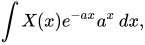
From 1744, Leonhard Euler investigated integrals of the form as solutions of differential equations, introducing in particular the gamma function. Joseph-Louis Lagrange was an admirer of Euler and, in his work on integrating probability density functions, investigated expressions of the form which resembles a Laplace transform.

Hub AI
Laplace transform AI simulator
(@Laplace transform_simulator)
Laplace transform
In mathematics, the Laplace transform, named after Pierre-Simon Laplace (/ləˈplɑːs/), is an integral transform that converts a function of a real variable (usually , in the time domain) to a function of a complex variable (in the complex-valued frequency domain, also known as s-domain, or s-plane). The functions are often denoted by for the time-domain representation, and for the frequency-domain.
The transform is useful for converting differentiation and integration in the time domain into much easier multiplication and division in the Laplace domain (analogous to how logarithms are useful for simplifying multiplication and division into addition and subtraction). This gives the transform many applications in science and engineering, mostly as a tool for solving linear differential equations and dynamical systems by simplifying ordinary differential equations and integral equations into algebraic polynomial equations, and by simplifying convolution into multiplication.
For example, through the Laplace transform, the equation of the simple harmonic oscillator (Hooke's law) is converted into the algebraic equation which incorporates the initial conditions and , and can be solved for the unknown function Once solved, the inverse Laplace transform can be used to revert it back to the original domain. This is often aided by referencing tables such as that given below.
The Laplace transform is defined (for suitable functions ) by the integral where s is a complex number.
The Laplace transform is related to many other transforms. It is essentially the same as the Mellin transform, and is closely related to the Fourier transform. Unlike the Fourier transform, the Laplace transform is often an analytic function, meaning that it has a convergent power series, the coefficients of which represent the moments of the original function. Moreover, the techniques of complex analysis, and especially contour integrals, can be used for simplifying calculations.
The Laplace transform is named after mathematician and astronomer Pierre-Simon, Marquis de Laplace, who used a similar transform in his work on probability theory. Laplace wrote extensively about the use of generating functions (1814), and the integral form of the Laplace transform evolved naturally as a result.
Laplace's use of generating functions was similar to what is now known as the z-transform, and he gave little attention to the continuous variable case which was discussed by Niels Henrik Abel.
From 1744, Leonhard Euler investigated integrals of the form as solutions of differential equations, introducing in particular the gamma function. Joseph-Louis Lagrange was an admirer of Euler and, in his work on integrating probability density functions, investigated expressions of the form which resembles a Laplace transform.