Hubbry Logo
search
logo
2085121

Crunch (exercise)

logo
Community Hub0 Subscribers
Read side by side
from Wikipedia
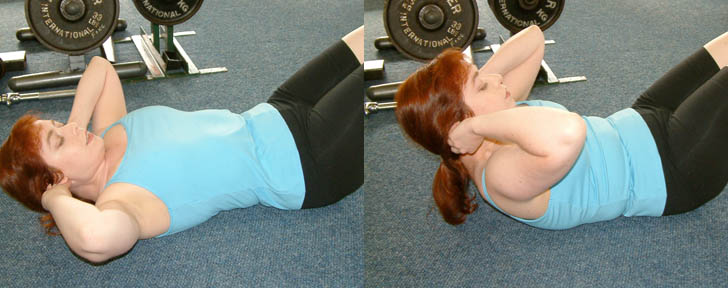
Performing the crunch

The crunch or curl-up is an abdominal exercise that works the rectus abdominis muscle.[1] It enables both building and defining "six-pack" abs and tightening the belly. Crunches use the exerciser's own body weight to tone muscle and are recommended by some experts[like whom?], despite negative research results[citation needed], as a low-cost exercise that can be performed at home.[2] Crunches are less effective than other exercises such as planks and carry risk of back injury.[3]

Form

[edit]
In a crunch, the lower back does not lift off the floor

The biomechanics professor Stuart McGill was quoted in The New York Times Health blog as stating:

An approved crunch begins with you lying down, one knee bent, and hands positioned beneath your lower back for support. "Do not hollow your stomach or press your back against the floor", McGill says. Gently lift your head and shoulders, hold briefly and relax back down.[4]

Research has shown that both sit-ups and crunches are mediocre strength-building exercises and have injured many people.[3] [better source needed]

In a crunch, unlike a sit-up, the lower back stays on the floor. This is said to eliminate any involvement by the hip flexors, and make the crunch an effective isolation exercise for the abdominals.[5]

World records

[edit]

Sirous Ahmadi has the record of doing over 20000 crunches in under 5 hours on May 11, 2024.[6][7]

In 2018, John Peterson from the US did 6,774 crunches in an hour and in 2021, he did a total of 13,994 crunches in two hours.[8][9][10]

See also

[edit]

References

[edit]
[edit]
Revisions and contributorsEdit on WikipediaRead on Wikipedia
from Grokipedia
The crunch, also known as the abdominal crunch, is a bodyweight strength-training exercise primarily targeting the rectus abdominis, the paired muscle forming the front wall of the abdomen often referred to as the "six-pack."[1] Performed in a supine position on the floor or a mat, it involves bending the knees with feet flat, placing the hands behind the head or across the chest, and curling the upper torso forward by contracting the abdominal muscles to lift the shoulders and mid-back off the ground while keeping the lower back, tailbone, and feet in contact with the surface.[2] This partial spinal flexion motion isolates the core without full hip flexion, distinguishing it from sit-ups.[3] In addition to the rectus abdominis, crunches engage the internal and external obliques as stabilizers, contributing to overall core activation, though they involve minimal transverse abdominis or hip flexor recruitment compared to more dynamic movements.[3] Research sponsored by the American Council on Exercise (ACE) has identified the traditional crunch as one of the top exercises for effectively activating the rectus abdominis, outperforming many abdominal machines and gadgets in electromyography (EMG) studies measuring muscle recruitment.[4] Benefits include enhanced core strength and muscular endurance, which support improved posture, spinal stability, and reduced risk of lower back pain during daily activities or athletic performance.[5] However, improper form—such as pulling on the neck with the hands or using momentum from the hips—can strain the cervical spine or diminish effectiveness, making proper technique essential.[6] Variations like the bicycle crunch, which incorporates alternating elbow-to-knee rotations, or stability ball crunches, performed while seated or leaning on a Swiss ball, can increase oblique engagement and core challenge while maintaining low hip flexor involvement for safer execution.[7] These adaptations allow for progression in difficulty and broader core development, aligning with evidence-based recommendations for incorporating crunches into balanced fitness routines alongside planks or other multi-planar exercises to avoid over-reliance on flexion-based movements.[4]

Overview

Description

The crunch is a bodyweight abdominal exercise performed from a supine position on the floor, involving controlled spinal flexion to lift the shoulders and upper back while contracting the rectus abdominis muscle.[2][4] Its primary purpose is to build strength and definition in the abdominal muscles, making it a staple in core training routines to enhance overall core stability and support daily activities.[8][4] No specialized equipment is required, though an exercise mat is optional for added comfort during floor-based execution.[2][8] In contrast to sit-ups, which entail a fuller torso lift and greater hip flexor activation, the crunch uses a shorter range of motion to isolate the abdominals while maintaining contact between the lower back and the ground.[2]

Historical Development

The crunch exercise originated in the mid-20th century as a partial-range modification of the traditional sit-up, designed to isolate the rectus abdominis while minimizing stress on the lower back and hips. This development coincided with a broader shift in fitness toward targeted abdominal training, driven by emerging concerns over the full spinal flexion involved in sit-ups, which had been a staple since World War II in military physical readiness programs. By the late 1960s, fitness professionals began advocating for safer alternatives like the crunch (often described as a "half sit-up" or "curl-up") to reduce injury risks associated with repeated full-range movements.[9] The exercise gained significant popularity during the 1970s and 1980s, fueled by the rise of home fitness and celebrity-endorsed programs that emphasized isolated abdominal work over comprehensive sit-ups. Fitness icon Charles Atlas, whose dynamic tension system from the 1920s onward included specialized abdominal routines, laid early groundwork for such targeted approaches, influencing later bodybuilding trends. Jane Fonda's 1982 workout video, Jane Fonda's Workout, further propelled the crunch into mainstream culture by featuring it prominently in abdominal segments alongside stretches and twists, selling millions of copies and inspiring widespread aerobics participation among women.[10][11] In the 1990s, the crunch solidified its status as a core exercise amid the explosion of gym culture and infomercials promoting abdominal devices, with U.S. gym memberships surging from 24.1 million in 1995 to 33 million by 1999. Innovations like the Ab Roller, introduced in 1994 and marketed heavily through late-night ads, integrated crunch variations into home routines, embedding the movement in aerobics classes and bodybuilding regimens as a quick, equipment-optional option for "six-pack" development. This era marked the crunch's transition from niche rehabilitation tool to ubiquitous fitness staple.[9][12] Since the 2010s, the crunch has faced growing scrutiny regarding its long-term efficacy and safety compared to functional core training methods, spurred by biomechanical research highlighting risks of cumulative spinal flexion. Pioneering studies by spine biomechanics expert Stuart McGill demonstrated that repeated flexion under load, as in crunches, can accelerate disc degeneration and low back pain, prompting shifts in guidelines—such as the U.S. military's adoption of planks over crunches in fitness tests by 2023. This debate has encouraged integration of anti-rotation and stability exercises like planks and bird dogs in modern programs, prioritizing overall core resilience over isolated flexion.[13][14]

Anatomy and Mechanics

Muscles Targeted

The crunch exercise primarily targets the rectus abdominis muscle, with particular emphasis on its upper portion, which is responsible for spinal flexion and contributes to the segmented "six-pack" appearance visible on the anterior abdominal wall when body fat levels are low and the muscle is well-developed.[15][16] Electromyography (EMG) studies indicate that the upper rectus abdominis achieves moderate to high activation levels during the crunch, typically ranging from 50% to 80% of maximum voluntary isometric contraction (MVIC), depending on hand position and trunk flexion angle, while the lower portion shows slightly lower activation around 40-50% MVIC.[16][17] Secondary muscles involved include the internal and external obliques, which provide stabilization to the trunk and assist in any minor rotational components if the movement deviates from pure flexion, with EMG activation generally between 30% and 60% MVIC.[16][18] The transverse abdominis also engages as a stabilizer, contributing to core bracing and intra-abdominal pressure maintenance, though its activation is lower at approximately 20-40% MVIC.[16][18] Unlike sit-ups, which recruit hip flexors such as the iliopsoas and rectus femoris more substantially (often exceeding 20-30% MVIC), the crunch minimizes their involvement to under 10% MVIC due to the limited range of motion that keeps the pelvis anchored and focuses effort on trunk flexion, thereby reducing potential lower back strain.[17][19][20] Muscle fiber recruitment in the crunch follows a phasic pattern: the primary and secondary abdominal muscles exhibit concentric contraction during the lifting phase of the torso, generating peak EMG activity as the trunk flexes upward, followed by eccentric contraction during the controlled lowering phase to resist gravity.[18][20]

Biomechanical Principles

The crunch exercise primarily involves flexion of the spine in the sagittal plane, with the greatest motion occurring at the thoracic vertebrae and lesser involvement at the lumbar region, accompanied by minimal pelvic tilt to isolate abdominal activation. This joint action enables a partial curl-up of the shoulders and upper torso from the supine position, distinguishing it from full sit-ups by limiting hip flexor recruitment.[21] The range of motion typically spans 30 to 45 degrees of spinal flexion, sufficient to engage the upper rectus abdominis through concentric contraction without elevating the entire trunk, thereby reducing shear forces compared to greater flexion angles. Force production occurs as the abdominal musculature generates torque to lift the upper body against gravity, which serves as the primary resistance in the floor-based, bodyweight version of the exercise. At peak flexion, an isometric hold can be incorporated to sustain contraction and maximize rectus abdominis engagement before controlled eccentric lowering.[21][22] Load distribution centers on the torso, where bodyweight creates compressive spinal forces estimated at approximately 2,000 N during standard execution, moderated somewhat by intra-abdominal pressure that can reduce net loading by up to 18%. Adding external resistance, such as holding a weight plate against the chest, increases the moment arm and overall torque on the spine, amplifying the demand on the flexors and potentially elevating compressive loads beyond bodyweight levels.[23][24]

Execution and Technique

Step-by-Step Instructions

To perform the standard crunch exercise, begin in the starting position by lying supine on a mat or the floor with your knees bent at approximately 90 degrees and your feet flat on the ground, positioned hip-width apart about 12-18 inches from your tailbone. Place your hands either behind your head with elbows flared out or crossed over your chest to maintain neutral neck alignment and avoid pulling on the neck. Keep your lower back in a neutral position, pressing it gently into the mat without arching, and align your head with your spine to ensure proper posture.[2][8] Engage your core muscles to initiate the movement. Exhale as you contract the abdominals and slowly curl your torso upward by lifting your shoulders and upper back off the ground, drawing your rib cage toward your pelvis while keeping your feet, tailbone, and lower back in contact with the mat. Avoid using momentum or lifting your entire back, focusing instead on a controlled flexion of the spine. Once at the top of the movement, hold the contraction for 1-2 seconds to maximize engagement. Then, inhale as you slowly lower your upper body back to the starting position without fully relaxing the core, maintaining tension throughout the eccentric phase for effective posture and muscle activation.[2][8] The breathing pattern is essential for safe execution: exhale during the concentric (lifting) phase to support core stabilization, and inhale during the eccentric (lowering) phase to control the descent and prevent strain. This coordinated rhythm helps maintain intra-abdominal pressure and proper spinal alignment.[2] For beginners, perform 10-20 repetitions per set, completing 2-3 sets with 30-60 seconds of rest between sets to build endurance without compromising form. As strength improves, adjust based on fitness level while prioritizing controlled movements over higher volume.[25]

Common Errors and Corrections

One frequent mistake during the crunch exercise is pulling on the neck with the hands, often by clasping them tightly behind the head, which strains the cervical spine and reduces the isolation of the abdominal muscles.[8] This error shifts the workload away from the core to the neck and shoulders, potentially leading to discomfort or injury.[26] To correct it, position the hands lightly on the sides of the head without interlacing fingers, or place them at the sides of the body or crossed over the chest; the focus should remain on contracting the abdominals to lift the upper torso. Another common issue is using momentum or performing a full sit-up motion, which diminishes the targeted engagement of the rectus abdominis by recruiting hip flexors and relying on ballistic force rather than controlled contraction.[26] This not only compromises the exercise's effectiveness but can also introduce unnecessary stress on the lower back. The proper correction involves executing the movement slowly and deliberately, lifting only until the shoulder blades clear the floor, and anchoring the feet if necessary to stabilize the pelvis without swinging the body upward.[27] Arching the lower back during the crunch increases compressive forces on the lumbar spine and disrupts the posterior pelvic tilt needed for optimal abdominal activation.[26] This posture error often occurs due to weak core control or excessive speed, allowing the hips to rise off the ground.[26] To fix it, consciously press the lumbar region into the floor throughout the entire range of motion, maintaining a neutral spine by gently tucking the pelvis and engaging the transverse abdominis.[27] Finally, an incomplete range of motion, such as barely lifting the head or stopping short of full shoulder blade elevation, limits the stretch and contraction of the abdominal muscles, reducing overall effectiveness. Over-curling the spine beyond the intended point can similarly strain the neck and back.[26] The correction is to aim for a controlled lift where the shoulder blades just peel off the ground—typically 1 to 2 inches—while keeping the lower back in contact with the floor and avoiding any jerking or excessive curling at the top of the movement.[27]

Variations

Beginner and Standard Forms

The standard floor crunch serves as the foundational form of the crunch exercise, ideal for beginners due to its simplicity and minimal equipment requirements. To perform it, lie supine on a mat with knees bent at approximately 90 degrees, feet flat on the floor hip-width apart, and heels 12-18 inches from the tailbone for stability. Place hands at the sides of the body or lightly on the chest to minimize neck strain and prevent pulling on the head, aligning the head with the spine throughout. Exhale as you contract the abdominal muscles to curl the torso upward, lifting only the shoulders and upper back off the mat while keeping the lower back, tailbone, and feet in contact with the floor; aim for a range of motion that raises the ribcage toward the pelvis without rocking the hips. Inhale to slowly lower back to the starting position, maintaining control to avoid momentum. This form primarily activates the rectus abdominis while allowing beginners to focus on proper form and breathing.[2][8] The knee hug crunch modifies the standard form by incorporating a hug around the knees to enhance stability, particularly for novices building confidence in core engagement, and it slightly increases oblique involvement through the rounded posture. Begin in the supine position with knees bent and feet flat, then draw the knees toward the chest while wrapping the arms around the shins or knees to secure them, keeping the tailbone grounded. From this tucked position, exhale to crunch upward by contracting the abs, rounding the upper back off the mat while maintaining the knee hug for support; the movement emphasizes a controlled lift without releasing the hug until the return phase. Inhale to lower slowly, hugging the knees tighter if needed for balance. This variation reduces the risk of lower back arching and promotes even core activation.[28] For individuals with back concerns, the half crunch, also known as the partial crunch, limits the range of motion to target the upper abdominals gently without full spinal flexion. Lie on the back with knees bent, feet flat on the floor, and arms crossed over the chest to avoid neck tension. Tighten the abdominal muscles and raise only the head and shoulders a few inches off the floor, holding for one second at the top to emphasize contraction before lowering slowly under control. Perform 8-12 repetitions, focusing on quality over quantity to build strength progressively. This adaptation is particularly suitable for those with lower back issues, as it minimizes stress on the spine while still engaging the core stabilizers.[29] The seated crunch offers an accessible alternative for beginners who prefer or require non-floor exercises, such as those with mobility limitations, and can be performed on a stability ball or sturdy chair. For the stability ball version, sit on the ball with feet flat on the floor hip-width apart, back straight, and arms crossed over the chest; the ball should be properly inflated to support the lower back. Tighten the abs and lean back slowly until the muscles contract, holding for three deep breaths, then return to upright. Start with 5 repetitions and progress to 10-15 as form improves. On a chair, sit toward the front with feet flat, arms straight out in front, hands on the sides for support if needed, tighten the abs (pull belly button toward spine), and lean back slowly until the back touches the chair while keeping the back straight, then return to upright. This form enhances balance and core awareness without demanding full bodyweight support.[30][31]

Advanced and Specialized Forms

The bicycle crunch is an advanced variation that incorporates rotational movement to enhance oblique engagement and overall core coordination. Performed by lying supine with hands behind the head, the exerciser alternates bringing the opposite elbow toward the knee while extending the other leg, simulating a pedaling motion. This exercise primarily targets the rectus abdominis and obliques, promoting trunk rotation and stability.[7] The reverse crunch shifts focus to the lower abdominal region through hip flexion, offering a progression from standard forms by emphasizing pelvic tilt rather than upper trunk lift. Starting supine with knees bent at 90 degrees above the hips, the exerciser contracts the abs and hip flexors to lift the hips off the floor, rolling the pelvis toward the rib cage before lowering controlled. It effectively activates the lower rectus abdominis and transverse abdominis, with a 2001 ACE-sponsored EMG study ranking it moderately (7th out of 13) for rectus abdominis activation among abdominal exercises; more recent research (as of 2020) confirms its value for lower abs.[32][33][34] Weighted crunches introduce external resistance to intensify the standard crunch, suitable for those seeking progressive overload in core strength training. The exerciser holds a dumbbell, medicine ball, or weight plate across the chest while performing the spinal flexion movement, maintaining a controlled range to avoid momentum. This variation heightens demand on the rectus abdominis, allowing for increased muscular tension and potential hypertrophy when integrated into routines.[35] Cable crunches utilize gym equipment to provide constant tension throughout the range of motion, making them ideal for advanced users aiming for full abdominal contraction. Kneeling below a high pulley with a rope attachment grasped behind the neck, the exerciser flexes the waist to pull the elbows toward the thighs, hyperextending the spine slightly at the top before returning. This targets the rectus abdominis with sustained resistance, enhancing endurance and strength in the upper and middle core regions.[36]

Benefits and Effectiveness

Health and Fitness Advantages

The crunch exercise primarily targets the rectus abdominis muscle, enhancing abdominal strength that contributes to improved posture by supporting the spine's natural alignment during upright activities.[37] Stronger abdominal muscles from crunches help distribute body weight more evenly, reducing strain on the lower back and thereby lowering the risk of chronic back pain associated with poor posture.[38] Incorporating crunches into a fitness routine bolsters core stability, which is essential for maintaining balance in everyday movements and enhancing athletic performance across various sports.[39] This stability allows for better control of the torso during dynamic actions, such as running or pivoting, thereby improving overall coordination and reducing the likelihood of imbalances that could lead to falls.[40] Crunches promote toning of the rectus abdominis, leading to increased muscle definition in the abdomen when paired with a calorie-controlled diet that reduces overall body fat percentage.[41] Visible abdominal contours emerge as the strengthened muscle becomes more prominent beneath lower subcutaneous fat layers, offering aesthetic improvements alongside the functional gains.[42] Functionally, crunches build endurance in the core muscles, supporting prolonged engagement in daily tasks like lifting objects or bending to reach low items without excessive fatigue.[43] This increased stamina translates to greater efficiency in activities requiring repetitive trunk flexion, such as gardening or childcare, enhancing overall physical resilience.[44]

Scientific Support and Studies

A study sponsored by the American Council on Exercise (ACE) in 2001 evaluated 13 common abdominal exercises using electromyography (EMG) to measure muscle activation in the rectus abdominis and obliques among 30 participants. The traditional crunch served as the baseline with 100% activation for the rectus abdominis, while it ranked moderately compared to others, such as the bicycle maneuver (248%) and captain's chair (212%), indicating solid but not superior engagement of the upper rectus abdominis.[5] Comparisons in subsequent research affirm the crunch's relative effectiveness for the upper rectus abdominis over certain lower-body focused movements. For instance, a 2016 study found sit-ups (akin to crunches) produced higher upper rectus abdominis activation (28.5% maximum voluntary contraction) than leg raises (20.7%), highlighting the crunch's targeted recruitment for the upper abdominal region. However, for oblique activation, the bicycle variation outperforms the traditional crunch, with EMG data showing 290% activation relative to the traditional crunch's 100% baseline for external oblique engagement in the bicycle variation.[45][5] Despite its muscle activation benefits, the crunch offers minimal caloric expenditure, with a metabolic equivalent (MET) value of 2.8–3.8, translating to roughly 3–5 calories burned per minute for a 70 kg individual—far less than aerobic activities like running (8–12 METs).[46] As such, evidence-based guidelines position crunches as a supplementary exercise within broader programs incorporating cardio and full-body resistance training for fat loss and overall fitness. Post-2010 research has scrutinized the crunch's potential for spinal stress, finding no conclusive evidence that low-volume sessions (e.g., under 60 repetitions) accelerate disc degeneration in healthy adults, though risks may elevate for those with pre-existing spinal conditions like herniations. Moderated programs emphasizing 6–15 reps per set with 48–72 hours recovery affirm the exercise's value for building abdominal endurance and hypertrophy without undue flexion-related harm.[47]

Risks and Safety

Potential Injuries

Performing abdominal crunches improperly, such as by pulling the head forward with the hands, can lead to neck strain, resulting in soreness of the cervical muscles. This forward pull places excessive tension on the neck's posterior muscles and ligaments, potentially exacerbating minor strains into more persistent discomfort.[48] Excessive arching of the lower back or reliance on momentum during crunches can compress the lumbar discs, leading to lower back pain. The repeated spinal flexion involved in the exercise squeezes the intervertebral discs, which over time may increase the risk of acute or chronic low-back injuries.[49] This compression is particularly problematic with poor form, such as those common errors where the spine hyperextends, further stressing the lumbar region.[25] In variations involving leg lifts, such as reverse crunches, hip flexors like the iliopsoas and rectus femoris are more heavily recruited, potentially leading to overuse if performed with poor form or in excess. This can contribute to anterior pelvic tilt, where overactive hip flexors pull the pelvis forward, increasing lumbar lordosis and lower back or hip discomfort.[50] This overuse is unsuitable for individuals with existing low back issues, as it heightens instability in the lumbar area.[51] Excessive or unbalanced crunches without incorporating varied core exercises can lead to overuse injuries, including muscle imbalances. Dominating a routine with crunches may also create imbalances, such as stronger hip flexors relative to weaker abdominals, altering posture and joint mechanics.

Modifications and Precautions

Individuals with back issues should emphasize maintaining a neutral spine during crunches to reduce strain on the lower back, avoiding any arching or excessive pressing into the floor.[52] Progressing to isometric holds, such as contracting the abdominal muscles and holding the raised position for three deep breaths without movement, can further stabilize the core while minimizing dynamic stress on the spine.[52][53] For beginners, it is advisable to start with fewer repetitions, such as 5-10 per set, gradually increasing as strength improves to prevent overexertion.[4] Those with a history of injury should consult a healthcare professional or certified trainer before incorporating crunches into their routine to ensure safe execution tailored to individual needs.[52] Individuals with diastasis recti abdominis (separation of the abdominal muscles) should avoid traditional crunches, as they may increase intra-abdominal pressure and worsen the condition. Consult a physical therapist for suitable alternatives like transverse abdominis activations.[54] Pregnant individuals should avoid the traditional supine crunch position after the first trimester due to the risk of supine hypotensive syndrome from compression of major blood vessels.[55] Instead, opt for seated modifications, such as seated abdominal contractions where one sits upright and draws the navel toward the spine while exhaling, to safely engage the core without lying flat.[56] General precautions include performing a warm-up of light aerobic activity, such as marching in place for at least five minutes, to prepare the muscles and reduce injury risk before crunches. Allow at least 48 hours of recovery between intense core sessions to permit muscle repair and prevent overuse.[57] Integrate crunches with balanced core training that includes exercises for the back and obliques to avoid muscular imbalances and support overall spinal health.[58] These adaptations help mitigate risks such as lower back strain by promoting proper form and progression.[52]

Achievements

World Records

The most abdominal crunches performed in one hour is 7,787, achieved by Ross B. Torres (Saudi Arabia) on November 17, 2017, as verified by RecordSetter, a platform for unofficial world records that requires video evidence and adherence to standard form guidelines.[59] Earlier, in 2002, Skip Chase (USA) set a Guinness World Record with 5,965 crunches in 60 minutes, surpassing the prior mark of 4,650, under official witnessing and form verification.[60] In 2018, John Peterson (USA) completed 6,774 crunches in one hour, confirmed via independent video and counters, though not officially ratified by Guinness.[61] For longer endurance, Dr. Sirous Ahmadi (Australia) established a benchmark with 20,034 crunches in a single five-hour session on May 11, 2024, witnessed and video-recorded under RecordSetter standards, highlighting extreme core stamina without exceeding brief rest allowances.[62] While 24-hour crunch-specific records remain unverified by major bodies like Guinness, related sit-up feats exceed 100,000 repetitions, but crunches emphasize partial-range form to isolate the rectus abdominis, distinguishing them in verification.[63] Records maintain separate categories by gender to account for physiological differences. For females, the most abdominal wheel crunches (a crunch variation) in one minute is 37, set by Sarah A. (USA) on May 12, 2016, requiring full extension and witnessed compliance.[64] Standard crunch one-minute marks for women hover around 59, as in Alicia Weber's (USA) sit-up equivalent verified in 2010, though pure crunch data is sparser.[65] Verification for all records demands strict form—shoulders lifting off the ground without full sit-up momentum, hands at sides or temples, and feet anchored—witnessed by independent officials or adjudicators, with no rest beyond 5-10 seconds per set and continuous video from multiple angles to prevent invalidation.[66]

Notable Performances

In the 2020s, viral fitness challenges on platforms like TikTok popularized daily crunch routines, such as the "100 crunches a day" streak, where participants committed to 30 or 100 days to build core endurance and share progress videos, amassing millions of views and inspiring widespread participation among home workout enthusiasts.[67] Bodybuilders in the 1970s, including Arnold Schwarzenegger, integrated high-rep crunches into their routines to sculpt visible abdominal definition, often performing 25-50 reps per set multiple times weekly as part of high-volume training sessions that complemented heavy lifting for overall symmetry.[68][69] Post-2010 fitness events have featured large-scale group crunch sessions to promote community health, such as the 2024 Dubai Fitness Challenge organized by Subway, where 261 participants completed a relay of crunches in 13 minutes, blending exercise with promotional energy to engage crowds in core-focused activities.[70][71] Endurance feats by influencers have highlighted the crunch's role in personal challenges, exemplified by fitness creator Jakob Carroll's 2022 commitment to 10,000 crunches over 30 days to celebrate reaching 10,000 followers, demonstrating sustained daily volume without official certification while motivating online audiences.

References

User Avatar
No comments yet.