


Community hub
Recent from talks
Contribute something
Nothing was collected or created yet.
Fly (exercise)
View on Wikipedia | This article needs additional citations for verification. (October 2015) |

A fly or flye is a strength training exercise in which the hand and arm move through an arc while the elbow is kept at a constant angle. Flies are used to work the muscles of the upper body. Because these exercises use the arms as levers at their longest possible length, the amount of weight that can be moved is significantly less than equivalent press exercises for the same muscles (the military press and bench press for the shoulder and chest respectively).[1] Due to this leverage, fly exercises of all types have a large potential to damage the shoulder joint and its associated ligaments and the tendons of the muscles connecting to it. They should be done with caution and their effects first tested while using very light weights; which are gradually incremented after more strength is gained.
Equipment
[edit]Flies can be performed using any weight that can be held in the hand. The simplest equipment to use is a dumbbell, though the exercise can also be performed using a cable machine. Flies can be performed supine, sitting or standing upright. When using a cable machine, the hands and arms move through the same anatomical plane as the dumbbell version. Using dumbbells for pectoral flies requires the use of stabilizer muscles associated with performing flies, when compared to performing flies with a cable machine.[2] Flies can also be performed with body weight by doing gymnastic ring chest flies.
Chest fly
[edit]The chest fly or pectoral fly (abbreviated to pec fly) primarily works the pectoralis major muscles to move the arms horizontally forward. If medially (internally) rotated, it is assisted in this by the anterior (front) head of the deltoideus in transverse flexion. If laterally (externally) rotated, the contribution of the deltoid is lessened and the pec major is strongly emphasized as the transverse adductor.[3]
The hands are usually brought out further than the elbows, in which case the flexors contract isometrically to inhibit undesired excess extension of the elbow. Muscles which do this are the biceps brachii, the brachialis and the brachioradialis. The biceps may also play a limited role in shoulder flexion. The straighter the elbow is, the more stretch in these muscles. For safety, many avoid locking out the joint.[4]
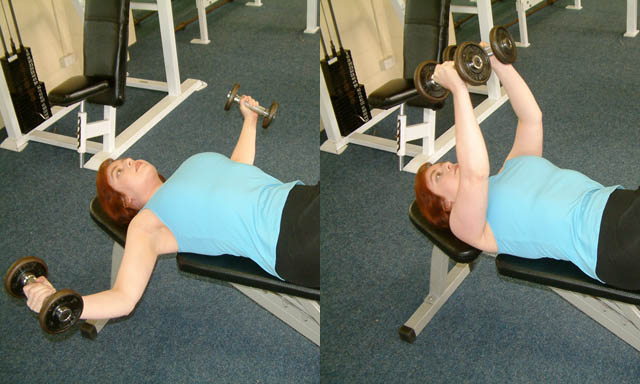
The movement is performed lying on the back on a bench, starting weights extended above the chest, meeting at the midsagittal plane. The arms are lowered through an arc passing through the transverse plane, terminating when the arm is roughly parallel to the floor, then returning to the starting position and repeating.[5]
This exercise can be done using other implements than dumbbells, such as kettlebells or weight plates. There are also machines such as the pec deck which perform a stabilized version of the movement while allowing people to sit upright.
-
 Butterfly machine fly (pec deck) start
 -
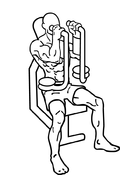 Butterfly machine fly (pec deck) end
 -
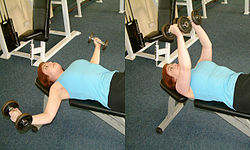
 Dumbbell fly start
 -
 Dumbbell fly end


If using a cable machine, the body leans forward to counterbalance the weight moved, with the feet braced and the elbows are positioned slightly below shoulder height. The arms move the same arc as a bench fly, relative to the torso.
-
 Cable crossover fly start
 -
 Cable crossover fly end
 -
 Crossover w/bands start
 -
 Crossover w/bands end
 -
 Lying cable fly start
 -
 Lying cable fly end


Incline
[edit]The clavicular portion of the pectoralis major is targeted through incline flies, when the arms rise upward as they adduct.
-
 Incline cable fly start
 -
 Incline cable fly end
 -
 Incline dumbbell fly start
 -
 Incline dumbbell fly end
 -
 Twisting fly start
 -
 Twisting fly end


In flies the shoulders are sometimes externally (laterally) rotated to point the elbows down to shift emphasis away from use of the anterior deltoid as a transverse adductor. Recordsetter World Record holder Jason Faulkner (Incredible Faulk) is featured in a video Completing 47 lifts with 65 Lb. Dumbbells in 1 minute. This surpasses Eamonn Keane's Guinness Record by 1,200 Pounds for Most weight Incline fly lifted in 1 minute.
Inverted fly
[edit]The inverted fly (also known as a bent-over lateral raise, reverse fly, or rear delt fly) works the posterior deltoid. This movement is the opposite of a chest fly. The exercise is performed with the torso parallel to the ground, facing down, with the hands in front of the face. Arms are moved through the transverse plane in an arc until parallel to the ground (or the limit of the range of motion of the shoulder is reached), then returned to the starting position and repeated.[6]
In terms of glenohumeral movement, the posterior deltoid does not work alone, and is assisted by other muscles. If the shoulder is neutrally rotated (elbows pointing outward then towards the scapulae as they lift) the posterior deltoid will be assisted in this transverse extension by the lateral rotators of the rotator cuff: the infraspinatus and teres minor. If the shoulder is externally rotated (elbows pointing towards the hips) then it will be assisted in this transverse abduction by the middle deltoid head.
This fly, while it seems like an isolation movement, is actually a compound movement because it involves movement in a second joint: the scapulothoracic. The scapulae will retract (adduct) during this type of fly. The muscles that perform this function are the rhomboids and the trapezius.[6]
If the lifter drops their elbows closer to their hips (rather than bringing them outward) the latissimus dorsi will come into play and deemphasize the use of the aforementioned muscles that cross both joints, as the lats bypass the scapulae and attach directly to the lumbar fascia.[6]
A variation involves sitting upright and using a cable machine; the machine is next to the shoulder opposite the muscle being worked (in line with the coronal plane), and the hand moves through the transverse plane across the front of the body at approximately eye level.[7][unreliable source?]
Lateral raise
[edit]
The shoulder fly (also known as a lateral raise) works the deltoid muscle of the shoulder. The movement starts with the arms straight, and the hands holding weights at the sides or in front of the body. Body is in a slight forward-leaning position with hips and knees bent a little. Arms are kept straight or slightly bent, and raised through an arc of movement in the coronal plane that terminates when the hands are at approximately shoulder height.[8] Weights are lowered to the starting position, completing one "rep". When using a cable machine the individual stands with the coronal plane in line with the pulley, which is at or near the ground.[9] The exercise can be completed one shoulder at a time (with the other hand used to stabilize the body against the weight moved), or with both hands simultaneously if two parallel pulleys are available.
This movement, when the shoulder is kept in neutral rotation, primarily targets the middle head of the deltoid. The anterior (front) and posterior (back) heads of the deltoid will also co-contract to aid in the abduction function. If the shoulder is laterally (externally, outwardly) rotated, the anterior deltoid becomes the prime mover of the glenohumeral joint, the posterior deltoid de-activates, and the middle head assists. By bending at the waist or leaning against a bench, the line of pull created allows the lateral deltoid to be isolated to a higher degree. [10]
If repetitions are done explosively, it is possible for form to deteriorate and other muscles may come into play to do work instead of the deltoid, by generating upward and rotation momentum. The muscles which can be used to "cheat" in this movement are primarily the serratus anterior and the upper fibers of the trapezius, both of which elevate and upwardly rotate the scapulae.


Common errors
[edit]- External rotation of shoulder – If external rotation occurs during the lift, the rotatory cuff muscles are activated. If the weight is lifted while the shoulder is in the externally rotated position, the anterior deltoid does all the work. In both cases, utilisation of the lateral deltoid is decreased to a great extent thereby defeating the purpose of the exercise.[11]
- Shoulder extension – Shoulder extension occurs when the elbows travel behind the shoulders during the lift. This movement, too, decreases the utilisation of the lateral deltoids.[11]
- Throwing the weight up – Using the hips or spine to generate momentum also lessens the emphasis on the lateral deltoids.[11]
- Complete upright position – Keeping the body totally straight increases the chances of the anterior deltoid being used.[11]
- Arms locked out at extension – This puts stress on joints which can lead to injury. Instead keep a slight bend in elbows. [12]
References
[edit]- ^ "Pectoral Fly Weightlifting Exercise". AZCentral. Archived from the original on 20 April 2021. Retrieved 10 December 2014.
- ^ "6 Exercise Machines You Should Do Without". Men's Health. Archived from the original on 2014-10-06. Retrieved 10 December 2014.[failed verification]
- ^ "How to Do a Chest Fly". fitday.com. Retrieved 10 December 2014.
- ^ "Chest Exercises – Pushups, Chest Presses and Chest Flies". about.com. Archived from the original on 7 April 2015. Retrieved 10 December 2014.
- ^ "Chest Flys – Useless Exercise Or Mass Builder?". nattyornot.com. Retrieved 10 December 2014.
- ^ a b c "Dumbbell Rear Lateral Raise". exrx.net. Retrieved 1 February 2018.
- ^ "Build a Big Chest: The Best Chest Workout for Mass". jackedfactory.com. Retrieved 10 December 2014.
- ^ "Dumbbell Lateral Raise". exrx.net. Retrieved 1 February 2018.
- ^ "Cable One Arm Lateral Raise". exrx.net. Retrieved 1 February 2018.
- ^ The Complete Guide to Side Lateral Raises[dead link]
- ^ a b c d "Common Lateral Raise Errors". exrx.net. Retrieved 1 February 2018.
- ^ "Want Bigger Shoulders ASAP? Make Lateral Raises Your Next Workout Staple". Men's Health. 2020-08-11. Retrieved 2023-08-28.
See also
[edit]- Bench press – a compound alternative to a chest fly.
- Bent-over row – a compound alternative to a reverse fly.
- Machine fly – the machine version of the chest fly.
- Supine row – a bodyweight, compound alternative to a reverse fly.
- Upright row – a compound alternative to a shoulder fly.

Fly (exercise)
View on GrokipediaDefinition and Overview
Core Concept
The fly exercise is a fundamental isolation movement in strength training, characterized by horizontal adduction or abduction of the arms through a controlled semi-circular arc, typically executed in lying, seated, or standing positions to engage specific upper body muscle groups.[3][6] This exercise maintains a fixed elbow angle with a slight bend throughout, distinguishing it as an auxiliary push or pull variation depending on the direction of motion.[3] Biomechanically, the fly replicates a hugging motion, where the arms traverse an expansive arc to maximize range of motion, providing a deep stretch at the extremities and peak contraction at the midline or rear position.[1] Unlike compound pressing exercises such as the bench press, which follow a linear trajectory involving elbow flexion and extension for multi-joint force production, the fly isolates the adduction or abduction plane, emphasizing scapular movement and joint stability without significant pushing or pulling leverage.[1][3] This arc-based path enhances the eccentric and concentric phases, promoting controlled resistance application across the full motion.[6] In bodybuilding and fitness programs, the fly exercise primarily aims to induce muscle hypertrophy through targeted isolation, complementing compound lifts by focusing on upper body development and improving aesthetic symmetry.[6][1] It supports overall strength gains by allowing practitioners to address specific movement patterns without the involvement of multiple muscle groups dominating the load.[3]Historical Development
The fly exercise, a movement pattern involving horizontal adduction of the arms to target the chest, emerged in the early 20th century as part of the burgeoning physical culture movement. The term "fly" likely derives from the arm motion resembling a bird's wings, with early references appearing in mid-20th century bodybuilding texts, building on 19th-century dumbbell practices. Pioneers like Eugen Sandow, often regarded as the father of modern bodybuilding, incorporated dumbbell exercises into their training regimens for pectoral development alongside push-ups, as inferred from his methods described in his 1894 book Strength and How to Obtain It, which emphasized isolated muscle work. Sandow's work in the late 19th century laid early groundwork for such training, with broader shifts toward isolated muscle training occurring in response to growing interest in aesthetic physiques during the 1920s and 1930s.[7] The exercise gained significant traction in the 1960s and 1970s through the influence of bodybuilding icons during the sport's Golden Era. Arnold Schwarzenegger, a seven-time Mr. Olympia winner, prominently featured dumbbell and cable flyes in his routines, emphasizing their role in achieving superior chest definition and fullness by providing a deep stretch and contraction. Schwarzenegger trained chest up to three times weekly, incorporating 3-5 sets of 10-20 repetitions of flyes after pressing movements, which helped popularize the exercise in gyms worldwide as bodybuilding transitioned from fringe activity to mainstream spectacle.[8] In the 1970s, innovations from companies like Nautilus, founded by Arthur Jones, incorporated cams and pulleys into machines that mimicked the fly motion, such as early pec deck designs, allowing for variable resistance throughout the range of motion. By the 1980s, amid a broader fitness boom that saw gym memberships surge and equipment proliferate, cable and machine variants evolved for enhanced isolation and safety. This period's commercialization of fitness, driven by aerobics trends and home workout videos, integrated these adaptations into standard gym setups, making fly exercises accessible to a wider audience beyond elite bodybuilders.[9]Muscles Involved
Primary Targets
The fly exercise primarily targets the pectoralis major muscle during chest fly variations, where the sternal head serves as the chief mover responsible for horizontal adduction of the humerus, drawing the arms across the midline of the body.[10] Electromyography (EMG) studies indicate high activation of the sternal portion of the pectoralis major, reaching approximately 90.8% of maximum voluntary isometric contraction (MVIC) during the concentric phase of dumbbell flyes, reflecting substantial fiber recruitment as the muscle fibers shorten to execute the adduction motion.[11] This recruitment emphasizes the lower and middle fibers of the sternal head, which originate from the sternum and costal cartilages and insert into the humerus, enabling the powerful squeezing action central to the exercise's mechanics.[12] In reverse fly variations, the posterior deltoids act as the primary movers, facilitating horizontal abduction and external rotation of the shoulder while contributing to scapular retraction during the concentric phase.[13] The rhomboids, including the major and minor, are also key targets, working to retract the scapulae by pulling them toward the spine as the arms extend backward against resistance.[14] Fiber recruitment in the posterior deltoids peaks during this shortening phase, with neutral grip positions resulting in significantly greater posterior deltoid EMG activity than pronated grips (p = 0.046; 95% CI = 0.1–7.4% MVIC), underscoring the muscle's role in stabilizing and extending the shoulder joint posteriorly.[13] The rhomboids' fibers, originating from the spinous processes and inserting on the medial scapular borders, are particularly engaged to counter protraction forces.[15] Lateral fly variations, often performed as lateral raises, primarily target the medial deltoids, which drive shoulder abduction by lifting the arms laterally away from the torso in the frontal plane.[16] The middle fibers of the deltoid, originating from the acromion process and inserting on the deltoid tuberosity of the humerus, exhibit significant recruitment during the concentric phase, with EMG measurements recording about 30.3% MVIC—substantially higher than in pressing or fly movements like the dumbbell fly (3.4% MVIC).[17] This activation pattern highlights the medial deltoids' role in elevating the humerus to approximately 90 degrees, with fiber shortening most pronounced in the mid-range of the motion to maintain abduction against gravity.[17]Secondary and Stabilizing Muscles
In the fly exercise, the biceps brachii and triceps brachii contribute to arm stabilization by maintaining elbow position and controlling the arc of motion during the adduction phase, preventing unwanted flexion or extension at the joint.[18][19] The biceps, particularly its short head, acts as a synergist to support the fixed elbow angle, while the triceps assists in the concentric contraction to ensure smooth resistance application.[20] The serratus anterior and rotator cuff muscles, such as the supraspinatus, play critical roles in scapular control and shoulder joint integrity by protracting the scapula and stabilizing the humeral head within the glenoid fossa throughout the movement.[21][22] These muscles counteract shear forces and maintain proper scapulohumeral rhythm, reducing stress on the shoulder capsule during the eccentric lowering.[23] In standing or cable fly variations, core muscles including the obliques provide torso stability by resisting rotational torque and maintaining an upright posture against the pulling force of the cables.[6][24] The obliques, in particular, engage isometrically to prevent lateral sway, ensuring balanced force distribution from the lower body upward.[25] Imbalances in these secondary and stabilizing muscles, such as weakness in the rotator cuff relative to the pectoralis major, can lead to compensatory patterns like excessive scapular elevation or internal rotation, potentially altering joint mechanics and increasing strain on primary movers.[26][27] Addressing these through targeted strengthening helps preserve overall form and efficiency in fly movements.[28]Equipment Options
Free Weights and Cables
Free weights and cables are versatile options for performing fly exercises, allowing for natural movement paths that mimic the pectoral muscles' adduction function. Dumbbells are commonly used for standard chest flies and reverse flies targeting the rear deltoids, providing unilateral loading to address imbalances.[29] To set up a dumbbell chest fly on a flat bench, lie supine with feet flat on the floor for stability, hold a dumbbell in each hand with a neutral grip (palms facing each other), and position the dumbbells directly above the chest with arms extended but elbows slightly bent to maintain tension.[29] For variations, adjust the bench to an incline angle of 30-45 degrees to emphasize the upper pectorals or a decline angle of 15-30 degrees for the lower portion, ensuring the torso remains supported against the backrest. Reverse flies with dumbbells follow a similar setup but focus on prone or seated positions to isolate the posterior shoulders.[30] Cable machines offer constant tension throughout the range of motion, which enhances muscle activation by preventing momentum and maintaining resistance even at peak contraction, unlike free weights where tension may decrease.[31] Setup involves selecting a cable crossover machine with adjustable pulleys; for a standard mid-chest fly, position both pulleys at shoulder height, grasp the handles with a neutral or pronated grip, and step forward to create slight preload tension with arms extended out to the sides.[32] Low-to-high configurations, with pulleys set below hip level, target the upper chest by pulling handles upward in an arc, while high-to-low setups, with pulleys above head height, emphasize the lower chest by drawing handles downward.[33] Grip width should approximate shoulder distance to align with natural arm paths, and the starting position maintains a slight forward lean for balance.[34] Resistance bands provide variable resistance that increases with stretch, matching the strength curve of the pectorals for improved hypertrophy potential compared to constant loads. To set up a band chest fly, anchor a looped band behind the body at chest height (e.g., around a sturdy post), hold the ends with palms facing forward at shoulder width, and stand with a staggered stance for stability, beginning with arms extended out to the sides.Machines and Bodyweight Alternatives
The pec deck machine, also known as the butterfly machine, offers a seated, fixed-path variation for chest flies that emphasizes isolation of the pectoral muscles. To set up, the user adjusts the seat height so the handles align with the mid-chest, positions the back firmly against the padded support, and places the forearms on the adjustable elbow pads with upper arms roughly parallel to the floor. A foot lever mechanism allows the pads to be released for movement, accommodating different user heights and arm lengths for proper alignment. Execution involves pressing the pads together in a controlled arc until the hands nearly meet, squeezing the chest at the peak, then slowly returning to the starting position where the chest is stretched, typically for 8-12 repetitions per set.[35][6] Research using electromyography has shown the pec deck to be one of the most effective chest exercises, activating the pectoralis major at 98% of the maximum compared to the barbell bench press.[36] The machine's guided motion reduces the need for stabilizer muscle engagement, providing constant tension through the range of motion and making it particularly accessible for beginners or individuals with shoulder instability, as it minimizes free weight demands on balance and coordination.[6][36] Bodyweight alternatives provide equipment-free options for rear delt flies, focusing on horizontal pulling and mobility to mimic the isolation without external loads. Inverted row variations, such as the wide-grip elbows-out version, target the rear deltoids by using a bar or rings set at waist height; the user lies underneath, grips wider than shoulders with palms facing in, flares the elbows outward, and pulls the chest toward the bar while squeezing the shoulder blades, then lowers controlled for 8-15 reps.[37] Floor angels, performed prone on the floor, engage the rear delts through scapular retraction; starting with arms extended overhead and palms down, the user slides the arms in an arc to the sides while pressing the palms into the ground and lifting the shoulders slightly off the floor, holding the squeeze briefly before reversing, which also improves shoulder mobility.[37][38] These exercises demand less from stabilizers than free-weight versions due to body positioning, suiting beginners by building foundational rear delt strength and posture without gym access.[6]Execution Technique
Step-by-Step Form
To perform a fly exercise correctly, begin by establishing a stable foundational posture. Maintain a neutral spine alignment throughout the movement to minimize stress on the lower back and promote proper force distribution.[2] Simultaneously, depress and retract the shoulder blades (scapulae) by pulling the shoulders down and back, which enhances scapular stability and protects the shoulder joints from undue strain.[2] This posture serves as the base for all fly variations, regardless of equipment.Step-by-Step Execution
- Setup and Starting Position: Select appropriate equipment, such as dumbbells or cable handles, and position yourself accordingly—for instance, lying supine on a bench for free-weight flies or standing centered between cable pulleys.[3] Hold the weights or handles above the chest with arms extended but with a slight bend in the elbows to reduce stress on the joints, using a neutral grip with palms facing each other (for dumbbells) or as per the equipment (for cables).[2] Keep the wrists neutral and the head, shoulders, and hips in contact with the supporting surface if applicable. For standing cable variations, start with arms extended forward across the midline at chest height.
- Concentric Phase: From the stretched position, initiate the movement by contracting the chest muscles to bring the arms together in a controlled arc toward the midline of the body above the chest, as if hugging a large tree trunk—this cue emphasizes the adduction motion without forcing the weights to touch.[39] Preserve the slight elbow bend throughout, allowing the arms to move fluidly while keeping the shoulder blades retracted and the spine neutral to ensure targeted muscle engagement over momentum.[3]
- Eccentric Phase: Slowly reverse the motion by allowing the arms to open outward in a wide arc to shoulder height or until a stretch is felt in the chest, resisting the pull of gravity to control the descent fully.[2] Maintain the fixed slight bend in the elbows and avoid any swinging or bouncing, which could compromise form and increase injury risk; aim for a deliberate pace to maximize muscle tension.[32]