Hubbry Logo
Curtain Fig TreeCurtain Fig TreeMain
Open search
Curtain Fig Tree
Community hub
Curtain Fig Tree
logo
8 pages, 0 posts
0 subscribers
Be the first to start a discussion here.
Curtain Fig Tree
Curtain Fig Tree
from Wikipedia

Curtain Fig Tree is a heritage-listed tree at Curtain Fig Tree Road, East Barron near Yungaburra, Tablelands Region, Queensland, Australia. It is one of the largest trees in Tropical North Queensland, Australia, and one of the best known attractions on the Atherton Tableland. It was added to the Queensland Heritage Register on 3 December 2009.[1]

Key Information

Growth of a strangler fig

[edit]
Creation of the Curtain Fig Tree

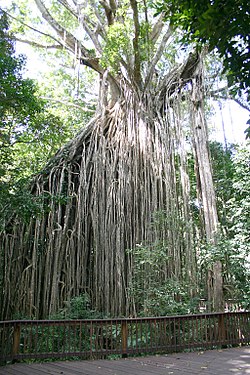
The Curtain Fig Tree is of the strangler fig species Ficus virens. Normally these figs germinate on top of another tree and try to grow roots into the ground. Once this important step is accomplished, the fig will grow vigorously, finally kill the hosting tree and then grow on independently. In this case, the hosting tree tilted towards a neighbouring tree, and the fig also grew around that one. Its curtain of aerial roots drops 15 metres (49 ft) (49 feet (15 m)) to the ground.[2]

Although these figs kill their hosts, they are an epiphyte which basically feeds from the ground, unlike a parasitic plant which feeds from the sap of the host plant/tree.

History

[edit]

The Curtain Fig Tree is located in the Curtain Fig National Park about one kilometre south-west of the town of Yungaburra on the Atherton Tableland.[3] It is estimated by the Queensland Parks and Wildlife Service to be at least 500 years old. Associated with organised tourism on the Tableland since the 1920s, the tree has been important in the development of the Cairns hinterland as a major tourist region in Queensland.[1]

Since the 1890s the tropical vegetation of the Atherton Tableland has been known variously as scrub, jungle and more recently, mabi rainforest. The term "rainforest" was coined in 1898 but it was not a descriptor applied to the tropical vegetation of the Cairns region until the 1970s. Mabi rainforest was classified in the 1960s by ecologists, based on its physical characteristics and species composition. The name "mabi" is derived from a local Aboriginal word for the rare Lumholtz's tree-kangaroo, the largest mammal found in this rainforest. Logging, agriculture and urban development on the Tableland has resulted in significant loss of mabi rainforest and it is listed as endangered under the Commonwealth Environment Protection and Biodiversity Conservation Act 1999.[1]

Early non-indigenous visitors to the Atherton Tableland often viewed the scrub in Romantic terms, fascinated by the dense and luxurious vegetation, especially the enormous trees covered with vines, and delicate and unusual ferns and orchids. A number of early twentieth century tourist attractions in the region, such as Fairyland (1907) and the Maze (1923) at Kuranda developed reflecting this view of the scrub. Other early commentators saw the fecundity of the scrub in a less favourable light, referring to it as gloomy, dank, and swarming with insects.[1]

Ways of seeing the rainforest began to shift in the 1920s from the Romantic view of nature as a collection of fascinating curiosities and grand and sublime landscapes, to an ecological paradigm which views nature as a systemic interrelationship between all living things including humans, and their environment. In the 1930s the North Queensland Naturalists' Club lobbied for language change, seeking to replace "scrub", often used in a derogatory manner, by "jungle", in a bid to change community attitudes to the rainforest. Valuing the rainforest gained momentum with the rise of the environmental movement in the 1960s and 1970s.[1]

Giant strangler figs such as the Curtain Fig Tree were considered to be wonders of nature. Strangler figs are epiphytes that develop when the seed of a fig germinates in the canopy of another tree and then sends roots to the ground. Once the root system is established, the fig grows vigorously, finally killing the host tree and then growing independently. The unusual formation of the Curtain Fig Tree was created when its vertical roots strangled the host causing it to fall into a neighbouring tree on a 45-degree angle. The extensive aerial roots of the strangler fig then dropped from the oblique angle of the fallen tree 15 metres (49 ft) to the forest floor, forming a "curtain". North Queensland strangler figs were portrayed photographically in The Queenslander from as early as 1896 and on postcards soon after 1900.[1]

Descriptions of unusual tropical vegetation such as the giant strangler figs began to appear in tourist guides from the 1920s. The Curtain Fig Tree was well known as a tourist attraction by the 1920s when Whitecars, a local hire-car service, commenced day tours of the southern Tableland c. 1926, stopping to view the giant tree. Prior to this the only comfortable travel available to visitors to the southern Tableland was by train via the Kuranda Railway. Whitecars was established c. 1922 by Les Battle and Norm Graham, who developed a timetabled taxi service between Malanda, Yungaburra and Atherton, and between Malanda and Millaa Millaa, with three cars. They took advantage of the 1926 opening of the Gillies Highway, linking the southern Tableland with Cairns, to take Ned Williams into partnership as The Cairns Tableland Motor Service Ltd (known locally as Whitecars), to capitalise on the expected influx of tourists. In 1927 the company won the tender to transport passengers between Cairns and the southern Tableland via the Gillies Highway, and to operate day tours on the Tableland out of Yungaburra. In 1934 Whitecars introduced its first bus, capable of carrying 17 passengers. The development of Whitecars was integral to the development of tourism on the Tablelands and led to the increased popularity of attractions such as the Curtain Fig Tree.[1]

By the 1950s, the Curtain Fig Tree was included in the Grand Tour/Tropical Wonderland Tour itineraries promoted by the Queensland Government Tourist Bureau (by then part of Queensland Railways). The Grand Tour operated during the winter months when a P&O ship would arrive at Cairns each week from Melbourne and Brisbane carrying around 200 passengers for a six-day stay in the region. Upon arrival passengers could join the Tropical Wonderland Tour, which included being taken by Whitecars to visit the attractions of the Atherton Tableland, including the Curtain Fig Tree.[1]

As tourism diversified and private car ownership became more commonplace in the 1960s, tourism numbers to the Cairns hinterland increased, as did numbers visiting the Curtain Fig Tree. More tours became available and the tree was included on the itinerary of the Tableland Circular Tour in 1966. The popularity of the tree continued unabated and it was included in more tours during the 1970s including the Atherton Tableland Tour.[1]

The Curtain Fig Tree remains a tourist attraction, but advances in science and a greater understanding of the natural environment mean the tree is now seen and portrayed in ecological terms. Since the 1970s, the area surrounding the Curtain Fig Tree has changed considerably: undergrowth has been trimmed back; interpretative signage educates tourists about the formation of the tree; and a boardwalk guides visitors to the tree. In December 1988, the Curtain Fig became part of the newly created Wet Tropics World Heritage Area, which consisted of 8,990 square kilometres of Far North Queensland rainforest.[1]

A boardwalk was constructed in 2001 to allow wheelchair access for the disabled and to provide further protection for the tree and its surrounds, while permitting visitors to view it from all angles. Large numbers of tourists continue to visit the Curtain Fig Tree every year independently or as part of an organised tour. In 1994, 58,000 people arrived in commercial vehicles and 123,000 in private vehicles.[1]

Description

[edit]
Curtin Fig Tree roots compared to a person in size

The Curtain Fig Tree (Ficus virens) is situated on Curtain Fig Tree Road approximately one kilometre south-west of the town of Yungaburra, in the Curtain Fig National Park within the Wet Tropics World Heritage Area. The vegetation type indigenous to the area is mabi rainforest (complex notophyll vine forest), now classified as endangered.[1][4]

The Curtain Fig Tree is approximately 50 metres (160 ft) high with a trunk circumference of 39 metres (128 ft). The canopy extends in a radius of approximately 30 metres (98 ft) from the trunk of the tree. Extensive aerial roots, which are now thick and interwoven, drop 15 metres (49 ft) to the forest floor, forming a curtain oriented north-west to south-east over approximately 7 metres (23 ft). The host tree has since rotted away and the fig is now a free-standing tree.[1]

Access to the Curtain Fig Tree which is approximately 50 metres (160 ft) from the road is via a 2 metres (6 ft 7 in) wide timber boardwalk from the roadside car park. At the beginning of the boardwalk there is a sheltered interpretation board that outlines the importance of the mabi rainforest and the history of the Curtain Fig Tree. The boardwalk then encircles the Curtain Fig. This boardwalk is easily accessible to wheelchairs and is raised above the forest floor (approximately 800 millimetres (31 in)) which also ensures visitors have minimal impact on the surrounding rainforest. Another interpretation board outlining how the tree was formed is located towards the end of the boardwalk, near the western face of the tree.[1]

At the base of the Curtain Fig are timber posts and stones, remnants of a previous boardwalk that once passed much closer to the base of the tree. The boardwalk and interpretative signage are not considered to be of cultural heritage significance.[1]

Heritage listing

[edit]

The Curtain Fig Tree was listed on the Queensland Heritage Register on 3 December 2009 having satisfied the following criteria.[1]

The place is important in demonstrating the evolution or pattern of Queensland's history.

The Curtain Fig Tree (Ficus virens), a 500-year old strangler fig that has been associated with organised tourism on the Atherton Tableland since the 1920s, is important for its association with the evolution of tourism in Far North Queensland, demonstrating the attraction of the North Queensland natural environment for tourists. Its popularity is associated with the impact of the motor vehicle on Far North Queensland tourism. As an unusual natural phenomenon, the tree evoked a sense of wonder and curiosity amongst settlers on the Atherton Tableland in the late nineteenth and early twentieth centuries, and has been one of the most tourist-visited large trees on the Tableland since the 1920s. It remains a popular tourist destination.[1]

The place is important because of its aesthetic significance.

The Curtain Fig Tree is an imposing and distinctive tree set within rare mabi rainforest. It is valued for its immense size and the curtain effect that has resulted from the thick and interwoven vertical root system. The tree's verdant and luxuriant growth has been valued by locals and tourists from the 1920s, and evokes a sense of awe, wonder, amazement and curiosity.[1]

See also

[edit]

References

[edit]
[edit]
Revisions and contributorsEdit on WikipediaRead on Wikipedia
from Grokipedia
The Curtain Fig Tree is a 500-year-old () located in Curtain Fig near Yungaburra in Queensland's Atherton Tablelands, , notable for its that extend 15 meters from the canopy to the ground, forming a dense, curtain-like drape. Rising nearly 50 meters in height with a trunk circumference of 39 meters, the exemplifies the hemiepiphytic growth of strangler figs, which germinate in the canopy of a host before sending down roots that envelop and eventually kill the host, leaving a hollow central cavity. Protected within rare mabi , it has drawn tourists since the and was designated a state heritage site in 2009, with an elevated providing non-intrusive access for observation. This formation highlights the ecological dynamics of tropical figs, which support diverse wildlife through their fruit and structure, though the specific tree's prominence stems from its scale and accessibility rather than unique biological anomalies.

Botanical and Ecological Foundations

Strangler Fig Biology

, commonly known as the white fig or green fig, is a species of in the Ficus of the Moraceae family, native to tropical and subtropical regions including . It displays a hemiepiphytic growth form characteristic of many Ficus species, initiating life as an after seeds—dispersed primarily by birds consuming the ripe syconia (figs)—germinate in the canopy of a host tree, often in bark fissures or branch crotches. The young plant initially obtains moisture and nutrients from atmospheric sources and debris, without parasitizing the host directly, while elongating aerial roots downward to anchor in the soil. These , numbering in the hundreds, thicken over decades, interweaving into a rigid lattice that encircles and compresses the host's trunk, mechanically it and disrupting cambial growth and vascular flow, which leads to the host's typically after 50–100 years. Following host decomposition, the fig persists as a freestanding supported by its fused network, which can span wide diameters and form cavernous interiors, as observed in mature specimens exceeding 30 meters in height. F. virens is in tropical lowland rainforests, periodically shedding leaves during drier periods before rapidly producing new foliage within one to two weeks, an rare among co-occurring species. Reproduction relies on syconial inflorescences inverted within the receptacle, pollinated by host-specific agaonid wasps that enter via a narrow ostiole, depositing on female flowers while ovipositing in select florets. Larval wasps develop inside galled flowers, with males emerging first to fertilize females before dying; winged females then exit, carrying to new figs, ensuring mutualistic where unpollinated syconia often abort. Mature figs, aggregating in clusters on short peduncles, provide nourishment for dispersers like birds and bats, perpetuating the cycle; trees can produce multiple crops annually, synchronized with local wet seasons.

Habitat and Environmental Adaptations

The Curtain Fig Tree (Ficus virens), a strangler fig species, is native to the tropical rainforests of northern Queensland, Australia, particularly within the Wet Tropics bioregion. It thrives in upland semi-evergreen notophyll vine forests known as Mabi forest, found exclusively on fertile basalt-derived soils rich in phosphorus and calcium. These soils originate from ancient volcanic activity in the Atherton Tablelands, supporting high biodiversity in this ecosystem. Annual rainfall in this habitat ranges from 1,300 to 1,600 mm, contributing to a warm, humid climate with temperatures averaging 18–28°C year-round, which favors the tree's growth in shaded, moist understories. As a hemi-epiphytic strangler, the Curtain Fig Tree exhibits adaptations enabling it to establish in the canopy rather than on the competitive . Seeds, dispersed by birds such as cassowaries or flying foxes, germinate in the crotches of host trees, allowing initial growth in elevated, shaded positions inaccessible to many competitors. From there, the produces photosynthetic shoots that ascend toward while extending downward to reach the , a process that can span decades and form extensive root curtains up to 15 meters long. These roots not only the plant but also envelop and girdle the host, eventually restricting its and access to light, leading to the host's death and the fig's transition to a freestanding supported by a fused lattice. This epiphytic strategy conserves energy during early development by minimizing reliance on nutrients; strangler figs like F. virens demonstrate low uptake, an suited to nutrient-scarce canopy environments where is limited. The species is , periodically shedding leaves in response to dry seasons or stress, which allows and rapid regrowth of foliage within weeks, enhancing resilience in fluctuating tropical conditions. Additionally, the dense system provides structural stability against storms and common in habitats, while the tree's broad canopy intercepts rainfall and fosters microhabitats for epiphytes and , reinforcing its ecological role.

Physical Characteristics and Formation

Dimensions and Structure

The Curtain Fig Tree reaches a of approximately 50 meters and features a trunk with a of 39 meters. This massive girth results from the coalescence of numerous that have fused over time, forming a robust, irregular central axis after the decay of the original host tree. The 's structure is defined by its hemiepiphytic strangler habit as a specimen, initiating growth from a lodged in the canopy of a host , extending downward prop roots that envelop and eventually kill the host, leaving a freestanding framework of lignified roots. , the host's trunk wedged into a neighboring tree before rotting, preserving the fig's elevated and contributing to the distinctive curtain formation. Prominent among its features is the "curtain" of , which descend up to 15 meters from the canopy branches to the , having thickened and interwoven into a dense, lattice-like over hundreds of years. These not only provide but also enhance stability and nutrient uptake in the environment. The overall form supports a broad canopy, though precise spread measurements are not documented, reflecting the tree's adaptation for maximal light capture in dense vegetation.

Aerial Root System and Curtain Phenomenon

The Curtain Fig Tree, a mature specimen of Ficus virens subsp. subulata, develops its aerial root system as part of the characteristic hemiepiphytic life cycle of strangler figs, beginning when a seed germinates high in the canopy of a host tree after dispersal by frugivorous birds. These adventitious roots, emerging from the stem and branches, exhibit positive gravitropism, elongating downward over years or decades until they penetrate the forest floor, where they thicken, branch profusely, and fuse into a supportive network. In humid tropical environments, such roots also facilitate atmospheric moisture absorption and gaseous exchange, aiding establishment before soil contact. Once anchored, the proliferating roots girdle the host trunk, exerting mechanical pressure that disrupts cambial growth and vascular flow, ultimately causing the host's death through starvation and decay, after which the fig stands independently within the hollowed root cage. The curtain phenomenon in this tree results from an atypical extension of the root deployment process, triggered by structural failure of the strangled host. As the host trunk weakened and toppled against a neighboring at roughly a 45-degree , the fig's branches sprawled horizontally along the fallen length—estimated at 30 meters—prompting dense production from elevated points along this span. This yielded a vertical cascade of over 1,000 interwoven descending 15 meters to the ground, forming a semi-transparent, lace-like curtain spanning up to 50 meters wide and enhancing against and storms. Unlike typical lattices, which form cylindrical enclosures around upright hosts, this configuration creates a planar drape, with roots fusing into cable-like strands up to 30 centimeters thick, visible evidence of iterative thickening over centuries. The resulting architecture not only supports the 30-meter-tall canopy but also traps humidity and detritus, fostering epiphytic communities within the root mesh.

Historical Context

Geological and Biological Timeline

The Atherton Tablelands, encompassing the site of the Curtain Fig Tree in Curtain Fig National Park, formed through prolonged volcanic activity that began approximately 7 million years ago with eruptions from shield volcanoes depositing thick lava flows across the region, generating fertile red soils essential for supporting ecosystems. This Pliocene-to-Pleistocene volcanism, continuing intermittently until about 10,000 years ago during the , produced the park's basaltic terrain, including vents and craters that stabilized into a landscape favorable for complex notophyll vine forests. Earlier geological foundations trace to the era, with metamorphic ranges emerging around 360 million years ago from sediment compression and granitic intrusions between 310 and 260 million years ago, followed by uplift of the eastern Australian escarpment 65 to 100 million years ago. Biologically, the genus, to which the Curtain Fig belongs, diverged around 98 to 105 million years ago during the , coinciding with the co-evolution of specialized fig-wasp pollination mutualisms that facilitated the of over 800 , many exhibiting hemi-epiphytic habits suited to tropical canopies. subsp. virens, the specific taxon of the Curtain Fig, represents a lineage adapted to Australasian and Southeast Asian , where its seeds—dispersed by vertebrates—germinate in host tree crevices, leveraging for anchorage and nutrient uptake in nutrient-poor, high-humidity environments like the Wet Tropics' mabi forests. These ecosystems, persisting post-volcanic stabilization over the last few million years, provided the for F. virens, with its strangling growth form enabling dominance in disturbed or mature settings through host and self-supporting root networks. The individual Curtain Fig Tree germinated over 500 years ago, likely in the early , when a bird-dispersed lodged in the bark or fork of a now-decayed host within the Yungaburra area's . Initial epiphytic growth transitioned to hemiepiphytism as prop roots descended 15 meters to the forest floor over decades, thickening and fusing into a curtain-like while encircling and suppressing the host, a process typical of strangler figs but accelerated in this basalt-derived, moisture-retentive soil. By the , the mature structure—comprising a hollow central cavity from host —had fully manifested, underscoring the tree's amid ongoing environmental stability in the protected Wet Tropics.

Human Discovery and Early Documentation

The Curtain Fig Tree, situated in what is now Curtain Fig National Park near Yungaburra in Queensland's Atherton Tablelands, predates recorded documentation by centuries, with estimates placing its age at over 500 years based on its growth as a (Ficus virens). While Aboriginal peoples of the region, including those referring to elements of the local as "Mabi" in reference to the , likely interacted with the tree and surrounding ecosystem for millennia, no specific pre-colonial records of the site exist in written form. European awareness of the Atherton Tablelands emerged in the late amid broader exploration and settlement of , though the Curtain Fig Tree itself was not singled out in initial surveys. By 1912, the surrounding area drew attention for potential settlement and timber extraction, leading to the gazettal of 486 acres as a timber reserve on 15 March 1913. This reserve was canceled in April 1915 and redesignated as state forest on the same day, reflecting early administrative recognition of the region's resources without explicit mention of the fig tree. Early formal documentation of the tree coincides with its integration into infrastructure in the , when Yungaburra-based operators, such as White Car tours, began transporting visitors from Cairns to view natural attractions including the site. The opening of the Cairns Range Road in 1926—later renamed Gillies Highway in 1934—facilitated access, embedding the tree in promotional itineraries. By the , the Tourist Bureau featured it in organized tours like and Tropical Wonderland Tour, marking its transition from local curiosity to documented landmark.

Conservation Efforts

Establishment of Protected Status

The Curtain Fig Tree, located near Yungaburra in , was initially protected through early 20th-century land reservations. On 15 March 1913, an area encompassing approximately 486 acres (197 hectares) was gazetted as a timber reserve to manage resource extraction, reflecting standard practices for forested lands at the time. This reserve was cancelled in April 1915 and redesignated as Curtain Fig State Forest, prioritizing sustainable over unrestricted logging while allowing limited human access. A significant escalation in protection occurred in December 1988, when the site was incorporated into the newly established World Heritage Area, spanning 8,990 square kilometers of rainforest ecosystems recognized for their outstanding universal value under criteria. This international designation imposed stringent conservation obligations on , prohibiting development that could harm the area's biodiversity and geological features, including the Curtain Fig's unique formation. The state forest was formally converted to Curtain Fig National Park on 1 July 2005, under 's vegetation management framework, dedicating 1.95 square kilometers exclusively to preservation and public appreciation. This transition enhanced legal safeguards against threats like and impacts, managed by the Queensland Parks and Wildlife Service. In December 2009, the tree itself received state-level heritage listing from the Queensland Heritage Council, acknowledging its cultural and significance dating back nearly a century, which further restricted alterations to its immediate environment.

Threats and Management Practices

The Curtain Fig Tree faces primary threats from high visitor volumes, with approximately 100,000 tourists annually contributing to , root damage, and crowding that can exacerbate erosion around its extensive system. To mitigate these impacts, Parks and Wildlife Service enforces 89 commercial operator permits with time allocations to control access and parking pressures. Invasive weeds such as Turbina corymbosa and , along with pest animals like the ( chinensis), pose risks to the surrounding mabi forest habitat, which has been historically fragmented by agricultural clearing, rendering associated plant species vulnerable. Fire represents a latent in the , given the tree's location in fire-prone sclerophyll interfaces adjacent to , though its moist microhabitat provides some natural resilience. Management under the Crater Lakes Aggregation Level 2 includes prescribed burns and monitoring to prevent uncontrolled wildfires that could damage bark or . Broader environmental pressures, such as regional loss from past of mabi forest (regional ecosystems 7.8.3, 7.3.39, 7.8.7), indirectly threaten the tree by reducing ecological corridors for pollinators like fig wasps essential to Ficus virens . Conservation practices emphasize sustainable infrastructure, including elevated boardwalks that direct foot traffic away from sensitive roots and vegetation, thereby minimizing direct physical damage while accommodating visitors. The tree's integration into , with planned amalgamation into Yungaburra , supports Level 2 pest management strategies targeting weed eradication and animal control to preserve . Ongoing monitoring of associated species, such as the endangered and spectacled flying-fox, informs adaptive measures, ensuring the tree's role as a keystone in this endangered . Heritage listing further mandates protection against unauthorized alterations, prioritizing long-term structural integrity over short-term exploitation.

Tourism and Human Engagement

Infrastructure and Visitor Experience

The Curtain Fig National Park provides basic centered on an elevated that encircles the tree, enabling visitors to observe its curtain from multiple angles without disturbing the fragile . This structure protects the tree's roots from foot traffic while facilitating close-up appreciation of its 15-meter-high formation. The measures 180 meters for a return loop, commencing directly from the adjacent parking area and requiring only about 10 minutes to complete, making it for a wide range of visitors including those using wheelchairs. It is well-maintained and designed for ease of navigation, though the park offers no additional amenities such as toilets or rubbish bins, necessitating visitors to arrive prepared and depart litter-free. is prohibited, limiting use to daytime excursions. Visitor experience emphasizes low-impact engagement, with opportunities for nocturnal wildlife spotting—such as Lumholtz’s tree-kangaroos and leaf-tailed geckos—using low-wattage spotlights (≤30W) and minimal noise to avoid disturbance. The site's integration into the Wet Tropics World Heritage Area underscores the need for respectful conduct, including acknowledgment of Aboriginal Traditional Owners' custodianship. Overall, the minimalistic setup prioritizes conservation over extensive development, delivering a focused, educational encounter with this ancient estimated at over 500 years old.

Economic Contributions and Potential Impacts

The Curtain Fig Tree attracts approximately 100,000 visitors annually as a key natural attraction in , drawing tourists to the Atherton Tablelands region and supporting indirect economic activity through expenditures on accommodations, dining, and transportation. Local businesses in Yungaburra and surrounding areas, including petrol stations, restaurants, and retail outlets, benefit from this visitor spending, which forms part of the broader Atherton Tablelands sector valued at $170 million annually as of 2013–2014 data, with $80 million from day visitors and $90 million from overnight stays. As part of Queensland's system, the Curtain Fig contributes to statewide impacts, where park visits generate $2.64 billion in annual direct and indirect spending and sustain over 31,000 jobs as reported in 2020. in the Wet Tropics, encompassing the Curtain Fig site, yields an average economic multiplier of $6.30 per dollar invested in , highlighting its role in regional through nature-based attractions. Potential positive impacts include expanded revenue from sustainable tourism infrastructure, such as boardwalks and interpretive signage, which enhance visitor capacity without entry fees typical of free-access Queensland parks. However, rising visitor numbers pose risks of soil compaction, root damage, and habitat disruption in the surrounding endangered mabi forest, necessitating ongoing management to mitigate economic losses from ecological degradation, as outlined in the Wet Tropics Sustainable Tourism Plan for 2021–2031. Climate variability could further influence impacts by altering rainfall patterns affecting tree health and visitor patterns, potentially reducing long-term tourism viability if conservation investments lag.

References

Add your contribution
Related Hubs
User Avatar
No comments yet.