


Community hub
Recent from talks
Contribute something
Nothing was collected or created yet.
DC Circulator
View on Wikipedia
 | |
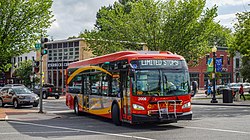
 A DC Circulator bus at Eastern Market in June 2018. | |
| Founded | July 2005[1] |
|---|---|
| Defunct | December 31, 2024 |
| Service area | Downtown Washington, D.C. |
| Service type | Downtown circulator |
| Routes | 6 + 1 seasonal |
| Stops | 139 |
| Fleet | 81 |
| Annual ridership | 1,236,100 (2024)[2] |
| Fuel type | Diesel, Diesel-electric Hybrid, Electric bus |
| Operator | RATP Dev |
| Partners |
|
| Website | dccirculator |
The DC Circulator was a bus system in Washington, D.C. The District of Columbia Department of Transportation operated the service in a public–private partnership with RATP Dev.[3][4]
The DC Circulator buses were similar to shuttle buses since they operated on a predictable fixed route and schedule, and run between the city's main attractions and some of the more popular neighborhoods for visitors. The service began in 2005, and passengers increased as the routes grew from two to five. Ridership peaked in 2011, and decreased thereafter. In 2024, the system had a ridership of 1,236,100.
The fare per ride was $1.00.[5] The subsidy per rider was unusually high; in 2016, it averaged $3.32.[1]
In July 2024, the Washington, D.C. Department of Transportation announced that the system's services would be reduced beginning in October 2024, and phased out entirely by the end of the year.[6][7] The last day of service for the DC Circulator was on December 31, 2024.[8]
History
[edit]The concept of a separate downtown bus was included in a 1997 report by the National Capital Planning Commission (NCPC). The report called for "a simple, inexpensive, and easily navigable surface transit system that complements Metrobus and Metrorail."[1] The next year, representatives of the Commission, the District of Columbia Department of Transportation, the Washington Metropolitan Area Transit Authority, and the Downtown D.C. business improvement district met to plan what would become the Circulator.[9]
After selecting First Transit as the system operator, the DC Circulator started service in July 2005 with two routes: one along K Street from Union Station to Georgetown, and a second from the Walter E. Washington Convention Center to the Southwest Waterfront.[9]
Additional routes were later added to serve the National Mall (2006), the 14th Street Corridor (2009), the Washington Navy Yard (2009), Rosslyn to Dupont Circle (2010), and the Skyland Town Center development in Southeast Washington (2011).[1] The two lines that served the National Mall and the Southwest Waterfront were discontinued in 2011 due to low ridership and redundant service.[10][11] The National Mall route was reinstated on June 15, 2015. The route is operated in collaboration with the National Park Service.[12]
A report released in March 2011 calls for developing better routes to replace those that had served the National Mall and Southwest Waterfront, and adding new service to the U Street Corridor, portions of Upper Northwest, and neighborhoods east of the Anacostia River.[1]
In 2018, RATP Dev replaced First Transit as the operator of the Circulator.[13]
From February 2019 until October 2019, DC Circulator rides were free under Mayor Bowser Fair Shot initiative.[14][15] However the $1 fare was reinstated due to increased ridership. However some city officials looked into reinstating the free rides.[16][17] Rides were free again due to the COVID-19 pandemic until the $1 fare was reinstated again on October 1, 2021.
Phaseout
[edit]On July 29, 2024, the District Department of Transportation announced that the service would be drawn down throughout the remainder of the year, and eventually discontinued on December 31.[18] Reductions including the discontinuation of most late-night services, elimination of the Rosslyn – Dupont Circle route, and increased headways, are planned to begin on October 1. The announcement cited decreasing ridership and transportation budget cuts as the reasons for ending the service.[6]
On October 1, 2024, the Rosslyn – Dupont Circle route was discontinued entirely, and late night service on the Woodley Park – Adams Morgan and Georgetown – Union Station routes were discontinued. Additionally, all routes were now scheduled to operate every 20 minutes.[19] WMATA responded to the route discontinuation by increasing weekend frequencies on the Ballston—Farragut Square Line (designated as route 38B) which operates a similar route to the discontinued Circulator route.[20]
On December 15, 2024, WMATA implemented multiple bus service adjustments, including the introduction of a new route, to prepare for the elimination of the Circulator routes. A new daily bus route called the Anacostia – Stanton Road Line (route C25) was created to provide service to Stanton Road and Pomeroy Road from Anacostia Station[21] every half hour. This new service was intended to provide coverage to areas serviced by the Congress Heights – Union Station route that were not previously serviced by any existing Metrobus routes. The routing of the Wisconsin Avenue Line was adjusted to move the northbound terminal of the 33 route from Federal Triangle to Union Station,[21] providing a similar routing to the Circulator's Georgetown – Union Station route. Service was increased on the 14th Street Line (routes 52 and 54) along 14th Street between Colorado Avenue and Metro Center Station to compensate for the elimination of the Eastern Market – L'Enfant Plaza route.[22]
December 31, 2024 was the last day that the DC Circulator ran service before ending all service.[23]
Routes
[edit]The DC Circulator had five lines operating at 20-minute intervals at the time of closure.[24][7]
Georgetown – Union Station
[edit]This east-west line connected Georgetown with Washington Union Station and operated primarily along Wisconsin Avenue, K Street, and Massachusetts Avenue. Eastbound, the bus started on Wisconsin Avenue at Whitehaven Street in Georgetown. Westbound, the route started in the bus level of the Union Station parking garage.[24] Service was replaced by an extended WMATA Route 33. Since the Better Bus network implementation it is now the D80.
Woodley Park – Adams Morgan – McPherson Square Metro
[edit]This line operated between Woodley Park, Adams Morgan, and McPherson Square via the 14th Street Corridor.[24] Part of this route replaced the discontinued Metrobus 98 route.[25] Service was replaced by additional WMATA Route 54 service.
Eastern Market – L’Enfant Plaza
[edit]This line connected Eastern Market and L'Enfant Plaza through Navy Yard & the DC Wharf District.[26] Service will be replaced in WMATA's Better Bus Network Redesign.
Congress Heights – Union Station via Barracks Row
[edit]This line operated from the Congress Heights and Union Station east of the Anacostia River via Barracks Row on Capitol Hill.[24] This route replaced the discontinued Metrobus 94 line.[27] Service was replaced by WMATA Route C25 service.
National Mall Route
[edit]This 15-stop loop line operated from Union Station to most of the major attractions on or near the Mall, including ones that are at some distance from Metro stations, such as the Lincoln, Jefferson, World War II, FDR, and Martin Luther King. Jr. memorials.[28]
Routes discontinued during first stage of phaseout
[edit]Rosslyn – Georgetown – Dupont
[edit]This line operated from Dupont Circle primarily via M Street through Georgetown and travels over the Key Bridge to Rosslyn.[24] This route replaced the former Georgetown Metro Connection "blue bus."[29] This service was discontinued on October 1, 2024 and replaced by additional WMATA 38B service.[7]
Routes discontinued prior to phase out
[edit]Smithsonian – National Gallery of Art
[edit]Until 2011 this line ran only on summer weekends, serving the National Mall in a loop along Constitution Avenue, 1st Street NE/SE, Independence Avenue, and 17th Street NW/SW.[11] The line was replaced by the more extensive National Mall route in June 2015.[12]
Convention Center – SW Waterfront
[edit]A north-south line connected the Washington Convention Center with the Southwest Waterfront and operated primarily along 7th and 9th streets, which have bus lanes. The service was eliminated on September 25, 2011 due to low ridership. A new Metrobus route, 74, was opened on September 23, 2011 along the 7th Street corridor between the Washington Convention Center and the Waterfront neighborhood, replacing the Circulator line and the eliminated portion of Metrobus Routes 70 and 71 from Pennsylvania Avenue to the South. The 74 bus costs more to ride and offers less frequent service, but the District officials said the ridership on the Circulator was too low to continue it.[10]
Potomac Ave Metro – Skyland via Barracks Row
[edit]This line operated from the Potomac Avenue Metro station and Skyland Town Center east of the Anacostia River via Barracks Row on Capitol Hill.[24] It was replaced by the Congress Heights – Union Station route on June 24, 2018 replacing Metrobus Route 94.
Union Station – Navy Yard Metro
[edit]This line connected Union Station and Navy Yard through Capitol Hill, with extended service on Washington Nationals game days.[24] This route was replaced by the Eastern Market – L’Enfant Plaza route on June 24, 2018. Also this route replaced the discontinued Metrobus N22 line.
Zoo Express Route
[edit]This seasonal line operated from Woodley Park station to Smithsonian National Zoo during the 2019 summer season. The service first ran between May 4, 2019 and September 30, 2019. DC Circulator planned on operating the line again during later summer seasons.[30]
Fleet
[edit]| Photo | Builder and model |
Model year | Length | Numbers (Total) |
Engine | Transmission | Notes |
|---|---|---|---|---|---|---|---|

|
Van Hool A300K |
2009 | 30 ft (9.144 m) | 1130-1143 (14 buses) |
Cummins ISB | Voith D854.5 |
|
|
|
New Flyer Xcelsior XDE40 |
2014–15 | 40 ft (12.19 m) | 2001-2018 (18 buses) |
Cummins ISB6.7 | BAE |
|

|
New Flyer Xcelsior XD40[31] |
2016 | 2101-2126 (26 buses) |
Cummins ISL9 | Allison B400R |
| |

|
Proterra Catalyst BE40 E2[32] |
2017 | 3001-3014 (14 buses) |
| |||
| Proterra ZX5 |
2022 | 3101 (1 bus) |
|
Retired Fleet
[edit]| Year | Builder and model | Number of vehicles |
Year Retired | Picture | Notes |
|---|---|---|---|---|---|
| 2003–04 | Van Hool A330 |
29 | 2018 | 
|
|
| 2010 | Van Hool A300L |
6 | 
|
|
See also
[edit]References
[edit]- ^ a b c d e "DC Circulator 2017 Transit Development Plan: Draft" (PDF). District of Columbia Department of Transportation. September 2017. Archived from the original (PDF) on June 9, 2024. Retrieved May 14, 2018.
- ^ "Transit Ridership Report Fourth Quarter 2024" (PDF). American Public Transportation Association. February 19, 2025. Retrieved February 25, 2025.
- ^ "Bus drivers, allies make a case for putting D.C. Circulator under city control". The Washington Post. May 14, 2018. Retrieved May 14, 2018.
- ^ "DC Circulator Celebrates a Sweet 16 Years of Service | ddot". ddot.dc.gov. Retrieved August 13, 2021.
- ^ "DC Circulator". Archived from the original on March 19, 2019. Retrieved March 19, 2019.
- ^ a b Nguyen, Danny (July 30, 2024). "Circulator bus system will begin phasing out Oct. 1 and end this year". Washington Post. Retrieved July 30, 2024.
- ^ a b c "DC Circulator Service Termination Information". Washington D.C. Circulator. Archived from the original on December 12, 2024. Retrieved December 22, 2024.
- ^ "DC Circulator Service to End Dec. 31, Riders Encouraged to Seek Alternate Routes with Metro | ddot". ddot.dc.gov. Retrieved January 1, 2025.
- ^ a b "DC Circulator". Downtown DC BID. Retrieved December 12, 2011.
- ^ a b "DDOT to Implement Changes to Existing Circulator Service". District of Columbia Department of Transportation. Archived from the original on June 11, 2012. Retrieved December 12, 2011.
- ^ a b "D.C. Circulator bus route on National Mall ends". TBD. April 1, 2011. Archived from the original on May 23, 2013. Retrieved December 12, 2011.
- ^ a b "District to Begin DC Circulator National Mall Route Bus Service". District of Columbia Department of Transportation. Archived from the original on February 1, 2017. Retrieved June 17, 2015.
- ^ Lazo, Luz. "D.C. Circulator operations contract going to a new provider". Washington Post. Retrieved October 17, 2018.
- ^ Rogger, Caitlin. "The Circulator is now free. Why just the Circulator? It's complicated". Greater Greater Washington. Retrieved April 23, 2020.
- ^ Carrasco, Maria. "DC Circulator Bus Rides Will Be Free Indefinitely". NBC4 Washington. Retrieved April 23, 2020.
- ^ Kaplan, Sophie. "DC Circulator to end free rides, charge $1 fare again". The Washington Times. Retrieved April 23, 2020.
- ^ Giambrone, Andrew (May 15, 2019). "Free D.C. Circulator service scrapped in initial budget vote but eastward expansion preserved". Curbed DC. Retrieved April 23, 2020.
- ^ "DDOT Announces Phased-in Elimination of DC Circulator Beginning October 1". ddot. July 29, 2024. Retrieved July 30, 2024.
- ^ "The DC Circulator Bus Is Officially Going to Die - Washingtonian". July 30, 2024. Retrieved January 1, 2025.
- ^ "WMATA | Expanded 38B Saturday and Sunday Service, Oct 5 to Dec 14". WMATA. Archived from the original on October 3, 2024. Retrieved January 1, 2025.
- ^ a b "WMATA | Metrobus Changes December 15". WMATA. Archived from the original on December 20, 2024. Retrieved January 1, 2025.
- ^ "Say 'goodbye' to DC Circulator: How the city plans to make up for lost bus routes". WTOP News. September 10, 2024. Retrieved January 1, 2025.
- ^ Dasgupta, Sonia (December 31, 2024). "DC Circulator service ends officially Tuesday night". WJLA. Retrieved January 1, 2025.
- ^ a b c d e f g "Circulator Map and Information Guide". DC Circulator. Archived from the original on May 15, 2018. Retrieved May 14, 2018.
- ^ "Metrobus Routes 98, N22 being replaced by DC Circulator" (Press release). Washington Metropolitan Area Transit Authority. March 27, 2009. Retrieved December 20, 2009.
- ^ "DC Circulator Final 2018 Service Changes". DDOT. June 24, 2018. Retrieved June 23, 2018.
- ^ "DC Circulator Final 2018 Service Changes". DDOT. June 24, 2018. Retrieved June 23, 2018.
- ^ "DC Circulator National Mall Route Service Map". DC Circulator. Retrieved May 14, 2018.
- ^ "DC Circulator Expansion Continues". DDOT. Archived from the original on February 28, 2012. Retrieved May 14, 2018.
- ^ "Convenient Bus Rides to the National Zoo in DC". dccirculator.com. Retrieved July 25, 2019.
- ^ "DC Government Awards New Flyer a Contract for 26 Clean Diesel Buses". newflyer.com. New Flyer. August 1, 2017. Retrieved August 1, 2017.[permanent dead link]
- ^ "Proposed task order cooperative agreement with Proterra, Inc". dccouncil.us. council of the district of columbia. May 25, 2017. Retrieved July 18, 2017.
External links
[edit]
- Official website at the Wayback Machine (archived February 9, 2024)
| Agencies | |
|---|---|
| Washington Metro | |
| Commuter rail | |
| Inter-city rail | |
| Bus | |
| Bus rapid transit | |
| DC Streetcar | |
| Aviation | |
| Former services | |
| Future projects | |


DC Circulator
View on GrokipediaHistory
Inception and Launch (2005)
The concept for a dedicated circulator bus service in Washington, D.C., originated from a 1997 report by the National Capital Planning Commission, which identified the need for improved transit connectivity in the downtown area to link tourist attractions, employment centers, and Metro stations amid growing demand for efficient surface transit.[5] This initiative evolved into a public-private partnership involving the District Department of Transportation (DDOT), the Washington Metropolitan Area Transit Authority (WMATA), and the Downtown DC Business Improvement District, aimed at supplementing Metrorail and Metrobus with high-frequency, reliable shuttles.[6] Service launched on July 9, 2005, with two initial routes: the Georgetown-Union Station line running east-west primarily along K Street NW, connecting Union Station to Georgetown via the Washington Convention Center, and the Convention Center-SW Waterfront line serving north-south travel from the Convention Center to L'Enfant Plaza and the Southwest Waterfront area.[7][8] The system debuted with a fleet of 29 low-floor buses designed for frequent service without fixed schedules, emphasizing short headways of 10 minutes or less during peak hours to facilitate seamless circulation in congested downtown corridors.[9] First Transit, a private operator, was contracted to manage daily operations under oversight from DDOT and WMATA, marking an early example of outsourced transit management in the District to leverage specialized expertise for reliability and customer service.[10] The initial fare was set at $1 per ride, with no transfers to other systems, positioning the Circulator as an affordable complement to existing transit rather than a direct competitor.[8] Early ridership surged, with usage increasing over 10% from July to December 2005, validating the model's focus on high-capacity, dedicated routes to alleviate Metro overcrowding and enhance accessibility for commuters and visitors.[11]Expansion and Route Development (2006–2011)
Following the initial launch of two routes in December 2005, the DC Circulator expanded in March 2006 with the addition of the Smithsonian–National Gallery of Art route, a seasonal loop serving the National Mall on summer weekends and holidays.[12] This route operated along Constitution Avenue NW from 17th Street to 4th Street and returned via Independence Avenue SW, providing dedicated access to major tourist sites including the Smithsonian museums and National Gallery of Art, with the aim of alleviating traffic congestion and improving pedestrian connectivity in high-visitation areas.[13] The expansion targeted seasonal demand, as initial ridership data indicated strong tourist usage but limited year-round residential traffic on Mall-adjacent paths.[14] By 2009, amid rising residential and commercial growth in peripheral neighborhoods, the District Department of Transportation (DDOT) added two permanent routes on March 29, effectively replacing select underperforming Metrobus services to streamline operations and boost frequency.[15] The Woodley Park–Adams Morgan–McPherson Square route (green line) connected Metro stations at Woodley Park, Columbia Heights, and McPherson Square via Columbia Road NW, 14th Street NW, and U Street NW, serving dense areas like Adams Morgan and the U Street corridor to facilitate feeder service to the regional rail network.[16] Simultaneously, the Union Station–Navy Yard route (blue line) linked Union Station to the Navy Yard Metro via Pennsylvania Avenue SE and the Capitol Riverfront, addressing development in the emerging Navy Yard district and providing direct ties to federal offices and waterfront redevelopment zones.[16] These additions increased system coverage by approximately 20% and were funded through DDOT's public-private partnership model, emphasizing high-frequency service (every 10 minutes) to compete with private vehicles.[12] In 2010, route development continued with the introduction of the Rosslyn–Dupont Circle route (orange line) in late summer, extending service across the Francis Scott Key Bridge into Arlington, Virginia, to connect Rosslyn's commercial hubs with Dupont Circle and Georgetown via M Street NW and Wisconsin Avenue NW.[17] Operating from 7 a.m. to midnight on weekdays and extended hours on weekends, this route aimed to reduce cross-jurisdictional transfers and support commuting patterns between Virginia employment centers and D.C. neighborhoods, with initial projections estimating 1,000 daily riders based on parallel traffic volumes.[17] The expansion reflected DDOT's strategy to integrate with WMATA's Metrorail while prioritizing circumferential travel over radial spokes, though it required coordination with Arlington County for Virginia-side stops.[12] Throughout 2011, focus shifted to operational refinements rather than new routes, including frequency adjustments on the Smithsonian–National Gallery line effective April 1 to extend service hours and improve reliability amid growing annual ridership exceeding 2 million system-wide.[18] DDOT also advanced planning for future phases, such as East of the River extensions via public hearings in August, evaluating alignments from Skyland to Potomac Avenue through Barracks Row to support Ward 8 connectivity, though implementation was deferred to FY2012 amid budget constraints.[19] These developments prioritized data-driven route selection, using origin-destination surveys to target gaps in Metro feeder coverage and commercial corridors.[11]Peak Operations and Ridership (2011)
In 2011, the DC Circulator achieved its peak operational scope and ridership prior to subsequent declines, operating five fixed routes seven days a week with headways of no more than 10 minutes during core service periods.[11] Most routes provided service from 7:00 a.m. to midnight on weekdays, with select lines extending to 3:30 a.m. on weekends; summer schedules (April through September) further expanded hours to 6:00 a.m. to 9:00 p.m. on weekdays and 7:00 a.m. to 9:00 p.m. on Saturdays for certain corridors.[11] The system emphasized reliable, high-frequency service connecting key tourist, commercial, and residential areas, including enhancements like additional runs for Washington Nationals games at Nationals Park.[11] Route adjustments in 2011 reflected efforts to optimize performance: the low-ridership Convention Center–Southwest Waterfront line was discontinued due to insufficient passenger volumes, while a new corridor from Potomac Avenue Metro Station to Skyland via Barracks Row launched in October, extending service east of the Anacostia River for the first time and targeting underserved neighborhoods.[20][21] These changes maintained the system's focus on short, loop-style routes with dedicated branding, low fares, and convenient scheduling to boost connectivity within central Washington, D.C.[21] Ridership peaked in 2011 at over 5.7 million annual passengers, with monthly volumes exceeding 500,000 and reaching a high of 546,130 in July amid seasonal tourism surges.[11][21] This marked the zenith of growth from the system's 2005 inception, driven by route expansions and reliable service, before factors like economic shifts and competition from other transit modes contributed to later drops.[22]Decline and Operational Challenges (2012–2023)
Following the peak ridership year of 2011, the DC Circulator encountered persistent operational hurdles, including traffic congestion that eroded service reliability across routes. A 2014 transit development plan update by the District Department of Transportation (DDOT) documented daily challenges during peak periods, with all routes experiencing delays that exceeded scheduled running times and compromised adherence to 10-minute headways. On-time performance for the Potomac Avenue Metro-Skyland route, for instance, stood at only 66.23% against an 80% target, primarily due to congestion rather than insufficient vehicles.[12] These issues contributed to inconsistent service, particularly on high-demand corridors like Georgetown-Union Station, where overcrowding occurred amid growing annual operating costs that rose from $15.9 million in 2011 to $17.1 million in 2013, while farebox recovery lagged at 19.81% below the 25% goal.[12] Fleet maintenance emerged as a critical vulnerability in the mid-2010s, exacerbated by reliance on private contractor First Transit. A 2016 DDOT audit revealed that 95% of the 70-bus fleet had at least one significant safety defect, including malfunctioning brakes, exhaust leaks, cracked windshields, and loose lug nuts, with older Van Hool models showing exceptionally high defect rates despite being kept in service.[23][24] Inadequate oversight and cramped maintenance facilities were cited as root causes, leading to deferred repairs and exterior damage from overcrowding.[25] These revelations halted planned expansions and prompted safety reforms, though drivers reported ongoing issues into 2017, with buses still operating under hazardous conditions due to persistent maintenance backlogs.[26] The COVID-19 pandemic intensified these strains starting in 2020, precipitating a sharp ridership collapse from pre-pandemic levels of approximately 7-8 million annual trips to just over 1 million in 2021—a 65% decline that persisted through 2023.[27] Recovery stalled amid remote work trends and competition from expanded ride-hailing services, while operating costs escalated due to inflation, labor, and fleet aging, straining D.C.'s budget deficit.[28] By 2023, Mayor Muriel Bowser's budget proposal sought to eliminate three of six routes to address fiscal pressures and an electrification push that proved cost-prohibitive without federal grants, highlighting the service's vulnerability to subsidy dependency—averaging $10-35 per ride—and overlap with WMATA Metrobus options.[29][5] These factors underscored systemic inefficiencies, including low non-peak utilization on underperforming lines like Potomac Avenue-Skyland, which saw only marginal growth despite investments.[12]Phaseout and Service Termination (2024–2025)
The District Department of Transportation (DDOT) announced on July 29, 2024, a phased elimination of DC Circulator service as part of the District of Columbia's Fiscal Year 2025 Budget and Financial Plan, with reductions commencing October 1, 2024, and full termination on December 31, 2024.[30] This decision stemmed from persistent budget shortfalls, exacerbated by declining tax revenues and a failure to restore pre-pandemic ridership levels, alongside escalating operational costs that strained municipal finances.[28] Circulator ridership, which peaked prior to 2020, had not recovered sufficiently post-COVID-19 restrictions, dropping to levels insufficient to justify continued subsidies amid broader fiscal constraints.[31] Initial phaseout measures on October 1, 2024, included the immediate termination of the Rosslyn-Dupont Circle route and the elimination of late-night service on the Woodley Park-Adams Morgan and Georgetown-Union Station lines, reducing overall service frequency and scope.[32] By late 2024, only limited routes—such as Eastern Market to L'Enfant Plaza—remained operational, with DDOT directing riders to enhanced Washington Metropolitan Area Transit Authority (WMATA) Metrobus services as replacements, including new or augmented lines like the G3, H2, and 31/33 to approximate former Circulator coverage.[33] These Metrobus enhancements, funded through collaborative agreements between DDOT and WMATA, aimed to mitigate disruptions but introduced longer wait times and fare structures differing from the Circulator's free model.[34] Service concluded as scheduled on December 31, 2024, marking the end of nearly two decades of operations, with the final buses completing routes amid public notifications urging transitions to alternative transit options.[2] Post-termination, DDOT planned to repurpose or auction Circulator vehicles, directing proceeds toward other transportation initiatives, while emergency legislation ensured fiscal accountability in asset sales.[35] The phaseout reflected pragmatic fiscal realism, prioritizing core infrastructure over subsidized niche services unable to demonstrate sustained viability in a post-pandemic environment.[36]Operations
Service Model and Characteristics
The DC Circulator functioned as a dedicated network of fixed-route bus services in Washington, D.C., emphasizing connectivity between major tourist attractions, residential neighborhoods, and Metrorail stations in areas underserved by rapid transit.[7] Launched to supplement the regional Metrorail and Metrobus systems, it prioritized short-haul trips within the city's core quadrants through looped or linear corridors that avoided heavy reliance on transfers.[11] Managed by the District Department of Transportation (DDOT), the service contracted private operators for execution, maintaining a distinct branding and operational independence from the Washington Metropolitan Area Transit Authority (WMATA).[7] Key operational characteristics included high-frequency scheduling, with buses dispatched at intervals of 10 minutes during peak and off-peak periods to ensure predictable wait times and minimize passenger anxiety over timetables.[37] Routes employed limited-stop patterns, reducing dwell times at stations equipped with distinctive signage and real-time arrival displays to expedite boarding and circulation efficiency.[38] Vehicles featured low-floor chassis for accessibility, multiple entry doors, expansive windows for visibility, and amenities such as complimentary Wi-Fi and USB charging ports, fostering a user-friendly environment tailored to both visitors and commuters.[37] Service hours varied by line but typically ran from 7:00 a.m. to midnight on weekdays and extended to 3:30 a.m. on weekends, accommodating diurnal patterns in tourism and nightlife while aligning with Metrorail extensions.[11] The model's focus on simplicity—through color-coded routes, uniformed operators, and integration with broader transit apps—aimed to lower barriers for infrequent riders, though empirical surveys indicated sustained high satisfaction ratings around 8.7 out of 10 despite growing demands.[39] Annual ridership approached five million passengers, underscoring its role in alleviating congestion on parallel roadways and rail lines.[40]Fares, Funding, and Subsidies
The DC Circulator operated with a flat fare of $1 per ride upon its launch in 2005, with reduced fares of $0.50 for seniors aged 65 and older and individuals with disabilities, and complimentary access for children under five years old.[41] This structure persisted as the standard policy, designed to encourage quick boarding and high turnover on short routes serving tourists and local commuters.[5] In March 2019, Mayor Muriel Bowser announced the elimination of fares to boost ridership and reduce congestion, a policy implemented until September 30, 2019.[42] Fares were reinstated at $1 effective October 1, 2019, following a D.C. Council directive tied to fiscal constraints in the FY2020 budget, which overrode the mayor's permanent free-rider initiative.[41][43] Funding for the DC Circulator derived primarily from the District of Columbia's local operating budget, administered by the District Department of Transportation (DDOT).[44] A dedicated DC Circulator Fund, established by D.C. law, received revenues from asset sales, leases, or transfers but served mainly to support transitions rather than core operations.[44] The service relied on reimbursable agreements with the Washington Metropolitan Area Transit Authority (WMATA) for operations, with DDOT covering costs as a DC-specific project outside WMATA's regional subsidy framework.[45] In FY2017, fares generated 6.4% of operating revenues, while DC government funding supplied 93.6%, reflecting the system's dependence on public subsidies to maintain frequent service.[40] Subsidies escalated over time due to rising operational costs, including labor, fuel, and maintenance, outpacing fare revenue even at $1 per ride.[46] Early analyses projected subsidies of $2.00–$2.63 per trip without fares, but by the 2020s, effective subsidies reached $10–$35 per ride amid stagnant ridership recovery post-pandemic and inflationary pressures.[46][5] This high per-trip burden, combined with broader fiscal priorities, prompted the D.C. Council's inclusion of Circulator reductions in the FY2025 budget, allocating funds for a one-year wind-down while redirecting resources to integrated WMATA services.[47][32] The phaseout underscored the challenges of sustaining a standalone, low-fare circulator model without corresponding revenue growth or efficiency gains.[5]Technology, Accessibility, and Passenger Experience
The DC Circulator implemented GPS-based real-time tracking to provide passengers with arrival predictions, accessible through dedicated mobile applications like the DC Circulator Live app on Google Play, which allowed users to search stops and routes instantly.[48] An iPhone app launched in 2009 enabled users to locate stops and track buses via GPS data.[49] By 2015, the system utilized smartphones installed in vehicles to transmit location information, supplementing traditional GPS for more accurate updates, though reliability varied due to signal inconsistencies.[50] Later fleet additions, such as the 2017 New Flyer buses, incorporated digital interior screens for route information and USB charging ports to enhance onboard convenience.[51] In 2018, the introduction of 14 Proterra Catalyst BE40 E2 electric buses marked a shift to battery-electric technology, capable of up to 250 miles per charge after overnight recharging, eliminating tailpipe emissions and reducing noise compared to diesel or hybrid predecessors.[51][52] These vehicles featured four underfloor battery packs supporting full 10-hour shifts, displacing over 88,900 gallons of diesel annually across the fleet.[53] Earlier models included hybrid diesel-electric options, but the transition to electrics prioritized sustainability over hybrid efficiency in procurement decisions.[54] Accessibility features across the fleet adhered to ADA standards, with all buses equipped with wheelchair ramps, securement areas, and low-floor or kneel designs for level boarding.[55] Newer buses from 2015 onward included sloped 32-inch wheelchair ramps, wider doors for easier entry, and priority seating for passengers with disabilities, reducing dwell times at stops.[56] These modifications facilitated independent travel for wheelchair users along tourist routes, though service disruptions from maintenance occasionally impacted availability.[26] Passenger experience centered on the service's free fare structure and connectivity to major attractions, fostering high satisfaction with frequency and integration with other transit modes in user surveys.[11] However, chronic maintenance issues and traffic congestion led to frequent delays, with riders reporting waits exceeding 25 minutes and inaccurate real-time tracking, eroding reliability perceptions in later years.[57][58] Despite onboard amenities like LED destination signs and quiet electric operation improving comfort, operational shortfalls—such as insufficient deployable buses—drew complaints about overcrowding and inconsistent service.[26][59]Routes
Primary Historical Routes
The DC Circulator launched on July 10, 2005, with two foundational routes intended to facilitate efficient travel between prominent tourist, business, and transit nodes in central Washington, D.C., using dedicated buses with simplified routing and frequent service. These initial lines, the Georgetown–Union Station route and the Convention Center–Southwest Waterfront route, collectively featured 52 stops served by a fleet of 29 buses, emphasizing accessibility for visitors over routine commuting needs.[9][7] The Georgetown–Union Station route established a key east-west axis, connecting the Georgetown neighborhood—known for its shopping and dining along M Street—with Union Station via downtown corridors including K Street NW, passing landmarks such as the Convention Center and facilitating transfers to intercity rail and Metrorail.[9][60] This route operated daily with headways as short as 10 minutes during peak hours, prioritizing reliability in mixed traffic to alleviate congestion in areas underserved by traditional Metrobus lines.[9] Complementing this, the Convention Center–Southwest Waterfront route provided a complementary linkage, running from the vicinity of the Walter E. Washington Convention Center southward to the Southwest Waterfront area, integrating stops near Pennsylvania Avenue and supporting event-driven traffic around federal and commercial sites.[7][9] Both routes were funded by the District Department of Transportation (DDOT) and operated under contract, initially offering low or no fares to encourage adoption, and served as the system's backbone through subsequent expansions while adapting to ridership patterns until their reconfiguration in the 2020s.[7]Route Expansions and Modifications
The DC Circulator initiated service on July 31, 2005, with two inaugural routes: the Georgetown-Union Station line, connecting residential and commercial areas west of the Potomac River to downtown destinations, and the Convention Center-Southwest Waterfront line, linking the Walter E. Washington Convention Center to waterfront developments.[61] These routes aimed to provide high-frequency, low-cost connectivity to supplement Metrorail and reduce downtown congestion.[12] Expansions accelerated in subsequent years to cover additional activity centers. In 2006, the Smithsonian-National Gallery of Art route was introduced, enhancing access to major tourist sites along the National Mall.[61] By March 2009, two further routes launched: Woodley Park-Adams Morgan-McPherson Square, serving northern neighborhoods and connecting to Metrorail stations for commuter flows, and Union Station-Navy Yard, bridging Capitol Hill to emerging waterfront areas east of the Anacostia River.[61][12] The system reached six routes in September 2010 with the addition of the Dupont Circle-Georgetown-Rosslyn line, extending service across the Key Bridge to Arlington, Virginia, to facilitate cross-jurisdictional travel.[61] The October 2011 introduction of the Potomac Avenue Metro-Skyland via Barracks Row route marked the first extension east of the Anacostia, targeting underserved areas with connections to retail and residential hubs; however, low-ridership routes like Smithsonian-National Gallery of Art and Convention Center-Southwest Waterfront were suspended that year to reallocate resources.[61] Modifications included rerouting the Union Station-Navy Yard line along 2nd Street NE in 2011 for better alignment with development patterns, stop consolidations on Georgetown-Union Station to streamline operations, and terminus adjustments in 2012 shifting to North Capitol Street NW.[61] By 2013, additional stops were incorporated on Union Station-Navy Yard and Potomac Avenue-Skyland to improve accessibility without extending overall length.[61] Later adjustments in June 2018 reconfigured the Union Station-Navy Yard and Potomac Avenue-Skyland routes to enhance frequency and coverage, including realignments for better integration with Metrobus and reduced overlaps, while extending service hours on select lines.[62] These changes responded to ridership data indicating uneven demand, prioritizing high-usage corridors amid fiscal constraints from the District Department of Transportation.[63] Proposed extensions in the 2014 Transit Development Plan, such as a National Mall route implemented around fiscal year 2015, further adapted the network to tourism peaks, though not all recommendations materialized due to performance evaluations favoring efficiency over unchecked growth.[12]Discontinued and Phased-Out Routes
The Convention Center–Southwest Waterfront route, introduced as part of early network expansions, was discontinued on September 25, 2011, primarily due to persistently low ridership that failed to justify dedicated operations.[64] Service along this corridor was subsequently absorbed by enhancements to WMATA's Metrobus route 74, which provided comparable connectivity between the Washington Convention Center, Southwest Waterfront, and adjacent areas.[64] The Smithsonian–National Gallery of Art route met a similar fate prior to 2020, as operators determined it overlapped inefficiently with existing Metrorail and pedestrian access points; it was replaced by the National Mall route to consolidate service and extend coverage westward along the Mall's core tourist axis.[64] Further rationalizations occurred on June 24, 2018, when the Union Station–Navy Yard route was eliminated amid low utilization and redundant coverage by Metrobus options; it was succeeded by the new Eastern Market Metro–L'Enfant Plaza Metro line, which rerouted via Barracks Row, Navy Yard Metro, M Street SE/SW, and Waterfront Metro to better serve emerging demand nodes.[65] Concurrently, the Potomac Avenue Metro–Skyland via Barracks Row route was discontinued, with partial replacement via the Congress Heights–Union Station line linking Union Station to Congress Heights Metro through Historic Anacostia; unaffected segments relied on Metrobus routes 92, U8, and W4 for continuity.[65] These adjustments reflected data-driven efforts to prune underperforming segments, reallocating buses and funding toward high-volume corridors while minimizing gaps through WMATA integration.[65]Fleet
Vehicle Types and Specifications
The DC Circulator fleet primarily utilized low-floor transit buses suited for urban routes, including both 30-foot and 40-foot models to accommodate varying route demands and passenger volumes. Early acquisitions featured diesel-powered Van Hool buses, with 30-foot variants introduced in 2009 comprising the entirety of that size class in the fleet at the time.[7] These vehicles were assembled in Belgium and powered by diesel engines, emphasizing maneuverability in dense city environments.[7] In 2017, the service introduced 26 New Flyer Xcelsior XD40 clean diesel buses, each 40 feet in length, to enhance reliability and replace aging units.[54] These buses included features such as air conditioning, USB charging ports for passengers, and a pedestrian alert system to mitigate collision risks in pedestrian-heavy areas.[54] From 2018, the fleet incorporated battery-electric propulsion with the addition of 14 Proterra Catalyst E2 (BE40) 40-foot buses, marking a shift toward zero-emission operations.[53] These vehicles were designed to displace approximately 88,900 gallons of diesel fuel annually across the group while eliminating over 243,980 pounds of CO2 emissions per year.[53] All models adhered to low-floor specifications for improved accessibility, facilitating level boarding at stops equipped with compatible infrastructure.Procurement, Maintenance, and Retirement
The DC Circulator fleet was procured through a combination of direct purchases by the District Department of Transportation (DDOT) and collaborative efforts with the Washington Metropolitan Area Transit Authority (WMATA), which handled procurement on behalf of the District for several expansions. Initial buses, including Van Hool A300 models acquired around 2005-2009, supported the service's launch with two routes.[1] In 2014, WMATA approved the purchase of five 40-foot buses to expand service, followed by authorization for 13 additional 40-foot buses later that year.[66][67] Subsequent procurements included 18 New Flyer Xcelsior diesel-electric hybrid buses in 2014-2015 and 14 Proterra Catalyst battery-electric buses introduced in 2018, aiming to modernize the fleet and reduce emissions.[54][68] Maintenance responsibilities were outsourced to private contractors under DDOT oversight, with First Transit managing operations and upkeep from the service's inception in 2005 until 2018.[69] In 2018, RATP Dev assumed the $140 million, five-year contract for operations and maintenance, including daily bus servicing, which transitioned direct oversight from WMATA to DDOT staff.[70][71] This model relied on contractor facilities for routine inspections, repairs, and compliance with federal safety standards, supplemented by data analysis for performance monitoring.[72] Fleet retirement aligned with the service's termination on December 31, 2024, prompted by fiscal considerations and integration into broader Metrobus enhancements. Older diesel buses from the early 2000s were progressively replaced through the 2010s, but the entire remaining fleet, including newer hybrids and electrics, was decommissioned without extension for alternative uses at that time.[2][73] No specific salvage or resale programs were detailed in termination announcements, marking the end of dedicated Circulator vehicle operations.[74]Post-Termination Disposition
Following the cessation of DC Circulator operations on December 31, 2024, the District of Columbia Department of Transportation (DDOT) initiated the disposition of the fleet through public auctions managed via GovDeals.com, a platform commonly used for surplus government assets.[75] [76] This process began in early 2025, with vehicles—including both diesel and electric models—listed for sale to recover value from the approximately 60-bus fleet accumulated over the service's history.[77] Bidding started as low as $1,000 for certain units, reflecting factors such as mileage, condition, and maintenance history, while premium examples reached up to $15,050.[78] [75] Proceeds from these sales were directed toward offsetting municipal costs, though exact totals remain undisclosed in public records as of mid-2025.[78] Among the auctioned vehicles were Proterra Catalyst BE40 electric buses, introduced in 2017, which sold for relatively low sums due to battery degradation and the need for potential recertification for commercial use.[77] No evidence indicates bulk transfers to other public transit agencies like WMATA; instead, dispositions favored private buyers, including charter operators seeking low-cost acquisitions for shuttle or tour services.[79] Repurposing examples include at least one former Circulator Van Hool or New Flyer model observed in contract shuttle operations for the MBTA Blue Line in Boston by June 2025, highlighting the buses' adaptability for secondary markets despite D.C.-specific branding and configurations.[79] This auction-based approach aligns with standard federal and local protocols for disposing of non-essential rolling stock, prioritizing fiscal recovery over preservation, with no designated vehicles retained for museum or historical purposes.[76]Ridership and Performance Metrics
Usage Statistics and Trends
The DC Circulator recorded approximately 5.5 million passenger boardings in fiscal year 2019, marking a pre-pandemic peak driven by expansions and high urban tourism demand.[80] This represented growth from earlier years, with surveys indicating sustained increases in usage from 2005 through 2012 alongside high customer satisfaction ratings.[11] The onset of the COVID-19 pandemic caused a precipitous drop, with ridership falling to 481,759 passengers in fiscal year 2021 amid lockdowns and remote work shifts.[81] Partial recovery followed, reaching 1,811,283 boardings in fiscal year 2022 and 1,954,321 in fiscal year 2023, though these figures remained well below pre-2020 levels.[81] By fiscal year 2022 overall, annual boardings had declined to about 2 million, reflecting broader national bus ridership trends influenced by competition from ride-hailing services and persistent hybrid work patterns.[80][82]| Fiscal Year | Passenger Boardings |
|---|---|
| 2019 | ~5,500,000 [80] |
| 2021 | 481,759 [81] |
| 2022 | 1,811,283 [81] |
| 2023 | 1,954,321 [81] |