Hubbry Logo
Dark stateDark stateMain
Open search
Dark state
Community hub
Dark state
logo
7 pages, 0 posts
0 subscribers
Be the first to start a discussion here.
Dark state
Dark state
from Wikipedia

In atomic physics, a dark state refers to a state of an atom or molecule that cannot absorb (or emit) photons. All atoms and molecules are described by quantum states; different states can have different energies and a system can make a transition from one energy level to another by emitting or absorbing one or more photons. However, not all transitions between arbitrary states are allowed. A state that cannot absorb an incident photon is called a dark state. This can occur in experiments using laser light to induce transitions between energy levels, when atoms can spontaneously decay into a state that is not coupled to any other level by the laser light, preventing the atom from absorbing or emitting light from that state.

A dark state can also be the result of quantum interference in a three-level system, when an atom is in a coherent superposition of two states, both of which are coupled by lasers at the right frequency to a third state. With the system in a particular superposition of the two states, the system can be made dark to both lasers as the probability of absorbing a photon goes to 0.

Two-level systems

[edit]

In practice

[edit]

Experiments in atomic physics are often done with a laser of a specific frequency (meaning the photons have a specific energy), so they only couple one set of states with a particular energy to another set of states with an energy . However, the atom can still decay spontaneously into a third state by emitting a photon of a different frequency. The new state with energy of the atom no longer interacts with the laser simply because no photons of the right frequency are present to induce a transition to a different level. In practice, the term dark state is often used for a state that is not accessible by the specific laser in use even though transitions from this state are in principle allowed.

In theory

[edit]

Whether or not we say a transition between a state and a state is allowed often depends on how detailed the model is that we use for the atom-light interaction. From a particular model follow a set of selection rules that determine which transitions are allowed and which are not. Often these selection rules can be boiled down to conservation of angular momentum (the photon has angular momentum). In most cases we only consider an atom interacting with the electric dipole field of the photon. Then some transitions are not allowed at all, others are only allowed for photons of a certain polarization. Consider for example the hydrogen atom. The transition from the state with mj=-1/2 to the state with mj=-1/2 is only allowed for light with polarization along the z axis (quantization axis) of the atom. The state with mj=-1/2 therefore appears dark for light of other polarizations. Transitions from the 2S level to the 1S level are not allowed at all. The 2S state can not decay to the ground state by emitting a single photon. It can only decay by collisions with other atoms or by emitting multiple photons. Since these events are rare, the atom can remain in this excited state for a very long time, such an excited state is called a metastable state.

Three-level systems

[edit]
A three-state Λ-type system

We start with a three-state Λ-type system, where and are dipole-allowed transitions and is forbidden. In the rotating wave approximation, the semi-classical Hamiltonian is given by

with

where and are the Rabi frequencies of the probe field (of frequency ) and the coupling field (of frequency ) in resonance with the transition frequencies and , respectively, and H.c. stands for the Hermitian conjugate of the entire expression. We will write the atomic wave function as

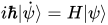
Solving the Schrödinger equation , we obtain the solutions
Using the initial condition

we can solve these equations to obtain

with . We observe that we can choose the initial conditions

which gives a time-independent solution to these equations with no probability of the system being in state .[1] This state can also be expressed in terms of a mixing angle as

with

This means that when the atoms are in this state, they will stay in this state indefinitely. This is a dark state, because it can not absorb or emit any photons from the applied fields. It is, therefore, effectively transparent to the probe laser, even when the laser is exactly resonant with the transition. Spontaneous emission from can result in an atom being in this dark state or another coherent state, known as a bright state. Therefore, in a collection of atoms, over time, decay into the dark state will inevitably result in the system being "trapped" coherently in that state, a phenomenon known as coherent population trapping.

See also

[edit]

References

[edit]
Revisions and contributorsEdit on WikipediaRead on Wikipedia
from Grokipedia
In and , a dark state is a coherent superposition of quantum states—typically ground or long-lived levels—that decouples from the , preventing absorption or emission of photons due to destructive interference and rendering the state optically inactive or "dark." This phenomenon arises in multilevel systems, such as Lambda-type three-level atoms, where the dark state is an eigenstate of the interaction Hamiltonian with zero eigenvalue for the light-matter coupling. First experimentally observed in 1976 by Alzetta et al. during studies of laser-induced resonances in oriented sodium vapor, dark states manifest as narrow, non-absorbing spectral features amid broader absorption lines. Dark states underpin several key quantum optical processes, including coherent population trapping (CPT), where bichromatic fields drive atoms into a stationary, non-radiative superposition, suppressing spontaneous decay and enabling long-lived coherences on the order of seconds. In stimulated Raman adiabatic passage (STIRAP), dark states facilitate robust, loss-free transfer of population between two ground states via adiabatic following of the instantaneous dark eigenstate, with efficiencies exceeding 99% in dilute atomic gases and applications in state-selective chemistry and preparation. These states also play roles in (EIT), where they create transparency windows in opaque media, slowing propagation to group velocities below 1 m/s. Beyond gaseous atoms, dark states have been realized in solid-state platforms, such as quantum dots, where CPT of spins achieves coherence times up to microseconds, advancing processing and spin manipulation. In superconducting circuits and , collective dark states emerge in multi-atom or multi-mode systems, enabling protected quantum memories and enhanced light-matter interfaces resistant to decoherence. Recent theoretical extensions describe dark states in non-Hermitian and dissipative environments, revealing their robustness for topological quantum protection and applications in precision magnetometry and atomic clocks with sensitivities below 1 fT/√Hz.

Fundamentals of Dark States

Definition and Characteristics

In , particularly in the context of atomic and , a dark state is defined as a stationary that does not absorb or emit photons under interaction with specific fields, rendering it undetectable by optical due to decoupling from the radiation field. This decoupling arises from destructive quantum interference among transition pathways or selection rules that prevent to the applied . The concept was first experimentally recognized in the 1970s through observations of reduced in resonance experiments with atomic vapors, marking the initial identification of such non-radiative states. Key characteristics of dark states include their to bright states, which are the complementary quantum states that actively couple to the light field and exhibit oscillatory behavior under resonant driving. Unlike bright states, dark states demonstrate stability against spontaneous decay in the presence of resonant fields, as they contain no population in optically active excited levels, thereby maintaining coherence without radiative losses. This leads to non-radiative coherence, where the system remains trapped in a superposition of ground-state sublevels, invisible to the driving radiation. Dark states are distinct from other quantum states, such as ground states that can absorb under appropriate conditions or bright states that interact dynamically with fields; in contrast, dark states are effectively "invisible" to the applied , preserving their integrity without exchange. This property underpins phenomena like coherent population trapping, where atomic populations are locked into these decoupled configurations.

Quantum Interference Mechanism

The formation of dark states relies on destructive quantum interference between transition amplitudes along multiple excitation pathways, which collectively cancel out the coupling to the and trap atomic population in a coherent superposition of ground states. This interference effect ensures that the net for excitation vanishes, preventing absorption of photons and maintaining the system in a non-radiating configuration. In this decoupled state, the dark state serves as an eigenstate of the interaction Hamiltonian with a zero eigenvalue relative to the field coupling operator, rendering it orthogonal to the fields and immune to their influence. This zero-eigenvalue property isolates the dark state from dissipative processes like , allowing indefinite persistence under coherent illumination. This mechanism introduces a between bright and dark states: bright states, being orthogonal superpositions, exhibit constructive interference that enhances to the field and promotes strong absorption and emission, while dark states remain decoupled due to their destructive interference, effectively "invisible" to the . Achieving this interference requires coherent control through multiple phase-locked fields, such as tuned to create the necessary superposition, often under conditions like to align the pathways precisely.

Dark States in Atomic Systems

Two-Level Systems

In two-level atomic systems, dark states primarily emerge from selection rules that render certain states uncoupled from the incident field, preventing absorption or emission of photons. These systems consist of a and an , often with quantum numbers that dictate allowed transitions via electric selection rules, such as ΔJ = 0, ±1 (with J ≠ 0 to J = 0 forbidden) and parity change. In practice, states may be inaccessible due to energy mismatch, for instance, when a frequency is detuned below for a particular transition, leaving the state dark to excitation. Polarization further enforces darkness; for example, in the , the Zeeman sublevel of the 2²P_{3/2} state with m_J = -1/2 is dark under σ⁺ polarized because the selection rule Δm = +1 prohibits coupling from the sublevels. Metastable states serve as another class of dark states in two-level configurations, characterized by extremely slow decay rates due to forbidden single-photon transitions. A prominent example is the 2S state in , which is metastable with a lifetime of approximately 0.12 seconds because the 2S–1S transition violates electric dipole selection rules (both states have even parity and Δl = 0), decaying instead via a two-photon process. This long-lived nature arises from the absence of allowed single-photon emission pathways, making the state effectively dark to radiative decay in isolation. True dark states formed through quantum interference, where coherent superpositions decouple from the field, are rare in pure two-level systems without additional control fields or levels, as the simple structure lacks the necessary pathways for destructive interference in coupling amplitudes. Instead, darkness often stems from conservation, enforcing selection rules like Δm = 0, ±1 for π and σ polarizations, which leave specific sublevels uncoupled. In experimental contexts, such dark states are observed in resonance experiments, where certain Zeeman sublevels of the ground or excited manifold do not scatter light under linearly or circularly polarized illumination, leading to reduced from those components. For instance, in alkali atoms like , selective pumping with σ-polarized light populates dark sublevels, quenching until a or polarization modulation is applied to access them.

Three-Level Systems

In three-level atomic systems, the lambda (Λ)-type configuration consists of two ground states, denoted as |1⟩ and |2⟩, that are coupled to a common |3⟩ through a weak probe field with Ω_p and a strong coupling field with Ω_c, respectively, with no direct dipole-allowed transition between |1⟩ and |2⟩. This setup is typically realized in atoms like sodium or cesium, where hyperfine levels serve as the ground states and an optical transition populates the . The dark state in this configuration emerges as a coherent superposition |D⟩ = (Ω_c |1⟩ - Ω_p |2⟩)/Ω, where Ω = √(Ω_p² + Ω_c²) is the effective , featuring zero amplitude in the |3⟩ and thus decoupling the system from spontaneous decay and light absorption. This superposition arises from the destructive quantum interference between the excitation pathways driven by the two fields, rendering the state "dark" to the applied . Under resonant bichromatic excitation, coherent (CPT) occurs as the atomic is fully transferred to the dark state |D⟩, suppressing and absorption on the probe transition. First experimentally observed in sodium vapor, CPT manifests as narrow resonances in the absorption , with linewidths limited by ground-state coherence times rather than lifetimes. In contrast, V-type configurations, featuring one ground state coupled to two excited states, and cascade () configurations, with sequential couplings between three levels, can also support dark states through similar interference, but these are generally less stable due to competing decay channels and reduced efficiency compared to the Λ scheme.

Theoretical Frameworks

Mathematical Formulation for Few-Level Systems

In few-level atomic systems, the mathematical description of dark states relies on the quantum mechanical treatment of the atom-light interaction via the Hamiltonian and the resulting of the state amplitudes. For a two-level system consisting of a |g⟩ and an |e⟩ coupled by a resonant field with Ω, the interaction is governed by the simplified Hamiltonian in the rotating frame under the (RWA), H=Ω2(ge+eg),H = \frac{\hbar \Omega}{2} \left( |g\rangle\langle e| + |e\rangle\langle g| \right), leading to coherent Rabi oscillations between the states with period 2π/Ω. However, true dark states in such systems arise not from the coherent dynamics but from selection rules, such as Δm = ±1 for σ-polarized , which leave certain magnetic sublevels (e.g., the stretched sublevel m = J in a transition from a with J under circularly polarized (σ) , which remains uncoupled as there is no excited sublevel with m = J + 1 accessible under the Δm = +1 ) uncoupled and thus optically dark, preventing absorption and enabling accumulation of population in these non-interacting states during . For three-level systems in the Λ configuration, where two ground states |1⟩ and |2⟩ couple to a common excited state |3⟩ via probe (Ω_p) and control (Ω_c) fields with frequencies ω_p and ω_c, the full Hamiltonian is H = H_0 + H_1. The free atomic part is H0=ω111+ω222+ω333,H_0 = \hbar \omega_1 |1\rangle\langle 1| + \hbar \omega_2 |2\rangle\langle 2| + \hbar \omega_3 |3\rangle\langle 3|, and the interaction Hamiltonian in the dipole approximation and semiclassical limit is H1=2(Ωpeiωpt13+Ωceiωct23+h.c.),H_1 = -\frac{\hbar}{2} \left( \Omega_p e^{i \omega_p t} |1\rangle\langle 3| + \Omega_c e^{i \omega_c t} |2\rangle\langle 3| + \text{h.c.} \right), assuming resonant coupling (ω_p ≈ ω_3 - ω_1, ω_c ≈ ω_3 - ω_2). Under the RWA, which neglects rapidly oscillating counter-rotating terms, and transforming to a rotating frame where the state vector is |ψ(t)⟩ = c_1(t) e^{-i \delta_p t} |1⟩ + c_2(t) e^{-i \delta_c t} |2⟩ + c_3(t) |3⟩ (with detunings δ_p = ω_p - (ω_3 - ω_1), δ_c = ω_c - (ω_3 - ω_2)), the time-dependent Schrödinger equation yields the coupled differential equations for the amplitudes: ic1˙=Ωp2c3,ic2˙=Ωc2c3,ic3˙=Ωp2c1eiδpt+Ωc2c2eiδct+δ3c3,i \dot{c_1} = \frac{\Omega_p}{2} c_3, \quad i \dot{c_2} = \frac{\Omega_c}{2} c_3, \quad i \dot{c_3} = \frac{\Omega_p^*}{2} c_1 e^{i \delta_p t} + \frac{\Omega_c^*}{2} c_2 e^{i \delta_c t} + \delta_3 c_3, where δ_3 is the effective detuning for |3⟩; for simplicity, assume δ_p = δ_c = 0 and real Rabi frequencies. In the resonant case, the steady-state solutions reveal a dark state |D⟩ as the zero-eigenvalue eigenstate of the effective non-Hermitian Hamiltonian (incorporating decay if needed, but ideally zero ), given by the coherent superposition |D⟩ = (Ω_c |1⟩ - Ω_p |2⟩)/√(Ω_p² + Ω_c²), or equivalently |D⟩ = cos θ |1⟩ - θ |2⟩, where the mixing θ satisfies tan θ = Ω_p / Ω_c. This state is orthogonal to the bright state |B⟩ = θ |1⟩ + cos θ |2⟩, which couples to |3⟩, and experiences no light-induced transitions due to destructive quantum interference between the probe and control paths. For coherent population trapping (CPT), starting from an initial condition such as population in |1⟩ (c_1(0) = 1, c_2(0) = c_3(0) = 0), the dynamics under continuous illumination drive the toward the dark state: the excited-state amplitude c_3(t) decays to zero as populates the ground manifold, while the population transfers to |D⟩, with |c_1(t)|² → cos² θ and |c_2(t)|² → sin² θ, the population indefinitely in the non-absorbing superposition without further excitation. This trapping efficiency depends on the ratio of Rabi frequencies and initial conditions, highlighting the role of the dark eigenvalue in stabilizing the against dissipation.

Generalization to Multilevel Systems

In multilevel , dark states generalize the concept observed in three-level Λ configurations, where coherent superpositions of multiple ground states become decoupled from the applied fields due to destructive quantum interference. These states are particularly relevant in N-level atoms, often realized in schemes or more complex architectures, allowing for the storage of population in subspaces immune to optical excitation. Unlike the single dark state in a basic Λ system, multilevel dark states form a degenerate manifold that can span multiple orthogonal combinations of the ground-state basis. The general theoretical framework describes dark states as the null space, or kernel, of the coupling matrix that connects ground states to excited states via the driving fields. For a with N total levels driven by M coherent fields coupling to one or more excited states, the dimension of this kernel yields up to N - M dark states, providing a systematic way to identify the decoupled subspace without solving the full time-dependent . This kernel-based approach applies to arbitrary coupling configurations and highlights the role of field polarizations and detunings in shaping the dark manifold. Coherent population trapping emerges as a special instance in such frameworks when the system relaxes into these steady states under continuous illumination. Specific configurations illustrate the utility of multiple dark states. In V-type systems, where a single couples to two , dark states arise from interference between the excited levels, enabling selective addressing. Double-Λ schemes, involving two interleaved Λ systems, support paired dark states for enhanced control over . configurations, with three ground states coupling to a common excited state, feature a two-dimensional dark subspace that facilitates selective between specific ground-state superpositions by tuning field amplitudes. These setups underscore the of dark states for manipulating high-dimensional . Recent theoretical advances have formalized a comprehensive for arbitrary multilevel systems, leveraging destructive interference to predict and engineer these states across diverse coupling topologies. This framework, developed in 2025, emphasizes scalability for applications in complex quantum networks by providing analytical conditions for dark-state existence, such as required degeneracies in the ground manifold. It extends beyond perturbative treatments, offering tools to diagonalize effective Hamiltonians within subspaces and predict transitions in N-level atoms. Decoherence introduces significant challenges in higher-dimensional systems, where environmental noise can lift the degeneracy among multiple dark states, causing mixing between them and gradual population leakage to bright states. In particular, amplitude damping and phase noise lead to dephasing rates that scale with the system's dimensionality, reducing the effective coherence time of the dark manifold and necessitating robust preparation protocols. Such effects are pronounced in configurations with closely spaced dark states, where even weak interactions with phonons or stray fields destabilize the interference conditions.

Applications

Coherent Population Trapping and STIRAP

Coherent population trapping (CPT) is a quantum interference phenomenon observed in three-level Λ-type atomic systems, where two coherent fields, resonant with the transitions from two ground states to a common , drive the system into a coherent superposition known as the dark state. This superposition is orthogonal to the , effectively decoupling the atoms from the optical fields and trapping the population in the ground-state manifold, thereby suppressing and absorption. The effect was first experimentally observed in sodium vapor by Alzetta et al. in 1976, who noted a reduction in due to the formation of non-absorbing states under bichromatic excitation. CPT has become a cornerstone for high-resolution , enabling narrow-linewidth resonances for atomic clocks and magnetometers with linewidths below 1 Hz in alkali vapors. Stimulated Raman adiabatic passage (STIRAP) extends the CPT concept to achieve efficient, coherent between the two ground states in a Λ system without populating the intermediate excited state, thus minimizing losses from spontaneous decay. In STIRAP, the dark state is adiabatically followed by applying the fields in a counter-intuitive sequence: the Stokes (coupling) field precedes the pump (probe) field, with their intensities varying such that the mixing angle θ—defined by tanθ=Ωp/Ωs\tan \theta = \Omega_p / \Omega_s, where Ωp\Omega_p and Ωs\Omega_s are the Rabi frequencies—slowly rotates from 0 to π/2\pi/2. This process, proposed by Gaubatz et al. in 1990 for selective transfer between molecular vibrational levels, relies on the to ensure the system remains in the instantaneous dark eigenstate. Under ideal conditions, STIRAP achieves near 100% efficiency in Λ systems, as demonstrated in atomic and molecular experiments with transfer fidelities exceeding 99% in rubidium and sodium atoms. The technique's robustness against decoherence stems from the adiabaticity condition dθdtΩ\left| \frac{d\theta}{dt} \right| \ll |\Omega|
Add your contribution
Related Hubs
User Avatar
No comments yet.
