Hubbry Logo
Hydrogen atomHydrogen atomMain
Open search
Hydrogen atom
Community hub
Hydrogen atom
logo
8 pages, 0 posts
0 subscribers
Be the first to start a discussion here.
Contribute something
Hydrogen atom
Hydrogen atom
from Wikipedia

Hydrogen atom
General
Symbol1H
Nameshydrogen atom,
protium
Protons (Z)1
Neutrons (N)0
Nuclide data
Natural abundance99.985%
Half-life (t1/2)stable
Isotope mass1.007825 Da
Spin1/2 ħ
Excess energy7288.969±0.001 keV
Binding energy0.000±0.0000 keV
Isotopes of hydrogen
Complete table of nuclides
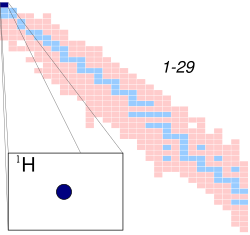
Depiction of a hydrogen atom showing the diameter as about twice the Bohr model radius. (Image not to scale)

A hydrogen atom is an atom of the chemical element hydrogen. The electrically neutral hydrogen atom contains a single positively charged proton in the nucleus, and a single negatively charged electron bound to the nucleus by the Coulomb force. Atomic hydrogen constitutes about 75% of the baryonic mass of the universe.[1]

In everyday life on Earth, isolated hydrogen atoms (called "atomic hydrogen") are extremely rare. Instead, a hydrogen atom tends to combine with other atoms in compounds, or with another hydrogen atom to form ordinary (diatomic) hydrogen gas, H2. "Atomic hydrogen" and "hydrogen atom" in ordinary English use have overlapping, yet distinct, meanings. For example, a water molecule contains two hydrogen atoms, but does not contain atomic hydrogen (which would refer to isolated hydrogen atoms).

Atomic spectroscopy shows that there is a discrete infinite set of states in which a hydrogen (or any) atom can exist, contrary to the predictions of classical physics. Attempts to develop a theoretical understanding of the states of the hydrogen atom have been important to the history of quantum mechanics, since all other atoms can be roughly understood by knowing in detail about this simplest atomic structure.

Isotopes

[edit]

The most abundant isotope, protium (1H), or light hydrogen, contains no neutrons and is simply a proton and an electron. Protium is stable and makes up 99.985% of naturally occurring hydrogen atoms.[2]

Deuterium (2H) contains one neutron and one proton in its nucleus. Deuterium is stable, makes up 0.0156% of naturally occurring hydrogen,[2] and is used in industrial processes like nuclear reactors and nuclear magnetic resonance spectroscopy.

Tritium (3H) contains two neutrons and one proton in its nucleus and is not stable, decaying with a half-life of 12.32 years. Because of its short half-life, tritium does not exist in nature except in trace amounts.

Heavier isotopes of hydrogen are only created artificially in particle accelerators and have half-lives on the order of 10−22 seconds. They are unbound resonances located beyond the neutron drip line; this results in prompt emission of a neutron.

The formulas below are valid for all three isotopes of hydrogen, but slightly different values of the Rydberg constant (correction formula given below) must be used for each hydrogen isotope.

Hydrogen ion

[edit]

Lone neutral hydrogen atoms are rare under normal conditions. However, neutral hydrogen is common when it is covalently bound to another atom, and hydrogen atoms can also exist in cationic and anionic forms.

If a neutral hydrogen atom loses its electron, it becomes a cation. The resulting ion, which consists solely of a proton for the usual isotope, is written as "H+" and sometimes called hydron. Free protons are common in the interstellar medium, and solar wind. In the context of aqueous solutions of classical Brønsted–Lowry acids, such as hydrochloric acid, it is actually hydronium, H3O+, that is meant. Instead of a literal ionized single hydrogen atom being formed, the acid transfers the hydrogen to H2O, forming H3O+.

If instead a hydrogen atom gains a second electron, it becomes an anion. The hydrogen anion is written as "H" and called hydride.

Theoretical analysis

[edit]

The hydrogen atom has special significance in quantum mechanics and quantum field theory as a simple two-body problem physical system which has yielded many simple analytical solutions in closed-form.

Failed classical description

[edit]

Experiments by Ernest Rutherford in 1909 showed the structure of the atom to be a dense, positive nucleus with a tenuous negative charge cloud around it. This immediately raised questions about how such a system could be stable. Classical electromagnetism had shown that any accelerating charge radiates energy, as shown by the Larmor formula. If the electron is assumed to orbit in a perfect circle and radiates energy continuously, the electron would rapidly spiral into the nucleus with a fall time of:[3] where is the Bohr radius and is the classical electron radius. If this were true, all atoms would instantly collapse. However, atoms seem to be stable. Furthermore, the spiral inward would release a smear of electromagnetic frequencies as the orbit got smaller. Instead, atoms were observed to emit only discrete frequencies of radiation. The resolution would lie in the development of quantum mechanics.

Bohr–Sommerfeld model

[edit]

In 1913, Niels Bohr obtained the energy levels and spectral frequencies of the hydrogen atom after making a number of simple assumptions in order to correct the failed classical model. The assumptions included:

  1. Electrons can only be in certain, discrete circular orbits or stationary states, thereby having a discrete set of possible radii and energies.
  2. Electrons do not emit radiation while in one of these stationary states.
  3. An electron can gain or lose energy by jumping from one discrete orbit to another.

Bohr supposed that the electron's angular momentum is quantized with possible values: where and is Planck constant over . He also supposed that the centripetal force which keeps the electron in its orbit is provided by the Coulomb force, and that energy is conserved. Bohr derived the energy of each orbit of the hydrogen atom to be:[4] where is the electron mass, is the electron charge, is the vacuum permittivity, and is the quantum number (now known as the principal quantum number). Bohr's predictions matched experiments measuring the hydrogen spectral series to the first order, giving more confidence to a theory that used quantized values.

For , the value[5] is called the Rydberg unit of energy. It is related to the Rydberg constant of atomic physics by

The exact value of the Rydberg constant assumes that the nucleus is infinitely massive with respect to the electron. For hydrogen-1, hydrogen-2 (deuterium), and hydrogen-3 (tritium) which have finite mass, the constant must be slightly modified to use the reduced mass of the system, rather than simply the mass of the electron. This includes the kinetic energy of the nucleus in the problem, because the total (electron plus nuclear) kinetic energy is equivalent to the kinetic energy of the reduced mass moving with a velocity equal to the electron velocity relative to the nucleus. However, since the nucleus is much heavier than the electron, the electron mass and reduced mass are nearly the same. The Rydberg constant RM for a hydrogen atom (one electron), R is given by where is the mass of the atomic nucleus. For hydrogen-1, the quantity is about 1/1836 (i.e. the electron-to-proton mass ratio). For deuterium and tritium, the ratios are about 1/3670 and 1/5497 respectively. These figures, when added to 1 in the denominator, represent very small corrections in the value of R, and thus only small corrections to all energy levels in corresponding hydrogen isotopes.

There were still problems with Bohr's model:

  1. it failed to predict other spectral details such as fine structure and hyperfine structure
  2. it could only predict energy levels with any accuracy for single–electron atoms (hydrogen-like atoms)
  3. the predicted values were only correct to , where is the fine-structure constant.

Most of these shortcomings were resolved by Arnold Sommerfeld's modification of the Bohr model. Sommerfeld introduced two additional degrees of freedom, allowing an electron to move on an elliptical orbit characterized by its eccentricity and declination with respect to a chosen axis. This introduced two additional quantum numbers, which correspond to the orbital angular momentum and its projection on the chosen axis. Thus the correct multiplicity of states (except for the factor 2 accounting for the yet unknown electron spin) was found. Further, by applying special relativity to the elliptic orbits, Sommerfeld succeeded in deriving the correct expression for the fine structure of hydrogen spectra (which happens to be exactly the same as in the most elaborate Dirac theory). However, some observed phenomena, such as the anomalous Zeeman effect, remained unexplained. These issues were resolved with the full development of quantum mechanics and the Dirac equation. It is often alleged that the Schrödinger equation is superior to the Bohr–Sommerfeld theory in describing hydrogen atom. This is not the case, as most of the results of both approaches coincide or are very close (a remarkable exception is the problem of hydrogen atom in crossed electric and magnetic fields, which cannot be self-consistently solved in the framework of the Bohr–Sommerfeld theory), and in both theories the main shortcomings result from the absence of the electron spin. It was the complete failure of the Bohr–Sommerfeld theory to explain many-electron systems (such as helium atom or hydrogen molecule) which demonstrated its inadequacy in describing quantum phenomena.

Schrödinger equation

[edit]

The Schrödinger equation is the standard quantum-mechanics model; it allows one to calculate the stationary states and also the time evolution of quantum systems. Exact analytical answers are available for the nonrelativistic hydrogen atom. Before we go to present a formal account, here we give an elementary overview.

Given that the hydrogen atom contains a nucleus and an electron, quantum mechanics allows one to predict the probability of finding the electron at any given radial distance . It is given by the square of a mathematical function known as the "wavefunction", which is a solution of the Schrödinger equation. The lowest energy equilibrium state of the hydrogen atom is known as the ground state. The ground state wave function is known as the wavefunction. It is written as:

Here, is the numerical value of the Bohr radius. The probability density of finding the electron at a distance in any radial direction is the squared value of the wavefunction:

The wavefunction is spherically symmetric, and the surface area of a shell at distance is , so the total probability of the electron being in a shell at a distance and thickness is

It turns out that this is a maximum at . That is, the Bohr picture of an electron orbiting the nucleus at radius corresponds to the most probable radius. Actually, there is a finite probability that the electron may be found at any place , with the probability indicated by the square of the wavefunction. Since the probability of finding the electron somewhere in the whole volume is unity, the integral of is unity. Then we say that the wavefunction is properly normalized.

As discussed below, the ground state is also indicated by the quantum numbers . The second lowest energy states, just above the ground state, are given by the quantum numbers , , and . These states all have the same energy and are known as the and states. There is one state: and there are three states:

An electron in the or state is most likely to be found in the second Bohr orbit with energy given by the Bohr formula.

Wavefunction

[edit]

The Hamiltonian of the hydrogen atom is the radial kinetic energy operator plus the Coulomb electrostatic potential energy between the positive proton and the negative electron. Using the time-independent Schrödinger equation, ignoring all spin-coupling interactions and using the reduced mass , the equation is written as:

Expanding the Laplacian in spherical coordinates:

This is a separable, partial differential equation which can be solved in terms of special functions. When the wavefunction is separated as product of functions , , and three independent differential functions appears[6] with A and B being the separation constants:

  • radial:
  • polar:
  • azimuth:

The normalized position wavefunctions, given in spherical coordinates are:

3D illustration of the eigenstate . Electrons in this state are 45% likely to be found within the solid body shown.

where:

  • ,
  • is the reduced Bohr radius, ,
  • is a generalized Laguerre polynomial of degree , and
  • is a spherical harmonic function of degree and order .

Note that the generalized Laguerre polynomials are defined differently by different authors. The usage here is consistent with the definitions used by Messiah,[7] and Mathematica.[8] In other places, the Laguerre polynomial includes a factor of ,[9] or the generalized Laguerre polynomial appearing in the hydrogen wave function is instead.[10]

The quantum numbers can take the following values:

Additionally, these wavefunctions are normalized (i.e., the integral of their modulus square equals 1) and orthogonal: where is the state represented by the wavefunction in Dirac notation, and is the Kronecker delta function.[11]

The wavefunctions in momentum space are related to the wavefunctions in position space through a Fourier transform which, for the bound states, results in[12] where denotes a Gegenbauer polynomial and is in units of .

The solutions to the Schrödinger equation for hydrogen are analytical, giving a simple expression for the hydrogen energy levels and thus the frequencies of the hydrogen spectral lines and fully reproduced the Bohr model and went beyond it. It also yields two other quantum numbers and the shape of the electron's wave function ("orbital") for the various possible quantum-mechanical states, thus explaining the anisotropic character of atomic bonds.

The Schrödinger equation also applies to more complicated atoms and molecules. When there is more than one electron or nucleus the solution is not analytical and either computer calculations are necessary or simplifying assumptions must be made.

Since the Schrödinger equation is only valid for non-relativistic quantum mechanics, the solutions it yields for the hydrogen atom are not entirely correct. The Dirac equation of relativistic quantum theory improves these solutions (see below).

Results of Schrödinger equation

[edit]

The solution of the Schrödinger equation (wave equation) for the hydrogen atom uses the fact that the Coulomb potential produced by the nucleus is isotropic (it is radially symmetric in space and only depends on the distance to the nucleus). Although the resulting energy eigenfunctions (the orbitals) are not necessarily isotropic themselves, their dependence on the angular coordinates follows completely generally from this isotropy of the underlying potential: the eigenstates of the Hamiltonian (that is, the energy eigenstates) can be chosen as simultaneous eigenstates of the angular momentum operator. This corresponds to the fact that angular momentum is conserved in the orbital motion of the electron around the nucleus. Therefore, the energy eigenstates may be classified by two angular momentum quantum numbers, and (both are integers). The angular momentum quantum number determines the magnitude of the angular momentum. The magnetic quantum number determines the projection of the angular momentum on the (arbitrarily chosen) -axis.

In addition to mathematical expressions for total angular momentum and angular momentum projection of wavefunctions, an expression for the radial dependence of the wave functions must be found. It is only here that the details of the Coulomb potential enter (leading to Laguerre polynomials in ). This leads to a third quantum number, the principal quantum number . The principal quantum number in hydrogen is related to the atom's total energy.

Note that the maximum value of the angular momentum quantum number is limited by the principal quantum number: it can run only up to , i.e., .

Due to angular momentum conservation, states of the same but different have the same energy (this holds for all problems with rotational symmetry). In addition, for the hydrogen atom, states of the same but different are also degenerate (i.e., they have the same energy). However, this is a specific property of hydrogen and is no longer true for more complicated atoms which have an (effective) potential differing from the form (due to the presence of the inner electrons shielding the nucleus potential).

Taking into account the spin of the electron adds a last quantum number, the projection of the electron's spin angular momentum along the -axis, which can take on two values. Therefore, any eigenstate of the electron in the hydrogen atom is described fully by four quantum numbers. According to the usual rules of quantum mechanics, the actual state of the electron may be any superposition of these states. This explains also why the choice of -axis for the directional quantization of the angular momentum vector is immaterial: an orbital of given and obtained for another preferred axis can always be represented as a suitable superposition of the various states of different (but same ) that have been obtained for .

Mathematical summary of eigenstates of hydrogen atom

[edit]

In 1928, Paul Dirac found an equation that was fully compatible with special relativity, and (as a consequence) made the wave function a 4-component "Dirac spinor" including "up" and "down" spin components, with both positive and "negative" energy (or matter and antimatter). The solution to this equation gave the following results, more accurate than the Schrödinger solution.

Energy levels
[edit]

The energy levels of hydrogen, including fine structure (excluding Lamb shift and hyperfine structure), are given by the Sommerfeld fine-structure expression:[13] where is the fine-structure constant and is the total angular momentum quantum number, which is equal to , depending on the orientation of the electron spin relative to the orbital angular momentum.[14] This formula represents a small correction to the energy obtained by Bohr and Schrödinger as given above. The factor in square brackets in the last expression is nearly one; the extra term arises from relativistic effects (for details, see #Features going beyond the Schrödinger solution). It is worth noting that this expression was first obtained by A. Sommerfeld in 1916 based on the relativistic version of the old Bohr theory. Sommerfeld has however used different notation for the quantum numbers.

Visualizing the hydrogen electron orbitals

[edit]
Probability densities through the xz-plane for the electron at different quantum numbers (, across top; n, down side; m = 0)

The image to the right shows the first few hydrogen atom orbitals (energy eigenfunctions). These are cross-sections of the probability density that are color-coded (black represents zero density and white represents the highest density). The angular momentum (orbital) quantum number is denoted in each column, using the usual spectroscopic letter code (s means  = 0, p means  = 1, d means  = 2). The main (principal) quantum number n (= 1, 2, 3, ...) is marked to the right of each row. For all pictures the magnetic quantum number m has been set to 0, and the cross-sectional plane is the xz-plane (z is the vertical axis). The probability density in three-dimensional space is obtained by rotating the one shown here around the z-axis.

The "ground state", i.e. the state of lowest energy, in which the electron is usually found, is the first one, the 1s state (principal quantum level n = 1, = 0).

Black lines occur in each but the first orbital: these are the nodes of the wavefunction, i.e. where the probability density is zero. (More precisely, the nodes are spherical harmonics that appear as a result of solving the Schrödinger equation in spherical coordinates.)

The quantum numbers determine the layout of these nodes. There are:[citation needed]

  • total nodes,
  • of which are angular nodes:
    • angular nodes go around the axis (in the xy plane). (The figure above does not show these nodes since it plots cross-sections through the xz-plane.)
    • (the remaining angular nodes) occur on the (vertical) axis.
  • (the remaining non-angular nodes) are radial nodes.

Oscillation of orbitals

[edit]
The oscillation of two orbitals with the same value of m

The frequency of a state in level n is , so in case of a superposition of multiple orbitals, they would oscillate due to the difference in frequency. For example two states, ψ1and ψ2: The wavefunction is given by and the probability function is

The oscillation of two orbitals with different angular momentum numbers

The result is a rotating wavefunction. The movement of electrons and change of quantum states radiates light at a frequency of the cosine.

Features going beyond the Schrödinger solution

[edit]

There are several important effects that are neglected by the Schrödinger equation and which are responsible for certain small but measurable deviations of the real spectral lines from the predicted ones:

  • Although the mean speed of the electron in hydrogen is only 1/137 of the speed of light, many modern experiments are sufficiently precise that a complete theoretical explanation requires a fully relativistic treatment of the problem. A relativistic treatment results in a momentum increase of about 1 part in 37000 for the electron. Since the electron's wavelength is determined by its momentum, orbitals containing higher speed electrons show contraction due to smaller wavelengths.
  • Even when there is no external magnetic field, in the inertial frame of the moving electron, the electromagnetic field of the nucleus has a magnetic component. The spin of the electron has an associated magnetic moment which interacts with this magnetic field. This effect is also explained by special relativity, and it leads to the so-called spin–orbit coupling, i.e., an interaction between the electron's orbital motion around the nucleus, and its spin.

Both of these features (and more) are incorporated in the relativistic Dirac equation, with predictions that come still closer to experiment. Again the Dirac equation may be solved analytically in the special case of a two-body system, such as the hydrogen atom. The resulting solution quantum states now must be classified by the total angular momentum number j (arising through the coupling between electron spin and orbital angular momentum). States of the same j and the same n are still degenerate. Thus, direct analytical solution of Dirac equation predicts 2S(1/2) and 2P(1/2) levels of hydrogen to have exactly the same energy, which is in a contradiction with observations (Lamb–Retherford experiment).

For these developments, it was essential that the solution of the Dirac equation for the hydrogen atom could be worked out exactly, such that any experimentally observed deviation had to be taken seriously as a signal of failure of the theory.

Alternatives to the Schrödinger theory

[edit]

In the language of Heisenberg's matrix mechanics, the hydrogen atom was first solved by Wolfgang Pauli[15] using a rotational symmetry in four dimensions [O(4)-symmetry] generated by the angular momentum and the Laplace–Runge–Lenz vector. By extending the symmetry group O(4) to the dynamical group O(4,2), the entire spectrum and all transitions were embedded in a single irreducible group representation.[16]

In 1979 the (non-relativistic) hydrogen atom was solved for the first time within Feynman's path integral formulation of quantum mechanics by Duru and Kleinert.[17][18] This work greatly extended the range of applicability of Feynman's method.

Further alternative models are Bohm mechanics and the complex Hamilton–Jacobi formulation of quantum mechanics.

See also

[edit]

References

[edit]

Books

[edit]
[edit]
Revisions and contributorsEdit on WikipediaRead on Wikipedia
from Grokipedia
The hydrogen atom is the simplest and most fundamental unit of matter in the chemical elements, defined by an atomic number of 1 and consisting of a single proton in the nucleus bound to a single , with no neutrons in its most common , protium (¹H). This neutral system has a of [1.00784, 1.00811] u, reflecting the dominance of ¹H, which accounts for 99.9885% of natural hydrogen abundance. In quantum mechanics, the hydrogen atom exemplifies an exactly solvable through the time-independent , yielding discrete energy levels that depend solely on the principal quantum number n and explain its characteristic atomic spectrum, including the of visible emission lines. The energy is -13.6 eV, corresponding to the electron's binding in the 1s orbital, while excited states lead to radiative transitions observed in astrophysical and laboratory settings. As the most abundant element, hydrogen comprises about 73.5% of the baryonic mass in the , primarily in atomic and molecular forms within , interstellar gas, and , where it drives processes that power . Recent observations as of 2025 have identified much of the previously unaccounted-for hydrogen as diffuse ionized gas surrounding galaxies. In chemistry, its small size and enable it to form the basis of covalent bonds, hydrides, and acids, while isotopes like (²H) and (³H) extend its applications in nuclear reactions and .

Basic Properties

Isotopes of Hydrogen

The hydrogen atom consists of three primary isotopes, distinguished by the number of neutrons in their nuclei, which significantly influences their nuclear stability and atomic . Protium, denoted as 1H^1\mathrm{H}, is the most abundant isotope, comprising a single proton and no neutrons in its nucleus. It accounts for approximately 99.98% of naturally occurring hydrogen atoms and is stable, with no measurable . As a single-proton nucleus, protium has a of 0 MeV, reflecting the absence of neutron-proton interactions to bind. Deuterium, or 2H^2\mathrm{H} (symbol D), features one proton and one neutron, making it the heaviest stable isotope of hydrogen. Its natural abundance is about 0.0156%, equivalent to one deuterium atom per roughly 6,420 hydrogen atoms in seawater. The nucleus is bound by an energy of 2.224 MeV, providing sufficient stability against dissociation. This doubled nuclear mass compared to protium alters the reduced mass in the hydrogen atom, leading to subtle shifts in atomic energy levels and spectral lines; specifically, deuterium's emission lines appear at slightly higher energies (shorter wavelengths) due to the increased reduced mass, with shifts on the order of 0.04% relative to protium. Tritium, denoted 3H^3\mathrm{H} (symbol T), contains one proton and two neutrons, resulting in a nuclear binding energy of 8.482 MeV, which is higher than that of deuterium but insufficient for long-term stability. It is radioactive, decaying via beta emission to with a half-life of 12.323 years. Tritium occurs only in trace amounts in nature, primarily from interactions, at abundances of approximately 10^{-18} relative to total . The additional neutron increases the nuclear mass threefold over protium, further modifying the reduced mass and causing even smaller spectral shifts compared to deuterium, though its rarity limits observational studies of neutral tritium atoms.
IsotopeSymbolNuclear CompositionNatural Abundance (atom %)StabilityBinding Energy (MeV)
Protium1H^1\mathrm{H}1 proton, 0 neutrons99.98Stable0
Deuterium2H^2\mathrm{H} (D)1 proton, 1 neutron0.0156Stable2.224
Tritium3H^3\mathrm{H} (T)1 proton, 2 neutrons≈ 10^{-16}Radioactive (half-life 12.323 y)8.482

Hydrogen Ion

The , denoted as H⁺, is the simplest atomic , consisting solely of a single proton with no bound electrons. This bare nucleus carries a +1 and has a mass of approximately 1.00784 atomic mass units. In , H⁺ represents the fully ionized state of the hydrogen atom, exhibiting high reactivity due to its positive charge and lack of electronic shielding. The H⁺ ion forms through the of a neutral atom, where the single is removed, requiring an of 13.59844 eV. This process is endothermic and occurs in high-energy environments such as plasmas or stellar atmospheres, making H⁺ prevalent in astrophysical contexts like the . Historically, the proton's identity as the was confirmed by in through experiments bombarding gas with alpha particles from , which produced hydrogen nuclei identifiable by their scintillation tracks; Rutherford named this particle the "proton" in a seminal paper published that year. In chemical contexts, particularly aqueous solutions, the bare H⁺ ion is unstable and rapidly associates with water molecules to form the hydronium ion, H₃O⁺, which serves as the solvated . This species results from of (H₂O + H⁺ → H₃O⁺) and is the active form in acid-base chemistry, influencing and facilitating reactions like . The hydronium ion's stability arises from hydrogen bonding in solution, preventing the bare proton's high mobility and reactivity. Isotopic variants of the hydrogen ion, such as the deuteron D⁺ (from ) or triton T⁺ (from ), exhibit behavioral differences primarily due to mass effects on reactivity. For instance, D⁺, with twice the mass of H⁺, experiences kinetic isotope effects in proton-transfer reactions, leading to slower reaction rates and altered in electrochemical processes compared to H⁺. These differences parallel those observed in neutral isotopes, where heavier nuclei influence vibrational frequencies and bond strengths.

Historical Models

Classical Electromagnetic Description

Prior to the development of nuclear models, J. J. Thomson proposed in 1904 that the atom consisted of a uniform sphere of positive charge with embedded s, akin to plums in a pudding, to maintain overall neutrality. This "plum pudding" model accounted for the discovery of the but failed to explain experiments. In 1911, Ernest Rutherford's gold foil experiments revealed that alpha particles were deflected at large angles, indicating a tiny, dense, positively charged nucleus at the atom's center surrounded by orbiting s, forming a planetary model of the atom. In this classical , the hydrogen atom features a single in a around the proton nucleus, analogous to a miniature solar system governed by Newtonian mechanics and . However, the centripetal of the orbiting implies it should radiate electromagnetic energy continuously, as any accelerating charge does according to classical electrodynamics. The quantifies this radiated power for a non-relativistic point charge: P=23e2a2c3P = \frac{2}{3} \frac{e^2 a^2}{c^3} in cgs units, where ee is the electron charge, aa is the , and cc is the . This energy loss causes the orbit to spiral inward, leading to the electron's collapse onto the nucleus in approximately 101110^{-11} seconds, rendering the model unstable and incompatible with the observed persistence of atoms. Classical theory also struggled to explain the discrete spectral lines of hydrogen observed by Johann Balmer in , such as the visible series fitting an relating wavelengths to integers. In the continuous orbital model, electron transitions would produce a continuum of frequencies rather than discrete lines, highlighting the inadequacy of purely without additional constraints. These shortcomings prompted the search for quantized descriptions to stabilize the atom and account for spectra.

Bohr-Sommerfeld Model

In 1913, proposed a semi-classical model for the hydrogen atom that incorporated quantum ideas to address the classical electromagnetic paradoxes, such as the instability of orbits predicted by Rutherford's nuclear model. In this model, the is assumed to move in stable circular orbits around the proton, with the key postulate that the LL is quantized in discrete units: L=nL = n \hbar, where nn is a positive known as the principal and =h/2π\hbar = h / 2\pi is the reduced Planck's constant. The orbital radius and energy derive from balancing the classical required for against the attraction between the and proton. The centripetal force equation is mv2r=ke2r2\frac{m v^2}{r} = \frac{k e^2}{r^2}, where mm is the , vv is its speed, rr is the radius, ee is the , and k=1/(4πϵ0)k = 1/(4\pi\epsilon_0) is Coulomb's constant. Combining this with the quantization condition mvr=nm v r = n \hbar yields the for the (n=1n=1) as approximately 0.529 Å and discrete energy levels given by En=13.6eVn2,E_n = -\frac{13.6 \, \mathrm{eV}}{n^2}, which accurately match the observed lines of upon transitions between levels. In 1916, Arnold Sommerfeld extended Bohr's model to allow for elliptical orbits, generalizing the quantization by applying action-angle variables from classical mechanics. This introduced a second quantum condition on the radial action integral, leading to an additional azimuthal quantum number kk (ranging from 1 to nn) that determines the eccentricity of the ellipse, with circular orbits corresponding to k=nk = n. Sommerfeld also incorporated special relativistic corrections, accounting for the variation in electron speed along the elliptical path, which causes the orbit to precess and splits the energy levels into fine structure components. This qualitative explanation of the fine structure—small deviations in spectral line positions—provided better agreement with experimental hydrogen spectra than Bohr's original circular-orbit assumption. Despite these advances, the Bohr-Sommerfeld model has significant limitations, as it relies on quantization rules without incorporating the wave nature of and fails to describe atoms with more than one due to unaccounted inter-electron interactions.

Quantum Mechanical Treatment

Schrödinger Equation Formulation

The quantum mechanical description of the hydrogen atom begins with the non-relativistic of a proton and an interacting via the potential. To simplify this, the system is transformed into an equivalent one-body problem using the center-of-mass frame, where the relative motion is governed by the μ=mempme+mp\mu = \frac{m_e m_p}{m_e + m_p}, with mem_e the and mpm_p the proton mass; since mpmem_p \gg m_e, μme\mu \approx m_e to a high degree of accuracy. The Hamiltonian for this effective one-body system is H=p22μe24πϵ0rH = \frac{\mathbf{p}^2}{2\mu} - \frac{e^2}{4\pi\epsilon_0 r}, where p\mathbf{p} is the , r=rr = |\mathbf{r}| is the radial distance between the particles, ee is the , and ϵ0\epsilon_0 is the ; this form captures the of the reduced particle and the attractive potential. The time-independent is then Hψ(r)=Eψ(r)H \psi(\mathbf{r}) = E \psi(\mathbf{r}), where ψ(r)\psi(\mathbf{r}) is the wave function and EE is the eigenvalue, providing the foundation for finding stationary states of the atom. Given the spherical symmetry of the Coulomb potential, the equation is solved in spherical coordinates (r,θ,ϕ)(r, \theta, \phi), where the wave function separates as ψ(r,θ,ϕ)=R(r)Y(θ,ϕ)\psi(r, \theta, \phi) = R(r) Y(\theta, \phi), with R(r)R(r) the radial part and Y(θ,ϕ)Y(\theta, \phi) the angular part. The Laplacian operator in spherical coordinates is 2=1r2r(r2r)+1r2sinθθ(sinθθ)+1r2sin2θ2ϕ2\nabla^2 = \frac{1}{r^2} \frac{\partial}{\partial r} \left( r^2 \frac{\partial}{\partial r} \right) + \frac{1}{r^2 \sin \theta} \frac{\partial}{\partial \theta} \left( \sin \theta \frac{\partial}{\partial \theta} \right) + \frac{1}{r^2 \sin^2 \theta} \frac{\partial^2}{\partial \phi^2}, leading to the separated radial equation involving d2Rdr2+2rdRdr\frac{d^2 R}{dr^2} + \frac{2}{r} \frac{dR}{dr} and the angular equation. The angular part corresponds to the operators for total L2Y=(+1)2YL^2 Y = \ell(\ell+1) \hbar^2 Y and z-component LzY=mYL_z Y = m \hbar Y, where \ell and mm are quantum numbers, with Y(θ,ϕ)Y(\theta, \phi) expressed as ; this separation exploits the commutativity of L2L^2 and LzL_z with the Hamiltonian. For bound states, the energy E<0E < 0 ensures square-integrable wave functions that vanish as rr \to \infty, imposing quantization through boundary conditions on the radial function, such as R(r)0R(r) \to 0 as r0r \to 0 and exponential decay at large rr.

Wavefunctions and Quantum Numbers

The solutions to the time-independent Schrödinger equation for the hydrogen atom are stationary states described by wavefunctions ψ_{n l m_l}(r, θ, φ) that depend on three spatial quantum numbers: the principal quantum number n = 1, 2, 3, ..., which determines the size and energy scale of the orbital; the orbital angular momentum quantum number l = 0, 1, ..., n-1, which specifies the orbital's angular momentum magnitude; and the magnetic quantum number m_l = -l, -l+1, ..., l, which describes the projection of the angular momentum along a chosen axis. Additionally, the electron's intrinsic spin introduces a fourth quantum number m_s = ±1/2, though it does not appear in the non-relativistic Schrödinger equation for the orbital wavefunction. These quantum numbers arise naturally from the separation of variables in spherical coordinates, ensuring the wavefunctions form a complete, orthonormal basis for the Hilbert space of the system. The angular dependence of the wavefunction is given by the spherical harmonics Y_{l}^{m_l}(θ, φ), which are eigenfunctions of the angular momentum operators and satisfy the associated differential equations on the unit sphere. These functions are complex-valued, with |Y_{l}^{m_l}|^2 providing the angular probability distribution, and they are normalized such that ∫ |Y_{l}^{m_l}|^2 dΩ = 1 over the solid angle dΩ = sinθ dθ dφ. The spherical harmonics encode the quantum mechanical analogs of classical orbital shapes, with l=0 corresponding to s-orbitals (spherically symmetric) and higher l to p, d, etc., orbitals. The radial part R_{n l}(r) of the wavefunction solves the radial Schrödinger equation and takes the form R_{n l}(r) = N e^{-ρ/2} ρ^l L_{n-l-1}^{2l+1}(ρ), where ρ = 2r/(n a_0), N is a normalization constant, a_0 is the (approximately 0.529 Å), and L_k^α(ρ) are associated , which are polynomial solutions to the Laguerre differential equation ensuring finite behavior at the origin and exponential decay at infinity. For the ground state (n=1, l=0, m_l=0), the full wavefunction simplifies to ψ_{100}(r) = \frac{1}{\sqrt{\pi a_0^3}} e^{-r/a_0}, which is spherically symmetric and peaks at the . This explicit form was derived by solving the separated equations, confirming the wavefunction's normalization ∫ |ψ|^2 dV = 1 over all space. The hydrogen wavefunctions satisfy orthogonality relations: ∫ ψ_{n l m_l}^* ψ_{n' l' m_l'} dV = δ_{n n'} δ_{l l'} δ_{m_l m_l'}, where δ are , allowing them to serve as basis functions for expanding arbitrary states. This orthogonality stems from the self-adjoint nature of the Hamiltonian and the boundary conditions of the problem. According to the , the square modulus |ψ_{n l m_l}|^2 represents the probability density for finding the electron in a volume element dV, providing a statistical description of the electron's position rather than a classical trajectory.

Energy Levels and Eigenstates

The energy levels of the hydrogen atom, derived from the time-independent Schrödinger equation, are discrete and labeled by the principal quantum number n=1,2,3,n = 1, 2, 3, \dots. These bound states have energies given by En=μe4(4πϵ0)222n2,E_n = -\frac{\mu e^4}{(4\pi \epsilon_0)^2 2 \hbar^2 n^2}, where μ\mu is the reduced mass of the electron-proton system, ee is the elementary charge, ϵ0\epsilon_0 is the vacuum permittivity, and \hbar is the reduced Planck's constant. This formula arises from separating the Schrödinger equation in spherical coordinates and solving the radial equation, yielding eigenvalues independent of the orbital angular momentum quantum number ll and the magnetic quantum number mlm_l. For hydrogen-1 (protium), the proton mass greatly exceeds the electron mass, so μme\mu \approx m_e, the electron mass. In this infinite nuclear mass approximation, the energies simplify to En13.598eV/n2E_n \approx -13.598 \, \text{eV} / n^2, with the ground state (n=1n=1) at approximately 13.6eV-13.6 \, \text{eV}. The negative sign indicates bound states below the ionization threshold at E=0E=0. This level structure explains the stability of the atom and the quantized nature of its excitation energies. The independence of EnE_n from ll (where 0l<n0 \leq l < n) and mlm_l (lmll-l \leq m_l \leq l) results in accidental degeneracy: each energy level nn accommodates n2n^2 distinct eigenstates, corresponding to all possible combinations of ll and mlm_l. These eigenstates are the familiar hydrogenic wavefunctions ψnlml(r,θ,ϕ)\psi_{n l m_l}(r, \theta, \phi), which define the spatial probability distributions for the electron. The spectroscopic implications of these levels are profound, as transitions between them produce the characteristic emission and absorption lines in the hydrogen spectrum. In the electric dipole approximation, the dominant transitions obey selection rules Δl=±1\Delta l = \pm 1 and Δml=0,±1\Delta m_l = 0, \pm 1, derived from the nonzero matrix elements of the dipole operator r\mathbf{r} between states of opposite parity. These rules dictate allowed radiative decays, with forbidden transitions (Δl=0,±2\Delta l = 0, \pm 2) occurring at much weaker rates via higher-order multipoles. The wavelengths of allowed transitions follow the Rydberg formula: 1λ=R(1n121n22),\frac{1}{\lambda} = R_\infty \left( \frac{1}{n_1^2} - \frac{1}{n_2^2} \right), where n2>n1n_2 > n_1 are the upper and lower principal quantum numbers, and R=10973731.568160(21)m1R_\infty = 10\,973\,731.568\,160(21) \, \text{m}^{-1} is the Rydberg constant for infinite nuclear mass (CODATA 2018). This empirical formula, originally proposed for series in alkali spectra and confirmed for hydrogen, groups transitions into named spectral series based on n1n_1: the Lyman series (n1=1n_1=1, ultraviolet, discovered 1906), Balmer series (n1=2n_1=2, visible, discovered 1885), and Paschen series (n1=3n_1=3, infrared, discovered 1908). For example, the Balmer-alpha line (n2=3n1=2n_2=3 \to n_1=2) appears at 656.3 nm, a prominent red line in stellar spectra. Isotope effects introduce subtle shifts in these levels and spectra due to variations in the μ=meM/(me+M)\mu = m_e M / (m_e + M), where MM is the nuclear mass. For (2^2H, M2mpM \approx 2 m_p), μ\mu is slightly larger than for protium (1^1H), leading to energy levels deeper by about 0.05% and corresponding blue-shifts in spectral lines (e.g., ~2.19 cm⁻¹ for Balmer-alpha). These shifts, first theoretically anticipated in the reduced-mass correction and experimentally verified in following deuterium's discovery, enable precise measurements and distinguish isotopic signatures in astrophysical observations.

Orbital Visualization

The shapes of hydrogen atom orbitals are determined by the angular part of the wavefunction and reflect the quantum mechanical of the . The s orbitals (l = 0) are spherically symmetric, with distributed evenly around the nucleus in a ball-like form that decreases radially outward. The p orbitals (l = 1) exhibit a , consisting of two lobes separated by a nodal plane through the nucleus, oriented along the x, y, or z axes depending on the m_l. Higher orbitals, such as d (l = 2), display more intricate cloverleaf or double- configurations with additional nodal planes, illustrating the increasing complexity as l increases. Nodal structures further characterize these orbitals, where nodes are regions of zero electron probability density. The number of radial nodes, which are spherical surfaces where the radial wavefunction vanishes, is given by nl1n - l - 1, with n as the quantum number and l the . The number of angular nodes, corresponding to conical or planar surfaces due to the , equals l. For example, the 1s orbital (n=1, l=0) has no nodes, resulting in a smooth spherical ; the 2p orbital (n=2, l=1) has one angular node (a plane) and no radial nodes; while the 3d orbital (n=3, l=2) has two angular nodes and no radial nodes. These nodes arise from the oscillatory nature of the solutions to the radial and angular Schrödinger equations. Boundary surface plots provide a common visualization tool, typically depicting isosurfaces that enclose a specified probability, such as 90% of the total , to represent the orbital's extent. For the 1s orbital, cross-sections reveal an of probability from the nucleus, with no nodes interrupting the smooth distribution. In contrast, a cross-section of the 2p_z orbital along the z-axis shows two lobes separated by a nodal plane at the nucleus, with peaking away from the origin due to the angular dependence. These plots emphasize the volume where the is most likely found, rather than precise paths. Orbital visualizations represent time-averaged probability densities, |\psi|^2, integrated over all time, rather than instantaneous positions or classical trajectories, as the electron does not follow definite paths in . This averaging highlights the stationary nature of the states, where the remains constant despite the underlying wavefunction's phase evolution. For orbitals with l > 0, the non-zero probability density near the nucleus, despite the classical centrifugal barrier, is interpreted as quantum tunneling, allowing the electron to penetrate regions forbidden in a semiclassical picture.

Extensions and Alternatives

Relativistic Effects and Fine Structure

The non-relativistic for the hydrogen atom predicts energy levels that depend solely on the principal nn, resulting in degeneracies for states with the same nn but different orbital quantum numbers \ell. Observations of the hydrogen spectrum, however, reveal small splittings within these levels, collectively known as the , which arise from relativistic effects and electron spin. These corrections are of order α2\alpha^2 times the gross energies, where α1/137\alpha \approx 1/137 is the , defined as α=e2/(4πϵ0c)\alpha = e^2 / (4\pi \epsilon_0 \hbar c). The provides the fundamental relativistic framework for describing the in the hydrogen atom's potential V(r)=e2/(4πϵ0r)V(r) = -e^2 / (4\pi \epsilon_0 r). This first-order relativistic , iψ/t=[cαp+βmec2+V(r)]ψi \hbar \partial \psi / \partial t = [c \vec{\alpha} \cdot \vec{p} + \beta m_e c^2 + V(r)] \psi
Add your contribution
Related Hubs
Contribute something
User Avatar
No comments yet.