Hubbry Logo
Diffusion-controlled reactionDiffusion-controlled reactionMain
Open search
Diffusion-controlled reaction
Community hub
Diffusion-controlled reaction
logo
7 pages, 0 posts
0 subscribers
Be the first to start a discussion here.
Diffusion-controlled reaction
from Wikipedia

Diffusion-controlled (or diffusion-limited) reactions are reactions in which the reaction rate is equal to the rate of transport of the reactants through the reaction medium (usually a solution).[1] The process of chemical reaction can be considered as involving the diffusion of reactants until they encounter each other in the right stoichiometry and form an activated complex which can form the product species. The observed rate of chemical reactions is, generally speaking, the rate of the slowest or "rate determining" step. In diffusion controlled reactions the formation of products from the activated complex is much faster than the diffusion of reactants and thus the rate is governed by collision frequency.

Diffusion control is rare in the gas phase, where rates of diffusion of molecules are generally very high. Diffusion control is more likely in solution where diffusion of reactants is slower due to the greater number of collisions with solvent molecules. Reactions where the activated complex forms easily and the products form rapidly are most likely to be limited by diffusion control. Examples are those involving catalysis and enzymatic reactions. Heterogeneous reactions where reactants are in different phases are also candidates for diffusion control.

One classical test for diffusion control of a heterogeneous reaction is to observe whether the rate of reaction is affected by stirring or agitation; if so then the reaction is almost certainly diffusion controlled under those conditions.

Derivation

[edit]

The following derivation is adapted from Foundations of Chemical Kinetics.[2] This derivation assumes the reaction . Consider a sphere of radius , centered at a spherical molecule A, with reactant B flowing in and out of it. A reaction is considered to occur if molecules A and B touch, that is, when the distance between the two molecules is apart.

If we assume a local steady state, then the rate at which B reaches is the limiting factor and balances the reaction.

Therefore, the steady state condition becomes

1.

where

is the flux of B, as given by Fick's law of diffusion,

2. ,

where is the diffusion coefficient and can be obtained by the Stokes-Einstein equation, and the second term is the gradient of the chemical potential with respect to position. Note that [B] refers to the average concentration of B in the solution, while [B](r) is the "local concentration" of B at position r.


Inserting 2 into 1 results in

3. .

It is convenient at this point to use the identity allowing us to rewrite 3 as


4. .

Rearranging 4 allows us to write

5.

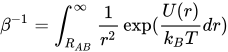
Using the boundary conditions that , ie the local concentration of B approaches that of the solution at large distances, and consequently , as , we can solve 5 by separation of variables, we get

6. or

7. (where : )

For the reaction between A and B, there is an inherent reaction constant , so . Substituting this into 7 and rearranging yields

8.

Limiting conditions

[edit]

Very fast intrinsic reaction

[edit]

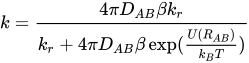
Suppose is very large compared to the diffusion process, so A and B react immediately. This is the classic diffusion limited reaction, and the corresponding diffusion limited rate constant, can be obtained from 8 as . 8 can then be re-written as the "diffusion influenced rate constant" as

9.
Weak intermolecular forces

[edit]

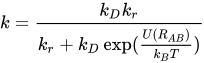
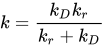
If the forces that bind A and B together are weak, ie for all r except very small r, . The reaction rate 9 simplifies even further to

10. This equation is true for a very large proportion of industrially relevant reactions in solution.
Viscosity dependence

[edit]

The Stokes-Einstein equation describes a frictional force on a sphere of diameter as where is the viscosity of the solution. Inserting this into 9 gives an estimate for as , where R is the gas constant, and is given in centipoise. For the following molecules, an estimate for is given:
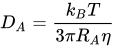
Solvents and
Solvent Viscosity (centipoise)
n-Pentane 0.24 27
Hexadecane 3.34 1.9
Methanol 0.55 11.8
Water 0.89 7.42
Toluene 0.59 11

[3]

See also

[edit]

References

[edit]
Revisions and contributorsEdit on WikipediaRead on Wikipedia
from Grokipedia
A diffusion-controlled reaction, also known as a diffusion-limited reaction, is a chemical process in which the overall rate is determined by the speed at which reactant molecules or particles diffuse through a medium, such as a or gas, to encounter each other or a reaction site, rather than by the intrinsic of the activation barrier. This limitation arises when the reaction probability upon encounter is near unity, making transport the bottleneck, and is described by the derived from Fick's laws, where the JJ of is proportional to the concentration : J=DdCdxJ = -D \frac{dC}{dx}, with DD as the diffusion . The theoretical foundation of diffusion-controlled reactions was established by in 1917, who modeled the of colloidal particles using and the , introducing boundary conditions that set the for irreversible encounters as kD=4π(DA+DB)(RA+RB)k_D = 4\pi (D_A + D_B) (R_A + R_B), where DAD_A and DBD_B are diffusion coefficients and RAR_A and RBR_B are radii of the reactants. This Smoluchowski rate constant highlights the dependence on molecular sizes, relative diffusion, and medium properties like η\eta, often quantified via the Stokes-Einstein relation D=kT6πηaD = \frac{kT}{6\pi \eta a}, where kk is Boltzmann's constant, TT is temperature, and aa is the particle radius. Subsequent developments, such as Collins and Kimball's 1949 extension with radiation boundary conditions, accounted for finite reaction probabilities at contact, broadening applicability to partially diffusion-influenced cases. These reactions are ubiquitous in fields like , biochemistry, and , with examples including bimolecular associations in solution, enzymatic where substrate diffusion to the limits turnover, and ligand-protein binding in biological systems. In viscous or crowded environments, such as cellular interiors, diffusion control can significantly reduce effective rates compared to gas-phase predictions, influencing processes like oxygen capture in lungs or . The diffusion coefficient typically ranges from 10910^{-9} m²/s for small ions in to 101110^{-11} m²/s for large biomolecules, underscoring the scale-dependent nature of these limitations.

Fundamentals

Definition

A diffusion-controlled reaction, also known as a diffusion-limited reaction, is a chemical process in which the overall rate is determined by the rate at which reactant molecules approach and collide through diffusion in the medium, rather than by the intrinsic kinetics of the reaction following the encounter. In these reactions, the activation energy barrier is sufficiently low that a reactive collision occurs nearly every time the reactants come within a critical encounter distance, making molecular transport the rate-limiting step. This contrasts with kinetically controlled reactions, where the rate is governed primarily by the energy required to surmount the reaction barrier after collision. The concept originates from early 20th-century work on colloidal systems, first conceptualized by Marian Smoluchowski in 1916 to describe coagulation processes driven by diffusive encounters between particles. Smoluchowski's approach was later adapted to chemical kinetics by Peter Debye in 1942, who applied it to ionic reactions in solution, emphasizing the role of diffusion in determining reaction rates under electrostatic influences. In diffusion-controlled regimes, bimolecular rate constants typically reach the theoretical upper limit of approximately 10910^9 to 101010^{10} M1^{-1}s1^{-1} in aqueous solutions at room temperature, reflecting the speed of diffusive collisions for small molecules. The underlying mechanism relies on , which provide the foundational description of reactant transport: Fick's first law states that the diffusive is proportional to the concentration , while law governs how concentrations evolve over time due to this . These laws underpin the Smoluchowski model, which treats reactant encounters as a steady-state diffusion problem to the reactive boundary.

Key Characteristics

Diffusion-controlled reactions are characterized by experimental signatures that distinguish them from kinetically controlled processes, primarily through the dominance of reactant over intrinsic reaction barriers. A key indicator is the weak dependence of the rate constant above a threshold where limits the process; here, the apparent approximates that of (typically 4–6 kcal/mol), leading to minimal increase in rate with rising , unlike activation-controlled reactions with higher barriers (15–30 kcal/mol). Another hallmark is the linear dependence of the bimolecular rate constant on the coefficients of the reactants, as the encounter rate scales directly with molecular mobility. Additionally, at high reactant concentrations, the observed may saturate due to depletion zones forming around reactive sites, limiting further encounters despite excess availability. These reactions apply mainly to bimolecular processes in solution, where isotropic prevails and reactants are modeled with spherical to simplify transport calculations. This framework assumes uniform random walks without directional biases, valid for dilute solutions of small molecules or ions. Quantitative metrics further aid identification: in aqueous media at , rate constants exceeding 109M1s110^9 \, \mathrm{M}^{-1} \mathrm{s}^{-1} signal diffusion limitation, while in more viscous solvents, the threshold drops proportionally (e.g., to 108M1s110^8 \, \mathrm{M}^{-1} \mathrm{s}^{-1} or lower in ). A common misconception is that all rapid reactions are inherently diffusion-controlled; high rates alone do not suffice, as verification requires probing transport influences, such as inverse proportionality to solvent or reduced rates in deuterated solvents due to higher and altered . These tests confirm diffusion dominance without conflating it with fast intrinsic kinetics.

Theoretical Framework

Smoluchowski Model

The Smoluchowski model, originally developed in as part of a theory on the of colloidal particles, serves as the cornerstone for analyzing -controlled reactions by modeling the encounters between diffusing reactant spheres. In this framework, the reactants are idealized as rigid spheres that undergo an irreversible reaction immediately upon contact, with the contact defined by a critical encounter radius RR equal to the sum of the effective radii of the two species. This approach shifts the focus from intrinsic to the transport-limited process governed by Brownian , treating the reaction rate as proportional to the frequency of such diffusive collisions. Central to the model are its simplifying physical assumptions, which enable a tractable mathematical treatment. is assumed to occur under steady-state conditions in three-dimensional isotropic space, with no external forces or barriers impeding the approach of reactants. Additionally, the reaction is taken to be perfectly efficient, meaning the probability of reaction upon reaching the encounter distance RR is exactly unity, thus eliminating any role for energies or orientation dependencies. These idealizations hold best for fast, barrierless processes in dilute solutions where dominates over other mechanisms. The theoretical foundation involves solving a for the steady-state concentration profile c(r)c(r) of one diffusing around a fixed central of the other, under the continuum approximation of Fick's laws. The governing equation is the Laplace equation for steady-state : 2c=0\nabla^2 c = 0 with boundary conditions specifying an absorbing surface at the reaction radius, c(R)=0c(R) = 0, and the undisturbed bulk concentration at infinity, c()=c0c(\infty) = c_0, where c0c_0 represents the far-field concentration. This setup captures the depletion of concentration near the reactive site due to absorption, reflecting the ongoing removal of reactants upon encounter. The encounter rate in the model is quantified through the interpretation of the diffusive flux across the boundary surface. The flux J=Dc\mathbf{J} = -D \nabla c, where DD is the relative diffusion coefficient of the pair, points radially inward at r=Rr = R and determines the net rate at which molecules arrive and react at the absorbing . Integrating this flux over the surface provides the total number of encounters per unit time, establishing the diffusion-limited under the model's assumptions.

Derivation of Rate Constant

In the steady-state limit for a diffusion-controlled reaction, the concentration profile c(r)c(\mathbf{r}) of reactant molecules around a spherical (e.g., a fixed reactant particle of radius RR) satisfies 2c=0\nabla^2 c = 0 under radial , assuming no potential interactions. The boundary conditions are c(r)=c0c(r \to \infty) = c_0 (bulk concentration) and c(R)=0c(R) = 0 (perfect absorption at the reaction surface). The general solution to Laplace's equation in spherical coordinates for radial dependence is c(r)=A+Brc(r) = A + \frac{B}{r}. Applying the boundary conditions yields A=c0A = c_0 and B=c0RB = -c_0 R, so the concentration profile is c(r)=c0(1Rr).c(r) = c_0 \left(1 - \frac{R}{r}\right). The gradient is dcdr=c0Rr2\frac{dc}{dr} = c_0 \frac{R}{r^2}, which at r=Rr = R gives dcdrr=R=c0R\frac{dc}{dr} \big|_{r=R} = \frac{c_0}{R}
Add your contribution
Related Hubs
User Avatar
No comments yet.