
Hubbry Logo
Direct stiffness methodDirect stiffness methodMain
Open search
Direct stiffness method
Community hub
Direct stiffness method
logo
7 pages, 0 posts
0 subscribers
Be the first to start a discussion here.
Direct stiffness method
from Wikipedia

In structural engineering, the direct stiffness method, also known as the matrix stiffness method, is a structural analysis technique particularly suited for computer-automated analysis of complex structures including the statically indeterminate type. It is a matrix method that makes use of the members' stiffness relations for computing member forces and displacements in structures. The direct stiffness method is the most common implementation of the finite element method (FEM). In applying the method, the system must be modeled as a set of simpler, idealized elements interconnected at the nodes. The material stiffness properties of these elements are then, through linear algebra, compiled into a single matrix equation which governs the behaviour of the entire idealized structure. The structure’s unknown displacements and forces can then be determined by solving this equation. The direct stiffness method forms the basis for most finite element software.

The direct stiffness method originated in the field of aerospace. Researchers looked at various approaches for analysis of complex airplane frames. These included elasticity theory, energy principles in structural mechanics, flexibility method and matrix stiffness method. It was through analysis of these methods that the direct stiffness method emerged as an efficient method ideally suited for computer implementation.

History

[edit]

Between 1934 and 1938 A. R. Collar and W. J. Duncan published the first papers with the representation and terminology for matrix systems that are used today. Aeroelastic research continued through World War II but publication restrictions from 1938 to 1947 make this work difficult to trace. The second major breakthrough in matrix structural analysis occurred through 1954 and 1955 when professor John H. Argyris systemized the concept of assembling elemental components of a structure into a system of equations. Finally, on Nov. 6 1959, M. J. Turner, head of Boeing’s Structural Dynamics Unit, published a paper outlining the direct stiffness method as an efficient model for computer implementation (Felippa 2001).

Member stiffness relations

[edit]

A typical member stiffness relation has the following general form:

where

m = member number m.
= vector of member's characteristic forces, which are unknown internal forces.
= member stiffness matrix which characterizes the member's resistance against deformations.
= vector of member's characteristic displacements or deformations.
= vector of member's characteristic forces caused by external effects (such as known forces and temperature changes) applied to the member while .

If are member deformations rather than absolute displacements, then are independent member forces, and in such case (1) can be inverted to yield the so-called member flexibility matrix, which is used in the flexibility method.

System stiffness relation

[edit]

For a system with many members interconnected at points called nodes, the members' stiffness relations such as Eq.(1) can be integrated by making use of the following observations:

  • The member deformations can be expressed in terms of system nodal displacements r in order to ensure compatibility between members. This implies that r will be the primary unknowns.
  • The member forces help to the keep the nodes in equilibrium under the nodal forces R. This implies that the right-hand-side of (1) will be integrated into the right-hand-side of the following nodal equilibrium equations for the entire system:

where

= vector of nodal forces, representing external forces applied to the system's nodes.
= system stiffness matrix, which is established by assembling the members' stiffness matrices .
= vector of system's nodal displacements that can define all possible deformed configurations of the system subject to arbitrary nodal forces R.
= vector of equivalent nodal forces, representing all external effects other than the nodal forces which are already included in the preceding nodal force vector R. This vector is established by assembling the members' .

Solution

[edit]

The system stiffness matrix K is square since the vectors R and r have the same size. In addition, it is symmetric because is symmetric. Once the supports' constraints are accounted for in (2), the nodal displacements are found by solving the system of linear equations (2), symbolically:

Subsequently, the members' characteristic forces may be found from Eq.(1) where can be found from r by compatibility consideration.

The direct stiffness method

[edit]

It is common to have Eq.(1) in a form where and are, respectively, the member-end displacements and forces matching in direction with r and R. In such case, and can be obtained by direct summation of the members' matrices and . The method is then known as the direct stiffness method.

The advantages and disadvantages of the matrix stiffness method are compared and discussed in the flexibility method article.

Example

[edit]

Breakdown

[edit]

The first step when using the direct stiffness method is to identify the individual elements which make up the structure.

Once the elements are identified, the structure is disconnected at the nodes, the points which connect the different elements together.

Each element is then analyzed individually to develop member stiffness equations. The forces and displacements are related through the element stiffness matrix which depends on the geometry and properties of the element.

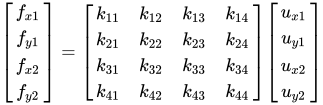
A truss element can only transmit forces in compression or tension. This means that in two dimensions, each node has two degrees of freedom (DOF): horizontal and vertical displacement. The resulting equation contains a four by four stiffness matrix.
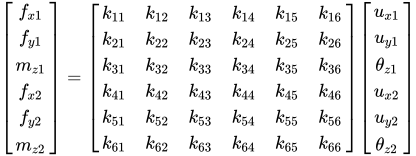
A frame element is able to withstand bending moments in addition to compression and tension. This results in three degrees of freedom: horizontal displacement, vertical displacement and in-plane rotation. The stiffness matrix in this case is six by six.
Other elements such as plates and shells can also be incorporated into the direct stiffness method and similar equations must be developed.

Assembly

[edit]

Once the individual element stiffness relations have been developed they must be assembled into the original structure. The first step in this process is to convert the stiffness relations for the individual elements into a global system for the entire structure. In the case of a truss element, the global form of the stiffness method depends on the angle of the element with respect to the global coordinate system (This system is usually the traditional Cartesian coordinate system).

(for a truss element at angle β) Equivalently,
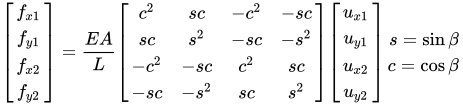
where and are the direction cosines of the truss element (i.e., they are components of a unit vector aligned with the member). This form reveals how to generalize the element stiffness to 3-D space trusses by simply extending the pattern that is evident in this formulation.

After developing the element stiffness matrix in the global coordinate system, they must be merged into a single “master” or “global” stiffness matrix. When merging these matrices together there are two rules that must be followed: compatibility of displacements and force equilibrium at each node. These rules are upheld by relating the element nodal displacements to the global nodal displacements.

The global displacement and force vectors each contain one entry for each degree of freedom in the structure. The element stiffness matrices are merged by augmenting or expanding each matrix in conformation to the global displacement and load vectors.

(for element (1) of the above structure)
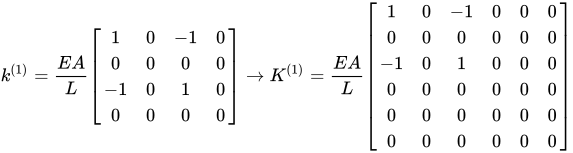
Finally, the global stiffness matrix is constructed by adding the individual expanded element matrices together.

Solution

[edit]

Once the global stiffness matrix, displacement vector, and force vector have been constructed, the system can be expressed as a single matrix equation.

For each degree of freedom in the structure, either the displacement or the force is known.

After inserting the known value for each degree of freedom, the master stiffness equation is complete and ready to be evaluated. There are several different methods available for evaluating a matrix equation including but not limited to Cholesky decomposition and the brute force evaluation of systems of equations. If a structure isn’t properly restrained, the application of a force will cause it to move rigidly and additional support conditions must be added.

The method described in this section is meant as an overview of the direct stiffness method. Additional sources should be consulted for more details on the process as well as the assumptions about material properties inherent in the process.

Applications

[edit]

The direct stiffness method was developed specifically to effectively and easily implement into computer software to evaluate complicated structures that contain a large number of elements. Today, nearly every finite element solver available is based on the direct stiffness method. While each program utilizes the same process, many have been streamlined to reduce computation time and reduce the required memory. In order to achieve this, shortcuts have been developed.

One of the largest areas to utilize the direct stiffness method is the field of structural analysis where this method has been incorporated into modeling software. The software allows users to model a structure and, after the user defines the material properties of the elements, the program automatically generates element and global stiffness relationships. When various loading conditions are applied the software evaluates the structure and generates the deflections for the user.

See also

[edit]
[edit]

References

[edit]
Revisions and contributorsEdit on WikipediaRead on Wikipedia
from Grokipedia
The direct stiffness method is a displacement-based numerical technique in for analyzing the behavior of linear elastic structures, such as trusses and frames, by relating nodal forces to nodal displacements through the assembly of individual element stiffness matrices into a global , which is then solved to obtain displacements, reactions, and member forces. The method emerged in the mid-20th century as a cornerstone of matrix , with foundational work beginning in the early amid challenges in analyzing complex aircraft structures like delta wings, which revived interest in stiffness-based approaches over flexibility methods. Key milestones include John H. Argyris's 1954 development of matrix formulations for structural elements using stiffness concepts, and the 1956 paper by M.J. Turner and colleagues at , which introduced the for triangular elements and emphasized convergence with refinement, laying the groundwork for the direct assembly process. Ray W. Clough at the , further advanced the technique in the late 1950s and early , coining the term "" in 1960 while extending it to analysis, and collaborating with Edward L. Wilson on applications like stress analysis in 1962, which unified it with principles. By the , the direct stiffness method had become integral to the (FEM), enabling automated computational solutions for both discrete structures and continua. In practice, the method involves several systematic steps: first, deriving the local stiffness matrix for each structural element (e.g., for a 1D bar element, =EAL[1111] = \frac{EA}{L} \begin{bmatrix} 1 & -1 \\ -1 & 1 \end{bmatrix}, where EE is the modulus of elasticity, AA is the cross-sectional area, and LL is the length) relating element nodal forces to displacements; second, transforming these local matrices to global coordinates using connectivity matrices and assembling them into the global stiffness matrix [K][K] such that {R}=[K]{r}\{R\} = [K]\{r\}, where {R}\{R\} are global forces and {r}\{r\} are global displacements; third, applying boundary conditions to reduce degrees of freedom and eliminate rigid-body modes, resulting in a positive definite system; fourth, solving the linear system for unknown displacements; and finally, back-substituting to compute element forces, stresses, and support reactions. This process is highly amenable to computer implementation, as seen in tools like the MATLAB-based MASTAN2 program, which supports both linear and nonlinear analyses. The direct stiffness method excels in handling structures without special modifications, supports efficient computation for large systems with lower memory demands compared to flexibility methods, and forms the basis for advanced finite element applications in civil, mechanical, and , including , frame, and continuum problems under various loads like axial forces, temperatures, or distributed pressures. Its versatility has made it a standard in modern structural design software, enabling precise predictions of deflections, stresses, and stability in complex real-world scenarios.

Introduction

Definition and Principles

The direct stiffness method is a displacement-based technique in that assembles individual element matrices into a global to determine nodal displacements resulting from applied loads. This approach systematically relates external forces to displacements by leveraging the inherent properties of structural members, enabling the solution of both determinate and indeterminate systems. At its core, the method models complex structures as an assemblage of discrete elements, such as bars, beams, or frames, interconnected at nodes where are defined. Equilibrium is enforced at these nodes through relations that connect applied forces to corresponding displacements, ensuring compatibility across elements while satisfying overall structural balance. These principles stem from the superposition of element contributions, allowing the global response to be derived from local behaviors without requiring explicit force distribution. The fundamental equilibrium equation governing the system is expressed as R=[K]r+Ro\mathbf{R} = [K] \mathbf{r} + \mathbf{R}^o where R\mathbf{R} is the vector of nodal forces, [K][K] is the global stiffness matrix, r\mathbf{r} is the vector of nodal displacements, and Ro\mathbf{R}^o accounts for fixed-end forces arising from initial loads or constraints on the elements. This method operates under key assumptions of linear elastic material behavior, small deformations that preserve geometry, and static loading conditions, which simplify the force-displacement relationships to linear forms. These premises ensure the stiffness matrix remains constant and symmetric, facilitating efficient matrix inversion for displacement solutions.

Relation to Finite Element Method

The direct stiffness method serves as the core assembly and solution technique in the (FEM) for , where continuous domains are discretized into finite elements to approximate the behavior of beams, trusses, frames, and other linear elastic structures. It systematically combines element-level stiffness matrices into a global system while enforcing nodal equilibrium, making it indispensable for solving displacement-based problems in . This approach underpins the matrix formulation that enables computational implementation in FEM software for civil, mechanical, and applications. In contrast to the more general FEM formulations that rely on variational principles or Galerkin weighted residuals for diverse physics like heat conduction or electromagnetics, the direct stiffness method is specifically tailored to structural problems by directly deriving stiffness matrices from force-displacement relations derived from equilibrium equations. This distinction arises because structural FEM prioritizes algebraic manipulation of stiffness coefficients over integral-based approximations, allowing for efficient handling of sparse matrices in one- and two-dimensional elements. For instance, in analysis, the method assembles bar element contributions without needing higher-order functions typical in continuum FEM. The process in FEM begins with dividing the into interconnected elements, such as line elements for trusses or beam segments, each governed by local stiffness relations that relate nodal forces to displacements. The direct stiffness method then takes over by transforming these local matrices to a global , superimposing them to form the overall , and solving the resulting Ku=F\mathbf{K} \mathbf{u} = \mathbf{F} system after applying boundary conditions, thereby focusing on matrix operations rather than the initial meshing or prerequisites. This post- emphasis assumes familiarity with and basic shape functions but excels in scalability for moderate-sized structural models. While general FEM often employs iterative solvers like conjugate gradient for large-scale, nonlinear, or three-dimensional problems to manage computational cost, the direct stiffness method traditionally relies on direct inversion or factorization techniques, such as Gaussian elimination, which are well-suited to the smaller, banded matrices arising from 1D/2D structural discretizations like planar frames or space trusses. This preference for direct methods ensures exact solutions for linear systems within floating-point precision but limits applicability to problems where matrix size remains manageable, typically under a few thousand degrees of freedom. The method's structural specificity thus complements broader FEM by providing a robust, exact framework for targeted engineering analyses.

Historical Development

Early Contributions

The origins of the direct stiffness method trace back to the 1930s, when British engineers A.R. Collar and W.J. Duncan at the National Physical Laboratory in pioneered matrix formulations for analyzing aircraft structures, particularly in the context of and vibrations. Their work addressed the need to model complex force-displacement relationships in discrete systems like wings and fuselages, using matrices to represent oscillatory motions and effects. This approach marked an early shift toward systematic algebraic representations of structural behavior, enabling more efficient handling of multi-degree-of-freedom problems compared to classical methods. Key publications by Duncan and Collar laid the groundwork, including their 1934 paper on solving oscillation problems via matrices, which introduced matrix-based techniques for conservative systems, followed by a 1935 extension to damped systems. These efforts were complemented by their 1938 book, Elementary Matrices and the Method of Least Squares, the first applied mathematics text dedicated to matrices, which provided tools for structural computations. Influenced by the demands of aircraft design during the interwar period, their formulations evolved from traditional flexibility methods—where forces were primary variables—to stiffness-oriented displacement methods, better suited for numerically stable solutions in complex airframes with redundant members. Prior to the , these matrix systems were applied manually using desk calculators to solve structural equations for entire assemblies, focusing on dynamic stability rather than static stress , as structures were often overdesigned for . This pre-automation era established the conceptual framework for assembling global system equations from local component relations, setting the stage for later computational advancements by demonstrating the practicality of matrix algebra in practice.

Formalization and Computer Implementation

In the mid-1950s, John H. Argyris played a pivotal role in formalizing the direct stiffness method by systematizing the assembly of structural equations from elemental components, building on earlier matrix formulations to unify force and displacement approaches through energy theorems. His series of articles, published between 1954 and 1955 in Aircraft Engineering and Aerospace Technology and later compiled in the 1960 book Energy Theorems and Structural Analysis, emphasized the parallel development of stiffness-based analyses where deformations serve as primary unknowns, enabling a structured element-by-element buildup for general structures. A key advancement in computer implementation came in 1959 when M.J. Turner and colleagues at presented the first explicit formulation of the direct stiffness method tailored for digital computation, applied to the analysis of complex aircraft structures such as wings. This work, detailed in a Structural and Materials Panel Paper at an AGARD meeting in , , on November 6, 1959, and expanded in a 1964 AGARDograph, introduced an assembly procedure where the global stiffness matrix is formed by direct summation of element matrices, optimizing for programmable efficiency in handling nonlinear and dynamic problems. The advent of these formalizations marked a profound shift in , transitioning from laborious hand calculations to automated matrix assembly on early computers, which allowed to tackle significantly larger and more intricate systems previously infeasible. By the , the direct stiffness method had been integrated into foundational finite element codes at institutions like , Bell, and universities such as Berkeley and , solidifying its role as the dominant paradigm in computational .

Element-Level Analysis

Stiffness Relations for Members

In the direct stiffness method, the stiffness relations for individual structural members form the foundation for analyzing the of discrete elements within a larger . For a generic member mm, the relationship between end forces {Qm}\{Q^m\} and end displacements {qm}\{q^m\} is expressed as {Qm}=[km]{qm}+{Qom}\{Q^m\} = [k^m]\{q^m\} + \{Q^{om}\}, where [km][k^m] is the local relating displacements to forces in the undeformed configuration, and {Qom}\{Q^{om}\} represents fixed-end actions due to initial loads such as distributed forces or changes. This formulation assumes linear elastic and small deformations, allowing the superposition of deformation-induced forces and initial effects. The seminal work by Turner, Clough, Martin, and Topp established this matrix-based approach for element-level relations in complex structures, enabling systematic assembly for overall analysis. For truss elements, which carry only axial loads, the stiffness matrix is derived from the basic relation between axial force and elongation in a bar of length LL, cross-sectional area AA, and EE. Consider a two-node element aligned along its local x-axis, with nodes 1 and 2 having axial displacements u1u_1 and u2u_2. The axial force FF is F=AEL(u2u1)F = \frac{AE}{L} (u_2 - u_1), and by equilibrium, the end forces are Q1=FQ_1 = -F and Q2=FQ_2 = F. Substituting yields the force-displacement relation {Q1Q2}=AEL[1111]{u1u2}\begin{Bmatrix} Q_1 \\ Q_2 \end{Bmatrix} = \frac{AE}{L} \begin{bmatrix} 1 & -1 \\ -1 & 1 \end{bmatrix} \begin{Bmatrix} u_1 \\ u_2 \end{Bmatrix}, where the 2×2 matrix [km]=AEL[1111][k^m] = \frac{AE}{L} \begin{bmatrix} 1 & -1 \\ -1 & 1 \end{bmatrix} embodies the member's resistance to relative axial deformation. This derivation relies on the assumption of uniform stress and one-dimensional strain, typical for slender members in pin-jointed trusses. If initial axial loads are present, {Qom}\{Q^{om}\} accounts for them directly. Beam elements, modeled using Euler-Bernoulli , incorporate and account for transverse displacements and rotations at each end, resulting in a 4×4 . For a beam of length LL, flexural rigidity EIEI (with [E](/page/E!)[E](/page/E!) as and II as ), the derivation starts from the EI[d](/page/D)4[v](/page/V.)dx4=0EI \frac{[d](/page/D*)^4 [v](/page/V.)}{dx^4} = 0 for the transverse deflection [v](/page/V.)(x)[v](/page/V.)(x) under no distributed load, assuming plane sections remain plane and perpendicular to the (neglecting shear deformation). The general solution is [v](/page/V.)(x)=a0+a1x+a2x2+a3x3[v](/page/V.)(x) = a_0 + a_1 x + a_2 x^2 + a_3 x^3, with end conditions defining displacements [v](/page/V.)1,θ1=[d](/page/D)[v](/page/V.)dxx=0[v](/page/V.)_1, \theta_1 = \frac{[d](/page/D*)[v](/page/V.)}{dx}|_{x=0} at node 1 and [v](/page/V.)2,θ2=[d](/page/D)[v](/page/V.)dxx=L[v](/page/V.)_2, \theta_2 = \frac{[d](/page/D*)[v](/page/V.)}{dx}|_{x=L} at node 2. End shear forces and moments are obtained via equilibrium: V=EI[d](/page/D)3[v](/page/V.)dx3V = EI \frac{[d](/page/D*)^3 [v](/page/V.)}{dx^3} and M=EI[d](/page/D)2[v](/page/V.)dx2M = -EI \frac{[d](/page/D*)^2 [v](/page/V.)}{dx^2}. Applying these at the ends and solving for coefficients leads to the relating {Qm}={V1M1V2M2}\{Q^m\} = \begin{Bmatrix} V_1 \\ M_1 \\ V_2 \\ M_2 \end{Bmatrix}
Add your contribution
Related Hubs
User Avatar
No comments yet.

