Hubbry Logo
MonologistMonologistMain
Open search
Monologist
Community hub
Monologist
logo
8 pages, 0 posts
0 subscribers
Be the first to start a discussion here.
Monologist
Monologist
from Wikipedia
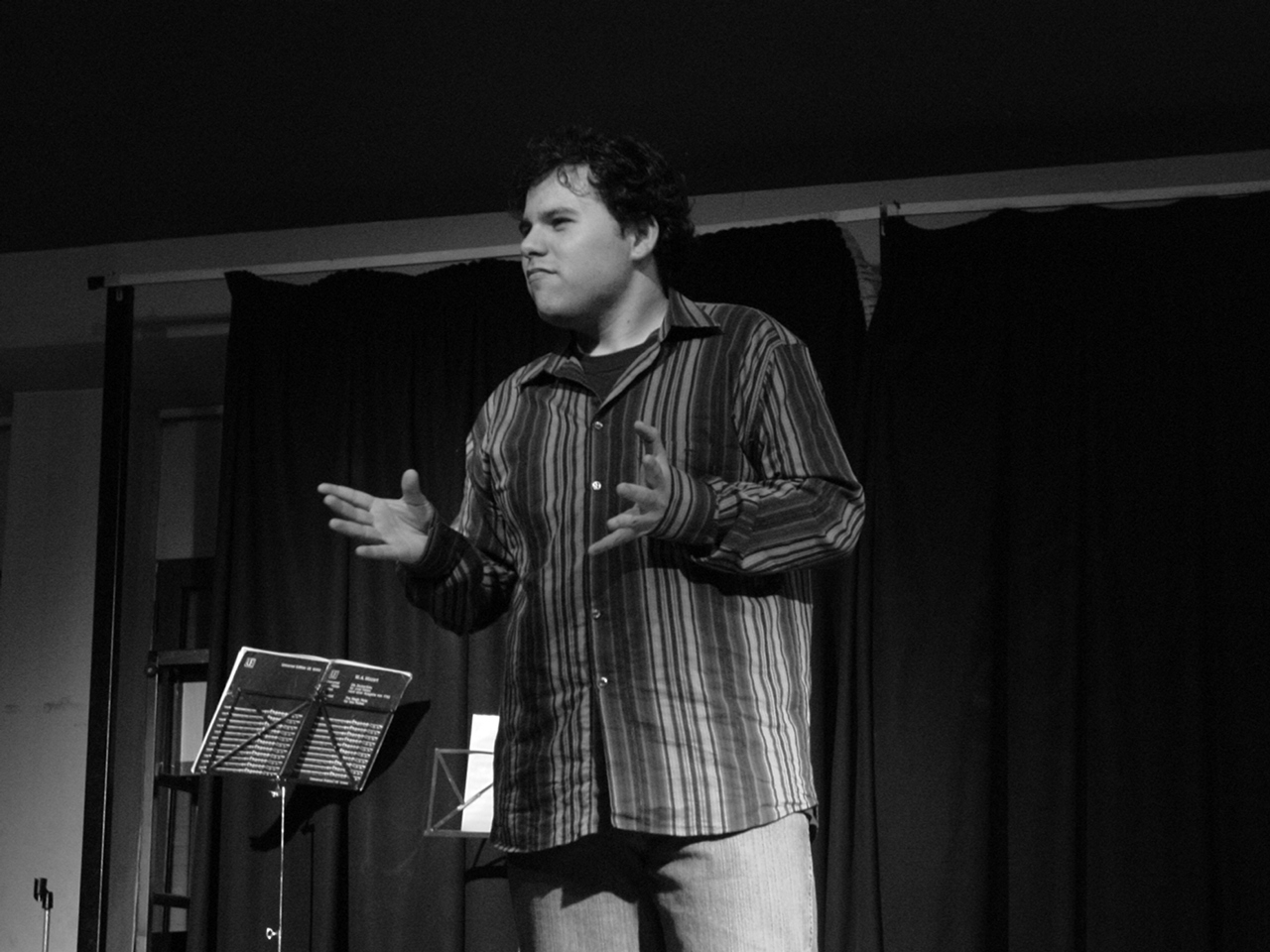
An actor delivering a monologue

A monologist (/məˈnɒləɪst, -ɡɪst/), or interchangeably monologuist (/məˈnɒləɡɪst/), is a solo artist who recites or gives dramatic readings from a monologue, soliloquy, poetry, or work of literature,[1] for the entertainment of an audience. The term can also refer to a person who monopolizes a conversation; and, in an obsolete sense, could describe a bird with an unchanging, repetitive song.[2]

Dramatic monologist

[edit]

A dramatic monologist is a term sometimes applied to an actor performing in a monodrama often with accompaniment of music. In a monodrama the lone player relays a story through the eyes of a central character, though at times may take on additional roles.[3] In the modern era the more successful practitioners of this art have been actresses frequently referred to by the French term “diseuse”.[4][5][6]

Diseuse

[edit]

Diseuse (UK: /dˈzɜːz/, US: /dˈzz/)[7][8] French for "teller", also called talkers, storytellers, dramatic-singers or dramatic-talkers[9][10] is a term, at least as used on the English-speaking stage, that appears to date to the last decade of the 19th century. The early uses of “diseuse” as a theatrical term in the American press seem to coincide with Yvette Guilbert’s tour of New York City in the mid-1890s.[11] In a February 1896 article on Guilbert, Cosmopolitan Magazine described the term as a "newly-coined and specific title".[12][13] Diseuse is the feminine form of the French word diseur "teller", a derivative of dire "to say, to tell", which came from Latin dīcere.[14] Few male actors became noteworthy performing solely as a dramatic monologist, though many well known actors have played in monodramas over their careers.

In the December 21, 1935, edition of the Pittsburgh Post-Gazette, an entertainment columnist wrote:

The English language does not contain a word which perfectly describes the performance of Ruth Draper, who comes to the Nixon next Thursday for the first time in several years to give a different program at each of her four performances here. "Speaking Portraits" and "Character Sketches" are the two terms most frequently applied to Miss Draper's work; and yet it is something more than that. "Diseuse" is the French word, but that is more readily applicable to an artist like Yvette Guilbert or Raquel Meller. Monologist is wholly inadequate. The word "Diseuse" really means "an artist in talking" so that may be the real term to use in connection with Miss Draper.[5]

The publication Theatre World wrote in a 1949 piece: "In our time we have fallen under the spell of three remarkable women practising the art of the diseuse—Ruth Draper, Cornelia Otis Skinner, and Joyce Grenfell. Each of these great artists has the gift of crowding the stage with imaginary figures who become so vivid as to be practically visible, but as all of these artists happen to be members of the fair sex it could be assumed that they possess a magic denied the mere male of the theatre." The article suggests that Sid Field was an actor of comparable talents.[15]

Joyce Grenfell wrote in Darling Ma: Joyce Grenfell's Letters to her Mother 1932–1944, "What makes a good diseuse is a capacious verbal (and visual) imagination, and an excellent oral delivery. Call these witty ladies Diseuses of the Heart and Lungs. I do."[16]

In the book The Guest List (2010) by Ethan Mordden, the art of the diseuse is defined as "a speaker of lyrics: in effect, one who uses the music to get to the words".[17]

Actresses who have been called noted diseuses[check spelling] over the years include:

Oral interpretation

[edit]

Oral interpretation, sometimes called dramatic reading or interpretative reading, is the oral staging of a work of literature, prose or poetry, by a person who reads rather than memorizes the material. Typically they are performed by solo artists who – unlike players in a monodrama – do not assume or tell the story through any one character, but do so instead with oral nuances to bring the story alive with their interpretation of how the creator of the piece intended the story to be told.[39][40]

Soliloquist

[edit]

The term soliloquist can apply to a monologist reciting a soliloquy, usually from a play, to entertain an audience. Passages in which characters orally reveal their thoughts are probably most associated with the works of William Shakespeare.[41][42]

References

[edit]
Revisions and contributorsEdit on WikipediaRead on Wikipedia
from Grokipedia
A monologist is an entertainer or performer who delivers a , typically a dramatic, comedic, or literary piece spoken by a single individual to an audience. This form of is common in theater, , and readings, where the monologist embodies a character or narrates a story without interaction from other performers. The term originates from the mid-17th century, derived from "monology" (itself formed from the Greek roots monos, meaning "alone," and logos, meaning "speech" or "discourse") combined with the suffix "-ist," indicating a practitioner. The earliest recorded use appears in English literature before 1632, attributed to playwrights John Webster and William Rowley, initially referring to someone who speaks at length or soliloquizes. Over time, the word evolved to emphasize professional solo artists, with notable 19th-century associations in dramatic monologues by poets like Robert Browning, who popularized the form as a vehicle for psychological insight and character revelation. In addition to its theatrical context, "monologist" can denote a who dominates conversations by speaking excessively, often to the exclusion of others—a usage that highlights soliloquy-like behavior in social settings. This sense underscores the word's roots in uninterrupted speech, distinguishing it from collaborative in performance arts.

Definition and Overview

Core Definition

A is a performer who delivers an extended, uninterrupted speech, known as a monologue, in contexts such as theater, literary , or solo . This functional role involves addressing an , oneself, or absent parties through a structured verbal that conveys , , or ideas. The term derives from the Greek roots monos ("alone") and ("speech" or "reason"), reflecting the solitary nature of the delivery. It entered English usage before 1632, with the earliest recorded evidence appearing in a dramatic work by playwrights and William Rowley. Distinguishing the monologist from an ordinary speaker, the role prioritizes performative elements, including vocal modulation, , and emotional intensity to engage listeners dramatically, rather than engaging in conversational exchange.

Key Characteristics

A monologist's performance is defined by its solo delivery, where a single performer delivers an extended speech without interruption from other characters or interlocutors, creating an uninterrupted flow of personal narrative or introspection. This isolation emphasizes self-expression and internal dialogue, often manifesting as confession or self-revelation to unveil the speaker's psyche. Unlike ensemble scenes, the monologist relies solely on their own presence to sustain momentum, fostering a direct, unmediated connection with the audience. Central to the craft are performative elements such as voice modulation, gestures, and pacing, which the monologist uses to convey complex emotions, progression, and character depth. Voice variations—ranging from to lyrical tones—help articulate internal conflicts or persuasive arguments, while deliberate pacing builds tension or releases through rhythmic control. Gestures complement these vocal choices, enhancing the portrayal of psychological states like madness or resolve, without the support of reactive partners. These traits distinguish monology by demanding a profound integration of theatrical skill and ability, often drawing on deep subject comprehension to make abstract ideas tangible. In performance roles, the monologist cultivates empathy through the intimacy of solo address, positioning spectators as silent confidants or implied adversaries to heighten emotional stakes. This format serves as a in larger theatrical works, advancing storylines via character exposition, or stands alone in and recitation formats for pure entertainment. Psychologically, it enables profound exploration of internal conflicts and societal commentary, differing from dialogue-driven scenes by focusing on , fate , or personal ambition without external . Such depth often results in heightened awareness of the character's experiences, reinforcing monology's power to mirror broader human .

Historical Development

Ancient and Classical Roots

The roots of monologic performance trace back to tragedy in the 5th century BCE, where solo speeches served as essential dramatic devices to reveal character inner turmoil, advance the plot, and engage the audience directly. In ' Oedipus Rex (c. 429 BCE), delivers extended monologues addressing the gods and the chorus, such as his invocation to Apollo for guidance amid the plague afflicting Thebes, which underscores themes of fate and self-discovery through direct supplication and rhetorical appeal. These speeches often broke the by turning toward the audience or divine entities, fostering a sense of communal witnessing in the theater of . , in his (c. 335 BCE), analyzes such solo speeches as integral to tragedy's structure, arguing that they contribute to —the emotional purging of pity and fear—by allowing characters to articulate moral dilemmas and evoke from spectators. Roman adaptations of Greek tragedy further developed the monologic form, emphasizing introspective and rhetorical depth. Lucius Annaeus Seneca (c. 4 BCE–65 CE), in works like Medea and Thyestes, incorporated extended soliloquies where protagonists, such as Medea contemplating revenge, ruminate on passion, fate, and Stoic restraint in isolation from other characters, heightening psychological intensity over action. These soliloquies, often spanning dozens of lines, influenced later European drama by prioritizing verbal elaboration and moral philosophy. Concurrently, oratorical performances by figures like Marcus Tullius Cicero (106–43 BCE) functioned as proto-monologic displays; his forensic speeches, such as the In Verrem (70 BCE), featured sustained solo addresses to the Roman senate and public, blending narrative persuasion with dramatic flair to sway audiences through vivid imagery and emotional appeals. Cicero's delivery, marked by gesture and vocal modulation, elevated public rhetoric to theatrical heights, bridging legal discourse and performative storytelling. Monologic elements in these ancient traditions emerged from broader oral practices and religious rituals, where the individual's voice amplified communal narratives. In Greek culture, evolved from dithyrambic hymns to —ecstatic choral songs that included solo improvisations by performers like (c. 6th century BCE), who stepped forward from the chorus to embody mythic figures in ritual processions. This shift emphasized the solo performer's role in invoking divine presence and resolving collective anxieties through spoken myth. Similarly, Roman mime and rhetorical contests drew from funerary and festival rites, where solo laments or invocations preserved oral histories and reinforced social bonds, transforming personal expression into a vehicle for cultural transmission. Such origins highlight the monologist's foundational function: harnessing the solitary voice to mediate between human experience and sacred or civic order.

Modern Evolution

The Renaissance period witnessed a pivotal advancement in monologic forms through William Shakespeare's innovative use of soliloquies, which elevated as a core dramatic device. In plays like (first performed around 1600–1601), the soliloquy "To be or not to be" exemplifies this evolution, portraying the protagonist's internal conflict and philosophical deliberation as a self-addressed speech that reveals psychological complexity to the audience. This technique drew on earlier traditions but expanded monologues into vehicles for individual subjectivity, influencing subsequent theatrical by maximizing rhetorical flexibility in character development. During the Enlightenment, 18th-century elocutionists systematized the delivery of monologues, transforming recitation into a disciplined art form focused on vocal modulation, gesture, and emotional authenticity. Pioneers like Thomas Sheridan and John Rice established elocution schools that trained performers in rendering dramatic and poetic texts, thereby standardizing monologic performance for educational and public oratory purposes. This formalization bridged literary composition with stage practice, ensuring monologues served as tools for eloquent expression in theaters and assemblies. The 19th century's Romantic movement further refined the as a performative poetic , with Robert Browning's works leading the charge. His poem (1842) presents a single speaker's veiled revelations of and control, a form designed for that highlighted character through ironic undertones and was frequently performed by monologists in literary salons and theaters. Concurrently, the proliferation of British music halls from the onward popularized solo monologic acts, featuring narrative sketches and character impersonations that captivated working-class audiences with accessible, humorous introspection. Performers in these venues, such as early monologists in the , adapted literary monologues into variety entertainment, emphasizing quick shifts in voice and demeanor to sustain engagement. Twentieth-century developments integrated psychoanalytic insights into monologic structures, reshaping them to probe the . Sigmund Freud's theories on repression and inner conflict, articulated in works like (1899), inspired stream-of-consciousness techniques in literature and theater, where internal monologues fragmented traditional narrative to mimic subconscious flows, as seen in modernist plays and novels. This influence fostered monologues that prioritized mental disarray over linear exposition, reflecting broader cultural preoccupations with psychological depth. The era's technological shifts prompted monologists to adapt to radio and , converting live stage soliloquies into mediated formats that preserved solo intimacy amid mass dissemination. Radio broadcasts from the onward incorporated monologic narration in dramas, relying on voice alone to evoke character interiors, while adaptations translated theatrical monologues into visual close-ups and voice-overs for enhanced emotional immediacy. These transitions, evident in early sound and audio plays, expanded monologic reach but required performers to navigate acoustic and cinematic constraints for authentic delivery.

Types of Monologists

Dramatic Monologist

A dramatic monologist is a performer who enacts an extended speech from a fictional character's viewpoint, often sourced from poetic or theatrical dramatic monologues, to unveil the speaker's concealed motivations and inner conflicts. This performance style distinguishes itself by maintaining a clear separation between the performer and the character, with the monologist adopting the to convey narrative tension through implied with a silent . Emerging prominently in 19th-century , it evolved from Romantic influences to emphasize character revelation over authorial voice. Central to the dramatic monologist's approach are elements of irony, psychological nuance, and a third-person-like detachment that highlights the character's self-exposure. In T.S. Eliot's "The Love Song of J. Alfred Prufrock" (1915), for example, the performer embodies the titular character's hesitant and social anxieties, using rhythmic delivery to underscore the poem's fragmented revelations about inadequacy and unfulfilled desire. This focus on depth allows the monologist to explore the speaker's , often revealing contradictions that the character overlooks, thereby engaging audiences in interpretive analysis. In , dramatic monologists serve as a vital link between poetic composition and theatrical expression, transforming static texts into dynamic character studies. Performers frequently recite Alfred Lord Tennyson's "Ulysses" (1842), portraying the weary hero's defiant urge for adventure despite age, which bridges epic narrative with intimate . Such recitations highlight the form's versatility, enabling actors to infuse Victorian poetry with live embodiment and emotional immediacy.

Soliloquist

A soliloquist is a type of who delivers a character's internal aloud, revealing unspoken thoughts and emotions to the audience while the character is typically alone on . This technique allows the performer to externalize private reflections that drive the dramatic narrative, providing insight into the character's psyche without interaction from other figures. In William Shakespeare's , first performed around 1606, the title character's in Act 1, Scene 7 exemplifies this, as Macbeth grapples with his ambition and moral hesitation before murdering . Key features of the soliloquist's delivery emphasize , , and self-revelation, often through introspective language that heightens tension and character depth. Unlike an , which is a brief remark directed to the or another character but unheard by onstage figures, a is extended and meditative, focusing on profound personal turmoil rather than quick commentary. This distinction enables the soliloquist to sustain a rhythmic, poetic flow—such as in Shakespearean works—that mirrors the character's mental processes, fostering with the performer's nuanced portrayal of . The soliloquist tradition evolved from Elizabethan drama, where it flourished in Shakespearean theater during the , to contemporary adaptations that translate these monologues into visual media. In modern film versions of , such as Franco Zeffirelli's 1990 adaptation starring , soliloquies like "To be or not to be" are repositioned for cinematic pacing—often moved earlier in the plot and delivered via or direct address to convey inner debate amid dynamic visuals. Similarly, Branagh's 1996 full-text preserves spoken soliloquies to maintain theatrical intimacy, allowing actors to highlight psychological layers through shots and minimalistic staging. Building on developments in Shakespearean theater, these adaptations demonstrate the soliloquist's enduring role in bridging stage solitude with screen realism.

Diseuse

A diseuse refers to a female performer skilled in reciting poetic or lyrical monologues, typically with musical accompaniment, who rose to prominence in French cabarets during the to . This role blended artistry with subtle musical elements, distinguishing it as a sophisticated solo act in the vibrant café-concert and music-hall scene of . Pioneering figures like exemplified the form through recitations of works such as Paul Verlaine's poems, delivered to piano accompaniment in venues like the and Eldorado. Central to the diseuse's technique was the fusion of precise recitation, dramatic gestures, and occasional melodic phrasing, creating an intimate yet theatrical experience that emphasized , urban wit, and emotional nuance. Performers often stood motionless except for arm movements, clad in signature attire like Guilbert's yellow gown and long black gloves, to underscore the lyrical content drawn from everyday Parisian life or risqué vignettes. This elegance contrasted with the bawdier elements of , allowing diseuses to elevate to an art form that captivated audiences across and the during international tours. The diseuse tradition left a lasting cultural imprint, influencing theater by inspiring experimental recitations in early 20th-century movements. Notably, performers like Emmy Hennings adapted the style for Dadaist cabarets, such as the Cabaret Voltaire in , where spoken-word pieces intertwined with poetry and to challenge conventional theater norms. This revival extended the diseuse's legacy into modernist contexts, bridging cabaret's populist roots with innovative artistic expression.

Contemporary Variants

Contemporary variants of monologists have evolved to incorporate elements of and , adapting the traditional solo performance into more accessible and interactive formats. represents a key adaptation, functioning as a modern evolution of the where a single performer delivers humorous narratives on personal or societal topics directly to an audience. This form retains the monologist's core structure of rhetorical delivery and audience engagement but infuses it with , timing, and crowd response to heighten value. For instance, George Carlin's routines from the 1970s, such as his observational bits on language and American culture, exemplify this shift, blending introspective commentary with comedic timing to critique everyday absurdities. Spoken-word artists further extend this variant through slam poetry performances, where poets deliver original, rhythmic pieces as monologic expressions of identity, , and personal experience. These performances emphasize vocal inflections, spontaneity, and theatricality, often lasting 3-4 minutes and focusing on freeform structures that prioritize emotional resonance over rigid rhyme. Key features include subtle audience interaction, such as snaps or calls for rewinds, which create a communal atmosphere while maintaining the solo narrative core. This is evident in events at venues like the , where performers like use to bridge personal stories with broader advocacy. Post-2000 developments have amplified these forms through digital platforms, with TED Talks emerging as structured solo monologues that deliver inspirational or educational to global audiences. Speakers in TED formats often employ performative techniques akin to monology, such as rhythmic pacing and direct address, to convey complex ideas in 18-minute segments, as seen in performances like Lexi Harman's "A Dream, Monologue." Similarly, vlogs function as everyday solo deliveries, where creators narrate personal experiences or stories in unscripted or semi-scripted monologues, fostering intimacy through visual and verbal . The rise of monologists has further democratized this variant, with solo formats allowing hosts to explore topics through extended, uninterrupted discourse, as in monologue-style shows that build listener loyalty through consistent personal insight. In , solo performances have innovated monologic delivery by immersing viewers in interactive environments, such as one-person theater pieces where performers embody characters in 360-degree spaces, enhancing emotional proximity without physical co-presence.

Performance Techniques

Delivery and Interpretation Methods

Monologists employ a range of delivery techniques to convey the emotional depth and narrative drive of their performances, primarily through vocal dynamics, , and strategic pauses. Vocal dynamics involve varying pitch to highlight emotional shifts, adjusting to control pacing and build intensity, and modulating to draw the audience into intimate moments or amplify dramatic peaks. These elements ensure the monologue remains engaging without external support, as seen in theater practices where vocal variety prevents monotony and enhances character revelation. complements this by using purposeful gestures and posture to externalize , such as subtle facial expressions for nuance or broader movements to suggest spatial awareness in the character's world. Pauses are particularly crucial, serving to heighten tension, allow audience reflection, or underscore pivotal revelations, thereby creating rhythmic breathing space within the spoken text. Props are used minimally in monologue performances to maintain focus on the and the performer's presence, avoiding distractions that could dilute the solo format's intensity. When incorporated, they must be essential to the character's action, such as a simple object symbolizing memory, but excessive handling is discouraged to prevent overshadowing the verbal delivery. Interpretation approaches begin with a deep of the text to uncover —the underlying emotions, motivations, and unspoken implications that enrich the surface narrative. This involves dissecting dialogue for layered meanings, such as irony or suppressed desires, to inform authentic emotional delivery. Monologists then adapt these interpretations to the audience context, scaling physical and vocal energy for intimate venues where subtle nuances foster closeness, versus larger spaces requiring amplified projection and gestures to reach distant viewers. A key challenge in monologue delivery is sustaining audience engagement without visual aids or co-performers, relying solely on the performer's and precision to combat potential waning . In stage performances, this demands heightened projection and spatial awareness to connect with a live , while recorded formats require subtler, camera-aware subtlety to suit viewing and edited pacing, though both risk losing immediacy if timing falters.

Training and Preparation

Aspiring monologists often pursue formal training through curricula that emphasize work as a core component of development. Institutions such as the Royal Academy of Dramatic Art (RADA) integrate preparation into their programs, including short courses like Fundamentals of , where participants analyze and rehearse monologues from using Stanislavski-based techniques to build foundational skills in character interpretation and textual delivery. Similarly, admission to the Juilliard School's training program requires applicants to prepare and perform memorized monologues, fostering discipline in script selection and emotional depth. For those opting for self-study, monologue anthologies serve as essential resources, providing curated selections of speeches for independent practice and skill refinement. Collections such as The Classical Monologue: Women by Michael Earley and Philippa Keil offer a variety of s drawn from classical plays, enabling actors to explore diverse voices and scenarios without formal instruction. More recent anthologies, like Hear Me Now: Audition Monologues for Actors of Colour compiled by award-winning writers including Titilola Dawudu and the Tamasha Theatre Company, supply over eighty original pieces tailored for auditions, supporting self-directed exploration of contemporary themes for diverse performers. Preparation for monologues begins with thorough to uncover the character's objectives, relationships, and emotional arc, often involving multiple readings of the full play to contextualize the speech. Rehearsal techniques include breaking the text into manageable chunks for focused practice, using mirrors to observe physical expressions or recordings to review vocal nuances and pacing. Building stamina for extended speeches requires targeted exercises, such as and progressive vocal warm-ups, to sustain energy and clarity over long performances without strain. Since 2010, modern resources have expanded access to training through online courses and workshops, which often incorporate to adapt monologues for contemporary variants like spoken-word or formats. Platforms such as The Barrow Group's Online Monologue Workshop provide four-week sessions focused on practical tools for and personalization, accommodating remote learners. Similarly, Interlochen's online Techniques: Monologues course guides participants through script clue identification and character exercises, blending traditional preparation with improvisational elements for versatile application.

Notable Figures and Examples

Historical Monologists

In ancient Greek theater of the 5th century BCE, performers delivered the monologues embedded in Sophocles' tragedies, such as Oedipus Rex and Antigone, during festivals like the City Dionysia in Athens' amphitheaters. These solo speeches, often comprising extended addresses by characters revealing inner conflicts or moral dilemmas, were enacted by a limited number of male actors—typically three per play—who used masks, stylized gestures, and heightened vocal delivery to embody multiple roles and engage vast audiences of up to 15,000 spectators. The three-actor rule constrained performances to no more than trialogues, making monologues essential for character introduction and psychological depth, as seen in the protagonist's self-reflective speeches that advanced the tragic narrative without overwhelming the chorus's choral odes. Roman rhetoricians exemplified solo oratory through declamations that paralleled monologic performance, with (c. 35–100 CE) serving as a key figure in his role as teacher and practitioner. In his , advocated for rigorous training in delivery (actio), including voice modulation, gesture, and , to make solo speeches persuasive and emotionally compelling, drawing from both forensic and traditions. He demonstrated these techniques in educational settings, using practice speeches (declamationes) to model how an orator could command attention alone, influencing later by emphasizing naturalness over theatrical excess while adapting elements from stage . During the , actors at London's elevated monologic performance through , with (1567–1619) renowned for portraying in the early 1600s. As the leading player of the , Burbage delivered the play's extended soliloquies, such as "To be, or not to be," infusing them with introspective emotion and physical dynamism that transformed the character's grief into a vivid, audience-captivating display. His innovative approach, described in contemporary elegies as leaping into graves and embodying "so true an eye" for tragic lovers, marked a shift toward realistic psychological interpretation in solo delivery, performed in the open-air theater to diverse crowds including and nobility. In the , reciters popularized Robert Browning's dramatic monologues through public readings and theatrical adaptations, adapting the form's introspective, character-driven speeches for Victorian audiences seeking intellectual entertainment. Browning's works, like "" and "Fra Lippo Lippi," were performed in drawing rooms, lecture halls, and stages, where elocutionists emphasized the poems' psychological nuance and ironic undertones to critique social norms. (1838–1905), the acclaimed actor-manager of the Lyceum Theatre, contributed to this tradition through his dramatic interpretations and personal association with Browning, including discussions on Shakespearean performance.

Modern and Influential Performers

, a pioneering French diseuse, rose to prominence in the cabaret scene of the , performing spoken set to music that captured the gritty realities of Parisian life, often standing motionless on stage and using subtle arm gestures to convey emotion. Her career spanned into the 1930s, evolving from risqué café-concert numbers to more refined recitals of medieval and folk songs, influencing the development of interpretive in . Guilbert's deadpan delivery and voice made her a sensation, earning her international tours and collaborations that bridged with theatrical monologue traditions. In the 1980s, American performer revolutionized autobiographical monologues by blending personal storytelling with minimalist staging, sitting at a desk with props like a glass of water and notes to recount life experiences in a stream-of-consciousness style. Works such as (1987), developed from earlier theater pieces with , explored themes of self-discovery and cultural observation, gaining acclaim through filmed adaptations directed by . Gray's approach popularized the form in experimental theater, emphasizing vulnerability and over scripted narrative. Mid-20th-century stand-up monologists like Lenny Bruce transformed comedy in the 1950s and 1960s by delivering improvisational routines that satirized social norms, religion, and obscenity laws, often facing arrests for his provocative language. Bruce's performances, such as those at the Cafe Au Go Go in 1964, integrated personal anecdotes with cultural critique, paving the way for confessional humor in live settings. His freewheeling style challenged censorship and influenced subsequent generations of comedians. Theater artist debuted his one-person show Mark Twain Tonight! in 1959, portraying the author in a that drew from Twain's writings to comment on American society, , and human folly. Holbrook refined the piece over decades, performing it more than 2,000 times worldwide until 2017, earning and establishing the solo historical impersonation as a durable theatrical format. His interpretation highlighted Twain's wit and moral insight, adapting the for television and Broadway revivals. In the 2000s, Sarah Jones emerged as a key figure in multicultural monologues, creating character-driven pieces like Surface Transit (premiered 2000) that embodied diverse New Yorkers— from Dominican students to Korean salon workers— to explore identity, , and urban life. Her 2001 performance Women Can't Wait at the featured eight women from various global cultures delivering monologues on gender discrimination, blending humor and advocacy to highlight international . Jones's work, including her Obie-winning Bridge & Tunnel (2006), innovated solo theater by rapidly switching between accents and personas. Contemporary digital monologist Hannah Gadsby captivated audiences with Nanette (2018), a special that subverted stand-up conventions through a raw, narrative-driven addressing trauma, autism, and homophobia in comedy. Drawing from her Australian upbringing and experiences of , Gadsby rejected self-deprecating humor in favor of direct confrontation with audience expectations, sparking global discussions on and representation in performance. The piece's blend of and critique, viewed by millions, marked a shift toward introspective monologues in .

References

Add your contribution
Related Hubs
User Avatar
No comments yet.