Hubbry Logo
Displacement operatorDisplacement operatorMain
Open search
Displacement operator
Community hub
Displacement operator
logo
7 pages, 0 posts
0 subscribers
Be the first to start a discussion here.
Displacement operator
from Wikipedia

In the quantum mechanics study of optical phase space, the displacement operator for one mode is the shift operator in quantum optics,

,

where is the amount of displacement in optical phase space, is the complex conjugate of that displacement, and and are the lowering and raising operators, respectively.

The name of this operator is derived from its ability to displace a localized state in phase space by a magnitude . It may also act on the vacuum state by displacing it into a coherent state. Specifically, where is a coherent state, which is an eigenstate of the annihilation (lowering) operator. This operator was introduced independently by Richard Feynman and Roy J. Glauber in 1951.[1][2][3]

Properties

[edit]

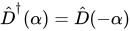
The displacement operator is a unitary operator, and therefore obeys , where is the identity operator. Since , the hermitian conjugate of the displacement operator can also be interpreted as a displacement of opposite magnitude (). The effect of applying this operator in a similarity transformation of the ladder operators results in their displacement.

The product of two displacement operators is another displacement operator whose total displacement, up to a phase factor, is the sum of the two individual displacements. This can be seen by utilizing the Baker–Campbell–Hausdorff formula.

which shows us that:

When acting on an eigenket, the phase factor appears in each term of the resulting state, which makes it physically irrelevant.[4]

It further leads to the braiding relation

Alternative expressions

[edit]

The Kermack–McCrea identity (named after William Ogilvy Kermack and William McCrea) gives two alternative ways to express the displacement operator:

Multimode displacement

[edit]

The displacement operator can also be generalized to multimode displacement. A multimode creation operator can be defined as

,

where is the wave vector and its magnitude is related to the frequency according to . Using this definition, we can write the multimode displacement operator as

,

and define the multimode coherent state as

.

See also

[edit]

References

[edit]
Revisions and contributorsEdit on WikipediaRead on Wikipedia
from Grokipedia
In and , the displacement operator is a that shifts the expectation values of the position and momentum quadratures (or equivalently, the annihilation and creation operators) of a state in , without altering the state's variance or higher-order moments. Mathematically, it is defined as D^(α)=exp(αa^αa^)\hat{D}(\alpha) = \exp(\alpha \hat{a}^\dagger - \alpha^* \hat{a}), where α\alpha is a complex parameter encoding the displacement amplitude and phase, and a^\hat{a}^\dagger, a^\hat{a} are the bosonic creation and operators satisfying [a^,a^]=1[\hat{a}, \hat{a}^\dagger] = 1. This operator, formalized by in his seminal work on the quantum theory of optical coherence, generates coherent states—the quantum analogs of classical electromagnetic waves—by acting on the vacuum state: α=D^(α)0|\alpha\rangle = \hat{D}(\alpha) |0\rangle. Coherent states are right eigenstates of the annihilation operator (a^α=αα\hat{a} |\alpha\rangle = \alpha |\alpha\rangle) and exhibit minimum uncertainty in the quadratures, Poissonian photon-number statistics, and Gaussian Wigner functions centered at the displaced position in . These properties make them ideal for modeling light and other coherent radiation fields, bridging classical and quantum descriptions of light. Key properties of the displacement operator include its unitarity (D^(α)=D^(α)=D^1(α)\hat{D}^\dagger(\alpha) = \hat{D}(-\alpha) = \hat{D}^{-1}(\alpha)) and the Baker-Campbell-Hausdorff relation for composition: D^(α)D^(β)=exp[12(αβαβ)]D^(α+β)\hat{D}(\alpha) \hat{D}(\beta) = \exp\left[\frac{1}{2} (\alpha \beta^* - \alpha^* \beta)\right] \hat{D}(\alpha + \beta). It transforms operators via conjugation, such as D^(α)a^D^(α)=a^+α\hat{D}^\dagger(\alpha) \hat{a} \hat{D}(\alpha) = \hat{a} + \alpha, which displaces the field while preserving the vacuum fluctuations. In phase-space formulations, it facilitates representations like the Wigner function. The displacement operator has broad applications in , including the engineering of non-classical states for and sensing, as well as in for cooling mechanical resonators by displacing cavity fields. Experimentally, it has been realized using interferometers to displace coherent states in quantum communication protocols. Generalizations extend to multi-mode systems, time-dependent drives, and non-harmonic potentials, underscoring its foundational role in modern quantum technologies.

Definition and Formulation

Operator Definition

The serves as a foundational model in , with its Hamiltonian given by H=ω(aa+12),H = \hbar \omega \left( a^\dagger a + \frac{1}{2} \right), where \hbar is the reduced Planck's constant, ω\omega is the , and aa and aa^\dagger denote the annihilation and creation operators, respectively, obeying the bosonic commutation relation [a,a]=1[a, a^\dagger] = 1. Readers are assumed to be familiar with these operators, which arise from the canonical quantization of the classical harmonic oscillator. The single-mode displacement operator D(α)D(\alpha), introduced in the study of coherent states for the radiation field, is defined as the exponential D(α)=exp(αaαa),D(\alpha) = \exp\left( \alpha a^\dagger - \alpha^* a \right), where αC\alpha \in \mathbb{C} is a complex parameter that specifies the magnitude and phase of the displacement. This generates translations in the of the oscillator. Acting on the vacuum state 0|0\rangle, which satisfies a0=0a |0\rangle = 0, the displacement operator produces a α=D(α)0|\alpha\rangle = D(\alpha) |0\rangle. This state minimizes the uncertainty in position and momentum quadratures while maintaining the canonical commutation relations, effectively shifting the origin of the . In the quadrature phase space, defined by the operators X=a+aX = a + a^\dagger and P=i(aa)P = -i(a - a^\dagger) (with [X,P]=2i[X, P] = 2i), the displacement corresponds to a shift of the expectation values X=2Re(α)\langle X \rangle = 2 \operatorname{Re}(\alpha) and P=2Im(α)\langle P \rangle = 2 \operatorname{Im}(\alpha), resulting in a Euclidean displacement distance of 2α2|\alpha| from the vacuum origin. The vacuum uncertainty ellipse, with variance 1 in both quadratures, is preserved under this translation.

Relation to Coherent States

Coherent states are fundamental quantum states of the harmonic oscillator that arise directly from the action of the displacement operator on the state. Specifically, the coherent α|\alpha\rangle, parameterized by a α\alpha, is defined as α=D(α)0|\alpha\rangle = D(\alpha) |0\rangle, where D(α)D(\alpha) is the displacement operator and 0|0\rangle is the state. This satisfies the eigenvalue for the annihilation operator: aα=ααa |\alpha\rangle = \alpha |\alpha\rangle, highlighting its role as a right eigenstate of aa with complex eigenvalue α\alpha. This property underscores the displacement operator's ability to shift the in while preserving the minimal uncertainty characteristic of Gaussian wave packets. The family of all coherent states {α}\{ |\alpha\rangle \} forms an overcomplete basis for the infinite-dimensional of the . This overcompleteness is formalized by the resolution of the identity operator: d2απαα=1^,\int \frac{d^2 \alpha}{\pi} \, |\alpha\rangle \langle \alpha| = \hat{1}, where the integral is over the , and d2α=d(Reα)d(Imα)d^2 \alpha = d(\operatorname{Re} \alpha) \, d(\operatorname{Im} \alpha). This relation allows any to be expanded in the basis, providing a powerful tool for phase-space representations in and beyond. The overcomplete nature reflects the redundancy inherent in continuous-variable systems, enabling efficient approximations and calculations. Under the free evolution of the Hamiltonian H=ω(aa+1/2)H = \hbar \omega (a^\dagger a + 1/2), coherent states exhibit classical-like behavior. The time-evolved state is given by α(t)=eiωt/2D(αeiωt)0,|\alpha(t)\rangle = e^{-i \omega t / 2} D(\alpha e^{-i \omega t}) |0\rangle, which corresponds to a of the displacement parameter α\alpha in the at ω\omega, up to a global phase. This evolution preserves the coherent state's minimal uncertainty and Gaussian profile, mimicking the periodic motion of a classical oscillator. A hallmark of coherent states is their photon number distribution, which follows a Poissonian statistics. The expectation value of the number operator n^=aa\hat{n} = a^\dagger a is n^=α2\langle \hat{n} \rangle = |\alpha|^2, and the variance is Δn^2=α2\Delta \hat{n}^2 = |\alpha|^2, matching the mean and indicating sub-Poissonian noise relative to thermal states but with equal mean and variance characteristic of classical-like fields. This property makes coherent states ideal models for laser light, where intensity fluctuations are minimal.

Mathematical Properties

Unitary Properties

The displacement operator D(α)=exp(αaαa)D(\alpha) = \exp(\alpha a^\dagger - \alpha^* a), where aa and aa^\dagger are the annihilation and creation operators satisfying [a,a]=1[a, a^\dagger] = 1, is unitary. This unitarity follows from the fact that the argument of the exponential is anti-Hermitian, ensuring D(α)=D(α)D^\dagger(\alpha) = D(-\alpha) and D(α)D(α)=ID^\dagger(\alpha) D(\alpha) = I. Consequently, D(α)D(\alpha) preserves the norm of quantum states and the inner products between them, making it a valid quantum evolution operator. In , the displacement operator conjugates the bosonic operators to effect a translation: D(α)aD(α)=a+α,D(α)aD(α)=a+α.D^\dagger(\alpha) a D(\alpha) = a + \alpha, \quad D^\dagger(\alpha) a^\dagger D(\alpha) = a^\dagger + \alpha^*. These relations demonstrate that D(α)D(\alpha) shifts the expectation values of the field amplitudes by the complex parameter α\alpha, without altering their quantum fluctuations. The transformed operators retain the canonical commutation relation [D(α)aD(α),D(α)aD(α)]=1,[D^\dagger(\alpha) a D(\alpha), D^\dagger(\alpha) a^\dagger D(\alpha)] = 1, as unitary transformations preserve the algebraic structure of the operator algebra. This conjugation property interprets the displacement operator as a Weyl operator, implementing a in . Specifically, applying D(α)D(\alpha) shifts the center of a state's by amounts proportional to Re(α)\operatorname{Re}(\alpha) in position and Im(α)\operatorname{Im}(\alpha) in , while leaving the distribution's invariant. Coherent states, obtained by displacing the α=D(α)0|\alpha\rangle = D(\alpha) |0\rangle, exemplify this , centering the Gaussian wavepacket at the classical phase-space point corresponding to α\alpha.

Composition and Baker-Hausdorff Formula

The composition of two displacement operators D(α)D(\alpha) and D(β)D(\beta) is given by the relation D(α)D(β)=exp[αβαβ2]D(α+β),D(\alpha) D(\beta) = \exp\left[\frac{\alpha \beta^* - \alpha^* \beta}{2}\right] D(\alpha + \beta), where the exponential factor is a phase due to the non-commutativity of the underlying . This formula reveals that the product of displacements corresponds to a total displacement α+β\alpha + \beta, up to a exp[αβαβ2]\exp\left[\frac{\alpha \beta^* - \alpha^* \beta}{2}\right], which arises from the commutation relations [a,a]=1[a, a^\dagger] = 1. To derive this, define A=αaαaA = \alpha a^\dagger - \alpha^* a and B=βaβaB = \beta a^\dagger - \beta^* a, so D(α)=eAD(\alpha) = e^A and D(β)=eBD(\beta) = e^B. The commutator is [A,B]=αβαβ[A, B] = \alpha \beta^* - \alpha^* \beta, a c-number that commutes with both AA and BB. The Baker-Campbell-Hausdorff formula then simplifies to eAeB=exp(A+B+12[A,B])e^A e^B = \exp\left(A + B + \frac{1}{2}[A, B]\right), yielding the product rule directly. This multiplication law underscores the non-Abelian structure of the displacement algebra, which generates the Heisenberg-Weyl group—a whose unitary representations describe the symmetries of the in . The phase factor in the composition highlights the group's non-commutativity, distinguishing it from classical translations and enabling applications in manipulation.

Alternative Representations

Exponential Form Variations

The displacement operator D(α)D(\alpha) in admits several equivalent exponential representations, distinguished by the ordering of the creation (aa^\dagger) and annihilation (aa) operators. These variations arise from the non-commutativity of aa and aa^\dagger, with [a,a]=1[a, a^\dagger] = 1, and are derived using the Baker-Campbell-Hausdorff (BCH) formula to disentangle the exponentials. The symmetrically ordered form, D(α)=exp(αaαa)D(\alpha) = \exp(\alpha a^\dagger - \alpha^* a), serves as the canonical expression, as it directly shifts the expectation values of the quadrature operators without altering higher-order moments. Applying the BCH formula to the symmetric form yields the normal-ordered variant, D(α)=exp(α22)exp(αa)exp(αa)D(\alpha) = \exp\left(-\frac{|\alpha|^2}{2}\right) \exp(\alpha a^\dagger) \exp(-\alpha^* a), where creation operators appear to the left of annihilation operators. This equivalence holds because the commutator [αa,αa]=α2[\alpha a^\dagger, -\alpha^* a] = -|\alpha|^2 is a c-number, allowing the exponentials to be separated with a multiplicative prefactor. The normal-ordered form is particularly advantageous for computations involving coherent states α=D(α)0|\alpha\rangle = D(\alpha) |0\rangle, as it simplifies the evaluation of normally ordered expectation values, such as those in the Glauber-Sudarshan P-representation, by aligning with the vacuum state's annihilation properties. Conversely, the anti-normal-ordered form reverses the operator sequence: D(α)=exp(α22)exp(αa)exp(αa)D(\alpha) = \exp\left(-\frac{|\alpha|^2}{2}\right) \exp(-\alpha^* a) \exp(\alpha a^\dagger). This representation is obtained analogously via BCH by reordering the terms in the symmetric exponential, placing annihilation operators to the left. It proves useful for anti-normally ordered calculations, including the evaluation of expectation values with the , where the operator acts on bras rather than kets, facilitating overlaps with the in phase-space formulations. These exponential variations, while equivalent through BCH relations detailed in the operator's mathematical properties, enable tailored applications in quantum optical simulations and state preparation, prioritizing conceptual clarity over direct numerical expansion.

Integral and Series Expansions

The displacement operator D(α)D(\alpha) admits a expansion directly from its exponential definition, D(α)=n=01n!(αaαa)n,D(\alpha) = \sum_{n=0}^{\infty} \frac{1}{n!} (\alpha a^\dagger - \alpha^* a)^n, where aa and aa^\dagger are the annihilation and creation operators, respectively. This series form, while formal, facilitates analytical manipulations in and within . More practical for computations, however, are expansions leveraging the of the number basis, where explicit matrix elements incorporate associated . The matrix elements of D(α)D(\alpha) in the Fock (number) basis {n}\{|n\rangle\} are given by mD(α)n=n!m!αmneα2/2Lnmn(α2)\langle m | D(\alpha) | n \rangle = \sqrt{\frac{n!}{m!}} \, \alpha^{m-n} \, e^{-|\alpha|^2/2} \, L_n^{m-n}(|\alpha|^2)
Add your contribution
Related Hubs
User Avatar
No comments yet.