Hubbry Logo
Display typefaceDisplay typefaceMain
Open search
Display typeface
Community hub
Display typeface
logo
8 pages, 0 posts
0 subscribers
Be the first to start a discussion here.
Contribute something
Display typeface
Display typeface
from Wikipedia
A number of common genres of display typeface

A display typeface is a typeface that is intended for use in display type (display copy) at large sizes for titles, headings, pull quotes, and other eye-catching elements, rather than for extended passages of body text.[1]

Display typefaces will often have more eccentric and variable designs than the simple, relatively restrained typefaces generally used for body text.[2][3][4][5] They may take inspiration from other genres of lettering, such as handpainted signs, calligraphy or an aesthetic appropriate to their use, perhaps ornamented, exotic, abstracted or drawn in the style of a different writing system.[6][7][8]

Several genres of font are particularly associated with display setting, such as slab serif, script font, reverse-contrast and to a lesser extent sans serif.[9][10] Walter Tracy defines display typefaces in the metal type sense as "sizes of type over 14 point" and in design that "text types when enlarged can be used for headings, display types, if reduced, cannot be used for text setting."[11]

Titling fonts are a subset of display typefaces which are typically used for headlines and titles. They are often only uppercase, and have stroke widths optimized for large sizes.[12][13]

Historical background

[edit]

For the first centuries of printing, display type generally did not exist. Printing was used primarily to print body text, although there might be use of some larger-sized letters for titling. Typefaces not intended for body text remained rooted in conventional letterforms: roman type, script typeface or blackletter. Signs were created as custom handlettering.[14]

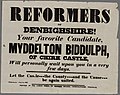
The arrival of the poster and greater use of signage spurred the arrival of new kinds of letterform, both as lettering and in print.[14] Historian James Mosley has written that "big types had been cast in sand, using wooden patterns, for some centuries [by 1750] but there is evidence that English typefounders only began to make big letters for posters and other commercial printing towards 1770, when Thomas Cottrell made his 'Proscription or Posting letter of great bulk and dimension' and William Caslon II cast his 'Patagonian' or 'Proscription letters'."[15][16][17]

New technologies, notably riveted "sanspareil" matrices made printing at large sizes easier from the beginning of the nineteenth century.[18] At the same time, new designs of letter began to appear around the beginning of the nineteenth century, such as "fat face" typefaces (based on serif faces of the period, but much bolder),[19][20] slab serifs (first seen from Vincent Figgins around 1817),[21][22] sans-serifs (already used in custom lettering but effectively unused in printing before the 1830s)[23] and new blackletter faces.[24] Many nineteenth-century display typefaces were extremely, aggressively bold or condensed in order to attract attention. An important development that followed was pantograph-engraved wood type, which allowed cheap printing of large type on posters. Equally, some display typefaces such as Cochin and Koch-Antiqua have a particularly delicate build with a low x-height, and this style was very popular around the start of the twentieth century.[11]

In the past, almost all decorative lettering other than that on paper was created as custom or hand-painted lettering. The use of fonts in place of lettering has increased due to new printing methods, phototypesetting, and digital typesetting, which allow fonts to be printed at any desired size. This has made it possible to use fonts in situations where before hand-lettering would be most common, such as on business logos and metal fabricated lettering.[25][26][27][28] As a result, many modern digital typeface families such as Neutraface, Neue Haas Grotesk, and Arno include both text styles and display companion optical sizes with a more delicate design.[29][30][31][32] Walter Tracy comments that in adapting a text face to display use such as in a headline "a judicious closing-up of the letters" improves the appearance.[11]

Styles of display typeface

[edit]

Common genres of display typeface include:

  • Lettering with a design intended to seem hand-drawn, such as script fonts or designs with swashes[33]
  • "Shadowed", "engraved", "inline" or "handtooled" lettering, with a blank space in the centre intended to suggest three-dimensional letters in relief. An early genre of display type, inline sans-serifs were also very popular in lettering of the inter-war period.[34] "Shaded" or hatched designs have also been made which appear grey when viewed at a distance.[35]
  • Unusual or abstract redesigns of the alphabet, such as those drawn by the Bauhaus school of design, Milton Glaser's Baby Teeth or Indépendant.[36]
  • "Distressed" lettering, intended to seem damaged or distorted, such as Shatter or Electric Circus[37]
  • Ultra-light or ultra-bold adaptations of conventional letterforms, such as "fat face" types, Cooper Black or Gill Kayo
  • Mixed case lettering that mixes upper- and lower-case letters in unexpected ways for an unconventional effect
  • Reverse-contrast typefaces that invert the contrast of conventional writing, with the horizontals made thicker than the verticals.[38][39]
  • Lettering made to suggest an aesthetic, such as modernism, the natural world, or another genre of lettering. Examples of the latter include use of stencil or embossing tape fonts to suggest an industrial aesthetic.
  • "Mimicry" or "simulation" typefaces intended to suggest another writing system. These are often used by restaurants.[40][41]

A more prosaic genre of "display typefaces" is those intended for signage, such as Johnston, Highway Gothic, Transport and Clearview. These often have adaptations to increase legibility and make letters more distinct from each other. For example, Johnston and Transport have a curl on the lower-case 'L' to distinguish it from an upper-case 'i'.[42]

In German the term "Akzidenzschrift" is used for faces not intended for body text but for commercial or trade printing, without implying a specific size range, so including small-size sans-serifs in uses such as on forms or tickets. The famous sans-serif Akzidenz-Grotesk's name derives from this. Akzidenz means some occasion or event (in the sense of "something that happens", not in the sense of a high-class social event or occasion)[43] and was therefore used as a term for trade printing; Akzidenzschrift was by the 1870s a generic term meaning typefaces intended for these uses.[43][44] A modern German-language dictionary describes it as work such as advertisements and forms.[45][46] The origin of the word is Latin accidentia, defined by Lewis and Short as "that which happens, a casual event, a chance".[43][47]

Note that these genres may also be seen in custom lettering, with which this topic overlaps. Older examples of lettering are often custom-drawn, rather than fonts.[25][26][27]

[edit]

The following gallery shows the historical development of display type, from type similar to body text typefaces to the highly decorative types of the nineteenth century.

See also

[edit]

References

[edit]
Revisions and contributorsEdit on WikipediaRead on Wikipedia
from Grokipedia
A display typeface is a category of typeface designed primarily for use at large sizes, typically above 18-20 points, to attract attention and create visual impact through bold, decorative, or stylized letterforms that depart from the neutral, legible skeletons of text typefaces. Unlike text typefaces optimized for extended reading, display typefaces prioritize expressiveness and emphasis for short phrases, making them unsuitable for body text due to reduced legibility at smaller scales. The history of display typefaces is rooted in the evolution of printing and advertising, with early distinctions emerging from the 15th-century incunabula period, where larger type sizes like Great Primer marked a shift toward display uses. Their modern form proliferated during the in the early , driven by lithographic and the demand for eye-catching posters and ; innovations such as typefaces (high-contrast serifs appearing around 1810-1820) and slab serifs were specifically created for bold displays. This era's wood type further expanded decorative styles, including scripts and ornamental designs, influencing 20th-century movements like and . Key characteristics of display typefaces include embellishments, distortions, and increased perimetric complexity (a measure of outline intricacy relative to area), which enhance their standout quality but compromise fine-print . They encompass diverse styles, from geometric sans serifs like Futura (1927) to high-contrast didones like (1798), often evoking specific emotions or themes through their form. In practice, display typefaces are widely used in headlines, branding, billboards, and digital interfaces to convey and , as seen in modern applications like poster titles and logo designs where trumps continuous .

Overview

Definition

A display typeface is a category of typeface designed primarily for short, prominent text such as headlines, titles, , and posters, emphasizing aesthetic impact over at small sizes. These typefaces are optimized for use at large point sizes, where they can make bold visual statements without the need for sustained . In contrast to text typefaces, display typefaces prioritize eye-catching over functional clarity in extended passages. The primary purposes of display typefaces are to capture attention, convey mood or brand identity, and enhance in layouts. By leveraging distinctive forms and styles, they help direct the viewer's focus and communicate emotional or thematic intent effectively in and . The term "display" originates from 19th-century traditions, where such typefaces were created for "display" purposes in , , and promotional materials amid the rise of . Display typefaces commonly incorporate bolder weights, larger x-heights relative to overall body height, and exaggerated proportions to amplify their impact at display scales.

Distinction from Text Typefaces

Display typefaces are distinguished from text typefaces primarily by their emphasis on expressiveness and novelty, often featuring irregular forms, high contrast, and decorative elements that depart from the basic letterform skeleton defining standard characters, whereas text typefaces prioritize neutrality and adherence to a simple, legible structure for sustained reading. This core difference arises because display faces are engineered for visual impact rather than functional uniformity, allowing for distortions and embellishments that enhance aesthetic appeal but compromise the optical balance essential in text faces. In terms of use cases, display typefaces are optimized for large-scale applications where reading occurs infrequently and from a distance, such as billboards, headlines, or posters, enabling them to capture through bold, dramatic presentations. Conversely, text typefaces are designed for body copy in books, websites, or documents, where they must maintain clarity and comfort over extended passages, typically at smaller sizes below 14 points. This contrast underscores how display faces trade subtlety for immediacy, making them unsuitable for prolonged text blocks due to potential issues at reduced scales. Design trade-offs further highlight these distinctions: display typefaces frequently sacrifice even spacing, precise , and consistent stroke weights to achieve exaggerated effects and personality, which can result in tighter or uneven counters that prioritize style over precision. Text typefaces, by , focus on optical balance through open counters, moderate contrasts, and refined proportions to ensure across varying sizes and media, avoiding the elaborate details that might blur or overwhelm in continuous reading. Such choices reflect a deliberate , where display designs amplify visual qualities like for short-form impact. Evolutionarily, display typefaces emerged as a specialized subset from text typeface traditions during periods of commercial expansion, diverging to meet the demands of and public signage that required attention-grabbing forms beyond the legibility-focused norms of body text. This split was driven by technological advancements in printing, which allowed for bolder, more varied designs tailored to promotional needs, while text faces remained anchored in for informational content.

History

Origins in the 19th Century

The emergence of in the 19th century was closely tied to the Industrial Revolution's advancements in printing technology, particularly the introduction of steam-powered presses in the early . Friedrich Koenig's steam-driven cylinder press, first tested in 1811 and adopted by of in 1814, dramatically increased printing speeds to over 1,100 sheets per hour, facilitating the of posters, broadsides, and materials that required bold, attention-grabbing letterforms. This technological shift, combined with rising and consumer markets, created demand for typefaces optimized for visual impact at a distance, distinct from the finer text faces used in books. Precursors to modern display typefaces appeared in the form of fat-face designs around 1809–1815, characterized by extreme contrast between thick and thin strokes to enhance legibility and drama in large sizes. Robert Thorne, a prominent type founder, is credited with introducing the first truly bold fat-face roman typeface in 1803, which influenced subsequent developments like Vincent Figgins' bold types by 1815. These were designed primarily for and , where their exaggerated proportions captured the eye amid the visual clutter of emerging commercial streets. A key milestone came in 1816 when IV released the first commercially produced typeface, known as "Two Lines English Egyptian" or "Caslon Egyptian," an uppercase-only design that stripped away serifs for a stark, monumental appearance suitable for headlines and posters. The proliferation of display typefaces accelerated in the 1820s and 1830s through innovations in wood-type production, which allowed for affordable, large-scale letters ideal for the booming trade. Darius Wells pioneered of in 1827 with his lateral router, publishing the first known wood-type catalog in 1828; this lightweight, easily carved material enabled intricate, oversized designs that metal type could not economically achieve. By the , American wood-type catalogs from firms like Wells and later , Sherman, and others showcased hundreds of ornamental styles, including shaded (simulating three-dimensional depth) and chromatic (multi-layered for ) variants, driven by Victorian-era needs for ornate, eye-catching in theaters, circuses, and shop fronts. These developments laid the foundation for display type's role in , emphasizing boldness and decoration over subtlety.

20th Century Developments

The early 20th century marked a pivotal shift in display typeface design, driven by the modernist aesthetics of and the movement, which emphasized geometric simplicity and functional form over Victorian ornamentation. 's influence introduced bold, streamlined letterforms with sharp angles and symmetrical patterns, as seen in typefaces like Bifur (1929) by A. M. Cassandre and Broadway (1928) by Morris Benton, which captured the era's glamour and machine-age optimism through their Egyptian-inspired, condensed shapes ideal for posters and signage. Similarly, the school's advocacy for reduced geometric ideals inspired sans-serif designs, culminating in Paul Renner's Futura (1927), a typeface with pure circular and square forms that rejected historical references in favor of universal and modernity. In the mid-20th century, the post-World War II economic boom fueled an explosion in and consumer culture, amplifying the demand for versatile display typefaces that could command attention in print media. technologies, emerging in the 1950s and maturing by the 1960s, revolutionized production by allowing scalable, experimental forms without the constraints of metal type, enabling designers to create distorted, kinetic letters for dynamic layouts in magazines and billboards. This era saw revivals of high-contrast Didone styles like , originally from the late but reinterpreted for posters; its extreme stroke variations and elegance made it a staple for luxury branding, as in Vogue covers and apparel ads that highlighted sophistication amid postwar prosperity. Key contributions came from American Type Founders (ATF), the dominant U.S. type foundry from the 1890s to the 1940s, which produced hundreds of display faces for commercial use, including slab-serif designs like by Frank Hinman Pierpont, favored for their bold, blocky serifs that conveyed industrial strength in branding for machinery and consumer goods. Designer Frederic W. Goudy, who created over 120 typefaces in total, many of which were produced by ATF including Goudy Heavyface (1925) and Deepdene (1929), advanced display typography with robust, calligraphic-inspired faces blending traditional warmth with bold weights suitable for headlines and packaging. Display typefaces played significant roles in cultural contexts, particularly in propaganda posters, where bold sans-serifs and slab-serifs like those from ATF's library ensured high-impact messaging amid and efforts; examples include the U.S. Office of War Information's use of condensed grotesques for urgent calls to action in over 200,000 different designs. In pop culture, these typefaces adapted to printing advancements from the onward, which simulated continuous tones via dot patterns, allowing color integration in magazines and ads to enhance visual drama without sacrificing readability. The advent of in the 1980s, exemplified by software like Adobe PageMaker and the integration of with laser printers, democratized access to a vast array of typefaces, enabling designers to experiment freely with display typography for headlines and posters without relying on expensive equipment. This shift was amplified by tools such as , released in 1987, which allowed vector-based manipulation of letterforms, fostering innovative display designs that blended bold, decorative elements with precise scalability. By the 2010s, the introduction of variable fonts through the 1.8 standard in further transformed display typefaces, permitting a single file to encompass multiple weights, widths, and styles that adapt responsively across digital screens, reducing file sizes while enhancing flexibility for web and app interfaces. Contemporary display typeface design increasingly incorporates global and diverse influences, particularly through the development of non-Latin scripts to support multiculturalism and inclusivity. For instance, modern display faces like and El Messiri, released by [Google Fonts](/page/Google Fonts) in the , combine traditional calligraphic flourishes with geometric modernity, enabling expressive branding in Middle Eastern markets while addressing challenges. Efforts in inclusive design extend to broader non-Latin systems, such as and Cyrillic, where type foundries prioritize to avoid Latin-centric biases, ensuring display fonts resonate across linguistic boundaries in global advertising. Current movements in display typefaces blend with digital experimentation, notably the revival of disco-inspired fonts—characterized by groovy, italicized sans-serifs like those reminiscent of Aachen Bold—for contemporary branding in fashion and entertainment, evoking retro vibrancy in logos and packaging. Simultaneously, experimental styles incorporating distortions and 3D effects have surged for graphics, with fonts like Recbold using fragmented letterforms to mimic digital errors, capturing the chaotic energy of online platforms and enhancing shareability in short-form video content. Sustainability has shaped recent display typeface releases, with foundries favoring digital-only distributions to minimize physical production waste, as seen in eco-optimized variable fonts that load efficiently on devices, thereby reducing energy consumption in web rendering. In the 2020s, AI-assisted design tools have emerged, enabling rapid generation of custom display typefaces; platforms like Refont AI allow users to create stylized variants from sketches or prompts, accelerating innovation while maintaining designer oversight in branding projects.

Characteristics and Design Principles

Visual Qualities

Display typefaces are distinguished by their bold, high-impact aesthetics, which prioritize visual prominence over in extended reading, making them ideal for headlines, logos, and advertising where attention must be captured immediately. These fonts often feature exaggerated proportions to create dynamism and emphasis, such as high contrast between thick and thin strokes that amplifies visual energy, as seen in Didone styles influenced by pointed-nib . Extended ascenders and descenders, as seen in typefaces like 29LT Zarid Display, further heighten this effect by stretching letterforms vertically to command space and draw the eye, while irregular baselines in such designs introduce subtle instability for a sense of movement. Ornamental elements enhance the decorative flair of display typefaces, incorporating swashes—flourishing extensions on letters—for elegance and personality, particularly in script variants. Ligatures, which merge character pairs into unified forms, add fluidity and custom connections, while inline decorations like flourishes or vignettes provide unique embellishments that elevate short textual elements beyond plain utility. These features are tailored for sporadic, prominent use rather than continuous text, allowing for expressive interplay without compromising the overall composition. Display typefaces often exhibit increased perimetric complexity, a measure of the intricacy of a letter's outline relative to its stroke area, which contributes to their decorative and standout quality compared to the simpler forms of text typefaces. The glyph shapes in display typefaces effectively convey mood and , influencing viewer through form alone. Angular, sharp-edged designs are often perceived as less pleasant and can evoke or urgency, with pointed terminals and tight angles signaling intensity. In contrast, rounded forms promote playfulness and approachability, featuring soft curves and open counters that soften the visual tone and suggest warmth or friendliness. This emotional stems from associations between and human response, enabling type to subtly reinforce messaging without words. Optimized for large-scale applications, display typefaces "pop" at headline sizes by emphasizing finer details and higher line contrast that might blur at smaller scales, differing from text faces' focus on uniform counterforms for . Designers reduce concerns for minute legibility issues, instead prioritizing bold silhouettes and spatial dominance that maintain clarity and impact from afar, as in posters or . This scale-specific approach ensures the typeface retains its striking presence without the even "color" required for body text.

Technical Considerations

In the design of display typefaces, spacing and metrics play a crucial role due to their intended use at large sizes, where visual impact must balance with . Loose and tracking are often employed to create openness and prevent crowding, particularly for capital letters or bold forms, as tighter spacing can make text appear weak or disconnected at display scales. For instance, sidebearings are typically set at 25-50% of stem width for letters like H, ensuring even optical across a text block, while adjusts problematic pairs such as "Ty" to maintain rhythmic flow. However, at screen resolutions, rasterization can introduce issues like pixel or blurring, especially for intricate details in display fonts, necessitating hinting techniques to align outlines with grids for crisp rendering. Display typeface font files frequently incorporate higher glyph counts to accommodate alternates and decorative variations, enabling greater customization for expressive applications. features, such as stylistic sets (ss01–ss20), allow access to these alternates—up to thousands of s in complex designs—replacing default forms with harmonious variants like swashes or contextual substitutions. This contrasts with text typefaces, which prioritize efficiency with fewer s, as display fonts leverage 's capacity for up to 65,535 glyphs to support multilingual and ornamental needs without compromising file integrity. Production challenges in display typefaces have evolved from the metal type era to digital vector formats, requiring careful balancing of and elegance. In metal type, designers made optical adjustments per size—thicker strokes for smaller casts to counter ink spread—while maintaining refined proportions to avoid clumsiness; digital vectors offer infinite scalability but demand similar compensations through variable weights and counters to preserve across resolutions. Common pitfalls include over-distortion of letterforms, such as excessive stretching or skewing, which disrupts proportions and leads to illegibility, particularly when bold elements overwhelm subtle curves. Although aesthetics take precedence, accessibility considerations in digital display typefaces emphasize sufficient contrast to ensure visibility for diverse users. Guidelines recommend a minimum contrast ratio of 3:1 between large text (18pt or 14pt bold) and its background, as lower ratios can reduce discernibility on screens, even for short phrases. This is secondary to stylistic goals but addresses potential issues like low-visibility thin strokes in bold designs.

Styles and Categories

Decorative and Ornamental Styles

Decorative and ornamental styles of display typefaces emphasize elaborate, non-functional embellishments that prioritize artistic expression over readability, often drawing from historical aesthetics to create visual impact. These typefaces emerged prominently in the , reflecting the era's fascination with excess and novelty in printing. Sub-styles include Victorian-inspired designs featuring intricate flourishes and swashes, shadow and outline variants that add depth through layered effects, and chromatic faces designed for multi-color printing to enhance vibrancy. Key design traits involve heavy, exaggerated serifs, curling extensions, and thematic motifs, such as those in Egyptian revival styles with blocky slab serifs and subtle hieroglyph-like geometric elements for an exotic flair. These elements create a sense of opulence and movement, making the typefaces ideal for short, attention-grabbing text. For instance, Tuscan variants typically exhibit flared terminals, faceted or concave strokes, and bifurcating verticals that evoke rustic or playful ornamentation. Historically, these styles gained popularity in circus posters and book covers during the , where their bold, eye-catching qualities amplified promotional messaging amid the rise of mass printing. Chromatic types, pioneered by designers like Edwin Allen in the 1840s, allowed for colorful, interlocking layers that simulated three-dimensional effects, particularly suited to production. In contemporary , revivals of these ornamental faces appear in retro branding, evoking through digitized versions that blend vintage excess with modern applications like and digital ads.

Geometric and Modernist Styles

Geometric and modernist display typefaces emphasize structural purity through the use of fundamental geometric shapes—circles, squares, and triangles—forming letterforms with consistent stroke widths and reduced complexity for maximum visual impact. This design philosophy prioritizes abstraction and universality, stripping away historical flourishes to achieve a clean, machine-like precision that conveys in headlines, posters, and branding elements. The roots of these styles lie in the Bauhaus movement, where the school's advocacy for and elimination of ornamentation inspired typefaces that aligned with broader modernist principles of simplicity and rationality. Herbert Bayer's 1925 Universal alphabet, a lowercase-only system constructed from basic modules, exemplified this shift, promoting as a tool for universal communication free from cultural specificity. Paul Renner's Futura, introduced in 1927 and drawn using compass and straightedge for geometric harmony, became a seminal example, widely adopted in corporate logos to project an aura of timeless progress and international . Variants of geometric typefaces often feature ultra-bold, condensed proportions tailored for demanding applications like architectural , where readability from afar is essential; the standard, developed in the early 20th century for German technical uses, includes such narrow, high-contrast forms built on grid-based constructions to withstand environmental variables. For added dynamism, designers apply isometric or perspectival distortions to these rigid structures, creating optical illusions that inject movement into static compositions while preserving the underlying geometric framework. Culturally, geometric and modernist display typefaces emerged as emblems of mid-20th-century , embodying the era's faith in and to foster a new for society. Their influence extended to minimalist , where clean lines and bold forms facilitated direct, uncluttered messaging that resonated with the post-war emphasis on progress and democratization of .

Script and Expressive Styles

Script and expressive styles in display typefaces emulate the fluidity and individuality of handwriting, prioritizing emotional resonance over uniformity. These typefaces feature connected or simulated cursive forms, with strokes that vary in thickness to mimic the natural inconsistencies of pen or brush movement. For instance, designs may incorporate rapid, sweeping gestures in brush-like scripts to convey energy and spontaneity, contrasting with slower, more deliberate calligraphic strokes that suggest elegance and precision. This organic variation allows for dynamic visual rhythm, where letterforms join seamlessly through ligatures or contextual alternates, enhancing the sense of motion and personal expression essential to display contexts. Subcategories within script styles include brush scripts, which adopt a casual, hand-lettered vibe through loose connections and irregular flourishes, evoking everyday informality. Popularized in mid-20th-century American signage and , these scripts drew from sign painters' techniques, achieving widespread use in the for their approachable, nostalgic appeal in commercial displays. Another subcategory encompasses blackletter-inspired scripts, which infuse gothic drama through angular, textured forms reminiscent of medieval , creating a bold, ornamental intensity suitable for emphatic headlines. Unlike the precise, impersonal of modernist styles, these expressive scripts thrive on organic irregularity to foster intimacy and flair. Such typefaces suit applications like wedding invitations and luxury branding, where their handwritten authenticity conveys warmth and sophistication. However, digital implementation poses challenges in maintaining consistency, as low-resolution screens can distort delicate connections and thin strokes, reducing without specialized hinting or multiple variants. Modern adaptations address this through features that alternate letterforms for smoother flow and improved readability across devices.

Applications

In Print and Advertising

Display typefaces have dominated print media since the early , particularly in newspapers where bold headlines were essential for capturing attention amid growing competition. Slab serifs, first commercially released in by Vincent Figgins as "," provided robust, square-ended forms that printed clearly at large sizes, making them ideal for headlines and early inserts. These typefaces established , drawing readers to key stories while body text remained in more subdued Romans. By the mid-1800s, designs—characterized by extreme contrast between thick vertical strokes and thin horizontals—further amplified persuasive impact in print promotions, evolving alongside the expansion of mass-circulation dailies. In posters and , display typefaces drove sales persuasion through exaggerated forms tailored to industrial-era demands. , perfected in the 1800s, allowed for vibrant, large-scale posters featuring compressed or extended variants that evoked drama and urgency, as seen in Victorian-era for circuses and consumer goods. benefited from these innovations, with fat faces applied to labels for standout visibility on shelves, their wedge-like serifs enhancing readability from afar. Techniques in adapted display type via wood blocks for oversized elements and hand-setting metal type for precision, often incorporating embossing to create tactile relief that heightened sensory appeal in promotional materials. , emerging in the early , enabled efficient color overlays on bold forms, further boosting their role in covers and billboards where scale amplified narrative drama. The halftone process, introduced in the 1880s, transformed display typography in print by allowing seamless integration of illustrations with large headings, particularly in magazines. This photomechanical technique broke images into dots for letterpress compatibility, freeing layouts to pair dramatic display type with visuals for more engaging editorial and advertising spreads. However, printing bold display faces presented challenges like ink spread on uncoated paper, where absorbent surfaces caused bleeding at stroke junctions, potentially softening edges and reducing impact. Designers mitigated this through ink traps—strategic notches in letterforms designed to compensate for ink spread in bold type during letterpress impression—to preserve sharpness.

In Digital and Branding

In digital contexts, display typefaces are adapted for web-safe rendering through formats like WOFF and WOFF2, which compress font data to enable efficient loading and consistent display across browsers without compromising quality. These formats support the bold, decorative qualities of display fonts, ensuring they render sharply on websites for headlines and interactive elements, while technology further enhances responsiveness by allowing weight, width, and other attributes to adjust dynamically to varying screen sizes, from mobile devices to large displays. In branding, display typefaces play a crucial role in and (UI) elements, where their and versatility allow for high-impact visual identity that maintains and aesthetic integrity at any size or resolution. For instance, custom display-inspired typefaces like the one developed for SAP Fiori emphasize multi-weight families optimized for UI components such as app icons and , providing brands with flexible tools to convey personality while ensuring cross-device compatibility. This draws from outlined font structures that vectorize letterforms, preventing in vector-based or high-DPI screens. Modern techniques integrate display typefaces with animation, such as in videos and , where tools like animate letterforms to create dynamic storytelling that amplifies brand messaging in . For web headlines, these typefaces also influence SEO by improving user engagement and click-through rates, as studies show display fonts in headers can boost conversions by enhancing and visual appeal on the . To achieve global reach, display typefaces ensure cross-platform consistency in and apps through web font services that standardize rendering across operating systems and browsers, delivering a unified branded regardless of the user's device or network. Services like (formerly Typekit) host these fonts to mitigate discrepancies in font handling, allowing brands to maintain stylistic integrity from desktop sites to mobile apps and social posts.

Notable Examples

Classic Display Typefaces

Classic display typefaces emerged in the late 18th and early 20th centuries, establishing enduring standards for visual impact in print media through bold contrasts, robust forms, and era-specific adaptations. These fonts prioritized at distance and aesthetic elegance or strength, influencing , posters, and editorial design. Among the most influential are Bodoni, Rockwell, and Cooper Black, each embodying distinct approaches to contrast and weight that defined their historical contexts. Bodoni, designed by Italian printer Giambattista Bodoni in 1798, exemplifies high-contrast with its extreme variation between thick vertical strokes and thin horizontal ones, creating a dramatic, vertical stress ideal for headlines. Its sharp, hairline serifs—unbracketed and precisely horizontal—along with compact letterforms and subtle diagonal stress in italics, reflect neoclassical precision, drawing from ancient Roman inscriptions while adapting to Enlightenment-era printing demands for clarity and rationality. Bodoni's press in produced works for European nobility and scholars, advancing typographic refinement during the Enlightenment by emphasizing geometric purity and legibility in scholarly texts and fine editions. This set foundational standards for contrast in display , inspiring later high-fashion and editorial uses with its elegant severity. Rockwell, a slab-serif typeface developed by the Monotype Corporation in 1934 under Frank Hinman Pierpont's supervision, features uniform, block-like serifs as thick as the main strokes, paired with geometric construction using straight lines, perfect circles, and sharp angles for a mechanical, stable appearance. Its monolinear strokes and high ensure bold readability, making it suitable for short texts and large displays without excessive flourish. Historically, Rockwell gained prominence in industrial posters and advertisements, where its robust form conveyed reliability and strength in and product promotions amid the Great Depression's economic focus. By reviving earlier wood-type aesthetics in metal form, it established slab serifs as a benchmark for boldness in utilitarian design, prioritizing impact over delicacy. Cooper Black, created by American designer Oswald Bruce Cooper in 1922 for the Barnhart Brothers & Spindler foundry, is a low-contrast, ultra-bold with rounded, even strokes and softened edges that evoke warmth and approachability in its "" style. The typeface's heavy weight, minimal variation between thick and thin elements, and subtle flaring on curves made it highly legible at small sizes and eye-catching in large formats, with glyphs like the rounded 'o' and bracketed serifs adding a friendly, organic feel. It became the best-selling face of the 1920s and 1930s, widely used in headlines, ads, and signage to compete in the burgeoning bold-type market driven by commercial printing advances. Cooper Black's legacy lies in popularizing accessible boldness for , setting standards for rounded, high-impact display forms that balanced aggression with charm. These classics collectively shaped display typography's emphasis on contrast and weight, providing templates for legibility and expressiveness that persisted through mechanical and digital eras.

Modern and Experimental Typefaces

Modern display typefaces have evolved to incorporate advanced technological features, enabling greater flexibility and adaptability in digital environments. , released by Monotype in 2019, represents a significant update to the iconic family, introducing technology that allows for seamless interpolation across weights, widths, and optical sizes tailored for display use. This update expands the to over 160 styles in its static version and millions in variable format, facilitating dynamic adjustments for headlines and branding while maintaining the clean, neutral aesthetic suitable for modern applications. Similarly, , a custom developed by Dalton Maag in collaboration with 's in-house team and launched in 2018, supports the streaming service's versatile branding needs across global marketing materials, user interfaces, and promotional content, with multiple weights optimized for both large-scale displays and smaller digital screens. Experimental display typefaces push further into innovative territory by leveraging variable font capabilities for creative interpolation and stylistic variation. Recursive, a five-axis variable font family released in 2019 by designer Stephen Nixon, blends monospaced and proportional designs inspired by casual signpainting, allowing users to adjust weight, slant, casualness, and monospace properties for unique display effects in UI and . Its open-source nature under the has encouraged widespread experimentation, particularly in code-related visuals and interactive . Glitch-style typefaces, such as those mimicking digital malfunctions with distorted, pixelated forms, have gained traction in experimental ; for instance, fonts like Recbold employ shredded, irregular letterforms to evoke aesthetics, ideal for short-lived, high-impact visuals in and posters. Innovations in modern display typefaces also emphasize broad Unicode support to enable multilingual expression, addressing the demands of global digital communication. Google's Noto Sans Display, part of the expansive Noto font family, incorporates extensive coverage for Latin, Greek, Cyrillic, and other scripts, ensuring consistent rendering across languages in display contexts like web headers and advertising. Emerging in the , AI-generated variants further expand possibilities, with tools like Creative Fabrica's AI Font Generator producing custom display fonts tailored for specific projects, such as designs for music streaming interfaces, by algorithmically generating shapes from user prompts. These typefaces play a pivotal role in and NFT art, where adaptability enhances shareability and cultural resonance. Helvetica's enduring appeal, for example, inspired the 2022 "Helvetica The NFT" collection by Monotype and artist KnownUnknown, which reimagined the typeface's letters as generative digital artworks, sold as NFTs to explore in virtual spaces and drive online engagement. In viral campaigns, variable and experimental designs like fonts amplify visual disruption on , fostering rapid dissemination, while their flexibility in NFTs allows for tokenized, customizable assets that adapt to blockchain-based art ecosystems.

References

Add your contribution
Related Hubs
Contribute something
User Avatar
No comments yet.