Hubbry Logo
Dingo FenceDingo FenceMain
Open search
Dingo Fence
Community hub
Dingo Fence
logo
8 pages, 0 posts
0 subscribers
Be the first to start a discussion here.
Dingo Fence
Dingo Fence
from Wikipedia

The Dingo Fence or Dog Fence is a pest-exclusion fence in Australia to keep dingoes out of the relatively fertile south-east part of the continent (where they have largely been exterminated) and protect the sheep flocks of southern Queensland.

Key Information

One of the longest structures in the world, it stretches 5,614 kilometres (3,488 mi)[1] from Jimbour on the Darling Downs near Dalby through thousands of kilometres of arid land ending west of Eyre peninsula on cliffs of the Nullarbor Plain[2] above the Great Australian Bight[3] near Nundroo.[4]

It has been partly successful, though dingoes can still be found in parts of the southern states. Although the fence has helped reduce losses of sheep to predators, this has been countered by holes in fences found in the 1990s through which dingo offspring have passed[2] and by increased pasture competition from rabbits and kangaroos.

History

[edit]
A portion of the Dingo Fence in 1952 in Queensland

The earliest pest exclusion fences in Australia were created to protect small plots of cropland from the predation by marsupials. In the 1860s and 1870s, introduced rabbit populations began to spread rapidly across southern Australia.

By 1884, a rabbit-proof fence was built. Having been unsuccessful at keeping rabbits out, and more successful at keeping out pigs, kangaroos, emus and brumbies, and as more sheep farms were established, the interest for a dingo-proof barrier increased enough that government funds were being used to heighten and expand the fence. In 1930, an estimated 32,000 km of dog netting in Queensland alone was being used on top of rabbit fences.

Dingo pups found just metres east of the Dingo Fence in 1976

Prior to 1948, the idea of a Dingo Barrier Fence Scheme had not come into fruition as a statewide project for which annual maintenance and repair were kept. Since this time, there have been pushes to move away from a method of barrier-exclusion to complete extinction of the dingo and wild-dog cross-breeds. Poisoning the species with compound 1080 (sodium monofluoroacetate) baits has been seen as a much cheaper alternative than fence maintenance. A compromise in the form of the continued use of poison and the shortening of the fence from its previous length of over 8000 km has been made.

Laws were appointed to protect the fence; jail terms of three months for leaving a crossing gate open, and six months for damage or removal of part of the fence – Introduced in 1946, these penalties are still in use today. In 2009 as part of the Q150 celebrations, the dingo fence was announced as one of the Q150 Icons of Queensland for its role as an iconic "innovation and invention".[5]

In December 2023, construction began on a 32 km extension to the fence, which closes the gap between the NSW and South Australian border fences. It is expected to be completed in late 2024.[6] Though researchers claim that extending the fence would be a "step backwards", because the fence was initially established so that landowners "could legally keep First Nations people off the land. It has a violent history and it hasn’t really been acknowledged in these terms", according to Dr Justine Philip, who has a PhD on dingoes at the University of New England.[7] A spokesperson for South Australia's Primary Industries and Regions SA stated that approximately 20,000 sheep perished each year before gaps in the fence were sealed, and an expansion of the fence is essential.[7]

Geography

[edit]
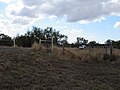
Dingo Fence at Igy Corner, SW of Coober Pedy

The 5,614km fence begins in South Australia, where it is named the dog fence, and it enters the NSW border near Broken Hill, where it becomes the state's responsibility and is called the wild dog fence. At Cameron Corner, it swerves north into Queensland and becomes the wild dog barrier fence. It travels the route commenced in the 1940s by the old dingo fence, which was used to drive out dingoes from grazing land to the west and agricultural country in Queensland's Darling Downs.[7]

The 2,500 km (1,553 mi) section of the fence in Queensland is also known as the Great Barrier Fence or Wild Dog Barrier Fence 11. It is administered by the Department of Agriculture and Fisheries. The Wild Dog Barrier Fence staff consists of 23 employees, including two-person teams that patrol a 300 km (186 mi) section of the fence twice every week. There are depots at Quilpie and Roma.[8]

The Queensland Border Fence stretches for 394 km (245 mi) westwards along the border with New South Wales, into the Strzelecki Desert. The fence passes the point where the three states of Queensland, New South Wales and South Australia meet (Cameron Corner). At this point, it connects with the South Australian Border Fence, which runs for 257 km (160 mi) southwards along the border with New South Wales,[9] these two sections are managed by the New South Wales Wild Dog Destruction Board.[10] It then joins a section known as the Dog Fence in South Australia, which is 2,225 km (1,383 mi) long.[1]

Physical design

[edit]
A portion of the dingo fence near Coober Pedy, South Australia

The fence varies in construction. Mostly it is made of 180-centimetre (6 ft) high wire mesh, but some sections in South Australia comprise multi-strand electric fence. The fence line on both sides is cleared to a 5 m (5.5 yd; 16 ft) width.[11]

Parts of the Dingo Fence are lit at night by 86 mm (3.4 in) cold cathode fluorescent lamps which are alternately red and white. They are powered by long life batteries which are charged by photovoltaic cells during the day.[12] At minor and farm crossings, a series of gates allow vehicles to pass through the fence.[13] Where the fence intersects major roads and highways, cattle grids are used to allow high-speed vehicles through.

Maintenance of the fence on the NSW side is managed by a team of 13 staff who manage portions of the fence between 60km and 100km, where they carry inspections every Monday and Friday. They are paid between $26 and $31 an hour with accommodation.[7]

Environmental impact

[edit]
Distribution map of Australian dingoes. The black line represents the Dingo fence (after Fleming et al. 2001).
Distribution map of Australian dingoes. The black line represents the Dingo Fence (after Fleming et al. 2001).

It seems that there are fewer kangaroos and emus on the northwestern side of the fence where the dingoes are, suggesting that the dingoes' presence reduces the populations of those animals.[14] Although the fence has been useful for protecting livestock against dingoes, ecologists opine that the fence is a colonial legacy that is more harmful than helpful.[7]

Believed to have been introduced into Australia by Aboriginal peoples between 4,600 and 18,300 years ago,[15] the dingo's status as a native or introduced species in Australia has been a controversy. According to Mike Letnic of the University of New South Wales, the dingo, as Australia's top predator, has an important role in maintaining the balance of nature. Where dingoes had been excluded by the fence, Letnic found reduced biodiversity, with fewer native mammals.[16]

Although the fence has helped reduce the loss of sheep to predators, the exclusion of dingoes has allowed for increased pasture competition from rabbits, kangaroos and emus. In a 2024 report conferred to the lands minister, Steve Kamper, the board chair, Andrew Bell, stated that fewer than 10 wild dogs were reported outside the fence, with a full review of the NSW side of the fence accomplished and shown to be in "very good order". Furthermore, Department of Regional NSW spokesperson stated that the fence is "one of a range of tools used in the fight against wild dogs and other biosecurity threats", since it prevents the entry of many different animals, not just dingoes.[7]

Dr Tom Newsome, a researcher at the University of Sydney’s global ecology lab, stated that by locking dingoes out, the fence may render unique perception into how they interact with the land. He says, “when you look at what happens when you remove an apex predator, there are some negative effects on the ecosystem...We have more herbivores, we have more invasive predators, localised extinctions, there's a negative story around that.”[7]

Drone and satellite technology have illustrated how removing dingos changes vegetation growth.[17]

[edit]

See also

[edit]

References

[edit]

Further reading

[edit]
Revisions and contributorsEdit on WikipediaRead on Wikipedia
from Grokipedia
The Dingo Fence, also known as the Dingo Barrier Fence or Dog Fence, is a 5,614-kilometre pest-exclusion barrier spanning southeastern , constructed to prevent () and other wild dogs from accessing pastures and preying on sheep and . Built primarily between the late 1940s and 1950s by collaborative efforts of , , and governments, the fence originates near Jimbour in , extends through arid interiors, and terminates near the in , forming the world's longest continuous man-made structure dedicated to vertebrate . Comprising wire mesh, toppings, and reinforced posts typically 1.8 metres high with an apron to deter digging, the fence has demonstrably reduced dingo predation in enclosed southeastern grazing zones, enabling sustained sheep production where losses previously reached unsustainable levels—empirical assessments indicate stable or increasing numbers within protected areas compared to buffer zones reliant on lethal controls alone. However, its exclusion of es, an , has cascading ecological effects: peer-reviewed studies document elevated abundances of mesopredators such as red foxes and feral cats south and east of the barrier, correlating with depressed populations of small- and medium-sized native mammals due to intensified predation pressure in the absence of dingo suppression. These impacts, alongside barriers to faunal dispersal and , fuel ongoing debates over the fence's long-term viability amid calls for partial decommissioning to restore trophic balances, though protection imperatives maintain its operational status through rigorous annual inspections and repairs costing millions.

History

Origins and Early Development

, introduced to Australia approximately 4,000 years ago by Southeast Asian seafarers, established as apex predators across the mainland, preying on native wildlife. With European settlement from 1788, dingoes quickly targeted introduced , particularly sheep, disrupting early pastoral expansion; violent encounters were recorded as early as the First Fleet's arrival, when dingoes attacked sheep in . As intensified in the early , dingo predation expanded with livestock distribution, contributing to economic pressures on settlers in arid and semi-arid regions. In and during the , anecdotal reports and documented losses from attacks fueled demands for protective measures, as sheep flocks suffered substantial depredation amid droughts and expanding frontiers. Annual losses reached significant levels, with graziers in noting raids as a primary barrier to viable sheep operations by the late ; similar pressures in Queensland's zones prompted organized responses. -proof emerged as a proposed solution by the , but gained traction in the as an alternative to bounties and , which proved inconsistent. Preliminary efforts involved graziers erecting short, localized dog-proof netting fences around individual properties in and to safeguard flocks. By 1885, state-initiated barrier fences, originally designed to halt incursions, were adapted or extended for dingo exclusion, marking the shift to larger-scale constructions; a notable early segment in , completed around 1890, formed part of the nascent network protecting southeastern grazing lands. These initial barriers, spanning hundreds of kilometers, laid the groundwork for more extensive systems amid ongoing threats.

Major Construction Phases

The Dingo Fence emerged from the linkage of earlier vermin-proof and rabbit-exclusion fences constructed primarily in the early across , , and . In , initial segments using wire mesh and wooden posts were established around the 1900s as part of border protection efforts. saw phased rabbit fence builds starting in 1886, extending to 1,171 km by 1903, with further developments under rabbit boards through the and to address incursions alongside s. 's early fences under the Vermin Districts Act formed cooperative districts, setting the stage for later unification. Coordinated construction to form a continuous dingo barrier accelerated post-World War II, following delays from wartime resource constraints. The South Australian Dog Fence Act of 1946, assented December 19 and proclaimed June 17, 1947, enabled the integration of existing fences into a unified system stretching approximately 2,365 km from the to the border. In Queensland, the Barrier Fence Scheme was proposed in 1948, with landholders providing labor while governments supplied materials, extending and realigning segments built decades earlier. By the 1950s, these efforts culminated in a near-continuous barrier totaling 5,614 km, incorporating engineering milestones such as wire mesh netting, aprons, and droppers spaced at intervals, erected through labor-intensive methods overseen by state governments and pastoral boards. The linkage by 1946-1947 in key sections marked the transition from fragmented protections to a strategic , though full dingo-proofing required ongoing adaptations.

Post-Completion Evolution

Following the linkage of disparate fences into a continuous barrier in the 1950s, the structure's emphasis transitioned from rabbit exclusion to primary containment of , as —introduced experimentally in 1950 and widely effective thereafter—decimated rabbit populations across much of , rendering rabbit-proofing secondary. This shift aligned with the fence's adaptation for livestock protection, incorporating reinforcements such as additional netting and later electric outriggers to withstand breaches by larger feral dogs (dingo-domestic hybrids) and macropods like , which burrowed or forced gaps averaging one new hole every 18 days per kilometer in under-maintained sections. In the 1960s and 1970s, aerial 1080 baiting campaigns outside the fence curtailed wild numbers, fostering complacency that resulted in widespread neglect, disrepair, and breaches—exemplified by incursions documented as close as meters inside protected zones by 1976. State governments responded with targeted restorations, including realignments adding thousands of square miles of protected area in (e.g., 4,863 square miles near in 1964) and repairs to address and fire damage, restoring operational continuity by the mid-1970s. Administrative evolution bolstered long-term integrity, with South Australia's Dog Fence Board—established in 1947—amended in 1975 to create local boards for decentralized oversight, while consolidated prior dingo boards into streamlined state management by the early , formalizing shared funding and patrol responsibilities across jurisdictions. These changes emphasized coordinated threat response without altering the fence's core exclusionary role.

Geographical and Structural Features

Route and Extent

The Dingo Fence stretches 5,614 kilometers across southeastern , marking it as the world's longest continuous man-made fence. It originates in Queensland's near Jimbour and Dalby, approximately 200 kilometers inland from the southeastern Queensland coast. From there, the fence extends generally southeast, bisecting and entering , where it passes through the tripoint at Cameron Corner before terminating near Fowlers Bay on the . This extensive barrier traverses diverse biomes, including vast arid deserts, semi-arid shrublands, and grasslands, spanning elevations from coastal plains to inland plateaus. The route effectively delineates the arid interior and northern regions from the more temperate and fertile southeastern agricultural heartlands, protecting approximately 170,000 square kilometers of grazing land. Strategically routed to maximize protection of sheep-farming districts, the fence encloses southeastern pastoral zones while skirting major fertile river valleys and avoiding unnecessary exclusion of productive soils. In Queensland alone, it covers about 2,500 kilometers, with Australia's segment measuring 2,110 kilometers from the state to the coast.

Design Specifications

The Dingo Fence, also known as the Dog Fence or Wild Dog Barrier Fence, features a standard height of 1.8 meters, constructed primarily from wire mesh or dog netting to form an effective physical barrier against dingoes. This height was determined through observations of dingo jumping capabilities, exceeding typical leap heights while balancing construction feasibility in arid terrains. The mesh is typically secured to wooden or steel posts spaced approximately 4 to 6 meters apart, with steel droppers or star pickets inserted every 3 to 4 meters to provide additional support and maintain tension. To deter digging, the base of the netting is buried approximately 30 centimeters underground in standard sections, creating a subsurface barrier informed by empirical assessments of dingo burrowing behavior. Climbing is discouraged through strained plain wires and strands at the top, often forming an outward-angled or overhang that exploits the animal's inability to grip smooth or spiked surfaces effectively. The , generally around 100-150 mm, excludes adult dingoes (which cannot pass through due to body size) while permitting smaller native mammals like bilbies or bandicoots to traverse, preserving ecological connectivity for non-target species. In flood-prone or erosion-vulnerable areas, design refinements include reinforced posts with deeper footings and elevated netting sections up to 2 meters, or hinged aprons of extending outward to prevent undermining during water flows; these adaptations stem from field tests documenting breach points under hydraulic pressure and predator exploitation. components predominate in corrosive soils, with standards ensuring longevity against , though wooden posts remain in less exposed segments for cost efficiency during initial builds. Overall, the specifications prioritize dingo exclusion via multi-layered deterrence—vertical height, subsurface anchoring, and anti-climb toppings—while minimizing impedance to smaller based on predator-prey size differentials observed in Australian rangelands.

Adaptations to Terrain

The Dingo Fence's construction incorporated modifications to address the challenges of diverse terrains, including sandy deserts, rocky outcrops, and flood-prone watercourses along its extensive route. In sandy regions prone to shifting sands, deep post anchors were employed to enhance stability and mitigate risks. Durable galvanized and high-tensile wire were selected for these areas to withstand extreme heat and sand movement. In rocky outcrops, posts were similarly anchored deeply to secure the structure against the rigors of hard, uneven ground. For floodways and river crossings, specialized designs featured heavy cabling and netting reinforced with timber logs on the downstream side to endure seasonal flooding and prevent structural failure. Gates at minor and farm crossings, along with cattle grids at major roads, allowed passage while preserving the barrier's integrity. In certain segments, the fence line was realigned to leverage natural , such as escarpments, thereby minimizing the extent of artificial required. Multiple layers of wire provided additional reinforcement in high-vulnerability zones identified from initial construction experiences.

Purpose and Operational Effectiveness

Core Objectives

The Dingo Fence, also known as the Dog Fence or Dingo Barrier Fence, was constructed primarily to exclude (Canis dingo) and hybrid wild dogs from the fertile southeastern regions of , thereby protecting sheep and herds from predation. This foundational goal addressed the economic threat posed by these apex predators to pastoral industries, which relied heavily on grazing in areas like , , and parts of . By creating a physical barrier, the fence aimed to enable sustainable south of the line, where dingo incursions had historically disrupted operations and incurred substantial costs to graziers. Prior to the fence's major construction phases in the mid-20th century, attacks on were a persistent challenge, with historical records from documenting peak predation between 1890 and 1910, including annual losses reaching up to 20% of flocks in affected areas. These depredations stemmed from ' opportunistic behavior, targeting vulnerable young and leading to direct financial hits for farmers through reduced herd sizes and increased management expenses. The barrier's design reflected a pragmatic response to this causal dynamic: predation as a direct limiter on agricultural output, necessitating exclusion to restore viability without relying solely on localized , which proved insufficient across vast rangelands. Secondary objectives included mitigating disease transmission risks associated with wild dogs, such as the spread of pathogens from populations to domestic animals, and indirectly curbing pest pressures on crops by limiting predator-driven disruptions in grazing zones. , introduced to by human seafarers approximately 5,000 years ago as a semi-domesticated canid from Asian lineages, lack the status of endemic in the context; their proliferation post-introduction conflicted with European-style farming introduced in the . Thus, the embodied a prioritization of human economic imperatives—securing food production and rural livelihoods—over maintaining contiguous habitats for introduced predators, aligning with first-principles where agricultural outputs outweigh unmanaged mobility.

Empirical Evidence of Success

Historical records document substantial reductions in dingo predation on sheep following the Dog Fence's establishment in , where pre-fence annual losses reached up to 20% of flocks during peak periods between 1890 and 1910. Post-completion around 1946, such losses became rare and isolated, enabling sustained high livestock survival rates in protected zones attributable to the barrier's exclusion of from core sheep-grazing areas. Property-level data from the late illustrate the fence's role in boosting stocking capacities, with one documented case showing sheep numbers rising from 4,000 to 14,000 head after implementation, reflecting broader industry expansion south of the barrier where presence was minimized. Economic analyses confirm ongoing benefits, projecting net present values of $58.9 million to $120.3 million over 20 years from and replacement, driven by preserved sheep enterprise income and reduced private costs for wild dog predation, estimated at 0.56%–1.12% annual losses without intervention. Monitoring by pastoral authorities indicates the fence restricts wild dog incursions effectively, maintaining low dingo abundances south of the structure compared to self-sustaining populations north, where hybridization with domestic dogs exacerbates predation pressures on . This exclusion supports long-term viability of the $4.3 billion South Australian livestock sector, with coordinated barrier integrity preventing widespread breaches that would otherwise amplify losses.

Limitations and Evolving Threats

The Dingo Barrier Fence, while effective against large-scale dingo movements, is susceptible to breaches caused by environmental forces such as floods, which erode or wash out sections, allowing temporary predator incursions into southeastern lands. Repairs following such damage often require rebuilding older segments, highlighting the structure's vulnerability to events exacerbated by variability. The fence's design specifications, optimized for excluding dingoes through height and anti-digging aprons, offer limited barriers to smaller like foxes (Vulpes vulpes) and rabbits (Oryctolagus cuniculus), which exploit gaps, burrow underneath, or traverse via wildlife crossings unintended for their passage. Fox populations exhibit higher densities south of the fence, correlating with reduced dingo presence rather than exclusion by the barrier itself, necessitating supplementary pest controls such as baiting or shooting in pastoral zones. Since the early 2000s, escalating threats from dogs—often hybrids resulting from escaped domestic pets interbreeding with northern —have intensified pressure on the fence, with reported increases in wild dog occurrences and depredation prompting calls for integrated strategies beyond physical exclusion. These hybrids contribute to shifting predator dynamics, as domestic ancestry may enhance adaptability to human-modified landscapes, undermining the fence's long-term isolation of pure populations north of the barrier and requiring , ground patrols, and lethal interventions to mitigate breaches.

Management and Economics

Maintenance Practices

The maintenance of the Dingo Fence, also known as the Dog Fence or Wild Dog Barrier Fence, relies on regular patrols conducted by dedicated fence maintenance officers and local boards across its tri-state extent in , , and . In , seven Border Fence Maintenance officers, stationed at outposts along the fence, perform twice-weekly vehicle-based patrols to inspect for structural integrity, damage from weather or wildlife, and potential breaches. In , local Dog Fence Boards and private landholders conduct inspections every 14 days, covering the entire fence length to identify issues such as vegetation overgrowth or flood-induced damage. These patrols prioritize early detection to prevent predator incursions, with officers documenting conditions and initiating immediate fixes where feasible. Repairs focus on restoring the fence's exclusion capabilities through targeted interventions like wire restringing and post replacement. Common damages from floods, emus, kangaroos, or wombats are addressed by splicing or replacing barbed wire strands and substituting degraded mulga posts with durable steel star pickets, as observed in routine fixes near gates and flood-prone sections. In South Australia, post-flood rebuilds have included completing segments up to 10.5 km of new fencing in affected areas like Billeroo West to Mulgaringie. Rapid response protocols ensure that breaches are sealed promptly to minimize livestock exposure to dingoes, with officers equipped for on-site welding, tensioning, and reinforcement. Vegetation management involves ongoing clearing to maintain visibility and prevent that could facilitate predator crossings, in line with state requirements. Patrol officers remove weeds and control regrowth using manual methods or herbicides, as trialed in problem sections like Lake Everard and Wilgena in , where recent rains exacerbate overgrowth. This upkeep, performed during regular inspections, avoids accumulation that could weaken the fence's deterrent effect or hinder access for repairs. Gate protocols emphasize secure closure to uphold the barrier's integrity, with officers routinely checking and latching gates left ajar by travelers or stock movements. Under South Australia's Dog Fence Act 1946, leaving gates open incurs penalties, reinforcing landholder responsibilities for adjacent access points. Wildlife entanglements, such as those from or emus impacting the wire, are assessed during patrols, with immediate disentanglement or repair prioritized to avert structural compromise and sustain exclusion efficacy, though non-target impacts on remain a noted challenge in inspections.

Funding Mechanisms and Costs

The maintenance of the Dingo Fence, spanning , , and , is funded through a combination of subsidies, contributions from local governments, and compulsory levies or rates imposed on landholders whose properties benefit from the barrier's protection against wild dogs and . These mechanisms reflect shared responsibilities, with landholders typically bearing a portion via area-based charges to ensure ongoing viability. Aggregate annual maintenance expenditures across the states are estimated at approximately AU$10 million, covering routine inspections, repairs, and material replacements, though state-specific budgets vary based on fence segments managed. In New South Wales, the Border Fence Maintenance Board levies wild dog rates of 6.3 cents per hectare on landholdings exceeding 1,000 hectares in the Western Division, generating $1.86 million in revenue for the 2024 rating year. This is supplemented by state government funding of $508,364, contributing to total revenue of $3.56 million against expenses of $2.87 million. Expenditures include personnel services for full-time inspectors and staff ($919,000), contractor hire for repairs ($695,000), and fence materials ($353,000), with additional emergency repairs following 2022 floods funded via the NSW Severe Weather and Flood Grant Program. Queensland's Dingo Barrier Fence receives an annual budget of about $2.2 million, split equally between the state government ($1.1 million) and nine local governments through precept levies under the Land Protection (Stock Route Management) Act 2002. These local contributions, totaling around $1.1 million, are derived from councils in protected areas and indirectly supported by pastoral industries, without direct landholder levies specified in funding structures. Maintenance covers labor for inspections and repairs, though detailed breakdowns are integrated into the overall budget. In , the Dog Fence Board collects rates from landholders south of the fence on properties larger than 10 square kilometers, tiered at $2.00 per square kilometer (minimum $475) for most areas and $1.70 per square kilometer (minimum $245) for others, yielding $505,000 in 2023-24. Additional funding includes $274,000 from the South Australian Sheep Industry Fund levy on sold sheep and a $989,000 state , supporting total maintenance income of $1.77 million. Key expenditures encompass staffing and board costs ($262,000), fence maintenance ($200,000), supplies and services ($332,000), and to local boards or private owners ($810,000). Historical costs have escalated significantly from early 20th-century phases, when per-kilometer expenses were minimal due to manual labor and basic materials, to current figures adjusted for , rising wages, and material prices—evident in levy increases from 5.5 cents per hectare in 2023 to 6.3 cents in 2024. Emergency events, such as floods, further drive sporadic spikes, necessitating grant-based interventions beyond routine allocations.

Cost-Benefit Evaluations

A 2019 economic analysis of the South Australian Dog Fence estimated annual maintenance costs at AU$1.126 million, with a proposed replacement program costing AU$25.1 million over three years (2018/19–2020/21), while projecting net benefits from reduced wild dog predation on sheep enterprises ranging from AU$56.4 million to AU$112.9 million in over 20 years across varying impact scenarios. The analysis calculated internal rates of return between 26% and 45%, far exceeding the 6% discount rate, with replacement outperforming continued patchwork repairs by enhancing survival rates (0.56%–1.12% reduction in losses). A 2007 benefit-cost assessment of Western Australia's State Barrier Fence, covering a 25-year horizon, found benefit-cost ratios of 1.08 to 2.42 across sections, driven by averted losses from wild dogs (up to $5.2 million ), emus (AU$11.5 million), and (AU$1.8 million) to protected . Annual maintenance for upgraded fencing was projected at approximately AU450500perkilometer,yieldingpositivenet[presentvalue](/page/Presentvalue)s(e.g.,AU450–500 per kilometer, yielding positive net [present value](/page/Present_value)s (e.g., AU9.1 million for the full fence under optimal specifications), confirming economic viability through sustained wool and production in fenced zones. Nationally, maintenance of the dingo-barrier fence system approaches AU$10 million annually, yet return-on-investment models from these state-level studies indicate multiples of 3–5 times in averted depredation, supporting continuation over decommissioning, which would disregard empirical evidence of farm profitability dependence on exclusion. These evaluations underscore contributions to broader agricultural GDP via secure sheep grazing south of the fence, where predation risks otherwise erode enterprise margins.

Environmental and Ecological Consequences

Predator Exclusion Effects

The Dingo Fence excludes (Canis dingo) from southeastern , maintaining near-zero dingo densities south of the barrier through continuous exclusion and control efforts, in contrast to densities ranging from 0.03 to 0.3 individuals per km² north of the fence where persist as apex predators. This predator exclusion directly diminishes top-down control on prey populations south of the fence, enabling irruptions of medium-sized herbivores such as red kangaroos (Osphranter rufus) and emus (Dromaius novaehollandiae). Aerial surveys conducted from 1991 to 2001 across revealed stark fence-line contrasts: post-drought, and populations inside the fence exhibited typical rapid recoveries to high densities, while those outside remained suppressed as numbers increased with improving conditions. These patterns indicate dingo predation as a key regulator preventing booms north of the fence, with densities notably higher inside the fence in compared to adjacent dingo-inhabited areas in . South of the fence, the relaxation of predation pressure has correlated with elevated abundances contributing to in unmanaged rangelands, where increased herbivore densities reduce vegetation cover and exacerbate . Comparative assessments of assemblages confirm that larger herbivores subject to dingo predation, including kangaroos, achieve higher abundances in dingo-absent zones south of the fence. Northward, sustained dingo presence enforces lower equilibrium densities among these prey species, as observed in arid regions where predation limits post-drought rebounds.

Ecosystem Dynamics North and South

North of the Dingo Fence, where dingoes (Canis lupus dingo) maintain higher population densities, their predation suppresses macropod abundances, particularly red kangaroos (Osphranter rufus), resulting in reduced grazing pressure and elevated vegetation cover observable via . This dynamic correlates with lower rates of in certain arid landscapes, as decreased kangaroo densities limit and maintain ground cover integrity, though direct causation requires accounting for variable rainfall and . However, in transitional zones with overlap, elevated dingo activity intensifies competitive pressures on native prey and incurs higher predation on calves and sheep, altering local trophic interactions without uniformly benefiting wild regulation. South of the fence, dingo exclusion fosters macropod population irruptions, with densities in exceeding those in adjacent dingo-present areas by factors of up to three times, driving intensified grazing that depletes soil nutrients and promotes bare ground formation. This has led to measurable vegetation recovery in selectively managed grazed pastures under controlled stocking rates, countering narratives of pervasive degradation by demonstrating fence-enabled stability in human-modified systems, though wild ungrazed zones exhibit persistent from unchecked herbivory. Empirical data from Sturt National Park, spanning the fence boundary, indicate mixed landscape responses, including variable small mammal abundances and no uniform trophic cascade reversal upon dingo presence, underscoring that local experiments yield inconclusive patterns for ecosystem-wide predictions rather than definitive support for reintroduction. These observations highlight verifiable north-south divergences in herbivory and metrics over speculative modeling, with dingo-mediated suppression evident north but modulated by site-specific factors south.

Long-Term Biodiversity Outcomes

Long-term monitoring across the Dingo Fence reveals persistent differences in mammal assemblages, with native small mammals generally more abundant north of the fence where dingoes suppress mesopredator populations such as red foxes (Vulpes vulpes). Spotlight surveys in arid regions indicate higher densities of species like the dusky hopping-mouse (Notomys fuscus) north of the fence (e.g., 0.10 sightings/km south vs. higher north), while foxes exhibit elevated abundances south (0.20 sightings/km south vs. 0.00 north), consistent with mesopredator release following dingo exclusion. Feral cats (Felis catus) show minimal variation across the fence, suggesting dingoes exert stronger control over foxes than cats. These patterns hold after accounting for regional rainfall gradients (180–220 mm annually), indicating dingo presence as a primary structuring factor rather than climatic variation alone. South of the fence, native small mammals persist at lower abundances and with reduced diversity compared to pre-European baselines, yet no data indicate ongoing extinctions or irreversible collapse within this human-modified landscape dominated by introduced predators and grazers. Cumulative ecological surveys spanning decades demonstrate stable, albeit shifted, community structures south, where dunnarts (Sminthopsis spp.) maintain comparable densities to northern populations despite elevated predation. This persistence occurs amid widespread Australian declines driven by feral cats, es, and rabbits—factors predating and transcending the fence—highlighting that exclusion effects represent one modulator in a multi-causal framework rather than a sole driver of degradation. Northern assemblages benefit from dingo-mediated suppression, fostering higher small metrics, but southern managed ecosystems sustain viable remnant populations through supplementary controls on invasives. Criticisms attributing southern primarily to exclusion overlook rainfall variability's dominant role in dynamics, as evidenced by aerial surveys showing (Osphranter rufus) and (Dromaius novaehollandiae) booms post-drought amplified south but fundamentally triggered by pulses. Inside the fence, populations surged after low-rainfall periods (e.g., 1990s drought recovery), reaching higher densities due to absent predation, yet outside, increases constrained rebounds to low levels. This interaction underscores episodic rainfall as the baseline driver, with exclusion exacerbating but not originating grazing pressure in a system already altered by and introduced s like rabbits, which are more abundant north. Empirical data refute claims of ecosystem-wide collapse, affirming stable alternate states where southern , though restructured, supports managed persistence without evidence of unrecoverable loss.

Controversies and Perspectives

Pro-Fence Arguments

The Dingo Fence has been instrumental in safeguarding Australia's sheep industry from predation, reversing pre-existing threats that imperiled pastoral viability in southeastern regions. Historical analyses of South Australian records from the 19th and early 20th centuries reveal that dingo depredations inflicted substantial losses on sheep flocks, often rendering early colonial grazing untenable without constant shepherding or relocation. The fence's completion between and , supplemented by and baiting, effectively excluded dingoes from southern agricultural zones, enabling sustained and meat production that stabilized rural economies. Long-term data from indicate that dingo exclusion facilitated sheep population expansions and distributional shifts into previously untenable areas, correlating with industry growth over five decades of monitoring. Economically, the fence underpins by prioritizing livestock protection in arable lands, where generates verifiable returns exceeding alternative land uses in arid margins. Annual expenditures of about A$10 million are dwarfed by pastoralist estimates of A$48 million in yearly losses from attacks absent barriers, affirming net fiscal prudence. This physical deterrent obviates reliance on resource-intensive lethal measures like widespread 1080 or aerial culls, which demand recurrent funding for deployment, monitoring, and of unintended casualties. Dingoes, introduced to Australia approximately 4,000 years ago via maritime activity from , function as non-native predators whose impacts on domestic herds warrant containment to preserve agricultural outputs essential for national sustenance. Policy perspectives from graziers emphasize empirical safeguarding over unmanaged predator , given ' historical role in suppressing sheep viability prior to engineered interventions.

Anti-Fence Criticisms

Critics of the Dingo Fence contend that it interrupts trophic cascades by preventing from suppressing and mesopredators south of the barrier, resulting in elevated and populations that degrade and soil stability. A 2017 analysis by Ritchie et al. documented correlative patterns where dingo exclusion correlated with reduced vegetation growth, increased herbivore densities, and diminished soil nutrients inside the fence, attributing these to absence. Similar observations in arid regions link fence-induced dingo scarcity to shrub encroachment and dune stabilization disruptions via herbivore north versus south. These claims, however, derive primarily from observational comparisons across the fence rather than randomized interventions, limiting amid variables like variable rainfall and historical . Restoration advocates propose decommissioning the fence to permit dingo dispersal southward, positing enhanced through predator-mediated regulation of prey and in marginal grazing lands. A 2021 review by Wallach et al. argues that removal could bolster arid zone resilience against climate variability by reinstating roles in trophic regulation and , while addressing the barrier's role in fragmenting ecosystems. Proponents cite potential for dingoes to curb and abundances, indirectly aiding small mammals, though such projections extrapolate from northern dingo-dominated areas without accounting for southern hybridization risks or conflicts. The fence also faces reproach for hindering among wildlife populations and impeding Indigenous practices tied to as cultural , including traditional tracking and ceremonial uses. Documented restrictions on dingo movement have been linked to reduced genetic exchange for like , exacerbating isolation in fenced zones, yet quantitative data on demographic viability or cultural disruptions remain sparse and anecdotal. Empirical assessments of these barriers are constrained by the fence's longevity, complicating pre- versus post-impact baselines.

Policy Debates and Future Prospects

Policy debates surrounding the Dingo Fence center on its long-term viability amid escalating maintenance demands and ecological critiques. Proponents of continued investment, primarily agricultural stakeholders, argue that the fence safeguards industries valued at billions annually by excluding wild dogs, with economic assessments indicating that removal could impose losses exceeding $40 million yearly in sheep predation alone. Opponents, including some conservation biologists, advocate decommissioning to facilitate dingo-mediated suppression of invasive mesopredators like foxes and cats, citing studies showing enhanced small mammal populations north of the fence. These positions reflect entrenched stakeholder conflicts, where empirical loss data supports farmers' emphasis on exclusion, while ecologists highlight biodiversity gradients but often overlook the causal primacy of predation risks to human food production systems. Recent proposals in the 2020s include partial realignments to close gaps, such as the effort to bridge a 32 km section, alongside trials of upgrades like drone for breach detection, initially tested in to reduce manual inspection costs. These measures are weighed against calls for full removal, as articulated in a 2021 submission to the Decade on Ecosystem Restoration, which posits the fence as a barrier to faunal connectivity and . Annual upkeep exceeds $10 million, distributed across jurisdictions, prompting scrutiny of cost-effectiveness amid static budgets and variable efficacy against breaches. Future prospects hinge on integrating the fence with broader wild dog management frameworks, such as the National Wild Dog Action Plan's emphasis on coordinated lethal controls, guardian animals, and fencing enhancements to counter evolving threats like dingo-domestic dog hybridization, which genetic monitoring reveals as pervasive south of the barrier and diluting native canid traits. Climate pressures exacerbate vulnerabilities, with floods eroding sections and bushfires igniting wire entanglements, necessitating resilient designs or localized abandonments in high-risk zones. Empirical modeling favors sustained maintenance coupled with integrated pest strategies over outright removal, as these yield net economic gains for pastoral viability while allowing targeted ecological interventions elsewhere. Ongoing genetic and landscape-scale assessments will likely inform adaptive policies, prioritizing verifiable predation reductions over unsubstantiated restoration narratives.

References

Add your contribution
Related Hubs
User Avatar
No comments yet.