Hubbry Logo
search
logo
2033182

Dolbadarn Castle

logo
Community Hub0 Subscribers
Read side by side
from Wikipedia

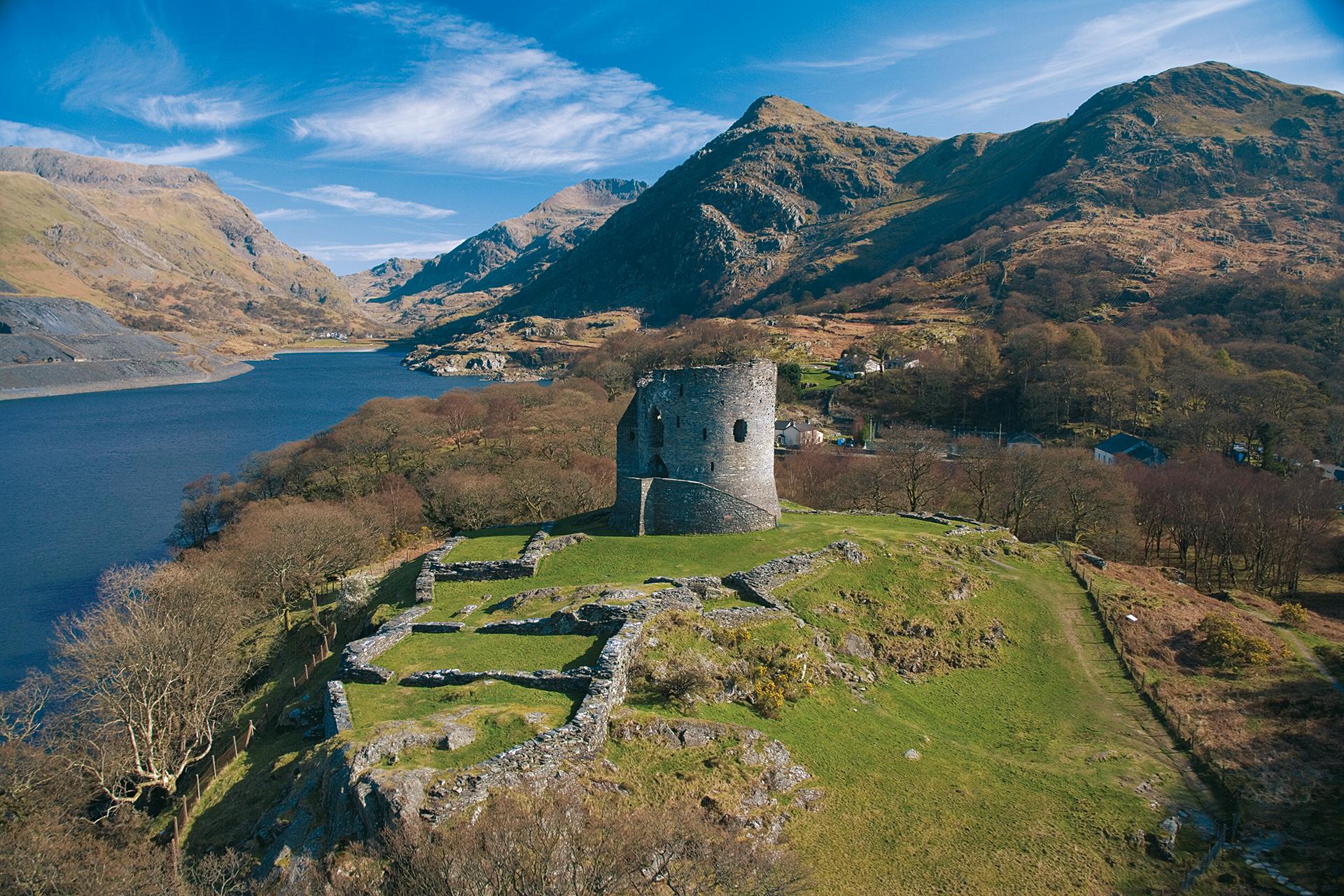
Dolbadarn Castle (English: /dɒlˈbædɑːn/ dol-BAD-an; Welsh: Castell Dolbadarn;[a] Welsh pronunciation: [kastɛɬ dɔl'badarn]) is a fortification built by the Welsh prince Llywelyn the Great during the early 13th century, at the base of the Llanberis Pass, in northern Wales. The castle was important both militarily and as a symbol of Llywelyn's power and authority. The castle features a large stone keep, which historian Richard Avent considers "the finest surviving example of a Welsh round tower".[2] In 1284 Dolbadarn was taken by Edward I, who removed some of its timbers to build his new castle at Caernarfon. The castle was used as a manor house for some years, before falling into ruin. In the 18th and 19th centuries, it was a popular destination for painters interested in Sublime and Picturesque landscapes. It is now owned by Cadw and managed as a tourist attraction, and is protected as a grade I listed building.

Key Information

History

[edit]

1220–40

[edit]

Dolbadarn Castle was built in either the 1220s or the 1230s by Llywelyn the Great, at the base of the Llanberis Pass, overlooking the lake of Llyn Padarn in northern Wales.[3] Traditionally the Welsh princes had not constructed castles, instead using undefended palaces called llysoedd, or courts.[4] From the late 11th century onwards, the Normans had advanced into Wales, taking lands in the north and establishing a band of occupied territory in the south called the Welsh Marches. During the 12th century, some timber and earthwork castles began to be built but in small numbers.[5]

Plan of the castle: A – South Tower; B – Keep; C – West Tower; D – East Building; E – Hall

Llywelyn the Great initially controlled the princedom of Gwynedd, but grew more powerful throughout his reign, extending his influence over much of Wales during the early years of the 13th century.[6] Llywelyn was faced with several challenges, including dealing with the threat from the kings of England and maintaining his authority over the native Welsh.[7] As part of this strategy, Llywelyn built Castell y Bere, an innovative stone Welsh castle, in the 1220s.[8] Shortly afterward he began the first phases of Dolbadarn Castle, constructing the initial stone fortifications on the site, including two square stone towers.[9]

The location of the castle was important both because it controlled an important mountain pass, and possibly because Llywelyn claimed authority as the lord of the mountains and coasts of Wales: several of his castles appear to have been located with such political symbolism in mind.[10] It is also possible that Llywelyn may have built his castle on top of the remains of a previous fortification constructed by Maelgwn Gwynedd, a king of Gwynedd in the 6th century, although no such remains have been found.[11]

As part of his strategy for dealing with the Marcher Lords, Llywelyn married his eldest son, Dafydd, to Isabella, the daughter of William de Braose, a powerful lord in Brecon, Builth and Abergavenny.[7] The Marcher Lords had adopted a style of the stone castle that included circular keeps and an integrated system of curtain walls. Following Dafydd's marriage, Llywelyn appears to have started a second phase of building at Dolbadarn, probably in the 1240s, adding these elements to the existing castle.[12] The prince was probably aiming not only to incorporate the latest military technology but also to create a castle of equal prestige to those of his new allies in the south.[13][nb 1] Traditionally the surrounding district of Is Gwyrfai had been run from the town of Llanbeblig; after the 1240s, this role was transferred to Dolbadarn.[3]

1240–1300

[edit]
The keep, seen across the hall and courtyard

Following Llywelyn's death in 1240, Gwynedd's power declined and many of its eastern lands were taken by Henry III of England in 1247.[15] Llywelyn's grandson, Llywelyn ap Gruffudd, took power in 1255 and imprisoned his brother Owain ap Gruffudd before extending his power across Wales.[15] Owain was eventually released in 1277 and there has been much historical debate over which castle he was held in. Hywel Foel ap Griffri wrote a famous poem describing Owain's long imprisonment in a round tower; historians believe that this refers to the keep at Dolbardarn.[16]

The conflict between the Welsh princes and the English kings continued during the reign of Edward I. In 1282 Llywelyn fought a final campaign against Edward, ending in the prince's death near Builth that December.[17] His brother, Dafydd ap Gruffydd, assumed power but during 1283 was forced south into Snowdonia and by May his government was based from Dolbadarn Castle.[17] Edward deployed 7,000 troops to detain Dafydd who was finally captured and executed in October; Dolbadarn was occupied by Norman forces.[17]

Edward was determined to prevent any further rebellion in North Wales and set about building a sequence of new castles and walled towns, replacing the old Welsh administrative system with a new principality governed from Caernarfon.[18] Dolbadarn was no longer relevant and within two years timber from the castle was being used by the Normans for the construction of Caernarfon Castle.[18] This was both a practical and symbolic action, demonstrating Norman power over one of the most important possessions of the Welsh princes.[18]

14th – 21st centuries

[edit]
J. M. W. Turner's painting Dolbadarn Castle, 1800.
"Dolbadarn Castle, Llanberis, Wales", ca. 1890 - 1900.

The remaining parts of the castle continued to be used as a manor house into the 14th century.[18] By the 18th century, however, Dolbadarn Castle was ruined and uninhabited.[19] From the 1760s onwards, however, it became a popular topic for painters interested in the then fashionable landscape styles of the Sublime and the Picturesque.[20] Typically the castle was painted in the middle ground, allowing the viewer's eye to contrast its ruined outline with the lakes and mountains of Snowdonia; frequently the landscape was misrepresented by the artist, to create a more striking or dramatic effect.[21] J. M. W. Turner's 1800 work Dolbadarn Castle depicted the back-lit castle looming over the landscape and became particularly famous, but the paintings of the castle by Richard Wilson and Paul Sandby also represent important artistic works of the period.[21]

In 1941 the castle was given to the State by Sir Michael Duff.[19] It is now maintained by Cadw and is protected as a Grade I listed building and as a scheduled monument. In the light of Welsh devolution and other political changes, the history of Dolbadarn Castle and similar Welsh castles has become increasingly prominent. In response, Cadw noted that they intend to give increased priority to communicating the history of these castles and the Welsh princes.[22] Since 2024, Cadw have used the Welsh name Castell Dolbadarn in English.[1]

Architecture

[edit]
The castle seen from the north-west, showing (near to far) the hall, the courtyard, the west tower, the east building, the keep, and the south tower

Dolbadarn Castle comprises a courtyard, surrounded by several towers and a round keep.[23] The castle is built from purple and green slate stone, mainly constructed in a dry stone fashion without mortar, except the keep.[23] The courtyard follows the natural shape of the hill and is protected by a curtain wall; originally perhaps 15 feet (5 m) high, it is now only at most 3 feet (1 m) high.[24] Of the castle buildings, only the keep remains at any significant height.[25]

The keep today is 46 feet (14 m) high and is modelled on early 13th-century English round towers built in the south of the Welsh Marches.[26] As with other Welsh-constructed towers, the entrance is on the first story, not at ground level; it may originally have been protected by a porch.[23] The keep had a portcullis which would have been drawn up past the window on the second story of the tower.[27] While the castle's flooring has long since disappeared, its interior staircase to the upper story may still be climbed.[28] This second story would have formed the main chamber in the keep and had a large fireplace and a latrine.[28] Originally the keep would have had a parapet and battlements, since destroyed.[28] Historian Richard Avent considers it "the finest surviving example of a Welsh round tower".[2]

The rectangular west tower was a relatively short defensive structure, designed to protect the more vulnerable western slope of the ridge.[24] A similar tower in the south overlooks the entrance to the castle.[25] At the north end of the castle is the hall, stretching across the courtyard; in the east corner is an additional building, probably built by the English at the end of the 13th century.[29] Although the hall is relatively large, 50 by 27 feet (15 by 8 m), these buildings follow a simpler design than those current in England at the time, where a combination of a hall, chamber, and a service block in castles was becoming more common.[30]

See also

[edit]

Notes

[edit]

References

[edit]

Bibliography

[edit]
[edit]
Revisions and contributorsEdit on WikipediaRead on Wikipedia
from Grokipedia
Dolbadarn Castle is a thirteenth-century fortification erected by the Welsh prince Llywelyn ap Iorwerth (Llywelyn the Great) to defend the strategic Llanberis Pass in northern Wales, commanding a rocky promontory above Llyn Padarn lake near the village of Llanberis in Gwynedd.[1][2] The castle's imposing round keep, constructed from local slate and rubble, exemplifies native Welsh military architecture and served as a key bulwark in the defenses of the kingdom of Gwynedd against incursions from Anglo-Norman forces.[1][3] Built likely before 1230 during Llywelyn's campaigns to consolidate power, it symbolized princely authority and controlled access to the mountainous heartland of Snowdonia.[2] Following the death of Llywelyn the Great in 1240, the stronghold remained vital to his grandson Llywelyn ap Gruffudd, who imprisoned his brother Owain there from around 1257 until his release in 1277 as part of peace terms with Edward I of England.[3] Captured by English forces in 1283 during the final conquest of Wales, the castle was partially dismantled, with timbers repurposed for Edward's new fortress at Caernarfon, and it subsequently decayed into ruin while serving briefly as a manor house.[3] Today, the evocative remnants, managed by Cadw, stand as a testament to medieval Welsh resilience amid the dramatic landscape of Eryri National Park.[1]

Location and Strategic Context

Geographical Setting

Dolbadarn Castle is positioned on a rocky outcrop elevated roughly 24 meters above the surface of Llyn Padarn, a glacial lake in the Llanberis Valley of Gwynedd, North Wales.[2] This natural prominence affords expansive views across the lake's 3.2-kilometer length and into the Llanberis Pass, with Mount Snowdon rising prominently to the west at 1,085 meters.[4][5] The site's topography integrates with the surrounding rugged terrain, shaped by Ordovician slate bedrock characteristic of the region, providing a stable foundation amid steep slopes and glacial features. The local geology, dominated by slate formations, supports the outcrop's defensibility through its inherent solidity, though extensive slate quarrying in nearby areas like Dinorwig has modified the broader valley landscape via excavation and waste accumulation.[6] As a Cadw-managed site within Eryri National Park, Dolbadarn is reached by a concise, ascending visitor path from the A4086 road, linking seamlessly to circumferential trails around Llyn Padarn and the Llanberis Path for ascents to Snowdon.[1][7]

Strategic Importance in Medieval Wales

Dolbadarn Castle occupied a commanding position at the southern tip of Llyn Padarn, directly overseeing the Llanberis Pass, one of the primary routes penetrating the mountainous heart of Gwynedd from the coastal lowlands.[2] This placement enabled control over access to the upland core of the principality, facilitating the monitoring and interdiction of potential incursions by blocking or ambushing forces navigating the narrow, constricted valley.[1] The pass's topography, characterized by steep enclosing slopes and limited maneuverability, amplified the defensive advantages, allowing a small garrison to disrupt enemy supply lines and foraging parties reliant on the route for provisioning during campaigns.[8] Comparable to Dolwyddelan Castle, which similarly dominated the Lledr Valley route through Snowdonia, Dolbadarn formed part of a networked system of native fortifications securing multiple principal pathways across the mountain massif.[8] Both sites leveraged elevated terrains for visibility and fallback positions, with Dolbadarn's proximity to fertile pastures around the lakes providing logistical sustainment through cattle herding, a key economic base for medieval Welsh resistance.[9] This strategic layering ensured territorial integrity by denying invaders uncontested traversal into Gwynedd's administrative and resource centers without engaging fortified chokepoints. However, the castle's reliance on natural barriers revealed inherent limitations against sustained assaults by larger, better-supplied armies, as evidenced by its swift capitulation in April 1283 following the fall of upstream defenses.[10] Prolonged sieges could exploit vulnerabilities in water access from the lake below and isolation from reinforcements amid encirclement, underscoring that while positional dominance deterred raids, it proved insufficient against coordinated invasions with superior artillery and engineering capabilities.[1]

Historical Development

Construction and Early Use (c. 1220–1240)

Dolbadarn Castle was constructed in the 1220s or early 1230s by Llywelyn ap Iorwerth, known as Llywelyn the Great, prince of Gwynedd, as part of his efforts to fortify key passes in northern Wales.[3][11] The fortress utilized local slate and rubble masonry, reflecting native Welsh adaptation of Norman-inspired stone architecture to project princely authority and replace traditional timber halls with more durable defenses.[2] Historical attribution stems from Llywelyn's documented program of building mountain strongholds, including Dolwyddelan and Castell y Bere, to consolidate control over Gwynedd amid rivalries with Anglo-Norman lords and internal Welsh factions.[12] The castle's primary function during this period was to secure the Llanberis Pass, a vital route linking the Welsh heartlands of Snowdonia to coastal territories, thereby enabling Llywelyn to monitor and blockade movements that could threaten his domain.[3][2] Positioned on a rocky outcrop overlooking Llyn Padarn, it served both as a military outpost and a princely residence, underscoring Llywelyn's unification campaigns that expanded Gwynedd's influence across Wales by the 1230s.[13] Early features likely included timber elements for internal fittings, such as floors and roofs, which were integral to its habitability before later quarrying diminished them.[2] Under Llywelyn's rule until his death in 1240, Dolbadarn exemplified the strategic depth of native Welsh fortifications, prioritizing defensibility in rugged terrain over expansive layouts, and contributed to Gwynedd's temporary dominance in resisting external incursions.[3][12] Contemporary records, while sparse on specific construction details, align the castle's establishment with Llywelyn's peak territorial achievements, as evidenced by his oversight of similar defenses to maintain sovereignty.[2]

Conflicts and Imprisonment (1240–1283)

During the mid-13th century, Dolbadarn Castle served as a stronghold for Llywelyn ap Gruffudd, Prince of Wales, amid intensifying familial rivalries within the House of Aberffraw. Following the Battle of Bryn Derwin on 28 June 1258, where Llywelyn defeated his elder brother Owain Goch ap Gruffudd in a bid for supremacy over Gwynedd, Owain was captured and imprisoned in the castle's round keep.[14] This confinement, lasting nearly two decades until Owain's release in 1277, exemplified the ruthless internal power struggles that characterized Welsh princely politics, with Llywelyn consolidating control by neutralizing potential claimants supported by rival factions and external English interests.[3] The castle's strategic position guarding the Llanberis Pass made it integral to Welsh defenses against English expansionism during the 1260s and 1270s. Llywelyn utilized Dolbadarn as a military base to project authority over Snowdonia's mountainous heartland, supplying troops and resources to counter marcher lords' encroachments and enforce homage from lesser Welsh rulers.[1] Tensions escalated after the 1267 Treaty of Montgomery, which recognized Llywelyn's overlordship but sowed seeds of resentment; by 1276, disputes over feudal obligations prompted Edward I's ultimatum, leading to the First Welsh War of 1277, where Dolbadarn anchored resistance in Gwynedd's core before Llywelyn's eventual submission at Rhuddlan.[10] These conflicts underscored how internal divisions eroded Welsh cohesion, as Owain's earlier rebellions—fueled by alliances with English-aligned nobles—diverted resources from unified fronts against Anglo-Norman forces. Chronicle accounts, such as those in the Annales Cambriae, highlight recurring princely fratricide as a causal factor in defensive vulnerabilities, with Dolbadarn's role shifting from familial prison to frontline bastion amid diplomatic breakdowns and skirmishes along border passes.[15] The imprisonment's resolution via Edward's 1277 treaty terms, exchanging Owain's freedom for territorial concessions, further illustrated how such strife invited external intervention, presaging broader conquests.[16]

Conquest, Decline, and Abandonment (1283–19th century)

In March 1283, during the final phase of Edward I's conquest of Wales, Dolbadarn Castle was surrendered to English forces under the command of Roger Mortimer and other marcher lords, following the death of Prince Llywelyn ap Gruffudd in December 1282 and the collapse of organized Welsh resistance in Gwynedd.[2] The castle's strategic isolation amid Edward's encirclement of remaining strongholds, combined with the execution of Llywelyn's brother Dafydd ap Gruffudd later that year, ensured minimal armed opposition, as Welsh garrisons prioritized survival over prolonged defense.[3] An English garrison was installed to secure the site, but no major fortifications were added, reflecting its diminished military value in the face of Edward's new concentric castle system.[17] By 1284–1285, the castle had been partially dismantled, with timber beams extracted for reuse in constructing Edward I's nearby fortress at Caernarfon, underscoring the English crown's policy of repurposing native structures to fund and accelerate the Edwardian castle-building program.[3] Stone from the walls was also quarried for local building projects, accelerating structural decay as the keep's upper floors and battlements were stripped.[2] Archaeological surveys reveal that by the early 14th century, the site had transitioned to use as a manor house under Crown oversight, with evidence of repaired domestic quarters but no sustained military occupation.[2] The castle's abandonment progressed through the 14th century, as shifting priorities— including the Glyndŵr revolt of 1400–1415, during which it briefly held prisoners like Lord Grey of Ruthin—failed to revive its role, leading to neglect and further material scavenging by locals for slate quarry operations and farm buildings.[2] By the 1550s, records indicate widespread disrepair, with walls breached and roofing absent, corroborated by 19th-century observations of eroded footings and missing wall-walks from prolonged exposure and opportunistic reuse.[18] Into the 19th century, the ruins served as a picturesque landmark amid industrial slate extraction, but without intervention, decay continued unchecked, leaving the round keep as the primary surviving feature amid overgrown debris.[2]

20th–21st Century Preservation

Dolbadarn Castle has been owned and managed by Cadw, the Welsh Government's historic environment service established in 1984, since the late 20th century, serving as a scheduled ancient monument and tourist site.[1][11] The ruins are protected as a Grade I listed building, with formal listing dated 28 May 1999, ensuring legal safeguards against unauthorized alterations.[19] Cadw integrates the castle into Eryri National Park tourism, offering public access with interpretive signage and facilities to promote appreciation of its medieval Welsh origins while controlling visitor numbers to mitigate wear.[20][4] Conservation efforts emphasize stabilization of the stonework and vegetation control to preserve the site's structural integrity without extensive reconstruction. Archival records indicate early 20th-century interventions by the Ministry of Works focused on basic ruin consolidation, transitioning to Cadw-led maintenance in subsequent decades that prioritizes weathering resistance and safety for visitors.[21] No major archaeological excavations or finds have occurred since the mid-20th century, with recent activities limited to routine monitoring rather than invasive digs.[22] In the 21st century, challenges include localized damage from environmental exposure and human activity, exemplified by a 2024 vandalism incident where portions of stone were deliberately removed from the keep using tools, leading to a police appeal for information.[23] Cadw continues annual inspections and minor repairs to address such threats, maintaining the castle as an accessible heritage asset amid growing regional tourism pressures.[1]

Architectural Features

The Round Keep

The round keep at Dolbadarn Castle stands as the site's most prominent surviving feature, constructed in the early 13th century as a robust defensive tower. Originally reaching approximately 50 feet (15.2 meters) in height, the cylindrical structure features walls up to 10 feet thick and an internal diameter of about 42 feet, providing substantial protection against siege tactics prevalent in medieval warfare.[1][24] Its round form, less vulnerable to battering rams and undermining than rectangular counterparts, exemplifies native Welsh adaptations for terrain-specific defense, drawing inspiration from contemporary Marcher lord fortifications while asserting indigenous architectural independence.[1] Internally, the keep includes a cramped spiral staircase ascending from the ground level, facilitating movement between floors while limiting attacker access during breaches. The basal area likely served storage or defensive purposes, with evidence of a void or lower chamber enhancing structural stability on the rocky outcrop. Upper levels once housed a hall chamber for command functions, with remnants suggesting a parapet for archers, though much of the superstructure has eroded over centuries.[24][25] Today, the keep survives to near its original height at around 46 feet (14 meters), though ruinous, with a single accessible staircase featuring modern safety rails. 19th-century documentation, including sketches and paintings, records losses from natural decay and neglect post-Edwardian conquest, underscoring its resilience as one of the finest preserved Welsh round towers.[1][13]

Outer Defenses and Layout

The outer defenses of Dolbadarn Castle enclosed a compact ward on a rocky crag, forming a simple, cohesive enclosure of curtain walls constructed from unmortared slate slabs that contoured the hillside.[1][2] The site, triangular in outline and covering less than one acre, relied on its elevated natural position for defense rather than elaborate fortifications, with only fragmentary remnants of the walls surviving today.[26] A ditch augmented the perimeter, enhancing protection against approach from lower ground, while foundations of rectangular outbuildings within the ward suggest additional utilitarian structures, though their precise functions remain unclear due to limited archaeological evidence.[1][26] Access to the interior was controlled via a gatehouse on the northwestern side, featuring a pointed arch entrance, provision for a portcullis, and a complex reversing spiral stairway, indicative of basic but functional security measures.[26] Unlike contemporary English castles, which often incorporated advanced elements such as barbicans or fortified gate complexes, Dolbadarn's defenses emphasized simplicity, reflecting the material and labor constraints faced by native Welsh builders under Llywelyn the Great.[2] Archaeological investigations have revealed no evidence of extensive timber reinforcements like postholes for outer palisades, underscoring the reliance on dry-stone construction vulnerable to siege without such hybrid enhancements.[26]

Legacy and Cultural Significance

Symbolism in Welsh History

Dolbadarn Castle, constructed by Llywelyn ab Iorwerth in the 1220s, functioned as a military and symbolic projection of Gwynedd's princely authority, strategically positioned to dominate the Llanberis Pass and safeguard access to Snowdonia's core territories.[1] This control facilitated defense against incursions from Anglo-Norman marcher lords, enabling Llywelyn to consolidate power over much of northern Wales during a period of intermittent resistance.[11] The castle's round keep, a rare native Welsh stone tower, underscored efforts to emulate continental fortification techniques while asserting indigenous rule.[10] Its fall in 1283, mere months after Llywelyn ap Gruffudd's death at the Battle of Orewin Bridge on 11 December 1282, exemplifies the empirical constraints on Welsh resistance: despite symbolic resonance as a bastion of independence, the fortress capitulated swiftly to Edward I's advancing columns, which leveraged superior numbers—estimated at over 10,000 troops including archers and infantry—advanced supply chains via coastal ports, and early gunpowder artillery absent among the Welsh.[27] English records indicate Dolbadarn's garrison yielded without prolonged siege, with structural timbers subsequently repurposed for Edward's new fortress at Caernarfon, highlighting technological and organizational disparities rather than mythic invincibility.[28] Historiographical emphasis on Dolbadarn as an icon of unyielding Welsh sovereignty, prominent in early 20th-century cultural narratives amid rising nationalism, tends to idealize princely achievements while downplaying internal fractures, such as the 1274–1275 revolt by Owain ap Gruffudd against his brother Llywelyn ap Gruffudd, which fractured Gwynedd's cohesion and culminated in Owain's imprisonment within the castle for over two decades.[14] This sibling conflict, rooted in succession disputes common among Welsh dynasties, diverted resources and fostered betrayals that English forces exploited in 1282–1283, when southern Welsh lords like Rhys ap Maredudd withheld support.[27] A causally grounded assessment reveals pre-1283 successes in pass blockade, which deterred invasions into Gwynedd's mountainous heartland and secured tribute flows, yet the site's isolation—hemmed by terrain limiting rapid mobilization—precluded scalable alliances with Deheubarth or external actors like Scotland, rendering princely domains vulnerable to piecemeal conquest once unity faltered.[10] Thus, while evoking narratives of defiance, Dolbadarn concretely illustrates how fragmented lordships and logistical asymmetries doomed sustained opposition to centralized English campaigns.[28]

Representation in Art, Literature, and Media

Dolbadarn Castle has been depicted in Romantic-era art, notably in J.M.W. Turner's oil painting Dolbadarn Castle (c. 1799–1800), which portrays the ruins dramatically against the mountainous Welsh landscape of Snowdonia, employing atmospheric effects to evoke the sublime rather than architectural precision.[29] This early work by Turner, submitted as a diploma piece to the Royal Academy, prioritizes emotional grandeur over fidelity to the site's 13th-century round keep, which archaeological surveys confirm as a more austere, functional structure built of local stone without the painting's intensified lighting and mist.[30] Such Romantic interpretations, common in 19th-century landscapes, amplified the castle's isolation and decay to symbolize transience, potentially distorting perceptions of its practical military role as a princely stronghold.[31] References in literature are sparse and often tied to historical narratives of Welsh princes, with the castle appearing indirectly in works evoking medieval confinement, such as Alfred Lord Tennyson's poetic descriptions of rocky fortifications that align with Dolbadarn's setting during his 1830s visits to Llanberis.[32] These allusions tend to infuse anachronistic heroism onto the site, portraying it as a bastion of defiance against English incursions, though primary accounts emphasize familial rivalries like the imprisonment of Owain Goch rather than mythic resistance. Later novels on Llywelyn the Great occasionally reference the castle's strategic position but rarely scrutinize its limited defensive efficacy against 13th-century siege tactics. In modern media, Dolbadarn Castle serves primarily as a backdrop in tourism videos and documentaries, such as those produced by Cadw, which present the ruins factually amid Llyn Padarn's scenery to attract visitors, avoiding embellished tales of unyielding Welsh sovereignty in favor of accessible heritage trails.[1] It has appeared in film productions, including location shooting for Netflix's The Witcher series in September 2024, where the site's dramatic perch enhanced fantasy sequences without historical accuracy.[33] These portrayals underscore the castle's visual appeal over interpretive legends, aligning with preservation efforts that prioritize empirical site management since the 20th century.

References

User Avatar
No comments yet.