


Community hub
Recent from talks
Contribute something
Nothing was collected or created yet.
Tywyn
View on Wikipedia
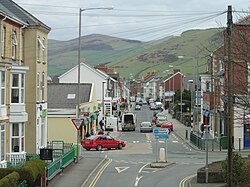
Tywyn (/ˈtaʊ.ɪn/; Welsh pronunciation: [ˈtəu̯ɨn]), formerly spelled Towyn,[1] is a town, community, and seaside resort on the Cardigan Bay coast of southern Gwynedd, Wales. It was previously in the historic county of Merionethshire. It is famous as the location of the Cadfan Stone, a stone cross with the earliest known example of written Welsh, and the home of the Talyllyn Railway.
Key Information


History of the name
[edit]The name derives from the Welsh tywyn ('beach, seashore, sand-dune').[2] The place-name element tywyn is found in many other parts of Wales, most notably Towyn near Abergele[3] and Porth Tywyn (Burry Port).
In Middle Welsh, the spelling was generally Tywyn. In the Early Modern period, however, the spelling Towyn was common in Welsh in order to reflect a slight variation in pronunciation. That also came to be the usual spelling in English up to the latter part of the twentieth century.
With the standardisation of the orthography of the Welsh language in the first part of the 20th century, the spelling Tywyn became increasingly common in all contexts. In 1967, members of Towyn Urban Council voted to request that the town be officially called Tywyn and in July 1967 this was accepted by Merionethshire County Council. Opponents of the change, however, campaigned against it and held an unofficial plebiscite in Tywyn on 25 May 1968.[4] This plebiscite was not administered by an official body but was organised and financed by tradespeople and the campaign to revert to the spelling Towyn.[5] Those who took part in the vote were asked to decide between Tywyn or Towyn – a large majority of those who voted favoured Towyn.[6] As a result, Tywyn Urban Council (as it had become) requested that the decision to use Tywyn be revisited. In June 1969, this request was declined by Merionethshire County Council and thus the name has remained as Tywyn.[7]
The spelling Tywyn better reflects the name's history and the standard orthography of modern Welsh.[8] Writing in 1967, Melville Richards, the noted toponymist and professor of Welsh at the University College of North Wales, Bangor stated that 'in modern Welsh the form should be uniformly "yw" and therefore, Tywyn is the most acceptable spelling for this name which means a strand or seashore'.[9] In 1974, he further commented: 'Mae'r holl ymrafael ynglŷn â sillebu'r enw wedi codi am fod cryn ansicrwydd ac amrywio yn Gymraeg gynt rhwng y seiniau ow ac yw. Ond yn ddiddadl, Tywyn yw'r ffurf gywir' ('All of the disagreement about spelling the name arises from the historic uncertainty and variation in Welsh between the sounds ow and yw. But, without doubt, Tywyn is the correct form').[10]
In Welsh, the town is sometimes referred to as Tywyn Meirionnydd. In origin, this usage probably refers to the cantref of Meirionnydd, but is now generally understood as referring to the historical county of the same name. In English, during the late nineteenth century and until the middle of the twentieth century, the town was sometimes called Towyn-on-Sea.
History
[edit]Tywyn was the location of the first religious community administered by the Breton saint Cadfan upon his arrival in Gwynedd in the early 6th century, prior to his departure he founded a monastery on Bardsey Island off the Llŷn Peninsula. The church contains some early material (see below).[citation needed]
Location
[edit]
The town's historic centre lies about a kilometre from the beach, around St Cadfan's Church. In the second half of the nineteenth century the town expanded considerably, mainly towards the sea.
To the north of the town lie the reclaimed salt marshes of Morfa Tywyn and Morfa Gwyllt, beyond which lie the Broad Water lagoon and the mouth of the Afon Dysynni. To the north-east lie the rich farmland of Bro Dysynni and the village of Bryncrug, and to the east the hills of Craig y Barcud and Craig Fach Goch. To the south towards Aberdyfi is the mouth of the Afon Dyffryn Gwyn and Morfa Penllyn.
The Tywyn coastal defence scheme, officially unveiled on 24 March 2011 by Jane Davidson (then Welsh Assembly Government Minister for Environment, Sustainability and Housing), provides a rock breakwater above the low-tide level, rock groynes, and rock revetment to protect 80 sea-front properties.[11] The costs of this civil engineering project was £7.62M, shared between the Welsh Assembly Government (£4.135M) and the European Union's Regional Development Fund (£3.485M).[12]
Language and demography
[edit]Until the middle of the twentieth century, Welsh was the main language of Tywyn. The local dialect is of a northern type with some features that are shared with southern dialects. This combinations of features led one Victorian observer to state that three languages were spoken in the town: English, Welsh and 'Tywynaeg'.[13]
Victorian Tywyn was overwhelmingly Welsh-speaking with English being for most a language learnt in school rather than in the home or on the street. Indeed, in the town's British School in the 1860s, a 'Welsh stick' (a version of the Welsh Not) was used to punish children who were caught speaking Welsh in school.[14] According to the 1901 and 1911 censuses, the percentages of Welsh speakers in the Towyn Urban District (as it then was) were 86.5% and 83.5% respectively, with 22.4% and 13.8% recorded as speaking only Welsh.[15]
Welsh remained the dominant language in Tywyn until the middle of the twentieth century. In his book Railway Adventure, L. T. C. Rolt recounts walking up the track of the Talyllyn Railway during the Second World War – on stopping to speak to two elderly railway workers a couple of miles from the town, he found that they didn't understand English.[16] Increased tourism, however, and the impact of the military camps on the outskirts of the town had a significant impact on language use and English came to predominate.
At the time of the 2001 census, 40.5% of the population were recorded as Welsh speakers. By the 2011 census this had decreased to 37.5%. In 2016, an Estyn inspection report of Ysgol Penybyryn, the town's primary school, noted that about 22% of the children at the school came from Welsh-speaking homes.[17]
Tywyn is now a significantly anglicised town, with the majority of its population (52.8%) having been born in England according to the 2011 census. Likewise, slightly more respondents claimed an English-only identity (35.0%) than a Welsh-only identity (33.7%).[18]
Transport and tourism
[edit]Improved transport links during the 19th century increased Tywyn's appeal as a tourist destination. In the early decades of that century, a creek of the river Dysynni allowed ships to approach the town's northern fringes, where there was a shipbuilding yard. The draining of the salt marsh and the channelling of the river brought this industry to an end,[19] but during the early part of that century the town was made more accessible by building new roads along the coast to Aberdyfi and Llwyngwril.
The railway arrived in the mid-1860s (first as the Aberystwith and Welsh Coast Railway, then as Cambrian Railways), and had a significant effect on the town. Tywyn railway station opened in 1863. The station is still open, and is served by the Cambrian Line.
Slate-quarrying in the Abergynolwyn area led to the building in 1865 of the Talyllyn Railway, a narrow-gauge line designed to carry slates to Tywyn. Two stations were opened in the town. Tywyn Wharf railway station was originally opened to enable slates to be unloaded onto a wharf adjacent to the main railway line. It is now the Talyllyn's western terminus and principal station. Pendre railway station was originally the passenger station, and now houses the locomotive and carriage sheds and works.
Notable visitors who stayed at Tywyn in the 19th century include:
- Thomas Love Peacock (1811, at Botalog)[20]
- Thomas Fremantle, 1st Baron Cottesloe (1818)
- Ignatius Spencer (1818)[21]
- Charles Darwin (1819, at Plas Edwards)[22]
- William Morris (1875)[23]
- Elizabeth Blackwell (exact date uncertain, at Brynarfor)[24]
- Sir Rupert Kettle (who built Glan-y-don as a holiday home in 1866)[25]
The beach and its extensive promenade have long been key attractions. In 1877, a pier was authorised by the Towyn Pier Order 1877 and built towards the northern end of the beach, but the structure only lasted a few months.[26] The street called 'Pier Road', which leads from the town to the beach, offers a suggestion as to its location. The promenade was completed in 1889 at the cost of some £30,000, paid for by John Corbett (1817–1901) of Ynysymaengwyn.
There has been extensive bungalow and caravan development in the vicinity.[27]
Other industries
[edit]Apart from tourism, agriculture has long been the most important industry in the area. Lead and copper used to be mined in the town's hinterland.
The Marconi Company built a Long Wave receiver station in Tywyn in 1914, working in duplex with the high-power transmitter station near Waunfawr. In 1921 the Tywyn and Waunfawr stations initiated a transatlantic wireless telegraph service with a similar RCA wireless transmitting station in New Brunswick, New Jersey, USA and RCA's receiver station in Belmar, New Jersey. This new transatlantic service replaced Marconi's obsolete transatlantic telegraph station in Clifden, Ireland following its 1922 destruction during the Irish Civil War.[28]
For most of the 20th century, the armed forces were a significant presence in Tywyn. The town was a major training ground for the amphibious warfare landings in the Second World War and had a strategic war base. Abandoned pillboxes may still be seen on the coast to the south of the town. RAF Towyn opened on 8 September 1940 as an air-cooperation base for the Royal Artillery Anti-Aircraft Practice Camp at Tonfanau, but closed on 25 July 1945.[29] The links with the armed forces came to an end when the Joint Service Mountain Training Centre at Morfa Camp closed in 1999.[30] Morfa camp is now in private ownership and many buildings are let as small storage units.
Facilities and notable features
[edit]Much of the town's infrastructure was put in place by an industrialist from the English Midlands, John Corbett, who in the 1870s decided to develop the town into a major tourist resort to rival Torquay. As well as constructing a row of boarding houses and a grand esplanade, he developed the water and sewerage system. He gave land and money for a new Market Hall, built to celebrate Queen Victoria's Diamond Jubilee in 1897. He paid for Brynarfor (formerly a private school originally called the Towyn Academy and then Brynarvor Hall School) to be opened as 'Towyn Intermediate School' in 1894. He refurbished the Corbet Arms Hotel (from then on spelled with two 't's), and also contributed to the Assembly Room (1893), now the Magic Lantern Cinema. Plaques commemorating his generosity may still be seen on the north end of the promenade and on the Market Hall. Another commemorative plaque was on Brynarfor (now demolished), and his portrait was hung there when the school first opened. However, the anticipated grand watering-place never took off, and these additions to the town were never matched.[27]
In 1912, a drill hall was built in the Pendre area of the town for the Territorial Army (the 7th Battalion the Royal Welsh Fusiliers). The hall, now known as Neuadd Pendre, has recently been renovated, mainly with money from the National Lottery Big Lottery Fund and the Welsh Government.[31] The hall houses a 3-manual 9-rank Wurlitzer Organ which was originally installed in a cinema in Woolwich in 1937.[32]
Tywyn Hospital (formerly Towyn and District War Memorial Cottage Hospital) is located on the outskirts of the town, on land known as Pen-y-bryn Mawr that was gifted by Thomas Corbett of Ynysymaengwyn. The foundation stone was laid by Dame Margaret Lloyd George on 11 August 1920[33] and the hospital was officially opened on 17 August 1922 by Sir Osmond Williams.[34]
Like the hospital, Towyn Memorial Institute was built to commemorate those killed in the First World War. It was officially opened by David Lloyd George on 29 October 1926.[35] The Institute was the location of the town's library before a new library building was built next to it and officially opened on 18 January 1973.[36] The Institute was closed in 2007.[37]
The main schools in Tywyn are the primary school, Ysgol Penybryn, and the secondary school, Ysgol Uwchradd Tywyn.
Local places of interest include Craig yr Aderyn (Bird Rock), Castell y Bere, Llanfendigaid Estate and Llyn Myngul (Tal-y-llyn Lake). Hen Dyffryn Gwyn is a Grade II listed building dating from 1640 which retains many of its original features.[38]

Religion
[edit]For many centuries, St Cadfan's church was the only place of worship in the town, but since the 19th century there have been several.
Following the Methodist Revival, the Calvinistic Methodists established a cause (i.e. a branch) in Tywyn at the end of the 18th century. Bethel Calvinistic Methodist Church (Welsh-speaking Presbyterian Church of Wales) was established in 1815. The current chapel was built in 1871 and altered in 1887.[39] The chapel closed in early 2010 but services are still held in the vestry.
Bethany Calvinistic Methodist Chapel (English-speaking Presbyterian Church of Wales) was also built in 1871 as one of the 'Inglis Côs' ('English cause') chapels that were advocated by Lewis Edwards and fiercely criticised by Emrys ap Iwan. It was opened in part with a view to attracting the increasing numbers of visitors who were coming to Tywyn since the opening of the railway and who previously had been provided for only by the English services at St Cadfan's.[40] The noted pacifist George Maitland Lloyd Davies was minister of Bethany and also of Maethlon Chapel in nearby Cwm Maethlon (Happy Valley) between 1926 and 1930. Bethany closed in 2016.[41]
Ebeneser (Welsh-speaking Wesleyan Methodist Church in Wales) was first built between 1817 and 1820 on a site off whats is now Brook Street. In 1883 the congregation moved to a new chapel on the High Street.[42] John Cadvan Davies (1846–1923), Archdruid of Wales in 1923, was minister of Ebeneser between 1889 and 1892.[43]
The original Bethesda Independent Chapel (Welsh-speaking Congregationalist) opened in 1820 on what is now Brook Street and was enlarged in 1865. The congregation moved to the newly built Bethesda Newydd ('new Bethesda') on the High Street in 1892.[44] It closed as a place of worship in January 2010 and is now a private residence.[45] The original Bethesda is now a Masonic Hall.
Tywyn Baptist Church (English-speaking)[46] was opened in 1900 and re-built in its present form in 1991.[47]
In 1935, Mary Corbett, daughter of John Corbett of Ynysymaengwyn, leased the old Ebeneser Wesleyan chapel off Brook Street for use as a Roman Catholic chapel. In 1969, the new Church of St David, designed by architects Weightman & Bullen, opened on Corbett Avenue. In its grounds is a sculpture of St David in Welsh slate by John Skelton.[48] The church is part of Dolgellau Deanery.
Sport
[edit]In Samuel Lewis's A Topographical Dictionary of Wales (1833) it is reported that popular horse races were held on land to the north of the town every September. Between 1904 and 1947, Towyn Golf Club (originally the Towyn-on-Sea Golf Club) was also located on land to the north of the town.[49]
The Towyn-on-Sea club opened with a 10-hole course in 1904, in 1906 a further eight holes were added. Attempts were made to re-establish the club following the Second World War but these proved unsuccessful.[50]
In the past Tywyn has had a rugby union team, and it now shares a football team with neighbouring Bryncrug (Tywyn & Bryncrug F.C.), playing their home matches in the village of Bryncrug. It also has a cricket club, Tywyn and District CC and a hockey team known as Dysynni Hockey Club. Also based in Tywyn is the Bro Dysynni Athletics Club.
Notable people
[edit]- The Anwyl family of Tywyn, direct male line descendants of Rhodri ab Owain Gwynedd, a member of the House of Aberffraw
- Arthur ap Huw (fl. 1555–1570), vicar of St Cadfan's 1555/1570, notable patron of Welsh poets, and translator of counter-Reformation literature into Welsh.
- Martin J. Ball (born 1951) professor in Linguistics at Bangor University.
- Tom Bradshaw (born 1992), footballer with over 360 club caps and 3 for Wales
- Robert L. Chidlaw-Roberts (1896–1989), World War I flying ace.
- Robin Davies (1954–2010), Welsh TV and film actor; starred in Catweazle playing the part of Carrot.
- Evan Evans (1731– 1788), bardic name Ieuan Fardd, poet and scholar, curate of St Cadfan's 1772/1777.
- Edward Ernest Hughes (1877–1953), the first professor of history at University College, Swansea, was born in Tywyn, the son of a local policeman.
- Griffith Hughes (1707–c.1758) clergyman from the parish of Tywyn, author of The Natural History of Barbados.
- John Ceiriog Hughes (1832–1887), poet, stationmaster at Tywyn for a short period from 1870.
- Joseph David Jones (1827–1870), musician, schoolmaster at Tywyn British School from 1851 to 1855.
- Sir Henry Haydn Jones (1863–1950), MP for Merioneth, brought up and lived in Tywyn.
- John Daniel Jones (1865–1942), Congregationalist minister, brought up in Tywyn.
- Owen Wynne Jones (1828–1870), bardic name Glasynys, Welsh cleric, antiquary, author and poet.
- Dai Lloyd (born 1956), Plaid Cymru politician and Member of the Senedd, was born in Tywyn.
- David Richards (1751–1827), bardic name Dafydd Ionawr, poet, from Glanymorfa is the author of an englyn to his mother Ann Dafydd (d. 1785) which is preserved on a brass plate in St Cadfan's Church.
- R. Bryn Williams (1902–1981), bardic name Bryn, Welsh-language writer, poet, playwright and historian; lived in Patagonia as a child.
See also
[edit]References
[edit]- ^ The local branch of the Royal Air Forces Association still employs the name "Towyn and Aberdovey".
- ^ Owen, Hywel Wyn; Morgan, Richard (2007). Dictionary of the Place-Names of Wales. Llandysul: Gomer. p. 483. ISBN 978-1-84323-901-7. OCLC 191731809.
- ^ The two places now use different spellings, partly for reasons of differentiation. Confusion between the two still occurs, however: Sat-nav mix up leaves pupils in Towyn not Tywyn, BBC News, 19 April 2013.
- ^ "Towyn neu Tywyn? 1968". YouTube. 17 May 2016. Archived from the original on 21 December 2021.
- ^ "Plebiscite is next step in name battle". Liverpool Daily Post (Welsh Edition). 17 May 1968. p. 4.
- ^ "Tywyn or Towyn – calls for a new referendum". Liverpool Daily Post (Welsh Edition). 13 August 1968. p. 4.
- ^ "Y..o..y – the name is to stay Tywyn". Liverpool Daily Post (Welsh Edition). 8 May 1969. p. 4.
- ^ Wmffre, Iwan (2003). Language and place-names in Wales: the evidence of toponymy in Cardiganshire. Cardiff: University of Wales Press. pp. 334–5. ISBN 0-7083-1796-0. OCLC 52877170.
- ^ Jones, Ivor Wynne (29 July 1967). "Why it should be Tywyn". Liverpool Daily Post (Welsh Edition): 1.
- ^ Richards, Melville (1974). "Enwau Lleoedd". In Bowen, Geraint (ed.). Atlas Meirionnydd (in Welsh). Y Bala: Gwasg y Sir. p. 207.
- ^ BBC Online, £10m north Wales tidal flood defences open.
- ^ Coastal Schemes with Multiple Funders and Objectives FD2635: Case Study Report 13 Tywyn Coastal Defence Scheme (2011).
- ^ D. S. Thomas, 'Yr Ail Draethawd', in P. H. Hughes et al. (ed.), Ystyron Enwau ... ym Mhlwyfi Towyn, Llangelynin, Llanfihangel y Pennant, Talyllyn, a Phennal (Caernarfon, 1907), p. 122.
- ^ Meirionnydd Archives, Gwynedd Archives Service, Towyn British School Log Book, Merionethshire, 1863–76, Gathering the Jewels: The website for Welsh heritage and culture Archived 11 July 2012 at the Wayback Machine
- ^ Jones, Dot (1998). Statistical evidence relating to the Welsh language, 1801–1911. A social history of the Welsh language. Cardiff: University of Wales Press. p. 235. ISBN 978-0-7083-1460-9.
- ^ Holt, L. T. C. (1971). Railway Adventure (2nd ed.). London: Pan. p. 30.
- ^ "A report on Ysgol Penybryn" (PDF). Estyn. 2016. Retrieved 23 August 2021.
- ^ Census statistics for Tywyn are available at Office for National Statistics, Neighbourhood Statistics: Tywyn Ward.
- ^ George Smith, Tywyn Coastal Protection Scheme Archaeological Assessment (Gwynedd Archaeological Trust Report No.555, 2004), p. 6 and fig. 3.
- ^ Madden, Mary and Lionel. 1986. 'Edward Scott, Bodtalog, and his literary circle: Thomas Love Peacock, James and John Stuart Mill and William Owen Pughe'. National Library of Wales Journal, 24.3, pp. 352–57.
- ^ Rev. Father Pius a Spiritu Sancto. 1866. The life of Father Ignatius of St. Paul, Passionist (The Hon. & Rev. George Spencer). London 1866, pp. 45–47.
- ^ Lucas, Peter. 2001. 'Three weeks which now appear like three months: Charles Darwin at Plas Edwards'. National Library of Wales Journal, 32.2, pp. 123–46.
- ^ Henderson, Philip. 1950. ed. The Letters of William Morris to his Family and Friends. London: Longmans, p. 69.
- ^ Elizabeth Blackwell Letters, c. 1850–1884.
- ^ "Death of Sir Rupert Kettle". The Cambrian News, Merionethshire Standard, and Welsh Farmers' Gazette. 26 October 1894. p. 3. Retrieved 1 November 2023.
- ^ Wilkinson, Jeremy. 1984. Tywyn Pier. Journal of the Merioneth Historical and Record Society, 9.4, pp. 457–71.
- ^ a b Simon Jenkins, 2008, Wales: churches, houses, castles, Allen Lane, London, p. 244
- ^ Williams, Harri. 1999. Marconi and his wireless stations in Wales. Llanrwst: Gwasg Carreg Gwalch. ISBN 0-86381-536-7; Hogan Jr, John L. A New Marconi Transatlantic Wireless Service. Electrical World, 29 August 1914.
- ^ "Angle Airfield, Angle (309967)". Coflein. RCAHMW. Retrieved 31 May 2023.
- ^ Jones, Rees Ivor. 2000. The Military in Tywyn 1795–1999: The Warlike Side of a Small Welsh Seaside Town. Tywyn: the author.
- ^ Neuadd Pendre Social Centre.
- ^ The Tywyn Wurlitzer Archived 8 October 2012 at the Wayback Machine.
- ^ "Towyn Cottage Hospital". Montgomery County Times and Shropshire and Mid-Wales Advertiser. 14 August 1920. p. 5.
- ^ "Tywyn Hospital". Historic Hospitals. Retrieved 21 March 2020.
- ^ "Breaking Down Class Barriers". Carnarvon and Denbigh Herald. 5 November 1926. p. 10.
- ^ "New Library". Liverpool Daily Post (Welsh Edition). 19 January 1973. p. 3.
- ^ BBC Online, Tywyn report highlights jobs, homes and tourism needs.
- ^ "Hen Dyffryn Gwyn, Tywyn". British Listed Buildings. Retrieved 10 April 2016.
- ^ "Bethel Chapel (Welsh Calvinistic Methodist), Tywyn (8615)". Coflein. RCAHMW.
- ^ "Bethany Chapel (English Presbyterian and Calvinistic Methodist), Tywyn (8619)". Coflein. RCAHMW.
- ^ Gareth Wyn-Williams, 'Plans to convert old church into private home', Cambrian News, 21 July 2018.
- ^ "Ebenezer Methodist Chapel (Wesleyan), Tywyn (97196)". Coflein. RCAHMW.
- ^ Morgan, Gwylfa H. 1983. Canmlwyddiant Ebeneser Tywyn 1983. Tywyn.
- ^ "Bethesda Welsh Independent Chapel, Tywyn (8609)". Coflein. RCAHMW.; Jones, Richard. 1970. Dathlu agor Capel Bethesda Tywyn, Mehefin 21, 1820. Hanes yr Achos 1803–1970. Abertawe: Gwasg John Penry.
- ^ Capel arall yn cau, Dail Dysynni, Rhagfyr 2009/Ionawr 2010.
- ^ "Who We Are". Tywyn Baptist Church. Retrieved 30 May 2019.
- ^ "Tywyn Baptist Church (8613)". Coflein. RCAHMW.
- ^ "Tywyn – St David". Taking Stock: Catholic churches of England and Wales. Retrieved 17 May 2025.
- ^ Gwynedd Archives: Meirionnydd Record Office, Towyn Golf Club Records.
- ^ 'Towyn-on-Sea Golf Club, Gwynedd', Golf's Missing Links.
External links
[edit]

- Visit Tywyn
- Tywyn an illustrated guide
- bbc.co.uk North West Wales: Tywyn
- Tywyn Information
- www.geograph.co.uk : photos of Tywyn and surrounding area


| National | |
|---|---|
| Other | |

Tywyn
View on GrokipediaEtymology
Historical origins and variations of the name
The name Tywyn originates from the Welsh noun tywyn, denoting a "dune," "sandhill," or "seashore," directly referencing the extensive coastal sand dunes that characterize the area's topography and remain visible south of the town.[7][8] This etymology aligns with the term's roots in Old Welsh, possibly linked to twyn ("hill" or "dune") or tywod ("sand"), emphasizing the empirical connection to the local landscape rather than legendary associations.[9] In English contexts, particularly during the 19th-century industrialization and railway development, the name was commonly anglicized as "Towyn," reflecting phonetic approximation and broader patterns of place-name adaptation in Wales.[10] This spelling persisted in official and cartographic records into the mid-20th century, often to distinguish it from a similarly named locality near Conwy while accommodating non-Welsh speakers.[11] Medieval Welsh records, including ecclesiastical documents tied to St. Cadfan's Church (established as a clas by the 6th century), reference the settlement in forms approximating Tywyn, underscoring its topographic descriptor amid early monastic and agrarian notations.[12] By the 1960s, a local referendum formalized the return to the Welsh orthography Tywyn in 1968, prioritizing linguistic accuracy over anglicized variants amid post-war cultural revival efforts.[13][14]History
Prehistoric and early settlements
Archaeological evidence indicates sporadic prehistoric human activity in the Tywyn area, primarily from the Bronze Age. Finds near the seafront, approximately 1 km north of the town center, include cremation urns, two bronze spearheads, and bronze axes, dating to the early second millennium BC and suggesting funerary practices or small-scale metalworking associated with agrarian communities.[15][16] Additional Bronze Age cairns and artifacts in the Dysynni Valley and at nearby farms further attest to regional occupation patterns focused on burial and resource exploitation rather than dense settlements.[17] Iron Age activity is represented by hillforts in proximity to Tywyn, such as Llechlwyd on Mynydd Garreg above Tonfanau, about 5 km northeast. This promontory fort, dating roughly from 800–600 BC to the Roman period, features inner and outer ramparts up to 3.6 m high and a 1.9 m deep ditch, with in-turned entrances, overlooking the Dysynni Valley and providing lines of sight to other regional defenses; these structures imply organized, defended communities amid landscape exploitation.[18] Roman influence in Tywyn proper remains minimal, with no confirmed forts or villas; potential settlement traces at local farms and a nearby road route through Bryncrug (about 2 km east) suggest indirect trade or transient presence rather than established occupation.[19][17] Early medieval settlement is tied to the site of St Cadfan's Church, where inscribed stones from the 7th–9th centuries mark the onset of organized Christian activity, including the Tywyn Stone dated around 800 AD with early Welsh script.[20][21] Tradition attributes the founding of a clas—an early monastic community—to Saint Cadfan around 516 AD, though direct archaeological corroboration begins later, with the site's dedication implying continuity from the 6th century amid Celtic Christian expansion.[22][23]Medieval to early modern developments
![St Cadfan's Church, Tywyn - geograph.org.uk - 430026.jpg][float-right] Tywyn, situated in the cantref of Ystumanner within medieval Meirionnydd, remained under the authority of the princes of Gwynedd until the late 13th century. Its regional importance is evidenced by a 1199 visit from Archbishop Baldwin of Canterbury and Gerald of Wales, who were received by Gruffydd ap Cynan, joint ruler of Meirionnydd and grandson of Owain Gwynedd, highlighting Tywyn's role as a key ecclesiastical and administrative center.[12] The Romanesque church of St Cadfan, originally founded in the 6th century, was rebuilt in the 12th century and subsequently expanded with a Gothic tower, transept, and chancel during the 13th and 14th centuries, reflecting ongoing investment in religious infrastructure amid native Welsh governance.[5] Following Edward I's conquest of Wales in 1282–1283, Tywyn was integrated into the English administrative framework via the Statute of Rhuddlan in 1284, becoming part of the new county of Merionethshire without direct Norman lordships, as deeper incursions into Gwynedd occurred late and under royal direction rather than marcher barons.[24] Land tenure shifted toward feudal obligations under the crown, with agricultural and pastoral farming dominating the economy, centered on smallholdings and communal fields. The Black Death in 1349 devastated Wales, reducing the population by approximately 25 percent, with effects in Meirionnydd inferred from subsequent depopulation patterns in ecclesiastical tithe records indicating labor shortages and abandoned holdings.[25] In the early modern period, from the 16th to 18th centuries, estates like Ynysymaengwyn consolidated holdings, tracing origins to figures such as Gruffudd ab Adda, bailiff of Ystumanner commote in 1330 and 1334, with the Wynne family holding prominence until the late 16th century before passing through marriage. Local enclosures occurred incrementally, prioritizing pastoral improvement over open-field arable, as seen in regional patterns rather than large-scale parliamentary acts. Coastal trade remained limited through nearby Aberdyfi, a small and hazardous port handling local exports like timber and agricultural surplus, with activity increasing modestly by the 18th century but overshadowed by agricultural self-sufficiency.[26][27]Industrial era and 19th-20th century growth
The arrival of the railway in the mid-1860s marked a pivotal shift in Tywyn's economy, connecting the town to broader networks and enabling slate export from inland quarries via the Talyllyn Railway, which opened in 1865 to link Bryn Eglwys quarries to the wharf at Tywyn for transshipment onto standard-gauge lines.[28] The Aberystwith and Welsh Coast Railway established a station in Tywyn by 1864, integrating into the Cambrian Railways system the following year, which facilitated passenger traffic and reduced isolation from urban centers like Aberystwyth and beyond.[29] This infrastructure directly spurred local development by lowering transport costs for goods and people, though Tywyn lacked large-scale manufacturing, relying instead on agriculture and emerging leisure pursuits. Tourism emerged as the primary growth driver during the Victorian era, with the railway enabling influxes of seasonal visitors seeking coastal respite. The Corbett Arms Hotel, originally documented in 1833, underwent significant rebuilding in 1867 specifically to accommodate anticipated rail-borne guests, reflecting confidence in the resort's potential amid Britain's seaside holiday boom.[26] Efforts to enhance appeal included the Towyn Pier Company's 1877 foundation stone for a proposed 300-foot pier to support sea bathing and excursions, though the project stalled due to engineering challenges and funding shortfalls.[30] These initiatives positioned Tywyn as a modest Victorian seaside destination, with promenade expansions and lodging catering to middle-class trippers rather than industrial workers, underscoring tourism's causal role in economic expansion over extractive sectors. Population expansion mirrored these transport-enabled changes, with the town experiencing steady increases from early 19th-century levels through the century's end, driven more by visitor economies than permanent settlement or factories. Census data indicate growth tied to railway access, as parishes with early stations saw elevated demographic shifts from 1851 to 1891, a pattern applicable to coastal locales like Tywyn where seasonal influxes boosted local commerce without fostering heavy industry.[31] By 1901, this had solidified Tywyn's orientation toward leisure, with hotels and boarding houses proliferating to serve transient populations. The 20th century brought wartime disruptions and post-war contraction in traditional activities. During World War II, the Talyllyn Railway operated at minimal capacity, its locomotives in poor condition and slate traffic negligible, reflecting broader decline in regional quarrying amid global shifts away from Welsh exports.) Tywyn, like much of rural Wales, hosted evacuees from urban areas—part of the 110,000 children relocated nationwide for safety—straining resources but providing temporary labor and integration into host communities without long-term industrial revival.[32] Post-1945, heavy industry waned further as slate demand fell, cementing tourism's dominance while underscoring the railways' enduring but evolved role in sustaining the town's viability.[33]Post-war changes and recent events
The preservation of the Talyllyn Railway in 1951 by a volunteer society marked a pivotal post-war development for Tywyn, transforming the disused 19th-century line into the world's first heritage railway and bolstering local tourism through enthusiast visits and seasonal passenger services originating from Tywyn station.[34] This initiative sustained economic activity amid broader seaside resort reliance on temporary summer employment in hospitality and transport, though the town's economy remained vulnerable to off-season downturns without diversified industry.[35] In 2012, Tywyn's chamber of tourism and commerce introduced a custom flag depicting a left-facing raven—symbolizing Victorian benefactor John Corbett—and dolphin, divided by a wavy line evoking the coast, intended to enhance promenade branding but igniting local debate over its £1,000-plus design and production costs during fiscal austerity.[36] Critics, including residents, questioned its relevance to heritage amid competing priorities like infrastructure maintenance, while supporters argued it promoted identity and visitor appeal in a stagnating tourism sector.[37] Recent development disputes underscore tensions between conservation, heritage, and regeneration. In 2022, community campaigns halted punt gunning and sport shooting at Tywyn's coastal lagoon, safeguarding vulnerable wader and wildfowl populations from disturbance during migration, in a win for ecological priorities over longstanding wildfowling rights on leased marshlands.[38] By 2025, proposals to demolish parts of the derelict Corbett Arms Hotel—site of John Lennon and Yoko Ono's 1969 stay amid the Beatles' final tensions—drew opposition from heritage groups urging Welsh government intervention to preserve its cultural value against structural collapses and council-backed partial deconstruction for safety and potential site redevelopment.[39][40] Proponents emphasized economic revitalization needs in a town grappling with vacant commercial spaces, highlighting causal trade-offs where preservation delays have exacerbated decay without viable funding alternatives.[41]Geography
Location and topography
Tywyn is positioned on the Cardigan Bay coastline in southern Gwynedd, Wales, at coordinates 52°35′N 4°05′W.[42] The town occupies low-lying coastal terrain at an average elevation of 10 metres above sea level, with gradual rises inland toward the Dysynni Valley hills and the southern fringes of the Snowdonia range.[43][44]
The local topography includes extensive sand dunes backing the 6.4-kilometre sandy beach and reclaimed lowlands from the former Dysynni estuary, which historically formed a broad inlet before drainage in the 19th century.[45][46] These features contribute to a landscape of flat coastal plains transitioning to undulating hills, with significant elevation variations up to 239 metres within 3 kilometres of the town centre.[47]
Tywyn's administrative community, defined following the 1974 local government reorganisation that placed it within Gwynedd, encompasses the town and adjacent coastal and valley areas vulnerable to tidal and fluvial flooding.[48] Flood risk assessments identify heightened exposure in the estuary lowlands and shoreline due to sea level rise and storm surges, with strategic planning noting increased threats to coastal infrastructure.[48][15]
Climate and natural environment
Tywyn exhibits a temperate maritime climate typical of coastal Wales, with mild temperatures and high humidity influenced by the Atlantic Ocean. Average high temperatures range from 8°C (46°F) in January to 19°C (66°F) in August, while lows vary from 4°C (39°F) in winter to 12°C (54°F) in summer; extremes rarely drop below -1°C (30°F) or exceed 23°C (73°F). Annual precipitation totals approximately 1,000 mm, distributed fairly evenly throughout the year with wetter conditions in autumn and winter, averaging 50-80 mm per month. The area is prone to windy conditions, with frequent gales from Atlantic storms, particularly between October and March, as recorded in regional historical weather data.[43][49] The coastal environment features extensive sand dunes backing Tywyn's beaches, which support specialized flora adapted to shifting sands and salt spray, including rare species such as sand couch and marram grass that stabilize the dunes against erosion. Adjacent to the town, the Dysynni estuary provides critical habitats for wetland birds, including waders and waterfowl, with salt marshes and lagoons fostering biodiversity; in 2022, local conservation efforts led to the cessation of sport shooting at Broad Water lagoon following surveys documenting declines in fragile bird populations due to disturbance. These ecosystems are part of broader coastal protections, including Sites of Special Scientific Interest nearby, emphasizing natural succession over human intervention.[50][38][51] Geologically, Tywyn sits atop Lower Paleozoic strata, predominantly Ordovician mudstones, siltstones, and volcanic rocks from the Welsh Basin, as mapped by the British Geological Survey; these ancient formations, dating to around 450-500 million years ago, underlie the coastal plain and contribute to ongoing erosion patterns through differential weathering of softer sediments against harder intrusions. The proximity to Snowdonia's tectonic influences exacerbates shoreline retreat, with historical gauges indicating average annual coastal erosion rates of 0.5-1 meter in exposed areas, driven by wave action on these friable rocks rather than recent climatic shifts alone.[52][53][54]Demographics and Society
Population trends and statistics
According to the 2021 United Kingdom census, the population of the Tywyn community stood at 3,133 residents, marking a modest decline from 3,264 in 2011 and 3,227 in 2001.[55] This equates to an average annual population decrease of 0.41% between 2011 and 2021, attributable primarily to net out-migration amid broader rural Welsh trends of youth departure for employment opportunities elsewhere.[55][56] Tywyn features an aging demographic profile, with coastal communities like it showing 24.7% of residents classified as retired in 2021, exceeding the national average for non-coastal built-up areas by over 4 percentage points.[57] In-migration of retirees, particularly from England since the 1970s, has contributed to this shift, drawing individuals seeking affordable coastal living and altering local age structures through sustained inflows of older households.[58] Economic inactivity rates in such areas exceed Welsh averages, reflecting high retirement proportions and limited local job opportunities for working-age residents.[59] High second-home ownership, at 21.3% of properties in the Tywyn and Llangelynnin area as of recent assessments, has strained housing affordability for permanent residents by inflating demand and prices.[60] This pattern, driven by seasonal and investment purchases, correlates with elevated council tax premiums on non-primary residences and ongoing debates over local housing access.[61]| Census Year | Population |
|---|---|
| 2001 | 3,227 |
| 2011 | 3,264 |
| 2021 | 3,133 |
Language usage and cultural identity
In Tywyn, the 2021 census indicated that 36.1% of residents aged three and over could speak Welsh, a figure lower than the Gwynedd average of 64.4% for the same period.[62][63] This bilingual proficiency supports cultural identity rooted in Welsh heritage, including ancient inscriptions at St Cadfan's Church dating to the 8th century, yet daily usage data reveal constraints, with national surveys showing only 14.0% of proficient speakers employing Welsh daily as of 2024.[64] Historical trends underscore a decline in ability despite Welsh Government policies promoting immersion education and bilingual services since the 1960s Welsh Language Act. Wales-wide, the proportion able to speak Welsh dropped from 26.0% in 1961 to 17.8% in 2021, with north-western areas like Gwynedd experiencing similar erosion from over 70% proficiency in mid-20th-century estimates to current levels, attributable to English-medium schooling prevalence and inward migration.[65][66] In Tywyn's schools, for instance, only 7% of secondary pupils reported always using Welsh in the yard as of 2019, highlighting limited organic transmission.[67] Cultural practices, including participation in eisteddfodau—festivals emphasizing Welsh literature and performance—bolster identity but have not stemmed usage erosion, as evidenced by stagnant or falling daily application rates amid media and economic anglicization.[68] Bilingual signage and services, mandated under policy frameworks like the Welsh Language Standards, aid tourism in this coastal locale by signaling cultural authenticity, though their efficacy is questioned where English predominates in commerce and social interactions, fostering pragmatic rather than ideological bilingualism.[69] Local identity thus reflects a tension between heritage preservation and functional English reliance, with policy-driven promotion yielding measurable ability gains in youth cohorts but failing to elevate community-wide usage beyond niche domains.[70]Religious composition
Tywyn's religious landscape has historically been dominated by Christianity, with St Cadfan's Church serving as the primary Anglican parish church since at least the 6th century, when tradition holds that Saint Cadfan established a hermitage there.[71] The town also features prominent Nonconformist chapels, reflecting Wales's strong Calvinistic Methodist tradition; Bethany Chapel, an English-speaking Presbyterian Church of Wales (formerly Calvinistic Methodist), traces its origins to informal gatherings in the early 19th century.[72] According to the 2021 Census for the Tywyn community, 1,600 residents (54.8% of the population) identified as Christian, while 1,258 (43.1%) reported no religion.[2] Other faiths were negligible, with Muslims numbering 15 (0.5%), Buddhists 15 (0.5%), Hindus 6 (0.2%), Sikhs 4 (0.1%), Jews 2 (0.1%), and other religions 18 (0.6%); 7.0% did not state a religion.[2] These figures indicate a shift toward secularization compared to earlier censuses, mirroring broader trends in Gwynedd where Christian affiliation fell from 57.5% in 2011 to 48.2% in 2021, with no religion rising from 29.7% to 43.0%.[73] Local churches and chapels continue to function in community roles, including charitable activities and social events, though actual attendance has declined since the mid-20th century, consistent with diocesan reports for the Church in Wales showing average Sunday attendance dropping from around 42,000 in 2004 to lower figures by the 2020s.[74] Non-Christian religious presence remains minimal, with no established places of worship for other faiths in the town.Economy
Tourism industry
Tywyn's tourism sector primarily revolves around its expansive 7-mile sandy beach along Cardigan Bay, which draws visitors for surfing, kite surfing, dog walking, and family activities, supported by a promenade, paddling pool, and accessible parking facilities.[75][76] The beach's open location and clean water quality enhance its appeal for watersports and sunset viewing, with optimal surfing conditions near high tide south of the main slipway.[77] A major draw is the adjacent Talyllyn Railway, the world's first heritage railway preserved by volunteers in 1951, operating a 7.25-mile narrow-gauge line through scenic Dysynni Valley landscapes. It transported 93,822 passengers in 2019—its strongest year in over a decade—though numbers fell to 36,472 in 2021 amid COVID-19 restrictions and stood at 42,000 in 2024, reflecting ongoing recovery and seasonal variability.[78][79][80] Visitor activity peaks in summer, driven by these attractions, with the Tywyn area offering around 17,964 accommodation beds—13% of Gwynedd's total capacity—supporting overnight stays that amplify local spending on hospitality and services.[81] While precise GVA for Tywyn remains undocumented in public datasets, broader Gwynedd tourism aligns with Wales' visitor economy, which generated £3.8 billion in GVA (5.1% of total) and 159,000 jobs in 2022, with coastal locales like Tywyn exhibiting heightened dependency due to limited diversification.[82] Post-pandemic volatility underscores risks, as evidenced by railway passenger dips and uneven regional recovery, potentially exacerbating seasonal unemployment in tourism-reliant communities.[83] Environmental concerns include foot traffic and recreational pressures on adjacent sand dunes, which serve as natural flood barriers and habitats but face erosion from human activity and climate factors, though management efforts aim to mitigate impacts while preserving tourism viability.[84] This tension highlights tourism's dual role: fostering economic resilience through indirect job support in a region where visitor industries comprise 16.7% of enterprises, yet risking overreliance amid fluctuating demand.[85]Other sectors and employment
Agriculture in the Tywyn area centers on dairy farming and mixed livestock operations in the Dysynni Valley, supporting local supply chains with small-scale holdings typical of rural Gwynedd.[86] Farms such as Erw Porthor and those operated by R D Lewis & Co contribute to animal production, though the sector employs a limited number of residents amid broader declines in Welsh agriculture.[87] Small manufacturing persists, exemplified by Brighter Foods, which specializes in producing healthier snack bars and represents niche food processing amid remnants of traditional industries like slate quarrying in nearby regions. These activities account for a higher proportion of manufacturing employment in Tywyn compared to the Gwynedd average, at around 5.5% above regional norms based on 2011 data adjusted for local patterns. Retail trade and personal services dominate non-tourism employment, with 29% of the local workforce in elementary occupations such as shop assistance and basic care roles per 2011 Census figures updated in area assessments.[81] Median weekly earnings in the Dwyfor Meirionnydd constituency, encompassing Tywyn, reached £361 in 2020-2021, 7% below Gwynedd's £386 and reflecting low-wage service dependency.[81] The unemployment rate for Tywyn's primary postcode (LL36) was 2% in the 2021 Census, below the UK average of 4.83% and aligned with Gwynedd's lower-than-Wales rate of around 4.4% for Jobseeker's Allowance claimants in 2020-2021.[88] [81] Economic inactivity for the working-age population mirrors Wales' 24% rate, driven by an aging workforce— with 75% of 16-64-year-olds in work or education—and challenges including health-related barriers and skills mismatches, as 23% hold skilled trades qualifications but face limited high-value opportunities.[89] [81] Underemployment persists due to seasonal and low-skill job prevalence, constraining diversification despite low headline unemployment.[90]Infrastructure and transport
The primary road serving Tywyn is the A493, a B-class coastal route connecting Dolgellau to Machynlleth via Fairbourne and Aberdyfi, facilitating local traffic and access to Cardigan Bay destinations with a single-carriageway configuration suitable for regional volumes rather than high-capacity freight.[91] Tywyn railway station lies on the Cambrian Coast Line, providing passenger services operated by Transport for Wales to destinations including Pwllheli, Barmouth, Harlech, Porthmadog, Aberdyfi, Machynlleth, and Shrewsbury, with the line's coastal section emphasizing scenic connectivity over heavy freight capacity.[92] The Talyllyn Railway, a 7.25-mile narrow-gauge line terminating at Tywyn Wharf station, operates as a volunteer-maintained heritage route to Abergynolwyn, relying on unpaid labor for maintenance and daily functions since its preservation, which supports supplementary transport options amid the mainline's passenger focus.[93] Bus services, primarily routes G21 and G24 operated by Lloyds Coaches, link Tywyn to Machynlleth hourly during peak periods, with extensions to Dolgellau and Aberdyfi, offering flexible short-haul connectivity for commuters lacking private vehicles.[94][95] The Dysynni estuary, adjacent to Tywyn, suffers from ongoing silting that has curtailed historical freight navigation, rendering it unsuitable for commercial shipping; flood mitigation efforts include Natural Resources Wales' removal of 60,000 tonnes of gravel in 2015 to enhance river flow and reduce inundation risks, complemented by £7.6 million in sea defenses completed in 2011 protecting approximately 75 properties.[96][97]Culture and Community
Notable facilities and landmarks
St Cadfan's Church, a Grade I listed structure dating primarily to the 11th and 12th centuries with later Gothic expansions, stands as Tywyn's principal historical landmark, incorporating the Cadfan Stone—a ninth-century or earlier inscribed cross bearing the oldest known written Welsh text. The site's origins trace to the sixth century, when Saint Cadfan reportedly established a hermitage around 516 AD, serving as the mother church for southern Meirionnydd and reflecting early medieval ecclesiastical influence in the region.[71][98] The church's Romanesque nave features circular pillars, and it houses a 13th-century font, underscoring its role in preserving pre-Norman artifacts amid post-medieval rebuilds prompted by decay and coastal erosion.[22] Tywyn Wharf railway station, the western terminus of the Talyllyn Railway—a narrow-gauge line operational since 1865 for slate transport—functions as a key transport and heritage facility, now preserved as the world's first such railway maintained by volunteers. The station includes the Narrow Gauge Railway Museum, which documents Britain's miniature rail networks and their industrial ties to quarrying economies. Economically, it supports tourism by linking Tywyn's coast to inland hills, sustaining operations through fares and events without public subsidy.[99][100] Ysgol Uwchradd Tywyn provides secondary education for pupils aged 11 to 16 in a bilingual Welsh-English environment, operating as one of Wales' smaller comprehensive schools focused on regional needs in a rural coastal setting. Located on Station Road, it emphasizes medium-of-Welsh instruction to maintain linguistic continuity amid demographic shifts.[101][102] The Corbett Arms Hotel, a Grade II listed building from the late 19th century, exemplifies Victorian-era seaside development, originally catering to tourists and later hosting figures like John Lennon and Yoko Ono in the 1960s. By 2025, structural collapses necessitated emergency works, sparking debates between Gwynedd Council priorities for safety and long-term viable use versus heritage groups' calls for independent scrutiny to avoid full demolition, highlighting tensions in balancing preservation costs against utility in a declining hospitality sector.[103][104][105]Sports and leisure activities
Tywyn & Bryncrug FC, a community football club based near Tywyn, competes in the MMP Central Wales League North division, with reserve teams in lower leagues, promoting local youth and adult participation.[106] Tywyn and District Cricket Club fields teams in the West Wales Cricket Conference, supporting recreational and competitive play among residents. The town's sandy Tywyn Beach serves as a site for surfing, with consistent waves suitable for beginners and intermediates, particularly around high tide south of the slipway toward Aberdyfi.[107][75] Walking and hiking opportunities abound via the Wales Coast Path traversing Tywyn and the Talyllyn Trails, which provide level, scenic routes with coastal and inland views accessible year-round.[108][109] The nearby Talyllyn Railway hosts annual leisure events, including the Heritage Weekend in September, featuring historical train operations and talks that draw crowds for participatory demonstrations, and the Awdry Extravaganza, the railway's largest event with themed activities and lectures.[110][111] These organized sports and outdoor pursuits contribute to physical activity in the community, where Gwynedd's adult overweight or obesity rate stands at 56%, marginally below the North Wales regional average of 57%.Notable Individuals
Key figures and their contributions
John Corbett (1817–1901), an English industrialist known as the "Salt King" for his Droitwich Spa saltworks, acquired the Ynysymaengwyn estate near Tywyn in 1878 and became a primary benefactor of the town's infrastructure. He funded the seafront promenade at a cost of around £30,000 to combat coastal erosion and enhance tourism appeal, alongside upgrades to the water supply and sewerage systems that supported population growth. Corbett also donated £500 toward the Market Hall's construction in 1893 and refurbished the Corbet Arms Hotel, renaming it to reflect the local estate, while contributing to the Assembly Rooms, later repurposed as the Magic Lantern Cinema.[112][26] The preceding Corbet family, Shropshire-origin landowners who held Ynysymaengwyn from the early 17th century, directed estate improvements including the drainage of Dysynni Valley salt marshes in the 19th century, enabling agricultural expansion and reducing flood risks for Tywyn's hinterland. Family members like Athelstan John Soden Corbet (1849–1935), who inherited in 1871, maintained patronage of local Welsh cultural activities, including eisteddfodau, fostering community ties amid estate management until its sale.[112][26] Griffith Evans (1860–1935), a veterinarian and bacteriologist born in nearby Meifod but associated with Tywyn through family and early career, advanced animal health research by identifying the trypanosome bacterium causing surra disease in Indian army horses during the 1890s, influencing colonial veterinary practices and equine disease control worldwide.[113]References
- https://en.wiktionary.org/wiki/tywyn
- https://en.wiktionary.org/wiki/twyn