Hubbry Logo
Half-time (music)Half-time (music)Main
Open search
Half-time (music)
Community hub
Half-time (music)
logo
8 pages, 0 posts
0 subscribers
Be the first to start a discussion here.
Half-time (music)
Half-time (music)
from Wikipedia
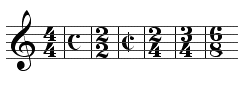
Basic time signatures: 4
4
, also known as common time (common time); 2
2
, also known as cut time or cut-common time (cut time); etc.

In popular music, half-time is a type of meter and tempo that alters the rhythmic feel by essentially doubling the tempo resolution or metric division/level in comparison to common-time. Thus, two measures of 4
4
approximate a single measure of 8
8
, while a single measure of 4/4 emulates 2/2. Half-time is not to be confused with alla breve or odd time. Though notes usually get the same value relative to the tempo, the way the beats are divided is altered. While much music typically has a backbeat on quarter note (crotchet) beats two and four, half time would increase the interval between backbeats to double, thus making it hit on beats three and seven, or the third beat of each measure (count out of an 8 beat measure (bar), common practice in half time):

1   2   3   4   1   2   3   4
1   2   3   4   5   6   7   8
1       2       3       4

Essentially, a half time 'groove' is one that expands one measure over the course of two. The length of each note is doubled while its frequency is halved.

Common-time

[edit]
Rhythm pattern characteristic of much popular music including rock (Play), quarter note (crotchet) or "regular" time: "bass drum on beats 1 and 3 and snare drum on beats 2 and 4 of the measure [bar]...add eighth notes [quavers] on the hi-hat".[1]

Time signatures are defined by how they divide the measure. In "common" time, often considered 4
4
, each level is divided in two. In a common-time rock drum pattern each measure (a whole note) is divided in two by the bass drum (half note), each half is divided in two by the snare drum (quarter note, collectively the bass and snare divide the measure into four), and each quarter note is divided in two by a ride pattern (eighth note). "Half"-time refers to halving this division (divide each measure into quarter notes with the ride pattern), while "double"-time refers to doubling this division (divide each measure into sixteenth notes with the ride pattern).

Half-time

[edit]
\version "2.16.2"
\header { tagline = ##f}
\score {
  <<
    \drums \with {midiInstrument = "drums"} \with { \numericTimeSignature } {
      \repeat volta 1 {
     <<{cymra4 cymra cymra cymra}\\{bd2 sne2}>>
      <<{cymra8 r cymra r cymra r cymra r}\\{bd4 r sne4 r}>>\break
 

    }}
>>
\layout {indent=0}

\midi { \tempo 4 = 100 }


}
Half time: notice the snare moves to beats 3 of measures (bars) one and two (beats 3 & 7) while the hi-hat plays only on the quarter notes (quavers). Note also, for example, that the quarter notes 'sound like' eighth notes in one giant measure.

A classic example is the half-time shuffle, a variation of a shuffle rhythm, which is used extensively in hip-hop and some blues music. Some of the variations of the basic groove are notoriously difficult to play on drum set. It is also a favorite in some pop and rock tunes. Some classic examples are the Purdie Shuffle by Bernard Purdie which appears in "Home At Last" and "Babylon Sisters", both of which are Steely Dan songs.[2] "Fool in the Rain" by Led Zeppelin uses a derivation of the Purdie Shuffle, and Jeff Porcaro of Toto created a hybridization of the Zeppelin and Purdie shuffles called the Rosanna shuffle for the track "Rosanna".[2]

Quarter note shuffle[3] play
"Basic half time shuffle"[4] play.

In half time, the feel of notes are chopped in half, but the actual time value remains the same. For example, at the same tempo, 8th notes (quavers) would sound like 16ths (semiquavers). In the case of the half time shuffle, triplets sound like 16th note (semiquaver) triplets, etc. By preserving the tempo, the beat is stretched by a factor of 2.

Same tempos
Double-, common, and half- time offbeats at the same tempo. Play
Equivalent tempos
Double-, common, and half- time offbeats at equivalent tempos. Play

Double-time

[edit]

In music and dance, double-time is a type of meter and tempo or rhythmic feel by essentially halving the tempo resolution or metric division/level. It is also associated with specific time signatures such as 2
2
. Contrast with half time.

In jazz the term means using note values twice as fast as previously but without changing the pace of the chord progressions. It is often used during improvised solos.[5]

"Double time [is] doubling a rhythm pattern within its original bar structure.":[6]

1   2   3   4
1 2 3 4 1 2 3 4
Double-time: notice the snare moves to the "&" beats while the hi-hat begins to subdivide sixteenth notes (semiquavers).Play Note also, for example, that the eighth notes (quavers) 'sound like' quarter notes (crotchets) in two tiny measures (bars).

It may help to picture the way musicians count each metric level in 4/4:

quarter:    1           2           3           4
eighth:     1     &     2     &     3     &     4     &
sixteenth:  1  e  &  a  2  e  &  a  3  e  &  a  4  e  &  a

See also

[edit]

Sources

[edit]
  1. ^ Peckman, Jonathan (2007). Picture Yourself Drumming, p.50. ISBN 1-59863-330-9.
  2. ^ a b The Rosanna Half Time Shuffle by Jeff Porcaro on YouTube. Accessed 31 July 2014.
  3. ^ Mattingly, Rick (2006). All About Drums, p.44. Hal Leonard. ISBN 1-4234-0818-7.
  4. ^ Potter, Dee (2001). The Drummer's Guide to Shuffles, p.19. ISBN 0-634-01098-0.
  5. ^ Randel, Don Michael (2003). Harvard dictionary of music, fourth edition, p. 253. Cambridge, Massachusetts: The Belknap Press of Harvard University Press. ISBN 0-674-01163-5.
  6. ^ Gray, Acia (1998). The Souls of Your Feet: A Tap Dance Guidebook for Rhythm Explorers, p.?. ISBN 0-9667445-0-0.
[edit]
Revisions and contributorsEdit on WikipediaRead on Wikipedia
from Grokipedia
In music, half-time is a rhythmic technique that creates a perceived reduction by half through the spacing of primary accents and backbeats, while the underlying or note values often remain unchanged or are adjusted via doubling to preserve energy. This method emphasizes beats 1 and 3 in 4/4 time—typically with the striking on beat 3 rather than the standard 2 and 4—resulting in a heavier, more laid-back groove that contrasts with faster sections for dynamic variation. Widely employed across genres, half-time alters the music's emotional impact, fostering tension or relaxation without altering the literal speed of subdivisions like patterns. The technique's implementation varies by context; in rock and , it often manifests as the half-time shuffle, a triplet-based pattern derived from and shuffles but executed at half the speed of a standard shuffle, producing a swinging yet sparse at tempos around 80–144 BPM. For instance, in metal, half-time feels appear in breakdowns like that of Every Time I Die's "" (2007), where the constant quarter-note pulse persists but the snare's relocation to beat 3 shifts the metric emphasis. In electronic music, half-time integrates into dubstep's 140 BPM framework, where it slows the head-nodding feel amid wobbling basslines, as heard in Burial's "" (2007), contrasting double-time for varied dancefloor propulsion. Half-time's roots lie in mid-20th-century and rhythms, evolving through rock drummers who adapted shuffles for broader appeal, and gaining prominence in 1990s hip-hop and late 2000s–2010s drum & bass subgenres like halftime DnB, which layers slow kicks and snares over rapid hi-hats at 140–175 BPM. This versatility makes it a staple for building intensity in choruses or bridges, influencing production tools in DAWs that automate half-time effects via time-stretching and filtering.

Fundamentals

Definition

In music, particularly within popular and contemporary genres, refers to a rhythmic technique that doubles the tempo resolution in a 4/4 meter, effectively transforming the perceived structure so that two measures of 4/4 feel equivalent to one extended measure akin to 8/8 by prolonging note durations and reallocating rhythmic emphasis. This alteration maintains the underlying beats per minute (BPM) while reshaping the metric subdivision, creating a broader, more expansive pulse that listeners interpret as slower-paced. The core mechanism of half-time involves reducing the frequency of primary pulses and backbeats to half that of , which shifts the placement of key percussive elements in the drum pattern. For instance, in an 8-beat cycle derived from two 4/4 measures, the typically lands on beats 1 and 5 to anchor the downbeats, while the emphasizes beats 3 and 7 as backbeats, contrasting with the more frequent hits (e.g., snare on 2 and 4) in conventional 4/4 grooves. This reconfiguration extends the effective length of each beat, fostering a sense of temporal stretching without altering the actual subdivision speed of the underlying . Importantly, is distinct from a literal tempo reduction, as the BPM remains unchanged; instead, the "feel" halves through the coarser rhythmic subdivision and sparser pulse placement, allowing harmonic and melodic elements to progress at the original rate while the groove evokes a laid-back, half-speed . This derives from the baseline 4/4 common time structure, where reinterprets the quarter-note pulse as a half-note equivalent for perceptual purposes.

Relation to Common Time

Common time, also known as 4/4 meter, is the most prevalent time signature in Western popular music, characterized by four quarter-note pulses per measure, typically with a bass drum accentuating beats 1 and 3, a snare drum providing backbeats on beats 2 and 4, and hi-hat cymbals subdividing the beats into eighth notes to maintain a steady groove. This standard pattern establishes a balanced, marching-like rhythmic foundation where the quarter note serves as the primary pulse, driving the music forward at a consistent tempo. In contrast, half-time modifies this common time structure while retaining the 4/4 notation, shifting the rhythmic emphasis to create a slower, more expansive feel; the snare drum moves to beat 3 (with bass drum on beat 1), effectively halving the perceived tempo without changing the notated speed. Here, the eighth-note subdivisions of common time—often played on hi-hats—emerge as the new primary pulse, transforming the original quarter notes into half notes relative to the listener's perception of the groove, which lends a sense of weight and drama to the music. For instance, a song notated at 92 beats per minute (BPM) in half-time may feel like 46 BPM due to this altered pulse emphasis. Mathematically, this relation equates two bars of common time to one perceived bar in , as the kick-snare alternation occurs at half the rate of the primary beat, preserving the notated but doubling the metric resolution for a broader rhythmic . This structural shift, as analyzed by music theorist Trevor de Clercq, allows performers to maintain technical precision at higher notated speeds while evoking a halved for emotional impact.

Characteristics and Techniques

Rhythmic Feel and Groove

In half-time rhythms, the auditory arises from emphasizing every other beat in a metric cycle, creating a perceptual of half-speed despite the underlying remaining constant. This emphasis shifts the listener's focus to a slower , resulting in a heavier, more spacious groove that contrasts with the denser feel of . The effect is achieved by subdividing the beat into finer units, such as 8th notes, where the primary accents fall on alternate positions, fostering a sense of expansion in the rhythmic space. The core components of a half-time groove typically include the bass drum placed on the downbeats—positions 1 and 5 in an 8th-note subdivision—providing a solid, anchoring foundation that reinforces the halved pulse. The snare or cross-stick accents beat 3 (position 5), introducing that propels the groove forward while maintaining its relaxed character. Sustained or patterns, often played in steady 8th-note figures, fill the space between accents, adding continuity and subtle motion without overwhelming the primary pulse. These elements derive from adapting common time's backbeat structure to a sparser , such as the basic pattern of on all 8th notes, kick on 1, and snare on 3. Emotionally, half-time induces a sense of relaxation through its spaciousness and deliberate pacing, evoking a laid-back atmosphere that encourages movement and immersion. In structural builds, however, it can heighten intensity by amplifying tension through the contrast with faster sections, making accents feel more weighted and dramatic. A representative example is the drag in shuffles, where the swung triplet subdivision creates a pulling, elastic quality that deepens the groove's introspective mood.

Notation and Performance Practices

In musical notation, half-time is most commonly represented within a 4/4 , where the underlying subdivision remains at the eighth-note level (often played on s or ride cymbals), but the primary —typically delivered by the kick drum and snare—is shifted to emphasize half notes or quarter notes, creating the illusion of a halved without altering the actual beats per minute (BPM). This approach avoids changing the time signature while implying the half-time feel through rhythmic placement, such as placing the kick on beats 1 and 3, and the snare on beat 3 (a shifted backbeat), with hi-hat eighth notes maintaining the faster subdivision. Alternatively, composers may use a 2/4 to explicitly denote the slower , treating each measure as half of a standard 4/4 bar, which simplifies reading for performers by aligning note values directly with the felt beat; this is particularly useful in ensemble charts where clarity is paramount. Less frequently, an 8/8 may appear in specific contexts with asymmetrical or dense rhythms, though it is rare for half-time feels, which are typically notated in 4/4. For performance practices, drummers accent half notes on the and snare to establish the core groove, ensuring the or pulses at twice the rate to sustain energy without rushing the overall ; this requires precise sticking to avoid , often using techniques for consistent eighth-note patterns. Bass players lock into the root notes on these half-note pulses, playing sustained quarters or dotted quarters to reinforce harmonic stability and drive forward, syncing tightly with the drummer's accents for a unified feel. When swung subdivisions are involved, such as in half-time shuffles, performers subdivide over the half-note framework, emphasizing the long-short pattern to maintain swing without disrupting the metronomic BPM. A common pitfall in performing half-time is inadvertently slowing the actual , which dilutes the groove's intensity; instead, musicians must preserve the original BPM while reallocating emphasis to the broader pulse, using a set to the eighth-note subdivision to monitor consistency. This emphasis shift, tied to the rhythmic groove's backbeat relocation, demands to internalize the dual-layer feel—fast subdivisions over slow pulses—preventing disjointed ensemble playing.

Historical and Genre Applications

Origins and Evolution

The half-time feel in music traces its roots to the shuffle rhythms prevalent in 1930s and 1940s jazz and blues, where triplet-based subdivisions created a laid-back, swinging pulse that halved the perceived tempo relative to straight eighth notes. This rhythmic approach drew heavily from the swing era's emphasis on uneven eighth notes—approximating triplets—to evoke a propulsive yet relaxed groove, as heard in early New Orleans jazz ensembles influenced by second-line parades, which featured syncopated bass drum patterns and brass accents on offbeats. In blues contexts, slower shuffles from this period, such as those in jump blues recordings, further developed the half-time sensation by placing primary accents on beats 1 and 3, slowing the harmonic rhythm while maintaining a triplet subdivision feel. A pivotal milestone came in the 1970s with the popularization of the shuffle in and , largely through session Bernard Purdie's innovations. Purdie refined the groove by incorporating on the snare and syncopated bass drum hits, creating the signature "Purdie Shuffle" that emphasized a backbeat on beat 3. This technique gained widespread recognition on Steely Dan's 1977 album Aja, particularly in the track "Home at Last," where Purdie's drumming blended subtlety with drive, influencing countless session recordings. By the , the shuffle transitioned into mainstream pop, exemplified by Toto drummer Jeff Porcaro's adaptation on the 1982 hit "Rosanna," which layered Purdie-inspired triplets over a crisp, half-time framework to propel the song's infectious energy. This era marked a standardization of the feel in commercial production, bridging acoustic roots with polished studio techniques. The broader evolution of accelerated in the as electronic production adopted the rhythm, shifting from live acoustic ensembles to synthesized breaks and loops that amplified its spacious quality. This paved the way for the 2000s emergence of the half-time subgenre in , where producers slowed jungle's frenetic 160-180 BPM templates to around 80-90 BPM, incorporating deep sub-bases and shuffled patterns for a darker, atmospheric vibe, as seen in mid-2000s tracks by artists like Amit.

Use in Specific Genres

In hip-hop and R&B, the feel has been used in various subgenres to create a relaxed groove, such as in West Coast productions by , where slower tempos around 90 BPM combined with emphasized beats 1 and 3 and subdivided hi-hats produced a laid-back, head-nodding effect, as heard in tracks like "" (1992). In rock and pop, half-time grooves provide dramatic contrast and emphasis, often appearing in breakdowns to build tension before resolving into full-speed sections. A seminal example is Led Zeppelin's "" from (1979), where John Bonham's iconic —featuring a triplet-based and snare pattern at around 108 BPM—drives the verse with a relaxed, syncopated swing that underscores the song's Latin-inflected rhythm. This technique influenced modern , as seen in breakdowns in tracks by artists like , where the feel shifts to highlight melodic hooks and create emotional depth. Electronic and dance music adapted half-time extensively in the 2000s and 2010s, particularly in subgenres like halftime (DnB) and , where it amplifies bass-heavy drops and atmospheric builds. In mid-2000s to 2010s halftime DnB, Dutch trio contributed to a slower, 80-90 BPM variant of the 170 BPM DnB template, incorporating glitchy elements and heavy sub-bass in tracks like those from their Split the Atom era (2010), which blended half-time rhythms with intricate breaks for a menacing, cinematic intensity. Similarly, in 2010s , producers influenced by employed half-time drops—often at a perceived 70 BPM within 140 BPM structures—to heighten wobbling basslines and aggressive synth stabs, as described adjusting snares to half-time for dynamic impact in his production process. In and , is used subtly to evoke introspection and swing in ballads, altering the rhythmic without disrupting the flow. pianists and drummers apply a swing feel by emphasizing quarter-note bass lines and displacing accents to create a relaxed, loping groove, as in slow standards where the shifts to a half-note for emotional weight—avoiding full application in very slow tempos to preserve ballad lyricism. In , this manifests in shuffles during ballads, where the triplet-based stretches across measures for a dragging, tension, enhancing the genre's raw expressiveness in pieces like slow 12-bar forms.

Double-Time

Double-time in music refers to a rhythmic technique that creates the illusion of doubling the without actually increasing the beats per minute (BPM), achieved by halving the prevailing note values in a 4/4 meter, such that eighth notes take on the feel of quarter notes. This perceptual acceleration arises from shifting the pulse to a finer subdivision, often while maintaining the underlying at the original speed, commonly employed in and popular genres to intensify energy. As the inverse of half-time, it provides a faster counterpart that can balance arrangements by introducing urgency against slower sections. Characteristic patterns in double-time emphasize accelerated subdivisions, prevalent in up-tempo fills and grooves. The bass drum and ride cymbal typically reinforce this by treating former quarter-note emphases as eighth notes, creating a denser, propulsive texture through syncopated swing sixteenths or straight-eighth patterns in contexts like jazz improvisation. This technique finds primary application in solos and build-ups, where it allows performers to navigate chord changes at the original pace while delivering rapid melodic lines, heightening excitement and contrasting the expansive quality of half-time grooves. In ensemble settings, it enhances structural transitions, such as breaks or climactic sections, by accelerating the surface rhythm to articulate form without altering the foundational tempo.

Other Tempo Feels

The feel is characterized by triplet-based subdivisions that create uneven eighth notes, typically with the first note receiving approximately two-thirds of the beat and the second one-third, producing a swinging, loping groove often implied in 4/4 notation despite its 12/8 essence. This rhythmic approach can integrate with structures to yield bluesy grooves, where the slower pulse amplifies the syncopated, laid-back quality, as seen in the half-time that halves the standard shuffle tempo while retaining its triplet foundation. Swing feel, prevalent in , involves performing straight eighth notes unevenly in a quasi-triplet , with a common 2:1 duration ratio between the first and second notes, fostering a relaxed distinct from rigid metric timing. When combined with , this swing introduces subtle delays in the —known as a laid-back approach—enhancing the overall relaxation without altering the underlying half-time division, as performers intentionally place notes behind the beat for expressive depth. Cut time, or (2/2 notation), organizes music into two half-note beats per measure, creating a broader, more emphatic pulse that feels larger and more driving than the subdivided beats in 4/4, often used to simplify notation in faster passages or to evoke a march-like steadiness. While sometimes confused with double-time due to its perceived acceleration when switching from common time, cut time maintains the same literal but shifts the metric emphasis to half notes, avoiding the halved speed of true half-time feels.

References

Add your contribution
Related Hubs
User Avatar
No comments yet.